
4x4 vs 6x6 Fence Posts: Which Size Fits Your Fence

The most repeated advice about 4x4 vs 6x6 fence posts is that the bigger post is the better post and the only real question is budget. That framing costs homeowners money in both directions. Some pay the premium for 6x6 lumber and still end up with a gate that sags by year three, because nothing about the hole underneath it changed. Others save on 4x4 posts, set them deep with drainage at the base, and the line stays straight through a decade of freeze and thaw. Width decides how much a post resists bending. Depth, backfill and drainage decide whether it stays where you put it. I'd settle the second question before spending a dollar on the first.
4x4 and 6x6 Specs Side by Side
A 6x6 is not twice the post. Nominal sizing flatters both options, and the finished face is what your hinges, brackets and post caps meet. A nominal 4x4 measures about 3.5 by 3.5 inches once milled, while a nominal 6x6 measures about 5.5 by 5.5 inches, as the wood fence post product specifications from BarrierBoss set out.
Run the arithmetic on those finished faces and the 4x4 comes to roughly 12.25 square inches of cross-section. The 6x6 comes to roughly 30.25 square inches, about 2.47 times the material in the post section. That is a genuine jump, and it explains why the larger post feels so much stiffer in the hand at the lumber yard.
What the 2.47x figure does not promise
The ratio is not a strength rating. Species, grade, moisture content, embedment, connection details, unsupported height and wind exposure all sit in the same calculation. A 6x6 doesn't hand you 2.47 times the usable capacity of a 4x4. What it does give you is a deeper section that deflects less under the same load, plus a wider flat face for bolting a gate frame or a heavy hinge.
Specification | 4x4 post | 6x6 post |
|---|---|---|
Nominal size | 4 x 4 in | 6 x 6 in |
Finished size (approx.) | 3.5 x 3.5 in | 5.5 x 5.5 in |
Cross-section area (approx.) | 12.25 sq in | 30.25 sq in |
Material in post section | 1x baseline | about 2.47x |
Typical application | Line posts on open or low fences | Gates, corners, tall or solid runs |
Read the table by role, not by rank. Line posts on an open or low fence carry wind and very little else. Gates, corners and tall solid runs carry wind plus added strain plus hardware, and that's where the extra section earns its price.
Before ordering, tape the parts you plan to reuse. A hinge bored for a 3.5-inch face won't close properly on a 5.5-inch post without new hardware, and post caps, base plates and brackets are all sold by finished dimension rather than nominal size. Then confirm that any pressure-treated post you buy is rated for ground contact when the design puts wood below grade, since the nominal label says nothing about treatment class or structural suitability.
Strength, Stiffness and Wind Load Compared
Three separate properties get bundled into the word strong, and buyers end up comparing the wrong one. Strength is resistance to breaking. Stiffness is resistance to leaning and racking. Load transfer is how wind pushing on a panel finds its way into the post and then into the ground. A post can be adequate on the first and weak on the second, and that gap is how most fences fail.
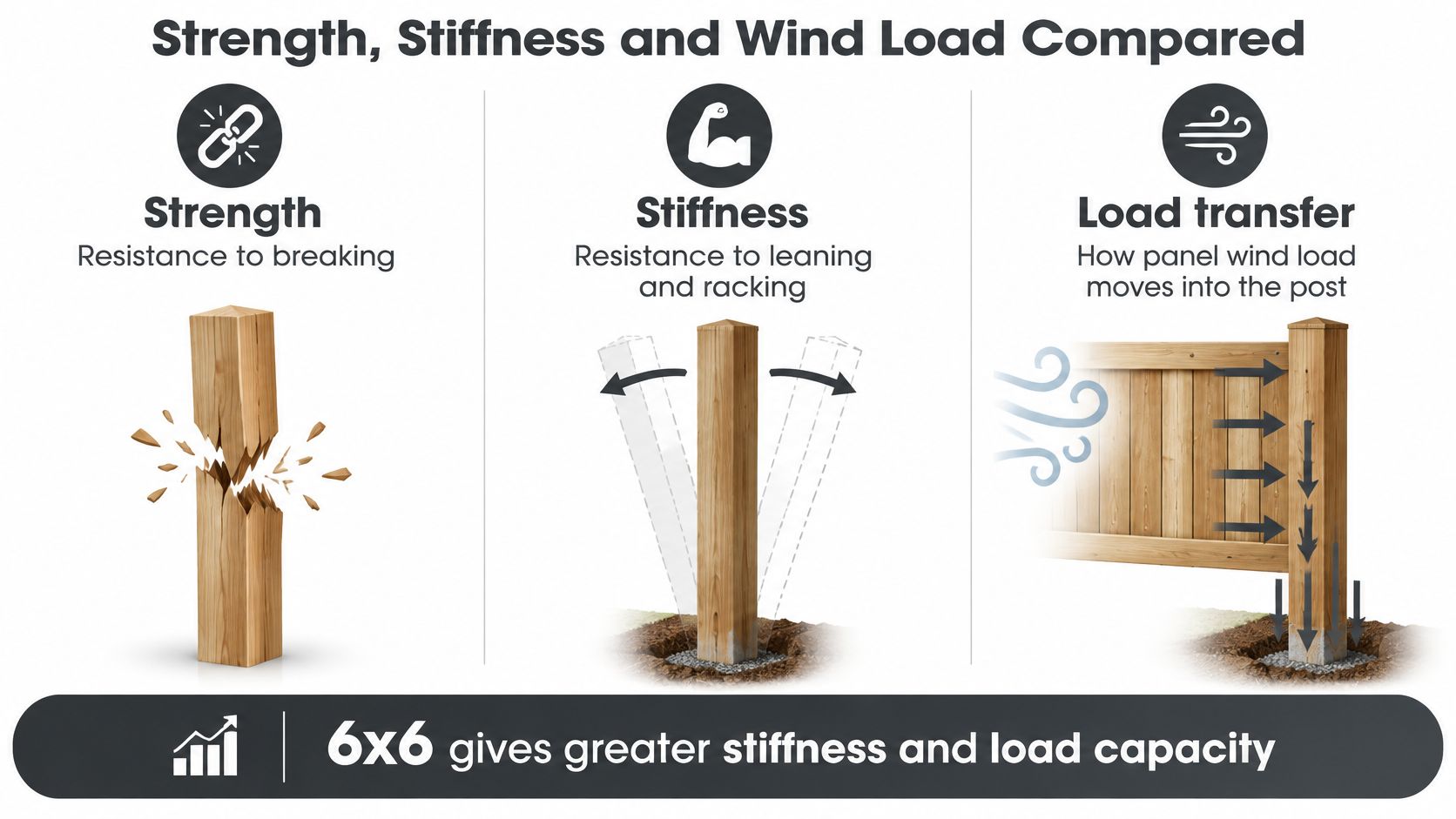
Stiffness is where the wider section shows up first
Over a long unsupported height, the 6x6 resists bending and lean far better than a 4x4, and it leaves room for substantial gate hardware and through-bolts that a narrow face can't accept cleanly. Nothing about that is controversial. Where the argument goes sloppy is the assumption that the wider post repairs a fence failing for another reason.
A wider post cannot compensate for shallow embedment or a rail connection held by two undersized screws. When a fence starts to lean after a couple of seasons, the fault usually sits at the footing or at the point where the rails meet the post. Swapping 4x4 for 6x6 without changing either one just moves the failure a year or two down the road.
Where a 4x4 is genuinely enough
Short, open, lightly loaded runs built from good-grade, properly treated 4x4 posts hold up well. A three-rail fence at 1.2 m in a sheltered backyard sees a fraction of the demand of a solid privacy panel at about 1.8 m. Wind load scales with the solid area you present to it, and a solid panel presents a great deal of it.
Practical rule: the taller and more solid the run, the more the 6x6 is worth paying for. On a low open fence, the money usually belongs in the footing instead.
Three checks to run on your own lot
Height above grade. Measure from the soil line to the top rail, not the post top. A fence that finishes higher than you planned is carrying more sail area than the design assumed.
Panel style. Boards tight together, lattice inserts and decorative panels all catch wind differently. An open picket run sheds most of what a solid panel has to resist.
Exposure. A corner lot, a lot backing onto an open field or a rise, or a run with nothing upwind for two hundred metres sees far more pressure than a fence tucked between neighbouring houses.
If two of those three answers point toward the heavier section, take it. If one does, spend the difference on a deeper hole.
Why Depth and Frost Matter More Than Width
A 6x6 set shallow into clay will lean. A well-treated 4x4 set deep with drainage under it will stand for decades. Around Ottawa–Gatineau, the hole matters more than the lumber.
Post size gets treated as the durability decision. In this region that ranking is often backwards. Ottawa frost depth guidance for foundation work puts frost penetration in the Ottawa area at roughly 1.2 m or more for foundation-type work, and a fence footing sits in the same frozen ground.
What frozen clay does to an embedded post
Frozen ground grips a post along its shaft and can lift it as the water in the soil expands. Clay is the worst offender because it holds moisture and moves hard when it freezes. That grip happens even when the base of the post sits below the frost zone, because the force acts along the buried length rather than at the tip.
Homeowners miss this part.
A 6x6 does not eliminate seasonal movement in clay. It gives the clay more surface to hold, so the post is heavier, stiffer and still being pushed. Depth gets the smooth part of the shaft below the worst of the freeze, and drainage keeps water from collecting where it can freeze against the wood.
Judge the whole installation, not the post
Compare complete systems when you price a fence. Six details decide how a post performs:
Hole geometry. Diameter and depth relative to the post size, dug straight rather than bell-shaped by a lazy auger.
Backfill. Concrete or compacted granular material, placed in lifts rather than dumped and left loose.
Drainage at the base. A gravel sump under the post so water has somewhere to go other than against the end grain.
Post spacing. Wider spacing loads each post harder and changes the rail spans.
Panel design. Solid panels transfer far more force into the footing than open ones.
Burial depth. Measured against local frost, not against a rule of thumb borrowed from a warmer climate.
A 4x4 installed to depth, spaced sensibly and drained at the base can outperform a shallow, poorly detailed 6x6. That argues for pricing the footing alongside the lumber, every time.
If you want the depth side of this settled before a contractor quotes, our guide to how deep fence posts should be in Ontario covers hole depth and diameter by post size.
FenceScape's own crew handles every installation, so the six details above are settled during planning, not improvised at the hole.
A deep, drained 4x4 beats a shallow 6x6 in clay every time you have to dig one out.
Cost Per Post and Per Fence Run
Start with the lumber. In 2026, a building supplier listed an 8-foot pressure-treated 4x4 post at CAD $14.99 each plus HST, and an 8-foot 6x6 post at CAD $37.99 each plus HST. The 6x6 comes out CAD $23.00 more per post.
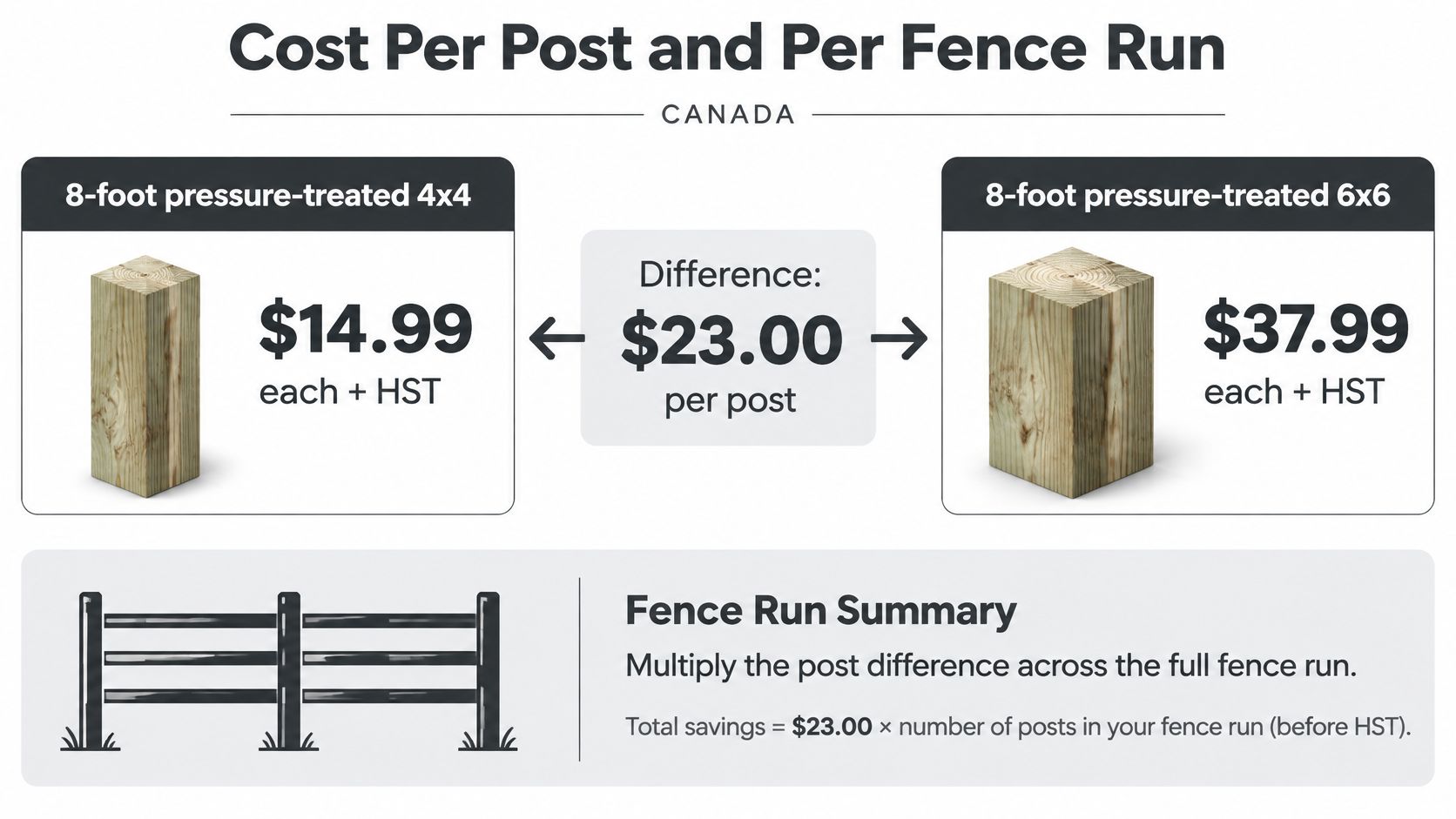
Per-post pricing hides the run total, so here it is at a common 8-foot spacing.
Item | 4x4 post | 6x6 post |
|---|---|---|
Price per 8 ft post before HST | CAD 14.99 | CAD 37.99 |
Posts needed for 100 ft at 8 ft spacing | 13 | 13 |
Post cost for the run before HST | CAD 194.87 | CAD 493.87 |
That CAD 299 gap across a 100-foot run is smaller than you might expect. It is also incomplete, and the full comparison starts here. A 6x6 needs a wider hole, which means more digging and more concrete per footing than the lumber price alone suggests. Gravel, hardware, disposal of old posts and labour sit outside the figure too, and on a long run those items outweigh it. Compare installed cost, not shelf price.
The cost of getting a post wrong
A failed post costs more than the upgrade. When a gate post leans, the repair means breaking out cured concrete, freeing the rails, resetting a new post and refinishing the area around it. One call-out of that kind runs past the CAD 299 difference on its own.
Prices move by supplier and season, so confirm current quotes rather than working from last year's numbers. Run your own figures through our fence cost calculator before the quote conversation so you can separate lumber cost from labour cost.
Fence material is one line on a longer list of exterior improvements, and the same logic of spending where it shows applies to the rest of the property. Edinhart Realty's Fresno curb appeal guide is a reasonable sanity check on where fence spending ranks next to paint, planting and lighting.
If spreading the cost helps, we offer 6 months of interest-free financing in Ontario and 3 months with no payments and no interest in Quebec.
Spend the extra where the load is highest, not evenly across every post in the line.
Matching Post Size to Height, Gates and Corners
One size for the whole fence is the most expensive way to get this wrong. Size each post for the load it carries, because the 4x4 vs 6x6 fence post question is really a question about load paths, not width for its own sake.
Our guidance on choosing a 4x4 fence post frames it the same way: taller, exposed or heavily loaded sections are where a 6x6 warrants assessment, while ordinary open or lightly loaded sections can start at 4x4 as a planning option.
Location or case | Suggested post | Why |
|---|---|---|
Open line posts under about 1.8 m | 4x4 with proper depth | Low wind demand and no hardware stress |
Solid privacy panels at about 1.8 m or taller | 6x6 or engineered reinforcement | High wind load transferred into every post |
Gate post with hinges and latch | 6x6 | Repeated dynamic load and leverage |
Corner or end post | 6x6 | Lateral load from two runs meeting at one post |
Grade change or sloped run | 4x4 or 6x6, sized by the tallest panel above grade | Each post tops out at a different height, so the deepest footing sets the pattern |
How each location loads the post
Line posts in an open run mostly hold the rails and take wind on a small surface. They're the easiest place to save money.
Solid panels push a large load into every post in the run, not just the ends. Wind pressure on a solid screen adds up across the whole length, which is why an ordinary 4x4 line that performs fine with pickets can feel loose once boards sit tight together.
Gates are their own problem. A gate creates force from its width and a repeated slam load every time someone walks through, so the post carrying the hinges and the post holding the latch both work harder than anything beside them.
Corners and ends resist sideways pull from two directions at once, and they're the posts most likely to be pulled out of plumb by a taut run.
Build a hybrid specification
Use 4x4 line posts where spacing, height and soil support them, then step up to 6x6 or engineered reinforcement at gates, corners and high-wind points. This keeps the material budget down without weakening the locations that fail. It only works if you check post spacing, panel weight, hinge layout and footing dimensions for each group separately, because a row of 4x4s spaced a foot closer together can outlast a row of 6x6s set shallow.
Whatever size you land on, any post set below grade should carry a ground-contact treatment rating. The buried section sits in sustained moisture while the visible part dries between rains, so treatment category and exposure deserve as much attention as cross-section size.
The practical version takes ten minutes with a site plan. Mark every post carrying a hinge, a corner or a solid panel, and treat those first.
Ottawa Pool Enclosure Height Rules and Post Choice
Every pool enclosure in Ottawa must be at least 1.5 metres high, roughly five feet, under the City's pool enclosure law, By-law No. 2013-39. The by-law applies to barriers around pools, hot tubs and ponds, and it requires the enclosure to meet specified construction standards rather than just look like a boundary.
That requirement changes the post decision because it fixes a minimum working height. A barrier that has to stay rigid at 1.5 m, hold a self-closing gate at one end and stay plumb through repeated freeze and thaw is doing more work than a decorative run along a side yard.
Why the height requirement shifts the choice
A solid or high-wind-resistant enclosure transfers panel, rail, hinge and gate loads straight into the posts. At that height, the stiffer section and the extra face for hardware stop being a nice upgrade and start being the thing that keeps the gate hanging square.
The 1.5-metre figure works well as a screening line. A post chosen for a shorter ornamental fence may not carry the stiffness or the hardware capacity a compliant barrier needs, and the difference only shows up after the first winter of the gate dragging.
Checks before you order a pool barrier
Confirm the height and construction details against the by-law rather than against a neighbour's fence.
Check the gate. Self-closing action and latch position matter as much as post size, and a heavy gate on a light post won't self-close reliably.
Verify post spacing for the panel type you've chosen, since solid panels at this height load every post.
Confirm the footing clears local frost and drains at the base.
Ask about the hinge sizes you plan to use before the posts are set, because hardware and post face have to match.
Our guide to the Ottawa pool enclosure bylaw walks through the barrier requirements in more detail.
Homeowners should confirm the complete enclosure design, including height, gate hardware and construction details, with the municipality or the installer instead of choosing a post by nominal lumber size alone.
Confirm the Post Size Before You Order Lumber
Here's the default I'd give anyone planning a fence this season. Use 4x4 posts for open, low, lightly loaded line runs where the soil drains and the footings can go deep. Use 6x6 posts or engineered reinforcement for gates, corners, solid privacy runs at about 1.8 m or taller, pool enclosures and any spot with high wind exposure.
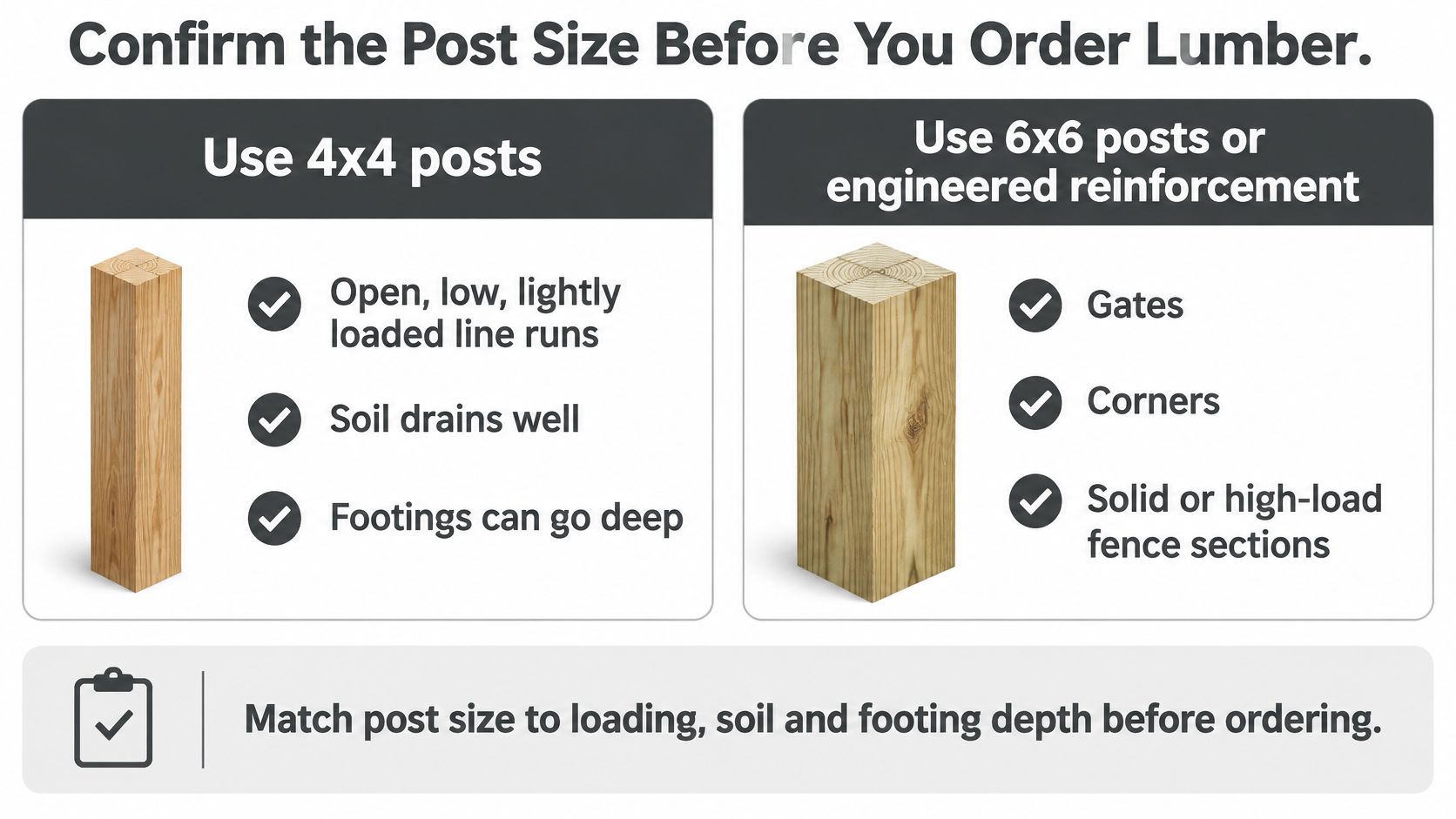
The pre-order checklist
Height and panel style. Decide both before pricing posts, because they set the wind demand on every location.
Mark the loaded posts. Walk the line and flag every gate, corner, end and solid-panel post.
Test the soil. Dig a sample hole, check for heavy clay, and look for standing water in the area a day after rain.
Set burial depth and hole diameter against local frost rather than a generic chart.
Confirm ground-contact treatment on any post that sits below grade.
Check the pool by-law if the fence forms any part of an enclosure.
Then ask for the footing and backfill plan in writing. Depth, hole diameter, backfill material and drainage detail should all be on the page before the order goes in, because those are the parts you can't inspect once the concrete sets.
We offer a free estimate, and you can request a Material Quote or an Installation Quote through our contact form, or call (613) 617-4414 or email info@fencescape.ca.
Pick the post size location by location, then confirm the installation system before the order goes in. The lumber is the last decision, not the first.
Choosing between 4x4 and 6x6 posts comes down to where each one sits and what it has to hold, and that's the conversation worth having before any lumber is ordered. FenceScape builds in Ottawa–Gatineau with in-house crews, so the post size, footing depth and drainage plan for your yard can be settled together on site rather than guessed at from a chart. Book a free estimate at FenceScape and get the footing and backfill plan in writing before you commit to a post size.
Comments