
Pool Enclosure Bylaw: Ottawa and Gatineau Rules Explained

You're ready to order a pool fence, but the quote leaves a few questions unanswered. Will the existing backyard fence count? Is the gate hardware suitable for your city? And will the enclosure still work after the ground shifts through winter?
The pool enclosure bylaw governs a safety system, not just a line of panels. For Ottawa–Gatineau homeowners, the practical starting point is to identify the municipality, confirm the design before ordering, and plan for maintenance after inspection.
Ottawa and Gatineau Pool Enclosure Requirements at a Glance
Pool enclosure requirements by city
Requirement | Ottawa | Gatineau |
|---|---|---|
Pools covered | Every privately owned outdoor pool, including in-ground, semi-in-ground, above-ground pools and hot tubs | Full scope unknown here. Confirm your pool or spa classification with the city |
Minimum enclosure height | 1.5 m (5 ft) under Ottawa's pool-enclosure requirements | Unknown here. Confirm before ordering panels |
Maximum opening | No opening through or beneath the enclosure may pass a 100 mm (4 in) sphere | Chain-link mesh wider than 30 mm needs slats |
Gate closing and latching | Gate must self-close and self-latch | A passive device must close and lock each enclosure door automatically |
Latch height | Unknown here. Confirm the required placement with Ottawa | At least 1.5 m on the exterior side or 1.2 m inside the enclosure |
Above-ground pool exception | Unknown here. Obtain municipal confirmation before relying on the pool wall | Pool wall at least 1.2 m above grade, or removable pool wall at least 1.4 m high, with access meeting municipal standards |
Permit trigger | New enclosure, replacement enclosure, or a new pool where fencing already exists | Construction, replacement or modification of a pool barrier |
An unknown entry isn't permission to choose your own specification. It means that detail needs confirmation from the city before you buy materials. In particular, don't confuse Gatineau's chain-link mesh rule with a general allowance for openings elsewhere in the barrier.
Ottawa's By-law No. 2013-39 replaced the earlier enclosure bylaw and treats privately owned outdoor pools, hot tubs and other qualifying water features as regulated safety installations. The owner's responsibility includes maintaining an enclosure that makes the pool inaccessible to small children.
Start with the finished yard, not the panel label
For an Ottawa enclosure, begin with these checks:
Measure the installed height from finished grade. Use a tape measure along the fence run, particularly where paving, soil or retaining work changes elevation. A panel's catalogue height doesn't establish the height of the completed barrier.
Check every opening with a rigid test ball. Inspect beneath panels, between members, beside gate posts and where the enclosure meets another structure. Don't squeeze a flexible ball through a gap and treat that as a reliable measurement.
A fence can look substantial and still have a weak point at a gate corner or under a panel on sloping ground. Horizontal members can also provide climbing opportunities, even when the overall height looks right.
Practical rule: Assess the completed enclosure, including the ground, posts, connections and gate. Don't approve a design based on the panel alone.
The permit process should settle uncertain dimensions before construction. Material selection then becomes a question of keeping those dimensions stable while giving the gate enough support to close and latch reliably.
Why the Rules Focus on Small Children and Openings
Think of an enclosure as a sieve. Its usefulness depends on what can pass through its weakest opening, not how solid the rest of it looks. A tall privacy fence doesn't compensate for an accessible gap beside the gate.
The opening test gives installers and inspectors a repeatable way to assess gaps. It isn't a substitute for checking climbability, gate operation or the full perimeter. Nor should homeowners treat a test ball as a precise prediction of what an individual child can do.
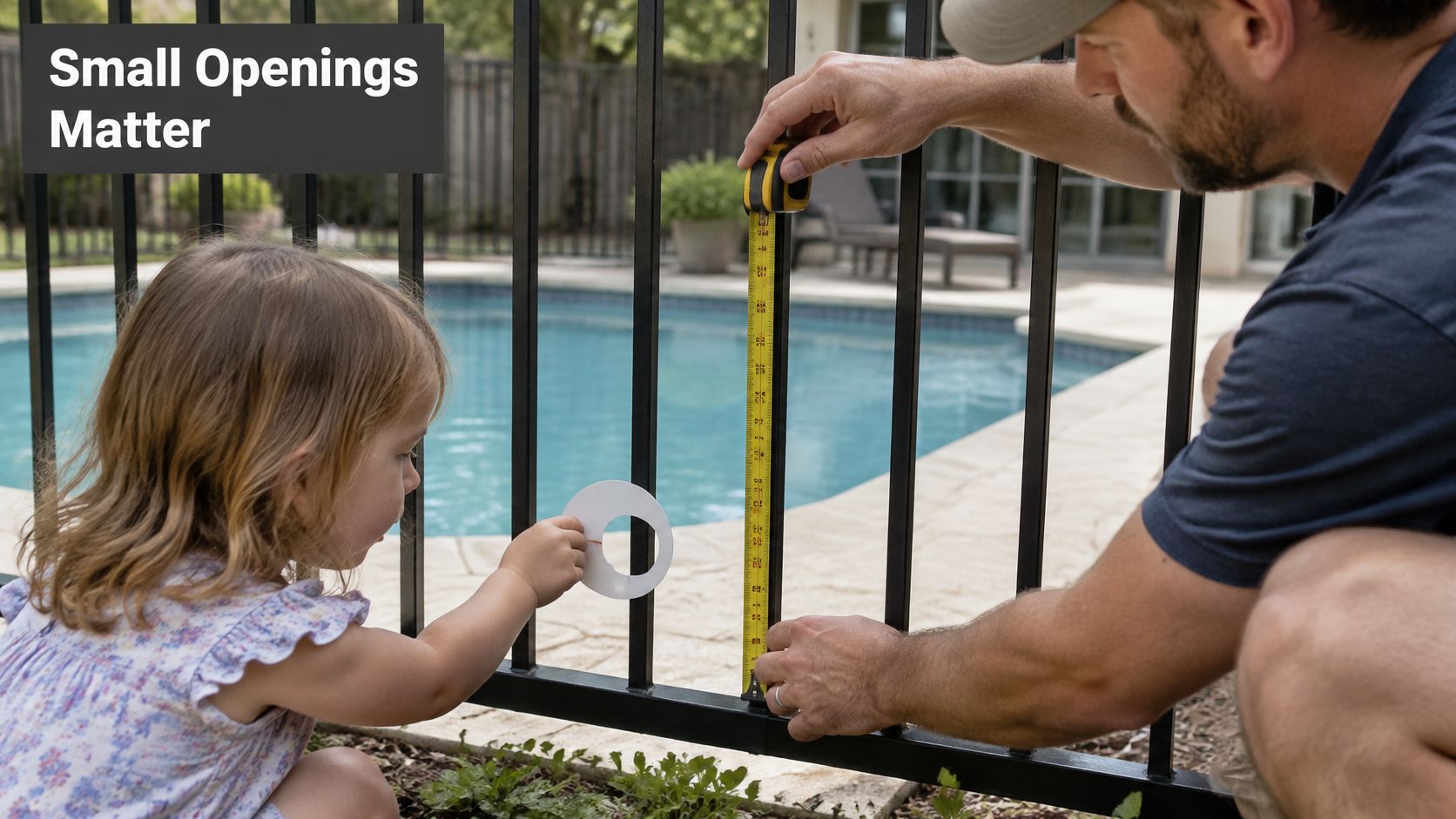
Why child resistance matters
According to Statistics Canada's water-safety overview, Health Canada's Canadian Hospitals Injury Reporting and Prevention Program recorded 1,109 drowning-related cases between April 1, 2011 and April 13, 2023, including 624 incidents, or 56.3%, in residential or public swimming pools. Of those pool-related cases, 497, or 79.6%, involved infants and children aged 9 or younger.
The same overview reports that 810 cases, or 73.0% of all recorded drowning-related cases, occurred from May through September. These are surveillance figures, not a count of Ottawa bylaw violations or a measure of the effectiveness of a particular fence product.
They do explain why enclosure design concentrates on preventing unsupervised access by young children. An adult may notice a sticky latch and pull the gate shut. A child approaching from outside won't correct that fault.
A gate that needs someone to finish closing it leaves the enclosure dependent on someone noticing.
Design for ordinary use
The practical response is to remove avoidable dependence on memory. Choose a closing mechanism suited to the gate, give the latch a stable mounting point, and keep access routes free of obstructions.
An enclosure also doesn't replace supervision. Its job is to restrict access when someone isn't actively managing the gate. That makes seemingly minor installation details, such as a loose strike plate or a bottom corner that lifts, worth correcting before the pool is used.
Which Rules Govern and How to Get Your Permit
Name the municipality before selecting the fence system. Ottawa and Gatineau have distinct pool-enclosure requirements, and approval on one side of the river doesn't establish compliance on the other.
General construction requirements and municipal enclosure rules serve different purposes. Think of the broader construction framework as the foundation and the municipal enclosure requirements as the detailed floor plan. For the fence layout, access arrangements and permit application, get direction from the municipality responsible for the property rather than relying on a general Ontario or Quebec pool guide.
Where a cross-river purchase can fail
Gatineau's pool and spa requirements require automatic closing and locking devices, with the locking device at least 1.5 m high on the exterior side or 1.2 m inside the enclosure, and require slats where chain-link mesh is wider than 30 mm.
Say a Gatineau homeowner buys a gate advertised for Ottawa installations. The latch sits too low for its proposed exterior placement, and the selected chain-link infill needs slats. The product may be well made, but the proposed installation still needs changes.
The same caution applies to above-ground pool walls. Gatineau recognises limited wall-based exceptions, but the access arrangement must satisfy its standards. A tall pool wall doesn't automatically resolve ladder, deck or doorway access.
Follow the permit sequence
Identify the city and property. Put the municipal address on the drawing and quote. The common slip is designing from a neighbour's installation without confirming that the same authority governs both properties.
Confirm what triggers the permit. Ottawa includes replacement enclosures and new pools within existing fencing. Gatineau's residential-fence guidance distinguishes an ordinary residential fence, which generally doesn't need a permit, from a fence protecting a pool, which does. The mistake is treating pool protection as ordinary boundary fencing.
Prepare a buildable design. Show the pool type, enclosure route, finished grades, proposed height, distance from the pool, post and footing details, infill spacing, gate hardware and latch location. Identify any pool wall proposed as part of the barrier. Leaving these details for the installer to decide on site can create a mismatch between the application and the finished work.
Submit and obtain approval before building. Ask the city what drawings and supporting information it needs. Don't order a non-returnable gate on the assumption that a permit application guarantees acceptance of the proposed hardware.
Build to the approved drawing. Keep the approval documents available on site. If landscaping forces the gate or fence line to move, check whether the revision needs municipal review rather than changing the layout.
Arrange the required inspection. For Ottawa, schedule the enclosure inspection and confirm the required timing before the pool is used. Don't assume that an installer's walkthrough replaces municipal inspection.
Make responsibility explicit
The quote should identify who prepares the drawings, who submits the application and who books the inspection. It should also describe how changes to the approved design will be handled.
At FenceScape, we handle design through installation, and our own crew carries out every installation. Keep the project-specific permit responsibilities explicit in the written scope so there isn't a gap between the fence work and the approval process.
A permit-ready drawing is useful beyond administration. It gives the homeowner, installer and inspector the same reference for what is being built.
Materials and Gate Hardware That Pass Inspection
A premium material isn't proof of compliance. Inspectors need to assess the installed geometry and access controls, not just whether the fence is made from glass, steel or PVC.
Choose the material around the yard's privacy needs, sightlines and maintenance demands. Then evaluate the actual panel and gate configuration. A decorative rail, wide connection gap or poorly supported gate can undermine an otherwise suitable system.
Enclosure materials against inspection concerns
Material | Climbing risk | Gap control | Inspection point |
|---|---|---|---|
PVC | Lower with vertical members and no accessible footholds | Check picket spacing and bottom clearance | Inspect panel connections and clearance along uneven ground |
Hybrid PVC or wood with steel | Steel support helps rigidity, but rail placement still matters | Control spacing at installation and at transitions | Confirm posts, rails and gate supports are firmly fixed |
Cedar or pressure-treated wood | Accessible horizontal rails can act as steps | Boards can shrink, swell or warp | Inspect board movement, fasteners and ground clearance |
Ornamental iron | Vertical bars discourage climbing when the configuration avoids footholds | Check bar spacing and openings beside posts | Examine decorative details as well as straight sections |
Chain link | Mesh can provide footholds | Review mesh, slats where applicable, and bottom restraint | Confirm city-specific mesh requirements and secure the lower edge |
Glass | Smooth panels offer few footholds, but fittings and nearby objects matter | Check panel joints, gate edges and base clearance | Inspect mounting hardware, alignment and exposed edge gaps |
Match the closer to the gate
Use self-closing hinges or a separate closer designed for the gate's weight and dimensions. A heavy gate on undersized hardware may close during adjustment but become unreliable as the hinges wear or the posts move.
The latch needs more than the correct position. Its strike must stay aligned, its fasteners must remain tight, and the gate must engage it without a push. Avoid placing rails, brackets or nearby objects where they make the release mechanism easier to reach.
Test the gate from a small opening as well as a wider one. If it stops short, diagnose hinge alignment, rubbing, closer adjustment, and post movement instead of increasing spring tension.
Check the whole assembly
Consider a hypothetical Gatineau chain-link installation with unslatted mesh that exceeds the city's threshold and an exterior latch mounted below the required position. Adding the appropriate slats and correcting the latch addresses those defects. It doesn't prove the complete enclosure passes, because height, access, placement and the remaining construction details still need review.
For a transparent design, our glass pool fence installation guide helps homeowners consider panel layout and mounting choices. Glass keeps sightlines open, but installation still requires careful control of joints and gate clearances.
With wood, inspect the finished gaps again after the first season. Before calling any installation complete, test the openings against the municipality's confirmed standard, including the awkward spaces at corners and gate posts.
Inspection Checklist and Seasonal Upkeep
Inspection confirms the enclosure on the day it was checked. It doesn't account for a later winter of frost movement, a raised garden bed or a gate that starts dragging after frequent use.
Ottawa's pool-enclosure brochure calls for a scheduled enclosure inspection, self-closing and self-latching gates, and openings that prevent passage of a 100 mm sphere. The bylaw places administration and enforcement with the Chief Building Official, so unresolved inspection questions belong with that office.
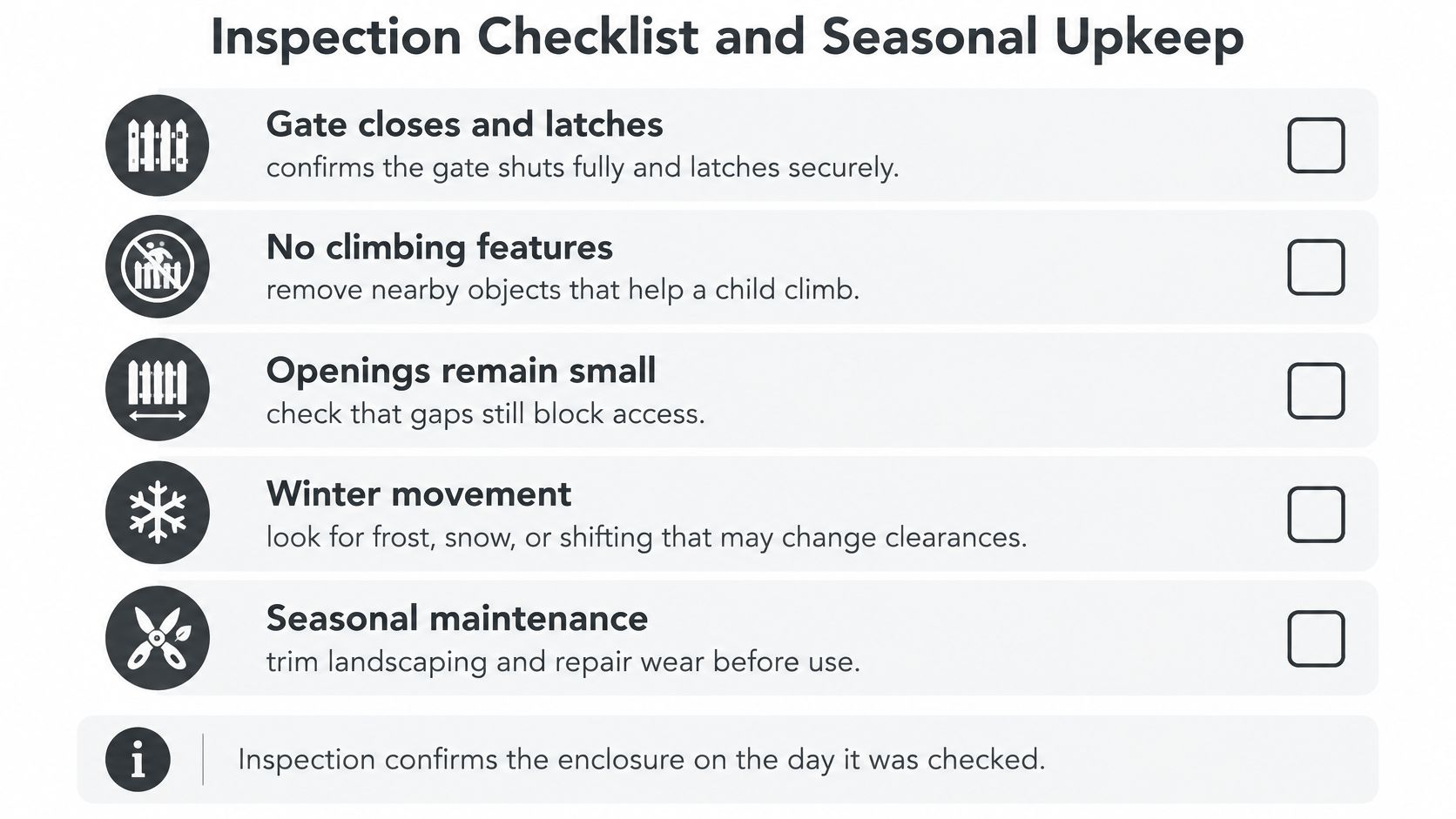
Run a spring and post-storm check
Test the gate and latch. Confirm the latch remains at its approved location, then release the gate without helping it. It must close fully and engage reliably. Use the pool gate latch requirements guide to review the hardware questions that need attention.
Test openings around the full perimeter. Include the underside of panels, spaces beside structures and gaps around gate posts. Ground settlement can change clearances without visibly damaging the fence.
Look for sag and loose hardware. Check hinges, latch fasteners and gate corners. A gate that needs lifting to latch needs repair, not a reminder to pull harder.
Inspect posts and footings. Use a level to investigate leaning or lifting after frost movement. If the support has moved, adjusting the latch alone may only hide the underlying problem.
Remove climbing aids. Relocate furniture, stored lumber, planters and other objects near the barrier. Trim shrubs that create usable steps, and keep snow piles away from the enclosure.
Review grading changes. New soil, paving or retaining work can create a raised standing surface beside the fence. Check enclosure clearances whenever landscaping changes.
Record repairs. Keep dated photos and a short description of the fault and correction. This makes recurring movement easier to recognise and gives a repair contractor useful context.
Keep maintenance tied to how the yard is used
During summer, watch for hoses, toys or debris obstructing the gate. Before winter, plan snow storage so clearing the driveway doesn't create a ramp beside the pool barrier.
Owner's check: A repair is finished when the gate works and the openings are correct, not when the fence looks straight again.
Don't prop the gate open to work around a faulty closer. Repair the defect and retest the assembly. If the enclosure fails any check, repair it before the pool is used.
Confirm Your Enclosure Before You Build
Before ordering materials, put the proposed enclosure on paper. Identify the municipality, measure from the intended finished grade, sketch the panel openings and gate, and confirm whether the work triggers a permit.
A useful sketch shows more than the pool and a rectangle around it. Mark slopes, retaining walls, existing fences, access routes and landscaping that could affect clearances. Add photographs of the proposed gate location so the support and closing arrangements can be assessed before installation.
Get the scope in writing
Ask any provider to identify these items in the proposal:
Municipal design basis. Name the city whose requirements govern the installation.
Permit responsibilities. Specify who prepares, submits and follows up on the application.
Gate hardware. Identify the closing and latching equipment and its proposed placement.
Completion checks. Include gate testing, opening checks and responsibility for arranging inspection.
For Ottawa, the key dimensional checks are enclosure height and restricted openings. In Gatineau, pay particular attention to the closing-and-locking device, latch placement, chain-link treatment and conditions attached to any pool-wall exception. Don't transfer an approval or product claim across the river without municipal confirmation.
Choose the support you need
Our pool fence installers guide can help you organise the installation questions before comparing proposals. Compare equivalent scopes, not just totals: a materials list and a complete installation scope aren't the same purchase.
We offer a free estimate, and our contact form lets you request a Material Quote or an Installation Quote. Our own crew handles every installation, with service from design through the final walkthrough.
Keep the approved drawing, hardware information and maintenance notes together after the work is complete. The enclosure you want is one that still passes its opening test and gate checks after the first winter.
FenceScape offers free estimates and in-house installation for pool-enclosure projects across Ottawa–Gatineau. Visit FenceScape to request a Material Quote or an Installation Quote, and include your municipality, pool type and photos of the proposed fence line so we can help plan the next steps.
Pool fencing is one of those projects where checking the details early saves so much trouble later. My neighbors upgraded their backyard pool last spring, and I helped them compare gate latches, fence heights, and equipment before calling installers. We also looked through https://zodiac-pool-systems.pissedconsumer.com/review.html while researching pool maintenance products, which reminded us to ask about warranties and ongoing upkeep. What surprised me most was how differently local rules can treat an existing fence. The advice about winter ground movement is especially useful around Ottawa. A secure gate that still closes properly after freezing weather is worth planning for before installation.