
Cedar Fence Cost Per Foot in Ottawa–Gatineau: 2026 Guide

In Ontario, cedar fencing typically runs about CAD $45–$75 per linear foot installed, against roughly CAD $25–$45 per foot for materials alone. The useful number for your Ottawa–Gatineau property is the installed price for a clearly defined scope, not the lowest advertised lumber allowance.
That distinction can change your budget substantially. A cedar fence cost per foot needs a denominator, the measured fence length, and a numerator that identifies exactly what you're buying. Posts, gates, demolition, excavation and taxes can make otherwise similar quotes describe different projects.
Cedar Fence Cost Per Foot Across Ottawa and Gatineau
For an Ontario starting point, Project Landscaping's fence cost guide places installed cedar at CAD $45–$75 per linear foot, or CAD $4,500–$7,500 for a 100-foot run, compared with roughly CAD $25–$45 per foot for materials. At the installed midpoint, the same guide's range implies CAD $60 per foot and approximately CAD $6,000 for that project.
Treat this as a planning benchmark, not a local contractor's guaranteed offer. An estimate for an accessible backyard doesn't establish the price of a retaining-wall boundary, a pool enclosure or a property where excavation equipment can't reach the fence line.
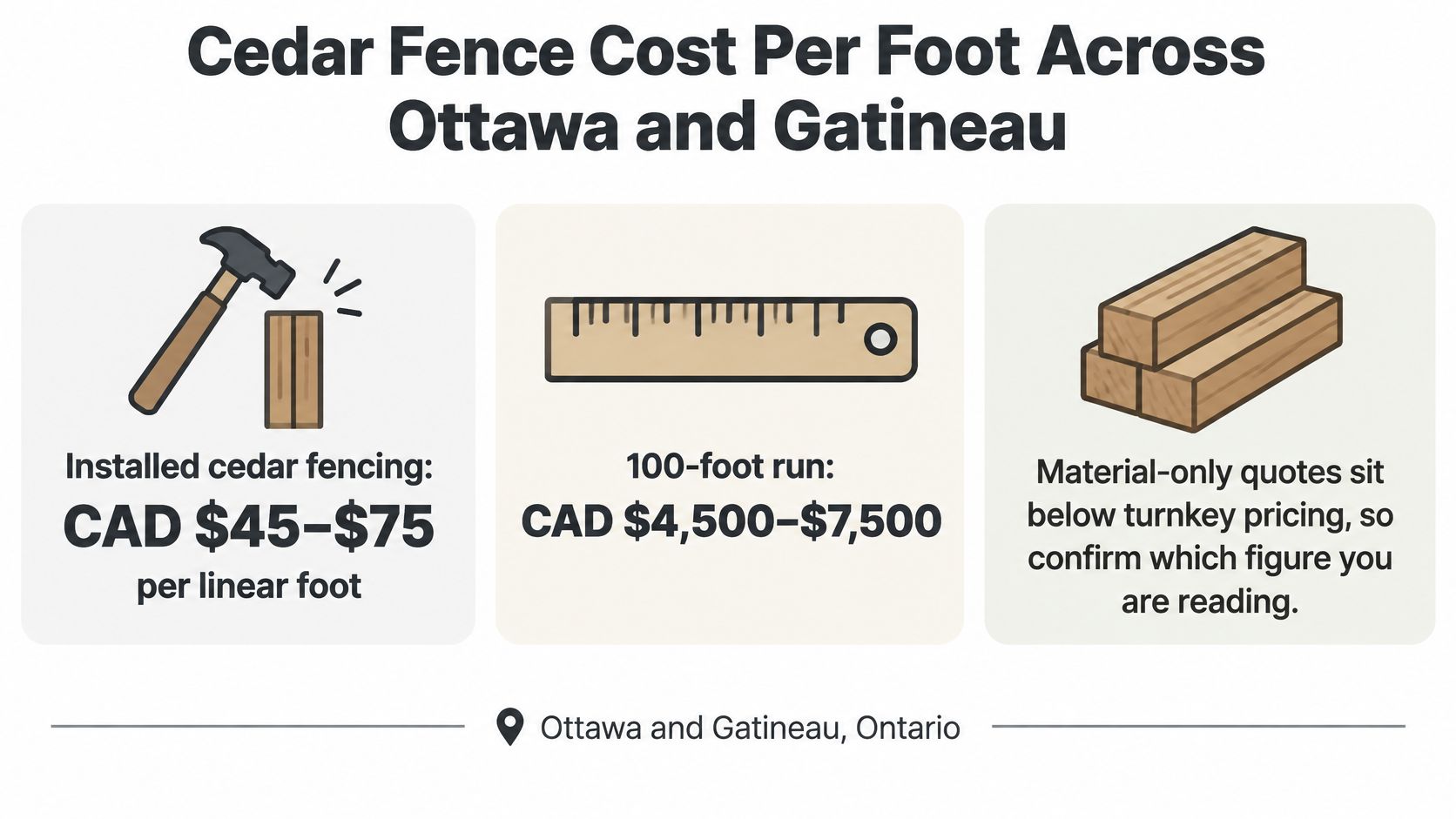
Installed cedar fence cost per linear foot by benchmark
The broader ranges below come from RenoCalc's Canadian fence installation cost guide, which gives an Ontario–Quebec installed cedar planning range of CAD $35–$75 per foot, alongside wider regional estimates.
Benchmark | Cost per linear foot (CAD) | What it covers |
|---|---|---|
Ontario installed, supplied and fitted | 45–75 | Turnkey installation; 100 ft = CAD 4,500–7,500 |
Ontario and Quebec planning range | 35–75 | Installed cedar, six-foot privacy fence |
Ontario outside the GTA | 30–100 | Regional estimate with wide site variation |
Montreal and Quebec | 25–90 | Regional installed estimate |
Ontario material only | 25–45 | Cedar materials, no installation labour; confirm post allowance |
These are the respective guides' benchmarks, not interchangeable specifications. In particular, a material-only allowance shouldn't be assumed to include the same post system, hardware or delivery scope as a supplied-and-installed quote.
For a 120-linear-foot, six-foot privacy fence, RenoCalc's planning range produces a base budget of CAD $4,200–$9,000, before unusual excavation, demolition, premium gates, taxes or difficult access. The arithmetic is length multiplied by the installed rate, but the rate is only useful after the contractor establishes the construction details.
Height, post spacing, gates and access explain much of the spread. Gatineau also needs its own quote rather than an automatic transfer of an Ontario rate.
Comparison test: Divide the quoted total by measured linear feet, then identify whether concrete-set posts, old-fence removal and gates are included. If those answers aren't clear, the resulting per-foot figure isn't ready for comparison.
Where the Money Goes in a Cedar Fence Budget
Cedar boards aren't the whole fence budget. A useful estimate separates the fence run from post work, labour, site preparation and optional upgrades. A low board allowance can hide the cost of completing the installation.
For a 100-linear-foot, six-foot cedar fence, a typical allocation runs CAD $800–$1,500 for cedar materials, CAD $300–$800 for posts and concrete, CAD $300–$1,200 for installation labour, and CAD $100–$400 for permits and site preparation, with up to CAD $1,600 for gates or hardware upgrades and 13% Ontario HST on taxable materials and labour.
Ontario cost allocation for a 100-foot, six-foot cedar fence
The per-foot equivalents divide each allowance by the 100-foot project length. They show how to read line items, not a second turnkey price.
Cost item | Allowance for 100 ft (CAD) | Per linear foot (CAD) |
|---|---|---|
Cedar materials | 800–1,500 | 8–15 |
Posts and concrete | 300–800 | 3–8 |
Installation labour | 300–1,200 | 3–12 |
Permits and site preparation | 100–400 | 1–4 |
Gates and hardware upgrades, if added | Up to 1,600 | Up to 16 |
HST on taxable materials and labour | 13% of taxable subtotal | 13% of taxable per-foot subtotal |
Divide any quoted line item by the measured footage to run the same test on a real estimate.
Our guide to Western Red Cedar fence boards can help you identify the board specification you want priced. Write that specification into the quote rather than accepting cedar as a complete description.
Separate fence length from project complexity
A gate needs its own framing, hardware and fitting work. Excavation through rock requires a different allowance from straightforward digging, while restricted access changes how the crew moves materials and equipment.
Those costs don't all increase neatly with fence length. A longer uninterrupted boundary spreads setup and layout costs across more footage; a short run with a substantial gate can produce a higher effective rate without using more expensive boards.
FenceScape's own crew handles every installation. For budgeting, the distinction that matters is between buying components and purchasing responsibility for the completed fence.
If you're planning fencing alongside a home purchase, The Money Maniac's home savings roadmap for first-time buyers provides broader savings-planning context. Keep the fence installation budget separate from your reserve for other property expenses.
Before accepting a total, request the line-item breakdown and establish whether its per-foot calculation is before tax or after tax. A subtotal isn't the amount you'll ultimately pay.
Site and Permit Rules That Change the Price
A contractor needs to establish the permitted fence before pricing your preferred design. Under Ottawa's Fence By-law, residential height limits are 1 metre in a front yard and 2.13 metres in other yards, while non-residential fences may reach 3 metres; ordinary residential fencing generally doesn't require a building permit, but a swimming-pool enclosure requires a pool-enclosure permit.
That changes the specification, not just the paperwork. A front boundary, backyard privacy fence and commercial perimeter shouldn't be priced as identical panels.
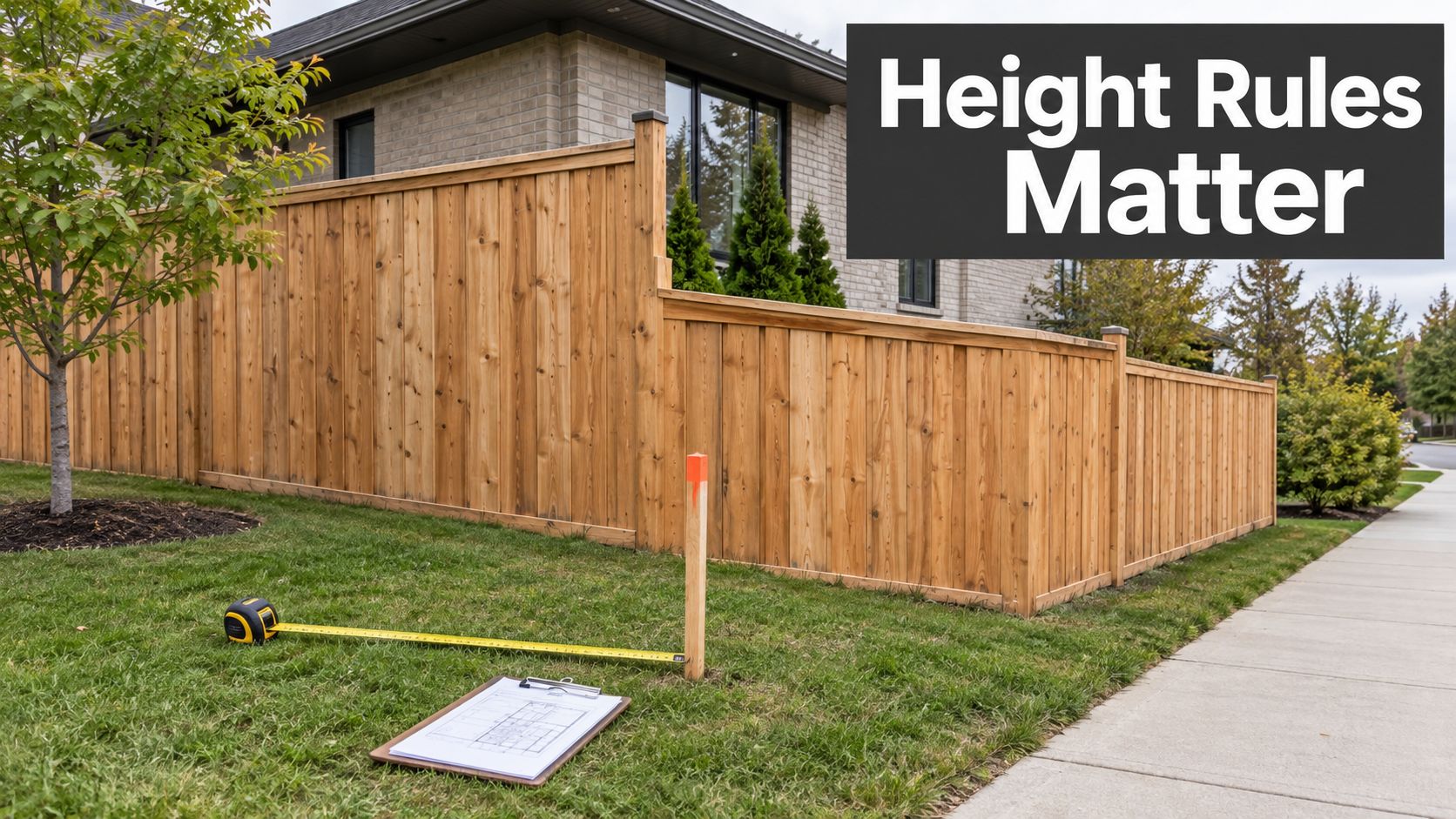
Price the actual buildable boundary
The same municipal by-law measures height from grade at the fence base, prohibits fencing in municipal rights-of-way and limits fences within corner-lot visibility triangles to 75 centimetres. Each requirement affects what the contractor can build.
Consider a hypothetical sloping boundary. Ask the estimator to mark each proposed section on the site sketch and explain whether the fence follows the ground or steps between sections. Extra transitions and posts should appear in the construction plan, not emerge as unexplained additions during installation.
For a corner property, identify the visibility area before ordering full-height panels. For a pool, specify the enclosure and gate requirements before treating an ordinary privacy-fence quote as suitable.
Our Ottawa fence by-law guide provides local planning context. Ottawa requirements shouldn't be assumed to apply across the river; confirm the applicable Gatineau requirements separately.
Keep construction safety fencing separate
For construction near public access, the City of Ottawa's protective-fencing document requires a fence at least 1.8 metres high when activity is 3 metres or less from a public pathway or gathering area, measured from outside grade; the minimum can drop to 1.2 metres only for residential buildings no more than three storeys and activity more than 3 metres from an adjacent public walkway.
Builders should identify temporary access gates, bracing and eventual removal separately. A permanent backyard allowance doesn't define a construction-site enclosure.
We design fences from simple layouts to complex projects, fitted to the customer's property and style. To clarify where screening is needed before choosing the layout, use the privacy screening tips from Outdoor Leisure Living as design inspiration, not local compliance guidance.
Confirm property boundaries, yard classification, slope, corner restrictions and pool use before multiplying fence length by a nominal rate.
Price Volatility and Quote Timing
A quote needs a date and an expiry condition. Without them, you can't tell whether the contractor has committed to the lumber allowance or estimated it for a future purchase.
Statistics Canada reported Canadian residential building construction cost increases of 0.6% in the first quarter of 2026, following 0.5% in the previous quarter, as discussed in New Purveyors' Ottawa fencing guidance. Its discussion also identifies Ottawa–Gatineau coverage in the Building Construction Price Index and regularly updated Canadian softwood-lumber pricing from Natural Resources Canada.
Those indicators provide context, not a cedar-fence escalation formula. You can't apply a broad construction index directly to a particular contractor's boards, crew costs and excavation allowance.
Compare dated specifications, not seasonal assumptions
Use a simple written record when requesting prices:
Validity: Record the issue date and when the contractor can revise the offer.
Lumber commitment: Establish whether material pricing is fixed at acceptance or determined when ordered.
Specification: List cedar grade, board dimensions, post size, fasteners and finish.
Timing: Obtain refreshed prices when comparing an older offer with a newly issued quote.
Waiting isn't automatically a saving. A scheduling concession could be offset by a changed material price, and a lower future price isn't assured.
Distinguish material choice from price movement
In Canada, cedar and pressure-treated lumber are the most common materials for wood fences. Comparing them requires a matched project scope, rather than assuming a difference between quotes comes entirely from timing.
For supplied-and-installed projects including concrete-set posts, a gate and old-fence removal, RenoClair's provincial calculator reports average cedar totals of CAD $7,450 in Ontario and CAD $7,200 in Quebec, with respective ranges of CAD $5,350–$10,400 and CAD $5,100–$10,200; its average cedar premium over pressure-treated fencing is CAD $1,550 in either province.
These are standardized project totals, not per-foot rates. Without the calculator's applicable project length, converting them into a precise local rate would create false accuracy.
Use them to check scope and material choice instead. Ask whether an apparent price change reflects different lumber, different work or a different quote date before deciding that a contractor has become more expensive.
How to Compare Two Cedar Fence Quotes
The lower total is only the better deal when the scope matches. Put both written offers beside a site sketch and mark every inclusion, exclusion and unresolved allowance.
The Superior Home Improvement quote comparison tips offer a useful companion approach for reviewing exterior-project proposals. For fencing, the comparison must also account for the measured boundary and post installation.
Use a matched-scope checklist
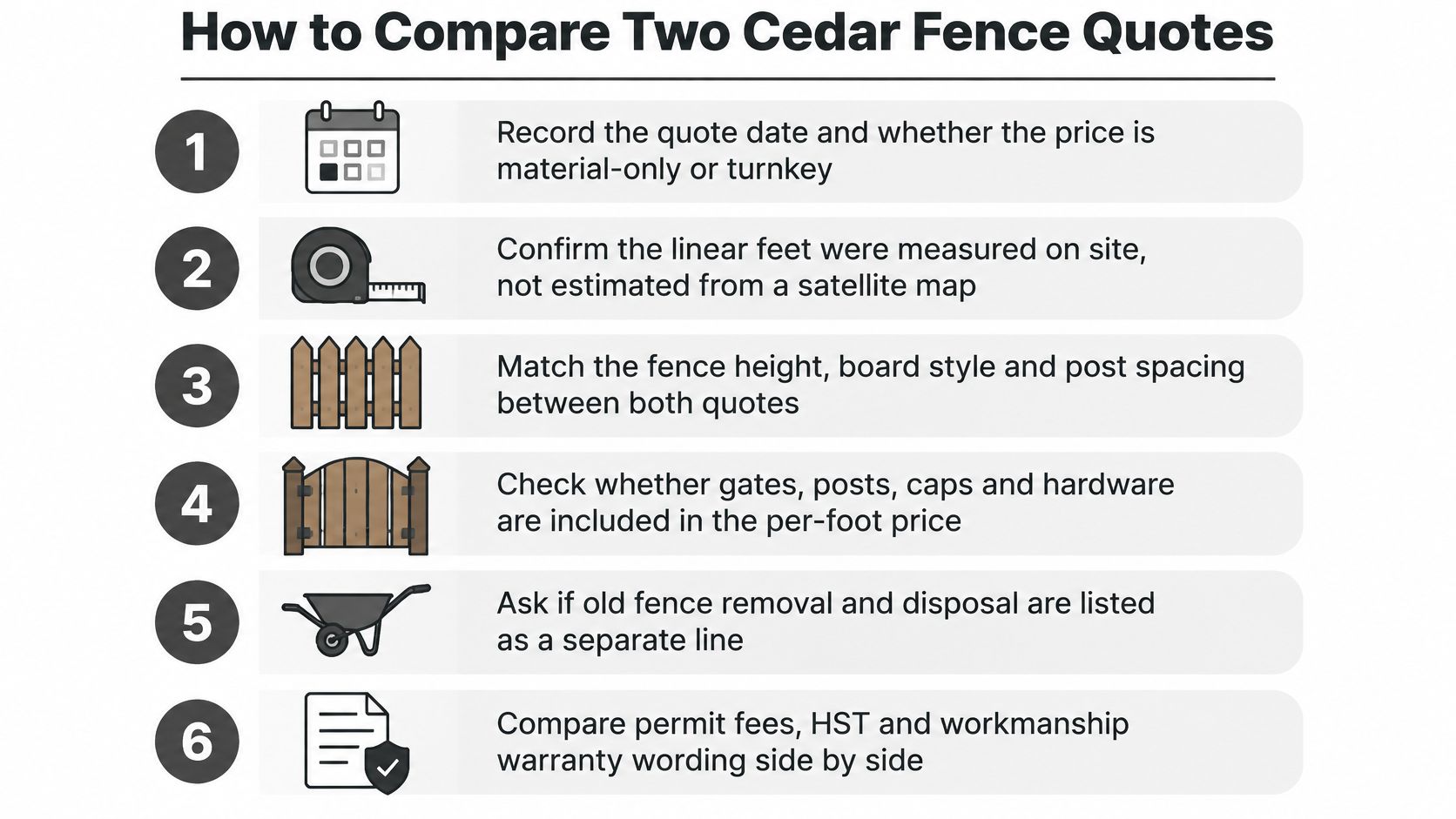
Record the date and purchase type. Identify whether each offer covers materials only or turnkey installed work. Don't compare a supplier package with a contractor's completed-project price.
Normalize the measured length. Divide each total by its own confirmed linear footage, then separate gate and demolition allowances to compare the straight run. Require an on-site measurement rather than relying solely on a satellite image.
Identify the labour basis. Establish whether labour is priced per foot, by crew-hour or as a fixed project amount. The Government of Canada Job Bank lists Ottawa Region fence-installer wages at CAD $18–$33 per hour, with a CAD $25 median, making 16 crew-hours approximately CAD $400 in direct wages before employer costs and overhead.
Match completion responsibilities. Mark whether posts, concrete, demolition, cleanup, disposal and site restoration are included. Ask how unexpected excavation will be authorized and priced before work proceeds.
Match the physical fence. Compare height, board pattern, cedar grade, board dimensions, rails, post size, spacing, caps, fasteners and finish. A description that only says cedar privacy fence leaves too much unresolved.
Confirm financial and administrative terms. Check taxes, permit responsibility, property-line verification, payment conditions and workmanship warranty wording. Read exclusions as carefully as the total.
Interpret labour without confusing wages and billing
Worker wages aren't contractor billing rates. The installed price also has to account for supervision, insurance, vehicles, tools, administration and profit, so multiplying a wage by estimated hours won't reconstruct the invoice.
Instead, use the labour basis to understand uncertainty. A fixed price needs clear assumptions about access and excavation; hourly work needs an explanation of how additional time is approved.
Our guide to fence contractors in Ottawa can help frame contractor-selection questions. Choose the proposal that makes the finished result and each party's responsibilities explicit, rather than the one with the shortest description.
Practical Ways to Lower Your Cost Per Foot
Simplify the work before shopping for cheaper boards. Removing an unnecessary gate or avoiding a complicated transition changes the installation itself. Switching to a lower material allowance leaves most project costs untouched.
Start with a sketch showing where privacy, access and security are needed. Preserve useful access for lawn equipment and bins, but don't add openings just because a sample design includes them.
Prioritize changes that remove work
Layout first: Prefer uninterrupted runs where the property allows them. Ask for an alternate price if a decorative return or extra corner doesn't serve the purpose.
Height second: Choose the lowest compliant height that achieves the purpose. Targeted screening around an occupied area often costs less than treating every boundary the same way.
Coordinate neighbouring work: Shared planning can simplify ordering and setup. We offer exclusive neighbourhood group discounts for customers who coordinate their fencing needs as a group, with conditions applying.
Treat timing as conditional: Request the actual available price and validity period. Don't budget around an assumed seasonal discount.
Group work still needs clear ownership. Record which household pays for each boundary, who approves gates and finishes, and whether the quoted discount requires coordinated acceptance.
Budget safeguard: A saving should reduce the cost of the same completed result, not transfer required work into an unspecified extra.
Include upkeep in the decision
Cedar rewards regular care and punishes neglect. Cleaning, inspection and refinishing recur throughout the fence's life, so the cheapest installation can cost more over ownership than a higher-priced one that arrives better protected.
Set a maintenance reserve when you build the budget, and decide who will do the work. Hired help prices differently from homeowner labour, and that choice affects the true cost per foot over the fence's life as much as the install quote does.
Financing addresses payment timing rather than the underlying installed price. In Ontario, we offer 6 months of interest-free financing; in Quebec, we offer 3 months with no payments and no interest.
Choose the scope changes first, then compare matching offers. A lower material-only price isn't a saving if the completed project still needs separately billed posts, concrete, installation and disposal.
Confirm Your Per-Foot Budget Before You Sign
An accurate estimate starts with a property description a contractor can verify. Prepare a marked site sketch, photographs of access routes and a written list of the fence features you want.
Don't treat a rough measurement as proof of the property boundary. Identify any uncertainty before authorizing post locations, particularly beside a neighbour's driveway, landscaping or existing structure.
Prepare one written scope
Include the information needed to price the finished installation:
Boundary: Mark the proposed run, corners, slopes, uncertain property lines and pool area.
Design: Specify the intended height, yard location, board style and every gate.
Purchase type: State whether you want materials or installed work, including the required removal and cleanup.
Commercial terms: Request the per-foot calculation, labour basis, applicable taxes, quote validity and responsibility for permits and boundary verification.
Our contact form lets you select a Material Quote or an Installation Quote, so your request can identify the purchase type from the start. We offer a free estimate, and you can call (613) 617-4414 to discuss the project.
Sign for a defined result
Before signing, resolve blank allowances and unclear exclusions in writing. Confirm how changed conditions will be documented, approved and charged, rather than relying on a verbal understanding.
This week, send the same written scope to at least two contractors and compare the dated proposals line by line. Sign only when you can identify the completed-project price, what the per-foot figure includes, and who is responsible for permits and property-line checks.
FenceScape offers free estimates for cedar fencing, with material-only and installation quote options for Ottawa–Gatineau projects. Visit FenceScape with your boundary sketch, preferred height and gate requirements to request a per-foot budget tied to your actual property.
Comments