
Wooden Driveway Gates Complete Buyers Guide for 2026

You're probably standing at the kitchen window looking at the driveway and thinking about two different problems at once. You want the entrance to look better, feel more private, and match the house. But you also know what Ottawa and Gatineau winters do to anything that swings, slides, or sits in wet ground.
That's why people get frustrated with wooden driveway gates. They shop by photo first, then deal with sagging hinges, binding at the latch, or a gate leaf that scrapes after the first hard freeze and thaw. The wood gets the blame, but most of the time the failure started underground or at the hardware.
A good wooden driveway gate isn't just a decorative panel. It's a system. The visible part is the wood. The parts that decide whether it still closes properly two winters later are the post depth, footing shape, drainage, hinge quality, and how the opening was laid out in the first place.
If you treat the project that way from day one, the choices become clearer. You can tell when cedar makes sense, when pressure-treated structure is smarter, when a hybrid frame is worth the extra money, and when a sliding gate solves a site problem that a swing gate never will.
Introduction to Wooden Driveway Gates That Last
A lot of gate failures start with a perfectly reasonable homeowner decision. Someone sees a handsome cedar gate, orders something similar, and assumes the installer will “make it work” on site. The gate goes up in summer, looks square in August, and by late winter one leaf is dragging just enough that you have to lift it with your hand to latch it.
That doesn't happen because wood is a bad material. It happens because a driveway gate does a harder job than a regular backyard gate. It opens and closes across a larger span, catches more wind, deals with snowbanks, and puts repeated strain on the same posts and hinges.
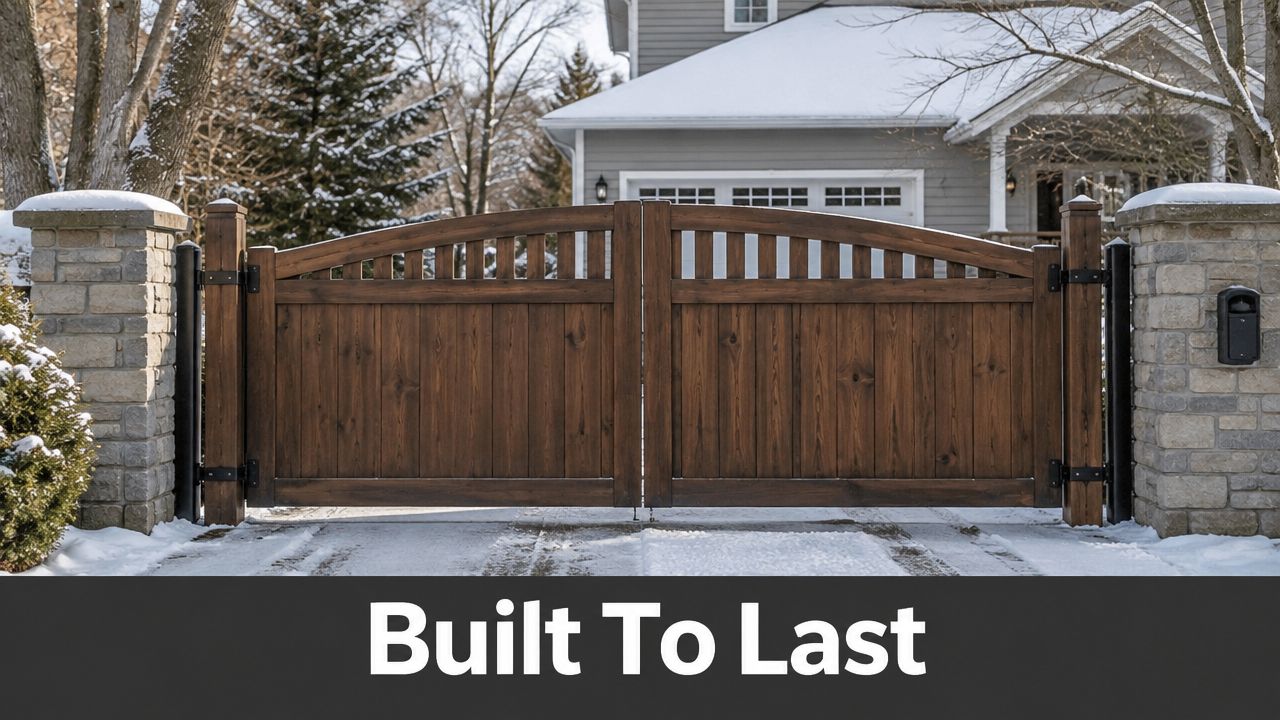
What actually makes a gate last
Think of a wooden driveway gate like a heavy exterior door at the front of your house. You wouldn't judge that door only by the stain colour. You'd care about the frame, hinges, sill, and whether the opening stays plumb through the seasons. The same logic applies here.
Three parts have to cooperate:
The gate leaf needs a stable build, sensible weight, and bracing that resists sagging.
The support structure has to hold that weight through freeze-thaw movement.
The operating hardware has to keep moving even when moisture, salt, and cold show up.
Practical rule: If a gate looks great but the posts, footing, and hinges were treated as an afterthought, you bought a short-term showpiece, not a long-term entrance.
The winter-first way to buy
Most articles start with wood species. Around here, that's not the first question I'd ask. My first question is simpler. Will this gate still open and latch after two Canadian winters?
That question leads to better decisions fast. It pushes you to think about slope, side clearance, snow storage, post depth, bell-shaped footings, drainage gravel, and corrosion-resistant hardware before you get distracted by trim details.
It also keeps you from overspending in the wrong place. Sometimes a beautiful all-wood gate is the right call. Sometimes wood above grade on stronger posts is the more sensible build. Sometimes the best answer is changing the operating style instead of changing the lumber.
How Wooden Driveway Gates Work and Which Style Fits Your Home
The first choice isn't colour or board pattern. It's how the gate moves. If you get that wrong, the nicest design in the world becomes annoying to use.
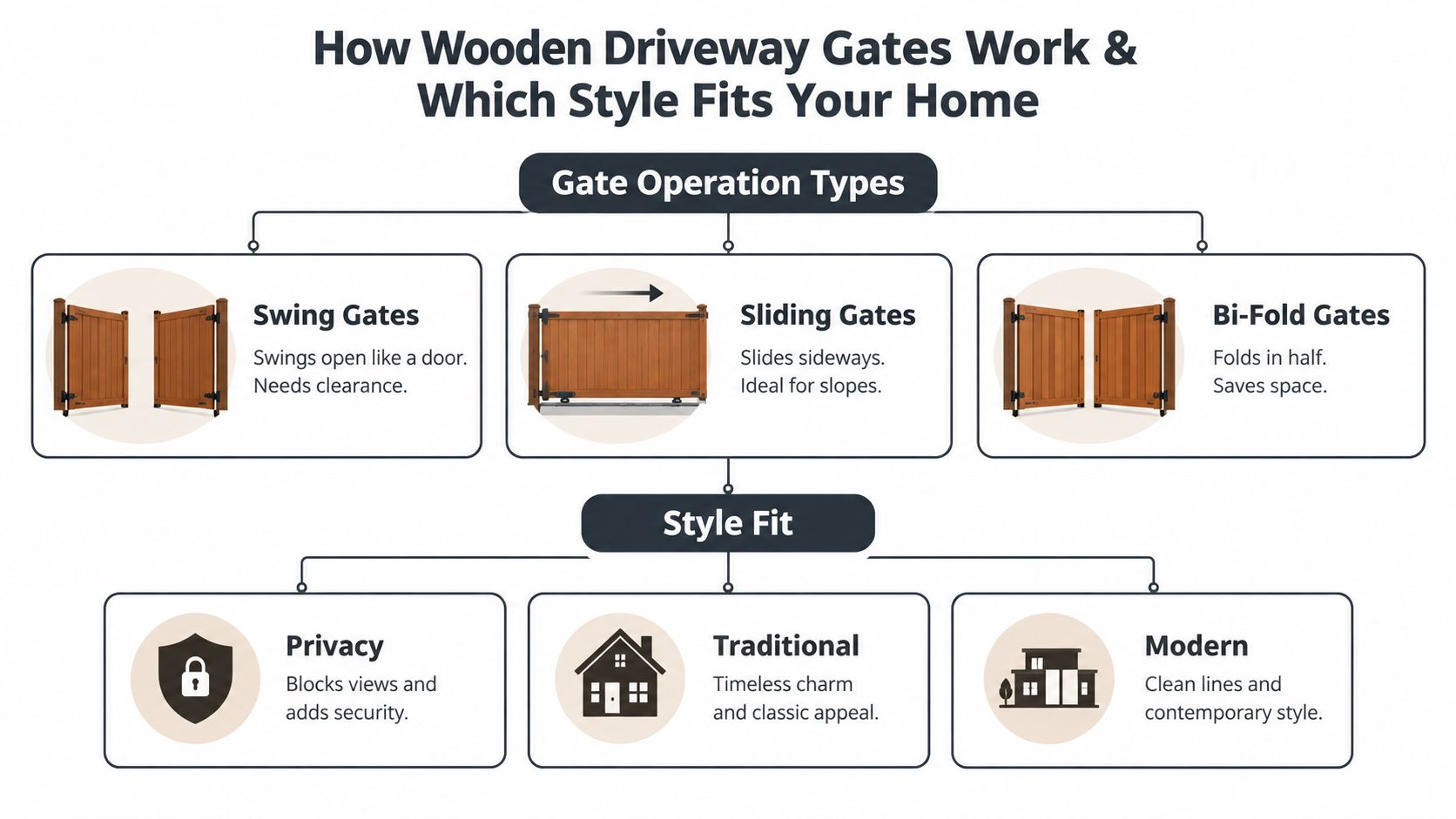
Operation comes first
A swing gate works like a regular door. It arcs open, which means it needs clearance in the direction it swings. That sounds obvious, but people forget to factor in snowbanks, driveway slope, and where the car stops.
A sliding gate moves sideways instead of outward. If your driveway climbs quickly or the swing path is awkward, sliding can solve a problem that hinges never will. FenceScape's article on rolling gates for driveway layouts is useful if you're comparing side room and slope constraints.
A bi-fold gate reduces swing depth by folding as it opens. It can help on tighter sites, though it introduces more moving parts and more setup sensitivity.
A gate that matches the site always feels lighter and easier to use, even when the structure itself is substantial.
Match the gate style to the house and the job
Once the operating method makes sense, then you can choose the visual style.
Privacy styles
Solid or near-solid wooden driveway gates block views and create a strong sense of enclosure. They suit homes where privacy matters more than outward visibility. The trade-off is weight and wind load. A more enclosed gate asks more from the posts and hardware.
Traditional open styles
Picket and framed designs feel lighter and often suit older homes, rural entrances, or properties where you want definition without a fully closed look. They also let more wind pass through, which can help performance.
Modern wood looks
Horizontal boards, clean frames, and restrained detailing pair well with contemporary homes. If you're also updating the garage, it helps to compare the gate and door together so the entrance doesn't look pieced together. A practical companion read is wood garage door styles and maintenance tips, especially if you want the wood tones and upkeep expectations to align.
A simple way to choose
Ask yourself three questions:
How much clearance do I really have? Look at snow storage, parked vehicles, and driveway slope.
How much privacy do I want? More privacy usually means more visual mass and more structural demand.
What should the entrance say about the home? Formal, understated, rustic, or modern.
If you answer those questions, most of the flashy options fall away and the right style becomes easier to see.
Choosing Wood and Build Methods for Canadian Winters
If you only compare cedar to pressure-treated lumber, you're missing the bigger decision. In Ottawa-Gatineau, the more important question is whether the gate should be all wood or wood supported by tougher structural parts where moisture and frost do their worst.
One of the more useful pieces of regional guidance says Western Red Cedar is naturally durable, in durability class 1-2, and can last 25+ years in favourable conditions, but it also stresses that posts set below the frost line, drainage, and corrosion-resistant hardware are what keep a gate aligned through winter as discussed in this Ottawa-area gate material guide. That's the buying lesson. Species matters, but structure matters more.
What each material does well
Cedar is popular for good reason. It's stable-looking, attractive, and a strong choice above grade where you want warmth and character. Pressure-treated lumber earns its keep where moisture exposure is harsher, especially in structural members that are harder to replace.
Hybrid builds deserve more attention than they usually get. In a hybrid gate or adjacent support system, you keep the wood look where people see it and rely on more durable structural support where freeze-thaw stress is highest. That approach becomes especially rational in damp ground or clay-heavy conditions.
The broader market direction also supports that shift. Canada's fencing market was about USD 2.73 billion in 2025 and is projected to keep growing, with residential demand leading according to this market coverage. More homeowners are shopping fence and gate upgrades, but low-maintenance expectations are rising too.
Cedar vs Pressure-Treated vs Hybrid Gate Builds Compared
Material Option | Best Use Case | Winter Performance | Maintenance Level |
|---|---|---|---|
Cedar | Visible gate faces and decorative sections above grade | Good when paired with proper structure and hardware | Moderate |
Pressure-treated | Structural members and posts in higher-moisture conditions | Strong practical choice where ground exposure is tough | Moderate |
Hybrid | Sites with wet soil, repeated freeze-thaw movement, or owners wanting less wood-related upkeep | Often the most rational option when alignment matters more than all-wood purity | Lower on the wood side, with hardware still needing inspection |
Where homeowners often get this wrong
They spend for premium boards and then put those boards on a weak support system. Or they insist every visible and hidden component should be wood, even when the site is telling them otherwise.
If your property has damp soil, limited winter sun, or a history of frost movement, I'd rather see you put cedar where you enjoy it visually and use a tougher support strategy below and behind it. FenceScape's overview of cedar for fencing is a good reference when you're deciding where cedar adds value and where another material may carry the load better.
Better-looking wood won't rescue a gate that was asked to do too much on undersized or unstable supports.
Sizing Setback and Site Prep That Prevents Sagging
Most sagging problems are set in motion before the gate is even built. The opening gets measured casually, the vehicle path isn't thought through, and the posts are treated like fence posts instead of gate anchors.
That's backwards. A driveway gate works only when the opening geometry and the foundation are right.
Start with the opening, not the gate panel
Measure the clear width where vehicles pass, not just the nicest-looking points between two posts. Then watch how vehicles enter. A straight approach is easy. A turn-in from the street changes what feels comfortable.
Single gates can work on narrower openings, but larger residential entrances often benefit from a pair of leaves because each side carries less swing weight. Height matters too, especially near streets and sidewalks where visibility affects what's allowed.
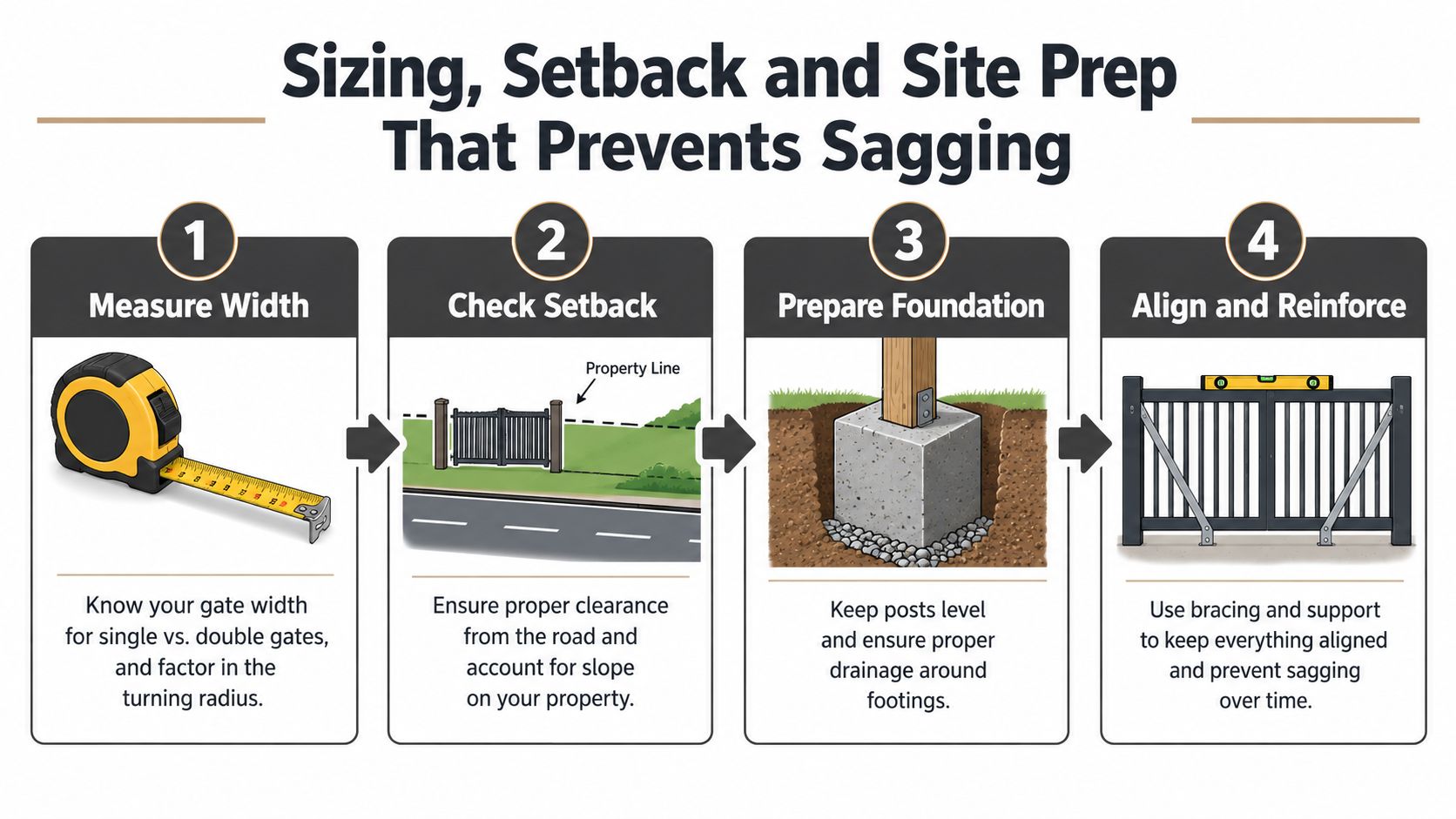
Setback and visibility aren't optional details
In Quebec municipalities, wood is explicitly allowed in multiple local fence bylaws, including treated, painted, stained, or varnished wood. In Pointe-Claire, wood is listed with metal, PVC, and aluminum as permitted materials, and local rules can also govern post spacing and solidity. For driveway-adjacent structures, geometry matters just as much as material. Pointe-Claire requires a fence at least 3 m from the sidewalk or street, limits corner sight-triangle areas to 91 cm in height, and allows backyard heights up to 2.45 m, while Montreal guidance places fences along property lines, 61 cm from sidewalks, and 1.2 m from fire hydrants in this Montreal-area fence guidance.
For practical planning, that means a beautiful wooden driveway gate can still be wrong if it blocks sightlines, crowds the street edge, or lands in the wrong place relative to pedestrian movement.
The underground work that keeps a gate square
In Ottawa-Gatineau, local guidance puts the frost line at about 1.2 to 1.5 metres (4 to 5 feet), with heavier gate posts sometimes recommended as deep as 1.8 metres to resist seasonal movement and torque in this anchoring guide. Another local benchmark puts typical residential burial depth at about 42 inches, with 48 to 60 inches for taller or wind-loaded sections, and says gate posts should generally be 6 to 12 inches deeper than adjacent line posts in this Ontario post-depth guide.
That's the part homeowners don't see, and it's the part that decides whether the latch lines up in March.
Site prep checklist that pays off later
Mark the true gate line: Set the opening where vehicles approach cleanly and where leaves can move without hitting grade changes.
Call for utility locates: Don't guess under a driveway edge or along an existing fence run.
Use drainage thoughtfully: Gravel below and around the lower zone helps water move instead of pooling around the post.
Build the footing for gate loads: Local guidance also points to a wider, bell-shaped concrete footing, including recommendations for an 18-inch bell base and concrete flared 4 inches wider than the post to resist frost heave from this frost-heave prevention article.
If you want a broader installation overview, this guide on driveway gate installation helps connect the measuring and planning stage to the actual build.
Hardware Hinges and Automation Options Explained
You can ruin a well-built wooden gate with cheap metal. That sounds harsh, but it's true. The hardware carries the stress every day, and in winter it deals with moisture, grit, and repeated movement when the structure is already under strain.
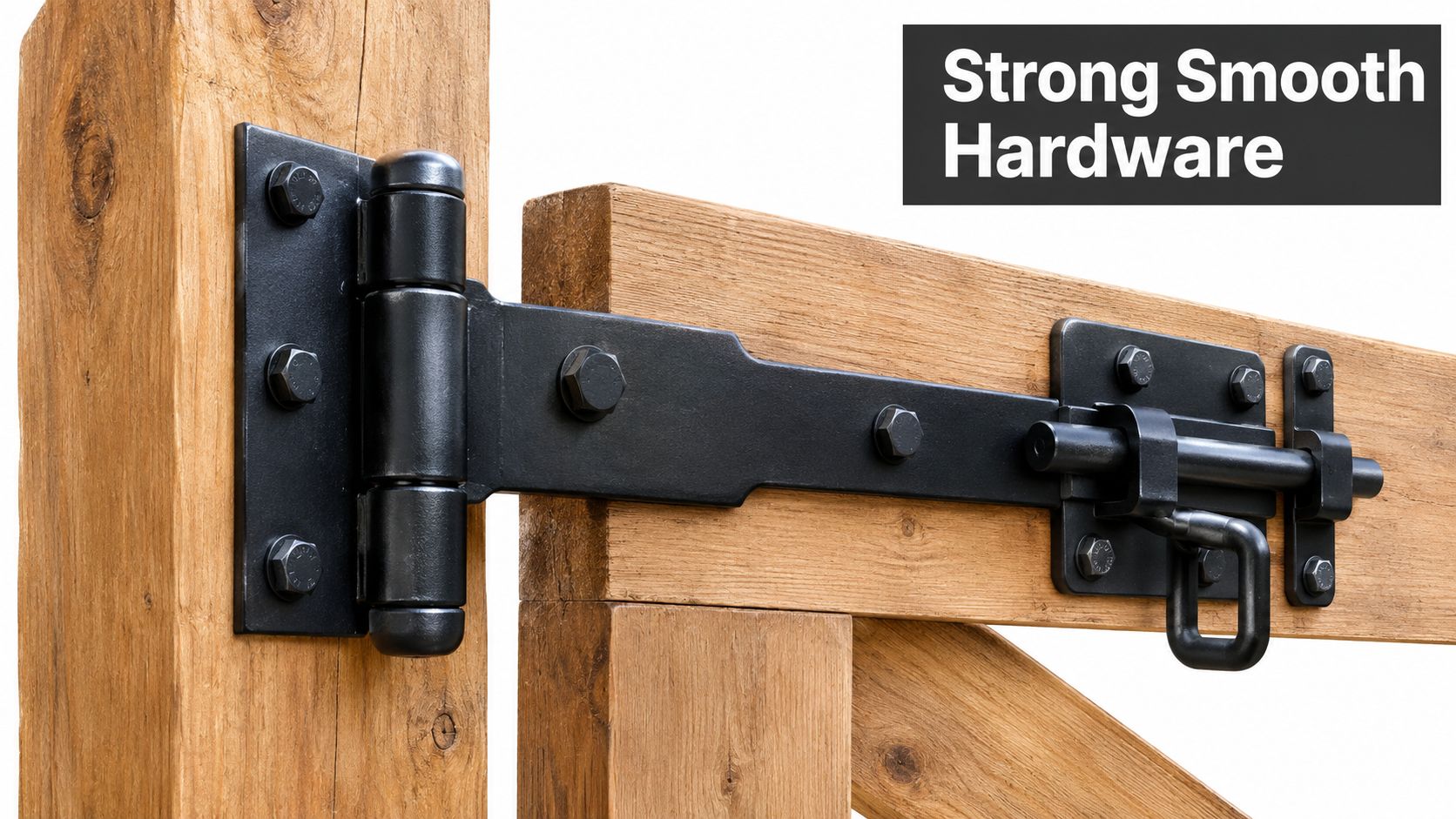
Hinges and fasteners do the heavy lifting
For manual wooden driveway gates, I tell homeowners to focus on three words: adjustable, corrosion-resistant, and appropriate for load.
Adjustable hinges matter because wood moves a bit and ground can shift a bit. You want some correction available without rebuilding the opening. Corrosion resistance matters because a hinge that rusts or binds will telegraph stress into the post and frame. Load suitability matters because a driveway gate is not a light garden gate, even when the design looks delicate.
Latches, drop rods, and stops also deserve attention. The rod should land cleanly. The latch should work with gloves on. The stop should prevent over-travel instead of letting the gate twist itself at full swing.
If a hardware package looks like it belongs on a shed door, it doesn't belong on a driveway gate.
When automation makes sense
Automation isn't just a luxury. On some sites it improves reliability because the gate opens and closes the same way each time instead of being pushed and slammed inconsistently.
A swing operator suits many residential layouts, but it needs proper arc clearance and stable hinge geometry. A sliding motor can be better where snow, slope, or limited swing room make a hinged gate awkward. Narrow lots sometimes benefit from compact movement patterns, while deeper suburban entries often have room for a traditional automated swing setup.
Before adding automation, ask these questions:
Can the frame handle repeat motion? Motors expose weaknesses quickly.
Is the hardware protected against corrosion? Fasteners and brackets live in a harsh environment.
Can the system be adjusted later? Fine-tuning matters after the first seasonal cycle.
Will snow clearing affect sensors or gate path? The best operator in the world won't help if packed snow blocks movement.
A quick visual can help if you're comparing operator layouts and movement paths:
Future-proof without overbuying
Even if you start manual, it's smart to build with automation in mind. That can mean choosing hardware with adjustment range, leaving room for operator mounting, and avoiding design choices that force a full rebuild later.
This is one place where a turnkey contractor such as FenceScape can be one practical option, because the same project can be planned around the gate, the support structure, and the hardware rather than treating each part as a separate purchase.
Security Privacy Permits and Budget Planning Made Simple
Homeowners often treat privacy, bylaws, and budget as three separate conversations. They're really one decision. The amount of screening you want changes the gate style. The gate style affects weight and visibility. Those choices affect what the site and municipality will allow, and all of that shapes cost.
Start with the privacy level you actually need
A fully screened wooden driveway gate gives a strong sense of separation from the street. That's useful if your home sits close to the road or if headlights wash into the property at night. But more privacy usually means a heavier visual presence and a structure that asks more from posts and hardware.
A more open design gives you partial privacy while preserving better sightlines. For many homes, that balance is easier to approve, easier to live with, and easier to integrate with landscaping.
Permits and local control
Quebec has a long regulatory history around built structures like fences and gates. The Québec Construction Code, Building chapter based on NBC 2015 as amended for Québec, came into effect on January 8, 2022 according to the RBQ. For homeowners in the broader Ottawa-Gatineau area, the practical lesson is simple. A driveway gate isn't an informal add-on. Local rules can affect permits, front-yard height limits, and visibility at driveways and intersections.
On the Ontario side, one practical note is that most residential fences under 2 metres in height do not require a building permit, but the installation still has to satisfy frost-depth requirements as noted in this Ontario footing guide. So “no permit needed” does not mean “build it shallow and hope.”
Build your budget around the parts that are hard to redo
If you need to control cost, cut ornament before you cut structure.
Keep the footing budget intact: Re-digging failed gate posts is miserable and expensive.
Choose hardware before decorative extras: Reliable hinges and latches matter more than fancy top profiles.
Phase the project if needed: Install the gate and strong supports now, then add automation later.
Ask about group timing: In some neighbourhoods, coordinated projects can reduce mobilisation headaches and simplify scheduling.
Spend first on the parts hidden in the ground and at the hinge line. Those are the parts that decide whether the gate feels solid five years from now.
Financing can also help smooth the decision, especially when the alternative is installing a cheaper setup and then repairing it after a couple of winters.
Keeping Your Wooden Driveway Gate Beautiful for Years
A wooden driveway gate lasts longer when maintenance becomes a rhythm instead of a rescue job. You don't need to fuss over it every month. You do need to look at it at the right times of year and catch small issues before they become structural ones.
Pick a finish you'll realistically maintain
Stain works well for homeowners who want the grain to show and don't mind periodic refreshing. Paint gives a more uniform look but demands good prep and touch-ups when the coating breaks. Some owners prefer natural weathering, but they should go into that choice knowing the appearance will soften and silver with time.
The key is consistency. A beautiful finish applied once and ignored isn't much protection.
A simple spring and fall routine
In spring, check what winter did.
Inspect alignment: Open and close the gate fully and notice any rubbing, binding, or latch drift.
Look at water behaviour: If runoff is pooling near posts, solve that before it affects stability.
Tighten hardware: Hinges, latches, and fasteners loosen gradually with use and movement.
In fall, prepare for the next freeze cycle.
Clean the gate surfaces: Dirt holds moisture against wood.
Refresh protective finish where needed: Worn spots usually show up before total failure.
Lubricate moving parts: Hinges and operator points should move smoothly before cold weather arrives.
For owners with automated systems, this guide to automatic gate maintenance from Lighthouse Energy is worth reading because the maintenance logic is similar even when the gate face is wood.
The long-life mindset
The best-looking gates aren't always the ones with the most decoration. They're the ones that stay straight, latch cleanly, and age evenly because someone paid attention to finish, drainage, and hardware before trouble showed up.
If you remember one thing, make it this: wood species affects appearance and durability, but winter performance comes from the whole assembly. When the posts stay stable, the footing sheds water, and the hardware remains adjustable and corrosion-resistant, wooden driveway gates keep doing their job without drama.
If you're planning wooden driveway gates in Ottawa-Gatineau, FenceScape can help you sort out the decisions first, including layout, winter-ready post design, material trade-offs, and hardware options that suit your site. You can see project examples and request a quote through FenceScape, whether you're replacing an older gate or starting from a fresh entrance plan.
Comments