
PVC Fence Post Guide for Canadian Homes That Last

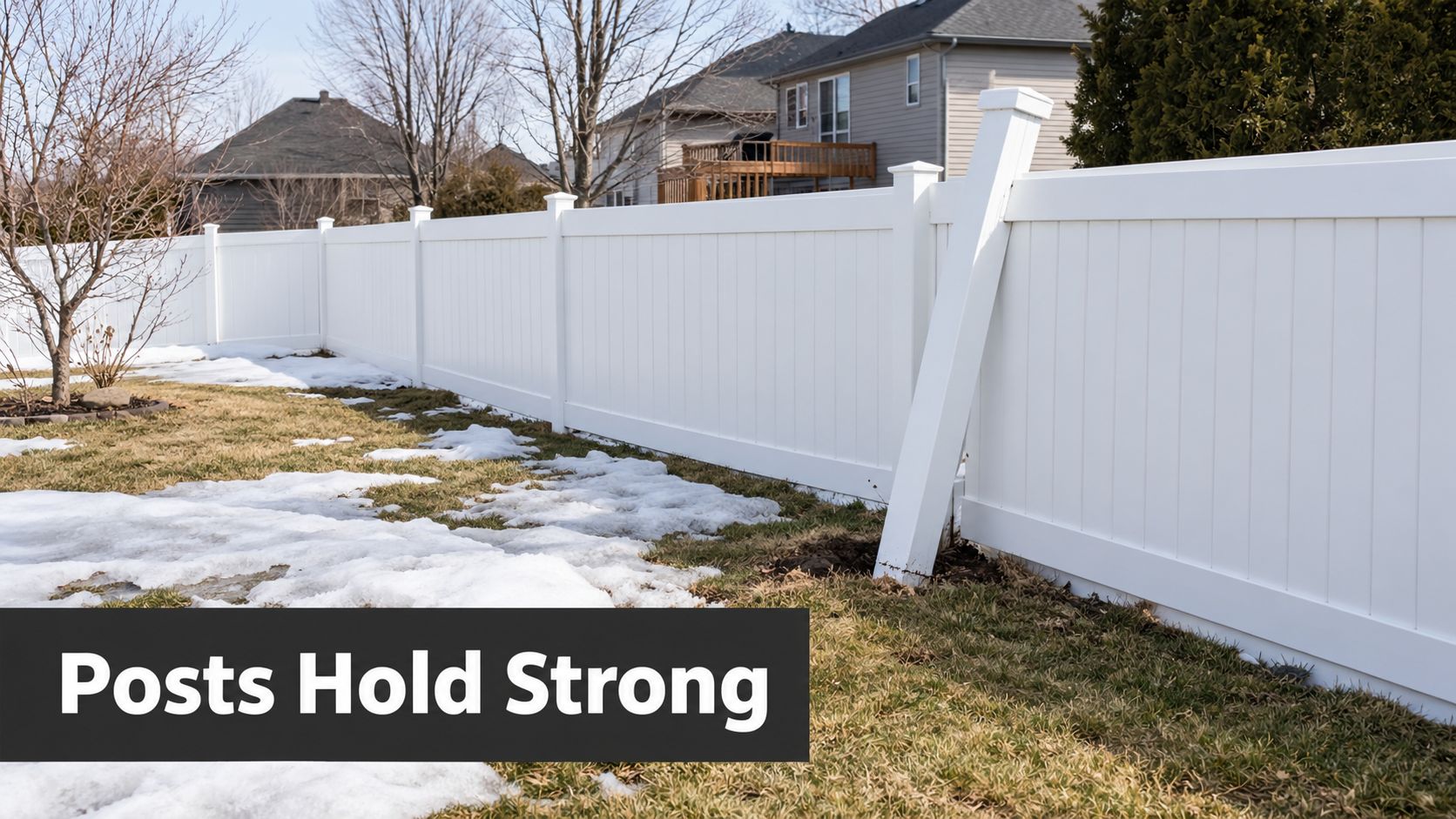
You notice it after the thaw. The white panels still look clean, the rails are intact, and nothing appears broken at first glance. Then the gate drags across the path, one end post leans toward the yard, and a privacy section has shifted enough to catch the afternoon light differently. In Ottawa and Gatineau, that pattern usually points to movement below grade, not a problem with the visible panel.
A PVC fence post is the structural backbone of the fence. It transfers wind and gate forces into the footing, keeps rails aligned, and helps the fence resist seasonal soil movement. A low-maintenance surface can't compensate for a shallow hole, an unsuitable post profile, or a missing stiffener.
Introduction Why Your Fence Post Matters More Than the Panel
After a hard Canadian winter, homeowners often inspect the fence from the wrong direction. They look for cracked panels, faded colour, or loose screws. Those checks matter, but the first place to investigate is the post, especially at corners, ends, and gates.
A rigid PVC fence system can look excellent while its support has started to rotate in the soil. Once a post moves, the rails transfer stress to neighbouring sections. The result can be a racked fence line, a gate that no longer latches, or a long privacy run that bows under wind. The panel may survive because it isn't the part carrying the load into the ground.
The post is part of a system
Think of the post as a column set into a foundation. The panel provides privacy, but the post supports the rails, receives the wind pressure, and holds the fence line in position. At a gate, it also absorbs repeated opening, closing, and latch forces.
That's why a product label promising a rot-resistant or maintenance-friendly fence doesn't answer the important installation questions. You still need to know the post type, internal reinforcement, footing depth, concrete arrangement, drainage, and cap compatibility.
Ottawa–Gatineau buyers aren't choosing from a tiny niche. The Canada construction plastics market was valued at about USD 2,346.1 million in 2025 and is projected to reach USD 2,937.9 million by 2030, with a 4.6% CAGR over 2025–2030. The same coverage identifies PVC as the largest plastic type segment, which places PVC fencing within an established Canadian exterior construction-materials category.
The practical lesson is simple: choose the panel for appearance and privacy, but choose the post and footing for the site. The rest of this guide builds that decision from the post profile outward, then connects it to wind, frost, installation, maintenance, and use.
Understanding PVC Fence Post Types and Profiles
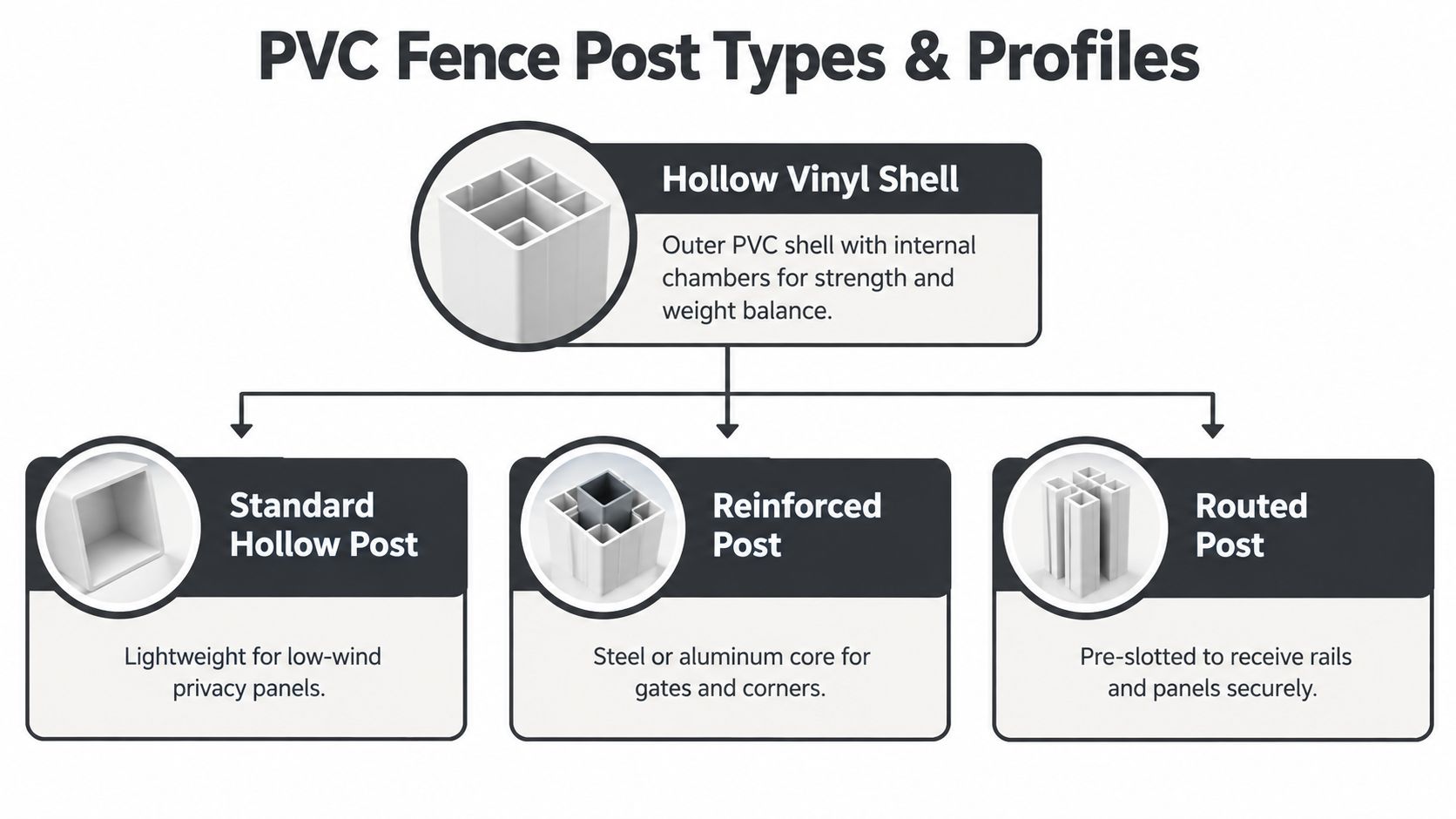
A PVC fence post usually starts as a hollow vinyl shell. Inside, it may have chambers that help the profile keep its shape, or it may receive a separate insert made from steel or aluminium. That construction is easier to understand if you compare it with a bone. A hollow bone can be light and strong for its weight, while a reinforced column resists bending more effectively when the load increases.
Start with the post's job
A line post sits between two fence sections. It normally carries a straightforward share of the rail and panel load. An end post supports a fence termination, while a corner post changes direction and receives forces from two runs.
A gate post has the hardest everyday assignment. It supports hinges, receives the latch, and handles the changing load of a moving gate. Treating it like an ordinary line post is a common reason for sagging or misalignment.
Hollow, reinforced, and routed profiles
A standard hollow post can work in a sheltered location when the complete system, panel height, spacing, and footing suit the site. It keeps weight and handling manageable, but its stiffness depends on the shell geometry and the support provided by the installation.
A reinforced post adds an internal steel or aluminium member. The insert can reduce flexing at gates, corners, ends, and exposed sections where the post faces more lateral force. Some PVC systems use an H-shaped post arrangement, with a galvanised metal stiffener set in a concrete base and a PVC sleeve fitted over it. That approach separates structural support from the visible finish.
A routed post comes prepared with slots or channels for rails and panels. Routing can improve alignment and connection security because the rails sit in a defined receiving profile instead of relying only on surface fasteners.
What to check before buying
Look beyond the colour sample. Ask for the post's outside dimensions, wall thickness, internal cavity arrangement, reinforcement material, connection method, and compatible cap. Also confirm whether the product is sold as part of a complete rigid PVC fence system.
Practical rule: A gate post and a line post may share the same colour, but they shouldn't automatically share the same specification.
The profile shape matters because a wider or better-supported section can resist rotation more effectively. The footing still determines whether that strength reaches stable soil, which is why the next question isn't “How tall is the post?” It's, “What loads will this post transfer, and how will the ground receive them?”
Dimensional Specs and Load Considerations That Keep Fences Upright
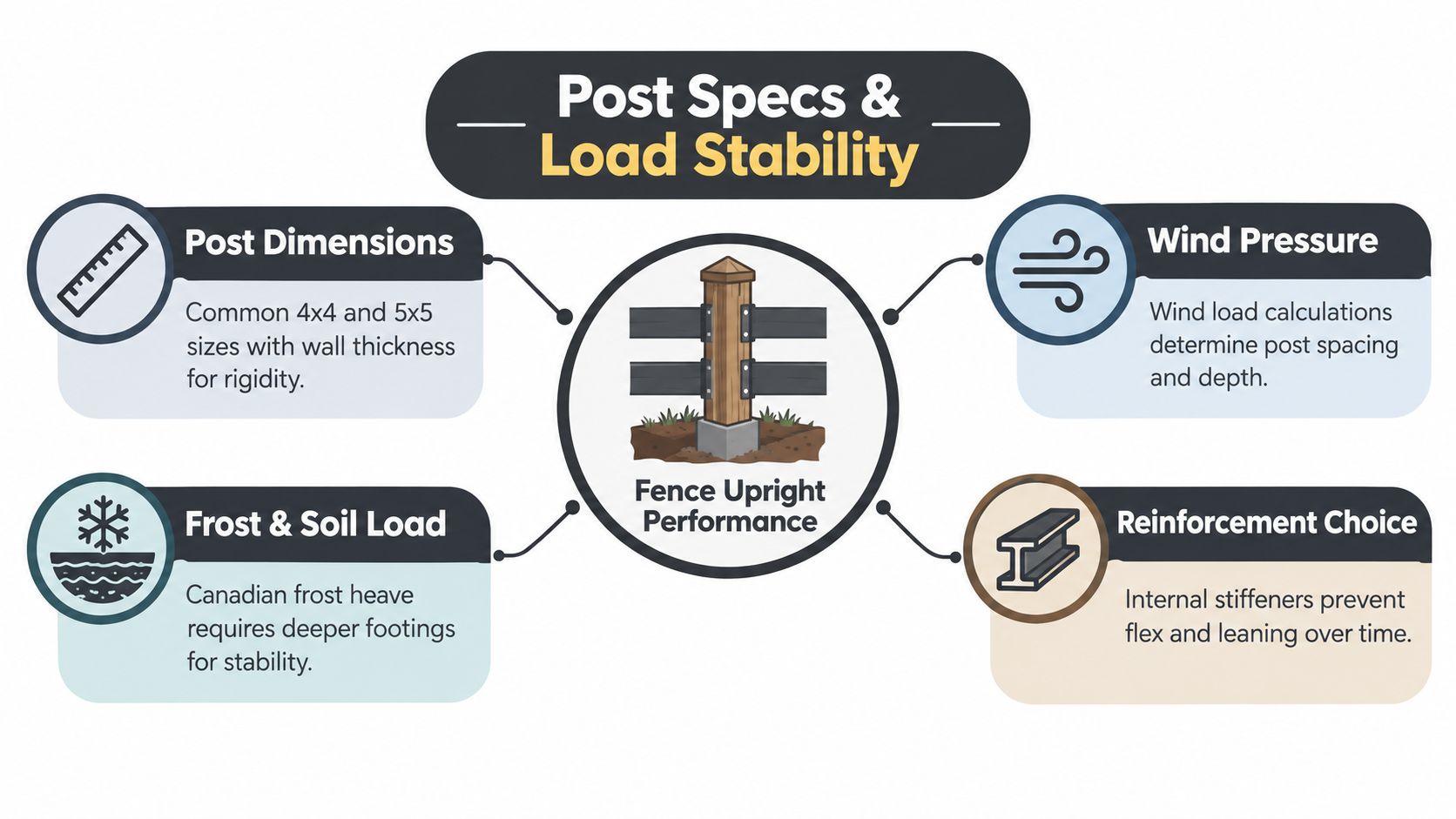
A post's dimensions only make sense alongside the fence around it. A common square profile may be described as a 4-by-4 or 5-by-5, but that label doesn't tell you the wall thickness, internal reinforcement, footing design, or exposure conditions. Two posts with similar outside dimensions can behave differently if one has a thicker shell or a metal insert.
Privacy panels create leverage
A solid PVC privacy panel acts like a sail. Wind pushes against the broad surface, and the post transfers that sideways force down into the footing. The taller and more uninterrupted the fence run, the more important the post spacing, section stiffness, corner details, and foundation become.
Canadian fence design guidance calls for assemblies to resist at least 0.9 kN applied horizontally at 1.2 metres above ground and 0.68 kN at the top rail, with design wind pressure applied perpendicular to the fence according to local exposure conditions. Those figures are set out in the Canadian fence design guidance.
You don't need to perform structural calculations at the kitchen table, but you should understand the consequence. A sheltered garden fence and a long, solid perimeter beside an open yard shouldn't receive the same post specification by default.
Match the post to the load path
Start at the panel, then follow the force:
Panel surface: Wind presses against the solid area.
Rails and connections: The load moves into the rails and their receiving points.
Post profile: The post resists bending and twisting.
Reinforcement: A stiffener can improve performance at high-load locations.
Footing and soil: The base resists rotation, uplift, and seasonal movement.
Homeowners can use Ottawa and Ontario fence-post depth guidance to question a quote that lists only panel height and colour. A sound proposal should identify the post type, footing approach, and any special treatment for gates, corners, and long exposed runs.
Wall thickness is another useful clue, but it isn't a standalone quality score. A thicker shell with a weak connection or shallow footing can still move. Conversely, a properly reinforced system can perform well because the insert, post, concrete, and soil work together.
The useful specification isn't “a strong post.” It's a post, insert, footing, and connection detail sized for the actual site.
PVC Versus Wood and Metal Posts Compared Honestly
PVC earns attention because it resists rot and keeps a clean, consistent appearance with limited routine upkeep. That doesn't make it automatically superior to wood or metal. Each material solves a different problem, and the installation determines how much of that material's potential you get.
PVC vs Wood vs Metal Fence Posts at a Glance
Criterion | PVC Post | Wood Post | Metal Post |
|---|---|---|---|
Rot and moisture | Won't rot like wood, but hollow sections and connections still need protection from water entry | Can decay where moisture remains trapped, especially around the ground line | Doesn't rot, but exposed or damaged coatings can allow corrosion |
Frost resilience | Depends heavily on below-frost-line embedment, footing, and reinforcement | Depends on the same footing principles, with additional moisture concerns | Strong structural option, but coating and soil conditions still matter |
Maintenance | Lower-maintenance than wood, not maintenance-free | Usually needs more attention to finish, moisture, and decay | May need inspection for coating damage, rust, and fastener condition |
Appearance | Consistent colour and a clean manufactured finish | Natural grain and a traditional look, with visible weathering over time | Modern or industrial unless sleeved or finished |
Upfront and lifecycle considerations | Installation quality can determine whether the lower upkeep delivers value | May have a lower initial material cost, but replacement and refinishing can affect lifecycle value | Often chosen where stiffness and impact resistance matter more than a soft residential appearance |
Gates and corners | Reinforced posts are generally the safer choice | Larger or specially reinforced wood members may be required | Well suited to high-load locations and heavy gate hardware |
Pools and privacy | Useful when the system meets local barrier requirements and receives proper footing | Can work, but moisture and finish care require attention | Strong and durable, though appearance and corrosion protection need review |
Lower-maintenance isn't the same as maintenance-free
Ottawa-area materials guidance says PVC can last 30 to 50 years with proper installation and notes that post replacement is normally not needed, while also emphasizing steel reinforcement, thick rails, and correct below-frost-line installation. The Ottawa climate comparison of PVC and wood fencing supports the more careful interpretation: PVC reduces routine maintenance, but it remains installation-sensitive.
Wood is forgiving in appearance because small movement can look natural, but decay and repeated refinishing can become the price of that familiar material. Metal offers stiffness and useful strength at gates or exposed sites, yet the finish, corrosion protection, and visual treatment deserve as much attention as the initial selection.
PVC makes sense when you want a consistent privacy finish and don't want the recurring work associated with wood. It makes less sense to specify a light hollow profile for a wind-exposed gate because the panels are lightweight.
Installation Basics Anchoring and Concrete Requirements in Canadian Soils
A good PVC fence installation begins before the auger reaches the ground. Mark the property line, confirm the fence location, identify gates and corners, and check whether the design needs municipal or neighbourhood review. In particular, homeowners should review permit rules for visibility and historic areas before finalising a layout.
Set the depth for the ground, not the brochure
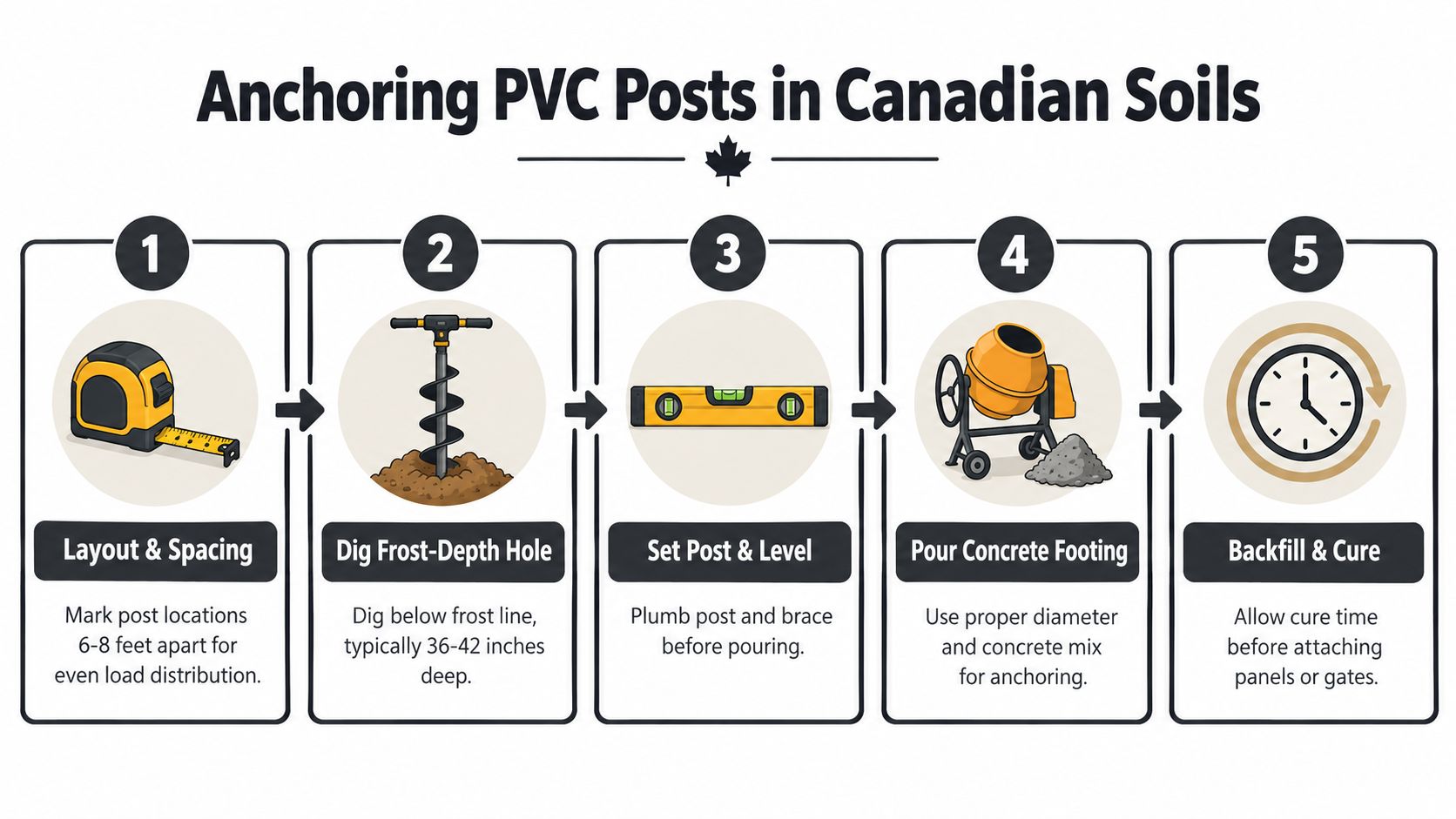
Canadian guidance recommends burying fence posts at least 3 feet, or about 0.9 metres, below grade in many southern regions to get below the frost line and reduce frost heave. For Ottawa–Gatineau, local guidance commonly places posts below a 3.5-foot frost line, with a practical minimum of 42 inches and 48 to 60 inches recommended for taller or wind-loaded sections, according to Ottawa–Gatineau fence-post depth guidance.
Local sources don't all give the same practical depth. One Ottawa guide describes posts as typically set around 48 inches, while another places the frost line at roughly 3 to 3.5 feet and recommends footing depths of 3.5 to 4.5 feet, as discussed in this Ottawa frost-depth installation guide. Ontario-facing guidance also distinguishes Southern Ontario and the GTA at around 1.2 metres from Ottawa and Montreal, where cited guidance reaches roughly 1.8 metres, which is why regional fence-post depth guidance shouldn't be treated as a universal eastern-Canada formula.
Build the footing in a controlled sequence
Layout and spacing: Mark every post location and identify which posts carry gates, corners, and ends. Spacing should follow the fence system's engineering and panel dimensions, not a convenient guess.
Excavate: Dig through loose topsoil and below the local frost-depth requirement. In rocky or clay-heavy ground, adjust the method rather than reducing the depth without a structural reason.
Prepare drainage: Keep the base from becoming a water pocket. The exact gravel and concrete arrangement depends on soil, drainage, and the selected system.
Set and brace: Plumb the post in two directions, check the fence line, and brace it before concrete placement. A post that sets out of alignment will make every rail connection harder.
Pour and finish: Use a footing diameter and concrete mix suited to the post and load. Keep the post stable while the concrete gains strength, and don't attach a heavy gate before the base can safely carry it.
The practical guide to installing a fence post is useful for reviewing the sequence, especially if you're comparing a DIY plan with a contractor's method.
Treat the cap as functional hardware
Rigid PVC fence systems in Canada fall under ASTM F1999, which addresses system-level installation requirements and identifies the post cap as a functional component. In Ontario, OPSS.PROV 1541 requires terminal and line post caps to conform to ASTM F626, while OPSS.PROV 772 requires tubular posts to use waterproof metal caps that fasten securely.
That detail protects more than appearance. A compatible cap helps keep water out of hollow sections. Water that enters and freezes can contribute to cracking, cap blow-off, moisture accumulation, and reduced stiffness near the top of the post over successive winters. Check the post dimensions, cap fit, and fastening method before the crew closes the job.
Before attaching panels, rails, or gates, verify that the post remains plumb and that the footing hasn't disturbed the layout. Small errors are easy to correct while the assembly is open. They become expensive once the full fence line is connected.
Durability Maintenance and When to Choose PVC for Your Property
PVC is a sensible choice when the property owner wants privacy, consistent colour, and less routine upkeep than wood. It's especially useful for residential side yards, townhouse boundaries, and pool enclosures where the finished appearance matters. The material still needs a well-designed support system, because freeze-thaw movement acts on the footing regardless of what covers the post.
Ottawa's winter conditions also make reinforcement worth considering at gates, corners, and long solid runs. Canadian PVC performance data lists 5.0 ft-lb/in notch at 23°C and 2.0 ft-lb/in notch at 0°C, with tensile strength of 6,500 psi and flexural strength of 11,400 psi, as provided in this Canadian PVC fence specification. Those figures help explain why cold-weather selection matters, but they don't replace proper embedment or site-specific load assessment.
Choose by use, not just appearance
For a backyard privacy fence in a sheltered setting, a properly installed PVC system can offer a clean finish with little more than seasonal washing and inspection. For a gate, specify a reinforced post and verify that the hinges and latch connect to a structure designed to receive their load.
A pool enclosure has another layer of responsibility. Quebec residential pool safety rules require a barrier at least 1.2 metres high, no openings that allow a 10 cm sphere to pass, and gates that are self-closing and self-latching. The requirements apply to many inground, semi-inground, and qualifying above-ground pools, so review the Quebec residential pool safety regulation before choosing the fence layout.
A commercial perimeter or exposed institutional boundary may call for a hybrid approach, with PVC for the visible finish and steel reinforcement where gate or wind loads peak. A homeowner who wants a wood appearance may also prefer wood or a sleeved metal system rather than forcing PVC to provide a character it doesn't naturally have.
Keep the system aligned
Maintenance is straightforward, but it isn't zero. Wash dirt and salt from the surface, inspect caps after severe weather, check gate alignment, and look for movement at the base. If a post begins leaning, address the footing or connection rather than trying to pull the panel straight with a surface fastener.
For homeowners comparing a clean PVC finish with a different visual treatment, a PVC post wrap option can help frame the decision around appearance and compatibility. The wrap still needs to match the post profile and shouldn't be used to hide structural movement.
Making a Confident Choice for a Fence That Lasts
A durable PVC fence starts with three decisions made together: post type, footing design, and cap compatibility. Choosing only the panel colour leaves out the parts that determine whether the fence stays straight through Ottawa–Gatineau's frost and wind cycles.
Before you buy materials or approve a quote, ask:
Is the post hollow, routed, reinforced, or built around a metal stiffener?
Which posts receive upgraded treatment at gates, corners, and ends?
What frost-depth assumption supports the proposed embedment?
How will the footing handle the site's soil and drainage?
Does the cap fit the post profile and keep the hollow section protected?
Has the design considered solid-panel wind exposure rather than panel height alone?
A contractor who answers those questions clearly is treating the fence as a structural assembly. That approach costs more attention at the planning stage, but it reduces the chance of chasing a leaning post after the first serious freeze-thaw season.
For Ottawa–Gatineau homeowners, FenceScape offers PVC fence planning and installation as part of a turnkey service, with attention to posts, reinforcement, footings, caps, gates, and the finished property line. Visit FenceScape to discuss your site conditions, privacy goals, and a PVC system sized for the ground beneath it.
Comments