
Chain Link Fence vs Wood Cost: Ottawa Guide

In the Ottawa-Gatineau market, chain link fencing typically costs $12 to $25 per linear foot installed, while wood privacy fencing ranges from $20 to $40 per linear foot installed, making wood roughly 1.3 to 3.3 times more expensive upfront. If your first priority is keeping the invoice down, chain link wins. If you're paying for privacy, appearance, and a more substantial backyard enclosure, wood can justify the premium, but only if you budget for its maintenance.
You're probably comparing quotes after realising the fence you want is more than a row of posts and panels. The final price depends on the perimeter length, fence height, gates, soil, access, material grade, and Ottawa's rules about where and how high you can build. A low-cost material installed in the wrong location isn't a saving. It's an expensive correction.
The practical question isn't, “Which fence is cheaper?” It's which fence solves your problem at an acceptable upfront and long-term cost. For most utility boundaries, pet containment, and larger perimeters, I favour chain link. For backyard privacy and curb appeal, I favour wood, provided you're prepared to maintain it.
Upfront Pricing and Per-Foot Estimates
A homeowner comparing quotes in Ottawa can quickly see the day-one gap. Chain link generally runs from $12 to $25 per linear foot installed, while wood privacy fencing generally runs from $20 to $40 per linear foot installed in the Ottawa-Gatineau market, according to local chain link and wood fence pricing guidance. Chain link is the better starting point when the immediate invoice controls the decision.
Those figures only work as a first comparison. Height, finish, post size, gate count, soil, access, and the property layout can change the quote. A basic chain link boundary uses less material and labour than a wood privacy fence with solid boards, heavier framing, a taller profile, decorative caps, or a finished gate.
Material choice changes the starting budget
Pressure-treated wood commonly falls around $18 to $35 per linear foot, while cedar commonly ranges from $25 to $45 per linear foot in the North American market, as reported in the Ontario fencing cost guide. Cedar suits a finished residential yard, but the material premium is clear. For a closer look at wood-specific pricing, review this wood fence cost per foot guide before comparing contractor estimates.
Ontario pricing references also place chain link at approximately $15 to $40 per linear foot, compared with $25 to $60 per linear foot for wood, depending on height, material, and installation conditions. The broad ranges explain why two quotes can differ substantially without either contractor being unreasonable. Check the specifications before judging the price.
Practical rule: Compare the same fence height, gate count, material grade, post specification, removal work, and finish before comparing the bottom-line price.
Don't mistake a per-foot quote for a complete budget
A per-foot figure screens options. It does not approve the project. Excavation difficulty, old-fence removal, gates, corner details, access, and repairs to disturbed ground can all appear on the final invoice. Ottawa's freeze-thaw cycles also make sound posts and proper drainage worth paying for, because a low initial price can become a maintenance expense over the next decade.
Measure the approximate perimeter before requesting estimates. Mark sections that require privacy separately from areas that only need containment. If wood is the preferred look but the full perimeter strains the budget, install wood beside patios or windows and use chain link along less visible boundaries. That hybrid layout keeps privacy where it matters without paying for an opaque barrier around the entire property. Verify the permitted height and placement with Ottawa before ordering, since a compliant design protects the budget from a costly redo.
Total Project Budgets and Material Variables
Per-foot pricing becomes more useful when you translate it into a complete project. A 2025 Ottawa cost guide reports an average installed cost of about $4,815 for chain link and $5,500 for wood, with chain link project ranges of $1,633 to $8,000 and wood project ranges of $2,100 to $13,000, as documented in the Ottawa fencing cost guide.
That spread is large because “a fence project” can mean a straightforward boundary on accessible, level ground or a tall privacy installation with difficult digging, multiple gates, premium lumber, and extensive preparation. The average is a reference point, not a promise.
Ottawa-Gatineau Fence Project Cost Ranges
Material Type | Average Installed Cost | Typical Project Range | Primary Cost Drivers |
|---|---|---|---|
Chain link | About $4,815 | $1,633 to $8,000 | Perimeter length, height, gates, excavation, finish, access |
Wood | About $5,500 | $2,100 to $13,000 | Lumber type, privacy design, height, gates, terrain, staining, access |
A cedar privacy build pushes the wood quote higher than a basic pressure-treated installation. Solid boards require substantial framing and careful alignment, while a chain link fence can cover a large boundary without the same amount of opaque material. If you're reviewing a quote that sits near the top of the local range, ask the contractor to identify every cost driver rather than accepting “premium installation” as an explanation.
What makes the invoice move
Ottawa Valley soil conditions can make post installation more demanding, particularly where the crew encounters rock, dense fill, roots, or difficult access. Sloped ground also requires more layout and adjustment because the fence must follow the property without creating awkward gaps or uneven sightlines.
Gates deserve separate attention. A simple walk gate and a wide driveway gate don't carry the same hardware, framing, or installation demands. Existing fence removal, disposal, grading, custom transitions, and restricted equipment access can also move a project from the lower end toward the higher end.
For a broader framework on how construction budgets separate labour, materials, site work, and other line items, review this breakdown of build costs from New American Funding, LLC. The same budgeting discipline applies here: insist on a written scope, not just a single total.
You can also use this Ontario fencing cost breakdown to compare how material selection and installation details affect a regional quote. My advice is simple: get the contractor to price your actual layout, then ask for a second option using a different material or fence height.
Lifecycle Costs and Freeze-Thaw Maintenance
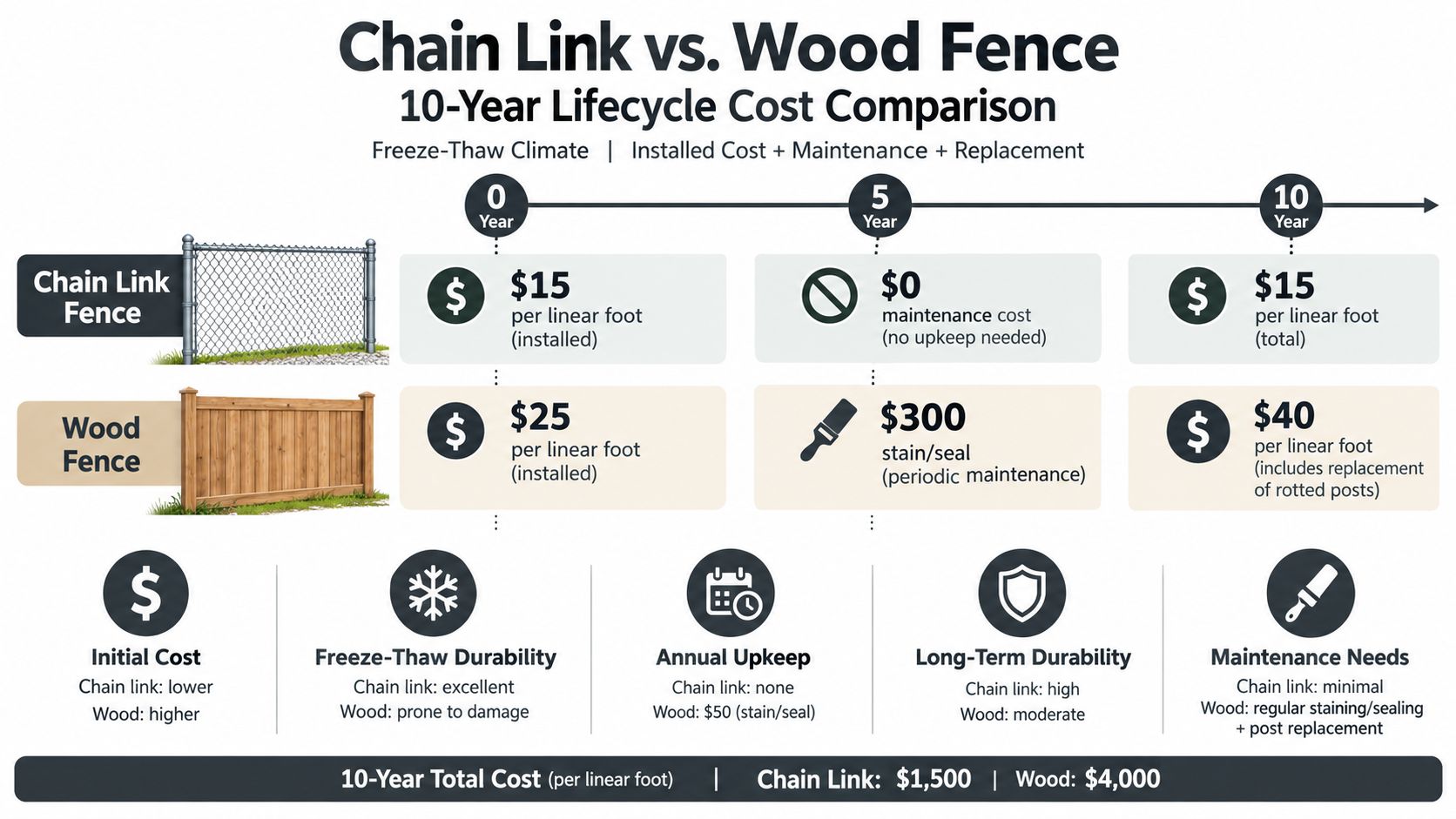
The cheapest fence on installation day isn't automatically the cheapest fence to own. Ottawa's freeze-thaw cycles punish neglected wood, especially when posts, fasteners, and boards absorb moisture and shift through repeated seasonal changes.
Ottawa-focused cost guidance notes that pressure-treated wood needs staining every 2 to 3 years to help it handle freeze-thaw conditions, while chain link is generally positioned as the lower-maintenance option, according to this Ottawa fence installation cost reference. That maintenance isn't optional if you want to protect the appearance and performance of a wood fence.
What ownership looks like over time
Wood maintenance includes cleaning, preparation, staining, sealing, and occasional board or post repairs. Homeowners who postpone those tasks may eventually pay for more than a surface refresh. Water intrusion, movement, rot, and damaged posts can turn routine upkeep into partial replacement.
Chain link doesn't need seasonal staining or painting. Galvanised or coated systems still need sensible care, including checking hardware, correcting damage, and keeping nearby vegetation from distorting the fabric, but the recurring finishing work is far less demanding.
The right comparison is not “chain link has no costs and wood has costs.” Every fence can need repairs. The more accurate point is that wood asks for a recurring maintenance commitment, while chain link usually asks for less hands-on attention.
Budget for the fence you'll actually maintain, not the fence you promise yourself you'll maintain.
A practical 10-year calculation
Start with the installed quote. Then list the maintenance events you expect over the next decade, including stain or seal work, replacement boards, post repairs, gate adjustments, and any surface preparation. Don't treat those expenses as theoretical. In this climate, they're part of choosing wood.
Freeze-thaw movement also makes installation quality important. Poor drainage, inadequate post depth, or weak alignment can create problems regardless of material. Homeowners should ask how the crew will address post stability and site drainage, then review ways to prevent frost heave before approving the work.
If you're choosing chain link because you want predictable ownership costs, specify the finish and hardware you want. If you're choosing wood because privacy matters, accept the maintenance schedule upfront. That honesty leads to better decisions than pretending the premium material is maintenance-free.
Navigating Local Bylaws and Permit Constraints
A fence quote is worthless if the proposed design doesn't comply with Ottawa's rules. Check the yard location, maximum height, property line, and sightline requirements before you select a material.
For Ottawa residential properties, fences are generally limited to 1 metre in the front yard and 2.13 metres in rear and side yards, while non-residential properties can reach 3 metres, according to Ottawa fence regulation guidance. These limits affect the budget immediately. A homeowner may want a tall privacy fence along the street, but the front-yard height limit can prevent that design.
Start with the yard location
Use this order before discussing boards or mesh:
Identify the yard section. Separate front, side, rear, and corner-lot areas because the permitted treatment may differ.
Confirm the proposed height. Don't pay for a design that exceeds the applicable limit.
Verify the common property line. A fence installed in the wrong location can create a dispute and costly relocation.
Ask about sightlines and local conditions. Visibility matters near streets, driveways, and intersections.
Put compliance in writing. Your contractor should show the planned height and placement on the quote or layout.
Ottawa rules also state that chain link fences are permitted in rear and side yards, must sit at least two feet from the common property line, and can't exceed six feet above natural grade, as outlined in the municipal zoning code. Those requirements can affect both the usable yard area and the amount of material required.
Design around the bylaw, not against it
If privacy is needed in a rear yard, wood may fit the permitted height and purpose. If the side yard mainly needs pet containment or boundary definition, chain link may provide the function without paying for an opaque barrier. In a front yard, a shorter design may be the only compliant option, so budget for a different material or a lower visual profile.
Don't assume the contractor is responsible for every approval or boundary question. Ask who verifies zoning, who identifies the property line, and whether you need a survey or municipal confirmation. Paying for clarity before installation is cheaper than rebuilding a compliant fence after a complaint.
Matching Fence Types to Property Goals
Fence material should follow the job. Chain link and wood aren't interchangeable products with different colours. They create different levels of privacy, visibility, wind exposure, maintenance, and visual presence.
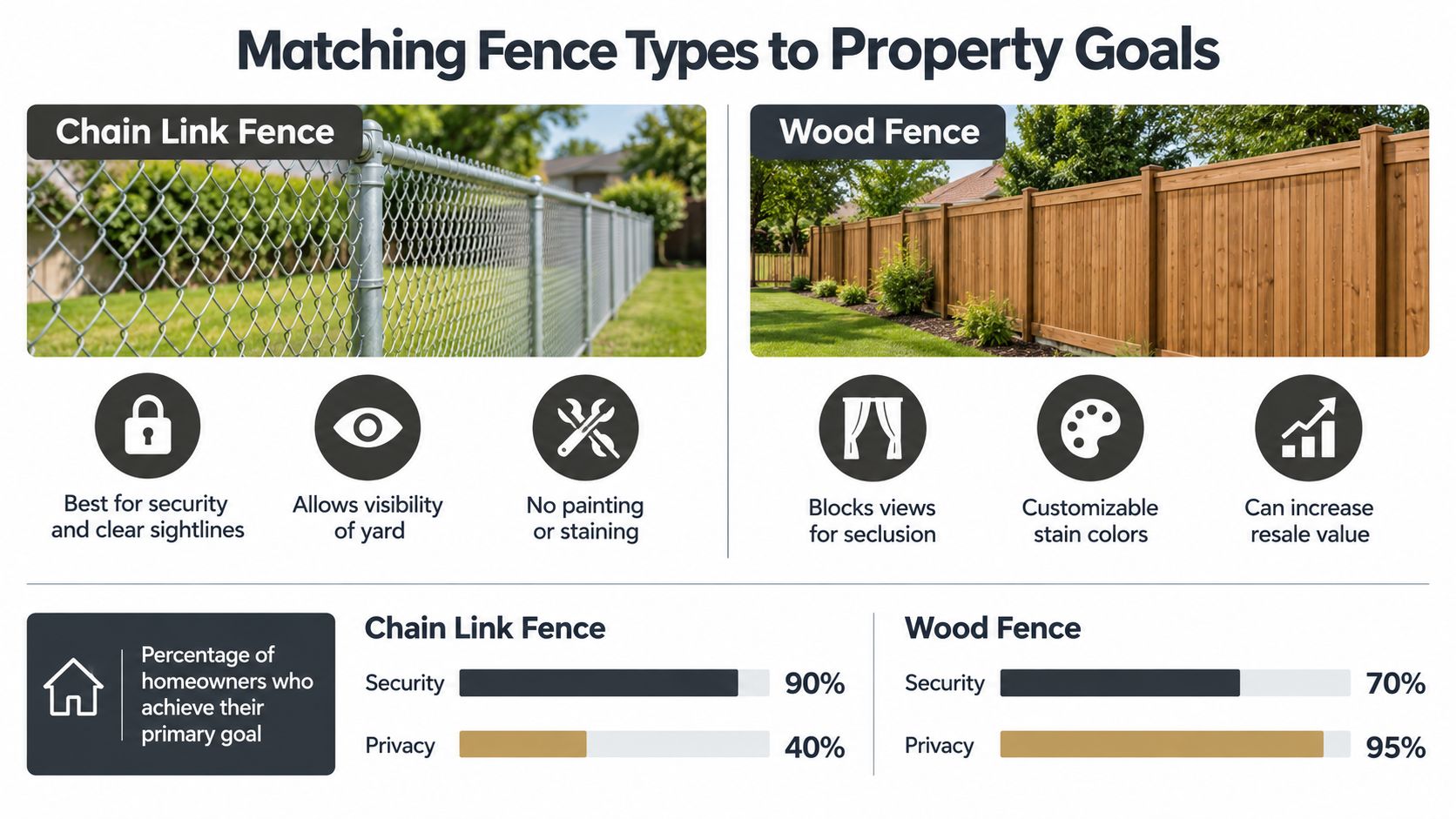
Choose chain link when the boundary must secure a space without hiding it. It works well for pet containment, side yards, larger perimeters, and situations where you want to see through the fence. It also avoids the solid wall effect that can block light or create a stronger wind load.
Match the material to the problem
For privacy, choose wood. A solid wood fence blocks direct views into the yard and gives a backyard a more enclosed feel. Chain link can accept privacy slats or screening, but those additions change the appearance and may reduce the price advantage.
For security and visibility, choose chain link. You can monitor the perimeter, keep pets contained, and avoid blind spots created by a solid barrier. A coated finish can provide a more deliberate appearance than basic galvanised mesh.
For curb appeal, choose based on the house and neighbourhood. Wood offers stain and paint flexibility and can suit traditional residential streets. Chain link makes more sense where function matters more than a decorative frontage, particularly in locations where the bylaw already limits height and visual mass.
Special situations deserve a separate check
Pool enclosures must satisfy the applicable safety requirements, so don't select a fence solely on appearance or price. Confirm the enclosure design, gate arrangement, and hardware with the contractor and the relevant local authority before ordering materials.
Heritage settings, townhouse communities, and neighbourhood associations may impose design expectations beyond municipal zoning. A transparent chain link fence might be acceptable in a rear service area but unsuitable along a prominent frontage. Conversely, a wood privacy fence may be unnecessary where the property only needs a clear boundary.
My recommendation is to define one primary goal and one secondary goal. If your primary goal is privacy, pay for wood where it matters. If your primary goal is containment or perimeter security, keep the design functional and use chain link unless a specific appearance requirement says otherwise.
Financing Options and Neighbourhood Group Rates
The easiest way to reduce a fencing invoice is to reduce duplicated work. If several nearby homeowners need fencing at the same time, a contractor may be able to coordinate material delivery, layout, crew movement, and installation scheduling across adjacent properties.
Neighbourhood group-rate work can make sense for shared boundaries, townhouse runs, and streets where multiple homeowners want similar materials. It doesn't turn an expensive material into a cheap one, but it can reduce inefficiency in the project. Each property still needs its own measurements, access review, gates, and responsibility for the boundary line.
Organise the group before requesting quotes
A group-rate request works best when one person gathers the basics:
List the properties: Record the addresses or lots involved and identify which sections are shared.
Standardise the scope: Agree on likely material, height, finish, and gate requirements before asking for pricing.
Separate private upgrades: Price individual gates, privacy sections, removal, and difficult access separately.
Set a decision date: Contractors can't hold a crew and materials indefinitely while neighbours debate.
Request written terms: Confirm whether the discount depends on every property proceeding.
FenceScape offers neighbourhood group discounts and coordinates turnkey fencing work across Ottawa-Gatineau, including planning, installation, and post-install support. That type of coordination is most valuable when several lots share a boundary or need a consistent streetscape.
Financing needs a hard budget
Financing can make a higher-cost wood or hybrid design easier to manage, but monthly affordability doesn't change the project's total cost. Ask about the interest rate, fees, promotional period, early-payment terms, and what happens if the project scope changes.
For broader context on small builder funding strategies, review the financing principles from Business Loan Warrior, then apply the same discipline to a residential fence: borrow only for a defined scope and compare the total repayment amount, not just the payment size.
Get the cash price and financed price in writing. If the numbers don't work without stretching the budget, reduce the fence height where permitted, use pressure-treated lumber instead of cedar, or install privacy only along the sections that face neighbours.
Final Decision Checklist and Next Steps
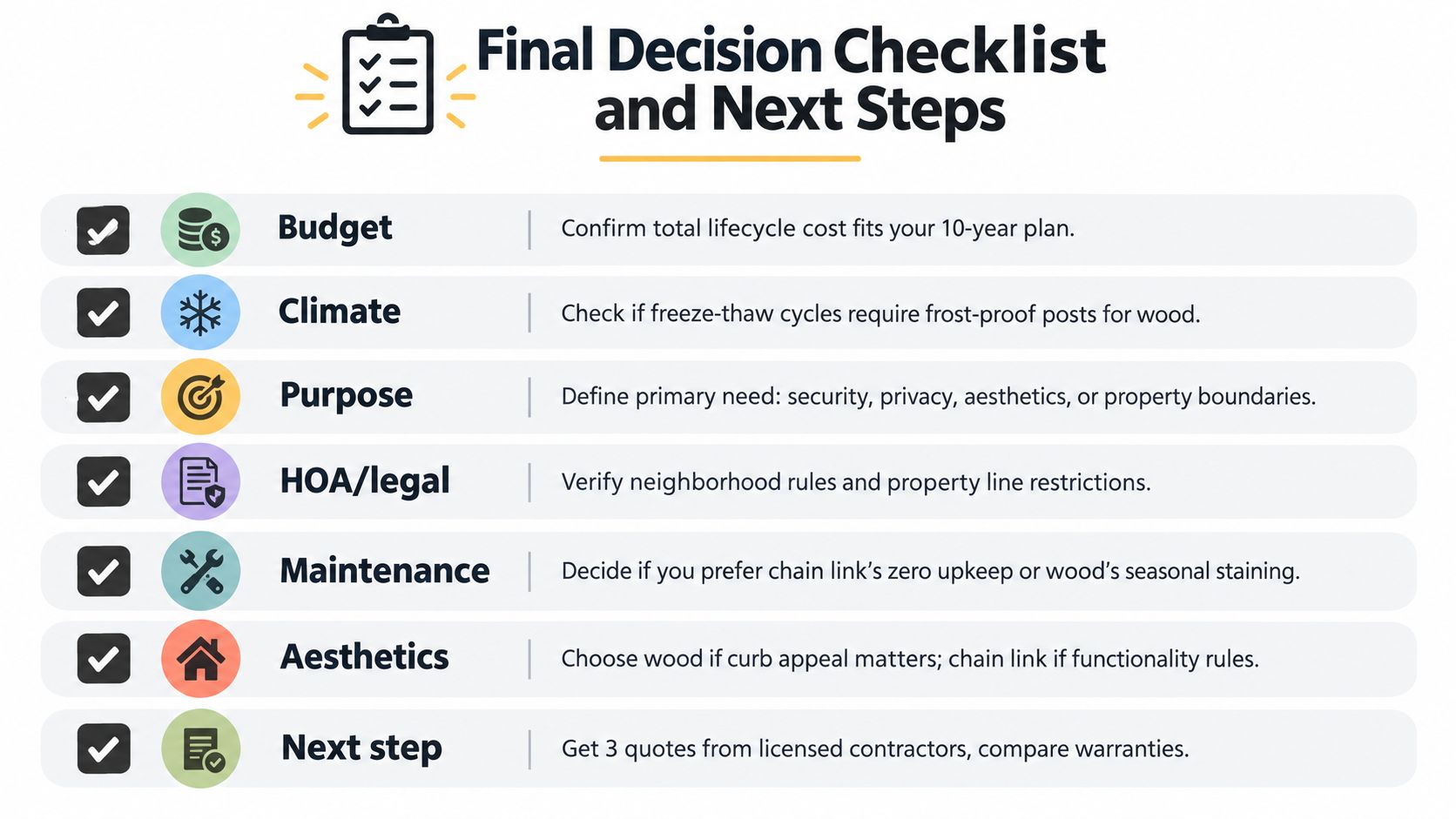
Your decision should be quick once you separate the priorities. Chain link is the practical choice for a lower upfront cost, low upkeep, visible security, pet containment, and large perimeter coverage. Wood is the right choice when privacy and appearance are worth the higher installation price and recurring maintenance.
Use this decision test
Budget: Can you afford the installed price and the maintenance plan, not just the deposit?
Climate: Will you keep up with staining and sealing if you choose wood?
Purpose: Is the main need privacy, security, pet containment, aesthetics, or boundary definition?
Legal fit: Does the proposed height and location comply with Ottawa rules?
Property line: Have you confirmed where the fence belongs before excavation?
Access: Can the crew bring materials and equipment to every section?
Quote quality: Does each estimate identify gates, removal, difficult digging, materials, warranty, and tax?
Don't skip the property line check. A professional survey may be appropriate where pins are missing, boundaries are disputed, or the fence will sit close to a neighbour's land. Arrange utility locates before digging, and make sure the contractor knows about buried services, drainage features, retaining walls, and existing landscaping.
Get comparable quotes
Ask contractors to quote the same layout in chain link and wood where both are allowed. Request a material specification, fence height, post details, gate hardware, finish, removal allowance, estimated schedule, warranty terms, and payment milestones. Three vague quotes aren't as useful as two detailed quotes that describe the same work.
If your budget is tight, ask for a staged plan. You might install the required perimeter first, then add a privacy section or upgrade a gate later. Don't choose a cheaper fence that fails to contain your dog, protect your pool, or give you the privacy you wanted.
FenceScape provides Ottawa-Gatineau homeowners with site assessments, custom fence designs, installation, material guidance, and neighbourhood group-rate options for chain link, wood, PVC, hybrid, ornamental iron, and glass systems. Visit FenceScape to request a free assessment and receive a quote based on your property layout, bylaws, privacy needs, and long-term budget.
Best forums is how much real-world experience you can find there. Instead of only seeing perfect winwin download finished models, members also discuss failed prints, testing different settings and figuring out better ways to complete a project. That makes the information much easier to understand and apply. I’ve found useful conversations about slicers, printing materials, sanding, painting and general workflow.