
PVC Fence Black Guide for Ottawa–Gatineau Homes

What if the colour you choose is the least important reason a PVC fence black succeeds or fails in your yard? Most buyers start with the modern look, then assume black vinyl from any supplier will behave the same. It won't. Barrier geometry, footings, gate hardware and permits decide whether the fence stays straight, opens properly in March, and passes inspection around a pool. Check those four things first, and colour becomes a safe final choice rather than a gamble.
Black PVC Fence Options Compared at a Glance
Black PVC gives you a contemporary look and low upkeep among solid-panel options, but it runs hottest in summer sun. That's the verdict to keep in mind while you compare. Read the table across, not down. Heat in summer sun tells you how the surface will feel and move, upkeep tells you what you'll do each year, and best fit matches the material to the job.
Option | Heat in summer sun | Upkeep | Privacy | Best fit |
|---|---|---|---|---|
Black PVC | Highest surface heat of the solid options | Wash and rinse, no painting | Full privacy with solid panels | Modern homes that want low upkeep |
White PVC | Lower surface heat | Wash and rinse, dirt shows sooner | Full privacy with solid panels | Traditional look and bright yards |
Hybrid PVC and steel | Follows the chosen PVC colour, black highest | Low, steel core needs no paint | High privacy, reduces sound | Pools, busy streets and longer spans |
Wood (cedar or pressure-treated) | Moderate | Stain or seal every few years | Full privacy with solid boards | Natural look and custom profiles |
Chain link | Low | Low | Little privacy | Pool surrounds and budget perimeters |
The trade-off driving most choices is simple. A darker colour absorbs more solar radiation, so a black panel feels warmer to touch and can show weathering sooner than white. You're not choosing a weaker fence, you're choosing one that needs a better formulation and more room to move.
How to use the comparison
Wood needs regular staining or sealing to hold its finish, while PVC needs washing rather than painting. Hybrid systems add steel strength for longer spans and better sound reduction, which matters on busy streets and around pools. Chain link stays cool and cheap to keep, but it doesn't give you privacy on its own.
Use this quick filter before you shop:
Choose black PVC: Low upkeep and a modern look matter most, and you'll specify a tested dark-colour product.
Choose white PVC: You want the same easy washing with a cooler surface.
Choose hybrid: Span, noise or pool safety drives the design.
Choose wood: A natural finish or custom profile is the priority, and you'll keep up with stain.
How Black PVC Handles Ottawa Heat, UV and Freeze-Thaw
How well will a black PVC fence hold its shape through Ottawa–Gatineau's hot summers and freezing winters? Colour affects surface temperature, but the fence's geometry, connections and footings determine whether seasonal movement leads to trouble.
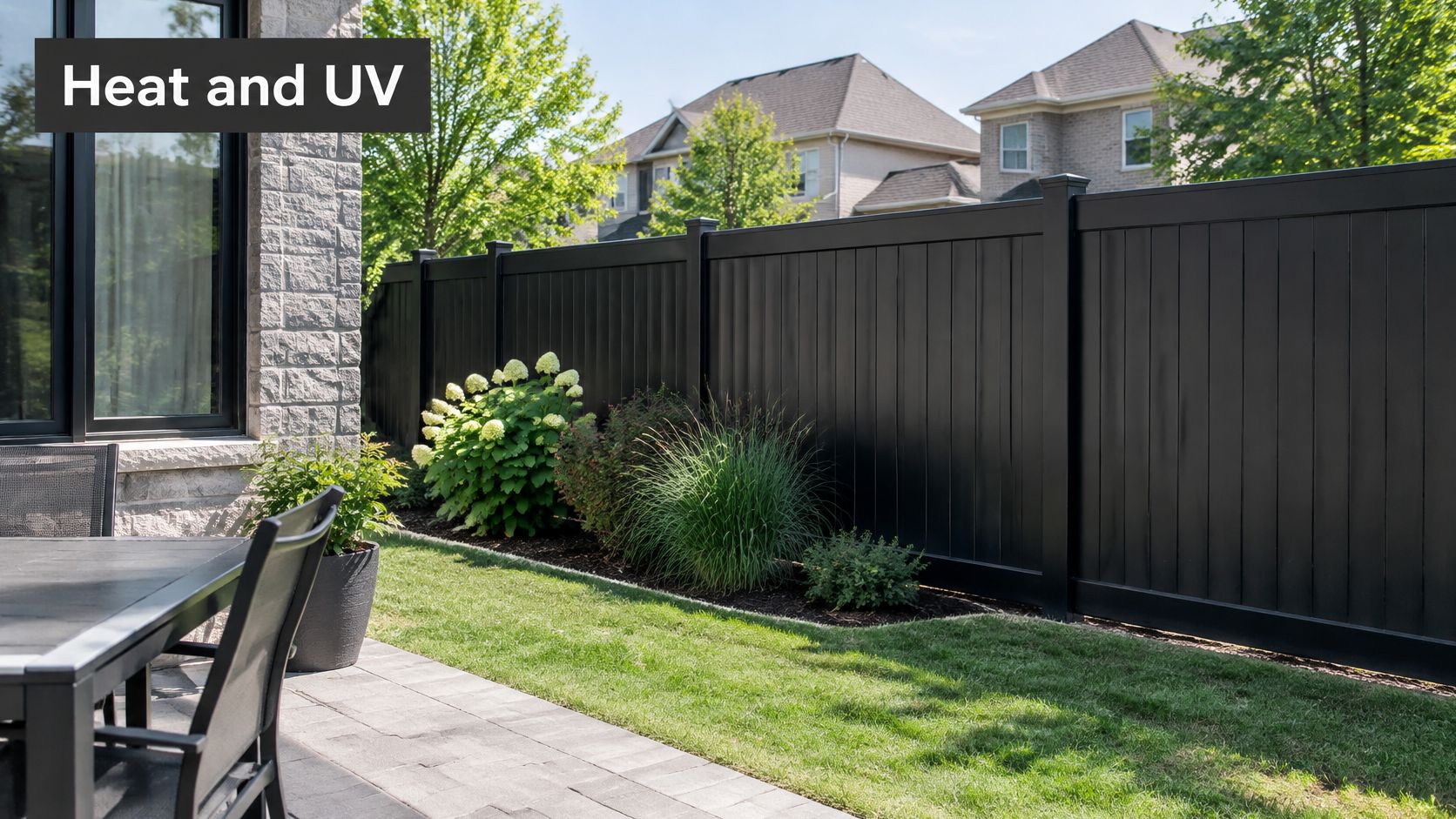
Dark surfaces absorb more sunlight than white vinyl, so a black panel gets warmer and expands more on a sunny summer day. That movement is expected. Rails and inserts need enough room to move; otherwise, panels can bow, joints can bind, and fixings can come under stress.
Ultraviolet light can change PVC over time. A Canadian engineering review of outdoor U-PVC weathering describes colour change, surface oxidation and reduced mechanical performance after UV exposure. Its test conditions do not provide a direct forecast of how long a fence will last in Ottawa, so use the product's own weathering and colour-retention information when comparing options.
What freeze-thaw adds
Water around a footing can freeze and expand, then soften the surrounding ground as it thaws. Repeated cycles can shift a post out of plumb. Gates often reveal the movement first: a gate that begins dragging or no longer latches smoothly may point to a post or footing that has shifted.
The practical lesson is that pigment alone does not specify performance. Ask for an exterior-grade, UV-stabilised product, and check how its posts, rails and footings will be set up to manage movement and drainage.
The video below shows panel and post assembly, which can help you see how the parts fit together.
Questions to ask before you order
Ask each supplier for the PVC material specification, weathering or colour-retention data, UV-stabiliser details, and information about rail reinforcement. You can also request impact, tensile and flexural test results for the profile, then check that they match its product datasheet.
Look at a sample outdoors in direct sun, not only under indoor lighting. A flat or uneven finish is easier to spot in natural light, and comparing samples this way helps you assess the actual colour and surface before choosing.
Check Your Property Line and Yard Height Rules
Where will each black PVC panel sit, and how high can it be? Check the legal property line before ordering panels or digging post holes. Ottawa's landscaping guide advises confirming that a fence sits on the owner's land and can legally be placed there. A fence over the boundary can lead to a dispute and costly relocation.
Compare a survey, deed information, or documented boundary markers. Take extra care with older fences, irregular lots, shared driveways, and corner properties. An existing fence, shed, or hedge does not confirm the legal line.
Height depends on which yard you mean
Maximum fence heights and setbacks vary by yard type and street frontage. Before ordering panels, check the current Ottawa or Gatineau bylaw for each segment. The guide to property line fence rules in Ottawa and Gatineau can help you identify questions to resolve.
Work through each segment separately:
Mark the boundary: Use documented markers to establish the legal line.
Classify the segment: Identify whether it is in the front, side, or rear yard, and whether it adjoins a street.
Check the current bylaw: Confirm the permitted height and any applicable setback for that location.
Plan panel heights: Match each run to the rules that apply there.
Order panels last: Finalize measurements after the boundary and local requirements are clear.
Corner lots and townhouses may need different heights or alignments along one fence. Sketching those changes before ordering helps avoid panels that do not fit the approved layout.
Pool Enclosure Rules That Black PVC Must Meet
Would the fence still pass if its colour changed? Pool inspectors focus on the barrier's height, openings, climbability and gate operation. Black PVC can suit a pool enclosure, but the panel design and hardware must meet the rules for your municipality.
Use this checklist image as a visual prompt while you measure your layout.
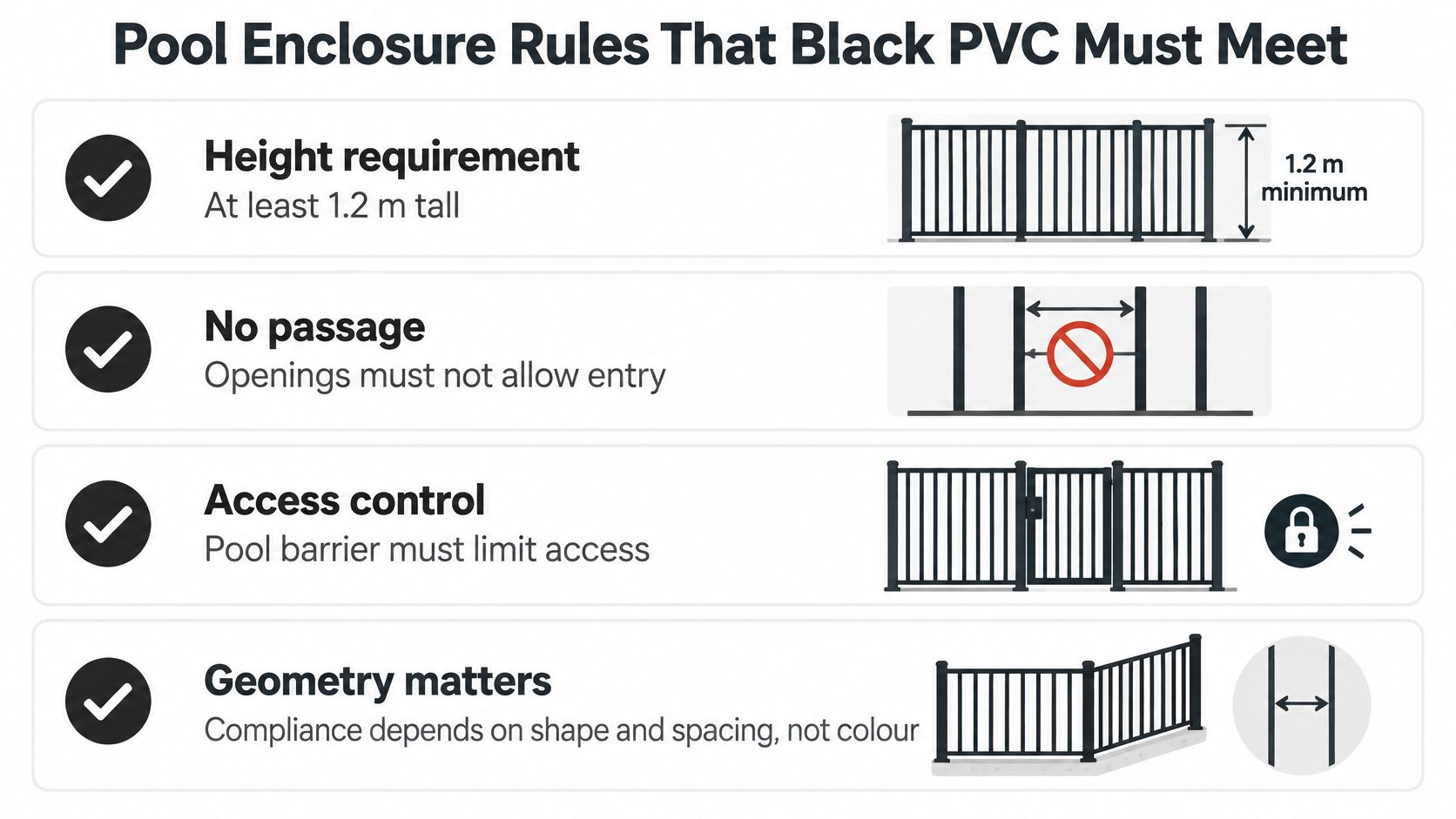
Quebec's Residential Swimming Pool Safety Regulation requires an enclosure at least 1.2 metres high, with openings that prevent a 10-centimetre sphere from passing through. It must not have a fixture, projection or opening that enables climbing. Ottawa and Montreal-area municipalities set their own pool-barrier requirements, so check the current rules with your municipality before ordering.
Jurisdiction | Minimum height | Opening limit | Gate or climb rule |
|---|---|---|---|
Quebec (Residential Swimming Pool Safety Regulation) | 1.2 m | No passage of a 10 cm sphere; chain-link mesh openings up to 30 mm | No fixture, projection or opening that enables climbing |
Ottawa | Confirm the current requirement with the municipality | Confirm the current requirement with the municipality | Confirm gate and climbability requirements with the municipality |
Montreal-area municipalities | Confirm the current requirement with the municipality | Confirm the current requirement with the municipality | Confirm gate and climbability requirements with the municipality |
A yard fence and a pool enclosure may be subject to different rules. Confirm the required height, opening limits, gate operation and permit requirements for your address before choosing a layout. For more detail, review the guide to inground pool fence requirements.
Your pre-order pool checklist
Measure from grade: Check the required height from the ground level specified by your municipality.
Check underneath: Measure the gap below panels and gates against the applicable opening limit.
Test the gate: Confirm it closes and latches as required, without relying on someone to push it into place.
Clear climb aids: Keep furniture, planters and storage boxes away from the barrier.
Confirm the permit route: Ask your municipality whether a permit is required before ordering.
A fence that meets yard-height rules may still need different openings or gate hardware to qualify as a pool barrier. Check both sets of requirements before you settle on the design.
How to Install Black PVC Fence Without Movement or Misalignment
For a black PVC fence to stay straight, its posts, rails and gates must work together. Footings support the run; careful alignment keeps small errors from carrying across each bay.
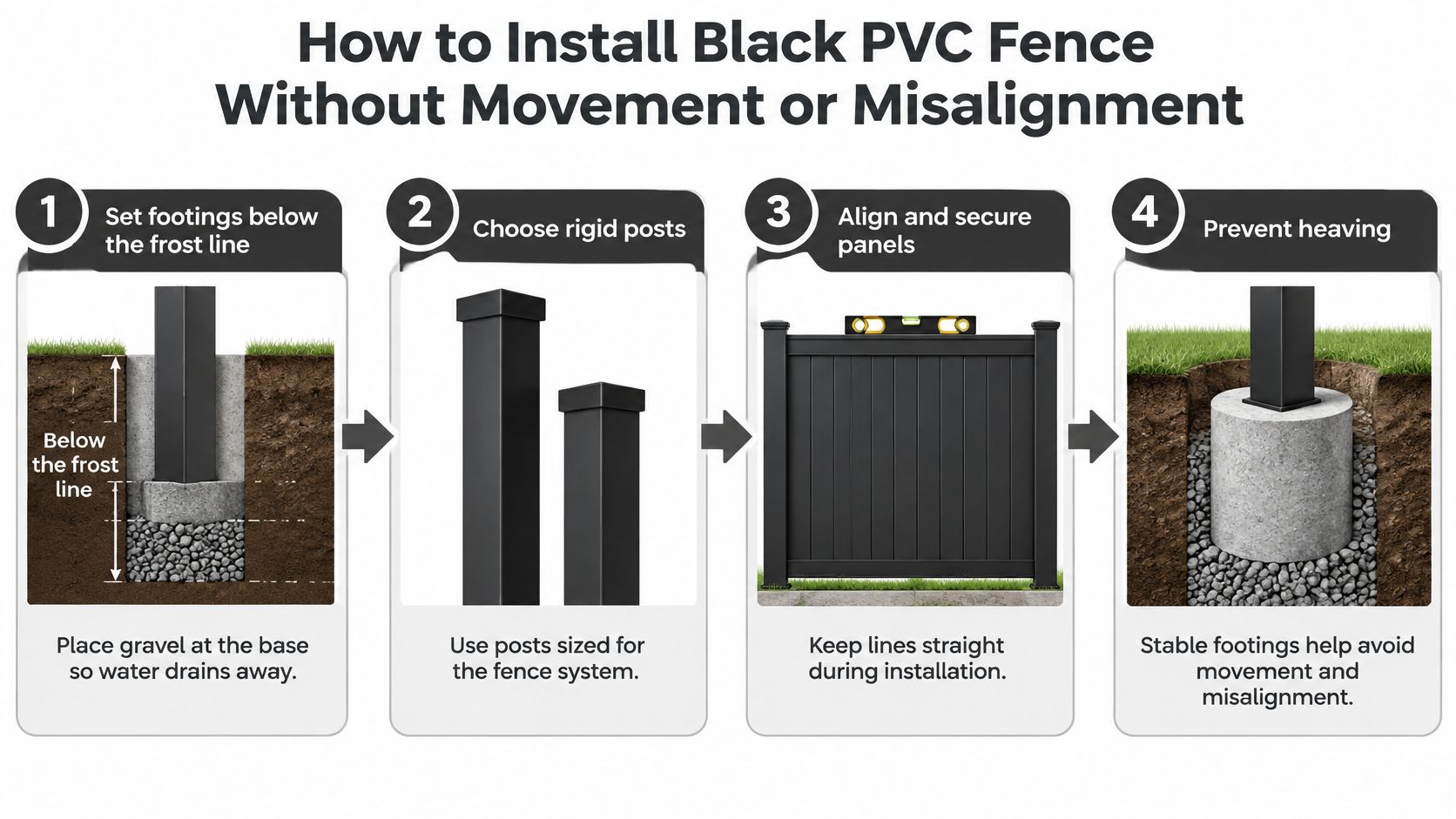
Set footings below the frost line. Add gravel at the base to help water drain away from the post. If frost lifts one footing, that post can shift while the next stays in place.
Choose posts to suit the panel load. Don't force a panel into an undersized post. Check the manufacturer's post requirements and PVC fence post installation steps before setting the posts.
Allow for expansion at rails and inserts. Follow the manufacturer's specified clearances rather than closing joints tightly. Consistent gaps help panels move as intended through temperature changes.
Level each rail before fitting panels. Use a level and string line to check each bay. A sloping rail can carry the alignment error into the panels that follow.
Hang gates on rigid hardware and check their swing. The gate should move without rubbing and close and latch properly. Check that the frame is square by comparing its diagonal measurements.
Use the specified fixings and avoid over-tightening. Tight screws can stress PVC. Tighten them as directed by the manufacturer.
Check the fence after a heat and freeze cycle. Use a level to check post plumb on two faces, inspect the fixings and confirm that gates still swing correctly.
Slips that cause callbacks
Frozen ground can shift after thawing, changing the levels set during installation. Tight panel joints can also leave too little room for expansion. Check gate squareness before installation is complete, rather than relying on an adjustment later.
A finished run has plumb posts, even panel gaps and a gate that closes and latches without assistance. A contractor answering service can handle incoming calls while an installation crew stays focused on those checks.
Keep Black PVC Looking New Through Each Season
Wash black PVC with mild soap and water, and rinse road salt, pollen and grime at least twice a year. You don't paint it, and you shouldn't use abrasive pads that dull the surface. A soft cloth, a bucket, and a garden hose handle most of the work.
Regional guidance in the vinyl privacy fence styles overview notes that UV stabilization helps PVC retain its appearance, while darker colours can show weathering sooner and may eventually chalk over a long service life. That distinction helps you tell dirt from surface change.
Tell chalking from dirt
Wipe a shaded panel with a damp dark cloth. Dirt wipes off and the panel looks clean underneath. Chalk leaves a pale residue on the cloth, and the surface still looks flat after washing. Dirt is a cleaning job. Repeated chalking is a supplier-specification conversation.
Season | Main task | Watch for |
|---|---|---|
Spring | Wash off winter road salt and grime | Chalky residue, algae on shaded panels |
Summer | Rinse pollen and dust, keep sprinklers off panels | Panels moving or buckling at rails on hot days |
Autumn | Clear leaves from the base, check post stability | Gaps opening at panel joins, loose fixings |
Winter | Brush snow off gently, keep salt away from posts | Gate binding, cracks after impact |
Follow the seasons in order. In spring, wash off winter salt and check shaded panels for algae. In summer, rinse pollen, redirect sprinklers, and look for rails shifting on hot days. In autumn, clear leaves from the base so moisture doesn't sit against posts, then tighten loose fixings.
In winter, brush snow off gently with a soft broom rather than chopping at ice. Keep de-icing salt away from post bases where you can. Avoid high-pressure washing near seams, because a hard jet can drive water into joints and lift grime unevenly.
Once a year, inspect panel joints, post plumb, the gate latch and each footing. Five minutes with a level in autumn beats a leaning bay in April.
Choose Your Black PVC Design and Request a Quote
Match the design to the segment, not to a single photo. These four examples cover most Ottawa and Gatineau properties.
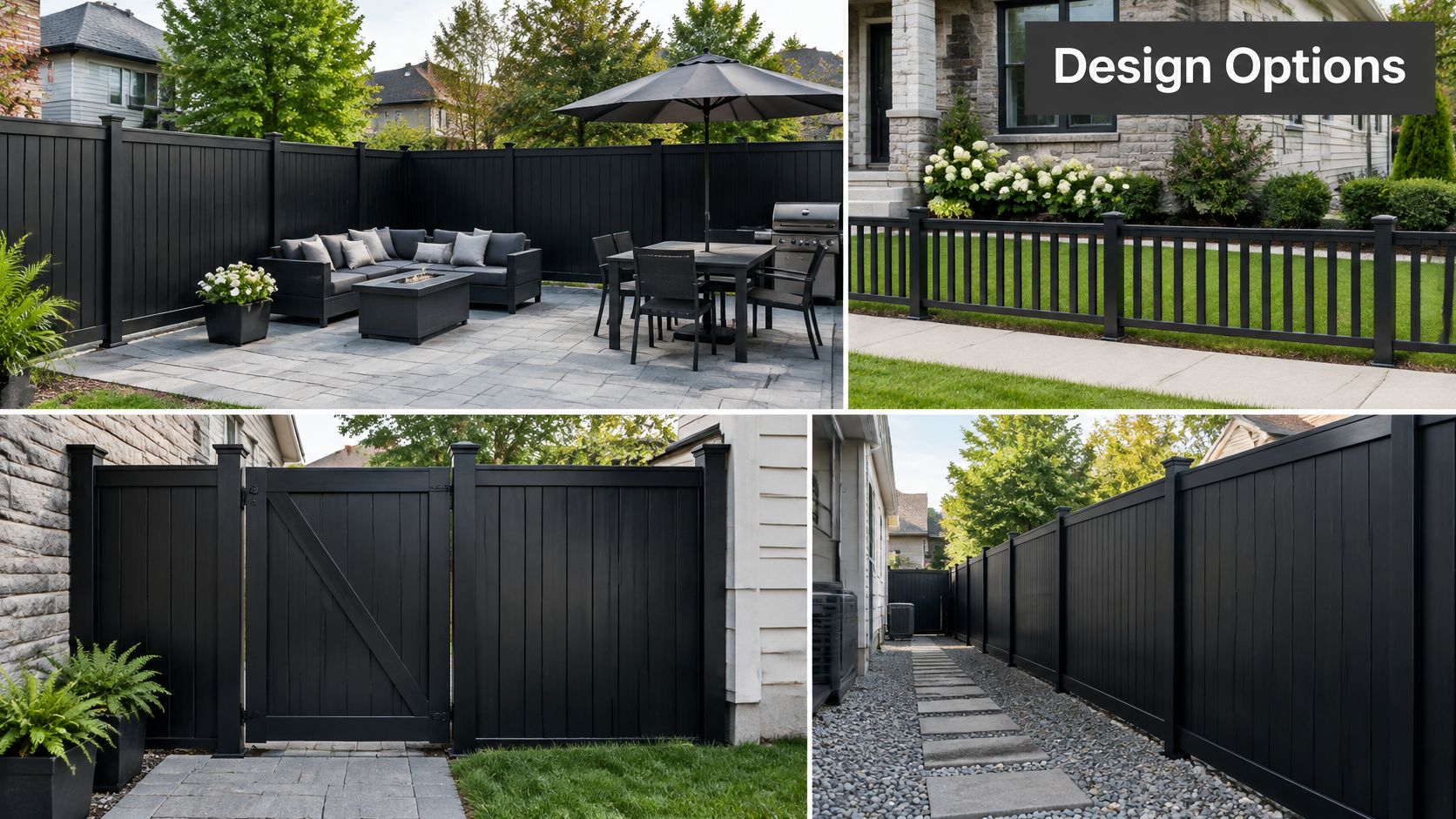
Rear-yard privacy. Solid black panels at the permitted 2 m height frame a dark-toned patio and make planting stand out. Black PVC proves its worth here, provided the formulation is documented for outdoor use.
Low front-yard run. A 1.2 m front run with a contrasting cap rail and matching gate keeps the street elevation tidy without breaching the front-yard cap. Don't carry the rear-yard height around the corner out of habit.
Townhouse and pool examples
A townhouse or multi-lot boundary works best with uniform panel heights and identical gate hardware. Standardising those details simplifies replacement, because one damaged bay doesn't become a custom order. Property managers benefit most from writing the panel width and hardware model into the project record.
A pool surround built from hybrid PVC and steel suits longer spans and gives better sound reduction. The steel core helps the barrier stay rigid, which helps gates keep latching after seasonal movement. Appearance still matters, but rigidity is the reason to choose it here.
Customisation options include panel width, flat or capped tops, lattice tops where code allows, gate hardware and post caps. Keep lattice and horizontal features away from a pool barrier if they'd help climbing. A detail that's harmless on a rear boundary can be a problem beside water.
Decide in this order
Confirm the layout: Check it against property-line and height rules.
Check pool requirements: Apply them if there's a pool, spa or planned pool.
Choose material and formulation: Only then pick black PVC, white PVC or hybrid.
We're a certified distributor of Bufftech PVC Fence and SimTek Fence, and we offer a free estimate. Through our contact form, you can request a Material Quote for a DIY build or an Installation Quote for a crew-led project. Bring your segment measurements and a note of which sides face a street. That one page makes your quote faster and more accurate this week.
Ready to price a black PVC fence that fits your property line, yard height limits and pool rules the first time? FenceScape offers a free estimate and lets you request a Material Quote for DIY or an Installation Quote for a crew-led build through the contact form. Send your segment measurements today and get a design matched to your Ottawa or Gatineau yard, not just a panel price.
Comments