
Property Line Fence Rules: A Homeowner's Guide

You're standing in an Ottawa backyard with a cedar fence design, a post-hole digger, and a neighbour watching from the other side of the hedge. The project sounds simple until three questions surface: Where is the actual property boundary? Does the fence comply with municipal rules? Who pays for it?
Those questions often get mixed together. An old chain-link fence may not mark the legal lot line. A proposed fence may exceed the permitted height or sit too close to a sidewalk. A neighbour may demand a share of the cost after construction has already started. The safest way to approach property line fence rules is to handle the issues in order: boundary location, municipal compliance, then shared-cost mechanics.
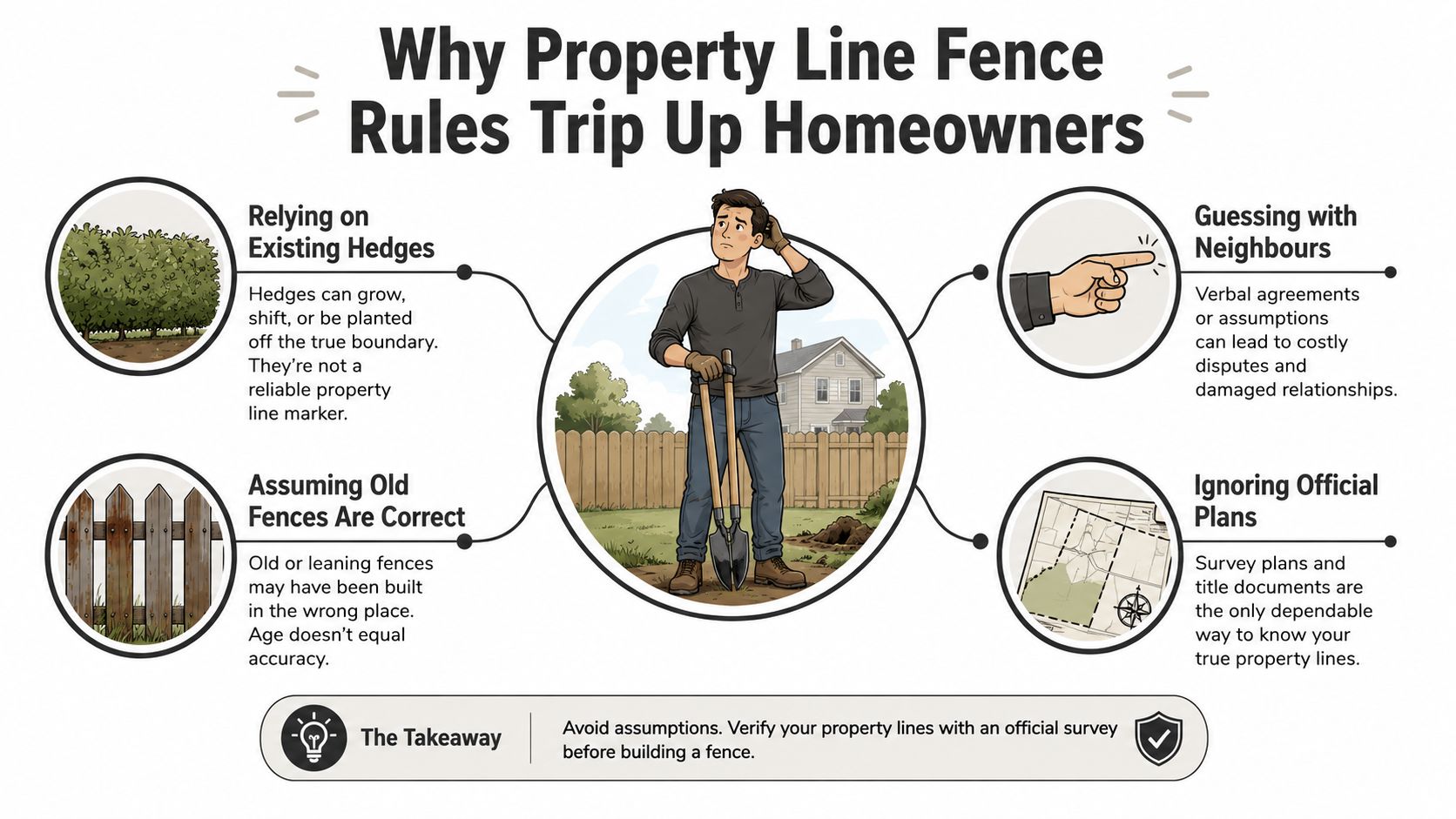
Why Property Line Fence Rules Trip Up Homeowners
A fence can be physically straight and still be legally misplaced. Many homeowners assume a hedge, retaining wall, or ageing fence marks the boundary because it has been there for years. That assumption may be wrong, especially where landscaping shifted, earlier owners built without a survey, or the visible fence was installed entirely on one property.
The second mistake is treating a neighbour's agreement as permission to ignore local rules. Even if both owners want a tall privacy fence, Ottawa's municipal by-law still controls residential fence heights. Ottawa generally limits residential fences to 1 m in front yards and 2.13 m in rear and side yards, while non-residential fences may reach 3 m under the city's fence by-law. Those limits affect the design before anyone chooses cedar, PVC, chain link, or ornamental metal. Ottawa's fence by-law operates separately from Ontario's Line Fences Act.
The third problem is cost. One owner may see a shared boundary fence as a joint improvement. The other may see it as a private privacy upgrade. If nobody discusses the design, location, necessity, and cost before work begins, even a modest backyard project can become a formal dispute.
The three questions to answer first
Boundary: Has the true lot line been established on the ground, rather than guessed from an existing feature?
Compliance: Does the proposed fence meet local height, setback, visibility, material, and permit requirements?
Cost: Which legal framework applies, and what exactly has each owner agreed to contribute?
Practical rule: Don't order materials or dig post holes until these three answers are documented.
Ontario's Line Fences Act helps with certain disputes about the necessity and cost of a line fence, but it doesn't decide where the boundary is. The province's guidance is explicit that boundary-location disagreements must be resolved separately. That distinction is the foundation of a sensible fence plan.
How to Find Your True Property Line
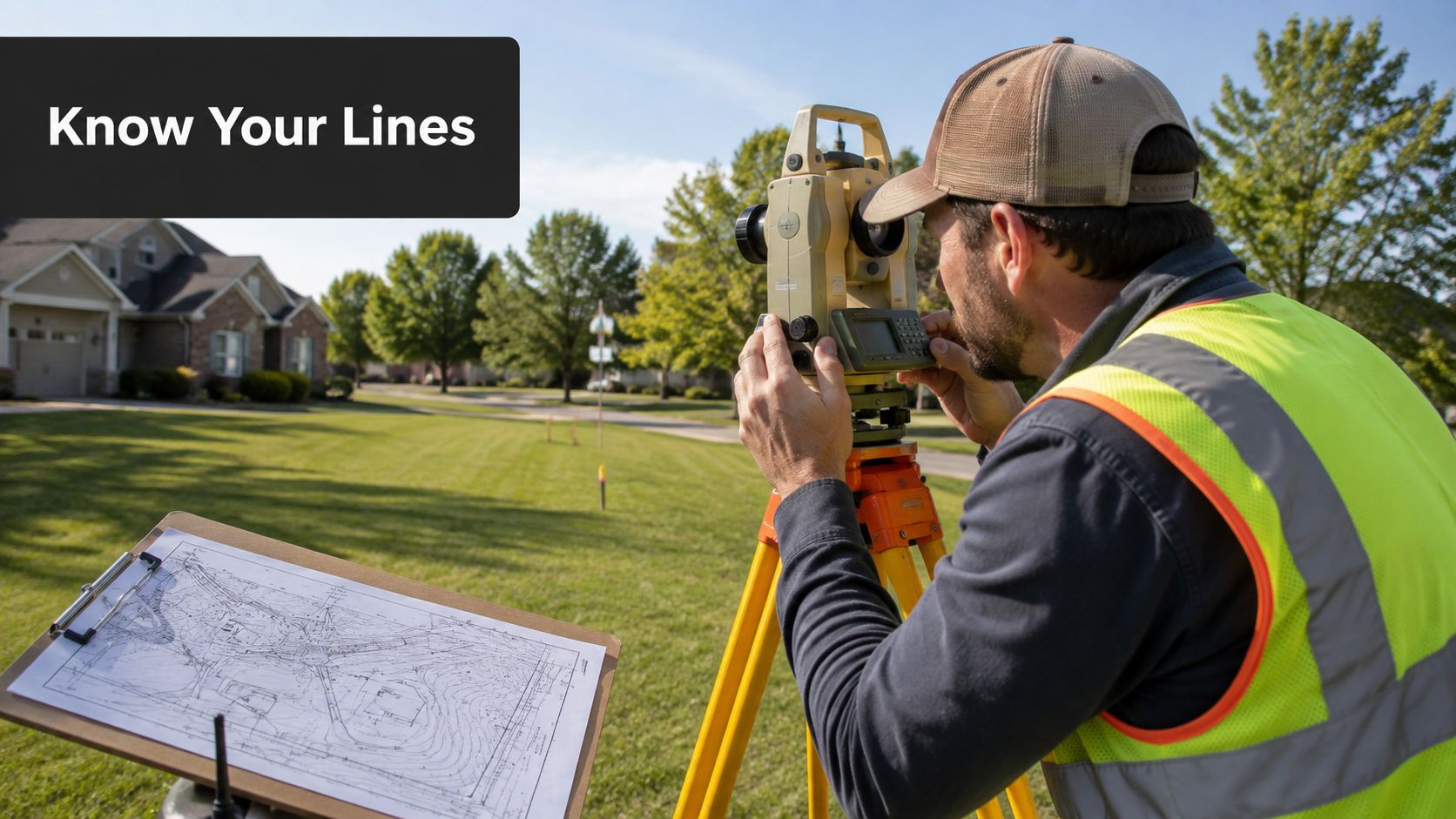
A survey plan and a fence line are related, but they aren't the same thing. The plan records the legal boundary. A professional must still identify where that boundary falls on the ground, using survey evidence and measurements that can guide construction.
Start by gathering the documents already connected to the property. In Ottawa, look for the registered plan and legal description through the Ontario land registry system. In Gatineau, obtain the relevant cadastral information through Québec's land-registration resources. These documents can show lot dimensions and legal references, but a plan alone may not tell you where a buried corner marker is located today.
What you can check yourself
Existing iron survey bars may be found at lot corners. A metal detector can help locate them, but you shouldn't treat a detected object as conclusive proof without confirming what it represents. A bar may be disturbed, hidden, or associated with an older survey reference rather than the current boundary.
A mortgage survey or title-insurance sketch may also be useful for general orientation, yet many such documents aren't precise enough for placing a fence. They may show the building in relation to the lot, without providing the boundary evidence needed for a construction decision.
When professional confirmation makes sense
For a disputed or uncertain line, hire an Ontario Land Surveyor in Ottawa or a Québec arpenteur-géomètre in Gatineau. A professional survey produces formal evidence that can resolve ambiguity and support later discussions with a neighbour, municipality, contractor, or court.
The supplied local planning guidance describes this type of survey as costing roughly 1,000 to 2,500 dollars, but the amount varies with the property, available records, access, and the work required. Because this is a quantitative claim, confirm the current quote directly with the survey professional before budgeting.
A confirmed boundary changes the conversation. You can now determine whether the fence will sit directly on the line or entirely inside one lot, check setbacks from that known location, and discuss cost without arguing over an assumed boundary. For readers dealing with a more complex title dispute, an overview such as Quiet Title Action in Hawaii can provide useful general context about legal proceedings used to clarify competing property claims, although Québec and Ontario require local advice.
Ontario's Line Fences Act Explained
Ontario's Line Fences Act isn't a general permission slip to build whatever fence you want. It creates a process for certain disagreements about a line fence between adjoining owners. The Act gives an owner the right to construct, maintain, and keep up a fence marking the boundary, but it doesn't require every owner to build a boundary fence. The Ontario statute also makes clear that it addresses fence disputes, not disputes about where the lot line is located.
An owner who wants the statutory process generally serves written notice to the neighbour. The notice identifies the proposed work and invites a response. The commonly described response period is 15 days, so dates matter. A neighbour may object by proposing a different cost arrangement, arguing that the work is unnecessary, or raising a defect in the notice.
What happens if the conversation fails
If the neighbour refuses to participate or doesn't respond, the owner may apply for the municipal fence-viewer process. Fence viewers assess the circumstances and can make an award dealing with the line-fence work and the parties' obligations. The process is about the fence dispute, not about changing the boundary or deciding that a particular height is legal under municipal rules.
A party dissatisfied with a certified award has 15 days from receiving it to appeal, which makes prompt record-keeping essential. Keep the notice, delivery proof, photographs, survey documents, quotes, plans, and every written response.
The Act also doesn't set the fence's height, material, or municipal setback. Ottawa's by-law still applies, and a fence-viewer outcome doesn't override city requirements. For a practical Ontario-focused explanation, see this actionable guide to the Line Fences Act.
Line Fences Act at a Glance
Step | What Happens | Timeframe |
|---|---|---|
Notice | The owner gives written notice describing the proposed line-fence work. | The neighbour's response period is 15 days. |
Response | The neighbour can object on recognised grounds, including necessity, cost-sharing, or a notice defect. | Respond within the notice period. |
Municipal process | If agreement fails, the owner may seek a fence-viewer determination. | Depends on municipal scheduling. |
Certified award | The fence viewers issue their decision. | The decision takes effect under the statutory process. |
Appeal | A dissatisfied party may appeal a certified award. | 15 days from receiving the award. |
Ottawa and Gatineau Fence Bylaws Compared
Municipal rules answer a different question from the Line Fences Act. They tell you what can be built, where it can sit, and whether an approval is needed. Neighbour consent doesn't cancel those requirements.
Rule | Ottawa | Gatineau |
|---|---|---|
Residential rear-yard height | Generally capped at 2.13 m under the municipal fence by-law. | Limits vary by zone and local rules. Confirm the applicable residential classification before designing. |
Residential front-yard height | Generally capped at 1 m. | Local guidance commonly uses different front-yard controls, so confirm the applicable zone and placement. |
Non-residential height | May reach 3 m under the cited by-law. | Confirm the rules for the property's use and zone. |
Permit question | Pool enclosures are regulated separately, and other requirements depend on the fence and location. | An ordinary residential fence generally doesn't need a permit, but a pool fence does. |
Placement | Height and other controls apply independently of the legal boundary. | Ordinary fences must remain on the owner's property, with local setbacks such as 1 m from a sidewalk or 1.5 m from a street curb where there's no sidewalk. |
The Gatineau guidance is especially important for the question, “Where can I put the fence?” An ordinary fence must remain on the owner's property, while a pool fence follows a separate approval path. A fence placed directly on the dividing line may also raise ownership and consent questions under Québec civil law.
Ottawa homeowners should verify the exact yard classification before choosing a design. The city's published by-law gives the general residential limits of 1 m in front yards and 2.13 m in rear and side yards, but a particular site may have added controls related to visibility, zoning, heritage considerations, or other municipal requirements. Pool enclosures are a separate safety issue and shouldn't be treated like an ordinary privacy fence.
For a broader municipal planning reference, consult this guide to fence by-law considerations. The key point remains simple: by-law compliance is independent from locating the boundary. You can agree with your neighbour about the line and still need to change the fence design or placement to satisfy the city.
Quebec's Common Fence Presumption
Gatineau homeowners work under a different default from their neighbours across the river. In Québec, a fence located on the dividing line between two properties is presumed to be a common fence. The Québec government explains that the dividing-line fence is jointly owned unless the original owner can prove they built it alone and never agreed to make it common. Québec's guidance on fences and common walls sets out that distinction.
The presumption matters because ownership affects upkeep, replacement, and cost discussions. A deed, contract, or other clear evidence may rebut the presumption and show that the fence belongs to one owner. A fence built entirely on one side of the boundary generally belongs to that property owner rather than becoming a common dividing-line structure.
Design and use still affect the practical answer
Suppose both owners want a basic boundary enclosure. The common-fence presumption gives them a shared starting point. If one owner wants a more expensive material, decorative treatment, or additional height beyond what the other owner needs, the parties should agree in writing about the upgrade and the extra cost. A shared legal default doesn't automatically mean one neighbour must fund the other's personal preference.
The same issue arises where only one owner receives a special benefit, such as using the fence to contain a dog. That use may support a more careful discussion about design, responsibility, and whether the proposed work goes beyond an ordinary shared boundary function. Municipal rules still control the build, so a private agreement can't authorise a prohibited height, location, or pool enclosure.
This Québec approach doesn't apply on the Ontario side. In Ontario, the Line Fences Act provides the relevant statutory process for qualifying line-fence disputes, while Québec starts with the civil-law presumption of common ownership. That difference is one reason Ottawa–Gatineau homeowners shouldn't rely on a generic online answer about who pays.
Steps to Approve a New Property Line Fence
A sound approval process follows the order in which the decisions depend on one another. Don't begin with a fence colour or a contractor quote. Begin with the line.
Confirm the boundary. Review the existing survey and locate reliable survey evidence. If the line remains uncertain, commission work from an Ontario Land Surveyor in Ottawa or a Québec arpenteur-géomètre in Gatineau. A contractor can install a fence, but shouldn't be asked to decide a disputed legal boundary.
Check the municipal rules. Verify height, setbacks, visibility requirements, materials, yard classification, zoning, and permit triggers. In Gatineau, also check whether the fence is an ordinary residential fence or a pool enclosure. In Ottawa, review the city's fence by-law and any separate pool-fence requirements.
Speak with the neighbour before ordering materials. Share the survey information, a sketch, the proposed fence type, and the expected cost. Explain whether the fence will sit on the boundary or entirely inside your property. In Ontario, discuss the Line Fences Act process. In Québec, address the common-fence presumption and any evidence that changes ownership. Put the final agreement in writing.
Apply for permits where required. Provide the requested survey, site plan, fence specifications, and supporting information. Don't assume a neighbour's signature replaces a municipal approval.
Build to the approved plan. Confirm the installer understands the boundary evidence, setback measurements, gate locations, grade changes, and material specification. Keep changes documented rather than approving them casually on site.
Complete any required inspection. Pool-related work and other regulated installations may require municipal follow-up. Keep the permit, final documents, photographs, and written neighbour agreement with the property records.
Skipping the sequence creates predictable trouble. A misplaced fence may need removal, a non-compliant fence may trigger municipal enforcement, and an undocumented cost promise may leave both owners arguing over what was agreed.
Resolving a Neighbour Fence Dispute
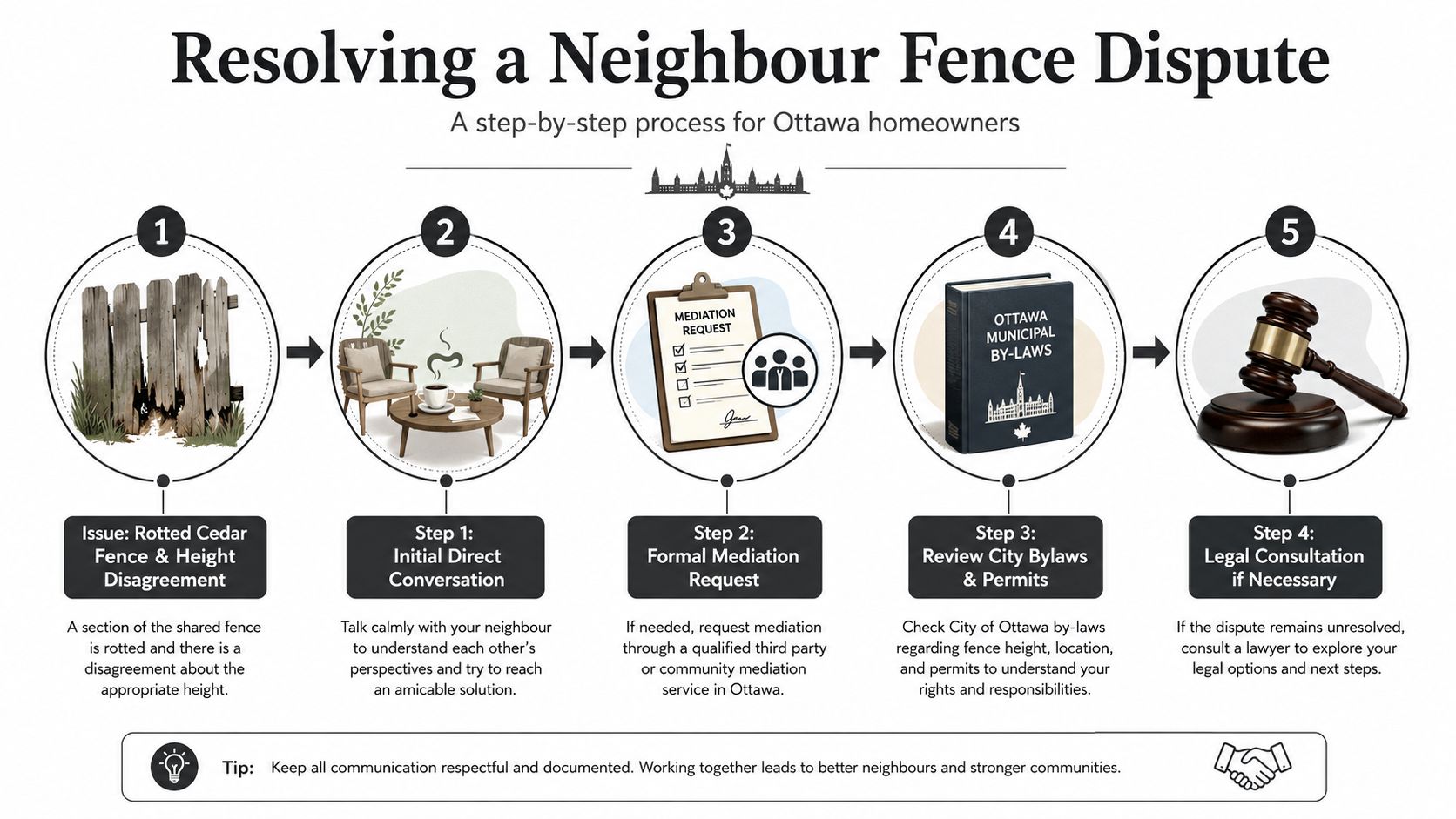
A rotted cedar fence separates two Ottawa backyards. One homeowner wants a taller board-on-board replacement for privacy. The neighbour objects to the height, dislikes the proposed style, and doesn't want to pay half the quoted amount. Before either side sends a formal notice, the practical first move is a calm conversation supported by documents.
The homeowner should show the survey or boundary evidence, a simple site sketch, the proposed height and material, and the quote. The neighbours should separate three issues: whether the fence is needed, whether the proposed design complies with Ottawa rules, and what cost each person is prepared to accept. A short written summary after the meeting can prevent later disagreement about the conversation itself.
When Ontario's statutory process becomes useful
If direct discussion fails, the owner can consider the Line Fences Act process. Each side can select a fence viewer, and the appointed viewers work through the dispute under the municipal procedure. If the viewers can't reach a decision alone, the process provides for a further viewer and a decision by the panel. The resulting award may address the line-fence work, necessity, and allocation of responsibility, but it doesn't settle an unresolved boundary-location dispute or replace Ottawa's by-law.
A party who receives a certified award and remains dissatisfied has 15 days to appeal, so the date of receipt must be recorded carefully. Keep copies of the notice, delivery evidence, survey, photographs, contractor proposals, municipal correspondence, and the certified award.
For a Gatineau property, don't automatically copy the Ontario process. Québec's common-fence presumption changes the starting point for ownership and shared responsibility. If agreement remains impossible, the appropriate route may involve mediation, civil proceedings, or another forum depending on the nature of the claim. Get local legal advice before filing, especially where the issue concerns title, ownership, or a costly construction decision.
Mediation can be worthwhile when both owners want the fence but disagree about upgrades. A mediator can help separate the ordinary shared work from one owner's preferred extras. Legal counsel becomes more valuable when the boundary is disputed, formal notices have been served, an award is being challenged, or construction could affect title and future resale.
Next Actions and When to Call a Contractor
Before anyone digs, run through this checklist:
Confirm the line: Use a reliable survey plan or hire a licensed survey professional if the boundary is uncertain.
Check municipal rules: Verify height, setback, visibility, materials, zoning, and permit requirements with the relevant city.
Identify the legal framework: Ontario uses the Line Fences Act process for qualifying line-fence disputes. Québec starts from its common-fence presumption for a fence on the dividing line.
Record the agreement: Put the design, location, maintenance expectations, and cost-sharing arrangement in writing and have both owners sign it.
Plan construction details: Confirm who handles utility locates, grade changes, access, and final property-line verification.
Bring in a professional when the lot has difficult soil or elevation changes, the project involves a pool-safety fence, a permit application is required, a fence-viewer request may be necessary, or the installation must be certified against a shared boundary. Ask for two or three written quotes, proof of WSIB coverage, liability insurance, and a clear statement identifying who is responsible for locates and final line verification.
A contractor can also help translate a confirmed boundary and approved design into a buildable plan. FenceScape provides planning and installation options for materials including PVC, hybrid PVC and wood with steel, wood, ornamental iron, chain link, and glass fencing and railings. Its Ottawa fence contractor guide can help you prepare for that conversation. Property managers can also learn from broader guidance on contractor compliance for California rentals, particularly the value of documenting insurance, responsibilities, and compliance before work starts.
FenceScape can help Ottawa–Gatineau homeowners turn confirmed property lines and municipal requirements into a clear fence plan, from material selection through installation and final walkthrough. Visit FenceScape to request a project discussion and start with the boundary, by-law, and cost questions before construction begins.
Comments