
PVC Fence vs Wood: Which Lasts Longer and Costs Less

You're standing in your Ottawa or Gatineau yard in April, looking at a fence that leaned over winter, with peeling stain, a gate that won't latch, and neighbours you can see more clearly than you'd like. You need privacy this summer, but the PVC fence vs wood decision isn't really about day one. It's about what freeze and thaw do to posts, what wet springs do to boards, and, if you've got a pool, what the city allows you to build at all.
PVC and Wood Fences Side by Side
PVC wins on upkeep and moisture resistance, wood wins on repairability, custom heights and a natural look, and the upfront price depends on the quote. Use the table as a lookup, then focus on the gaps that change your weekends and your repair bills.
Criterion | PVC | Wood |
|---|---|---|
Upfront price | Higher per linear foot in most Ontario quotes | Lower per linear foot in most Ontario quotes |
Surface maintenance | Wash only, no paint or stain needed | Stain or paint every few years, check sealed surfaces |
Moisture and rot | Does not absorb water, no rot | Absorbs moisture, decays where water is trapped |
Colour stability | Holds colour, does not fade | Stain fades, boards can warp or twist |
Repairability | Replace whole panels, match profile and colour | Swap single boards on site |
Design flexibility | Fixed panel profiles and heights | Custom heights, board spacing and mixed styles |
Typical lifespan | About 20 years or more with normal care | Shorter than PVC when sealing lapses |
Pool enclosure fit | Permitted in Ottawa when posts, gate and height comply | Permitted as a vertical-board enclosure when built and maintained to code |
The Three Gaps That Matter Most
The first gap is surface work. PVC asks for washing, wood asks for a finish cycle. If you know you won't restain on schedule, don't buy a fence that needs it.
The second is repair size. A cracked PVC panel usually means ordering a matching profile and swapping the section. A split wood board means a trip for one board, screws, and an hour with a drill.
The third is fit to the site. Wood can be cut to follow a slope, step around a tree, or hit a non-standard height. PVC panels reward precise layout and punish improvisation, so awkward runs need planning before posts go in.
Practical rule: PVC is low maintenance, not maintenance free. Impact, extreme cold, poor post setting and ground movement can still damage panels.
Lifespan figures assume a normal climate and regular care. In Ottawa's wet, freeze and thaw winters, moisture control is the factor that most often decides the result, because water trapped at post bases and board ends shortens wood life and frost movement stresses either material.
Wood is a sound choice when treated cedar or pressure-treated lumber is sealed and boards and posts drain properly. PVC is a sound choice when you want that drainage worry off your list and you're willing to accept fixed profiles.
Pick the two or three rows that matter most for your property, weigh them first, and treat the rest as tie-breakers. I'd start with upkeep, repairability, and pool fit if any of them apply to you.
What Each Material Costs Over Twenty Years
Location | Material | Average (C$ per linear foot) | Range (C$ per linear foot) |
|---|---|---|---|
Orangeville, ON | Cedar or wood privacy | 42 | 27 to 60 |
Innisfil, ON | Cedar or wood privacy | 42 | 27 to 60 |
North Bay, ON | Vinyl or PVC | 46 | 32 to 70 |
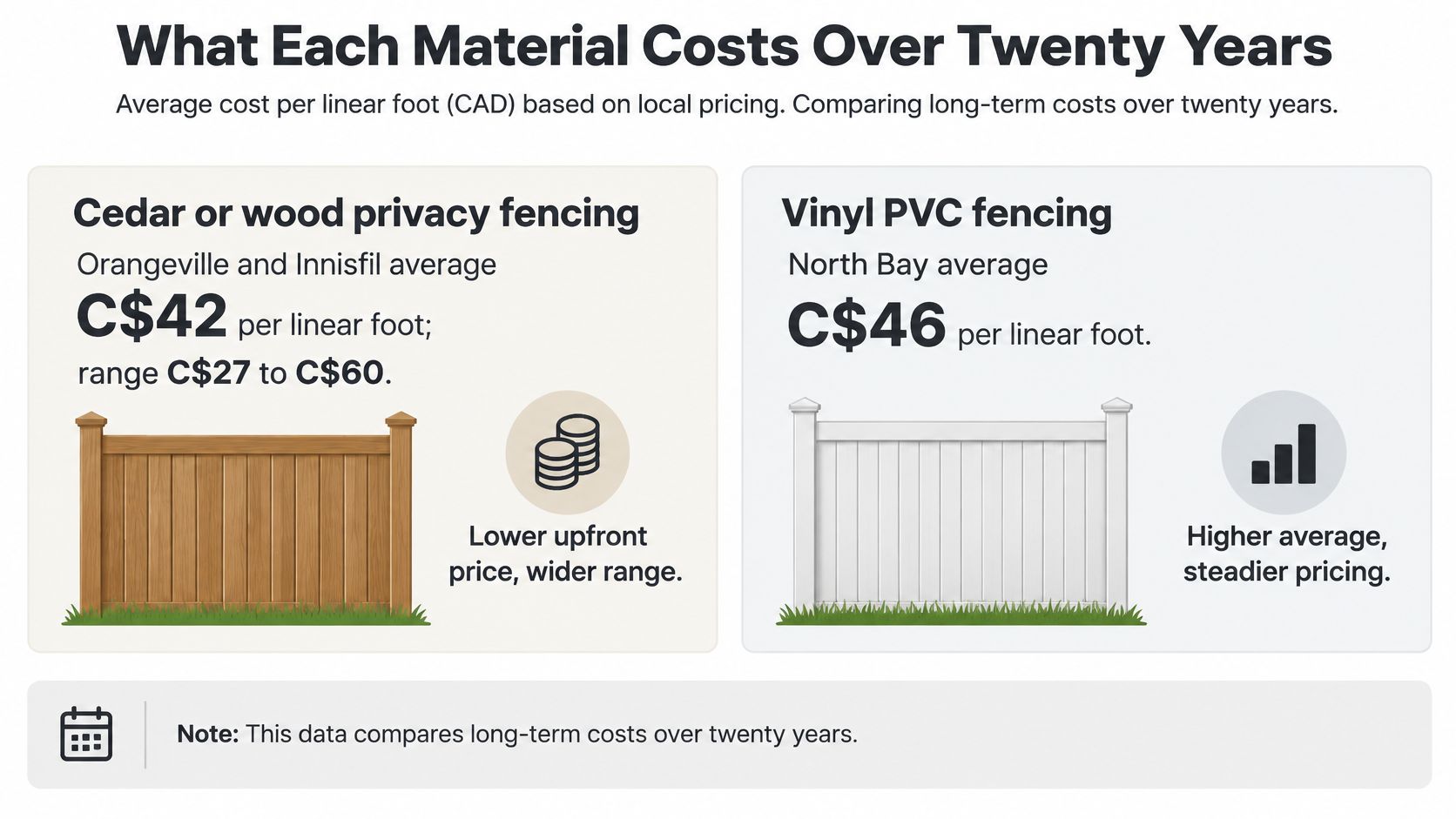
Bidmii's 2026 Orangeville directory reported installed cedar or wood privacy fencing averaged C$42 per linear foot, with a range of C$27 to C$60 per linear foot, and Bidmii's 2026 North Bay directory reported installed vinyl or PVC fencing cost C$46 per linear foot on average, with a range of C$32 to C$70 per linear foot. Innisfil matched the Orangeville wood figures, but there's no Ottawa and Gatineau average in that reporting, so treat these numbers as indicative, not like for like.
A Worked Example You Can Redo
Say your run is 150 linear feet. At the averages above, wood is roughly C$6,300 and PVC is roughly C$6,900 before upkeep. That installation gap is narrow, which is why the twenty-year decision sits elsewhere.
Use this formula with your own quotes: installed price, plus upkeep over twenty years, plus one replacement of worn parts. For wood, upkeep means staining or painting every few years, replacing damaged boards, and repairing posts that rot at the ground line. For PVC, it means washing and the occasional panel replacement.
Ask each wood quoter two direct questions: how often does this finish need redoing, and what do you charge to do it? Multiply that charge by the number of cycles in twenty years. That's the line most comparisons leave out, and it's where the order can flip.
A quote well above or below the ranges above isn't automatically wrong. Height, gate count, terrain and removal of an old fence all move the number.
Collect two or three local quotes for the same linear footage, same height and same gate count, so you're comparing assemblies, not sales pitches. Our breakdown of what a PVC fence costs in Ottawa shows the cost drivers to check line by line.
Financing can spread the first months. In Ontario, we offer 6 months of interest-free financing, and in Quebec, 3 months with no payments and no interest. Confirm those terms against your current contract before relying on them, since offers change and the signed terms govern.
How Ottawa Winters and Rain Change the Choice
The City of Ottawa's Climate Ready Ottawa projections identify increases in winter freeze and thaw conditions of approximately 13%, 33%, and 54% across successive future projection periods, while fall, winter and spring precipitation is projected to rise by about 5%, 8%, and 12%. Intense precipitation is also projected to increase by approximately 5%, 14%, and 19%, respectively.
What Those Numbers Do to a Fence
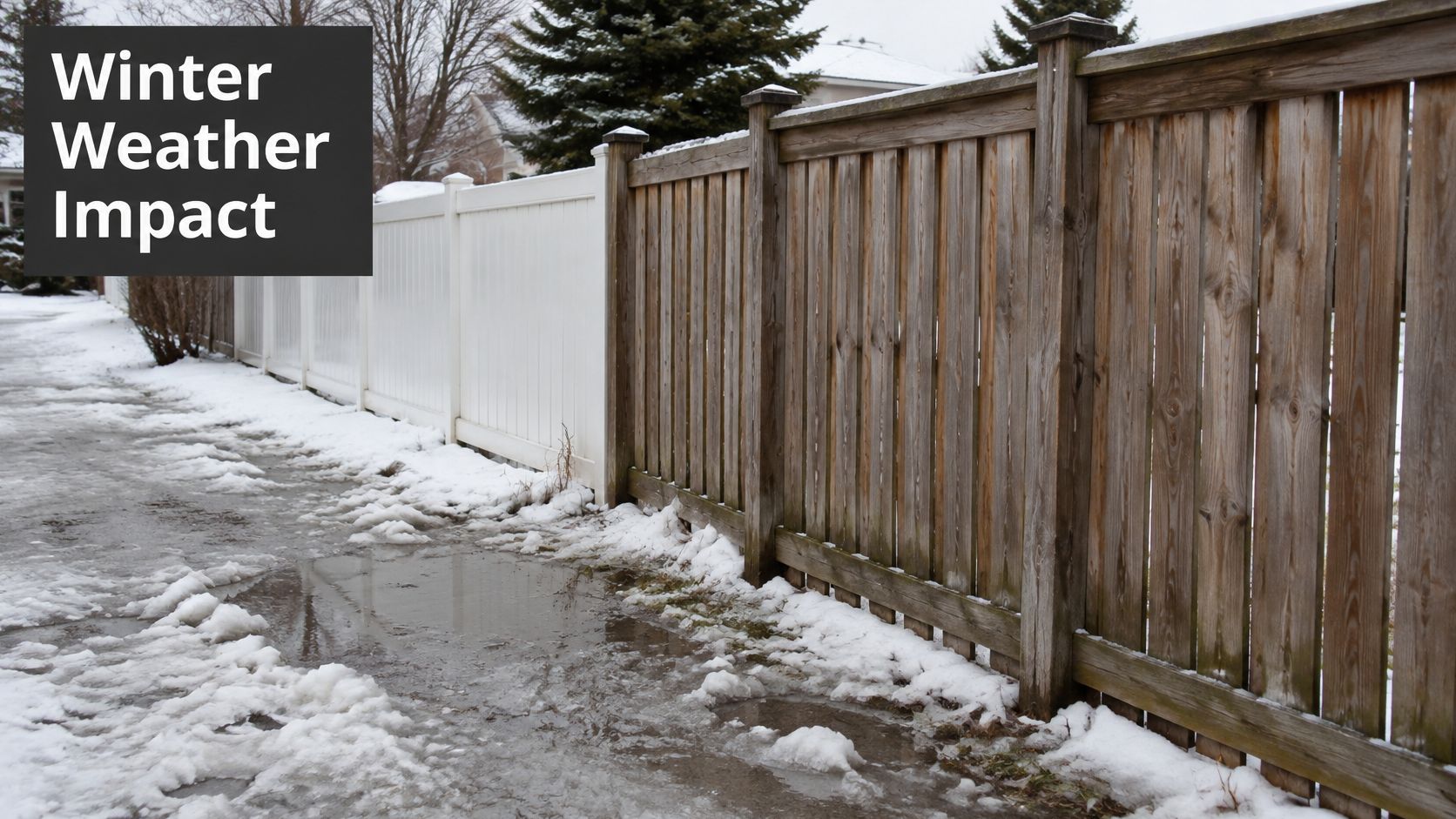
Water in the soil freezes, expands, and lifts. It thaws, the soil settles, and the post doesn't always return to plumb. Repeated cycles stress fasteners, loosen rails, and expose weak footings, while extra moisture keeps organic material damp for longer stretches.
Wood handles this climate when it's built from treated or naturally durable species and protected with paint, stain or sealant. It still absorbs moisture, so any detail that traps water, such as boards tight to grade or leaf litter packed at a post base, shortens its life.
PVC doesn't absorb water, so it avoids rot and peeling stain. Cold makes panels more brittle on impact, though, so a snowblower strike or a fallen branch in January does more damage than the same hit in July. Ground movement can also crack a rigid panel or pull brackets loose.
Posts Decide More Than Panels
Set footings deep enough for local frost, put gravel at the base for drainage, and use concrete collars sized to the post and soil. Keep finished grade sloping away from post bases so meltwater doesn't pond where wood meets ground. For PVC, engineered posts and proper rail connections matter because the panel itself isn't structural.
Follow the numbered annual routine in the upkeep section below rather than inventing your own schedule. Seasonal checks catch heave early, when resetting one post is still a small job.
The decision rule is simple. Choose PVC when your project prioritises low recurring maintenance and moisture resistance. Choose wood when you value repairability and a natural look and you'll commit to annual checks.
Pool Enclosure Rules That Override Material Choice
A pool fence can look finished and still fail inspection. Inspectors measure geometry, test gate hardware, and check permit status, and PVC or wood can pass or fail on all three.
Jurisdiction | Minimum height | Gap or sphere limit | Material and gate rules |
|---|---|---|---|
City of Ottawa | 1.5 m | 100 mm sphere | PVC and vertical-board wood allowed, non-frost-susceptible posts, latch at least 1.35 m high |
Quebec provincial regulation | 1.2 m | 10 cm sphere | No features that enable climbing, municipal permit required |
Quebec municipalities | May exceed the provincial minimum | Local bylaws may tighten the limit | Stricter local rules allowed; confirm before building |
The City of Ottawa pool enclosure rules require the fence to be at least 1.5 metres high, prevent passage of a 100-millimetre sphere, use non-frost-susceptible posts, and have self-closing, self-latching gates with the latch at least 1.35 metres above the enclosure floor. Ottawa explicitly permits vinyl or PVC and vertical-board construction, so both materials qualify in principle.
Across the river, Quebec's provincial pool safety regulation requires a pool enclosure to be at least 1.2 metres high, prevent passage of a 10-centimetre sphere, and contain no features that enable climbing, with a municipal permit required for constructing, installing, or replacing the enclosure. Municipalities in Quebec can impose stricter local rules than that provincial minimum, so confirm the local bylaw before assuming the regulation alone governs your design.
Where Enclosures Actually Fail
An ordinary privacy fence is not automatically a compliant pool barrier. Horizontal rails can become climbing aids, board shrinkage can open gaps past the sphere limit, and a gate that drags after winter may stop self-latching. Replacing an existing enclosure still requires a pool enclosure permit in Ottawa, even if you keep the same material and footprint.
Low-maintenance PVC does not eliminate the highest-risk components. Posts, gates, latches, clearances and frost-resistant installation remain decisive.
Wood needs its boards, finishes and joints maintained so shrinkage and deterioration never open a non-compliant gap. PVC needs adequate structural support and compliant gate hardware, because consistent panel dimensions alone do not make a safe enclosure. Our guide to inground pool fence requirements walks through the approval sequence.
Before you compare PVC fence vs wood pricing for a pool, confirm five things in writing: height, opening size, gate latch height, post foundation type, and permit status. I would not order a single panel until your municipality confirms the design.
Installation and Upkeep Differences That Matter
Task | PVC | Wood |
|---|---|---|
Cleaning | Wash once or twice a year | Wash before any new finish |
Surface finish | None | Restain or repaint when finish fades |
Damage repair | Replace matched panel section | Swap individual boards on site |
Seasonal check | Posts, brackets, gate latch | Posts, rot at ground line, loose rails, gate latch |
Wood can be cut and adjusted on site, which helps on uneven grades and around obstructions. PVC arrives in manufactured dimensions, so run lengths must be planned around panel spacing and posts set precisely, because you can't trim your way out of a measuring error as easily.
The Annual Routine
Wash once or twice a year: Use a garden hose, soft brush and mild detergent, and rinse PVC clean rather than pressure washing brackets loose.
Inspect posts each spring: Look for heave, rot at the ground line on wood, and loose rails or brackets on PVC.
Restain or repaint wood when the finish fades: Sun-exposed faces go first, and delaying lets water into the grain.
Replace damaged boards or panels promptly: Open gaps invite warping, climbing and, around pools, non-compliance.
Check gate closing and latch function each season: Adjust hinges until the gate closes and latches from a partly open position without help.
For the wood-specific steps, our notes on pressure-treated wood maintenance cover cleaning and sealing intervals. If you're repainting an existing wood fence rather than replacing it, professional fence painters in Dublin publish useful preparation guidance on sanding, priming and coating weathered boards that applies wherever you do the work.
Environmentally, wood is renewable, and cedar and pressure-treated lumber are the most common choices in Canada, though treatments and finishes matter for handling and disposal. PVC is a petroleum-based plastic with fewer recycling outlets, but it lasts longer with less upkeep, so compare how many replacements each material needs over twenty years rather than judging one purchase in isolation. A wood fence replaced early because maintenance lapsed carries a larger footprint than its first invoice suggests.
We handle every detail from design to installation with our own crew, so the team that measures your line also sets and checks the posts. That continuity matters most on gates, where small alignment errors become daily annoyances.
Which Fence Fits Each Property Type
Property | Better fit | Why |
|---|---|---|
Pool owner | PVC, or compliant vertical-board wood | Lower upkeep where splashing and humidity are constant |
Rear-yard privacy homeowner | PVC if low upkeep wins, wood if natural look and repairs matter | Both can reach the 2.1 m rear-yard limit |
Front yard | Open or lower design in either material | Front-yard maximum is 1 m |
HOA or multi-lot townhouse | PVC for uniform colour across lots | Consistent panels and fewer repaint cycles across many properties |
Commercial perimeter | Hybrid fence with steel strength | Added strength and security where impact risk is higher |
DIY buyer, materials only | Wood for on-site cutting, PVC for consistent panels | Wood adapts to irregular sites, PVC needs careful measuring |
The City of Ottawa landscaping guide allows a maximum height of 1 metre in a residential front yard and 2.1 metres in a residential rear or side yard, and gates may be 30 centimetres taller than the applicable fence limit. Standard residential fences generally don't require a permit, but pool enclosures are the exception.
That split changes your design before material enters the conversation. A tall opaque PVC privacy panel works along a rear line, while the front yard calls for a shorter or more open design, similar in spirit to the glass barrier advice from Binks Balustrades on keeping sightlines open where solid panels would feel heavy. Wood gives you another lever, since board spacing and height can be adjusted to suit each zone.
Group, Commercial and DIY Projects
For HOAs and multi-lot townhouse projects, PVC holds one colour across many lots and removes staggered repaint cycles that make a row look patchy. We offer exclusive neighbourhood group discounts for customers who coordinate their fencing needs as a group, and conditions apply, so coordinated runs can cost less per lot than separate jobs.
For commercial perimeters, our hybrid fences combine the beauty of PVC or wood with the strength of steel, offering privacy, sound reduction, and weather resistance. That build suits sites where panels face carts, plows or deliberate impact.
For do-it-yourself buyers purchasing materials only, wood suits on-site cutting with a circular saw and standard lumber sizes. PVC suits consistent panels, provided you measure twice and order posts, rails and caps as one system.
Confirm your exact yard location, property line and any visibility restrictions before ordering. A survey stake found late can move a whole run.
Example Scenarios
Here are three common property situations showing how the comparison plays out, using the indicative averages cited above.
Ottawa Rear Yard, 150 Linear Feet
Those averages come from Ontario directory listings outside Ottawa, so treat the totals below as a planning estimate and confirm them with real quotes for your footage. At the reported averages, wood comes to about C$6,300 and PVC to about C$6,900 before upkeep. I'd weigh that gap against twenty years of maintenance: staining every few years plus one post repair after freeze-thaw heaves a footing, compared with washing PVC and replacing a single panel if something hits it. Question to answer first: will you restain on schedule, or pay someone who will?
Gatineau Backyard Pool
On a pool lot, the enclosure rules pick the design before the material debate starts. The provincial rule sets 1.2 m minimum height, a 10 cm sphere limit and a municipal permit requirement, and your municipal bylaw may be stricter. Budget for the permit and a compliant self-latching gate first, then aim for the Ottawa standard of 1.5 m with the latch at 1.35 m as the safer target. Question to answer first: has the municipality approved your enclosure design in writing?
Townhouse Group of 12 Lots
A coordinated run changes the math. PVC gives one colour across all 12 lots and fewer repaint cycles for the association to police, while wood gives each owner more design freedom at the cost of staggered maintenance. Compare one coordinated order against 12 separate jobs, with each installer measuring the same run length and gate count per lot. Question to answer first: can the group agree on one style and one installation window?
Confirm These Points Before You Order Your Fence
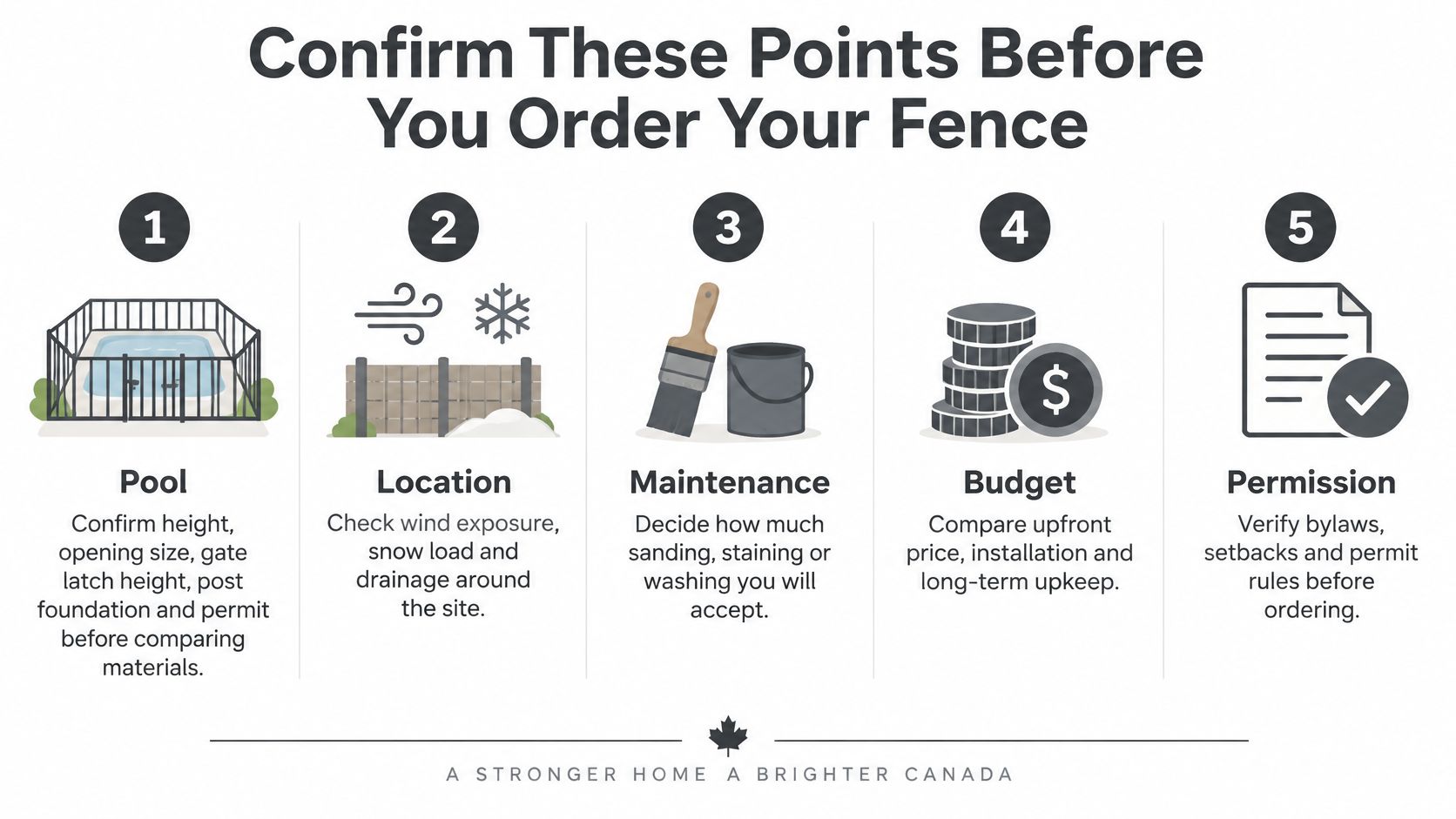
Work through this list in order. Each item can change the material answer, so don't start with colour swatches.
Pool: Confirm height, opening size, gate latch height, post foundation and permit before comparing materials, because a non-compliant design gets rebuilt at your cost.
Location: Measure the yard zone and property line, remembering the 1 metre front-yard and 2.1 metre rear and side limits.
Exposure: Note freeze and thaw and wet conditions on your site, then plan post depth and drainage for the worst corner, not the best.
Upkeep: Decide whether an annual wash and inspection is acceptable, or whether a finish every few years is manageable for you or a contractor.
Budget: Compare installed price per linear foot plus the twenty-year upkeep estimate, not the quote alone.
Property type: Confirm whether this is a single home, a multi-lot HOA or a commercial perimeter, since each changes material and group options.
Do this week: Get every quoter to price the same footage, height and gate count, and ask each one how posts are set. The answers separate careful installers from cheap ones quickly.
When you're ready, request a free estimate from us. Our contact form lets you ask for a Material Quote or an Installation Quote, depending on whether you're building it yourself or want our crew on site. You can also call us at (613) 617-4414 to confirm the pool and height rules for your specific property before ordering.
Bring three things to that conversation: your measured linear footage, photos of the grade and any existing fence, and your answers to the checklist above. I'd rather spend ten minutes on post depth and gate hardware now than quote you a rebuild later.
If you're weighing PVC fence vs wood for an Ottawa or Gatineau property, we can price both options for your exact footage, confirm the height and pool rules that apply, and install with our own crew. Visit FenceScape to request your free estimate and get a clear, written comparison before you commit to a material.
Comments