
Pressure Treated Fence Cost: Ottawa Prices and Budget

A standard 6-foot pressure-treated privacy fence in Ottawa costs approximately CAD $25-$40 per linear foot installed, equivalent to about CAD $200-$320 per 8-foot panel. Those figures are a starting budget, not a promise that gates, demolition, difficult digging or finishing are included.
The most useful question isn't what a fence costs. It's what the quoted price buys. A stack of boards, a labour-only installation and a turnkey project are different purchases, even when each contractor describes the price per foot.
For Ottawa–Gatineau buyers, location matters too. The installed benchmark below is Ottawa-specific, and Ottawa's municipal rules don't automatically apply across the river in Gatineau.
Pressure Treated Fence Cost per Foot and per Panel
For a standard 6-foot privacy fence, Ottawa Decking Solutions' cost guide gives an installed benchmark of CAD $25-$40 per linear foot and a labour-only benchmark of CAD $12-$20 per linear foot when materials are supplied. Multiplying the installed range by eight gives CAD $200-$320 per 8-foot section, a calculated comparison rather than a separately quoted panel price.
That distinction matters. A contractor may build the fence on site rather than install prefabricated panels, and the section price doesn't necessarily include a separate post at every end.
Pressure treated fence prices per unit
The installed and labour-only rows use the regional benchmark above. Retail rows link directly to the corresponding supplier listings.
Item | Basis | Price (CAD) |
|---|---|---|
Installed 6-ft privacy fence | Per linear foot | $25-$40 |
Installed 6-ft privacy fence | Per 8-ft panel, calculated | $200-$320 |
Installation labour only | Per linear foot | $12-$20 |
Per board | $2.68 | |
Per board | $3.98 | |
Per board | $17.21 | |
Per board | $3.98 |
The Home Depot listings aren't year-specific, so treat them as shopping references, not current project quotations. The IHL listing is identified as a 2026 listing, but stock, delivery and the final order still need confirmation.
Board price isn't fence price. A board-only shopping list leaves out framing, posts, footings, fasteners and installation. Different board lengths also aren't interchangeable without considering the design and cutting waste.
Run a dimensional check
Start by multiplying measured linear footage by the installed benchmark. Then divide the footage by eight to estimate equivalent sections, allowing for shorter end sections and gate openings rather than rounding everything into full panels.
Our guide to fence panel sizes helps distinguish nominal section sizes from the layout you'll order. Confirm whether measurements run between post centres or across the full property boundary.
For property managers coordinating fencing with other exterior work, Prestonwood Commercial Landscape Services' resource on budgeting for commercial landscaping projects offers useful broader budgeting context. Keep those allowances separate from the fence scope so neither contractor assumes the other has included restoration.
What Labour and Materials Add to Your Price
An installed quote combines a product purchase with a construction service. The crew lays out the fence, digs holes, sets and aligns posts, attaches rails, installs boards, hangs gates and cleans the work area. A materials supplier doesn't perform those tasks because its invoice uses the same unit of measurement.
In Canada, cedar and pressure-treated lumber are the most common wood-fence materials. Pressure-treated lumber is therefore a standard baseline for comparison, not automatically a compromised specification.
Read the estimate in construction order
Ask for the footing and post specification first. It should identify post dimensions, treatment suitability, hole preparation and concrete, rather than naming only the visible fence height.
Next, inspect the rails and framing. Their dimensions, arrangement and connections determine what supports the privacy boards. The board line should identify the profile, grade, length and layout, including whether boards overlap.
Finally, check the fasteners and gate hardware. Specify hot-dip galvanized or suitably rated stainless-steel fasteners compatible with the treated lumber, not an unspecified box of outdoor screws.
Quote line | What should be identifiable |
|---|---|
Posts and concrete | Post specification, footing work and whether concrete is included |
Rails and boards | Dimensions, grade, layout and supply responsibility |
Labour | Construction tasks, equipment and cleanup |
Gates | Opening, framing, hinges, latch and installation |
Removal | Dismantling, hauling and disposal |
Treat subtraction as an allowance, not a material quote
Pairing the low installed endpoint with the low labour endpoint, and the high with the high, produces a calculated residual of approximately CAD $13-$20 per linear foot. That's arithmetic using the earlier benchmarks, not a supplier's quoted material range.
More importantly, the residual may contain delivery, equipment, overhead and profit. It cannot establish what a contractor paid for lumber.
Statistics Canada's construction-price methodology treats contractor prices as including materials, labour, equipment, overhead and profit. That's why subtracting a labour allowance doesn't isolate a clean retail material cost.
Comparison rule: If a quote doesn't distinguish supply from installation, you can't reliably compare it with either a materials invoice or a labour-only offer.
Confirm explicitly whether posts and concrete are included, whether gates are additional, and whether an existing fence must be removed. Those answers are more useful than an unexplained per-foot total.
Factors That Move the Price Up or Down
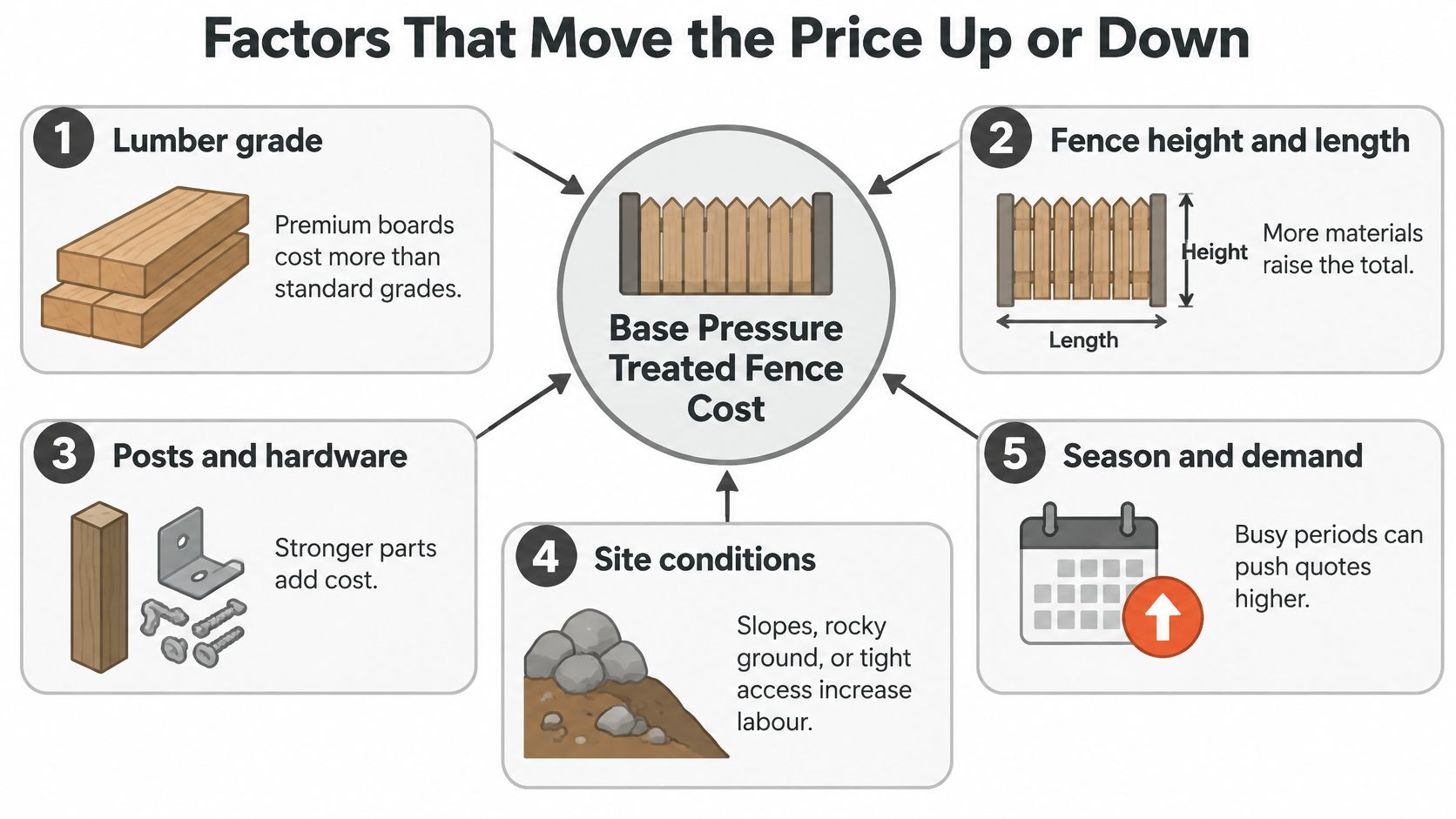
Use the following order to inspect a quote, rather than treating it as a measured ranking of how often Ottawa homeowners encounter each condition. Start with the specified fence, then examine the ground and access, and finish with optional features.
The diagram summarises the main categories to flag during a site visit.
Separate design choices from site constraints
Lumber grade and layout. Premium-grade boards generally carry a higher purchase price than standard-grade equivalents. Ask for an actual alternate price using the same dimensions and layout; the retail examples aren't a controlled grade comparison.
Height and length. Taller boards and longer runs change the material order. More corners and short returns can also complicate an otherwise simple footage calculation.
Posts and footings. Deeper excavation, larger footings and extra concrete increase work and supply requirements. Ask the installer to explain how the footing design addresses Ottawa's frost conditions rather than accepting an unsupported universal depth.
Terrain and access. A slope may require stepped sections or a racked layout. Tight passageways can mean hand-carrying materials and using smaller digging equipment, while buried obstructions require a separate excavation decision.
The useful distinction is controllable versus unavoidable cost. You can choose a simpler board pattern, but you can't price rocky ground out of existence. Have the contractor state how unexpected excavation will be authorised and charged.
Price gates, finish and alternatives separately
A gate needs its own frame, hardware, alignment and supporting posts. Request a separate installed amount so you can change the opening or hardware without obscuring the fence price.
Stain, sealer or paint should also appear separately. Ask whether the amount covers preparation and both accessible faces, not just product application.
Hybrid fences change the specification more substantially. Our hybrid designs combine the beauty of PVC or wood with steel strength, offering privacy, sound reduction and weather resistance. Compare the complete system rather than assuming its installation allowance matches a conventional wood fence.
More complications generally move a project towards the upper end of the benchmark, or beyond it. Don't force a difficult job into a standard-yard range; require identifiable additions instead.
Permits, Height Limits and Shared Boundary Costs
No building permit doesn't mean no paperwork or design restrictions. Ottawa's building-permit guidance says ordinary residential fences generally don't require a building permit, but they must comply with Fence By-law 2003-462, including placing the more attractive side towards the neighbour or street.
The city's residential land-use guide lists maximum heights of 1 metre in front yards and 2.1 metres in side or rear yards, with gates permitted 30 centimetres taller. It also prohibits fences in the city right-of-way and advises confirming property lines.
Height, permit and cost effect by fence scenario in Ottawa
The city guidance linked above establishes the following ordinary-fence and pool-enclosure requirements.
Scenario | Height rule | Permit | Cost effect |
|---|---|---|---|
Front-yard fence | 1 metre maximum | Not required for a standard fence | Lower board requirement and potentially smaller posts; design must meet Fence By-law 2003-462 |
Side or rear-yard privacy fence | 2.1 metres maximum; gates up to 30 cm taller | Not required for a standard fence | More board material and potentially stronger posts than a front-yard design |
Pool enclosure | Generally at least 1.5 metres | Required, even with an existing yard fence | Non-frost-susceptible posts, maximum 100 mm openings, self-closing and self-latching gate, lock at least 1.35 metres above the enclosure bottom |
Pool-enclosure requirements can also apply to hot tubs and qualifying ponds. Don't assume an existing perimeter fence automatically satisfies a new enclosure application.
For Gatineau projects, confirm the applicable municipal requirements separately. Ottawa's height limits and Ontario's boundary-fence legislation aren't a cross-border compliance checklist.
Resolve the boundary before allocating the bill
Ontario's Line Fences Act provides a process through which an owner may notify the municipal clerk and request fence-viewers to allocate construction, reconstruction, repair and maintenance responsibilities. The resulting award is deposited with the clerk, with certified copies sent to the owners and occupants.
That isn't an automatic equal split of whatever design an owner chooses. Confirm the process's local applicability before relying on it, and record any voluntary agreement about ownership, access and maintenance.
Our explanation of property-line fence rules helps organise those discussions before construction.
A lower quotation isn't a saving if the completed fence needs replacement posts, different gate hardware or a revised layout to comply.
Sample Budgets for Common Ottawa Job Sizes
Say you measure a rear boundary and side return, sketch the corners, and identify a pedestrian gate near the house. The first budgeting decision is whether your measurement includes the opening or only the solid fence runs.
For a hypothetical 120-linear-foot fence run, applying the installed benchmark produces CAD $3,000-$4,800 before the gate. This is a calculated planning range, not a contractor's offer, and it sits between the corresponding backyard and corner-lot examples below.
Installed budget ranges by common Ottawa job size
All project totals below are calculations using the regional installed benchmark. Panel counts are approximate equivalents, not fabrication or ordering instructions.
Job size | Installed range (CAD) | Panels (8 ft) | Cost note |
|---|---|---|---|
50 ft side-yard privacy run | $1,250-$2,000 | About 6 | Gates and removal priced separately |
100 ft standard backyard perimeter | $2,500-$4,000 | About 12-13 | Gates and grading extra |
150 ft corner lot with side run | $3,750-$6,000 | About 19 | Access and layout can add cost |
200 ft larger lot perimeter | $5,000-$8,000 | 25 | Group pricing may reduce cost per lot |
Each gate | Separately quoted by opening, frame and hardware | Not a standard fence panel | Quote as a separate line |
These are base construction allowances, not all-in spending limits. They aren't guaranteed minimum prices either; a contractor may quote differently after assessing the scope.
Turn the measurement into a complete scenario
For the hypothetical rear-and-side project, draw the gate opening on the sketch and ask the estimator to reconcile it with the measured footage. That prevents paying for a full run of solid fencing and then adding a gate without clarifying what the gate replaces.
Build the written budget around distinct decisions:
Standard perimeter. Begin with the measured solid runs and specified height.
Replacement on existing posts. Make reuse conditional on checking alignment, condition, spacing and suitability for the proposed fence.
Pool enclosure. Obtain a compliant enclosure scope rather than adding a generic gate to an ordinary fence estimate.
Difficult-access yard. Identify carrying routes and excavation restrictions before accepting a standard installation allowance.
Multi-lot installation. Separate each owner's work from shared mobilisation and scheduling.
For a wider garden redesign, R.E. and Sons Landscaping lets you compare backyard renovation price ranges. Use that as broader project context, not as evidence of Ottawa fencing rates.
We offer exclusive neighbourhood group discounts when customers coordinate their fencing needs as a group, with conditions applying. Shared mobilisation and coordinated layout can reduce duplicated work, but each property still needs its own boundary, grade and gate-location checks.
Find the table row nearest your footage, then compare the contractor's inclusions. Investigate the reason for a difference before deciding whether the quotation is expensive or incomplete.
Why Lumber Prices Shift and When to Buy
Pressure-treated lumber doesn't have a fixed material rate. A useful purchasing plan focuses on when the contractor commits to buying materials, not which month you sign.
Keep the quote date and proposed purchasing date together when planning the work.

Statistics Canada's national Softwood Lumber Price Index, using January 2020 as the comparison base, reached 328.0 in May 2021, approximately 228% above base, before falling to 117.1 in September 2025, still 17.1% above base. Its 2025 readings also moved within the year: 142.7 in January, 148.6 in March, 128.0 in May and 128.4 in June.
Those are national index readings, not Ottawa retail prices or installed fence rates. They demonstrate volatility; they don't tell you what a local contractor should charge.
Ask when the price becomes firm
The Building Construction Price Index also tracks quarterly contractor-charged construction prices, including the Ottawa–Gatineau metropolitan area's Ontario part, as described in Statista's construction-index overview. Its building-construction scope isn't a fence-price schedule, but it helps explain why labour and wider construction costs matter alongside lumber.
Ask these questions before committing:
Quote validity. Until what date can I accept this scope at this price?
Price lock. Does the amount become firm at signing, deposit or material purchase?
Coordinated purchasing. Can neighbouring projects share procurement and mobilisation, and what happens if someone withdraws?
The following video provides an additional planning resource.
There's no supported cheapest-month rule in these figures. Compare quotations prepared for the same scope and purchasing window, and don't assume a fall in lumber automatically reduces labour, concrete, hardware or removal charges.
Maintenance, Disposal and Lifetime Cost
A pressure-treated fence budget should include ownership work, not just installation. LookupCost's Ottawa benchmark suggests staining every 2-3 years; applying that interval produces a calculated allowance of three to five recoats over ten years, depending on timing and condition.
That's a maintenance scenario, not a guaranteed service schedule. Wood absorbs and releases moisture, while seasonal freezing can intensify stress around checks, end grain, fastener penetrations and unprotected cuts.
Build an ownership allowance
Use a simple model: installed price + recoating + repairs + eventual removal. Obtain a separate coating quotation that identifies cleaning, preparation, product, accessible faces and labour.
For routine care:
Inspect annually. Check post movement, loose connections, gate sag and deteriorating boards.
Protect cuts. Treat field-cut ends and exposed end grain with a compatible wood preservative.
Reduce trapped moisture. Keep soil, mulch and dense vegetation away from boards.
Assess the surface. Plan recoating when the finish weathers or the wood readily absorbs water, subject to product instructions and suitable drying conditions.
Our pressure-treated wood maintenance guide helps organise that routine. For another perspective on coating preparation, use the fence advice from Painters North Shore, while recognising that its Auckland context doesn't establish Ottawa pricing or seasonal timing.
Compare systems over the same ownership period
Our PVC fences are low maintenance and don't fade, twist or crack like wood. Hybrid systems add steel strength, but their maintenance requirements still depend on whether the infill is wood or PVC.
Ask for comparable installed and maintenance scopes before deciding that an upgrade pays for itself. Without local alternative-system and recoating quotations, a precise break-even year would be speculation.
Ownership test: A cheaper installation can become the more expensive choice if you'll pay others to complete every maintenance task.
Finally, specify disposal before demolition. The Canadian Wood Council's treated-wood specification guide warns against burning treated wood in open fires, stoves, fireplaces or residential boilers because preservative components can concentrate in ash and particulates.
Its commercial and industrial disposal provisions aren't a household drop-off directory. Ask where your removed boards, rails and posts will be accepted, and have hauling and disposal identified separately.
Get an Accurate Local Quote Before You Commit
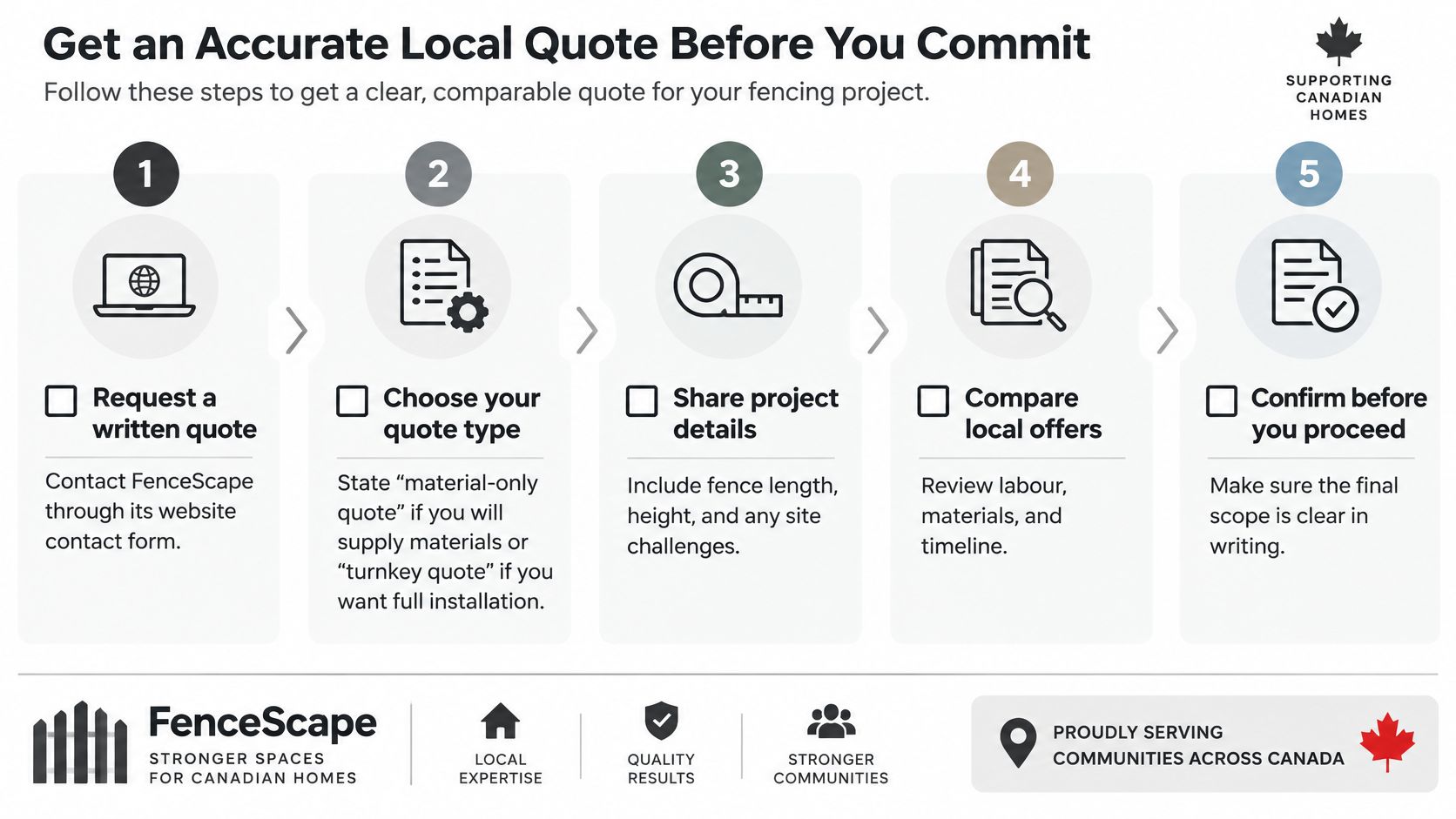
An accurate pressure treated fence cost starts with a measurable scope. FenceScape offers a free estimate, and our contact form lets you request a Material Quote or an Installation Quote.
Choose carefully: a Material Quote means you're buying supplies. If you already own materials and need someone to build the fence, describe that as a labour-only installation request, not a material-only quote.
Use this checklist to prepare a request that an estimator can assess.
Send a usable project description
Map each run. Provide measured length, intended height, corners and the side of the property involved. Include a sketch and photographs of the access route.
Identify special requirements. Mark gate openings, pool-enclosure needs, slopes, obstructions and any posts proposed for reuse.
Clarify the boundary. State how the property line has been confirmed and whether neighbours have agreed to shared work.
Define the handover. Say whether dismantling, disposal, surface restoration and finishing should be included.
Name the purchaser. Identify who supplies boards, posts, concrete and hardware, particularly for DIY or hybrid supply-and-install arrangements.
Our own crew handles every installation, and we manage projects from design through installation. That gives you a clear party to ask about the relationship between the proposed design and the construction scope.
Get commercial terms in writing
Require identifiable allowances for materials, labour, gates and removal, even if the contractor presents a single contract total. Also request the proposed schedule, quote-validity period, treatment of unexpected excavation, and whether any initial finish or later recoating is included.
For financing, confirm the current terms for the project's province. In Ontario, we offer six months of interest-free financing; in Quebec, we offer three months with no payments and no interest. Ask us to confirm applicable conditions before treating financing as part of your purchasing plan.
If neighbours intend to proceed together, raise group pricing before individual scopes are finalised and obtain the discount conditions in writing.
Compare written offers line by line, not merely by the last number. Don't accept an unexplained total as a comparable quote, and treat an unusually low amount as a reason to investigate exclusions rather than assume you've found equivalent work for less.
FenceScape offers free estimates for material purchases and complete fence installations across Ottawa–Gatineau. Visit FenceScape with your measurements, gate locations and site photos to request a written scope that separates your fence construction from optional work and ongoing maintenance.
Comments