
Privacy Fence Cost in Ottawa and Gatineau: A 2026 Guide

Standard wood and vinyl privacy fencing typically runs about CAD $25 to $95 per linear foot installed, and an Ottawa-specific estimate for a 6-foot cedar privacy fence sits around CAD $16 to $58 per linear foot with a midpoint near CAD $31. You're likely staring at two quotes that don't agree, one with a low rate and one with a single lump sum, and neither shows whether the posts, the gate, or the slope are in the price. A privacy fence cost only becomes useful when you treat the city's rules, the grade, and the written scope as part of the price, not as surprises after you sign.
What a Privacy Fence Really Costs Per Linear Foot
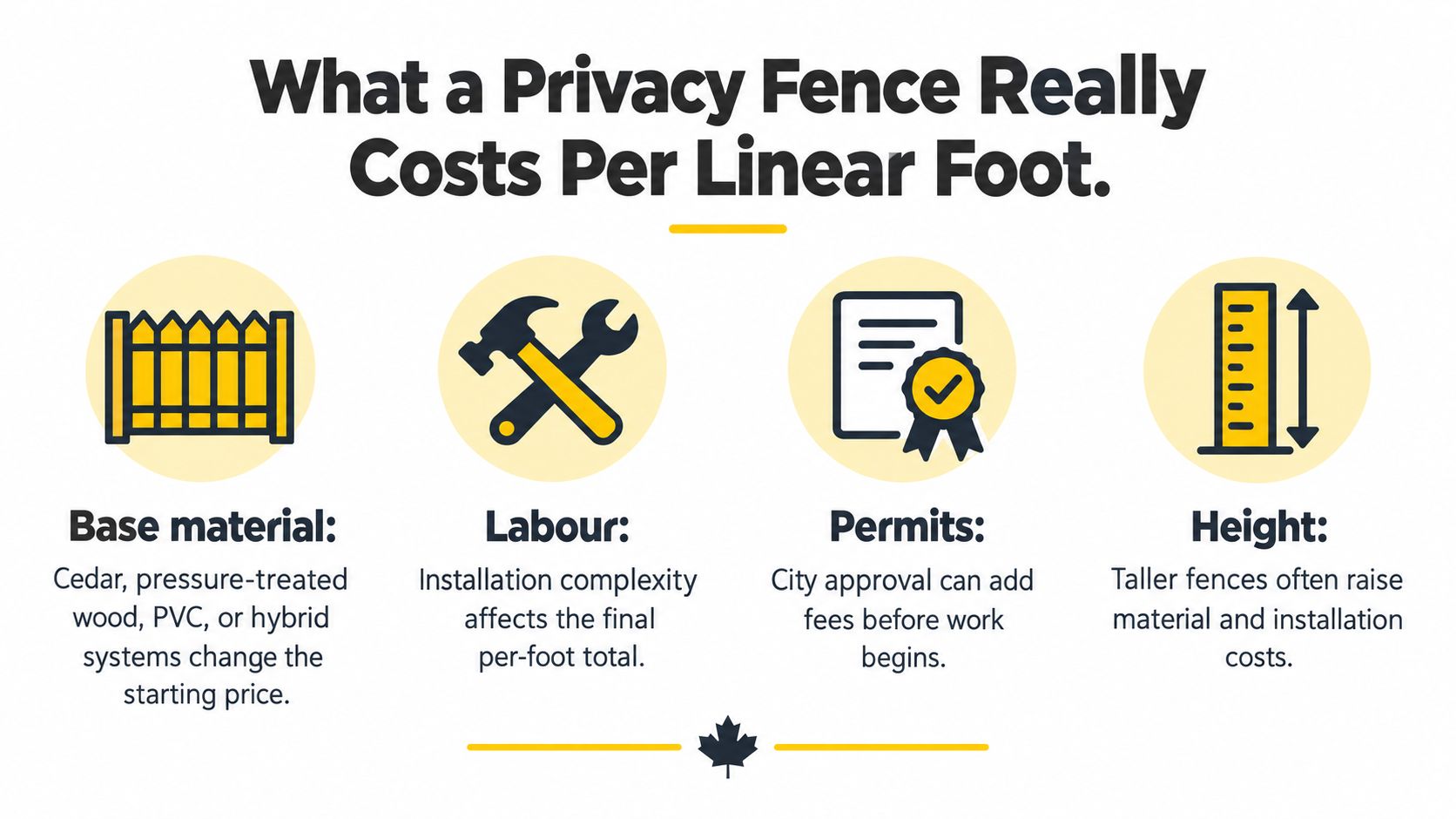
Treat the per-foot rate the way you treat a menu price. The dish looks reasonable until tax, service, and the side order hit the bill. Installed cost per linear foot is the unit that folds panels, posts, and ordinary labour into one number you can compare. A headline total hides whether one bid covers 90 feet and the other covers 110.
How the bill actually scales
Canadian benchmark data places standard wood and vinyl privacy fencing at about CAD $25 to $95 per linear foot installed, while a more Ottawa-specific read puts a 6-foot cedar privacy fence at roughly CAD $16 to $58 per linear foot, with a midpoint near CAD $31. At that midpoint a 100-linear-foot run implies about CAD $3,100 before tax and unusual site work, a 200-foot perimeter roughly doubles the fence-area, post, and labour components, and an 8-foot privacy fence may run CAD $50 to $85 per linear foot against CAD $25 to $55 for a 6-foot wood privacy fence, because taller panels add wind load, material, and stronger posts, according to cost ranges for different fence types.
Length doesn't double every line. Mobilisation, one gate, and a survey stay put while panels and posts grow. Height is the multiplier people skip. Ottawa's construction-fence guidance is a site benchmark, not a backyard rule: a construction fence must be at least 1.8 metres high when the site is 3 metres or less from a public pathway, and that minimum may fall to 1.2 metres only for a residential building of no more than three storeys more than 3 metres from a walkway. A 1.8-metre enclosure is about 50% taller than a 1.2-metre barrier, so surface area, post loading, screening, and handling all rise, as set out in Ottawa's fencing information sheet.
A fair quote lists linear footage, height, gates, and site work as separate lines. Two lump sums can't be compared.
A commercial edge, a townhouse row, or a renovation tight to a sidewalk can need a different enclosure than a detached backyard. Read every proposal in linear feet first, then ask which height and which surroundings that rate assumes.
Materials That Shape Your Privacy Fence Price
Material is the base price of the meal. Finish, height, and how long you want it to last decide what you get.
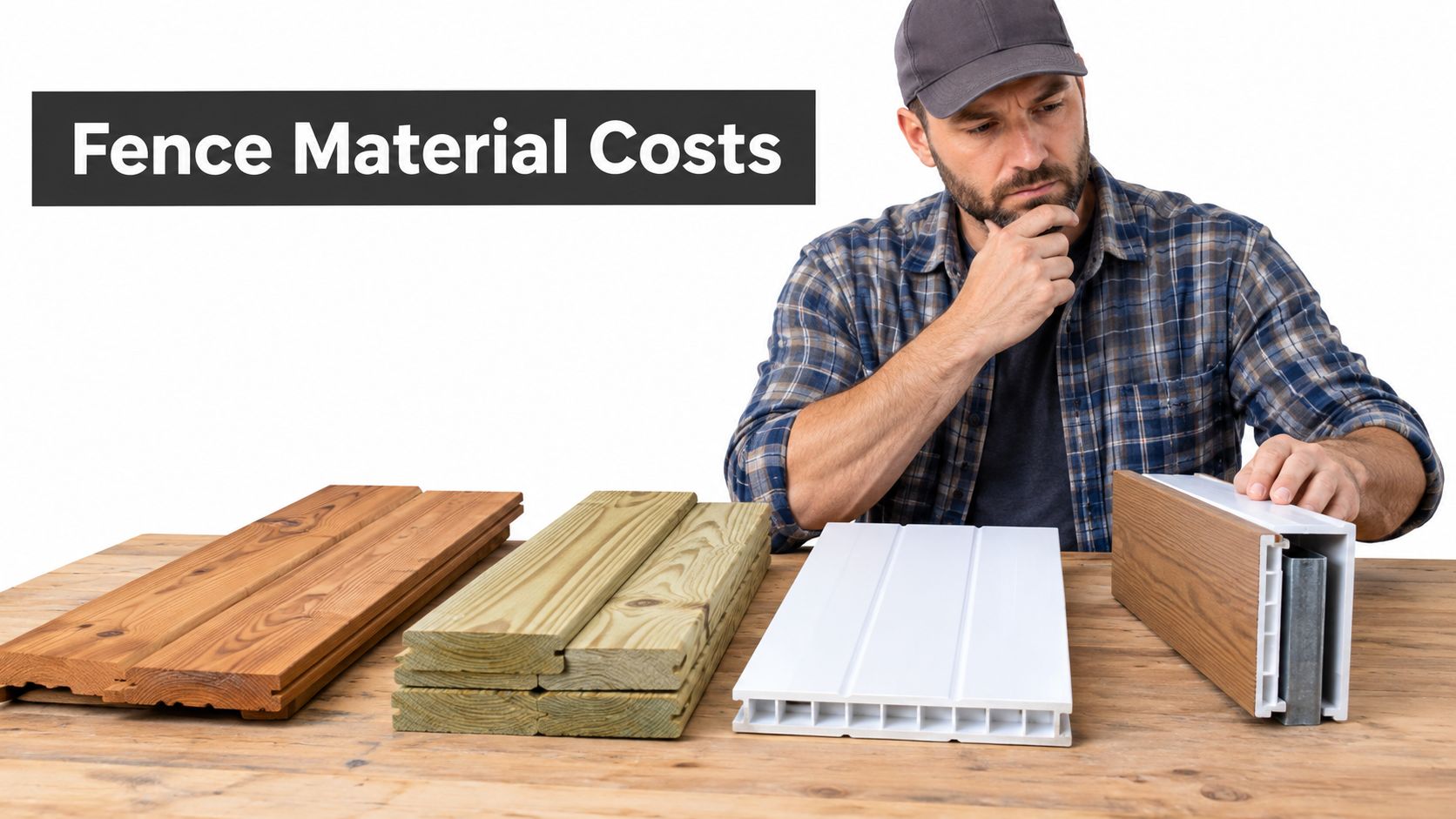
Cedar is the local favourite for a reason. It looks warm, it resists rot better than many softwoods, and a board-on-board layout can look acceptable from both sides, which matters when the finished face has to point outward. Pressure-treated lumber usually starts lower and needs stain or sealer on a regular cycle if you want it to stay straight through Ottawa winters. Both move with the lumber market, not with your lot line.
When the wood price moves without the fence changing
Lumber can shift a wood budget even when the drawing stays the same. The Canadian Construction Association's Summer 2025 economic report stated that softwood prices were down 9 percent in May, reflecting weak demand from a soft residential market, and a separate 2025 construction-cost report described softwood pricing around $500 to $600 per thousand board feet while noting that prices were beginning to rise, as summarised in Normac's 2025 construction cost trends. Those figures aren't an installed Ottawa fence price. They do explain why pickets, rails, posts, gates, and waste allowances can change between a quote dated in spring and one dated in late summer.
PVC costs more up front and asks for almost no staining. It won't rot, and colour is through the material rather than a coat you renew. Hybrid systems, PVC or wood infill on steel posts and rails, put the money into the frame that carries wind, which is often where a wood fence fails first. Ornamental and chain-link options sit outside a full privacy screen, though slats can close a chain-link run if security matters more than a solid wall.
Before you treat a cheap wood number as the winner, ask the same questions of every bidder:
Grade and species: Is it cedar, treated pine, or a mix, and which grade?
Treatment and finish: What preservative or stain is included, and who supplies it?
Waste: Is cutting waste in the material total, or will short boards become an extra?
Price hold: What date is the lumber priced to, and how long is that price guaranteed?
A side-by-side on those four points is more useful than a brand name. If you want a closer look at how those wood choices behave in this climate, the notes on wood privacy fence materials walk through species and upkeep without turning the decision into a catalogue.
A short walk-through of how panels, posts, and layout fit together helps when you're picturing the difference between a wood run and a vinyl one.
Match the material to how long you'll stay and how much weekend maintenance you'll do. A lower wood rate built on a short price guarantee isn't the same product as a PVC or hybrid bid with steel support.
Labour, Posts, and Site Conditions in the Quote
The panels are what you see. They often aren't where most of the money goes. Think of the posts the way you think of a house foundation. Nobody photographs them, and they carry the load for decades.
Canadian cost benchmarks attribute about 40% to 60% of an installed fence project to labour, while posts and footings can represent roughly CAD $1,900 to $3,200 in a typical project budget. Old-fence removal runs about CAD $5 to $12 per linear foot, gates commonly land at CAD $300 to $650 each, municipal or property-line approvals can add one to three weeks, and a 120-foot backyard fence is estimated at roughly CAD $5,808 to $10,176 overall, which is why a material-only quote understates the turnkey cost, based on the fence cost calculator benchmarks.
What the ground does to identical panels
Ottawa and Gatineau soils don't behave like a flat suburban catalogue photo. Frost-sensitive ground, rock, slopes, buried obstructions, and spring freeze-thaw cycles change how long each hole takes and how likely a post is to heave. Two fences can look the same on day one and diverge by year three if one crew set posts shallow in holes that hold water.
A technically comparable bid should spell out the buried work, not wave at "standard installation."
Post spacing and material: How far apart, and are the posts wood, steel, or vinyl sleeves over a core?
Footing size: What diameter and depth, and is that depth below the local frost line?
Concrete method: Dry-pack, mixed concrete, or a collar that sheds water away from the post?
Bad ground: Is rock, rubble, or unsuitable soil a separate unit rate, or buried in a contingency you can't see?
Access: Can a machine reach the line, or is every hole by hand behind a narrow gate?
Removal and gates deserve their own lines. Hauling an old fence is labour plus disposal, and a wide gate needs heavier hardware than a walk gate. If one quote is silent on those items, it isn't cheaper. It's incomplete. Ask for a quantity schedule with linear footage, post count, gates, demolition, footing assumptions, taxes, and allowances for rock or utilities. That's how you see whether a higher system is buying stronger support or only a nicer cap.
Permits and Height Rules That Affect Your Budget
Price the fence you're allowed to build, not the fence you sketched on a napkin. Height and setback rules change the design, the usable length, and sometimes the installation method. A tall rear-yard screen can be illegal on the street side of the same lot, and moving a fence after a boundary mistake is an unpriced cost.
Ottawa's baseline
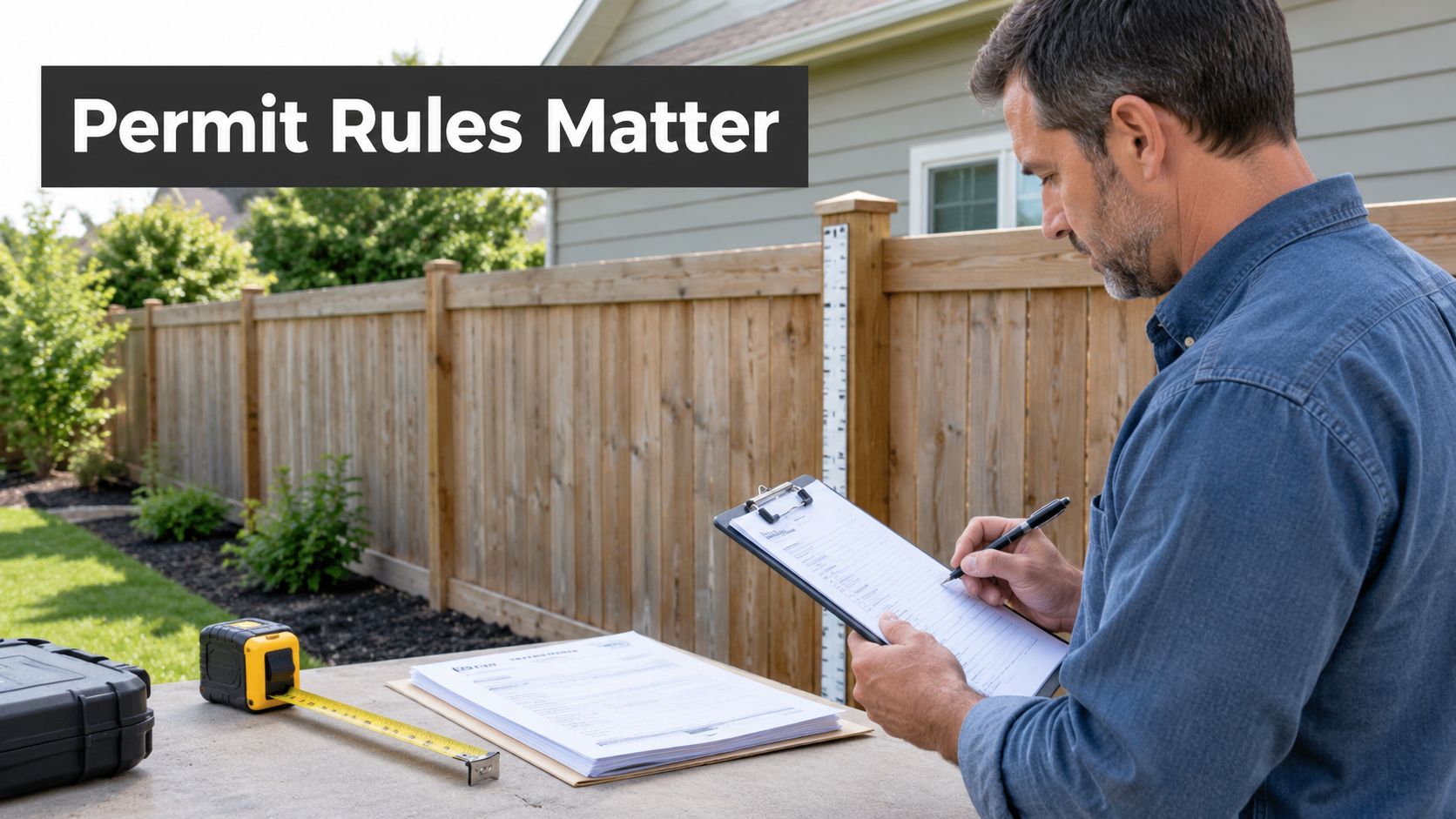
In Ottawa, a standard residential privacy fence generally doesn't need a building permit if it complies with Fence By-law 2003-462, while a pool enclosure permit is required even though ordinary fences typically aren't, according to the city's building permit FAQ. The landscaping education guide sets the maximum at 1 metre in a front yard and 2.1 metres in a side or rear yard, with gates allowed 30 centimetres taller. Fences can't sit in the municipal right-of-way, so confirm the property line before anyone digs. Ottawa also wants the finished, more attractive side facing the neighbour or the street, which can mean more finished material when both faces have to look acceptable.
A compliant 2.1-metre backyard run can often avoid a standard building-permit charge. The price still depends on footage, gates, terrain, demolition, posts, and material. Exceeding the normal dimensions can mean extra design review, different materials, or a specialised install.
Gatineau's tiered limits
Gatineau uses a different ladder for homes with one to four dwelling units. The maximum is 1.2 metres in the front yard, 1.5 metres in a side yard beside a street, and 2 metres in a side or rear yard that doesn't touch a street. A building with more than four dwellings, or collective housing, may reach 2.5 metres in a non-street side or rear area. A fence may generally sit on the property line unless that line borders a street right-of-way. Beside a sidewalk the setback is 1 metre, and where there's no sidewalk the distance from the curb is 1.5 metres. Ordinary residential fences don't need a permit, except pool enclosures. Those rules are on Gatineau's page for residential fence regulations.
Measure height from the grade the by-law uses, not from the high side of a slope that flatters your drawing.
Setbacks can shorten the usable run, so check them before you multiply a rate by a tape-measure guess. Corner lots, shared townhouse lines, and yards where the neighbour's grade differs are the usual traps. The fence by-law overview is a practical checkpoint for orientation, height, and where a pool enclosure splits off from a normal yard fence. Confirm the survey, note easements and municipal strips, and settle who owns a shared fence before you lock a linear-foot price.
Financing and Neighbourhood Group Discounts
A solid fence doesn't have to be paid in one uncomfortable lump, and it doesn't have to be thinned out to fit a month's cash flow. Financing, including promotional programs for Ontario and Quebec customers through FenceScape, is a way to line payments up with the project calendar. It isn't a reason to drop post depth or skip a gate. You still want the same footing spec. You're only changing when the cash leaves the account.
Neighbourhood group installs work differently. Several homeowners book one mobilisation, one material drop, and a shared crew sequence. The truck isn't driving across the city between three small jobs, and the layout crew isn't relearning a new street every morning. That efficiency can shorten the calendar and trim cost, but only when the neighbours agree on the awkward parts first.
What to settle before anyone shares a rate
Who owns the line: Shared fence or each lot on its own side of the boundary.
Height that fits every parcel: A rear-yard maximum on one lot may be illegal on a corner lot's street face.
Gates and hardware: Whose gate, what width, and who maintains the latch.
Survey and grade: Each lot confirmed, not one drawing copied down the block.
Access and timing: Where materials sit, and which yard the crew enters first.
Property managers and HOAs run into the same issue at a larger scale. A townhouse row looks uniform from the sidewalk and isn't uniform underground. One unit may have a walkway setback, another a slope, another a buried service. Standardising the panel is fine. Standardising the footing assumption without a parcel check is how a "group saving" turns into change orders. Ask the contractor to price the common design once, then list exceptions by address. You'll see the discount, which is fewer trips and bulk material, separated from the lots that cost more.
Comparing Quotes for an Accurate Estimate
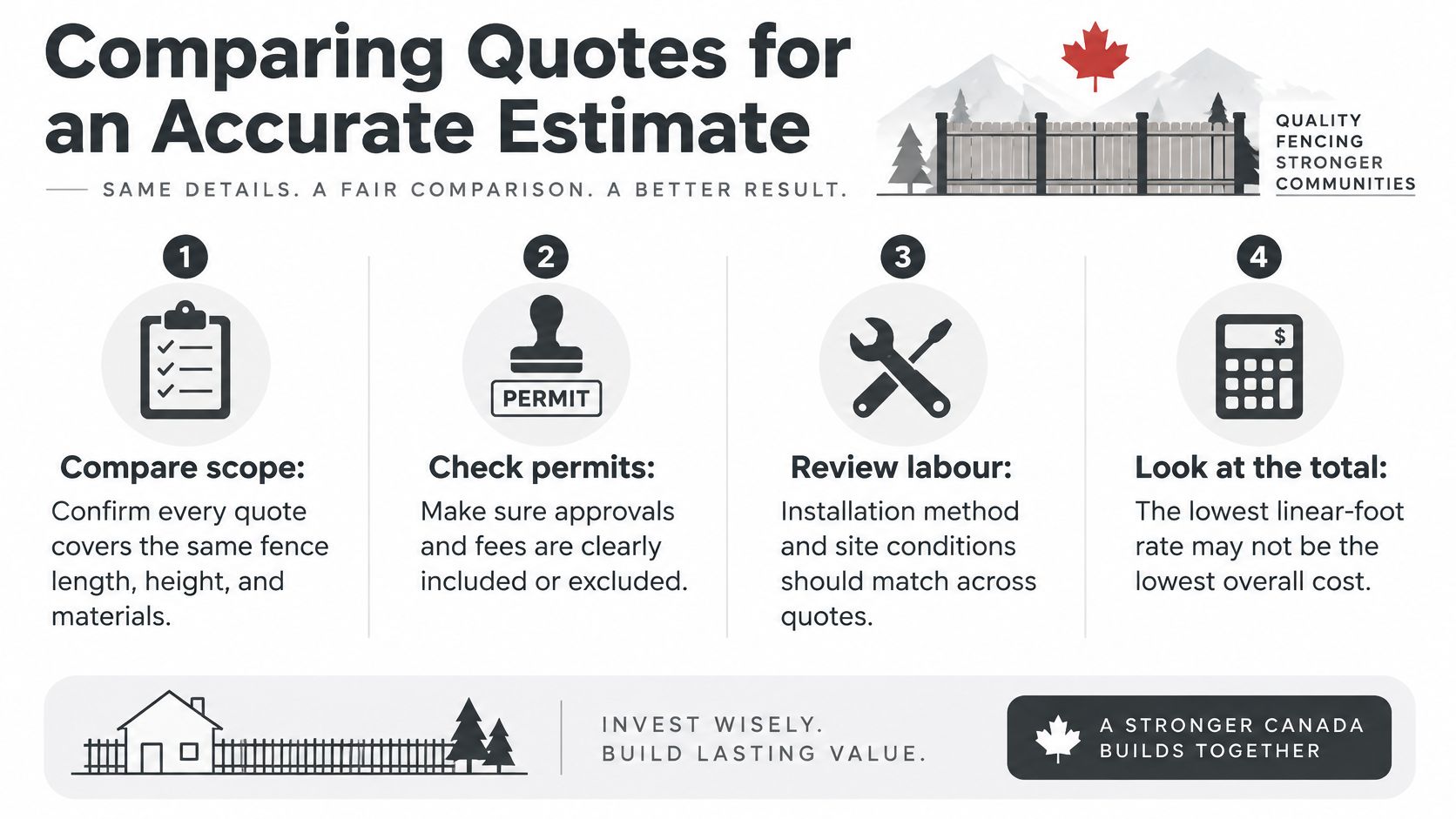
The lowest linear-foot rate isn't the lowest project if it skips the survey, the old fence, the gate, or the by-law check. You want the same scope on every page before you talk price. People who compare bids before negotiating tend to argue about real differences instead of a number that was never the same job.
A checklist that makes bids comparable
Length and height. Same measured run, same height on each segment, including the shorter street-side pieces.
Posts and footings. Spacing, material, diameter, depth, and concrete method written down.
Gates. Count, width, hardware, and whether a self-closing pool gate is a different item.
Demolition and disposal. Removal priced per foot or as a lump, with haul-away named.
Allowances. Rock, utilities, and poor access either included or shown as unit rates.
Taxes and validity. HST or QST stated, quote date shown, and a material-price hold you can read.
What's excluded. Permits, surveys, and stain called out as in or out, not implied.
If a line is missing, ask for it in writing. "Included" isn't a quantity. A premium system earns its keep when the extra dollars buy deeper posts, steel frames, or a longer material warranty, not only a decorative cap.
FenceScape's estimate path is one way to get that paperwork: a free site visit, a custom layout, in-house crews, and a written plan from install through the final walkthrough. Use it the same way you'd use any detailed bid. If you want to test footage and height before the visit, the fence cost calculator is a starting sketch, not a substitute for the quantity schedule. Bring both quotes to the same checklist. The bid that survives that comparison is the one you can sign.
Your Next Step Toward an Accurate Fence Quote
You don't need a perfect drawing to get a useful number. You need a map before the road trip. Mark the route and the detours show up before you're halfway there.
Start with the job the fence has to do. Privacy from a deck, a dog that clears a low rail, a pool that has its own enclosure rules, or a commercial edge that isn't a backyard at all. Then measure. Linear footage along the boundary, not the flower bed. Height by segment, because the street face and the rear yard aren't the same allowance. Note the property pins or the survey, and flag slopes, rock you already know about, and any gate the crew can't get a machine through.
Photos help more than a long email. Corners, the neighbour's grade, the old fence, and the path from the driveway. Add a note if this is a pool, a commercial perimeter, or a group of neighbours who want one mobilisation. That package is what turns a guess into a quantity schedule: footage, post count, gates, demolition, footing assumptions, taxes, and allowances.
The measurement you skip is the line item that shows up later as a change order.
A written schedule is what you compare, not a verbal "about thirty a foot." Once those lines match across bidders, the decision is about support, material life, and timing, which is the part you can judge.
FenceScape designs and installs privacy fences across Ottawa and Gatineau, with a free estimate and a written scope you can set beside other bids. If you're pricing wood, PVC, or a hybrid system and want the posts, gates, and site conditions on the page before you commit, visit FenceScape and book that walkthrough. Bring your measurements and photos so the quote matches your yard.
Comments