
Glass Pool Fence Cost in Ottawa-Gatineau: What to Budget

In 2026, a pool construction guide put installed tempered-glass pool fencing at $120 to $500 per linear foot, and Canadian pricing commonly reaches several hundred dollars a foot at the upper end. That spread is why two neighbours with similar pools can get quotes that barely overlap. In Ottawa and Gatineau the gap is usually the code, the gate, and the deck, not a mystery markup on the panels.
That per-foot band buys the glass. It does not buy a finished, inspection-ready barrier.
Treat the advertised per-foot price as a starting point. A quote that only multiplies footage by a glass rate leaves out the permit, the self-closing gate hardware, and the labour that shows up once someone measures your actual fence line. Add site preparation and any corrections the inspector asks for, and the all-in number lands well above the advertised rate.
Glass Pool Fence Cost at a Glance
A Canadian pool-fence cost comparison puts installed glass at about $100 to $300 per linear foot, against about $20 to $65 for chain link and $45 to $150 for aluminium. On a straight 40-linear-foot run, glass implies roughly $4,000 to $12,000 before unusual site conditions, premium gates, demolition, engineering, taxes, or permit-related services. The top of that range is the one that shows up on frameless Ottawa–Gatineau jobs with tight access, a slope, or a custom gate.
A wider market listing puts installed tempered-glass pool fencing at $100 to $600 per linear foot, which is why a “glass” label alone doesn't pin the cheque. Angi's pool fence cost guide is the source of that wider band. Semi-frameless and post-mounted systems sit nearer the bottom. Frameless systems, thick safety glass, and awkward sites push toward the top.
How the 40-foot maths works
Measure the barrier perimeter, the fence line, not the waterline. The barrier sits back from the water, so it is longer than the pool edge. Multiply that length by the installed rate for the system you want, then add separate allowances for gates, permits, and site preparation.
Say the measured line is 40 feet. At $100 a foot the glass portion is $4,000. At $300 a foot it is $12,000. At the wider tempered-glass ceiling of $600 a foot, the same 40 feet is $24,000 before those extras. Chain link on the same length is about $800 to $2,600. Aluminium is about $1,800 to $6,000. Glass is the premium material on that comparison, and the premium is the view, not a shorter install.
Fence type | Installed cost per linear foot | 40-foot pool enclosure |
|---|---|---|
Chain link | $20-65 | $800-$2,600 |
Aluminium | $45-150 | $1,800-$6,000 |
Glass, Canadian regional estimate | $100-300 | $4,000-$12,000 |
Tempered glass, wider market estimate | $100-600 | $4,000-$24,000 |
Clearview Township's 2026 guide, cited in that same comparison, prices an above-ground-pool enclosure permit at $116 and an in-ground-pool permit at $193. Fees move from town to town inside Ontario, so don't borrow a neighbour's permit number. Our notes on pool fence installation cost walk through how footage and material choice change a full fence budget.
Practical rule: Multiply the measured perimeter by a glass-specific installed range, then add distinct lines for gates, site preparation, access, and municipal approvals. A per-panel price is not a project price.
The per-foot figure leaves out gate hardware, demolition, drilling, and the permit. The next sections set the minimum spec those lines have to meet.
Ottawa and Gatineau Rules That Set Your Minimum Spec
Budget the fence from the rule book, then from the glass. The City of Ottawa building-permit guidance requires a permit for every pool enclosure, including a replacement, and requires the enclosure to be at least 1.5 metres (5 feet) high. Openings must stop a 100-millimetre (4-inch) sphere. Every gate must be self-closing and self-latching, with the lock at least 1.35 metres (4 feet 6 inches) above the enclosure floor.
An existing yard fence doesn't exempt you. Ottawa still wants a separate pool-enclosure permit when a pool goes in or when an enclosure is built or replaced. Pool Enclosure By-law No. 2013-39 set that framework, and the city's stated purpose is making privately owned outdoor pools inaccessible to small children. A short decorative screen, a wide bottom gap, or a latch a child can reach fails that purpose even if the glass looks finished.
Québec, including Gatineau
Québec's pool regulation requires an enclosure at least 1.2 metres high, no passage for a 10-centimetre sphere, and no climbable features. A municipal permit is required to erect or replace an enclosure. Gatineau applies that provincial floor, then its own permit conditions on top. Latch height and the exact self-closing hardware aren't a single province-wide dollar or dimension in that regulation, so the municipality's permit sheet is what the gate has to match.
Older pools can sit under transitional rules. Don't assume a fence that was fine ten years ago still passes a replacement inspection. Call the municipality and ask which standard applies to your address before you order panels.
Requirement | Ottawa, Ontario | Québec (including Gatineau) |
|---|---|---|
Minimum height | 1.5 m | 1.2 m |
Largest opening | Cannot pass a 100 mm sphere | Cannot pass a 10 cm sphere |
Gate latch height | At least 1.35 m above enclosure floor | Set by the municipal permit |
Climbable features | Must leave the pool inaccessible to small children | Must be avoided |
Gate closing | Self-closing and self-latching | Set by the municipal permit |
Permit for new or replacement enclosure | Required, including replacements | Required, fee set by the municipality |
Why the thresholds change the quote
Height sets panel size. Ottawa's 1.5-metre minimum means more glass per foot than a low garden screen, and it changes post or clamp selection. The sphere test sets the gap under the glass and between panels. A low latch means new hardware after inspection, not a small adjustment.
A quote that doesn't show height, opening size, and gate hardware isn't comparable with one that does.
If a cheaper design misses the 1.5-metre height, the opening limit, or the latch rule, you pay for redesign, replacement components, or extra labour before approval. Read the pool enclosure bylaw notes before you accept a lump sum that never names those three items.
What Pushes a Glass Fence Quote Up or Down
Five levers move a glass quote. Check each one on the page, not just the total.
Glass system. Frameless panels need base shoes or spigots, accurately drilled anchors, and tight tolerances. Semi-frameless and post-mounted designs use more visible metal and less precision at the base, so they usually cost less per foot. If the quote says “glass” and doesn't name the system, you can't tell which price you were given.
Height. Ottawa's 1.5-metre minimum is taller glass than a decorative barrier. Taller panels mean more glass, heavier handling, and sometimes a thicker specification so the panel stays stiff between supports.
Layout. Corners, steps, slopes, and short runs between gates add fitting time. Each panel is measured on site instead of dropped in from a repeated template. A long straight run on a flat deck is the cheap layout. A pool wrapped by a raised spa and two direction changes is not.
Gates. A self-closing, self-latching gate with compliant hardware costs more than a fixed panel of the same width. A wide opening needs stronger posts. Two gates don't cost twice one gate in labour, because each still needs its own hinges, closer, and latch test.
Site. Concrete coring in a pool deck, a retaining wall, uneven grade, and restricted side-yard access all add labour. If the crew can't roll a glass rack to the line, every panel is a carry.
Glass fences and railings offer a sleek, modern look and add openness and sophistication. That view is part of why people pay the premium over chain link. It doesn't remove the hardware.
Glass type and what to ask
Tempered safety glass is the baseline for a pool barrier. Laminated tempered costs more and holds together better if a panel breaks, which matters beside a deck where people walk. Ask every quote to name the glass type and the thickness. Where a panel would sit close to the water and below 60 inches above grade, California guidance requires safety glazing. Ottawa and Québec don't copy that wording, but you still want the safety rating written down so a later replacement matches.
Compare two quotes on the same five levers:
System: frameless, semi-frameless, or posts.
Height: stated in metres, not “code height.”
Layout: corner count, slope, and gate count.
Gate hardware: closer and latch named, not “hardware included.”
Substrate: deck, coping, or soil, and who drills it.
If those five match and the totals still differ, you're looking at labour and glass spec. If they don't match, you're looking at two different fences.
Hidden Costs That Most Glass Fence Quotes Leave Out
The advertised panel price is not the project. Ottawa's pool enclosure by-law page lists the pool-enclosure permit fee at $241, and it applies to replacement enclosures as well as new ones. An ordinary fence doesn't need a building permit. A fence used as a pool enclosure does. Homeowners who compare panel prices and stop there miss that split.
Watch how a real enclosure gets laid out, including the gate and the line around the water, before you treat a per-foot ad as a budget.
Lines a single total hides
Permit administration is the first line most quotes leave silent. Gate hardware that meets the latch-height rule is a second, and it carries its own package price rather than folding into the panel rate. Then come the site lines: removal of the old enclosure, concrete drilling or deck repair, layout work, and engineering when the site is complex. Each arrives as its own charge. Stack enough of them and the glass stops being the biggest cheque, and a frameless system can lose the "premium look" argument when substrate prep, hardware, access, and retrofit work dominate the total.
Corrections after inspection are the expensive surprise. A latch mounted too low or a gap that passes the sphere test means a return visit, and sometimes a new panel. That labour is priced twice: once to install the wrong detail, once to fix it.
Line item | What to confirm in the quote |
|---|---|
Glass panels and posts | Perimeter and glass system named |
Pool enclosure permit, Ottawa | Fee amount and whether a replacement enclosure needs a new permit |
Self-closing gate hardware | Closer and latch specified, latch at least 1.35 m above the floor |
Removal of existing enclosure | Listed as its own labour line |
Concrete drilling or deck repair | Priced separately from the panel rate |
Engineering or site survey | Whether the layout requires it |
An existing yard fence still doesn't satisfy the pool-enclosure rules. You apply for the permit to confirm compliance. Ask for every line, not one total, and check the gate and height lines against the Ottawa and Québec thresholds before you sign.
Recurring Costs and Maintenance of a Glass Pool Fence
The installed price stops at handover. The fence doesn't. Pool spray, chlorine residue, and hard-water spots cloud the clear sightline that justified the glass. Plan a regular clean with non-abrasive products. Abrasive pads and harsh acids haze tempered glass, and haze doesn't polish out the way a fingerprint does.
The same mineral film shows up on shower glass. A practical walk-through of shower door mineral buildup removal from Pine Country Window Cleaning is a useful method for spotting deposits early and choosing a cleaner that won't scratch.
A yearly check that protects the permit
At least twice a year, open the gate and let it go from several positions. It has to close and latch by itself. A closer that has weakened, or a latch that needs a shove, no longer meets the self-closing, self-latching rule. That is a compliance failure, not a cosmetic one.
In the first seasons, walk the anchors, clamps, base shoes, and spigots. Decks settle, and a shoe that was tight in October can shift by spring. Seal the joint where the glass meets the deck or coping so water doesn't sit in the metal and start corrosion. Our notes on exterior glass railings cover how outdoor glass and its fixings behave once weather is on them all year.
If a panel is chipped or cracked, replace it. Don't patch it. Ask the supplier to match the original height and safety rating, and ask the municipality whether that repair needs a permit. A mismatched shorter panel is how a compliant fence becomes a failed one.
Budget a yearly allowance for cleaning, hardware, and one possible panel, separate from the installed price, and ask for a written maintenance schedule at handover.
Ways to Lower the Cost Without Failing Code
Cut length and complexity, not the rules.
Scope the glass to the pool perimeter the by-law requires. Don't pay glass rates to enclose the whole yard if a different fence already closes the property line and the pool barrier can stop at the compliant line. Measure that shorter run, then price it.
Use height, opening size, and gate hardware as the pass-or-fail test. Then compare a semi-frameless or post-mounted design with the frameless quote on the same per-foot rate. You keep the safety glass and the legal height. You drop the base-channel precision that frameless demands. On a simple rectangular deck, that swap is often the largest clean saving.
Equal quotes, one mobilisation
Bundle the fence and the gate in one quote so hardware and labour aren't priced twice. Ask whether the old enclosure can come out on the same visit as the new install, so the crew mobilises once. Two trips, one to demolish and one to install, is a common way a “cheap panel” quote grows.
Ask each contractor for the same itemised lines: glass system, footage, gate, permit, removal, drilling. Savings only show up when the lines match.
We offer exclusive neighbourhood group discounts when customers coordinate fencing as a group, and conditions apply. In Ontario, we offer 6 months of interest-free financing. In Quebec, we offer 3 months with no payments and no interest. Financing spreads the all-in cost. It doesn't change what the inspector measures.
A lower per-foot quote that fails the 1.5-metre height, the 100-millimetre opening limit, or the latch-height rule creates a redesign, replacement panels, or extra labour. That rework erases the saving, and the pool stays non-compliant until it is done.
Installation Steps and the Quote Checklist
Collect the site facts before you ask for a number. A quote built on “about 40 feet, there's a deck” is a guess.
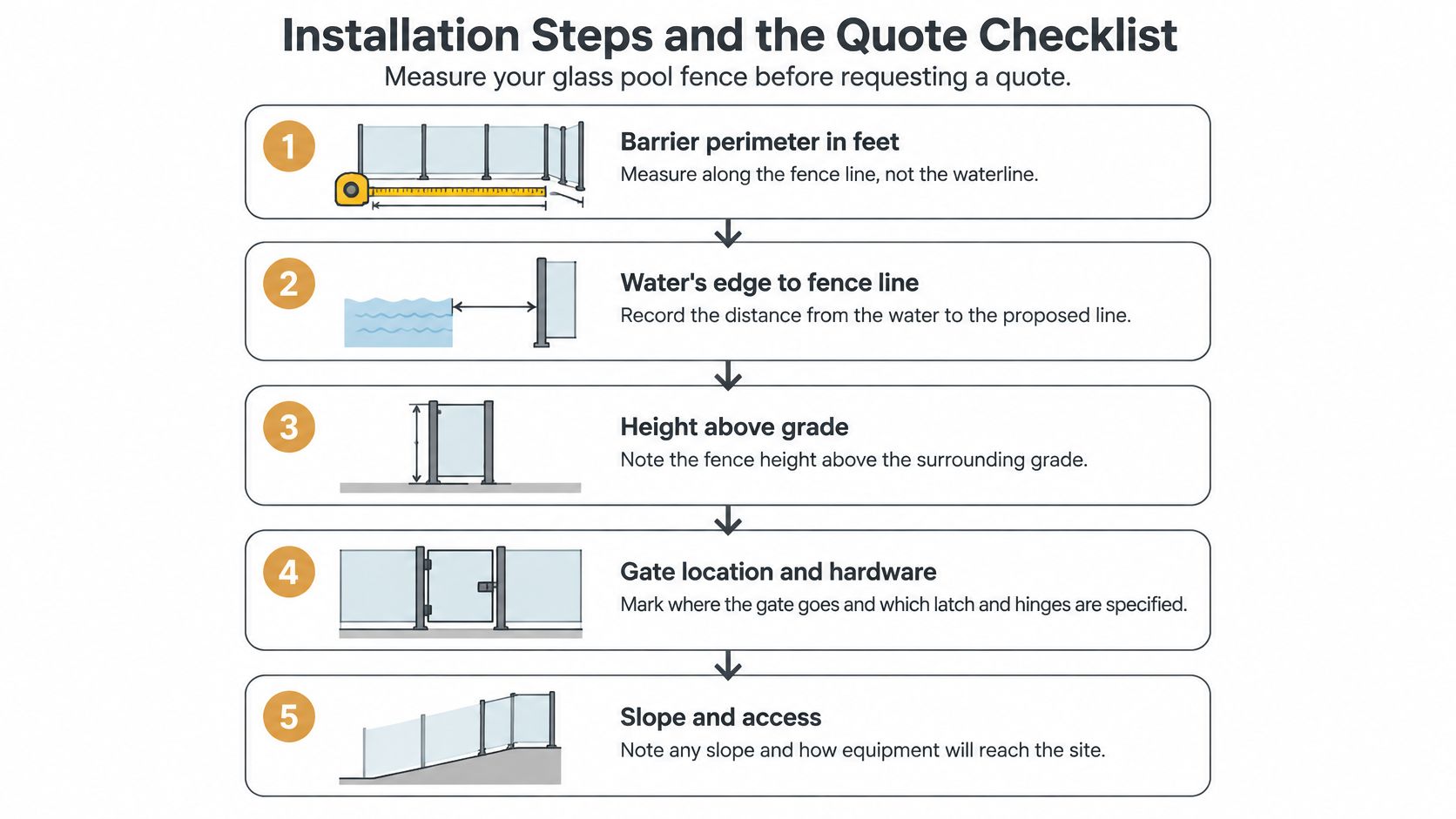
Have these in hand:
Barrier perimeter in feet, measured along the fence line, not the waterline.
Distance from the water's edge to the proposed line.
Height above grade on both sides, especially where the deck drops.
Gates: number, width, and swing direction, away from the water.
Deck material, plus any coping the shoes will land on. If you're still choosing the edge detail, the Tiles Mate pool coping guide from Tiles Mate Pty Ltd is a clear look at how coping meets the water and why that edge has to be flat enough for anchors.
What comes out: old fence or enclosure, and who hauls it.
City: Ottawa or Gatineau, and whether a permit is already issued.
The sequence and what each step costs
Confirm the permit and the minimum spec with the municipality before design. A redraw after someone has already cut glass costs more than a correct first drawing. This step is mostly time, plus the permit fee itself.
Design the layout and choose the system, height, and hardware. Frameless construction and taller panels raise the per-foot rate. Lock those choices here so the quote isn't revised after the glass is ordered.
Issue the quote with separate lines for glass, gates, permits, and site work. If a line is missing, the total isn't comparable.
Remove the old enclosure that sits on the new line. Doing it in the same mobilisation avoids a second call-out.
Set posts or base shoes, drill the anchors, and check level and spacing before the glass arrives. A shoe that's out of line shows up as a gap the sphere test will fail. Fixing it after the panels are on site means idle glass and a return drill.
Hang the glass, install the gate, and test it. The gate has to close and latch on its own from the open position you use, not only from a gentle crack.
Pass inspection and correct what fails. Each correction adds a visit. A latch moved up to 1.35 metres is a small part. A panel that is too short is a new panel.
We handle every detail from design to installation, and our own crew handles every installation. We offer a free estimate. Use the contact form and choose a Material Quote or an Installation Quote, or call (613) 617-4414. Ask for every cost line itemised so you can set it beside the all-in model: measured perimeter times the glass rate, plus gates, the permit, removal, and site work.
FenceScape designs and installs pool enclosures across Ottawa–Gatineau, from the permit-ready layout through glass, compliant gates, and the final walkthrough. If you want a glass pool fence cost built from your measured line rather than a per-foot ad, request a free estimate and we'll itemise the glass, the hardware, and the site work. Visit FenceScape to start with a Material Quote or an Installation Quote.
Comments