
Wrought Iron Railing Outdoor: What to Know Before You Buy

Late March in Ottawa, the porch is grey, wet, and gritty with road salt. You step onto the front landing, put your hand on the railing, and notice whether it feels solid or shifts under your grip. That small moment tells you more than a showroom photograph. An outdoor wrought iron railing has to handle freeze-thaw cycles, wet snow, salt, inspection requirements, and years of ordinary use.
The decorative look matters, but it comes after three practical decisions: the finish system, the code fit, and the maintenance load. A railing that looks excellent in October can begin rusting at a weld after winter if the steel was only painted. A beautiful scroll pattern can also create a climbable guard or leave openings that don't meet Ontario requirements. Here's what I'd look for on a real Ottawa-Gatineau quote.
A Front-Step Reality Check
A front-step railing earns its keep when the surface is slippery and the person using it needs confidence. That includes older homeowners, children carrying school bags, guests arriving in winter boots, and anyone stepping down from a porch while holding a shovel or grocery bag. The railing should feel rigid at the posts, comfortable in the hand, and properly integrated with the steps or deck structure.
The first question isn't whether you prefer a scroll, spear, or square baluster. Ask what happens when the finish gets damaged by salt, abrasion, or a careless shovel. Southern Ontario and western Quebec put outdoor metal through repeated wetting, freezing, thawing, and drying. Road salt and moisture tend to collect at joints, fasteners, base plates, and field-cut edges, which are exactly the places a rushed installation often leaves vulnerable.
Practical rule: If a contractor can't explain how the welds, drilled holes, cut ends, and inside surfaces are protected, the colour sample isn't the important part of the quote.
The phrase wrought iron also needs a reality check. Most new products sold under that name are steel-based interpretations, not hand-forged iron. Ontario's long ornamental metalwork tradition helped preserve the classic appearance, but modern fabrication usually relies on welded steel sections with a protective coating. That can be a sensible choice, provided the steel and finish are specified clearly.
For a different material comparison on steps, review this aluminum railing option for steps. Aluminium may reduce corrosion concerns, while steel gives you a more traditional iron profile and visual weight.
What Wrought Iron Actually Means Today
Traditional wrought iron was shaped by hand and used for items such as handrails, gates, chains, rails, and ornamental ironwork. Mass steel production eventually displaced it for many practical applications, and modern suppliers commonly use steel products that reproduce the old appearance. In everyday quoting, “wrought iron” is often closer to a style category than a precise material specification.
The label suggests a familiar look and use, but it doesn't tell you whether the product is solid, hollow, forged, welded, galvanised, or painted. Two railings can look similar in a catalogue while having very different corrosion resistance and structural behaviour.
An Ottawa buyer might receive a railing made from hollow steel tubing, solid steel bars, flat bar, or a combination of sections. Joints may be MIG-welded, ornamental details may come from a catalogue pattern, and the steel may be galvanised before the finish is applied. Those details affect weight, appearance, repairability, and how moisture behaves inside the assembly.
True hand-forged work is custom, heavy, and labour intensive. Production railings are lighter, welded, and generally more affordable, but a paint-only system carries a much higher maintenance burden in a salted winter climate. I wouldn't reject production steel. I would reject an unclear specification.
Put these questions in writing before approving the design:
What is the core? Is it hollow steel tubing, solid bar, flat bar, aluminium, or a combination?
What happens before painting? Is the complete assembly hot-dip galvanised, or is it receiving only a zinc-rich primer or a factory-galvanised tube?
The answer determines whether you're buying a decorative railing that needs close attention or a properly protected exterior assembly.
Styles That Suit Ottawa-Gatineau Properties
A front step in Centretown, a raised deck in Kanata, and a side entrance in Gatineau face different demands. Choose the railing for the property, the users, and the inspection, then judge the decorative details. In Ottawa winters, scrolls and tight intersections also hold snow, salt, and dirty meltwater, so an attractive pattern can create more cleaning and corrosion points.
A Centretown heritage semi suits a restrained classical baluster or a controlled scroll. A newer Kanata or Orleans home usually looks sharper with flat bar or a glass-top arrangement. Across the river, local character and conservation review may limit how far you can depart from the existing streetscape.
Style | Curb Appeal Fit | Climbability Risk | Code Fit (OBC 9.8) |
|---|---|---|---|
Vertical baluster | Traditional and broadly adaptable | Lower when the pattern stays predominantly vertical | Usually the clearest route to compliant openings |
Decorative scroll | Strong heritage character | Higher where scrolls create footholds or ladder-like gaps | Requires careful spacing and review of negative space |
Flat-bar modern | Suits newer, restrained architecture | Can rise if horizontal bars form continuous footholds | Works when openings, height, and loads are properly resolved |
Glass-top | Contemporary and visually open | Depends on the supporting frame and adjacent rails | Needs a complete guard design, not just a glass panel choice |
Use the 100 mm maximum opening approach for guards, and set stair and ramp handrails between 865 mm and 1,070 mm under Ontario's Building Code provisions in the provincial regulation. Guard height is checked separately. For exterior decks and balconies, the commonly applied thresholds are 900 mm where the walking surface is no more than 1,800 mm above grade, and 1,070 mm above that elevation in this Ontario code guide.
Measure the finished walking surface and grade at every relevant section. On a sloped Ottawa lot, one railing can protect a low landing at one end and a much higher deck edge at the other. A generic height on the quote is not enough.
Horizontal ornament can look elegant in a drawing and still create a ladder effect in person.
Keep horizontal bars and foothold-like scrolls out of locations used by children. Check tight intersections for trapped salt and water, especially around repaired welds and ornamental joints. Vertical patterns are easier to rinse and inspect. Flat-bar designs suit modern homes and shed winter grime more readily, while elaborate scrollwork demands closer seasonal attention.
Matte black remains the safest visual choice for many masonry homes. Bronze works better with warm brick or limestone. Choose the colour after deciding how much detail you are prepared to maintain.
Finish Systems That Survive Canadian Salt
Salt corrosion is the first technical question, not an afterthought. In Southern Quebec, wet snow, road salt, freeze-thaw cycles, and long moisture dwell times at joints and fasteners can break down a coating. Once the finish is breached, corrosion can spread quickly around welds and cut edges as outlined in this outdoor handrail guidance.
A durable specification has layers:
Prepare the steel. Remove mill scale, oil, dirt, and corrosion so the coating can bond to a clean surface.
Hot-dip galvanise the assembly. Canadian procurement references identify CAN/CSA G164 for zinc coating on irregularly shaped articles and ASTM A123/A123M for zinc-coated iron and steel products in this Canadian fencing specification reference.
Repair vulnerable areas. Drilled holes, field cuts, repaired galvanised areas, and weld zones need compatible restoration so the sacrificial zinc protection isn't interrupted.
Apply the finish coat. A powder topcoat adds the colour and a further barrier, but it can't compensate for poorly prepared or unprotected steel beneath it.
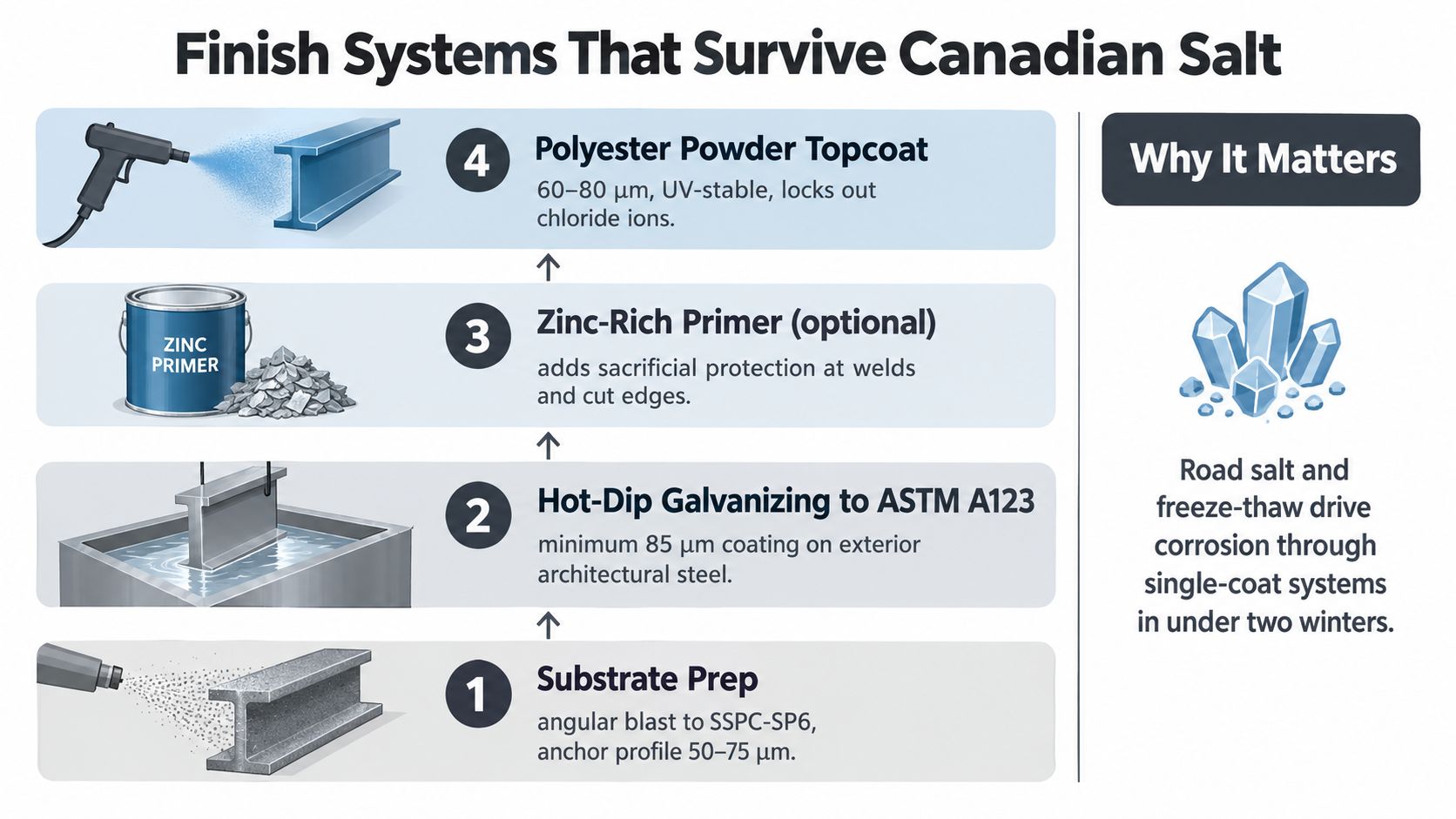
The weak alternatives are easy to identify. A single enamel coat can look fine at installation and fail at scratches. Zinc-rich paint can be useful for repairs, but it isn't the same as immersing the prepared assembly in molten zinc. Pre-galvanised tubing may protect the outside while welds and drilled locations remain exposed. Hollow sections also deserve attention, because trapped moisture inside an unprotected tube can become a hidden corrosion problem.
For general metal-paint background, this guide to the best paint for Irish weather sheds is useful because it reinforces a basic principle: exterior metal needs a coating selected for moisture and weather exposure, not ordinary interior paint.
Ask for a quote that names the galvanising standard, the powder-coat system, the repair method for damaged zinc, and the written inspection or warranty period. Product names such as Tiger Drylac or Axalta can identify the powder supplier, but the brand alone doesn't prove good preparation. If you want an overview of the local powder-coating process, see this Ottawa powder-coating resource.
Code, Permits, and Pool-Deck Safety
A railing can look right on a drawing and still fail inspection at the property. On an Ottawa-area quote, confirm the height, opening pattern, and intended use before anyone orders steel. Ontario distinguishes a stair handrail from a guard protecting a drop. The provincial regulation sets a handrail range of 865 mm to 1,070 mm for stairs and ramps. Exterior guards commonly measure 900 mm at lower deck elevations and 1,070 mm where the walking surface is higher under the Ontario guidance cited above.
Opening size needs the same attention. A 100 mm sphere must not pass through guard openings where the applicable code provisions apply. Measure the finished design, including the negative space inside scrolls and decorative panels. A sketch showing baluster spacing is not enough if the welds, collars, or scroll intersections change the actual gap.
Test the design before fabrication
Stand beside the proposed guard and inspect it from a child's viewpoint. Horizontal rails, scroll intersections, and decorative ledges can create footholds. Vertical balusters usually reduce that risk, but the complete pattern still has to meet the applicable requirements. Ask the fabricator to confirm the finished opening dimensions, not only the centre-to-centre baluster spacing.
Pool work has stricter practical demands. The enclosure and gate must limit easy access, while the gate commonly requires self-closing and self-latching hardware. A front-step railing is not a pool barrier. Use this wrought iron pool fence guide to compare the safety priorities for pool enclosures.
Plan for the property, not just the railing
Permit requirements depend on the municipality, project scope, property location, and heritage controls. Check before fabrication if the railing crosses a property line, changes a shared boundary, or sits within a heritage overlay. Lowertown West, Sandy Hill, and the Plateau may involve different review expectations, so get the process confirmed in writing.
For an Ontario pool project, review this pool safety fence guidance for Ontario. Have the installer record the gate, latch, opening, and climbability decisions. Also ask who will correct a failed inspection and whether repaired welds or field modifications receive the specified corrosion protection. That paperwork matters when winter salt reaches exposed steel.
Maintenance Through the Four Seasons
A powder-coated and galvanised railing still needs care. The coating reduces corrosion exposure, but salt film remains abrasive and moisture still finds weak points at joints, anchors, and base plates. Canadian conservation guidance also stresses the importance of controlling moisture conditions and protecting iron once corrosion begins in this care guidance from the Canadian Conservation Institute.
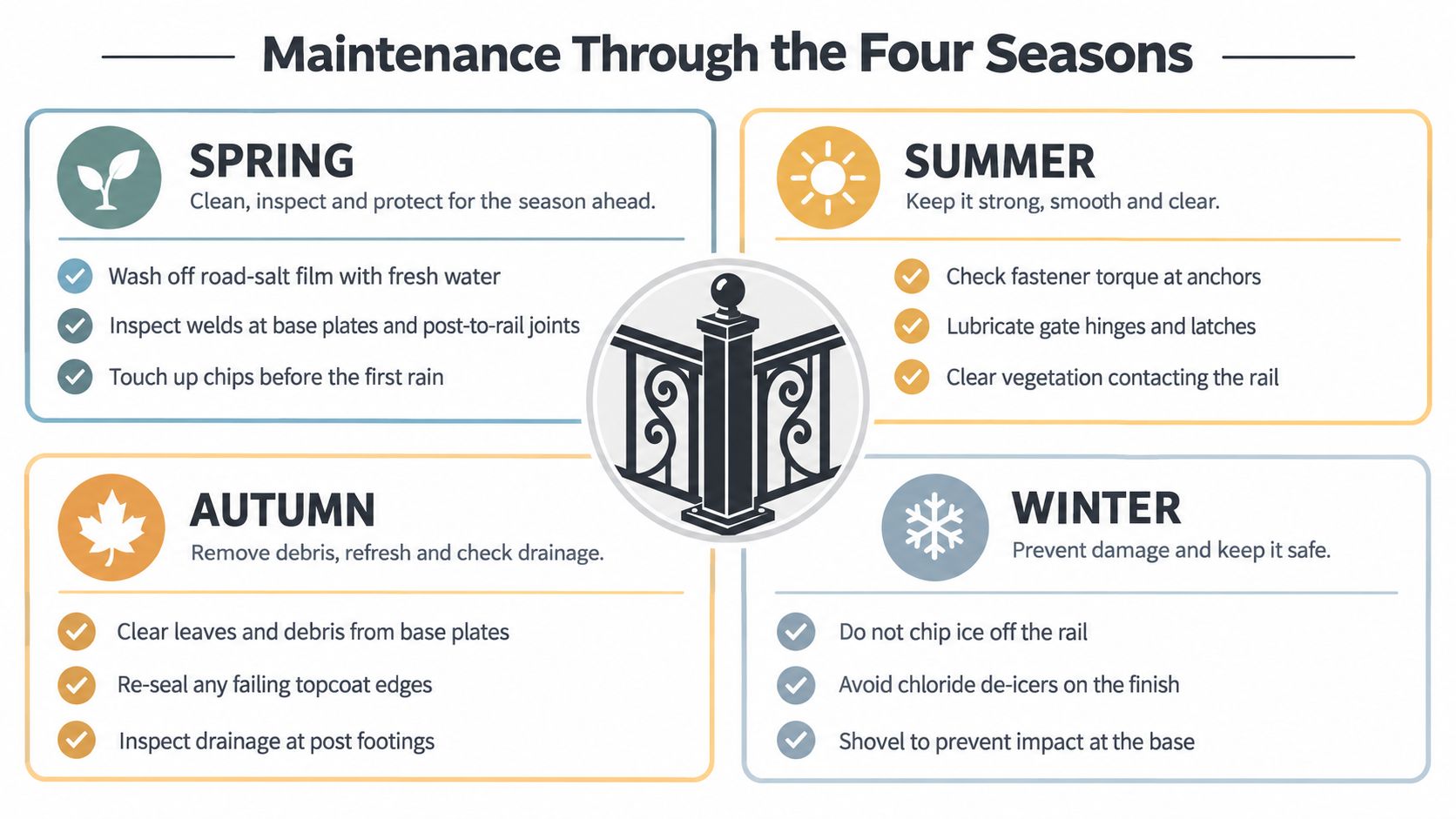
Use the weather as your schedule:
Spring: Rinse away road-salt film with fresh water. Inspect welds, base plates, post-to-rail joints, fasteners, and any white corrosion residue. Touch up chips before repeated rain reaches bare steel.
Summer: Wash with mild soap and water, then dry the railing. Check for loose sections, damaged coating, and gate hardware. Keep sprinklers and dense vegetation from wetting the metal continuously.
Autumn: Clear leaves and soil from post-to-deck interfaces. Check whether sealant has separated around base plates and whether water can drain away from the footing.
Winter: Keep chloride de-icers away from the railing wherever possible. Shovel carefully so tools don't strike the finish, and inspect after major freeze-thaw swings.
Don't pressure-wash an older railing with peeling coating. Strong water can force moisture into joints and lift damaged paint. Hand washing gives you control around welds and decorative details.
A full hot-dip galvanising and powder-coat system should be evaluated as a long-term maintenance choice, not a no-maintenance promise. A primed-and-painted system usually demands earlier touch-ups and closer inspections in Ottawa-Gatineau conditions. Your quote should state who handles coating repairs, which touch-up product is approved, and what damage is excluded from the finish warranty.
Matching Railing to Property and Use
A residential front step doesn't need the same profile as a school entrance or pool deck. The right choice depends on traffic, impact, appearance, inspection requirements, and how much maintenance the owner will handle.
Property Type | Recommended Style | Finish Minimum | Key Code Focus |
|---|---|---|---|
Residential front steps | Vertical baluster, restrained scroll, or flat bar | Galvanised steel under a suitable exterior topcoat | Handrail height, guard height, openings, secure anchorage |
Heritage home | Sympathetic classical pattern with controlled ornament | A durable protective system that preserves the chosen colour | Heritage review, guard geometry, opening limits |
Commercial or institutional site | Robust, simple vertical or flat-bar profile | Documented exterior coating and repair procedure | Loads, openings, public use, inspection documentation |
Pool deck | Climb-resistant vertical design with compliant gate hardware | Corrosion-resistant system suited to splash and salt exposure | Barrier continuity, gate closing and latching, openings |
Residential owners often overbuy ornament. A modest front landing may look better with a clean vertical pattern that doesn't trap leaves or create footholds. A heritage property may justify custom details, but the extra fabrication and maintenance become part of the price.
Commercial and institutional work deserves written fabrication and inspection documentation. The railing receives more contact, more cleaning, and less forgiving public use. Simpler geometry usually makes damage easier to spot and repairs easier to organise.
Pool owners should spend less time on scroll profiles and more time checking the complete barrier. The gate, latch, transitions, and adjacent structures all matter. Across the river, confirm which Quebec requirements apply to the property before ordering a design based on an Ontario assumption.
The trade-off is straightforward. More ornament increases visual character and usually increases cleaning effort. More exposed steel and more joints increase the number of places where salt and moisture can attack the system. Choose complexity only where the property benefits from it.
A Short Decision Checklist Before You Sign
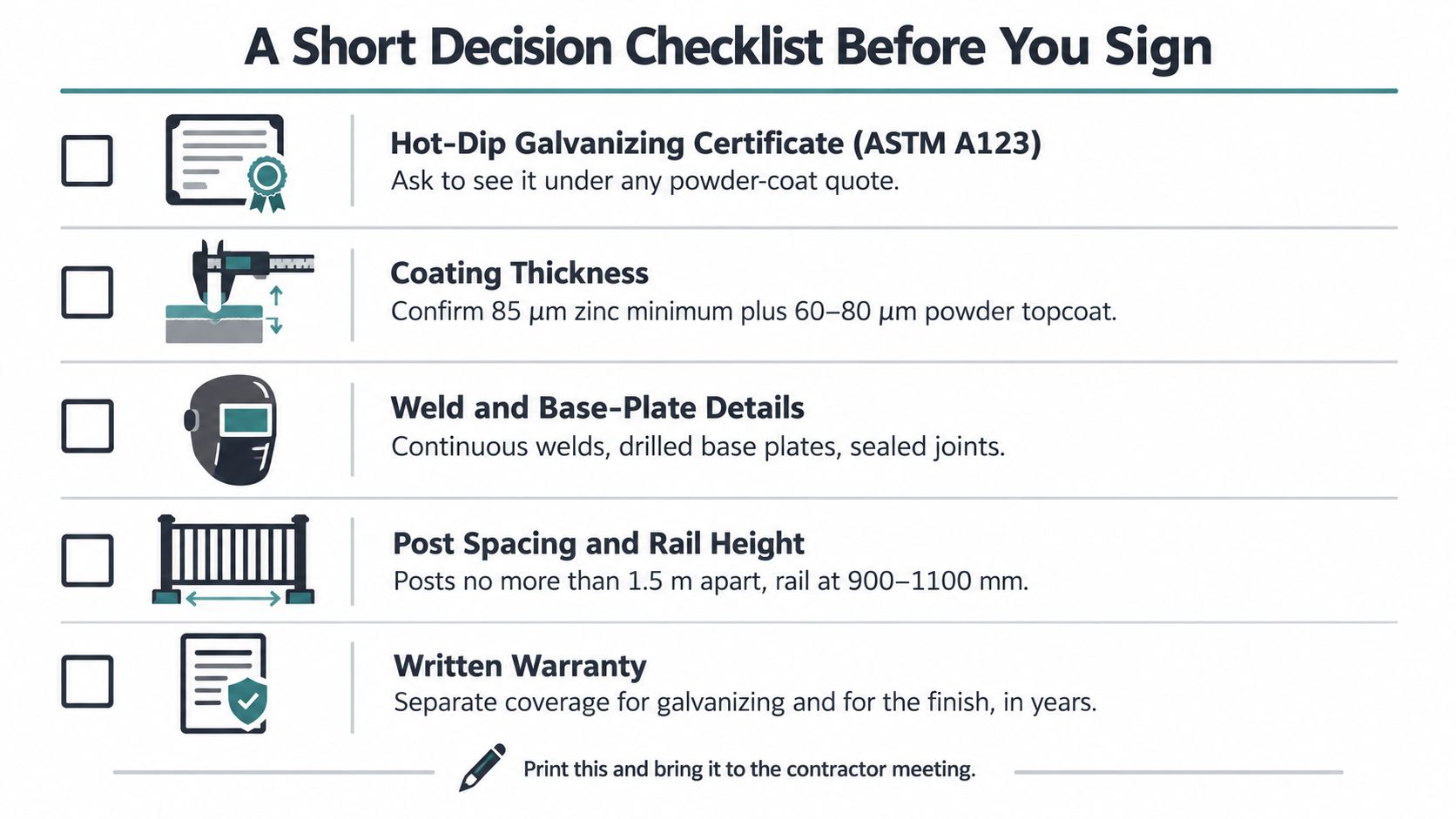
Take these questions to the quote meeting and require written answers. A contractor should explain the railing assembly, not sell you on a colour sample.
Confirm the galvanising method. Ask for proof of hot-dip galvanising beneath the powder coat and the applicable standard. A cold spray, paint-only system, or vague “galvanised finish” does not give you a fair comparison.
Verify every measurement. Confirm handrail and guard heights for each stair, landing, deck, and balcony. Ontario guidance separates handrail height from guard height, and guard openings must stay within the 100 mm limit as described in the provincial requirements.
Inspect the weld plan. Ask how welds, drilled holes, field cuts, and damaged galvanised areas will be protected. Each exposed repair point needs a defined treatment before coating. Powder coat alone is not a repair procedure.
Define the finish in writing. The quote should name the surface preparation, galvanising process, powder-coat product or system, colour, touch-up method, and warranty conditions. “It will last” provides no protection when a chip exposes steel to Ottawa road salt.
Compare materials on equal terms. Price the same design in galvanised steel, aluminium, and other suitable options. A lower starting price may require more maintenance, while heavy custom steel can add appearance without adding value to the property.
For Ottawa or Gatineau, put the budget into corrosion protection and installation accuracy before adding ornate scrollwork. The hidden preparation determines how the railing handles winter salt.
FenceScape can provide site measurements, ornamental iron installation, galvanised or powder-coated options, and code-related details for a real quote. Visit FenceScape to request an estimate for a design and finish system suited to Ottawa-Gatineau winters.
Comments