
Chain Link Fence Materials: A Complete Canadian Guide

You're comparing rolls of chain link at the supplier, and the labels seem simple enough: galvanized or black, light or heavy, standard mesh or small mesh. Then the quote arrives, and you realise the fence isn't one product at all. It's a system of fabric, posts, rails, fittings, gates, and concrete footings.
For a backyard in Ottawa or a commercial yard in Hamilton, the practical choice is to specify every part separately. Canadian freeze-thaw cycles, road salt, snow loading, and frost movement expose weak posts and cheap fittings long before a buyer notices a problem with the colour.
The Two-Minute Reality Check Before You Choose Chain Link
A common chain link callback starts with a bargain roll bought from a rack. The homeowner chooses the lightest fabric, uses undersized framework, buries the posts in a shallow footing, and assumes the concrete will compensate for everything else. It won't.
The first visible problem is often a loose bottom edge or sagging fabric. Then the top rail starts to bow, fittings loosen, and a terminal or gate post shifts when the ground moves. The fence may still look acceptable from a distance, but the structure has already lost its tension.
Practical rule: A low price for fabric doesn't make a weak framework acceptable. The posts and footings carry the fence.
Before you compare colours or ask about privacy slats, get these items written into the quote:
Fabric: mesh opening, wire gauge, wire diameter, and zinc or vinyl coating.
Framework: line posts, terminal posts, gate posts, top rail, and brace rails.
Fittings: tension bands, brace bands, rail caps, tie wire, bolts, nuts, and tension wire.
Gates: frame size, hinges, latch, stops, and whether the gate needs self-closing hardware.
Foundations: hole dimensions, concrete placement, drainage, and finishing around each post.
Ontario public works specifications show why this detail matters. OPSS.PROV 1541 specifies chain link fabric widths of 1,200 mm or 1,800 mm, a uniform 50 mm diamond mesh, galvanized steel or roll-formed steel framework, and matching vinyl coating when vinyl-coated fabric is used. It also specifies 4.50 mm top, bottom, and diagonal wire, a minimum Class 5 galvanized coating for those wires, and hot-dip galvanized hardware.
That is the material list a buyer should have before requesting prices. In Ottawa, Hamilton, or anywhere else with winter ground movement, the sensible question isn't “Which roll is cheapest?” It's “Which complete assembly will stay aligned after the ground moves?”
Mesh, Gauge, and Wire Diameter: Three Measurements That Matter
Chain link buyers need to specify three separate measurements before they compare quotes. Mesh size is the diamond opening. Wire gauge is the wire's thickness in a numbering system, where a lower gauge usually means heavier wire. Wire diameter is the actual thickness of that wire, usually stated in millimetres.
Gauge tells you how much steel is in the fabric. Heavier wire stands up better to bending, contact, and abuse. Wire diameter gives you the physical measurement to check. Mesh size is different, because it describes the opening, not the steel.
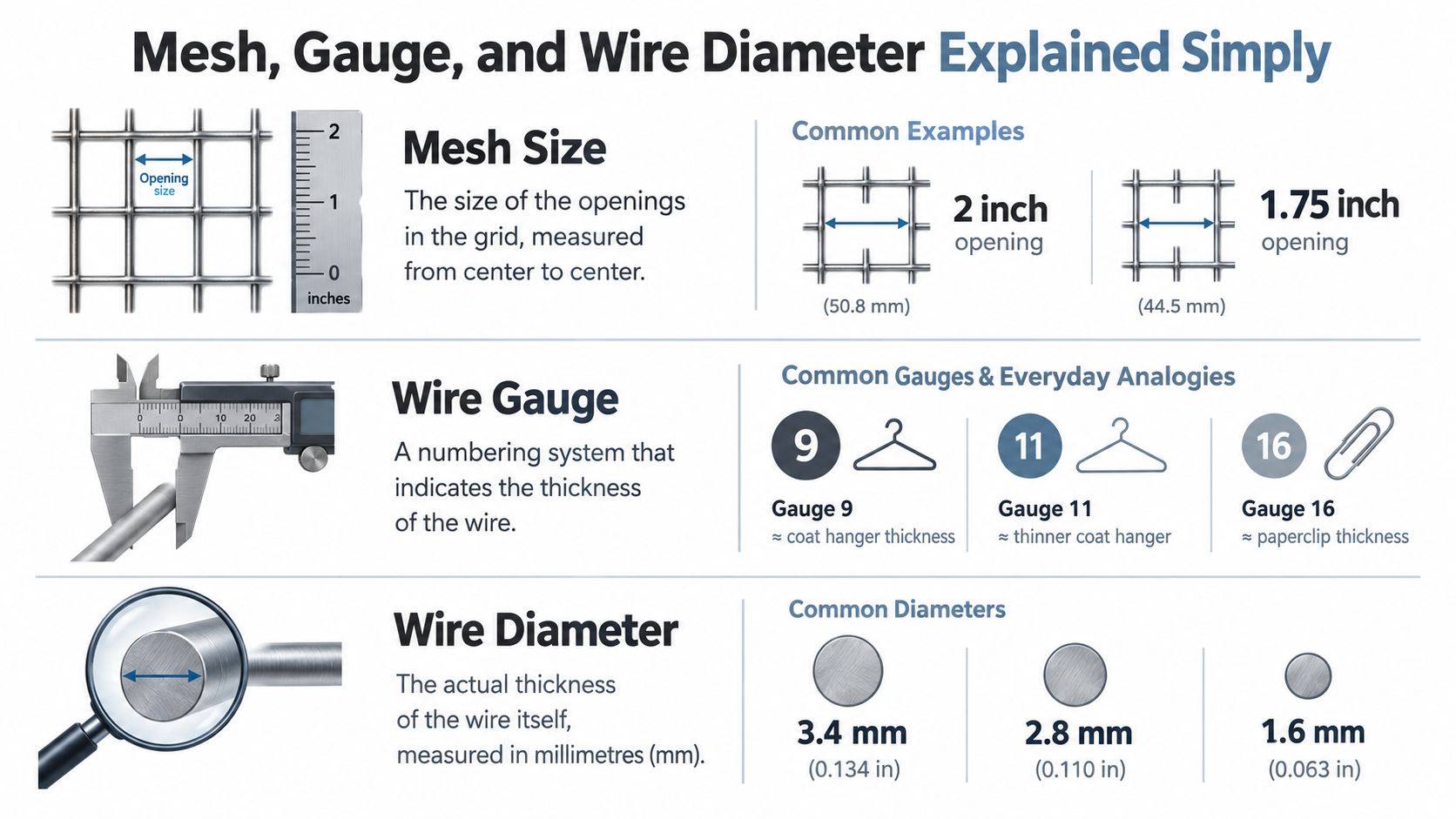
Start with the opening
A larger diamond is cheaper and works for a simple boundary or visual enclosure. A smaller opening is harder to climb through and leaves less room for a pet to force its way through.
Ontario public works fabric commonly uses a 50 mm diamond-pattern mesh, while pool enclosure rules can require openings no larger than 38 mm. Hamilton's swimming-pool enclosure checklist permits 12-gauge galvanized wire or 14-gauge wire with vinyl or another approved coating that provides total thickness equivalent to 12-gauge galvanized wire.
For the deeper breakdown of opening size and how it affects the fence spec, see our chain link fence mesh guide.
Then choose the wire weight
For a normal backyard in Ottawa or Hamilton, do not choose fabric by colour alone. Put the gauge and actual wire diameter on the quote. A pet run, a boundary fence, and a commercial security perimeter do not put the same demand on the mesh.
Heavier wire makes sense where children, pets, equipment, snow clearing, or repeated contact will push against the fence. Lighter fabric can work for a low-contact boundary, but it shifts more of the job onto the framework and fittings.
Finally, verify the coating
A zinc coating protects steel from corrosion. A vinyl finish adds colour and another layer of protection, but it does not make up for undersized posts, damaged edges, or poor installation. Canada's federal fabric standard allows zinc-coated wire to be electrolytically galvanized or hot-dip galvanized, while vinyl-coated fabric must start with galvanized steel wire and receive its vinyl coating before weaving, as described in the CAN/CGSB chain link fabric standard.
The minimum backyard spec should name mesh opening, gauge, wire diameter, coating type, and framework coating. If a quote only says “black chain link,” it is not specific enough to compare.
The Anatomy of a Chain Link Fence and What Each Part Does
A chain link fence is a kit, and every part has a separate job. Fabric provides the enclosure. Posts hold the geometry. Rails and braces resist movement. Fittings transfer tension into the framework. Gates create the moving opening, and concrete footings keep the entire assembly in the ground.
The chain link fence parts guide is useful vocabulary for reading a quotation, but the buyer still needs to ask how each part is coated and sized.
The five component families
Fabric is the woven steel mesh. It may be zinc-coated or vinyl-coated over galvanized wire. The fabric should match the use, particularly where a pool enclosure or controlled-access site requires a smaller opening.
Framework includes line posts, terminal posts, gate posts, top rails, and brace rails. Posts and rails are normally steel pipe or roll-formed steel shapes. Terminal and gate posts deserve more attention than line posts because they absorb tension, hinge loads, and movement at corners and ends.
Fittings include tension bands, brace bands, rail caps, tension bars, tie wires, bolts, and nuts. These pieces are small, but they connect the loads. Poor fittings loosen at joints, rust at damaged coatings, or fail to hold the fabric tight.
Gates need their own specification. A gate frame must stay square under its own weight, and hinges, latches, stops, and hardware must suit the opening and the security requirement.
Foundations are the buried part of the fence. Concrete, soil conditions, drainage, and finishing around the post determine whether the visible structure stays straight.
Component | Material / Coating | Applicable Standard | Where It Fails First |
|---|---|---|---|
Fabric | Galvanized or vinyl-coated steel wire | CAN/CGSB chain link fabric requirements | Cut edges, damaged coating, and loose tension |
Posts and rails | Galvanized steel pipe or roll-formed steel shapes | OPSS and CAN/CGSB framework requirements | Footings, joints, and exposed coating damage |
Fittings | Hot-dip galvanized steel hardware or matching coated hardware | Project specification and Canadian framework requirements | Rail connections, bands, bolts, and ties |
Gates | Steel frame with compatible hinges and latch hardware | Gate requirements should be stated separately | Hinge alignment, latch operation, and gate posts |
Foundations | Concrete-set steel posts | Site and project installation requirements | Frost movement, water collection, and leaning posts |
Ontario's public works specification references CAN/CGSB-138.1-96 for fabric, CAN/CGSB-138.2-96 for steel framework, and CAN/CGSB-138.4-96 for gates. The federal standards apply commercial and industrial chain link work to material quality and workmanship, and require steel framework components, apart from normally used aluminium components, to receive hot-dip zinc coating, as set out in the Canadian framework and installation standards.
Galvanized Versus Vinyl-Coated in Canadian Climates
Galvanized chain link is the straightforward workhorse. Vinyl-coated chain link adds colour and a softer visual finish, but it still depends on galvanized steel beneath the coating. The right decision is about the full assembly, not whether the fabric looks more finished on delivery day.
Road splash, salt, abrasive snow, and repeated contact at the bottom edge all expose weak coating and weak hardware. A vinyl surface can be a good choice where appearance matters, but a vinyl finish won't repair an undersized gate post or a footing that moves.
Attribute | Galvanized (Class 2) | Vinyl-Coated (Fused & Bonded) | Galvanized (Class 1) | Vinyl-Coated (Extruded) |
|---|---|---|---|---|
Finish | Metallic zinc appearance | Integrated coloured coating | Metallic zinc appearance | Coloured coating over galvanized wire |
Main advantage | Simple, serviceable, easy to inspect | Strong visual finish with bonded coating | Basic corrosion protection | Colour and layered protection |
Main concern | Visible weathering and coating damage | Coating damage can expose the underlying wire | Not enough detail by itself for a harsh site | Must be checked for coating quality and compatibility |
Best buying question | What zinc coating and wire specification are included? | What galvanized core and coating process are included? | What does the class mean in this quote? | Is the coating applied before weaving and to what specification? |
Canada's chain link materials standards distinguish the fabric, steel framework, installation, and gates rather than treating them as one generic product. That matters in Ontario because the highest corrosion risk often sits at framework, fittings, cut edges, and joints. Galvanized chain link guidance can help buyers compare finishes, but the quote should still identify every component.
For a backyard pet enclosure, choose a properly tensioned galvanized system when appearance is secondary. Select vinyl-coated fabric when the fence borders a finished outdoor area or the colour is important, but keep the framework and fittings matched.
For a pool enclosure, follow the local opening and gate requirements first. In Hamilton, the mesh opening must be no more than 38 mm, and horizontal rails must be galvanized or vinyl-coated steel with a minimum 32 mm diameter, according to the municipal checklist linked earlier.
For a commercial yard, prioritize heavier framework, durable galvanized protection, and compatible hot-dip galvanized hardware. Vinyl can suit a public-facing property, but don't downgrade posts or fittings to obtain a particular colour.
For hockey-rink boards or other high-contact locations, specify the assembly for impact and maintenance access. A decorative coating is secondary to a strong frame, secure fittings, and fabric that can be retensioned or repaired.
Canadian and Ontario Standards That Actually Change Your Spec
Standards become useful when they change the wording on your purchase order. Don't ask for “commercial chain link” and assume everyone means the same thing. State the mesh, wire, coating, framework, hardware, and gate requirements separately.
Ontario public works specifications require fabric in defined widths and a uniform 50 mm diamond mesh. They also require galvanized steel framework, matching vinyl coating where vinyl fabric is used, 4.50 mm top, bottom, and diagonal wire, a minimum Class 5 galvanized coating on those wires, and hot-dip galvanized bolts, nuts, and wire ties. Metrolinx requires chain link material standards to follow the latest OPSS.PROV 772 and 1541 revisions, so public and institutional work needs current project documentation rather than a generic retail description.
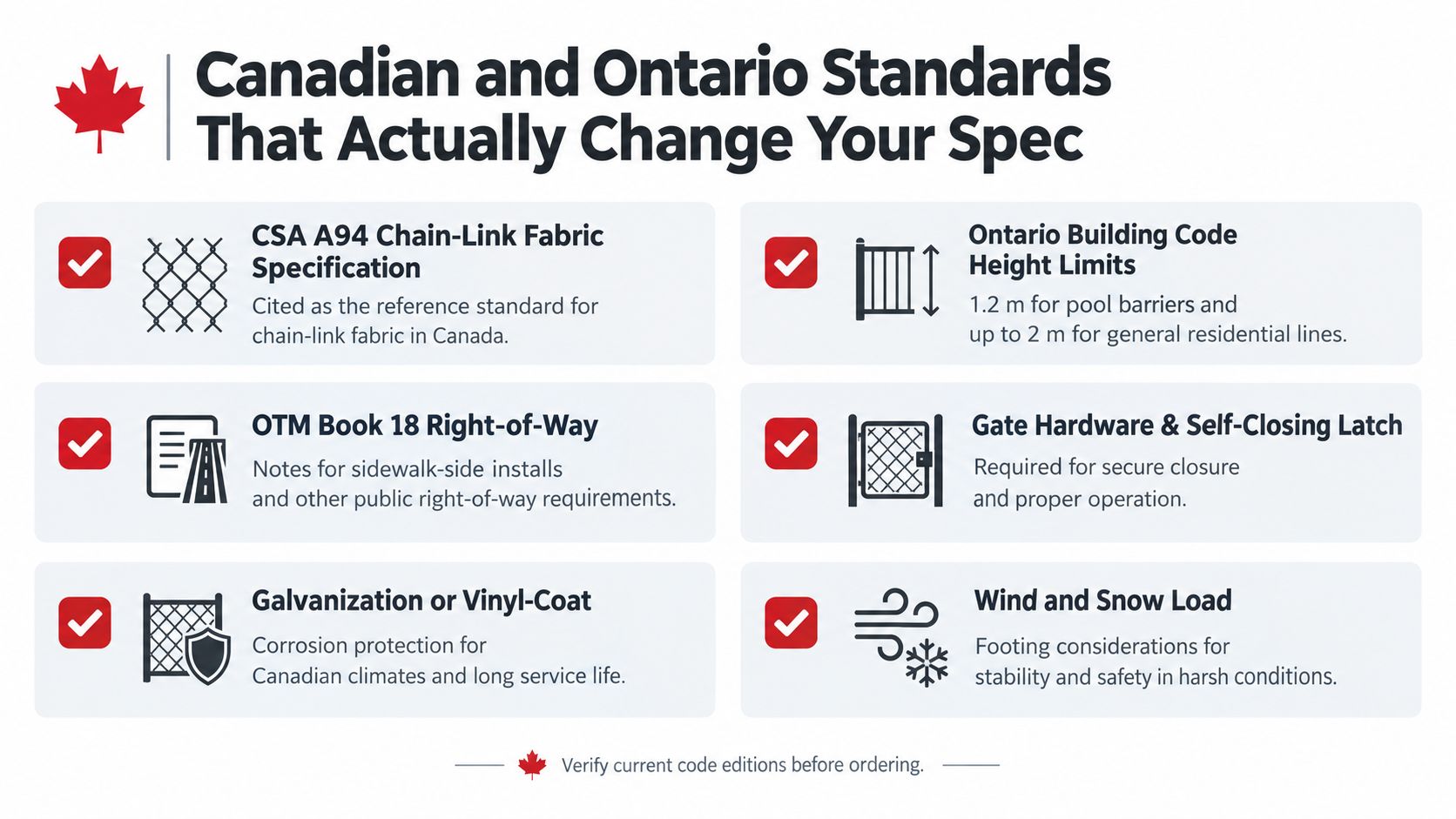
Write the material requirements plainly
A useful specification should answer these questions:
What opening is permitted? General chain link work may use a larger opening than a pool enclosure. Don't let a standard residential roll substitute for a regulated barrier.
What wire is included? State gauge and diameter, not just “heavy duty.”
What protects the steel? Identify zinc coating, vinyl coating, and whether the framework receives the same finish as the fabric.
What are the posts? Name the material, coating, schedule, spacing, and concrete footing requirements.
What does the gate need to do? Pool and access gates may require self-closing and self-latching operation. Confirm the current local rule before ordering.
Hamilton's pool checklist accepts the galvanized or coated wire combinations described above and requires rails with a minimum 32 mm diameter. East Gwillimbury's pool-enclosure by-law also limits mesh openings to 38 mm, requires posts spaced no more than 3 metres apart, calls for concrete embedment of at least 1.2 metres below grade, and specifies horizontal rails at least 3.8 cm in diameter, as stated in the East Gwillimbury pool-enclosure by-law.
For a homeowner, the action is simple. Give the contractor the site purpose and ask for a written compliance check. For a procurement officer, require the supplier to identify the applicable Canadian or Ontario standard beside each material line.
What Chain Link Costs Per Foot in Canada
Chain link pricing starts with parts, not a single fence. Fabric gauge, coating, post size, rail weight, fittings, gates, soil, access, and installation all change the final quote. A straight backyard run in Ottawa is a different spec from a commercial yard in Hamilton with corners, gates, removal work, or hard digging.
Installed chain link fencing in Canada is commonly planned around $15 to $45 per linear foot nationally, according to this Canadian chain link fence cost calculator. Use that range for budgeting. It is not a material-only number, and it tells you nothing about how much of the job is steel, coating, hardware, or labour.
For material planning, separate the system into pieces. Fabric is one line item, framework is another, and gates are never an afterthought.
Specification Tier | Material-only planning range | What should drive the spec |
|---|---|---|
Basic galvanized residential system | Lower cost, depends on supplier and length | Use standard galvanized fabric, posts, and rails where the site is simple and load is light |
Heavier galvanized framework | Higher than basic galvanized | Put money into stronger terminal and gate posts before you chase appearance upgrades |
Vinyl-coated residential system | Higher than basic galvanized | Match the coating across fabric and framework, or the fence looks mismatched and ages unevenly |
Commercial security assembly | Highest of the common tiers | Specify fittings, gate hardware, and heavier components separately, especially for access points |
Material-only fabric planning | Commonly priced by roll, not by finished fence | Ask for the fabric grade, coating, and wire diameter on the quote so you know what you are buying |
Spend the upgrade money where the fence carries load
A fence fails at the weak link. Stronger terminal and gate posts, properly coated fittings, sound concrete footings, and accurate tensioning usually matter more than a prettier finish.
Ask for separate line items for fabric, posts, rails, fittings, gates, concrete, removal, and installation. If you get one blended price, you cannot tell whether the contractor saved money through efficient labour or by trimming the post and hardware spec.
Start with the structure. Confirm terminal posts, gate posts, rails, and footings first. Match the coating second, so the fabric and framework age at the same rate. Choose heavier fabric only after the structure is right, especially where pets, equipment, impact, or security pressure the fence. Price gates separately, because a gate can change the labour and post requirements more than a small fabric upgrade.
Installation Details That Decide Whether the Fence Survives Winter
The visible mesh gets attention, but the buried posts determine whether the line survives winter. A fence can use quality chain link fence materials and still fail if the footing collects water, the post is too shallow, or the fabric is installed with slack.
Set posts for the ground
East Gwillimbury's pool-enclosure by-law provides a concrete local benchmark, requiring posts to be embedded at least 1.2 metres below grade for that application. Use the applicable municipal and project requirements for the site, and treat terminal and gate posts as structural points rather than ordinary line posts.
The concrete should fully support the post and finish so meltwater doesn't sit around the steel. A low, unfinished footing leaves a depression that holds water and encourages movement at the most vulnerable part of the installation.
Keep the line straight and dry
Seat the top rail fully in its caps and keep the run aligned through corners and gates. Grade the top rail and concrete finish so water moves away from gates and post collars instead of collecting at joints.
Install the fabric with a proper stretcher or come-along. Pull the mesh tight, set the tension bar and bands, then attach the fabric with properly coated ties. Stretching by hand leaves slack, and slack turns into sag when snow, ice, or pets push against the fence.
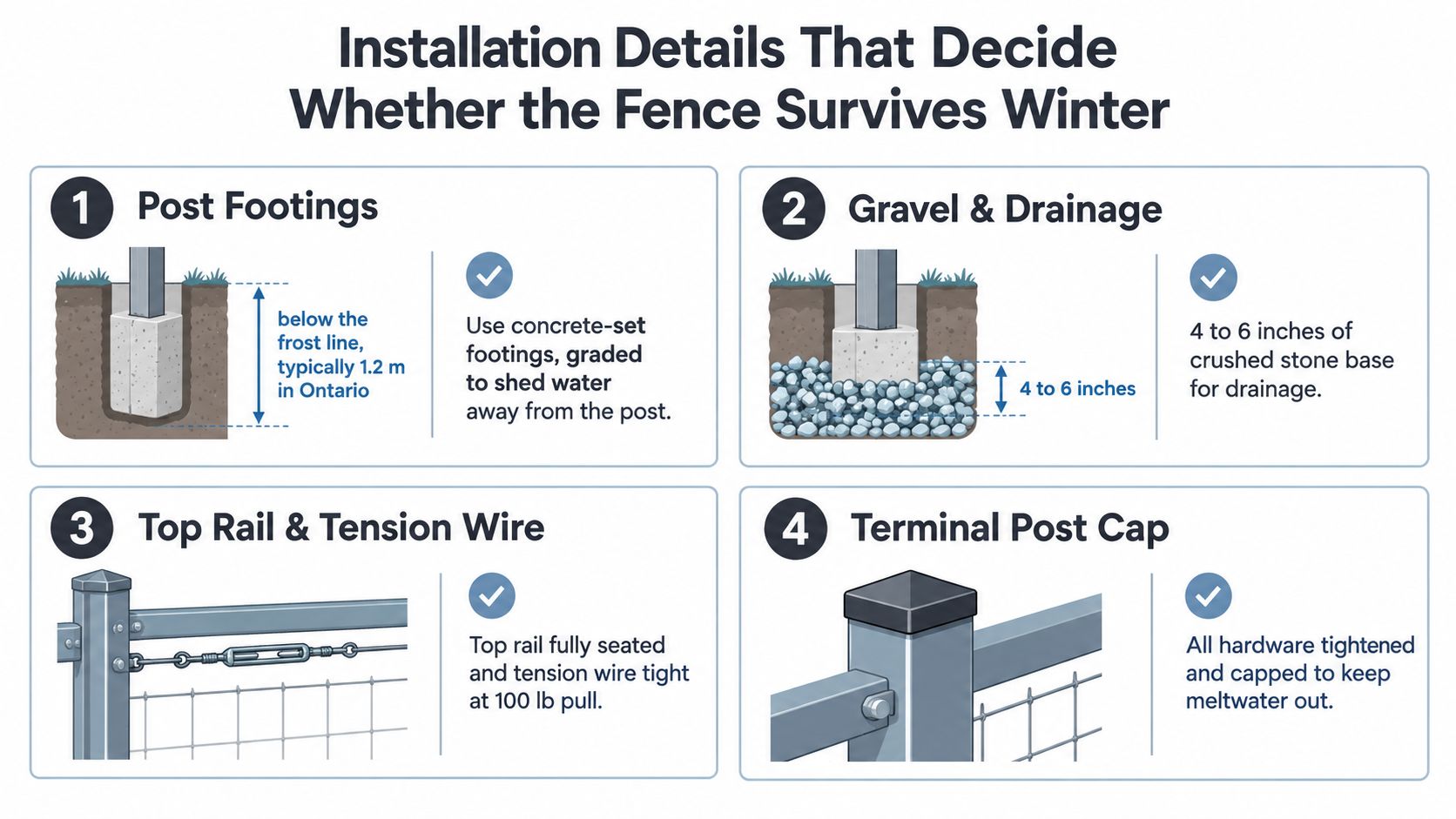
The most common shortcuts are shallow holes, dry-mixed concrete left below grade, loose rail fittings, and fabric attached before the structure is fully aligned. Each one transfers movement into the next component instead of letting the complete system share the load.
The installation sequence below shows the basic order, but a site with frost-sensitive soil, slopes, rock, or gates still needs a project-specific footing decision.
Contractor's preference: Spend on the post, the footing, and the connection hardware before spending on a decorative finish.
Choosing the Right Spec for Your Project
Three decisions drive a useful chain link quote: fabric gauge and coating, post and footing strength, and gate frame and hardware. A contractor should be able to write each decision into the proposal instead of leaving you with a colour name and a total price.
For an Ottawa or Hamilton backyard, start with a medium-to-heavy galvanized fabric selected for the actual pet, boundary, or access requirement. Pair it with properly sized line, terminal, and gate posts, concrete footings suited to the soil, and galvanized fittings. Choose vinyl when the finished colour matters, but require the framework to match the fabric's coating class.
A commercial yard needs a heavier assembly, especially at corners, gates, loading areas, and equipment routes. Ask for the applicable OPSS or CAN/CGSB references, the wire diameter, coating details, post specification, rail specification, and hardware finish.
A pool enclosure is a compliance project, not a colour decision. Start with the local mesh opening, rail, post, gate, self-closing, and self-latching requirements, then price the complete system.
Before accepting a quote, ask: Is this a backyard enclosure, a pool barrier, a pet run, or a commercial perimeter? That answer tells the installer which spec sheet to build.
FenceScape supplies and installs chain link fencing in the Ottawa–Gatineau region, including galvanized and black vinyl options, and can help match fabric, framework, fittings, gates, and footings to the site. Visit FenceScape to discuss your project and request a quote based on a complete material specification rather than a price for fabric alone.
Comments