
10 Pool Fence Ideas for Ottawa–Gatineau Yards

A pool is ready for summer, but the fence decision still isn't. You need to see children in the water, keep the gate reliably self-closing and self-latching, preserve some privacy, and choose materials that can handle Ottawa–Gatineau winters without turning the yard into an eyesore. The right pool fence ideas begin with the site layout and current municipal requirements, not with a photo saved from a design gallery.
Use a practical decision lens: visibility, privacy, upkeep, budget, permanence, seasonal durability, and installation complexity. A removable or electronic system may support safer routines, but it shouldn't replace a required physical barrier. Quebec guidance requires outdoor basins deeper than 60 cm to be enclosed, with the enclosure at least 1.2 m high, while local rules can differ across Ottawa, Gatineau, and surrounding municipalities. Confirm the current standard before ordering materials through Quebec's residential pool safety guidance.
FenceScape is a relevant local option when you need help planning the route, selecting weather-resistant materials, coordinating installation, and handling post-install support. These ten barrier concepts show what each style does well, where it creates problems, and how to turn the look into a safer, more workable design.
1. Removable Aluminum Pool Fence Panels with Self-Closing Gates
Removable aluminum panels suit homeowners who want a defined pool barrier without committing every part of the yard to a permanent enclosure. The open vertical design keeps supervision straightforward, and the modular layout can work around a patio, garden bed, or uneven edge more easily than a rigid full-perimeter system. It also gives seasonal flexibility, provided the system remains installed whenever the pool requires protection.
The gate deserves more attention than the panel colour. Choose a self-closing, self-latching arrangement with durable hardware rated for wet, freezing conditions, and position the latch where children can't easily defeat it. Quebec guidance requires the latch inside the enclosure in the upper part of the gate, and the enclosure must prevent a 10 cm sphere from passing through openings or beneath it. The province's pool safety rules explain those measurable details.
Make removability work in real use
Removable doesn't mean casual. Mark post locations, keep spare hardware on site, and remove panels only when you can control access to the pool by another compliant method. Plastic shims can help with minor grade variation, while drainage around post footings helps prevent water from collecting and freezing.
Practical rule: A removable fence is useful only when reinstalling it is simple enough that nobody leaves it down for convenience.
Tempo systems, Diplomat Fencing modular products, and custom Ottawa–Gatineau installations are examples worth comparing with a contractor. Ask for a site review before drilling into concrete, coping, or a deck, and read this guide to self-closing pool gate hardware before approving the gate package.
2. Semi-Privacy Vinyl Pool Fence with Alternating Pickets
Semi-privacy vinyl works when you want to soften sightlines without creating a completely hidden pool area. Alternating solid and open sections can screen a seating zone or neighbouring windows while leaving a useful visual connection from the kitchen, deck, or main patio. That balance matters because a fence that looks private from the street may also make supervision harder from inside the home.
PVC won't rot or splinter like untreated wood, and it doesn't demand seasonal staining. It still needs thoughtful detailing. Choose a finish that won't create distracting glare in direct sun, and keep the pool-facing side easy to rinse. Grey and tan can sit more softly in a planted Ottawa yard than bright white, particularly beside stone, cedar, or darker siding.
Design privacy in zones
Don't make every side equally opaque. A solid section beside a neighbour's yard may be sensible, while a more open section facing the house supports supervision. Alternating panels can also hide equipment without blocking the route from the back door to the gate.
Plan for replacement: Keep matching pickets or panel components for future repairs, because colour matching becomes harder after weather exposure.
Control expansion: Install vinyl in a season suitable for the manufacturer's instructions so movement doesn't stress fasteners or joints.
Simplify cleaning: Use mild soap and low-pressure washing rather than aggressive abrasion that can mark the surface.
Bufftech Pro, Azek DuraLife, and custom PVC work from FenceScape can provide starting points for a material comparison. The best choice depends less on a product label than on how the panels meet steps, retaining edges, drainage routes, and the required gate swing.
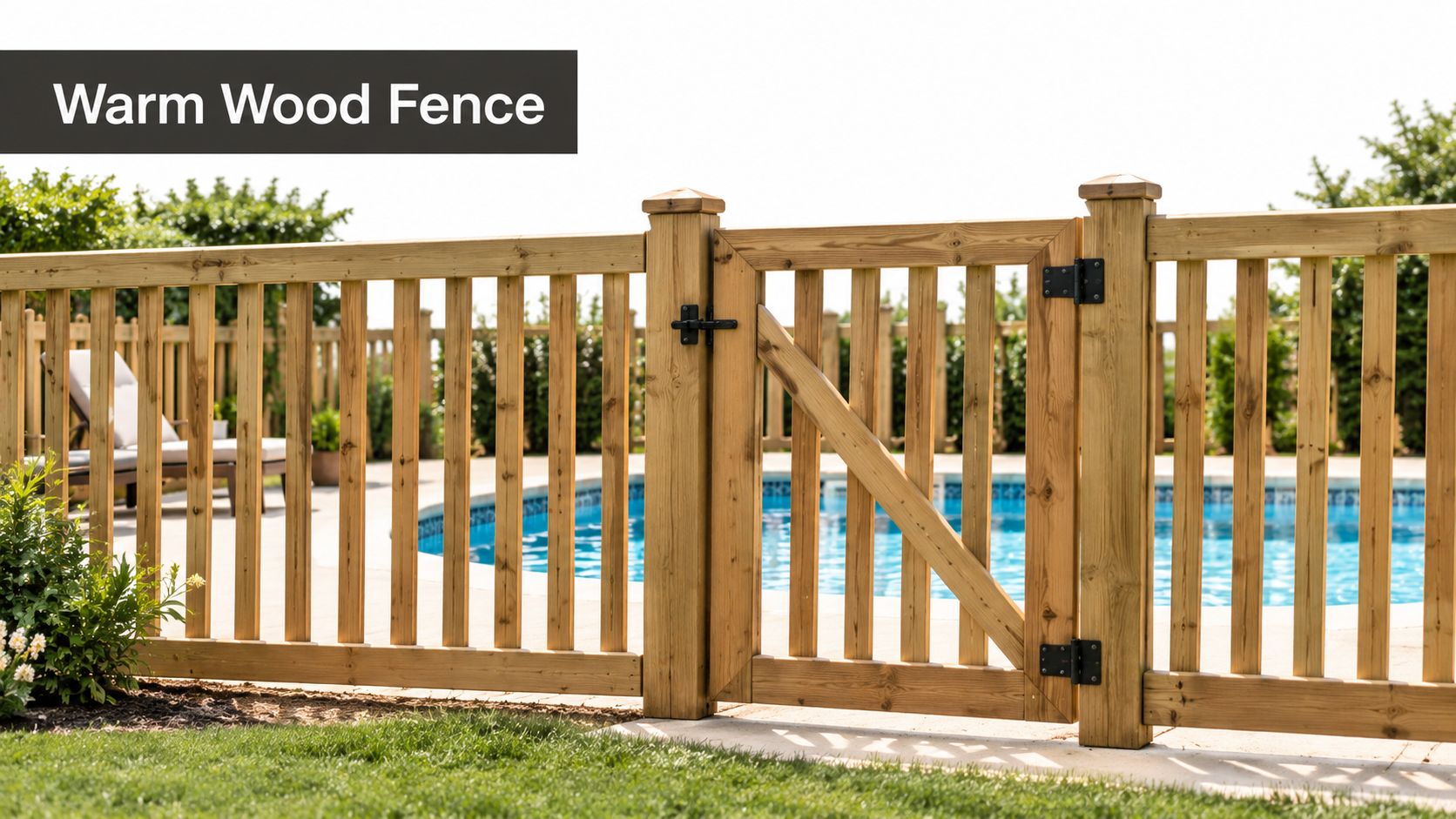
3. Pressure-Treated Wood Pool Fence with Sealant Protection
Wood remains one of the easiest pool fence ideas to tailor to an older Ottawa home, a cottage-style property, or a yard with established gardens. A semi-private picket arrangement preserves more visibility than a solid screen, while a framed panel can echo the home's trim and deck. Cedar and pressure-treated lumber also make it easier to adjust the design around trees, slopes, and unusual property lines.
The trade-off is maintenance. Wood absorbs moisture, moves through freeze-thaw cycles, and can develop cracks, splits, or heaving around posts. A penetrating exterior sealant is generally more practical than a surface film that traps moisture, and the first treatment should happen according to the product and installer's recommendations rather than after the first signs of weathering.
Inspect the fence after winter
Spring is the important season. Look for leaning posts, loose gate hinges, damaged pickets, pooling water, and soil movement before the pool opens. Improve drainage behind the fence where runoff collects, and keep vegetation from creating footholds or obstructing the gate.
A low-pressure wash can remove dirt before resealing, but excessive pressure can tear wood fibres and make the surface rougher. Set a recurring maintenance reminder, keep the gate hardware adjustable, and choose a finish that suits the pool environment. A cedar privacy fence in Ottawa or pressure-treated white pine in Gatineau can look excellent, but neither is a “install it and forget it” solution.
4. Glass and Aluminum Frameless Pool Fence with Stainless Steel Hardware
A glass and aluminum frameless fence suits a pool that needs constant visual connection with the house. Clear tempered panels keep swimmers visible, preserve sightlines across a compact yard, and support a clean contemporary look. The trade-off is privacy: neighbours and passers-by can still see the pool area, so this option works better when supervision and curb appeal matter more than seclusion.
Use stainless steel clips, posts, hinges, and latches with compatible aluminum components. Glass panels require accurate setting on stable supports, and the gate must align correctly to close and latch without rubbing. Installation becomes more complex on sloped ground, near retaining walls, or where Ottawa and Gatineau yards experience frost movement. Confirm current local requirements before ordering, including height, openings, and gate provisions. Québec's regulatory text is a stronger starting point than a generic product image. A hedge, planter, slope, or retaining wall does not automatically provide a compliant barrier.
Budget for cleaning and inspection
Glass displays fingerprints, pollen, sprinkler marks, and mineral residue. Keep a squeegee and compatible cleaner available, and redirect irrigation that repeatedly sprays the panels. Stainless hardware resists staining, but inspect clips, connections, hinges, and latches for looseness, coating damage, or movement after winter.
Avoid on-site cutting or drilling. Choose factory-finished panels and schedule installation when the base and surrounding grade are stable. FenceScape's glass pool fence installation guide provides practical questions about panel support, gate alignment, and ongoing service.
5. Hybrid PVC and Steel Composite Fence with Integrated Cable System
A hybrid PVC and steel system is aimed at difficult sites where a light appearance needs more structural support. PVC or composite pickets provide a softer visual finish, while a concealed steel frame and cable arrangement can help maintain a clean sightline across a sloped yard, exposed edge, or modern pool terrace.
This style can look precise, but it isn't a forgiving do-it-yourself installation. Posts need accurate alignment, cable assemblies require consistent tension, and thermal movement can affect the final fit. Treat the cable system as a working safety component, not as decoration hidden inside a designer fence.
Record the installation settings
Ask the installer to supply one coordinated package of brackets, turnbuckles, cables, fasteners, and gate hardware. Mixing components from different systems can create corrosion or compatibility problems. Have the contractor document the original tension and connection details, then schedule a follow-up inspection after the system has experienced its first seasonal changes.
A quarterly visual check can identify a sagging cable, loose fitting, damaged coating, or movement at a post before it becomes a larger repair. Keep compatible replacement parts available if the manufacturer recommends them. This concept works best when the property owner is comfortable with periodic checks and the installation team is prepared to service the system.
For Ottawa–Gatineau yards, map snow storage and winter equipment before selecting the route. A snowblower, plough pile, or frequently used side path can damage a carefully tensioned system if the fence is placed where seasonal traffic naturally travels.
6. Ornamental Iron Fence with Decorative Finishes and Sealant Protection
Ornamental iron brings a formal, established character to heritage homes, stone properties, and settings with classical details. Scrollwork, finials, and shaped posts can make the fence feel like part of the architecture rather than a utility boundary. Open pickets also preserve supervision and airflow, although they offer little privacy.
The attractive finish can hide a demanding maintenance reality. Chips, scratches, weld points, and cut edges expose metal to moisture, salt, and winter weather. Hot-dip galvanizing is a strong option for corrosion protection, while a quality powder-coated finish can provide a clean appearance when the underlying preparation is sound. Specify corrosion-resistant fasteners and ask how the installer will repair future damage.
Keep the gate visually decorative and mechanically serious
A decorative gate still needs to close and latch every time. Avoid scrollwork or horizontal elements that create footholds, and examine the approach from both sides for nearby planters, benches, steps, and stacked firewood. The fence's visual style should never compromise the clear operation of the gate.
Schedule a fall inspection before winter. Touch up damaged areas with the correct compatible coating, lubricate hardware as recommended, and keep the finish type and colour recorded for repairs. Ornamental iron can last well in the local climate, but it rewards owners who treat corrosion prevention as routine care rather than an emergency response.
7. Chain Link Fence with Slat Privacy Screening
Chain link with vinyl-coated slats suits homeowners who need a defined pool barrier, partial privacy, and a familiar installation process. The mesh preserves airflow and keeps the fence visually lighter than a solid enclosure. Slats can screen views from a neighbouring property or lane, though they also reduce sightlines from some angles. Check the route from the house before giving privacy priority over supervision.
Compliance depends on the underlying mesh, not only the screening. Quebec pool-enclosure rules limit chain-link mesh openings to 30 mm. The provincial regulation sets the reference point, but confirm current Ottawa and Gatineau requirements with the local authority and installer before ordering. A mesh that is too open remains unsuitable even after privacy strips are added. Confirm post locations, gate clearances, coping, grading, and snow-clearing access during the site visit.
Treat slats as a replaceable finish
Choose a vinyl-coated frame with corrosion-resistant components. Aluminium slats can reduce weight compared with steel, while darker colours may make fading less noticeable. Installation and tensioning in moderate conditions can help, but inspect bolts, ties, posts, and the gate after seasonal movement.
Keep the original product details so damaged strips can be matched. Snow clearing, lawn equipment, wind, and children leaning on the fence can damage individual slats while leaving the frame usable. FenceScape's chain-link privacy options offer a useful comparison of screening approaches.
8. Composite Wood-Plastic Hybrid Fence with Built-In Drainage Channels
Composite fencing gives you a wood-like visual language without asking you to stain the entire enclosure regularly. It can suit a newer Ottawa home, a deck with composite boards, or a homeowner who wants a coordinated low-maintenance palette. Solid boards create more privacy, while carefully selected openings can preserve a view from the house.
The drainage detail is as important as the board colour. Water that sits in channels, around posts, or against the lower edge can freeze, move components, and create avoidable wear. Ask how the system drains, where water exits, and whether the bottom detail works with the existing grade rather than assuming a channel solves every site problem.
Allow the material to move
Composite boards need installation clearances and fastening methods specified by the manufacturer. Let boards acclimate as directed, avoid solvent-based cleaners, and document the fastener type and spacing for future repairs. A pre-assembled panel can reduce on-site mistakes, but the installer still needs to check the final route against steps, coping, drainage, and gate clearances.
Clear drainage paths during routine yard care. Leaves, mulch, grass clippings, and winter debris can block an otherwise effective channel. Keep spare boards and colour information for repairs, because a replacement from a later production run may not match the original surface exactly.
This is a strong privacy-led concept, but solid composite panels can make supervision harder from some rooms. Use a more open treatment on the house-facing side if the pool isn't visible from the main living areas.
9. Temporary Mesh Safety Fence
A temporary mesh barrier can separate the pool from the rest of the yard during a particular season, rental period, event, or construction phase. Fabric mesh is visually lighter than many permanent fences, and removable posts make it useful where the owner needs the yard to serve different purposes at different times.
It must still be treated as a real barrier, not a decorative ribbon. The mesh should remain taut, posts must stay firmly positioned, and the gate must close and latch reliably. Weighted bases can help on hard surfaces, but they need to be stable, protected from movement, and acceptable under the applicable local requirements.
Check whether temporary means legally acceptable
Quebec allows removable fences when they meet the regulatory requirements, but “removable” doesn't mean exempt. An inground or semi-inground pool must be surrounded by an enclosure, and temporary protection is also required during construction, installation, or replacement. Local guidance on residential pool regulations explains why a worksite cannot just remain open while the final fence is delayed.
Store mesh and posts indoors through winter, keep spare clips available, and replace stretched or damaged fabric rather than trying to patch a critical section indefinitely. For a family yard, this style works only when the household has a clear routine for installation, inspection, and controlled access.
10. Smart Electronic Pool Fence and Gate Alarm System
Electronic alarms are useful because they address the moment a gate opens or someone enters an unexpected area. A gate alarm connected to a local siren, smartphone, or property-management system can alert an adult who is indoors, working in another part of the yard, or managing a rental property. Sensors can also support a wider safety plan around a physical enclosure.
They don't create a compliant barrier by themselves. A notification can be missed, a battery can fail, a wireless connection can drop, and an alarm can't physically prevent access. Use electronic monitoring to reinforce a properly designed fence, self-closing gate, supervision routine, and controlled route to the pool.
Build in a local fallback
Choose equipment with weather protection suitable for outdoor exposure and a secure wireless setup. Keep an audible local alarm even when remote notifications are enabled, and document sensor positions, baseline settings, and reset procedures. Test the whole sequence regularly, including the gate opening, audible alert, phone notification, and battery condition.
The same layered approach applies to covers and other access controls. Canadian injury-prevention guidance describes fences, alarms, and covers as complementary measures rather than interchangeable products in its layers-of-protection resource. Electronic features are most valuable when they make safe behaviour easier, not when they encourage the owner to rely on a device instead of a barrier.
10-Option Pool Fence Comparison
Option | 🔄 Implementation Complexity | ⚡ Installation Speed & Resource Intensity | ⭐ Expected Effectiveness / Quality | 📊 Durability & Maintenance Impact | 💡 Ideal Use Case & Quick Tip |
|---|---|---|---|---|---|
Removable Aluminum Pool Fence Panels with Self-Closing Gates | Moderate, modular panels, precise gate alignment | Moderate, concrete footings and seasonal removal; higher upfront cost | ⭐⭐⭐⭐, strong code compliance (ASTM F1908) | 📊 High durability, low maintenance; inspect fasteners quarterly | Ideal for seasonal Ottawa–Gatineau pools, order stainless hardware and install in spring |
Semi-Privacy Vinyl (PVC) Pool Fence with Alternating Pickets | Moderate, panelized systems, aluminum rails required | Moderate, pre-assembled panels speed install; mid–high material cost | ⭐⭐⭐⭐, excellent low-maintenance performance | 📊 Very long life (50+ yrs); minimal upkeep aside from cleaning | Great for low-maintenance screening, choose neutral colours and order extra pickets |
Pressure-Treated Wood Pool Fence with Sealant Protection | Moderate, carpentry skills, pre-drilling and sealing | Moderate, readily available materials; recurring sealant maintenance | ⭐⭐⭐, attractive but maintenance-dependent | 📊 Mid lifespan (15–20 yrs) with 2–3 year sealant cycle | Good for warm aesthetics, apply first sealant within 6 months |
Glass and Aluminum Frameless Pool Fence with Stainless Steel Hardware | High, precision measurement and specialist installers | Slow, highest cost, custom glass panels and careful plumbing of posts | ⭐⭐⭐⭐⭐, unmatched visibility and premium finish | 📊 Very durable when maintained; high replacement cost for damaged panels | Best for high-end properties, use factory-cut tempered glass and 316 stainless hardware |
Hybrid PVC and Steel Composite Fence with Integrated Cable System | High, specialized cable tensioning and concealed framing | Moderate–Slow, higher material cost, specialized contractors | ⭐⭐⭐⭐, strong structural performance with minimal visual obstruction | 📊 Extreme durability; requires annual cable tension checks | Ideal where views and strength are required, document and maintain cable tension |
Ornamental Iron Fence with Decorative Finishes and Sealant Protection | High, heavy materials, skilled labor or welding | Slow, high material & install cost; requires finish protection | ⭐⭐⭐⭐, very durable and secure; classic aesthetic | 📊 Very long life (50+ yrs) if galvanized/powder-coated; periodic touch-ups | Suited to heritage or formal sites, specify hot-dip galvanize + stainless fasteners |
Chain Link Fence with Slat Privacy Screening (Vinyl-Coated) | Low, DIY-friendly, simple rolling and slat threading | Fast, lowest upfront cost; quick to install | ⭐⭐, functional containment, less premium look | 📊 Durable (30–40 yrs) if high-quality coating; slats may fade/deteriorate | Budget-conscious choice, use vinyl-coated chain and aluminum slats |
Composite (Wood-Plastic Hybrid) Fence with Built-In Drainage Channels | Moderate, requires acclimation and specific spacing | Moderate, mid-to-high cost; install gaps for thermal movement | ⭐⭐⭐⭐, wood-like appearance with low maintenance | 📊 25–30 yrs typical; drainage reduces freeze-thaw damage | Good for wood look without heavy upkeep, allow boards to acclimate before fastening |
Temporary Mesh Safety Fence (Removable Fabric Pool Barrier) | Low, tool-free or minimal tools; very portable | Very fast, minimal ground disturbance; very low cost | ⭐, suitable only as short-term barrier; not full code substitute | 📊 Low durability; store indoors over winter to extend life | Use for events/rentals only, never as a permanent code-compliant solution |
Smart Electronic Pool Fence and Gate Alarm System | Low–Moderate, straightforward mounts but requires configuration | Fast, quick add-on; low material cost vs. fencing | ⭐⭐⭐, effective supplemental alerting, not a replacement for barriers | 📊 Ongoing maintenance (batteries, testing); possible false alarms | Best as supplement to physical fence, test monthly and keep multiple alert recipients |
Turn a Favourite Style Into a Safer Plan
The best pool fence ideas become useful only after they survive a site review. Start by confirming the current municipal and provincial requirements for your address, including enclosure height, opening limits, gate hardware, setbacks, permits, and inspection expectations. Ottawa and Gatineau don't necessarily apply the same rules, and a general Ontario or Quebec summary may not answer questions created by your particular lot, pool type, grade, or existing deck.
Next, map the pool and every realistic access point. Include the back door, side gate, steps, raised patio, equipment pad, shed, play area, driveway, and the route used for lawn care or winter snow removal. The most attractive fence line may be the wrong one if a retaining wall, planter, furniture arrangement, or stored equipment creates a foothold or allows people to bypass the gate.
Choose the required separation and gate arrangement before choosing decorative details. A four-sided barrier is usually the clearest starting point for supervision and access control, but the final design must reflect the applicable local rules. Quebec guidance requires a pool enclosure to prevent a 10 cm sphere from passing through the opening or underneath it, and municipal guidance can add further requirements for height, climbing resistance, and gate placement. Treat every measurement as a design constraint, not as an afterthought.
Then compare your priorities straightforwardly:
Supervision first: Choose open aluminum, glass, ornamental iron, or a carefully zoned semi-privacy layout when the pool needs to remain visible from the home.
Privacy first: Consider vinyl, composite, wood, or chain-link screening, but leave a deliberate observation zone where adults can check the water.
Low upkeep first: PVC, composite, aluminium, and glass reduce some maintenance tasks, but each still needs inspection, cleaning, and hardware checks.
Seasonal flexibility first: A removable system may suit the yard, but it must remain compliant and reliably reinstalled.
Architectural fit first: Match the fence's lines, colour, posts, and gate proportions to the house, deck, stonework, and existing grounds rather than treating the pool as a separate visual object.
Specify weather-resistant materials and corrosion-resistant hardware as one coordinated package. Ottawa–Gatineau winters expose fences to moisture, freezing, snow clearing, salt, and ground movement, so ask how posts are supported, where water drains, how the gate will be adjusted, and which components can be replaced later. Don't accept a beautiful panel system with an unsuitable latch, weak footing, or an unresolved grade transition.
A professional site review is particularly valuable when the pool sits beside a slope, retaining wall, raised deck, narrow side yard, or busy patio. FenceScape can provide a specific estimate for coordinated design, installation, and post-install support, with material options that include PVC, hybrid systems, wood, ornamental iron, chain link, and glass. Before construction, verify approvals and inspection expectations with the relevant local authority, and ask the installer to show how the proposed enclosure will remain secure during construction as well as after completion.
The right fence isn't just the one that looks best in a photograph. It's the barrier that your household can see through or live with, operate correctly, maintain after winter, and keep in place every day the pool is accessible.
FenceScape helps Ottawa–Gatineau homeowners plan and install pool enclosures that balance supervision, privacy, seasonal durability, and curb appeal. Visit FenceScape to discuss your site, compare materials, and request a custom estimate from planning through post-install support.
Comments