
Wood Fence Replacement Cost: Ottawa–Gatineau 2026 Guide

A cheap installed price can hide the work that decides whether the replacement lasts. Cedar in the Ottawa area often lands around CAD 45–75 per linear foot installed, so a 100-foot fence budgets at roughly CAD 4,500–7,500 before site extras. Broader supplied-and-installed averages sit near CAD 7,450 in Ontario and CAD 7,200 in Quebec.
The expensive mistake is assuming every installed price buys the same scope. A quote that leaves buried concrete, reuses failing posts or excludes disposal can look affordable until you pay someone to finish the job. Start with length, then price the work needed to leave a sound, compliant fence behind. Pool permits, sight triangles, post extraction and tight site access can turn that low number into a second project.
Wood Fence Replacement Cost at a Glance
Installed pricing and material-only pricing aren't interchangeable. The Ottawa Decking Solutions fence cost guide gives a broad Ottawa installed range of approximately CAD 30–100 per linear foot, alongside Ontario cedar estimates of CAD 45–75 installed and CAD 25–45 for materials alone.
The table applies those published rates to example lengths. Its basic cedar rows assume concrete-set posts and basic panels without a gate, while the provincial comparisons use the guide's supplied-and-installed project scope. These are budgeting calculations, not promises that a contractor includes every listed component at that rate.
Installed wood fence replacement cost by length
Project profile | Length | Low estimate | High estimate | What the number assumes |
|---|---|---|---|---|
Installed cedar at CAD 45–75 per linear foot | 50 ft | CAD 2,250 | CAD 3,750 | Concrete-set posts, basic panels, no gate |
Installed cedar at CAD 45–75 per linear foot | 75 ft | CAD 3,375 | CAD 5,625 | Concrete-set posts, basic panels, no gate |
Installed cedar at CAD 45–75 per linear foot | 100 ft | CAD 4,500 | CAD 7,500 | Concrete-set posts, basic panels, no gate |
Installed cedar at CAD 45–75 per linear foot | 150 ft | CAD 6,750 | CAD 11,250 | Concrete-set posts, basic panels, no gate |
Installed cedar at CAD 45–75 per linear foot | 200 ft | CAD 9,000 | CAD 15,000 | Concrete-set posts, basic panels, no gate |
Broader Ottawa installed range at CAD 30–100 per linear foot | 100 ft | CAD 3,000 | CAD 10,000 | Material, labour and typical site work; broad scope |
Cedar material only at CAD 25–45 per linear foot | 100 ft | CAD 2,500 | CAD 4,500 | Lumber and panels; assumes no posts, concrete, labour or disposal |
Ontario supplied and installed average | Typical residential project | CAD 5,350 | CAD 10,400 | Average CAD 7,450; concrete-set posts, one gate, old fence removal |
Quebec supplied and installed average | Typical residential project | CAD 5,100 | CAD 10,200 | Average CAD 7,200; concrete-set posts, one gate, old fence removal |
The provincial figures are useful because their stated scope includes concrete-set posts, a gate and removal of the old fence. They're closer to a replacement budget than a stack of lumber delivered to your driveway. They aren't matched projects of identical length, however, so don't interpret the provincial difference as a guaranteed saving across the river.
Read the price as a scope allowance
Material-only estimates need particular care. A supplier may use that term for panels, loose boards or a complete materials package. The table deliberately separates posts and concrete, but your actual material order must identify whether they're included.
Likewise, subtracting a material-only range from an installed range doesn't produce a reliable labour rate. The installed package can contain layout, excavation, concrete, hauling, gate fabrication and project coordination, not just carpentry.
Budgeting rule: Use a per-foot calculation to decide whether the project is financially plausible. Use an itemised site quotation to decide whether to sign.
For a normal backyard replacement with removal and a gate, a practical preliminary allowance is roughly CAD 5,000–10,000, rather than the material-only total. Treat that as an editorial planning band informed by the turnkey comparisons, not a cap. Difficult excavation, restricted access or pool-enclosure work can put the actual project outside it.
Scope, Site Conditions and What Quotes Leave Out
Take an estimator along the entire fence line, not just to the gate. Point out leaning sections, soft post bases, standing water and any place where equipment can't pass. Those observations help distinguish a straightforward panel replacement from an excavation job with carpentry attached.
Post extraction deserves its own scope line. Cutting an old post below grade isn't the same as extracting its concrete footing. If the new layout needs a post in that location, leaving the footing behind can create another digging problem.
Scope checklist for comparing wood fence quotes
These are comparison prompts, not guarantees about what any particular installed package contains.
Scope line | Material-only quote | Installed quote | What to confirm |
|---|---|---|---|
Lumber, pickets and rails | Included | Included | Species, grade, board thickness and separately priced waste |
Posts | Usually not included | Included | New or reused posts, spacing and depth |
Concrete and post setting | Usually not included | Included | Concrete-set or gravel-set approach, soil and frost considerations |
Old fence removal | Not included | Often included | Whether demolition is separately priced |
Disposal and tipping fees | Not included | Often included | Responsibility for hauling and landfill fees |
Gate and hardware | Not included | One gate often included | Width, hinges, latch and pool-gate hardware |
Permit and drawings | Not included | Not always included | Application, site plan and inspection responsibility |
Site access and slope | Not included | Must be explicitly scoped | Narrow access, deck removal, stepped panels and retaining work |
Post extraction and concrete removal | Not included | Must be explicitly scoped | Footings extracted or posts cut below grade |
Clean-up and final walkthrough | Not included | Included | Site care, alignment check and hardware adjustment |
Don't accept “remove existing fence” as the entire demolition description. Ask whether it includes buried concrete, abandoned fasteners and debris behind sheds. Also identify who restores disturbed planting beds or lawn.
Price the digging and carrying
A narrow side yard can require crews to hand-carry boards, concrete and demolition debris. Rocks and roots can slow excavation; a slope can require stepped panels and different post lengths. Ask the estimator to distinguish known site work from concealed conditions that would trigger an extra charge.
Material movements don't tell you the whole installation story. Statistics Canada's building construction price release reported residential construction costs rising 0.5% in the second quarter of 2026, while wood, plastics and composites declined 0.3%. Obtain a written lumber-price expiry and specify the grade and treatment rather than assuming an older benchmark still applies.
Ottawa's weather also makes drainage worth inspecting: Environment and Climate Change Canada's climate normals record 938.1 millimetres of annual precipitation and 184.5 centimetres of annual snowfall. Mark persistently wet post locations before requesting replacement details. New boards won't correct water collecting around the supports.
Cedar, Pressure-Treated Lumber and Hybrid Choices
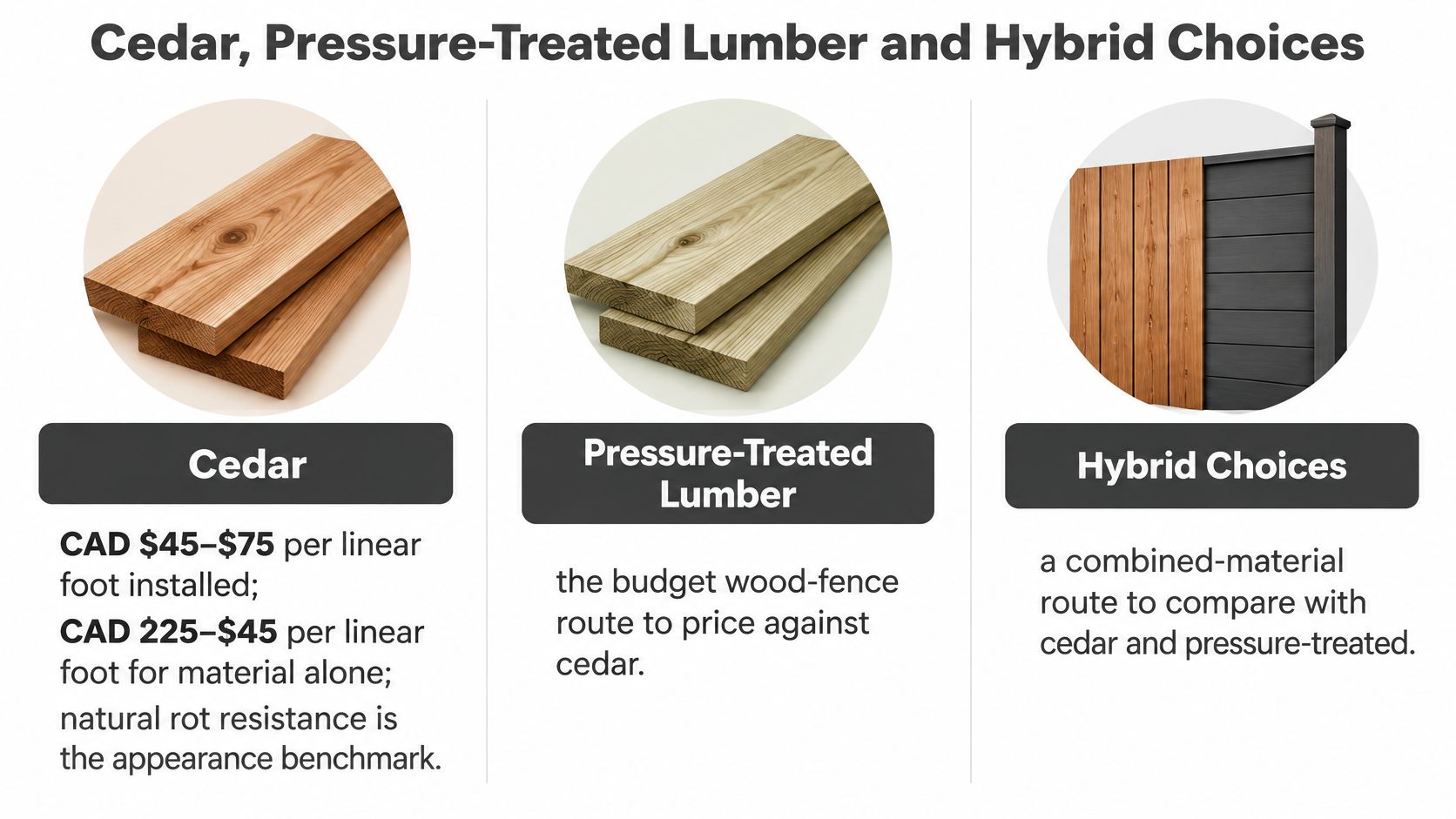
Cedar and pressure-treated lumber are the most common wood-fence materials in Canada. They're sensible alternatives to price against each other, but the comparison should keep height, panel style and post construction consistent. Otherwise, you're comparing different fences rather than different wood choices.
The material comparison below provides a starting point for choosing the face and structure of the fence.
Choose the material around your priorities
Cedar suits homeowners who value natural grain and rot resistance. Specify the visible-board grade and ask to see the proposed panel construction. Cedar isn't a substitute for sound posts, and paying for an attractive face won't rescue weak rails or poor drainage.
Pressure-treated lumber is the budget wood-fence route to price against cedar. Moisture changes can cause checking, twisting and movement, so board selection, fastening and gate adjustment still matter. If you intend to stain it, assess the wood's moisture condition and use a coating compatible with the treatment rather than coating wet lumber immediately.
Hybrid fencing combines a PVC or wood face with steel strength. Our hybrid options offer privacy, sound reduction and weather resistance. Compare the actual assembly, not the word hybrid alone: a wood-faced system still contains wood that needs attention, while the frame, connections and finish have their own maintenance requirements.
Our wood privacy fence materials guide can help you narrow the style before requesting matching material and installation options.
Separate a coating exemption from upkeep
Under Ottawa's fence by-law, cedar, redwood and treated wood are exempt from the general requirement for added weather-resistant protection, but fences must still remain safe, structurally sound and in good repair.
That distinction matters when comparing proposals. An untreated species may need a protective finishing allowance, whereas a cedar or treated-wood proposal shouldn't imply that an additional coating is automatically required for municipal compliance. You may still choose a finish for appearance and moisture management.
A maintenance exemption isn't a maintenance plan. Choose the finish for the result you want, then budget for the work that finish will require.
I would choose cedar when appearance and natural resistance justify the premium, pressure-treated lumber when the initial budget leads, and a hybrid when the proposed assembly better matches your upkeep priorities. Ask for the maintenance instructions and replacement-panel availability before paying extra for a combined-material system.
Ottawa and Gatineau Rules That Change the Scope
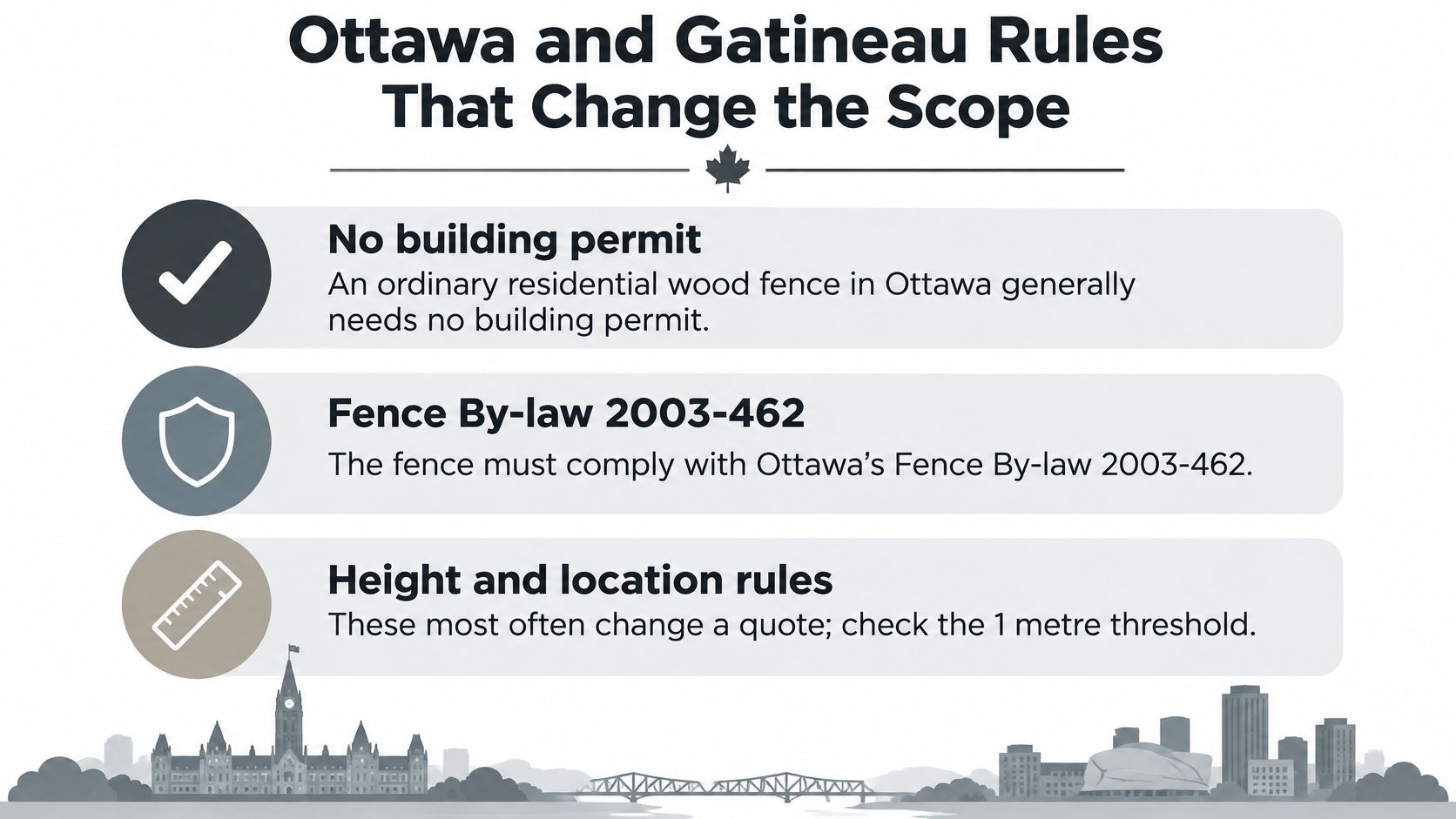
Confirm the permitted layout before choosing panels. An existing fence isn't proof that the same height, orientation or location is acceptable for its replacement. Copying it without checking can leave you paying for alterations after installation.
Use the municipal checklist to identify where a boundary fence becomes a different design or approval problem.
Check location before height and finish
The City of Ottawa's residential property regulations set residential fence-height limits of 1 metre in front yards and 2.13 metres in other residential yards. Measure the proposed fence by yard location rather than ordering the same panel throughout the property.
A front-to-side transition may need a deliberate change in panel height. On a sloping property, ask how the installer will measure the finished height and handle the transition. Don't assume cutting the tops off standard panels is the best construction detail.
The City's residential land guide also describes the good-neighbour requirement for the more attractive side to face neighbouring property and the street, and advises checking the property line and municipal right-of-way. Decide the finished-side orientation on the drawing, especially where different runs face different properties.
Locate the boundary. Use reliable property information rather than assuming the old posts mark ownership.
Identify public land. Flag any proposed work near a sidewalk, road allowance or municipal right-of-way.
Agree on appearance. Record panel orientation and any finish on exposed framing before neighbours approve the design.
Treat a pool barrier as a separate approval scope
The City of Ottawa's pool-enclosure requirements require a permit for replacement pool enclosures and application details describing the fence, gates, location and construction specifications. Drawings, gate hardware and approval administration therefore belong in the estimate rather than being left to an informal conversation.
Ask who will maintain a compliant barrier during removal and reconstruction. Don't authorise demolition until the installation sequence and municipal requirements are resolved.
Our Ottawa fence by-law guide is useful for preparing questions, but confirm property-specific interpretations with the City. For a Gatineau replacement, check the current Gatineau by-law independently. Ottawa's yard categories, height limits and approval process shouldn't be carried across the river as design assumptions.
Five Replacement Scenarios and Their Budgets
A useful replacement budget describes a property, not just a material. The examples below apply the cedar budgeting rates to hypothetical lengths, while the standard backyard row uses the Ontario turnkey benchmark. The provincial benchmark isn't a quotation for that exact example length.
Municipal approval changes the pool calculation: the City of Ottawa's building-permit guidance says ordinary fences generally don't need a building permit, while qualifying pool enclosures require approval with a cited CAD 257 permit fee; sight-triangle restrictions can limit fences to 75 centimetres or require substantial open area.
Ottawa–Gatineau wood fence replacement scenarios
Scenario | Size and conditions | Base budget | Add-ons to expect | What to confirm |
|---|---|---|---|---|
Standard backyard replacement | 100 ft, one gate, old fence removed | CAD 5,350–10,400; average CAD 7,450 | Hardware upgrades; disposal or extraction if excluded | Whether removal and one gate are included |
Pool enclosure replacement | 60 ft, pool barrier, permit required | CAD 2,700–4,500 before enclosure extras | CAD 257 pool-enclosure permit, drawings, compliant self-closing gate hardware | Permit responsibility and gate compliance |
Corner-lot replacement | 100 ft, sight triangle at driveway or intersection | CAD 4,500–7,500 before redesign | Lower sections, open-area design, extra panels or posts | Exact sight-triangle restriction and layout |
Sloped-yard replacement | 100 ft, grade change across the run | CAD 4,500–7,500 plus site work | Stepped panels, extra posts, retaining work, hand-carry access | Treatment of grade changes and additional supports |
Shared boundary replacement | 80 ft, neighbour cost-sharing | CAD 3,600–6,000 before shared-project extras | Finished-side detailing, survey, eligible group pricing | Property line, cost allocation and build coordination |
What changes the final total
For the standard backyard, start by checking whether the quoted removal includes the supports and their concrete. If demolition and disposal are included, don't add them again merely because another contractor lists them separately. Compare the final scope, not the number of lines on the page.
For the pool enclosure, the fence-length calculation is only a starting allowance. Gate operation, drawings and permit administration need separate confirmation. A contractor quoting ordinary boundary fencing hasn't necessarily priced a compliant pool barrier.
A corner lot can cost more to design without providing the same continuous privacy as a rear boundary. Locate the visibility-restricted area on the plan before deciding whether solid screening is feasible. Buying taller panels first and resolving visibility later is the wrong order.
For a sloped yard, require a sketch showing steps, ground clearance and gate placement. Stepping panels can leave openings beneath sections; adding retaining work is a separate construction decision, not an automatic part of fence installation.
For a shared boundary, put payment responsibilities and change approvals in writing. A neighbour agreeing to share the fence doesn't automatically mean equal responsibility for decorative upgrades or difficult access on your side.
FenceScape offers exclusive neighbourhood group discounts for customers coordinating their fencing needs as a group, with conditions applying. Request written group-pricing terms before neighbours rely on a reduced budget.
Compare the completed project each contractor promises, including exclusions. A bare fence allowance and a turnkey replacement aren't competing prices for the same job.
Repair or Replace and the Ten-Year Cost View
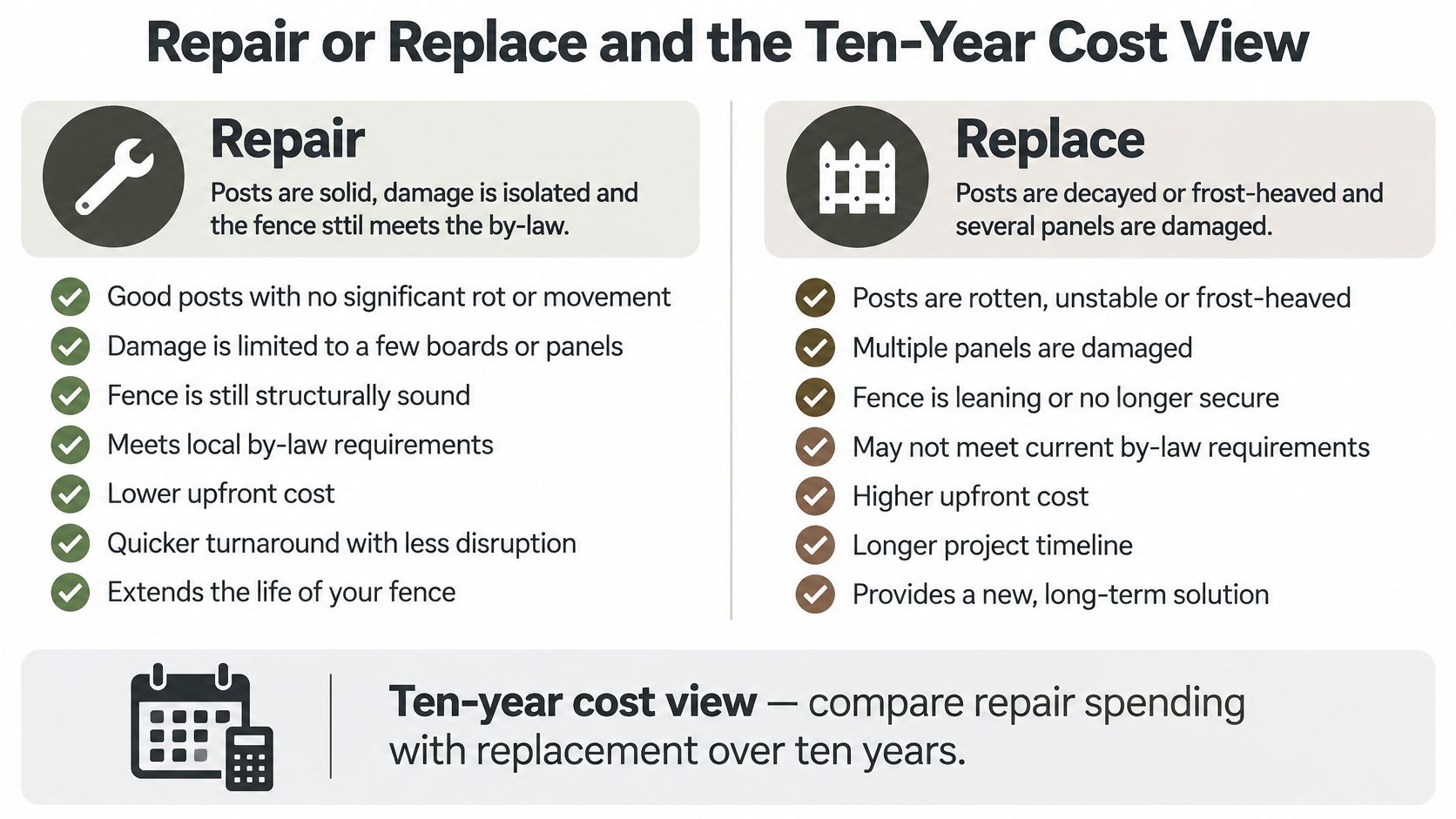
Repair is sensible when the supports are sound and the damage is isolated. Replacement becomes more persuasive when several sections fail together, posts move at ground level or the layout itself needs correction. A sagging gate alone isn't a reason to demolish a sound boundary, but new hinges won't correct a failing gate post.
Use this comparison to identify whether you're buying a lasting repair or delaying structural work.
Inspect the supports before counting damaged boards
Push gently against each suspect post while watching its base. Movement in the soil, a split around a connection or soft wood near ground level deserves closer assessment. Avoid loading an unstable section, and don't test a pool barrier in a way that compromises safety.
For an isolated failure, obtain a defined repair scope through our fence repair guidance. Ask whether the repair includes correcting the cause, such as a failed connection or displaced support, rather than straightening the visible panel.
Deferring work doesn't preserve today's pricing. Statistics Canada's residential renovation price report recorded renovation costs increasing 0.3% in the first quarter of 2025, following 0.5% in the fourth quarter of 2024, and noted commodity-price and tariff uncertainty affecting wood-intensive work, including fences.
Build an ownership worksheet
Don't invent a lifespan to make the preferred option look cheaper. Ask the estimator which components can reasonably remain, what condition they're in and which future repairs remain uncertain.
Cost item | Repair option | Replacement option |
|---|---|---|
Upfront work | Defined damaged components | Complete agreed replacement scope |
Routine upkeep | Existing finish and hardware needs | Selected material and finish needs |
Expected repairs | Remaining weak posts, rails or panels | Likely adjustments and component maintenance |
Later major work | Potential broader replacement | Unresolved site or drainage work, if excluded |
Ownership total | Initial repair plus subsequent work | Initial installation plus subsequent work |
Prepare separate five-year and ten-year totals using actual estimates and your chosen maintenance schedule. Include paid maintenance or your own time consistently in both options. Don't count owner labour as free for repair while charging professional labour against replacement.
This video provides another way to assess the repair decision.
I would prioritise structural repairs over cosmetic refinishing. If a proposed repair leaves several questionable supports untouched, request a replacement alternative before committing. The useful comparison is the total work you're likely to purchase, not the smallest bill available this month.
Request a Site-Specific Quote Before You Commit
Turn your preliminary wood fence replacement cost into a written scope that another estimator could price without guessing. Clear measurements and photographs help, but they don't replace a site assessment of access, supports and ground conditions.
Prepare a quote request contractors can price
Confirm and measure the route. Identify the property line using reliable records, then measure fence runs, gate openings and proposed heights by yard location. Flag any boundary uncertainty instead of presenting a guessed line as established.
Photograph the difficult areas. Include post bases, leaning sections, slope transitions, narrow access and any pool barrier. Show nearby decks, sheds and landscaping that could obstruct removal.
Request separated work items. Ask for lumber, posts, concrete, extraction, demolition, disposal, gate hardware, permit work and clean-up. Require explicit exclusions and a method for approving additional work.
Record purchasing details. Confirm species, grade, treatment, board dimensions and the lumber-price expiry. Ask what happens if installation is scheduled after that expiry.
Compare matching proposals. Obtain competing quotations for the same design and removal scope. Resolve differences before treating the lowest total as a saving.
Our contact form lets you request a Material Quote or an Installation Quote. Request both if you're weighing DIY against installed work, and make sure the material package includes everything your construction plan requires.
Keep payment separate from scope
We offer 6 months of interest-free financing in Ontario and 3 months with no payments and no interest in Quebec. Review the applicable terms before deciding how to fund the project; financing doesn't resolve an incomplete quotation.
The right proposal names what will be removed, what will be built and who handles the approvals. It should also explain how concealed conditions are authorised, so an unexpected footing doesn't become an unapproved invoice.
FenceScape offers a free estimate for your wood-fence replacement, with material-only and installation quote options. Visit FenceScape to request an assessment, and include your measurements, access photos and pool-barrier details so we can help turn a per-foot allowance into a property-specific scope.
Comments