
What Is Considered a Perimeter Fence in Ottawa

You're standing on your corner lot on a Saturday morning, tape measure in hand, trying to work out why a neighbour's fence looks legal on one street and too tall on another. You've called the low picket run along your front lawn your perimeter fence, but the pool contractor, the city inspector and a builder down the road would each judge that same line differently. That's not a vocabulary problem. It's a job problem, and it's where most Ottawa and Gatineau fence projects go wrong before a single post hole is dug.
In this region, what is considered a perimeter fence depends on the work the fence has to do. A line that marks where your lot ends isn't judged the same way as a barrier that has to keep a toddler out of a pool or keep the public away from an open excavation. Learn to name the job first, and the height, openings, setback and permit rules stop feeling like a maze.
What Makes a Fence a Perimeter Fence
Say you own that corner lot. You've got a white picket fence across the front, a taller wood fence down the side, and a pool planned for the back. You might call all of it one perimeter, but the city won't. The front run has to preserve sightlines for drivers, the side run divides you from a neighbour, and the pool edge has to stop a small child reaching water.
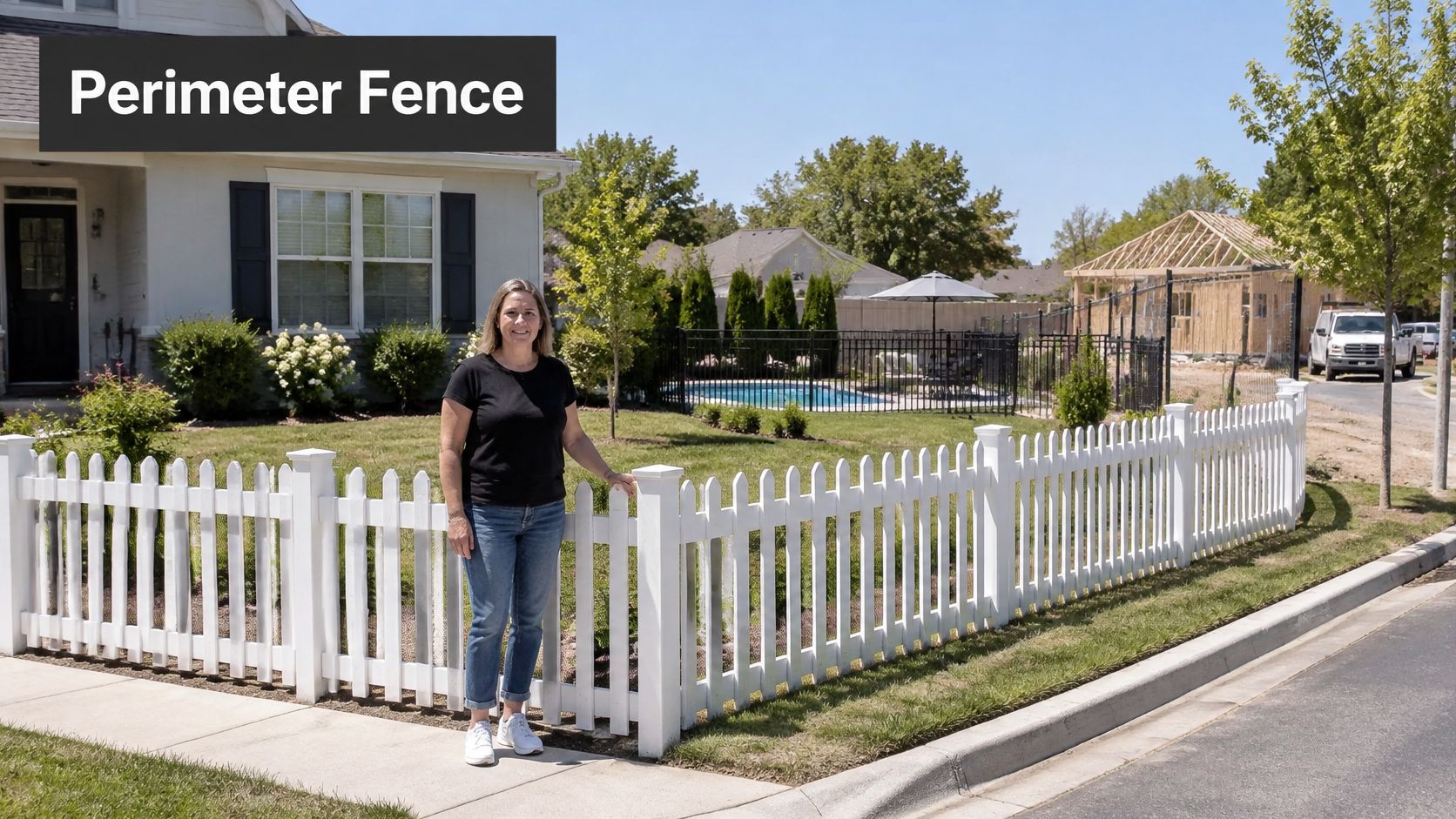
Start with a plain definition and test every fence against it.
A perimeter fence is a continuous physical boundary whose job is to mark a limit, control who can enter, or keep people away from a hazard such as water or active construction.
That word continuous matters more than the material. A perimeter has to connect, corner to corner, wall to post, with gates that close the gaps. If someone can walk around the end, step through a wide opening or push open an unlatched gate, you don't have a working perimeter. You have a suggestion.
A Garden Accent Is Not a Perimeter
Contrast that with a short decorative run that frames a flower bed. It encloses nothing, controls no entry and protects nobody from anything. It can be lovely, and it still has to respect your yard's height limit, but removing it wouldn't leave a boundary unclear or a hazard exposed.
That removal test is the fastest way to sort your own yard. If taking the fence away would leave a boundary, hazard or access point uncontrolled, it was doing perimeter work. If taking it away only changes how the garden looks, it was decoration.
There's also no single Canada-wide fence standard you can look up once and apply everywhere. On both sides of the Ottawa River, the municipality where the lot sits sets height, placement, materials, upkeep and ownership. Two houses ten minutes apart, one in Ottawa and one in Gatineau, can face different maxima, different setbacks and different assumptions about who owns a fence on the line.
Perimeter Fence Versus Decorative Fence
Test | Perimeter fence | Decorative fence |
|---|---|---|
Job | Marks a limit, controls access or guards a hazard | Frames planting or adds curb appeal |
Continuity | Connected boundary with gates that can close | Short run or open accent is enough |
Height | Fixed by yard, land use and city | Chosen for looks, but still under the yard maximum |
Openings and gates | Sized to the safety or security job | Often wide, low or climbable |
Legal effect | Can be a boundary, pool enclosure or site barrier | Does not by itself meet those duties |
Read the table row by row against your own plan. Most confusion comes from mixing rows, for example picking a decorative height for a fence that has a safety job, or assuming a handsome front picket run also counts as access control for the back yard. It doesn't, because each row is judged on its own test.
Three Checks Before You Choose Panels
Before you look at cedar, vinyl or chain link samples, answer three questions in order.
What's the job: Is this line marking a boundary, giving privacy, controlling entry, or guarding water or a worksite?
Which rule does that job trigger: Does the answer set a maximum height, a minimum height, an opening size or a gate latch position?
Where does it belong: Does it sit on the lot line, step back from a sidewalk, or wrap tightly around a temporary hazard?
If you can't answer those three, you aren't ready to choose a style. Style is the last decision, not the first, and homeowners who reverse that order often buy panels they then have to cut down, move or replace.
Keep the removal test in your pocket as you read the numbers that follow. Every measurement in this guide exists because a fence was expected to do a specific job, and the measurement is how the city checks whether it can.
Height and Opening Limits by Purpose
Find the row that matches your fence's job before you think about style. Treat the table below as a lookup, not a rulebook to memorise. Your city, your yard position and your land use pick the row, and the row picks the number.
In Ottawa, allowable height follows location and land use rather than material. The City of Ottawa technical guidance limits residential fences to 1.0 m in front yards and 2.1 m in rear or side yards, allows non-residential fences to reach 3.0 m, and lets gates exceed the applicable fence height by 0.3 m. The same guidance keeps the fence on the owner's property, out of the municipal right-of-way.
Perimeter Fence Limits in Ottawa and Gatineau
Situation | Height rule | Placement | Permit note |
|---|---|---|---|
Ottawa residential front yard | Maximum 1.0 m | On the owner's land, outside the right-of-way | No building permit if Fence By-law 2003-462 is met |
Ottawa residential rear or side yard | Maximum 2.1 m | On the owner's land | Same by-law, no ordinary building permit |
Ottawa gate | Up to 0.3 m above the fence limit | Same yard as the fence | Follows the fence rules |
Ottawa non-residential yard | Maximum 3.0 m | Front, rear or side, on the property | Specific exemptions can apply |
Ottawa pool or hot tub enclosure | Minimum 1.5 m, openings under 100 mm, latch at least 1.35 m | Continuous barrier around the water | Pool enclosure permit even if a yard fence exists |
Ottawa worksite within 3 m of the public | Minimum 1.8 m from outside grade | Separates people from the hazard | Height set by proximity |
Ottawa low-rise site more than 3 m from a walkway | Minimum 1.2 m | Residential building of at most three storeys | Lower height exception only |
Gatineau front yard, one to four units | Maximum 1.2 m | About 1 m from a sidewalk, or 1.5 m if none | Entirely on private property |
Gatineau side yard beside a street | Maximum 1.5 m | On private property, clear of the street edge | One to four unit homes |
Gatineau rear or non-street side | Maximum 2 m | On private property | One to four unit homes |
Gatineau larger residential rear or non-street side | Maximum 2.5 m | On private property | Buildings above the small home category |
Gatineau vacant lot after demolition | Minimum 0.75 m | Street edge fence, berm or evergreen hedge | Stops vehicle access |
How to Read the Rows Without Mixing Them
Notice the switch between maximum and minimum. Yard fences are capped so they don't block sightlines or dominate a street. Pool and worksite fences are floored so they can't be too low to protect anyone. Applying a residential maximum to a pool, or a pool minimum to a front yard, is the most common lookup error.
Notice also that a standard residential fence in Ottawa generally doesn't need a building permit when it meets Fence By-law 2003-462, while a pool enclosure needs its own permit. That's not a contradiction. The permit follows the hazard, not the panels.
Gatineau splits its rows by dwelling type as well as yard position, which is why a one to four unit home and a larger residential building don't share the same rear yard ceiling. The vacant lot row is different again. It's a minimum street edge barrier meant to stop vehicles, not a privacy fence at all.
The city where the lot sits decides the row. The neighbourhood name and the fence style don't.
One limit no table can settle for you is visibility. Corner lots and driveway entrances need a visibility triangle check so drivers and pedestrians can see each other. Get the survey confirmed and the sightlines reviewed on your specific lot before you lock in post positions, because a fence that's legal in height can still be wrong in placement.
When a Yard Fence Fails as a Pool Enclosure
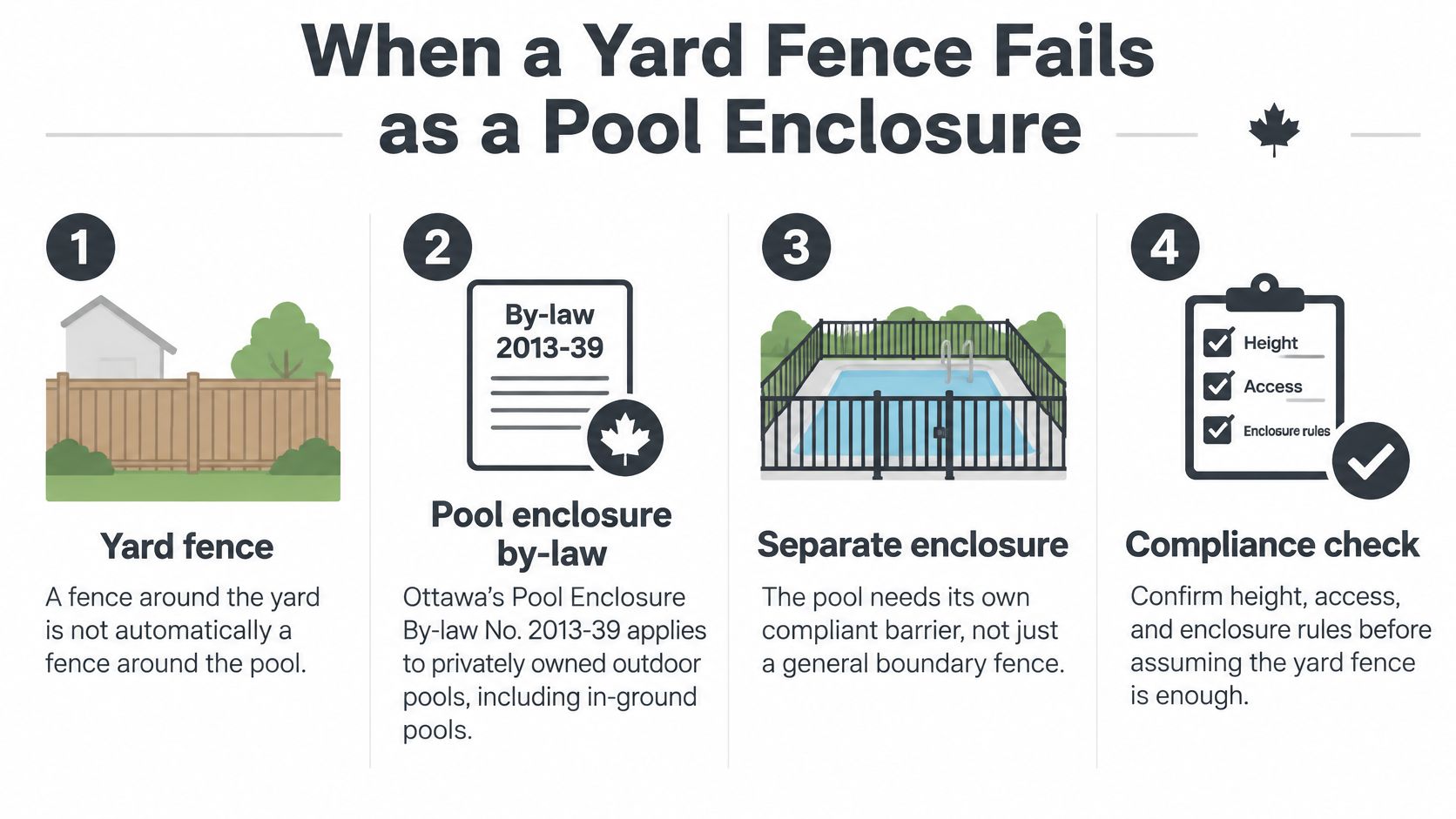
A fence around the yard is not automatically a fence around the pool. That sentence surprises more pool buyers than any price quote, usually after they've assumed the existing back fence already covers them. It may cover the lot. It may not cover the water.
The City of Ottawa pool enclosure guidance explains that Pool Enclosure By-law No. 2013-39 requires every privately owned outdoor pool, including in-ground, semi-in-ground and above-ground pools, as well as hot tubs, to have an enclosure that makes the water area inaccessible to small children. The enclosure must be at least 1.5 metres (5 feet) high, openings through or beneath it must be too small for a 100-millimetre (4-inch) sphere to pass through, and gates must be self-closing and self-latching with the lock at least 1.35 metres (4 feet 5 inches) above the enclosure bottom.
Why Each Measurement Exists
Think cause and effect rather than red tape. Height slows a climb and puts the top rail out of easy reach. Small openings stop a child squeezing through or under. A self-closing, self-latching gate removes the human error of forgetting to shut it, and a high latch puts the release where small hands can't work it.
Remove any one of those and the barrier leaks. A tall fence with a propped gate isn't an enclosure. A tight gate on a low, climbable fence isn't either.
Where Ordinary Yard Fences Usually Fail
Walk your existing fence with a child's route in mind and you'll spot the usual failures quickly.
Climbable horizontal rails: A rail on the outside face works like a ladder rung, even on a tall fence.
Too much bottom clearance: A gap under the fence on sloped ground can pass the sphere test in one spot and fail it two posts later.
A gate that doesn't close itself: A garden gate you pull shut by hand will eventually be left open.
Posts that heave: Frost-susceptible posts shift through freeze and thaw cycles, opening gaps and throwing gates out of alignment.
Loose transitions: The joint where fence meets house wall, deck or shed is often wider and weaker than the fence itself.
Accepted construction includes chain link, vertical boards, wrought iron, aluminum, vinyl or an equivalent barrier, set on posts that aren't frost-susceptible. The material list is generous on purpose. The geometry and the gate hardware are where compliance is won or lost, and our guide to pool safety fencing requirements in Ontario walks through those checks in more detail.
Don't skip the permit point. Ottawa requires a pool enclosure permit even when a yard fence is already standing, while an ordinary residential fence generally doesn't need a building permit. Before you call your yard fence compliant, walk the whole access path, including patio doors and side gates that open into the pool area. A perimeter is only as strong as its easiest entry.
Homes Worksites and Commercial Perimeters
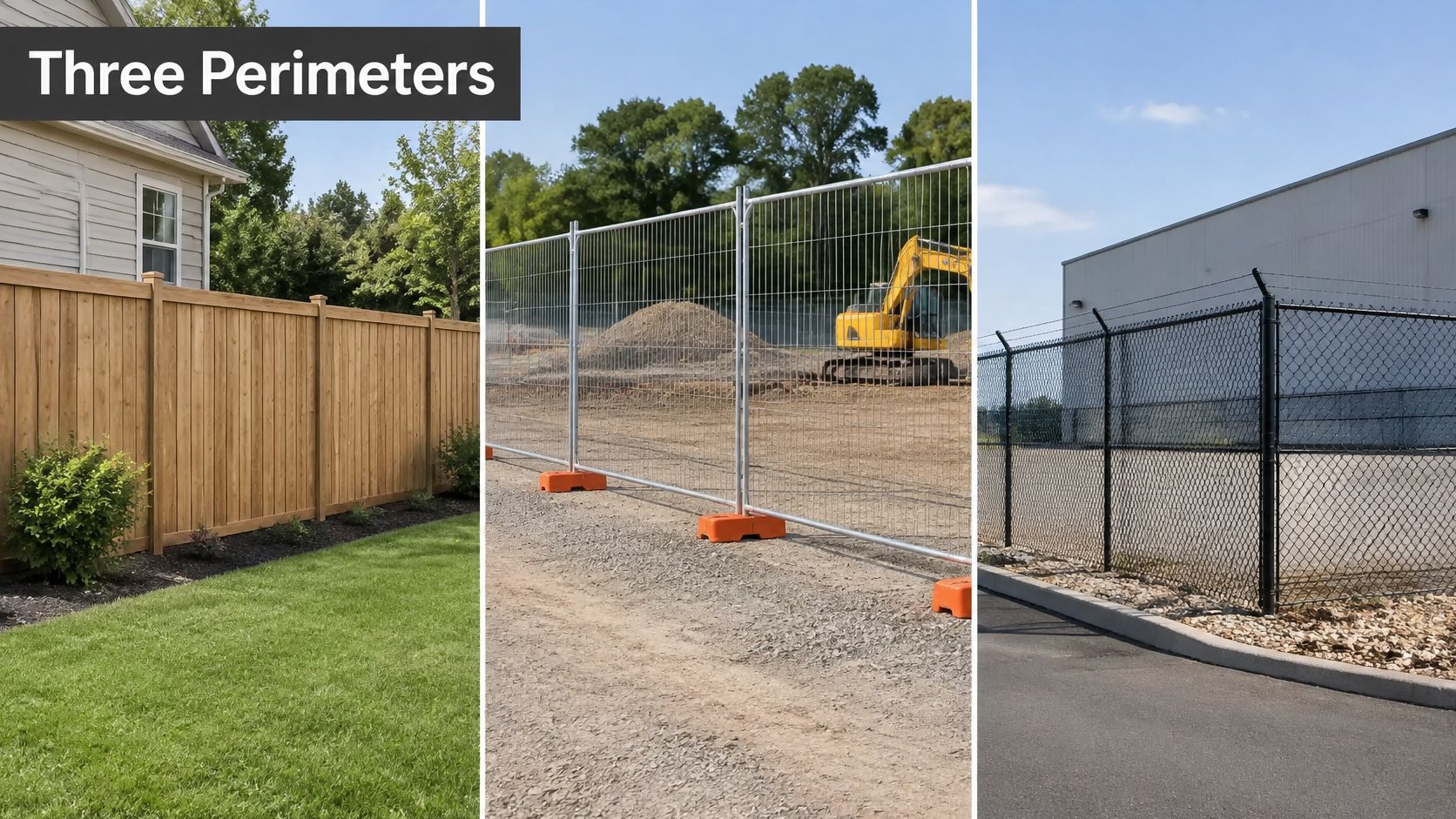
Three local scenes show the job-first idea faster than any definition. In each one, the material makes sense only after you know what the fence has to do.
A Rear Yard in Ottawa
A homeowner wants privacy from the neighbour's deck and a finished face turned outward, with the structural supports on her own side. Here the job is separation and screening within the taller rear and side yard allowance. In Canada, cedar and pressure-treated lumber are the usual wood choices, while vinyl avoids the fade, twist and cracking that wood can show after a few winters. Either can work, because the job is privacy, not hazard control.
A Commercial Yard That Needs Eyes on It
Now picture a storage yard where staff and cameras need to see in and out. A solid privacy screen would hide the very activity the owner wants visible, so ornamental iron or chain link fits better. Security here means controlled access through proper gates, not concealment. Chain link remains the practical pick for pools, back lots and commercial edges when budget and visibility both matter, and commercial security fencing and gate planning shows how those gates get specified.
The short video below shows how different perimeter styles read from the street, which helps when you're weighing openness against screening.
A Worksite Beside a Sidewalk
A construction perimeter isn't specified by the look the owner wants at all. The City of Ottawa fencing information sheet states that where a construction site is 3 metres or less from a public pathway or an area where the public congregates, the fence must be at least 1.8 metres high, measured from the grade on the outside of the enclosure. The minimum may drop to 1.2 metres only for a residential building of no more than three storeys where the site is more than 3 metres from an adjacent public walkway.
That measured distance from the public is the specification. Contractors comparing approaches to site security with GM GROUP Services will recognise the same principle, since a worksite barrier exists to separate people from hazards first and mark property second.
Gatineau adds one more scene worth knowing. After certain demolition work, the street edge barrier on a vacant lot can be a fence, a berm with plants, or an evergreen hedge. A perimeter isn't always a panel product. Sometimes it's a planted or graded edge that still blocks vehicle access.
Material match: Choose for the job first, then for weather and maintenance, and treat glass railings as an open modern edge rather than a child safety enclosure unless the rest of the barrier meets the relevant rule.
Gatineau Setbacks and Shared Ownership
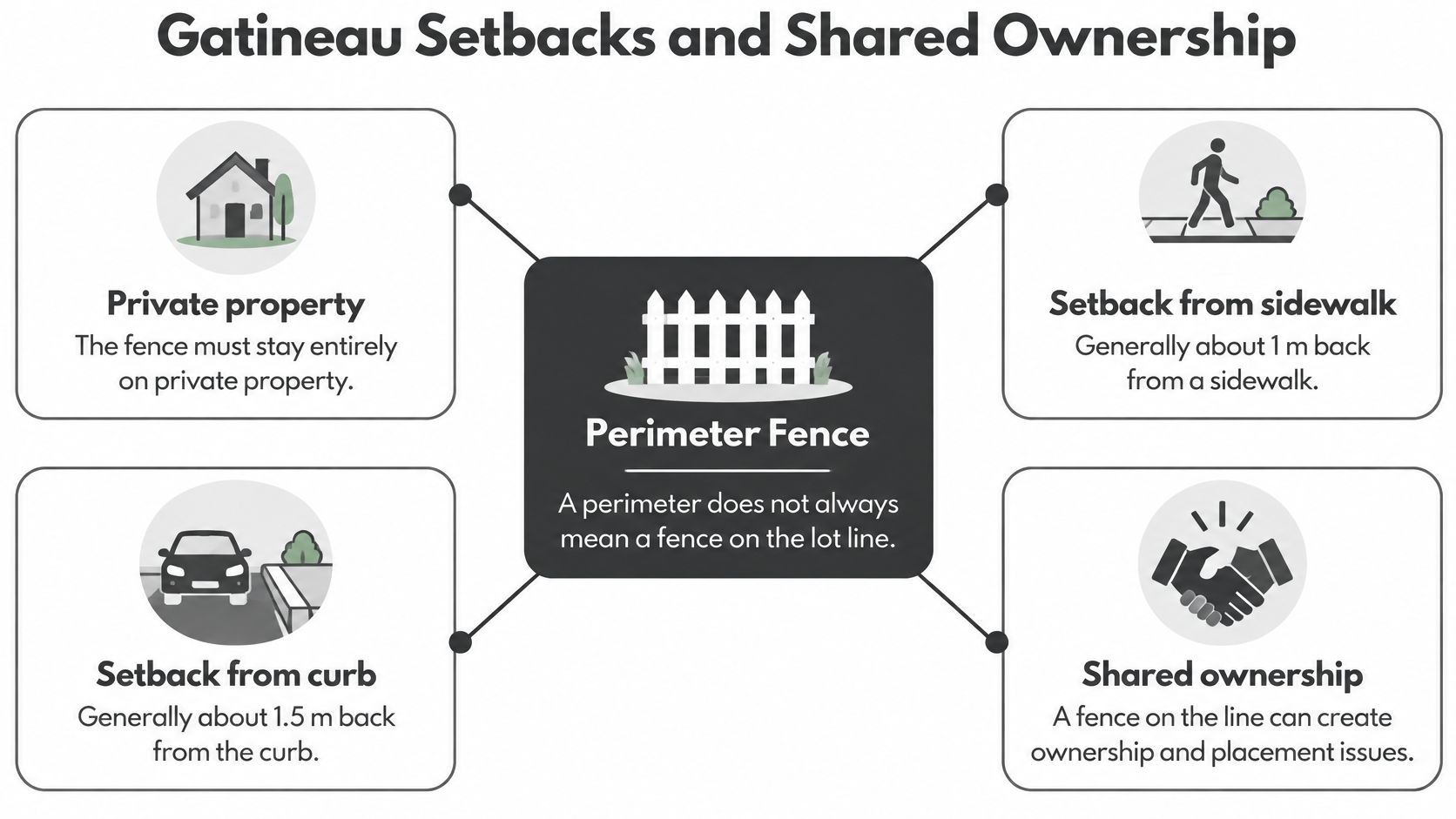
Perimeter doesn't always mean a fence standing on the lot line. That assumption causes real trouble in Gatineau, where a perfectly straight fence on the wrong line can still be a bylaw problem and a neighbour dispute waiting to happen.
The Ville de Gatineau residential fence rules require fences to remain entirely on private property and set them back generally 1 m from a sidewalk or 1.5 m where there is no sidewalk. For one to four unit homes, typical limits are 1.2 m in front yards, 1.5 m on side yards adjoining a street, and 2 m in non-street side and rear yards, while larger residential buildings can reach 2.5 m in rear and non-street side yards. After certain demolition or relocation work creates a vacant lot, a street edge fence, planted berm or evergreen hedge with a minimum height of 0.75 m may be required to prevent vehicle access.
Three Barriers Readers Lump Together
Separate these before you measure anything.
A property line fence: This sits between two neighbours and raises ownership and cost questions.
A street facing barrier: This sits back from the sidewalk or curb to protect sightlines and public space, so the legal perimeter sits inside your lot.
A mandatory vacant lot barrier: This is a street edge fence, berm or hedge required after demolition, built to stop vehicles rather than give privacy.
Each one can look like a simple fence from the road. Each one is governed by a different reason for existing, which is why copying the house across the street can mislead you if that house falls in a different category.
Who Owns a Fence on the Line in Quebec
Quebec treats boundary marking broadly. A wall, ditch, hedge, barrier or other fence can mark a property boundary. A fence built directly on the dividing line is presumed to be a common fence, unless the original owner can prove it was built independently and never accepted as shared.
A fence placed near the line instead must remain wholly on the owner's land, must not touch the dividing line, and must follow the municipal bylaw. That small gap changes the legal picture completely. On the line suggests shared ownership. Off the line, entirely on your land, keeps it yours.
Don't leave that to a handshake and a guess. Confirm the survey first, talk to your neighbour before posts go in, and agree in writing if the fence will be shared, including who maintains which side. And don't assume an Ottawa height applies in Gatineau or the reverse. Crossing the river changes the row in the table, the setback from the sidewalk and the ownership presumption all at once.
Confirm the Line Before You Build
You don't need more rules. You need the decisions in the right order. Four moves will get most Ottawa and Gatineau projects from guesswork to a buildable layout.
Name the job: Boundary, privacy, pool safety, commercial access or worksite separation. One fence can serve two jobs, but the stricter job sets the standard.
Match the job to the row: Use the lookup table to fix your height, opening and permit position before you price materials.
Confirm the survey: Make sure the fence stays on the right land, including any Gatineau sidewalk setback and any shared fence agreement with a neighbour. Our overview of property line fence rules helps you prepare for that conversation.
Choose the material last: Pick chain link, vinyl, aluminum or wood that can hold the required geometry through freeze and thaw weather.
Copying a neighbour's fence skips all four moves. You can inherit the wrong city's limit, a pool gate that doesn't latch itself, or a line that's on shared land. The fence across the street is evidence of what that owner built, not proof of what your lot allows.
If you'd rather have the layout checked than guessed, we serve Ottawa-Gatineau and the surrounding areas and design everything from simple lines to complex sites. We offer a free estimate at 920 Belfast Rd unit 103, Ottawa, or by phone at (613) 617-4414. Ask for an installation quote when you want our crew to handle the build, or a material quote when your DIY scope is already clear.
Finish with a walkthrough test you can do yourself. The line runs straight and sits on the right land, the gates close and latch the way their job requires, and the fence matches the bylaw for that side of the river. When all three hold, you've got a real perimeter, not just a fence that looks the part.
If you're planning a perimeter fence in Ottawa or Gatineau and want the job, height, setback and permit questions settled before materials are ordered, visit FenceScape to request your free estimate. Tell us whether the fence has to mark a boundary, guard a pool or secure a worksite, and we'll design a straight, durable line that fits your lot, your bylaw and your budget.
Accessories can completely change the character of an outfit, even when the main clothing pieces remain the same. I find it fascinating how a handbag, belt, scarf, or pair of sunglasses can transform a simple combination into something more distinctive. While looking for accessory inspiration, I found fashionmakestrends.com, which features outfit ideas incorporating different colours and finishing touches. I particularly enjoy experimenting with contrasting textures, such as leather accessories alongside soft knitwear. For everyday fashion in Canada, versatile accessories are useful because they can work with several seasonal wardrobes. It is a creative way to refresh familiar looks without constantly purchasing new clothing.