
PVC Fence Styles: 8 Designs Compared for Ottawa Homes

A homeowner in Kanata orders a tall, solid PVC fence for an exposed corner lot. The panels promise backyard privacy, but the installation review reveals a problem: the posts need deeper footings than budgeted, and the broad panels will take much more wind pressure than an open fence. The style looked right in a photograph. It wasn't matched to the property.
Choosing among PVC fence styles starts with the conditions along your fence line. A sheltered patio, a windswept rural boundary, and a shared townhouse lot need different solutions, even when the homeowners want the same colour. Frost-sensitive soil, drifting snow, sloping ground, and pool-barrier requirements also affect what you should order.
The main options are solid privacy, board-on-board, scalloped picket, ranch rail, lattice-top, pool-enclosure, reinforced hybrid, and ornamental-look fencing. Each can work well in the right location, but panel appearance alone won't tell you whether the posts, rails, and gates suit your site.
Start with the job the fence must do, then check how the complete system will handle your property's exposure and rules. That's more useful than choosing a decorative top first and trying to solve the installation afterwards.
1. Full Privacy PVC Fence (Solid Flat Panel)
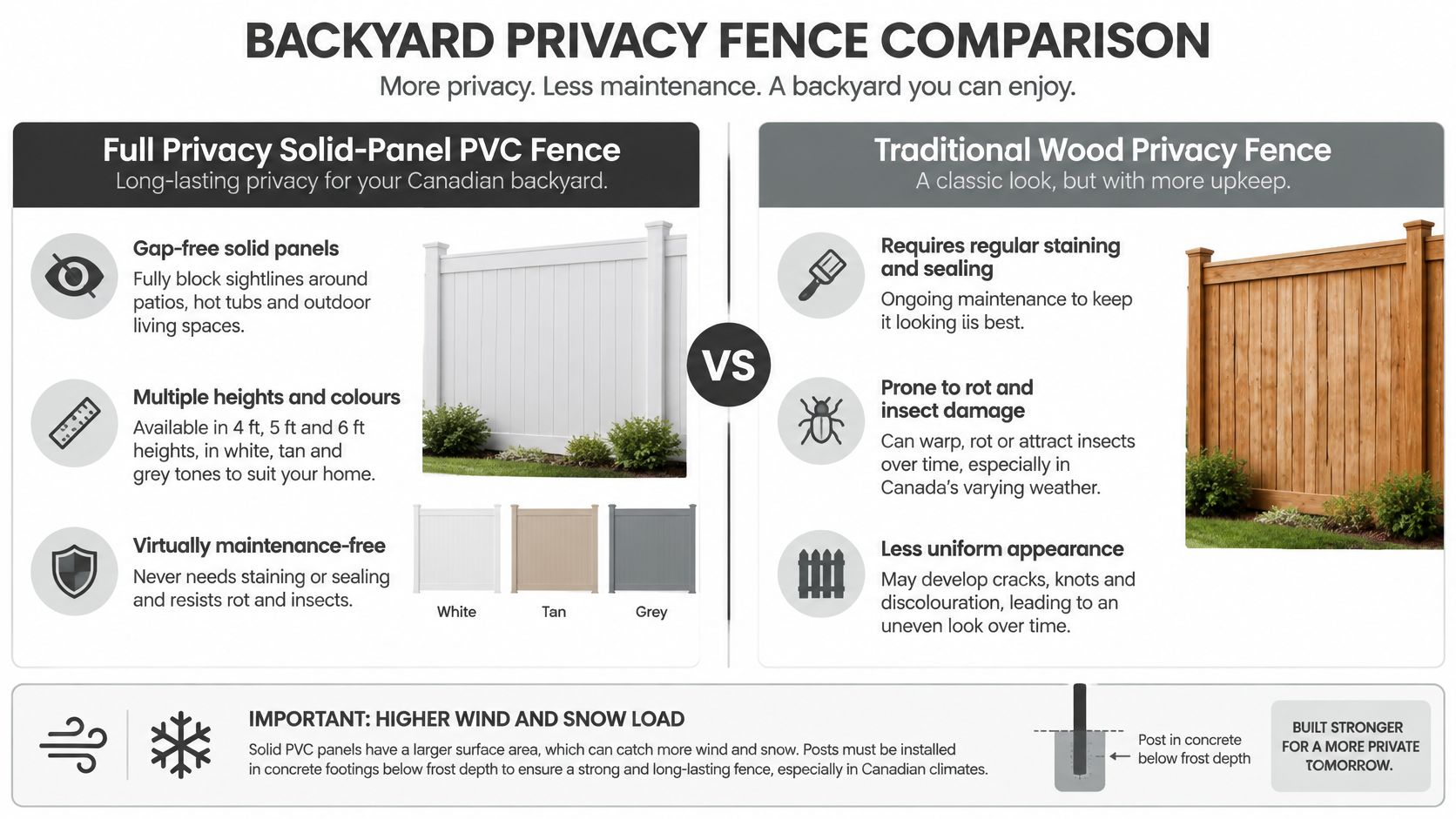
Solid flat panels are the straightforward choice for blocking direct sightlines. Interlocking infill creates a continuous screen around a patio, hot tub, or backyard perimeter. On a suburban lot in Kanata, Orléans, or Gatineau, that can make outdoor seating feel substantially more secluded.
The trade-off is exposure. A solid surface catches more wind than open pickets, so post reinforcement, rail connections, and footings matter as much as the panel itself. Don't assume the foundation suitable for a sheltered side yard will suit an open corner facing a field.
Check the Foundation Before the Finish
Specify footing depth for the actual soil, frost conditions, and fence system rather than relying on a generic regional estimate. A PVC sleeve isn't proof that the post assembly underneath has adequate strength.
Before ordering, settle these details:
Wind exposure: Identify open approaches, gaps between buildings, and exposed end posts.
Thermal movement: Follow the panel manufacturer's allowance for expansion inside routed posts or channels. Don't cut infill so tightly that it binds.
Winter clearance: Keep ploughed or compacted snow from bearing against the panels.
Sightlines: Check privacy from the patio chair and neighbouring windows, not just while standing beside the proposed fence.
A solid panel blocks views through the fence, but it won't necessarily screen a raised deck. Confirm the permitted height and finished ground levels before paying for extra-tall sections.
Practical rule: Choose a solid fence for privacy, then design its supports for exposure. Don't treat stronger posts as an optional cosmetic upgrade.
2. Board-on-Board PVC Privacy Fence
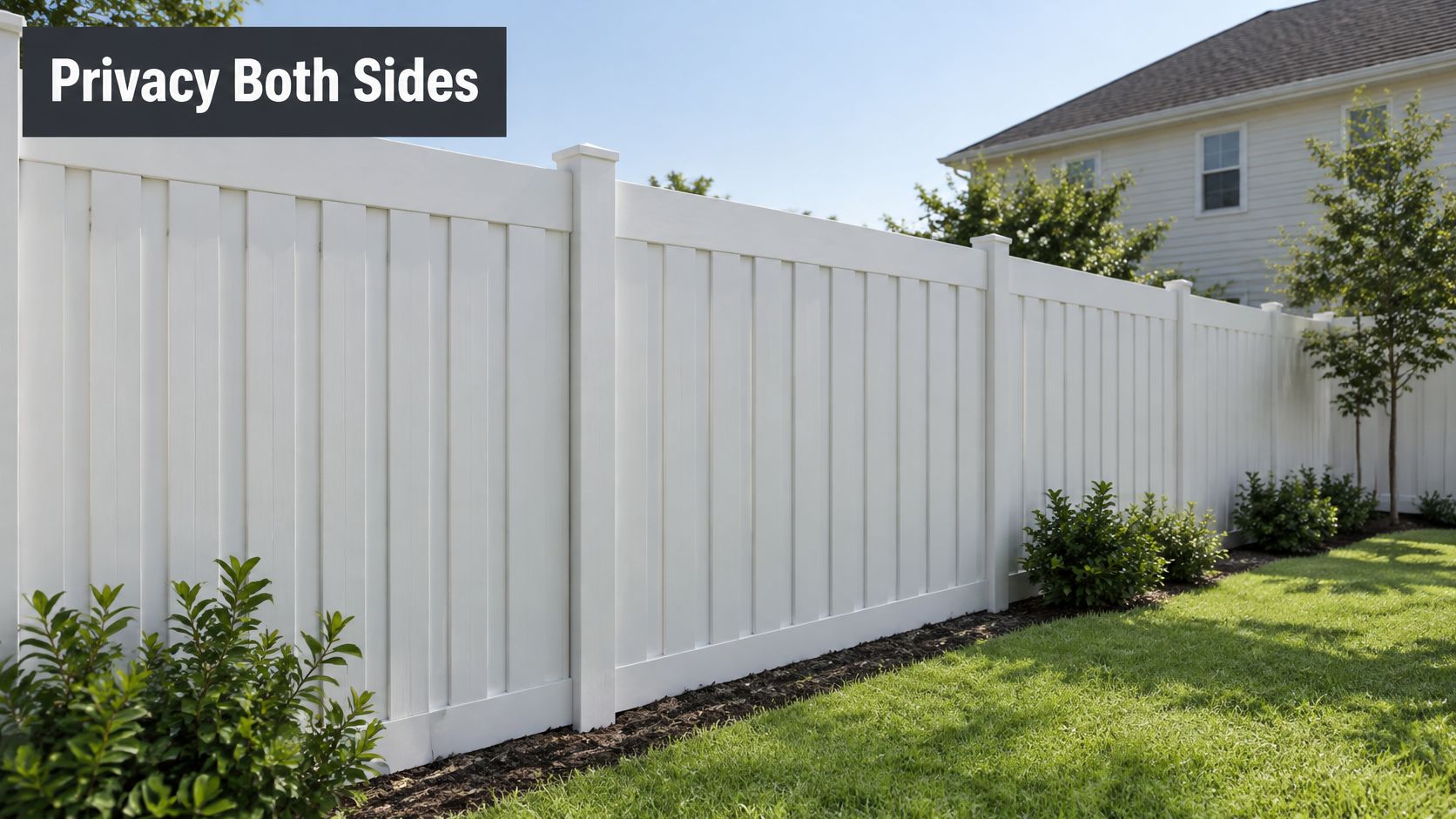
A shared boundary between Barrhaven townhouses needs more than privacy. Both households will look at the fence every day, and neither wants exposed backing rails facing their patio. A double-sided board-on-board layout can provide a balanced appearance with overlapping vertical elements and pronounced shadow lines.
Check the actual panel construction, though. Suppliers sometimes use similar style names for different profiles. An overlapping design may allow air through while limiting direct views, but privacy at an angle depends on board width, spacing, and overlap.
Ottawa's building-permit guidance explains that ordinary residential fences generally don't need a building permit but must comply with the fence by-law, including the good-neighbour requirement for the more attractive side to face neighbouring property and the street. A double-sided finish can simplify that design decision, but it doesn't settle ownership or property-line placement.
Inspect Both Faces and the Overlaps
Compare a physical panel with the other vinyl privacy fence styles before committing to a shared run. Look diagonally through the boards and inspect how rails meet the posts.
Shared responsibility: Agree on placement, cost, gate access, and future repairs before installation.
Rail support: Use the manufacturer's specified rail and reinforcement arrangement rather than adding unsupported spans.
Spring cleaning: Flush leaves and dirt from overlapping joints with mild soap, water, and a soft brush.
This style suits neighbouring patios where appearance matters on both sides. It's less useful when the homeowner expects complete visual screening from every viewing angle without checking a sample first.
3. Semi-Privacy Scalloped Picket PVC Fence
For an older Ottawa home with a small front garden, a solid boundary can feel heavy. Scalloped pickets define the yard without closing it off, preserving views of planting beds and allowing neighbours to see the entrance.
The decorative curve needs careful planning on sloping ground. A panel that looks balanced on level pavement may leave uneven bottom gaps beside a descending walkway. Lay out the fence profile against finished grade before ordering routed posts and matching gates.
Picket spacing should reflect what you're containing. A gap that looks narrow from the street may still let a small dog squeeze through, and a decorative fence isn't automatically a child-safety barrier. Check the clear openings throughout the assembly, including beneath gates.
Order for the Frontage You Actually Have
A front-yard fence must suit driveway visibility, walkway access, and local height restrictions. Don't carry a backyard specification around the corner without checking the frontage rules.
Scallop shape: Check the lowest part of the curve when evaluating containment or barrier height.
Gate position: Keep the opening clear of steps, snow-storage areas, and parked vehicles.
Hardware: Use self-closing hardware where appropriate, with hinges and a latch selected for the gate's weight.
Pet clearance: Compare openings with your animal's size rather than relying on the style name.
This is a good choice for a side-yard boundary where you want light and visibility. It's a poor choice beside a hot tub or dining terrace when uninterrupted screening is the main priority.
An open fence can make a yard feel welcoming, but visibility and containment are different jobs. Decide which one matters before choosing the picket gap.
4. Ranch Rail PVC Fence (2-Rail and 3-Rail)
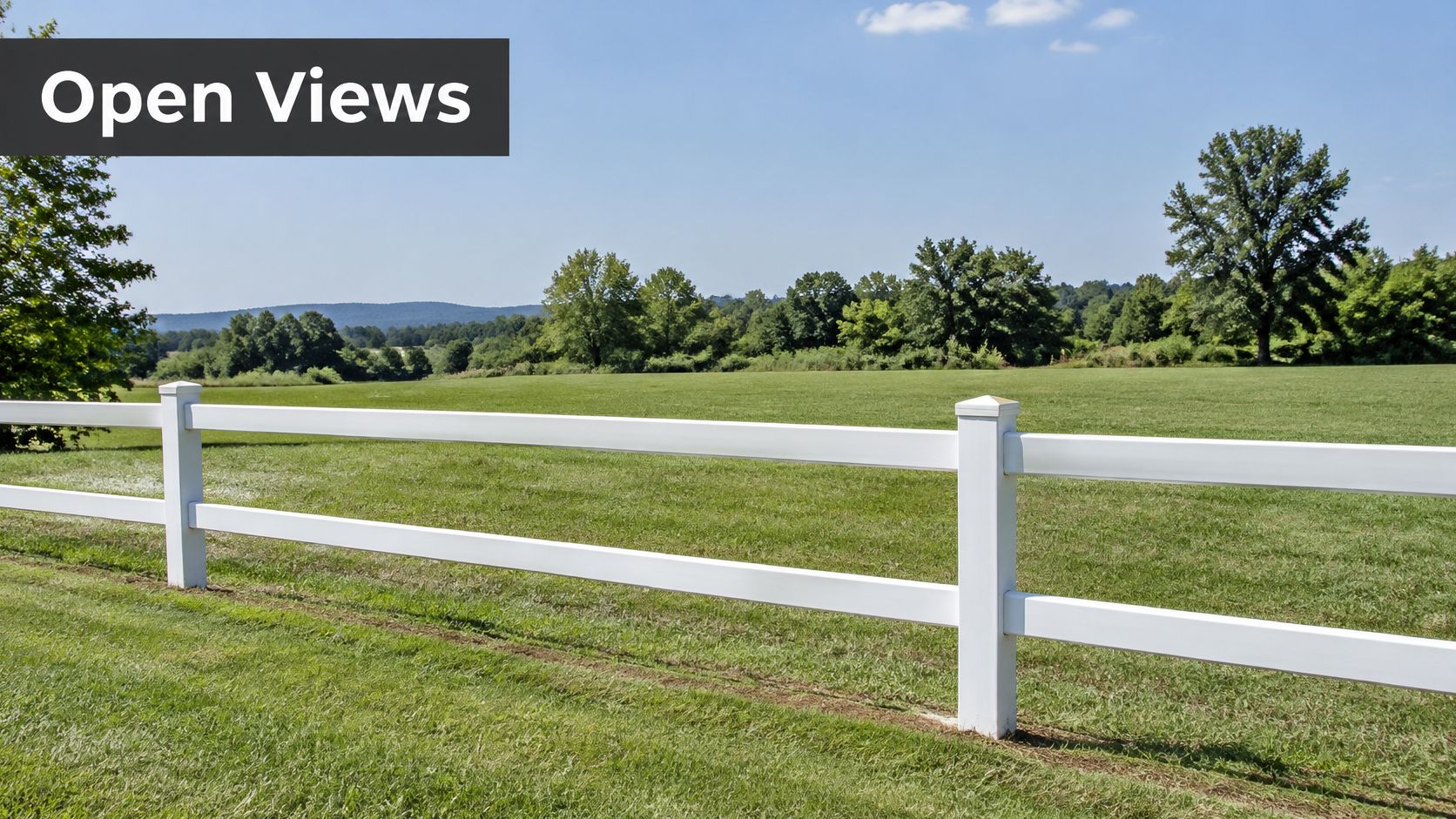
Ranch rail marks a boundary without hiding the view. It suits rural Ottawa and Outaouais properties where the purpose is to frame a driveway, separate a paddock, or define the edge of a large lawn.
The open layout presents less solid surface to wind than privacy panels. That doesn't eliminate structural planning: corners, gate openings, and changing ground levels still need suitable posts and connections. A long, straight run also makes small alignment errors easy to see.
Boundary Marker or Animal Enclosure?
Those are different specifications. Ordinary open rails won't contain a small dog, and a decorative residential product shouldn't be assumed suitable for horses or livestock.
For a hobby-farm driveway, ranch rail can provide the visible boundary while an appropriate mesh insert handles smaller animals. Select mesh, attachment hardware, and exposed edges for the animals involved, and make sure the underlying PVC system permits that attachment.
Post layout: Use the selected system's specified spacing and rail engagement.
Gate support: Reinforce gate posts for the gate assembly, not merely the adjoining rails.
Snow operations: Leave room for ploughing and snow storage without pushing banks into the fence.
Terrain: Confirm whether rails can follow the slope or whether the layout needs stepped sections.
Ranch rail can use less infill than privacy fencing, but don't assume it will deliver the cheapest completed project. Long runs, clearing, mesh, rock excavation, and substantial gates can change the total considerably.
5. Lattice-Top PVC Privacy Fence
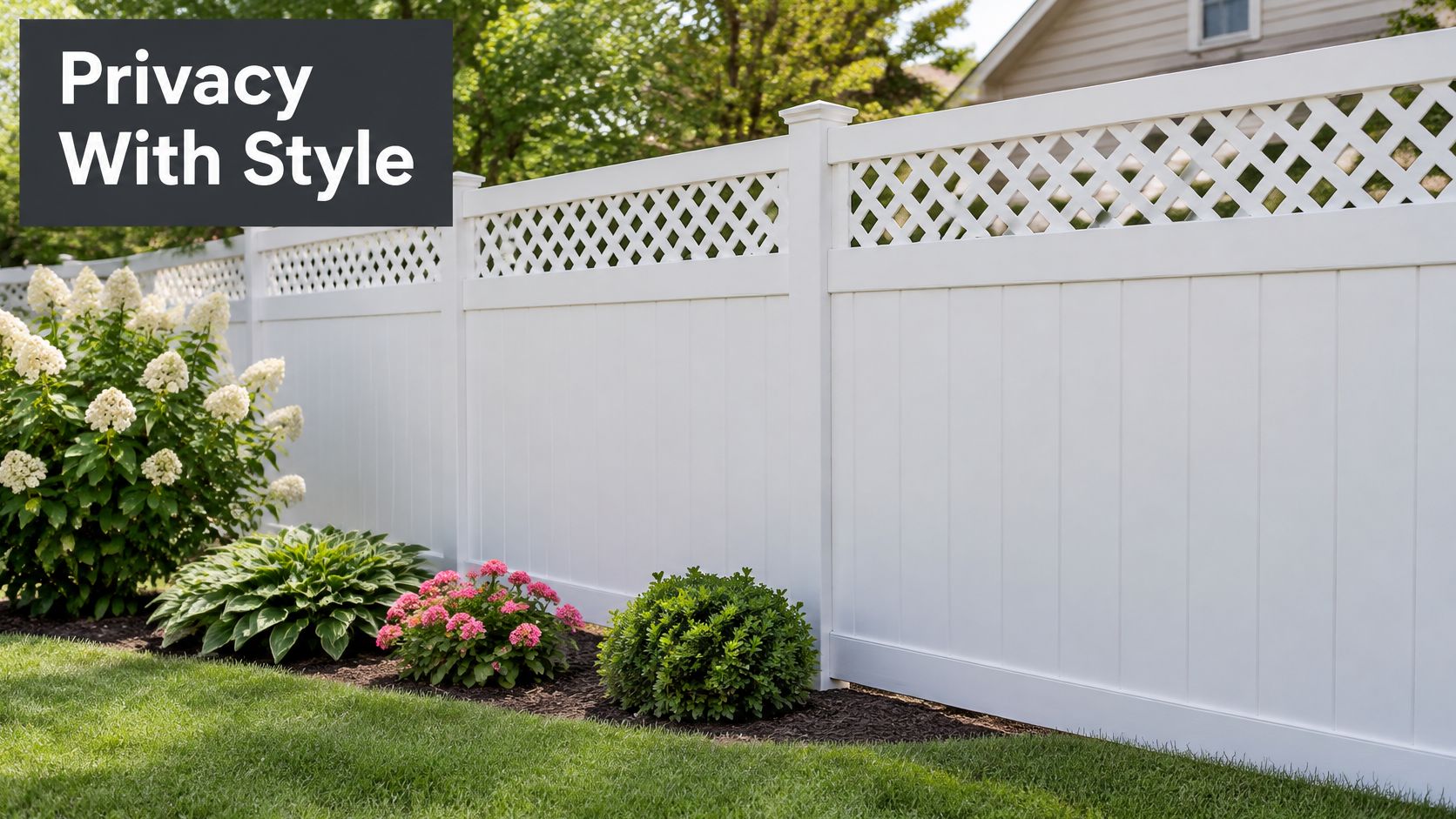
A lattice top works well behind a patio where you want screening at seated eye level without making the entire boundary look solid. The lower panel provides privacy; the upper section provides openness and detail.
That distinction matters beside raised neighbouring windows. If the unwanted view passes through the lattice, decorative height won't solve the privacy problem. Stand at the proposed seating area and check the viewing angle before selecting the solid-to-open proportion.
The lattice also needs proper framing. Thin decorative infill shouldn't carry the weight of mature vines, hanging baskets, or snow-laden vegetation. If climbing plants are part of the garden plan, use an independently supported trellis where practical.
Check the Decorative Section as Carefully as the Panel
Ottawa's residential landscaping guide distinguishes ordinary residential fencing from pool enclosures, which require their own permit. A garden-style product should never be treated as a pool barrier because its overall appearance seems substantial.
For an ordinary patio screen, inspect how the lattice is captured in its frame and whether that assembly is approved for your exposure. Decorative openings don't remove the wind load on the solid panel beneath them.
Confirm the total installed height, including the lattice and caps, with the municipality. On a sloped boundary, establish where height is measured rather than assuming every post can use the same reference point.
This style is strongest as a garden feature with useful lower-level privacy. Choose full privacy instead when screening matters more than an open upper profile.
6. Code-Compliant PVC Pool Enclosure Fence
A pool enclosure is a safety system, not another decorative style. PVC can form that system, but the panels, posts, clearances, gate, latch, and surrounding grade must work together.
Ottawa's pool-enclosure requirements require an enclosure at least 1.5 metres high, with openings through or below the barrier that won't pass a 100-millimetre sphere. The same municipal requirements recognize sufficiently strong vinyl construction, require self-closing and self-latching gates, and place the locking device at least 1.35 metres above the enclosure bottom.
Those Ottawa dimensions shouldn't be carried across the river as a Gatineau specification. Confirm the rules for the actual property before selecting or fabricating components.
Make the Gate Part of the Design
For a backyard pool, plan the gate location before finalizing panel quantities. The approach should remain clear of furniture, planters, and snow-storage areas, with swing direction and hardware matching municipal requirements.
Our pool fence installation guide provides additional planning context for the enclosure layout.
Grade and gaps: Check the lowest clearances along slopes and beneath gates.
Climb resistance: Keep usable footholds and nearby climbable objects out of the layout.
Maintenance: Test closing and latching action each season and after any ground movement.
Approval: Obtain the required enclosure permit, including when replacing an existing barrier.
Safety check: A gate that closes only when pushed isn't performing as a self-closing gate. Correct dragging, misalignment, or worn hardware promptly.
The video below provides additional pool-fencing context.
7. Hybrid PVC Fence with Steel or Aluminum Inserts
On an exposed commercial boundary or a long townhouse perimeter, the important difference may be inside the fence. A reinforced hybrid system pairs PVC surfaces with metal structural components, rather than asking an unreinforced profile to handle every load.
Internal inserts and external metal frames aren't interchangeable designs. Compare the complete assembly, including post anchorage, rail connections, infill retention, and gate support. A metal insert won't compensate for an undersized footing or a poorly connected rail.
A sloping site adds another decision. Stepped panels maintain level panel tops with changes between sections, while racked panels follow the slope where the product allows it. Neither approach should be improvised by forcing components beyond their intended adjustment.
Specify the Whole Assembly
For a property manager replacing a shared perimeter, record the reinforcement and hardware specifications alongside the colour and panel profile. That makes future repairs more straightforward than an order describing only a grey privacy fence.
Metal protection: Treat field-cut steel ends with the specified compatible protective coating.
Mixed materials: Use approved fasteners and connections where dissimilar metals meet.
Footings: Design foundations for exposure, soil, fence height, and gate loads.
Service access: Keep replacement infill and connection points accessible.
Compare structural details alongside the maintenance considerations in our guide to low-maintenance fence options. The finish may reduce routine upkeep, but hinges, fasteners, and structural connections still deserve inspection.
Hybrid construction is worth evaluating where wind exposure, large gates, or demanding use make reinforcement valuable. It isn't a reason to extend spans beyond the system's approved limits.
8. Ornamental-Look PVC Fence (Faux Iron or Aluminum Style)
A heritage-style front yard may need a visible boundary without a solid screen. Ornamental-look PVC uses slender pickets and decorative rails to suggest a traditional metal fence, while keeping views through the property open.
Inspect a sample before choosing it for a prominent frontage. Moulded joints, picket thickness, surface sheen, and cap details can look different at close range than in a catalogue. Dark finishes also deserve a daylight check beside the home's masonry, trim, and existing railings.
For a townhouse community, consistency matters beyond the initial installation. Record the product name, finish, gate hardware, and decorative components so later replacements don't create a patchwork boundary.
Separate Appearance from Barrier Performance
An ornamental profile doesn't automatically qualify for a pool enclosure. Ottawa's pool-enclosure brochure emphasizes compliant barrier construction, frost-resistant post arrangements, and properly functioning gates. Decorative rails and picket spacing need review before the design is used around a pool.
For a front-yard application, focus on these ordering checks:
Visibility: Preserve safe views at driveways, walkways, and street corners.
Finish: Select an exterior-rated, UV-stabilized product and review its care instructions.
Hardware: Match the gate hardware visually, but prioritize correct capacity and operation.
Winter access: Keep decorative sections outside snow-clearing paths and areas likely to receive impact.
I'd choose this style where the open view is an advantage, not where screening is the main objective. Also compare it with actual ornamental aluminum or iron rather than assuming the PVC version will always cost less.
How the 8 PVC Fence Styles Compare on Height, Privacy, Wind Load, and Best Use
Read wind load as the force posts and footings must resist, not as a style score.
Item | Typical Height | Privacy Level | Wind Load | Best For |
|---|---|---|---|---|
Full Privacy PVC Fence (Solid Flat Panel) | 4, 5, or 6 ft | Maximum | High | Backyard screening and blocking sightlines |
Board-on-Board PVC Privacy Fence | Typically 6 ft | High | Moderate; allows some airflow | Shared boundaries with a finished look on both sides |
Semi-Privacy Scalloped Picket PVC Fence | 3-4 ft | Partial | Low | Front yards and curb appeal |
Ranch Rail PVC Fence (2-Rail and 3-Rail) | 3-4 ft | Minimal | Very low | Marking boundaries while preserving views |
Lattice-Top PVC Privacy Fence | 6-8 ft total | High; partial at the top | Moderate; lattice passes some wind | Decorative garden and patio screening |
Code-Compliant PVC Pool Enclosure Fence | At least 1.5 m (Ottawa requirement) | Moderate to high, depending on panel coverage | Moderate to high, depending on solid coverage and footings | Pool barriers with compliant gates and spacing |
Hybrid PVC Fence with Steel or Aluminum Inserts | 5-8 ft | High when solid panels are specified | Reinforced for added strength | Long spans, slopes, and security-focused perimeters |
Ornamental-Look PVC Fence (Faux Iron or Aluminum Style) | 3-4 ft | Low | Open design; low wind resistance | Decorative front yards and heritage-style homes |
Match Your PVC Fence to Your Site Before You Order
The best PVC fence for an Ottawa–Gatineau property is the one that meets the job without creating avoidable installation problems. Full privacy suits an overlooked patio, ranch rail suits an open rural boundary, and reinforced construction deserves consideration where exposure or demanding use changes the structural requirements.
Don't force the same profile around every edge of the property. A private rear seating area and a street-facing corner can need different treatments, provided the transitions are planned and local rules permit them.
Complete These Checks Before Committing
Bring a property sketch, photographs, and any available survey information to the planning discussion. Mark slopes, gates, pool access, utilities, existing structures, and the places where snow accumulates.
Confirm the privacy goal: Identify the specific view you want to block, including higher sightlines.
Assess wind exposure: Note open fields, street corners, and exposed ends where solid panels need particular attention.
Plan for snow: Separate ordinary snowfall from ploughed banks, drifting snow, and snow sliding from nearby roofs.
Verify frost and soil conditions: Establish suitable footing depth and construction for the site rather than copying a neighbour's installation.
Check municipal requirements: Confirm height, frontage, visibility, and pool-enclosure rules for Ottawa or Gatineau as applicable.
Resolve shared boundaries: Agree on placement, finished faces, access, and repair responsibility with neighbours.
Finalize the system: Match posts, reinforcement, gates, and hardware to the selected panels.
For material-only projects, complete those decisions before preparing the order. Include end posts, corners, gate posts, caps, connection hardware, and reinforcement so the material list represents a buildable fence rather than just a panel count.
A free estimate from FenceScape gives homeowners an opportunity to review suitable options for their property. Our in-house crew handles every installation, with the project managed from design through installation and the final walkthrough.
Use the contact form on our website to request a Material Quote or Installation Quote, or call (613) 617-4414. Include your location, preferred style, approximate layout, and any pool, slope, or shared-boundary considerations so the discussion starts with the conditions that matter.
FenceScape offers free estimates and design-to-installation service for PVC fencing across Ottawa–Gatineau. Visit FenceScape to request a Material Quote or Installation Quote and compare fence styles against your property's privacy needs, exposure, and layout.
Comments