
Hot Tub Privacy Fence Ideas That Actually Work

You've chosen the hot tub, cleared a corner of the yard, and started looking at tall privacy panels. The obvious question seems to be which fence will block the neighbours' view. In Ottawa and Gatineau, that's only half the job. The fence also has to control access, handle snow and wind, leave the cover and equipment usable, and satisfy the enclosure rules that apply to spas.
A well-designed hot tub privacy fence starts with compliance and structure, then adds the right level of visual screening. A decorative screen can look finished on installation day and still fail because the gate doesn't latch, the posts aren't anchored for exposure, or the existing yard fence doesn't qualify as the enclosure. The practical approach is to settle the safety and site constraints first, then choose materials and colours that make the space feel private.
Why Your Hot Tub Privacy Fence Is Really an Enclosure
A neighbour's view is only one design constraint. A tall panel can screen the spa and still leave an opening below, a climbable rail, or a gate that does not secure properly. In Ottawa, a hot tub is treated like a pool for enclosure purposes. The City requires a pool enclosure unless the spa has a lockable safety cover that meets the by-law. An existing pool fence may also need permit review to confirm compliance. Check Ottawa's pool and hot tub enclosure requirements before ordering materials.
Privacy screening and safety enclosure are different jobs
Visual screening controls sightlines. A safety enclosure controls access to the water. Good fencing for privacy can make the spa area feel closed in, but it does not automatically satisfy the requirements for gates, hardware, spacing, height, or access control.
A solid PVC panel may solve the view problem while the gate remains the weak point. Specify a self-closing, self-latching gate where required, keep latch access controlled, and check every route from the yard to the spa. The enclosure includes more than the panel facing the neighbour.
Ottawa generally exempts fences that do not enclose a pool from permits. A screen beside a patio can therefore become a regulated structure when it forms part of the barrier around a hot tub.
Practical rule: Design the fence as though an inspector will assess the entire path to the water, not just the panel facing the neighbour.
A lockable cover can change the layout. It does not remove the need to follow the applicable municipal rules. Ottawa's enclosure brochure explains that, when the cover qualifies, the cover itself is treated as the enclosure and must remain closed and locked when the hot tub is not in use. That option can suit a compact installation, but it creates a daily-use obligation. If the cover is open while people are using the spa, the surrounding arrangement still needs safe, controlled access under the relevant rules.
Start with the municipality, not the catalogue
Requirements differ between municipalities, so confirm them before choosing panel height or gate hardware. In Ontario, Scugog requires a pool fence to be at least 1.5 metres high and permits wood, metal, or chain link. Its hot tub guidance uses the same permit application as pools. A hot tub may avoid a fence only with a solid, lockable cover capable of supporting up to 90.7 kg of pressure, as stated in Scugog's pool and hot tub permit guidance.
Quebec's rules require a hot tub or pool privacy fence to be at least 1.2 metres high, prevent the passage of a 10 cm sphere, and avoid climbable fixtures. Chain-link mesh openings cannot exceed 30 mm, according to the Quebec regulation on private pools. These limits affect picket spacing, panel gaps, and latch placement.
Before construction, classify the structure as a privacy screen, the required enclosure, or both. That decision determines the gate, cover, anchoring, and inspection requirements, and prevents an attractive barrier from needing a costly rebuild.
Choosing Materials That Balance Privacy and Canadian Durability
Steam, splash, freeze-thaw movement, snow and wind all expose weak materials quickly. The right choice depends on whether the spa sits in a sheltered corner, an open yard, beside a river corridor, or on a raised deck with little protection from drifting snow.
PVC offers the easiest routine care. It won't absorb moisture like wood, doesn't need seasonal staining, and can provide solid screening with a clean, consistent colour. The trade-off is that a fully opaque panel can take more wind than a slatted design, so the post system and layout must match the exposure.
Cedar gives a warmer, more natural appearance and works well beside gardens, decks and stonework. It needs a planned sealing or staining cycle, especially around splash zones. Pressure-treated wood is practical and accessible, but it moves as moisture levels change and needs upkeep through Ottawa's freeze-thaw seasons. A hybrid PVC and wood system with steel reinforcement can provide a wood-look finish while giving the frame more structural support.
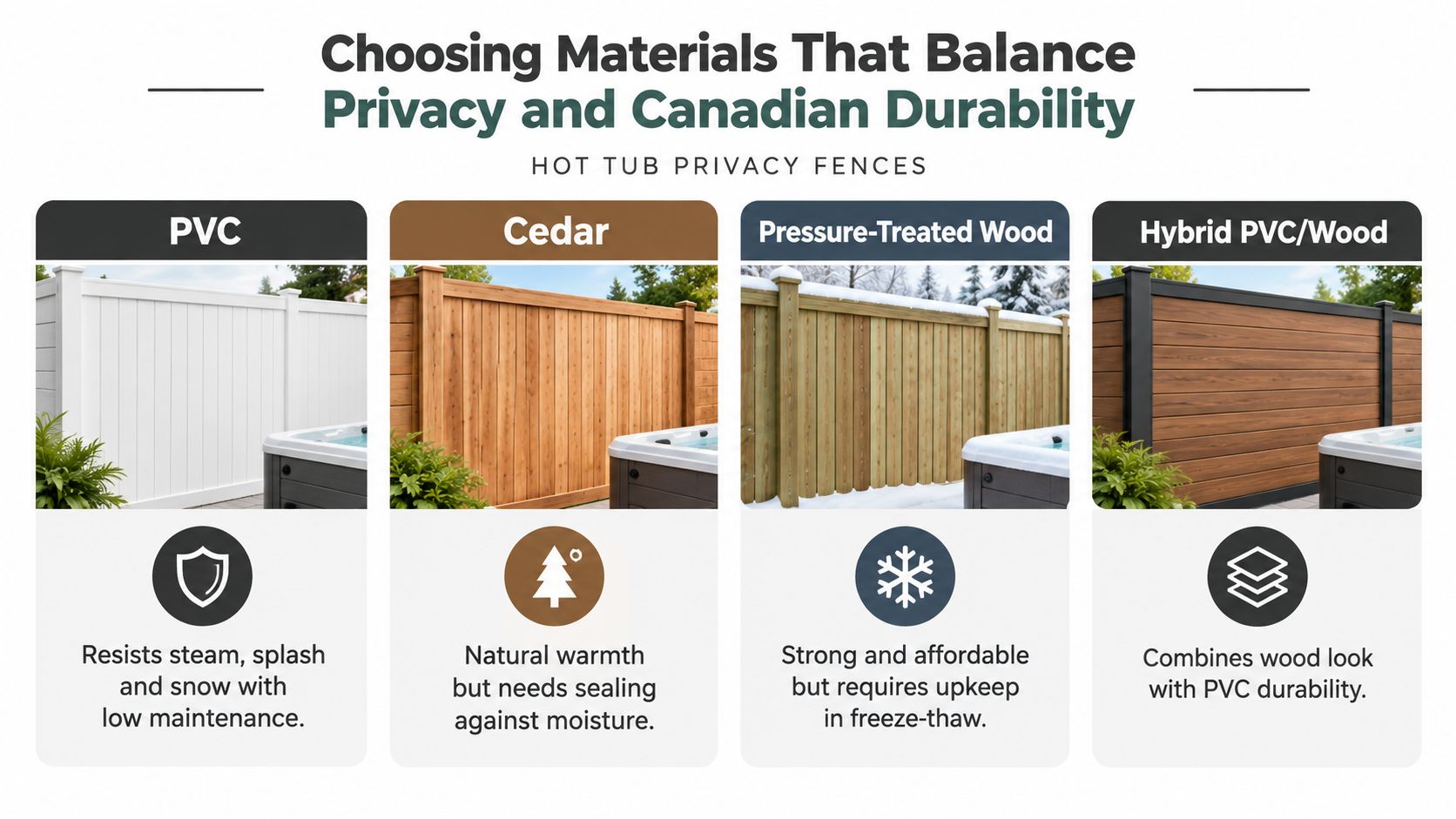
Match opacity to exposure
Solid panels maximise privacy but create a stronger sail effect. Semi-privacy slats, spaced boards, lattice sections, or a carefully placed screen can reduce wind pressure and allow steam to disperse. That doesn't mean open fencing is always safer. It means the panel style should be selected alongside post size, embedment, bracing and the direction of prevailing wind.
Ornamental metal gives a durable boundary but little visual privacy unless paired with a screen or planting. Glass can preserve views and create a polished spa setting, but it demands careful cleaning and detailed planning around impact, privacy angles and hardware. Living screens soften the space and improve the garden feel, but hedges and shrubs don't replace a compliant enclosure. Use them as a supplement, not as the safety barrier.
Material | Privacy Level | Maintenance | Best For |
|---|---|---|---|
PVC | High with solid panels, adjustable with slats | Low routine maintenance | Homeowners wanting consistent privacy and easy cleaning |
Cedar | High with close-board construction | Requires sealing or staining | Natural-looking yards and landscaped settings |
Pressure-treated wood | High with solid construction | Requires ongoing inspection and upkeep | Practical builds where budget and repairability matter |
Hybrid PVC and wood with steel | High, depending on panel style | Moderate, with less exposed wood | Sites needing a wood appearance with reinforced support |
A useful resource for controlling material spend without sacrificing the basics is these cheap fence building tips. Use cost-saving ideas carefully around a spa. Reducing decorative features is sensible, but cutting post support or buying unsuitable gate hardware is false economy.
FenceScape's all-season fencing guidance is also relevant when the enclosure has to remain stable and presentable through changing weather. The final shortlist should answer three questions: how much privacy do you need, how much maintenance will you accept, and how exposed is the site to wind and snow?
Planning Layout Height and Sound Privacy Around Your Hot Tub
A good layout begins with a sightline test, not a tape measure. Stand where neighbours, pedestrians and second-storey windows can see the tub. Then mark the exact sides that need screening. Many installations need full coverage on one edge and a lighter, more open treatment on another.
Map the site before digging
Use stakes and string to represent the proposed fence line. Sit in the hot tub location, check the view from standing height, and walk the neighbouring sightlines. Include the cover in its open position, the cover lifter if you have one, steps, towels, service panels and the path used to carry supplies into the yard.
Wind needs equal attention. A solid wall can shelter the seating area, but it can also collect pressure, drifting snow and moisture. Semi-privacy slats may be the better choice in an exposed corridor, especially when the fence sits perpendicular to prevailing winds. Keep enough airflow around the spa that steam doesn't remain trapped against the panels or neighbouring wall.
The fence line also needs to respect the local setback. Whitby requires pool fences to sit at least 1.0 m from the pool edge, and its guidance says a secure rigid cover kept locked when not in use removes the need for a fence around a hot tub. Check Whitby's swimming-pool requirements if that municipality applies to your project.
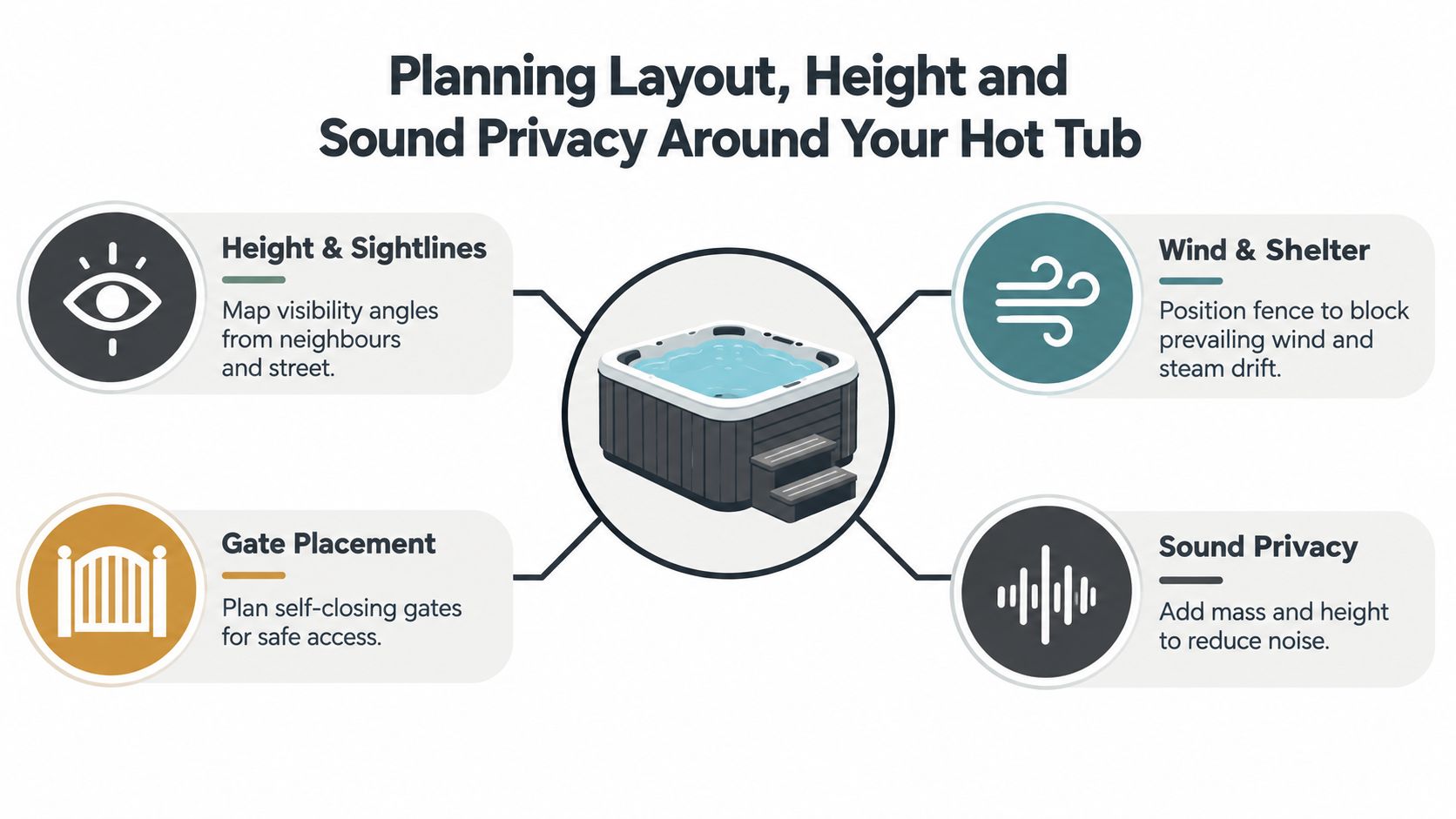
Set height, spacing and gate position together
Don't choose height in isolation. Quebec's enclosure benchmark is 1.2 m, while Scugog's pool-fence requirement is 1.5 m, and Fort Erie requires enclosures to be at least 1.22 m, or 4 ft, for private spas deeper than 0.6 m, or 24 in. Fort Erie also requires self-closing, self-latching gates and non-climbable fence designs, as described in its pool and spa requirements.
Gate placement should keep the route direct but not point straight toward the hot tub steps. Use self-closing hinges and a latch positioned beyond a young child's reach where required. Avoid horizontal rails, decorative crossbars and broad cap details that turn the fence into a ladder.
For sound, mass helps, but total enclosure isn't always the answer. A solid lower section can soften conversation and equipment noise while upper slats preserve airflow. Planting can absorb and scatter sound visually, although it shouldn't be counted as the barrier.
Before ordering, confirm:
Sightlines: The seated and standing views are screened from the relevant properties.
Access: The gate opens comfortably and doesn't strike the cover, lifter or steps.
Spacing: Gaps and mesh comply with the applicable enclosure rule.
Hardware: Hinges and latches provide controlled, self-closing access.
Setbacks: The fence line is measured from the water edge where the municipality requires it.
Service clearance: Filters, controls and equipment remain reachable.
Wind path: Panel opacity and anchoring suit the site exposure.
For practical examples of increasing an existing boundary without making the layout awkward, review this guide to extending fence height.
Building It Right From Footings to Final Hardware
The installation fails at the weak point. Around a hot tub, that point is often a gate post, a shallow footing, poor drainage, or a panel chosen without considering wind. A straight line of attractive boards won't compensate for movement at the base.
Build the support before the screen
Start by grading water away from the spa and creating a stable, well-drained base. Splash and meltwater shouldn't sit against wood posts or freeze beside the footing. Gravel can improve drainage, but it doesn't replace a correctly designed footing for the soil and exposure.
Post embedment and mounting method have a direct effect on wind resistance. A Canadian aluminum fence source reports 6×6 privacy panels tested to 169.8 km/h, underground-mounted posts to 226 km/h, and on-ground base-plate installations to 153 km/h. The comparison appears in PrimeAlux's aluminum privacy fence testing information. The lesson isn't to copy those figures to every material. It's to specify the post system before approving the panel style.
Solid panels increase wind load. Slatted or semi-privacy panels can reduce that load, but only when the complete system, including posts, fasteners and gates, is designed accordingly. In frost-prone soil, shallow posts and rigid panels often show movement first at the gate opening.
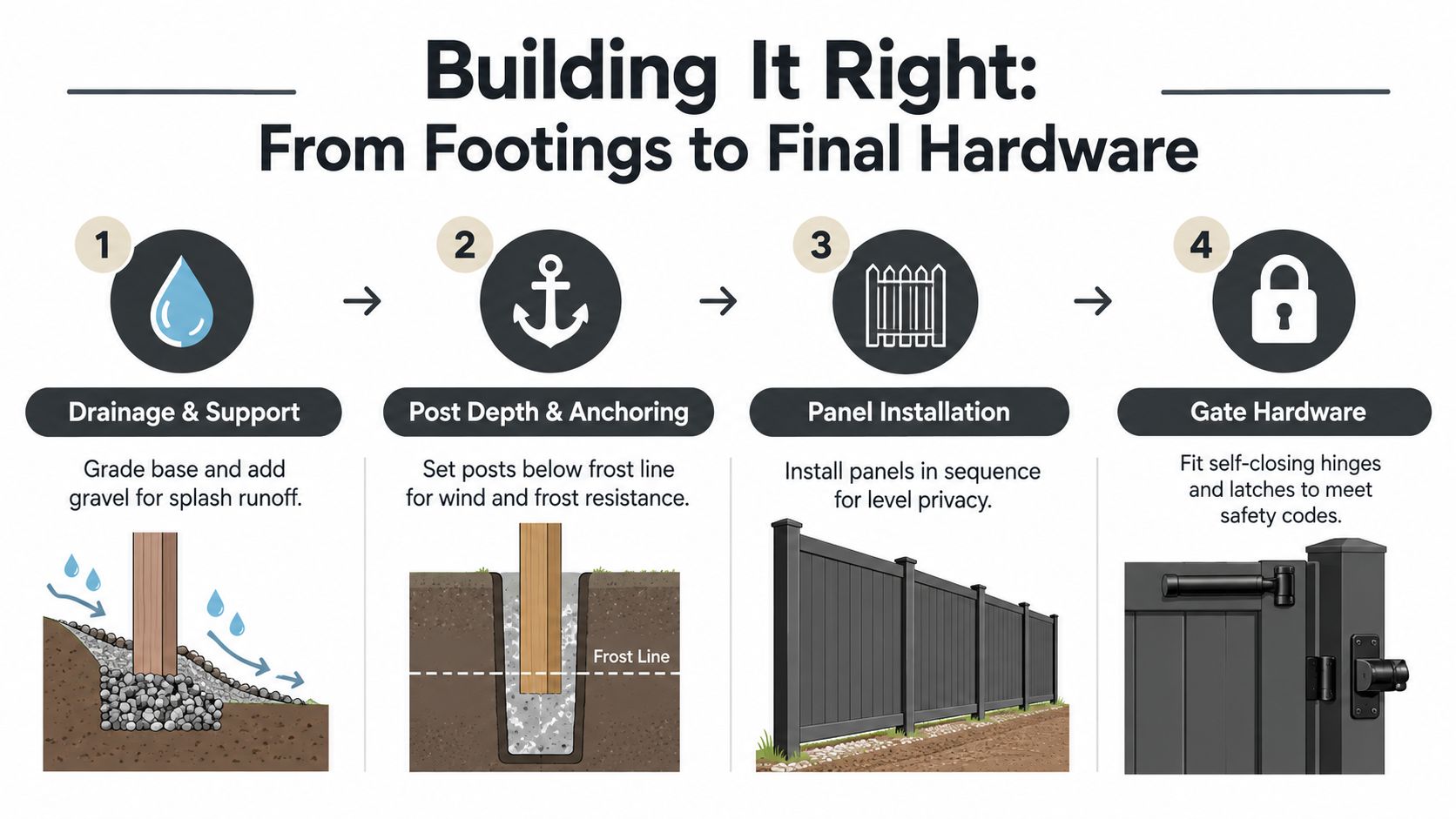
Choose the right installation path
A capable homeowner can handle a material-only project when the layout is simple, the permit question is settled, the soil is manageable and the person installing it understands post alignment and gate adjustment. Order the complete system rather than mixing panels, posts and hardware from unrelated manufacturers. Keep the enclosure route continuous and photograph the work before closing up footings.
A turnkey installation makes more sense when the fence forms part of the required barrier, the yard has difficult access, the spa sits near a slope, or the gate must align precisely with an existing enclosure. FenceScape offers planning, material selection, installation and post-install support for Ottawa–Gatineau projects, with in-house crews handling the sequence from site review through final walkthrough. Neighbourhood group installations can also coordinate multiple properties under one organised schedule, while financing programs are available for Ontario and Quebec customers.
The gate deserves its own inspection. Open and release it repeatedly before finalising the latch position. Check that it returns fully closed without dragging, that the latch engages every time, and that no nearby planter, chair or snowbank can hold it open.
Avoid the shortcuts that create rework
Hedges, shrubs and decorative curtains can improve privacy, but Quebec guidance explicitly says hedges and shrubs don't count as a safe enclosure. A gate that looks closed but doesn't self-latch is another common failure. So is setting every post to the same shallow depth despite different wind exposure, soil conditions and panel weights.
The final walkthrough should inspect drainage, plumb posts, panel level, fastener security, gate swing, latch operation and access to the hot tub equipment. If any of those elements is unresolved, the fence isn't finished just because the last panel is in place.
Costs Maintenance and Winterization for Ottawa–Gatineau
A realistic quote depends on more than the number of linear feet. The major cost drivers are material, panel opacity, gate count, footing conditions, access for equipment, removal of an existing fence, terrain, custom corners and the reinforcement needed for wind and snow exposure.
PVC usually reduces routine maintenance, while cedar and pressure-treated wood trade a lower entry point or more natural appearance for ongoing sealing, staining and inspection. Hybrid systems can add structural value where a solid screen needs stronger support. Glass and ornamental metal tend to involve more detailed hardware and finishing decisions, particularly when privacy depends on added screening.
The estimate should separate the fence, gates, posts, footings, removal, permits or reviews where applicable, and any changes needed around the spa equipment. That makes comparisons useful. The cheapest line item can become the expensive option if it excludes the gate hardware or support required for enclosure compliance.
Use a seasonal maintenance rhythm
Before freeze-up, inspect every hinge, latch, screw and post connection. Confirm that the gate closes without rubbing and that the cover can open without contacting the screen. Clear leaves and splash debris from the base, and make sure drainage paths remain open.
During winter, don't let snowpack lean against the panels or gate. Brush snow from the cover with a suitable soft tool instead of pushing heavy accumulation into the fence. Watch for drifting at corners, where a solid panel can collect snow and where a gate may stop closing properly.
In spring, look for frost movement. A post that has lifted, rotated or pulled the gate out of alignment should be corrected before the opening becomes a safety problem. Wash PVC with a suitable mild cleaner, and inspect wood for exposed end grain, peeling finish, soft spots or fastener corrosion.
When the cover is the enclosure, cover discipline becomes part of maintenance and safety. Keep it closed and locked whenever the spa isn't in use, and don't treat a decorative screen as a substitute for that requirement.
Your Hot Tub Privacy Fence Checklist and Next Steps
The cleanest project follows a short sequence:
Assess the site: Map neighbour and street sightlines, wind direction, snow accumulation, cover movement and equipment access.
Confirm the rule: Ask the municipality whether the hot tub needs a permit, a four-sided enclosure, a setback, or a qualifying lockable cover.
Choose the barrier: Select solid, semi-private or mixed screening based on privacy, airflow and exposure.
Detail the gate: Specify self-closing, self-latching hardware and keep the latch out of reach where required.
Design the base: Plan drainage, footing support, post embedment and the transition to existing fences or walls.
Review the finished work: Test the gate, inspect spacing, check the cover clearance and confirm service access.
A few municipal examples show why assumptions cause trouble. Edmonton says a building permit isn't required for a fence unless it's being built as part of hot tub or swimming-pool screening, while Ottawa may require a permit review even when an existing fence is already present. Quebec's enclosure rules also make non-climbable construction and opening sizes part of the design, not an afterthought.
For ongoing care beyond the fence itself, homeowners may find broader seasonal ideas in this guide to landscaping maintenance ideas Arizona. The climate differs, but the principle carries over: plan maintenance around moisture, access, planting growth and the parts of the installation that must stay clear.
A free estimate should lock down the fence line, material, gate location, enclosure approach, footing assumptions, access conditions and installation schedule before materials are ordered. That paperwork is where many costly surprises can be removed.
FenceScape can assess your Ottawa–Gatineau site, design a hot tub privacy fence around the applicable enclosure requirements, and install the posts, panels and gate hardware as one coordinated project. Visit FenceScape to request a free estimate and move from an exposed spa area to a durable, properly planned enclosure.
My experience with Bovada Poker has been mostly positive. What I noticed first was the clean interface and quick access to different poker formats. I enjoy regular No-Limit Hold’em tables, but sometimes switch to fast-fold when I want a quicker pace. The tournament schedule also provides enough variety for different types of players. Anonymous tables make the sessions feel less predictable, while the platform itself remains easy to navigate. It is a practical option for anyone who prefers a simple poker interface https://www.gipsyteam.com/pokerrooms/bovada-poker