
Fence Installation Financing: Costs, Options and Approval

You're staring at a leaning backyard fence in Kanata, Barrhaven or across the river in Gatineau, and the quote in your inbox is larger than the cash you've set aside. A neighbour wants to split the shared line, the dog needs a secure yard before summer, or a pool can't open until the enclosure passes inspection. Fence installation financing can move that project ahead, but only if you judge it by the full installed scope and the total repayable, not by an attractive monthly payment. A low payment stretched over a long term, built on an incomplete quote, is how a manageable fence becomes an expensive one.
What a Fence Installation Really Costs
A fence quote that arrives as one lump sum tells you almost nothing about what you're financing. I would not put a loan against that number until it is broken into the seven cost lines below, each shown separately so you and the lender are pricing the same project.
Cost line | What to include | Effect on financing |
|---|---|---|
Materials | Posts, panels or rails, hardware, stain or sealant | Largest share of the total; confirm grade and warranty in writing |
Excavation and site prep | Post holes, old-fence removal, grade changes | Confirmed only after site assessment for soil and access |
Gates and hardware | Single or double gates, latches, self-closing hinges | Pool gates must be self-closing and self-latching |
Permits and drawings | Municipal permit, revised site plan, pool enclosure drawings | Pool enclosures in Ottawa need a permit even with an existing fence |
Applicable sales tax | Tax on materials and labour | Added to the financed total; confirm whether the quote includes it |
Site restoration | Lawn repair, debris removal, cleanup | Often omitted from quotes and then added as a surprise |
Contingency | Buffer for rock, buried utilities or scope changes | Set a written buffer before signing so the loan covers it |
If you're budgeting by length first, work through the fence installation cost per foot breakdown, then convert that estimate into the seven lines above. A per-foot figure alone won't capture gates, corner posts or restoration. Watch the tax line in particular. When a quote lists sales tax as an extra, the amount you borrow has to cover the higher total, or you pay the difference out of pocket on installation day.
Where Compliance Changes the Total
According to the City of Ottawa building permit guidance, Ottawa generally does not require a building permit for a standard residential fence, but the project still has to satisfy the municipal Fence By-law, including the "good neighbour" requirement that the more attractive side face the neighbour and street. Pool enclosures are treated differently: a pool-enclosure permit is required even when an existing yard fence will serve, and the enclosure must meet requirements such as a minimum 1.5 m height, self-closing and self-latching gates, and openings small enough to block a 100 mm sphere.
Compliant gates, frost-resistant posts, revised drawings and the inspection itself all belong in the financed total from the start. Municipal approval is a condition of lawful use, and retrofitting a non-compliant gate or height after installation costs more than speccing it correctly the first time.
Gatineau plays by different rules. Residential fence requirements vary by location on the Quebec side, and pool barriers fall under Quebec rules plus local requirements. A quote written to an Ottawa privacy standard can miss compliant gates, setbacks or permit work in Quebec, so confirm the exact requirements for your property before you borrow against the number.
The staged build-up is not unique to fencing. The Waterloo Turf Indianapolis putting green guide prices a different yard project the same way, splitting it into base work, materials and finishing before a total is set, which is the same discipline the seven lines above apply to a fence.
If the quote has no gate, restoration or permit line, the total is incomplete and any financing decision based on it is premature.
Financing Options Compared by Total Repayable
Option | Typical cost structure | Repayment pattern | Watch for |
|---|---|---|---|
Credit card | Rates can exceed 18% | Revolving minimum payments | Balance grows if only minimums are paid |
Personal line of credit | Usually lower rate than a credit card; administration fees stated in disclosure | Revolving, draw as needed | Variable terms and fees; confirm before signing |
Personal loan | Interest and fees combined in the annual rate for comparison | Regular fixed payments over one to five years | A longer term raises total interest |
Home-equity line of credit or loan | Potentially lower rate; setup costs such as legal fees | Secured against the home | Home equity is at risk if payments stop |
Contractor financing | Promotional rate or deferred interest; fees stated in the agreement | Set by the financing agreement | Deferred interest may be added back if the balance is not cleared in time |
Read the table by cost risk, not convenience. The Canada Mortgage and Housing Corporation's renovation financing guide notes that credit-card rates can exceed 18%, and that a personal loan typically repays through regular payments over a fixed term commonly running one to five years. A personal line of credit usually sits below card rates, while borrowing against home equity can price lower still, though setup costs such as legal fees apply.
A credit card suits only a small balance you'll clear quickly; at card rates, minimum payments stretch a fence into years of interest. A personal line of credit suits staged work because you draw as sections are completed. The catch is discipline: revolving draws only become a fence you own when you convert them into real principal payments.
A personal loan is often the cleanest fit for a single fence. Payment, term and payoff date are fixed, so the total repayable is easy to verify before you sign. Home-equity borrowing can look cheaper on rate, but your home secures the debt. I wouldn't secure a modest fence against the property unless the setup costs still leave it ahead on total and a payoff plan is in writing. Secured borrowing rules also differ by product and jurisdiction, so check the governing terms before signing anything tied to your home; guides to state rules for boat title loans press the same point for a different kind of secured asset.
Contractor financing needs the closest reading. Ask whether the promotion is a true interest-free period or deferred interest, where unpaid interest is added back if the balance isn't cleared before the term ends. FenceScape's Ontario program offers six months interest-free, and its Quebec program offers three months with no payments and no interest; with any contractor offer, confirm which structure you're signing and what a leftover balance costs once the promotion ends.
That single clause can erase the benefit of a low opening payment.
Run the Same Quote Through Every Offer
Take a $12,000 installed fence financed at 9% annual interest over five years as a worked example of the mechanism. That structure produces about $249 a month and about $14,950 in total repayable. The same balance over three years costs about $382 a month and about $13,740 overall, cutting roughly $1,200 off the total while raising the payment by about $133. Run each real offer through the same calculation with its own rate, fees and term, and use the finished quote, compliance and inspection costs included, as the balance whether the job sits in Ottawa or Gatineau.
Match the product to the project. A single fence with a clear payoff plan suits a personal loan, and you can test scope choices against the privacy fence cost guide before you borrow. A multi-lot or property-manager project needing documented draws fits a line of credit with written scope controls per lot. Whichever product you carry, judge it on the total repayable: a low monthly payment can hide a longer term and a bigger total.
Documents and Approval Criteria to Prepare
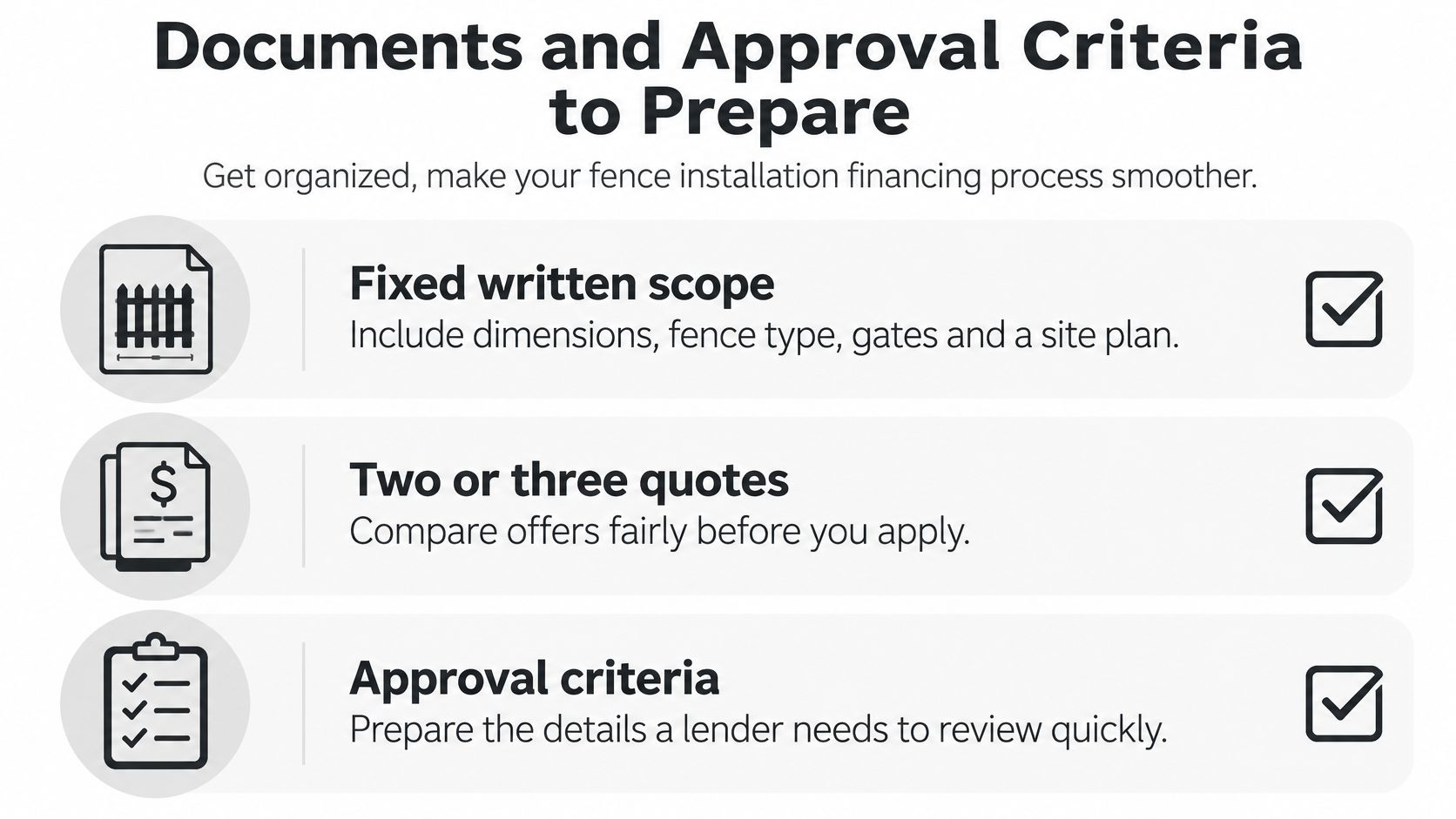
An application stalls when a lender asks for a permit confirmation or a second quote after the credit check is done. A ready file gets you faster answers and fairer comparisons, because every lender ends up pricing the same project. Gather these before you apply:
Fixed written scope: Dimensions, fence type, gates and a site plan.
Two or three itemized quotes: Each covering the same scope, so price differences are real.
Ownership and approvals: Proof of property ownership, plus strata or HOA approval where it applies.
Identity and income: Government photo ID, recent pay stubs or notices of assessment, and business statements if you're self-employed.
Debt summary: Existing balances and monthly obligations, stated in full.
Home-equity documents: A recent mortgage statement and an estimate of property value, only if you're considering secured borrowing.
Permit status: Written confirmation from Ottawa or Gatineau, plus enclosure drawings for a pool.
That last item deserves attention. Permit rules differ on each side of the Ottawa River, and no lender will flag a missing permit for you. If the fence needs one and the loan covers only materials and labour, the compliance cost lands on you after funding.
Use the checklist below to organise the file before you send it anywhere.
Lenders weigh income, debt load and credit history, and none of those move quickly. What you control is the file. Complete documents on day one keep the approval focused on your creditworthiness.
Build a Four-Figure Comparison Sheet
Quebec borrowers get clear direction on what to compare. The Office de la protection du consommateur counts borrowing costs as interest plus other charges such as administration, brokerage, storage and certain insurance fees, and states that the applicable credit rate expresses those charges annually. Both the rate and the term affect total cost, so a higher rate or a longer repayment period increases what you pay.
The worked example of a $12,000 fence at 9% shows what a filled row looks like:
Offer | Annual credit rate | All listed fees | Total amount repayable | Payoff date |
|---|---|---|---|---|
Example loan, 3-year term | 9% on $12,000 | $0 assumed in the example | About $13,740 (about $382 a month for 36 months) | Month 36 |
Example loan, 5-year term | 9% on $12,000 | $0 assumed in the example | About $14,950 (about $249 a month for 60 months) | Month 60 |
Cash purchase, same scope | 0% | $0 | $12,000 | At completion |
Fill your own rows the same way, pulling every figure from each lender's written disclosure. The gap between a financed row and the cash row is the price of borrowing on that offer. If a lender can't fill in the four data columns beside its name, that offer isn't ready to compare.
How to Apply for Fence Financing Step by Step
A fence loan is only as safe as the scope behind it. The sequence below keeps the borrowed amount tied to a fixed, signed scope, and the overview image maps the flow before the details.
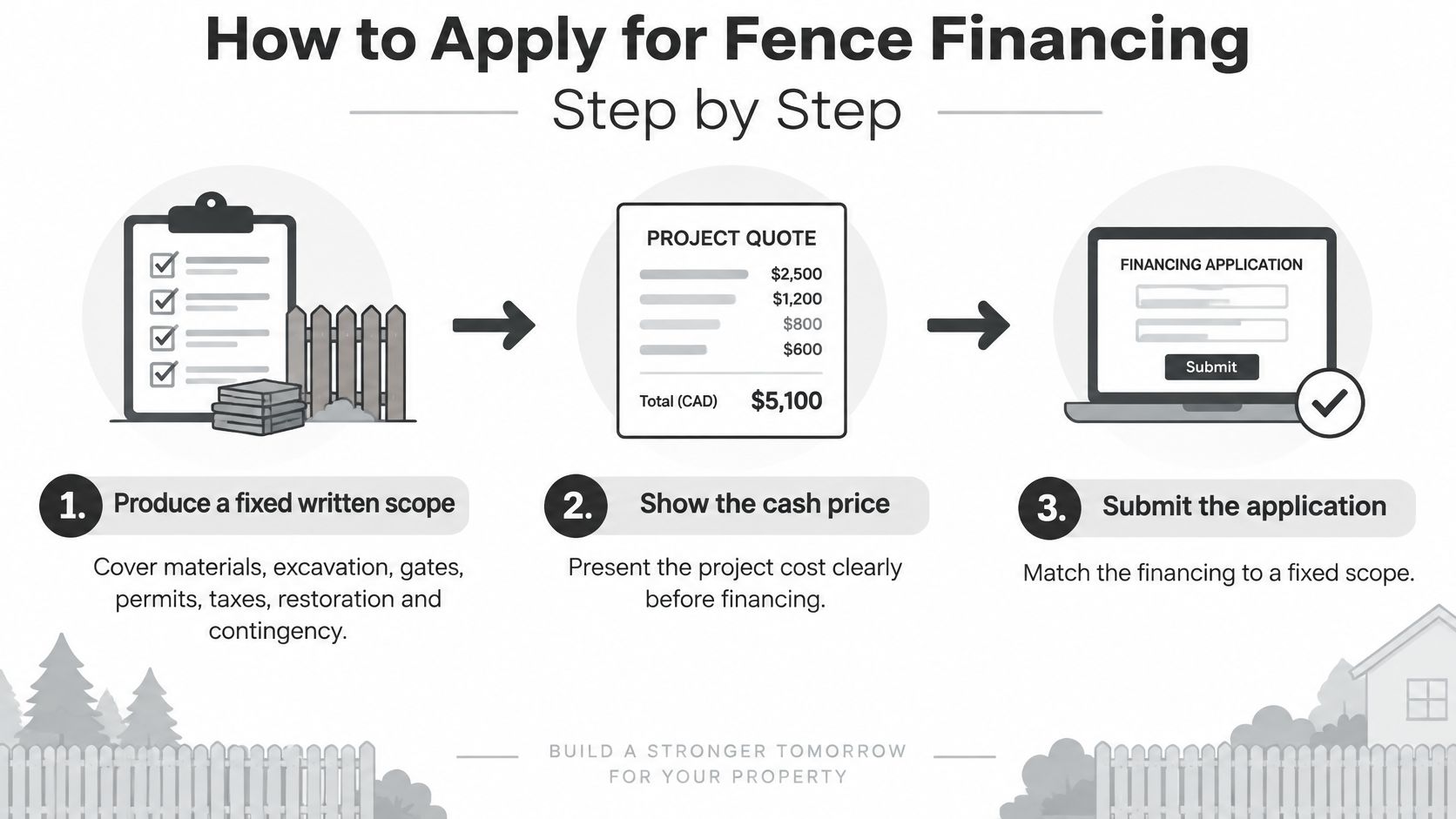
Produce a fixed written scope. Cover materials, excavation, gates, permits, taxes, site restoration and a contingency line. Permit and tax rules follow the municipality, so those lines have to be priced before the loan amount is set, whether the property sits in Ottawa or Gatineau.
Show the cash price and financed total separately. Two lines, side by side. The gap between them is the true cost of borrowing, and it should never be buried inside a monthly figure.
Get full disclosure before you consent. Ask for the APR or interest rate, term, payment frequency, administrative fees, prepayment rules and late-payment consequences in writing, and find out whether the loan is secured or places a lien on the property.
Consent to the application and credit assessment. Only the lender named in the disclosure should run your credit, and only with your signed consent.
Treat prequalification as a starting point only. Wait for final approval in writing before you commit to dates. Prequalification doesn't guarantee the amount, rate or term.
Sign the financing contract and change-order terms. Keep signed copies of both. Any later scope change goes through the change-order process, priced and signed before work proceeds.
Schedule excavation and materials last. Book digging and delivery only after approval and signed records are in hand, so you're never holding materials the loan doesn't cover.
That ordering protects you from the pattern FCAC research has documented in HELOC borrowing: borrowers drift into interest-only payments and end up further in debt than they planned. Test the payment against the full installed price. If it fails your budget, shrink the scope rather than stretching the term. You're also free to shop independent bank or credit-union financing, and that comparison belongs in your written file.
Watch the walkthrough below before you sign, then check your own file against it.
A complete file is easy to recognise. One signed scope, one disclosed total and one written approval, all in hand before any materials are ordered.
Protect Your Rights and Avoid Costly Mistakes
Four mistakes account for most of the money homeowners lose on financed fences.
Judging by the monthly payment: A low payment hides the total. Compare total repayable and payoff date across two or three scenarios for the same fence, and sign an acknowledgment of the total financed amount.
Financing an incomplete scope: Leaving out tax, gates or restoration understates the loan. The financed total must match the signed scope, line for line.
Mistaking prequalification for approval: Ordering materials on a prequalification leaves you exposed if final terms change. Wait for written approval.
Starting before terms are clear: Beginning work before the credit contract and cancellation and change-order terms are settled removes your negotiating power. Schedule approval before excavation or delivery.
The knowledge gap behind these errors is documented. In a 2022 Leger survey of 1,012 Canadian homeowners reported through the FCAC research database, 39% said they were postponing or reducing renovation scope, only 23% were aware that contractors might offer financing, and 59% would feel more comfortable if they understood the programs better. Reading each disclosure line is how you close that gap.
Know your provincial footing too. Under Ontario's Consumer Protection Act, a borrower may pay the full outstanding balance of a credit agreement at any time without a prepayment charge or penalty, which matters if you receive a bonus, refinance or sell. In Quebec, confirm the annual credit rate and every listed fee, since borrowing costs include interest and other charges.
For multi-lot or townhouse work coordinated through fence contractors in Ottawa, require every change order in writing, because scope changes multiply across properties.
Practical rule: The cheapest advertised monthly payment is the riskiest option when the scope isn't fixed.
Confirm Your Financed Total Before You Book
Fix the scope and total first, then choose the lender. Work through these five actions in order.
Request an itemized written quote. Use our contact form to request a Material Quote if you're building yourself or an Installation Quote for the full job. We offer a free estimate, so the scope conversation costs you nothing.
Check all seven cost lines. Materials, excavation and site prep, gates and hardware, permits and drawings, sales tax, site restoration and contingency should all appear, and the total should match the written scope.
Confirm jurisdiction-specific work. Establish whether a pool enclosure or a Gatineau-side requirement applies, and make sure any permit work sits inside the quote rather than outside it.
Run the four-figure comparison. For each offer, record the annual credit rate, all fees, total amount repayable and payoff date. Choose the lowest total repayable you can comfortably carry.
Get promotional terms in writing. In Ontario, we offer 6 months of interest-free financing when you shop with us, and in Quebec, 3 months with no payments and no interest. Ask us or any lender to confirm conditions, payoff date and fees in writing before you sign.
You can reach us at (613) 617-4414, by email at info@fencescape.ca, or at our office at 920 Belfast Rd unit 103, Ottawa. Book installation only after the complete scope and written approval are in hand.
Ready to price your fence properly before you borrow for it? Visit FenceScape to request your free estimate, and we'll build an itemized quote covering materials, gates, permits and restoration so your financed total matches the project. Bring that fixed scope to any lender you choose, compare total repayable with confidence, and book your Ottawa or Gatineau installation on terms you've verified line by line.
Comments