
Cloture Des Patriotes Fence Rules Explained

Clôtures des Patriotes is a Québec fencing contractor, not a historic fence or a place name. Any similar Ottawa-Gatineau project is still governed by different municipal rules on each side of the river.
Why do so many owners start by choosing a panel style when the first question should be which city, which yard, and whether there's a pool? That order matters. A design that works in Gatineau can fail in Ottawa on the finished face, the setback, or the permit, and a pool barrier is judged on measurements that ordinary yard fences aren't.
What Cloture des Patriotes Actually Names
Most searches for Cloture des Patriotes mix up three different things. There's the present-day contractor, there's the Patriote political movement of the 1830s, and there's the fence you want built on your lot. Treating those as one subject leads to bad calls, so separate them before you ask for a price.
The contractor is a Québec based fencing business. Its range covers ornamental steel or aluminum, wood and composite, chain link, commercial fencing, and glass or stainless steel hybrid systems, and its online quotation form from Clôtures des Patriotes separates pool enclosure work from other projects. That split is the useful clue. It tells you the company treats a pool barrier as a safety and access control job, not just a looks job.
Name the Job Before the Material
Use one plain label for your project and stick to it when you talk to any installer:
Privacy: You want to block sightlines along a side or rear yard.
Perimeter security: You want a stronger boundary that controls entry points.
Pool protection: You need a barrier that must pass specific height, opening, and gate checks.
Architectural separation: You want a cleaner edge that keeps views open.
That label changes what you buy. A privacy fence can be mostly solid. A pool fence can't have openings or climb points that a boundary screen might get away with. A commercial perimeter cares more about impact and access than a front yard feature does.
The contractor also offers temporary fencing for pool projects while permanent work is pending, based on the same quotation page cited above. Don't treat that as an upsell. If water is present and the permanent barrier isn't finished, you've got an unsecured pool area during construction, and that risk doesn't pause because concrete is curing.
Practical rule: A permit free fence is not a rule free fence. Name the function first, then check the city rules, then pick the material.
My recommendation is blunt. Don't call anyone asking for a "Patriote style fence." There's no municipal fence style by that name to approve, and there's no heritage palisade to copy onto a suburban lot. Call with your city, your yard location, and your one word job label. You'll get a usable quote faster, and you won't order panels for the wrong bank of the Ottawa River.
The Patriote History Behind the Fence Name
The name borrows from Lower Canada, the colony that largely corresponds to present day Quebec. The Patriote movement grew out of disputes over representative government, colonial administration, and the concentration of political and commercial power among British elites, and it culminated in the Rebellions of 1837 to 1838. That's the history behind the brand name. It's not a fence design, and it doesn't create a heritage structure you need to restore.
The population picture explains where support sat. By 1837 the population was approximately 650,000, with about 510,000 people of French-Canadian origin and 140,000 British residents recorded in this historical study of Lower Canada mobilization. British residents clustered in Montreal, Quebec City, and the Eastern Townships. French-Canadian communities spread along the St. Lawrence River and through the seigneurial countryside, with the strongest Patriote support in rural French speaking areas south of the St. Lawrence and around the Richelieu River valley.
A Political Campaign, Not Only a Revolt
Between 1834 and October 1837, researchers counted 609 Patriote political activities across 44 counties, compared with 645 loyalist activities, and approximately 30,000 men may have been involved directly or indirectly in the wider mobilization, according to the historical study cited above. Read that scale carefully. This was a broad political campaign across Lower Canada before it became an armed crisis, which is why the name still carries political weight in Quebec.
The fighting also has a clear geography. Major confrontations at Saint-Denis-sur-Richelieu, Saint-Charles-sur-Richelieu, and Saint-Eustache sit in the broader Montreal, Laurentians, and Richelieu area that's still central to Patriote heritage. For Ottawa-Gatineau readers, that's regional Quebec history, not a local municipal event tied to your lot, your street, or a City of Ottawa fence file.
The Cost and the Legacy
Official Quebec heritage documentation records approximately 298 Patriote deaths and 1,280 arrests or imprisonments, with 12 prisoners executed by hanging, 58 exiled to Australia, and 8 sent to Bermuda in the provincial toponymy record for the Patriotes. Other regional summaries round deaths to about 300 and deportations to 66, reflecting different counting methods rather than a different event.
Defeat brought suppression of the Parti patriote, suspension of constitutional liberties, and the forced union of Lower and Upper Canada in 1840. Some former leaders later returned to political life, and the period became foundational to Quebec memory around responsible government, francophone political rights, and national identity. That's why a fencing company would choose the name. It signals a historic Quebec identity. It doesn't tell you anything about post depth, panel height, or whether your gate latch will pass.
Ottawa and Gatineau Fence Rules Side by Side
Can you install the same fence design on both sides of the Ottawa River? Sometimes, but don't assume it. Ottawa and Gatineau regulate ordinary fences differently, and the differences are material enough to change height, placement, and which face your neighbour sees.
Start with this comparison, then test your own lot against it using municipality, yard type, sidewalk or curb condition, pool status, and housing type. For a deeper walkthrough of the Ontario side, review this guide to Ottawa fence by-law requirements before you finalize a drawing.
Ordinary Fence Rules in Ottawa and Gatineau
Rule | ||
|---|---|---|
Permit for ordinary fence | No building permit, but Fence By-law 2003-462 applies | No permit for standard residential fence |
Finished face | More attractive side faces neighbour and street | Check placement and property line rules |
Placement | Must comply despite no permit | Entirely on private land, at least 1 metre from a sidewalk or 1.5 metres from a curb with no sidewalk |
Height | Governed by the fence by-law | 1.2 metres front yard, 1.5 metres beside a street, 2 metres in non-street side and rear yards |
Multi-unit housing | Confirm applicable rules for the property type | Up to 2.5 metres in specified areas for multi-unit or collective housing |
Pool enclosure | Separate permit required | Permit mandatory to build, install, replace, or modify |
Test One Lot at a Time
Take a Gatineau rear yard with no pool and no sidewalk. You're checking private land placement, distance from the curb, and the rear yard height limit from the table. Move that same drawing to an Ottawa side yard and your first problem may be different. The good neighbour rule means the better looking face goes toward your neighbour and the street, so board orientation and post placement need planning before materials arrive.
Now change one fact. Add a pool in either city and you are no longer in ordinary fence territory. You've moved into a separate permit stream with its own measurements, which the next section covers. Change a different fact, from a single house to collective housing in Gatineau, and the height conversation changes again in specified areas.
Permit free does not mean unregulated, and a fence on the property line is still wrong if it enters public right-of-way or misses a required setback.
My recommendation is to write five facts at the top of every quote request. Write the city, the yard type, whether there's a sidewalk or only a curb, whether there's a pool, and whether it's a single home or multi-unit property. Add proof of the property line if you've got it. If an installer gives you a height and price without asking for those five facts, don't sign. That quote was built on a guess, and the city won't care that the guess looked good on paper.
Pool Enclosure Checks That Fail Inspection
A pool enclosure is a safety barrier you must prove with a tape measure. It's not a yard screen with a latch added at the end. If you've got a privately owned outdoor pool, spa, or hot tub, design to the measurements first and choose the look second.
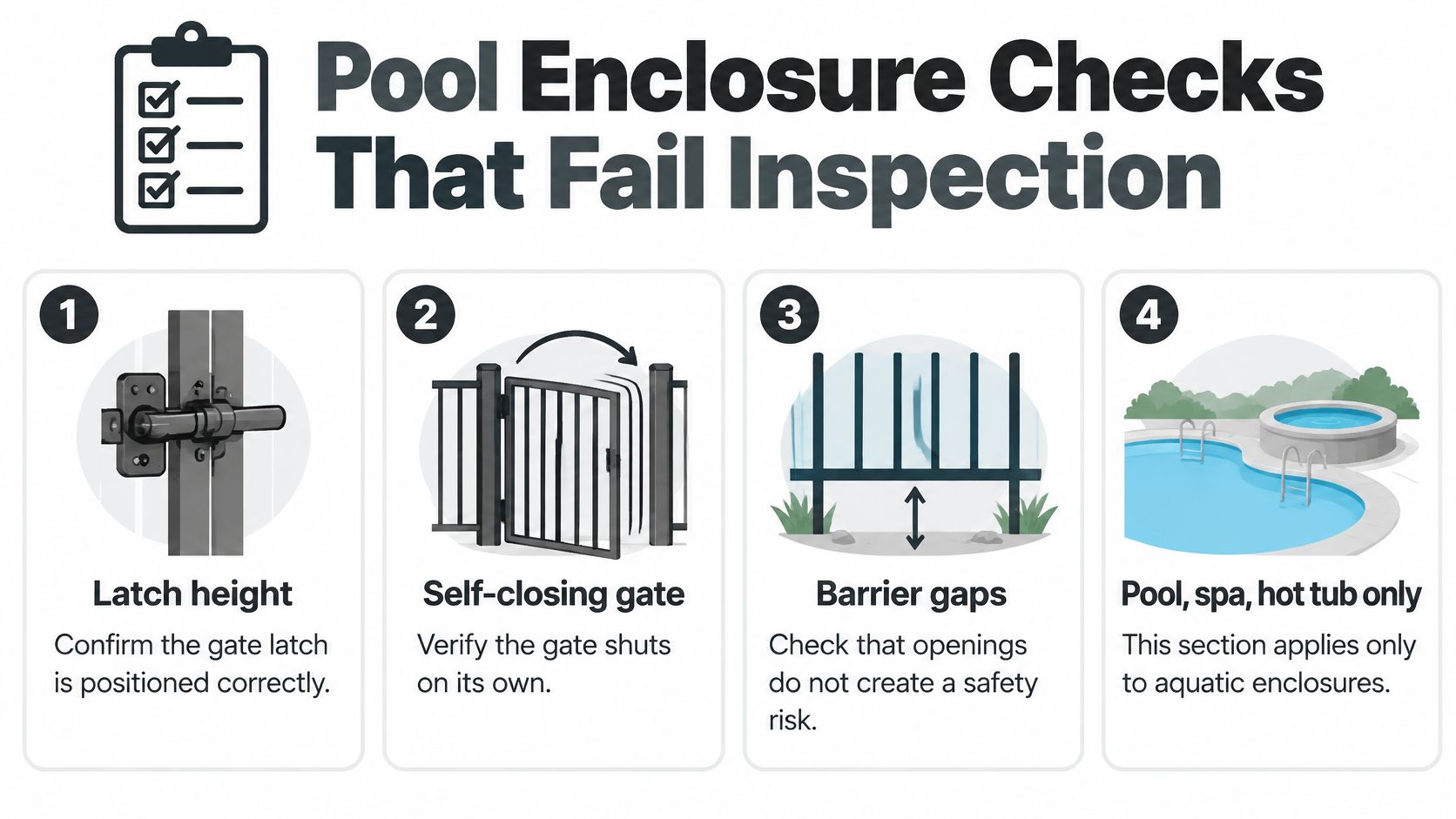
Ottawa covers in-ground, semi-in-ground, above-ground pools, and hot tubs. The enclosure must be at least 1.5 metres high, openings must be too small for a 100 millimetre spherical object to pass through, chain link mesh openings must be no greater than 38 millimetres, and every gate lock must sit at least 1.35 metres above the bottom of the enclosure under Ottawa's pool enclosure brochure. Permitted construction examples there include chain link, vertical boards, wrought iron, aluminum, and vinyl, and every gate must be self-closing and self-latching. Review these pool gate latch requirements for Ottawa-Gatineau projects alongside the city brochure when you spec hardware.
Four Pass or Fail Checks
Height: Measure the finished enclosure, not the panel on the truck.
Openings: Check through and under the barrier, including gates and grade changes.
Gate action: Open it partway and confirm it closes and latches without help.
Lock position: Confirm placement after hardware is mounted, not from a catalogue drawing.
Gatineau draws the permit line differently. A standard residential fence needs no permit except when it protects a swimming pool, and a permit is mandatory to build, install, replace, or modify a pool or spa enclosure, including a fence or wall used as that enclosure, under the Gatineau residential fence rules linked in the comparison above. That same source notes an above-ground pool wall at least 1.2 metres high at every point, or a removable pool wall at least 1.4 metres high, may not need a surrounding enclosure if access meets the standards. It also requires slats in chain link where the mesh is wider than 30 millimetres.
Don't gloss over those exceptions. "May not need" depends on compliant access, so measure the pool wall at every point and confirm how people enter. If you're coordinating installers, inspectors, and service visits across multiple properties, a tool such as Recepta.ai for pool maintenance teams can help keep follow ups from slipping while you wait on permits and curing.
Use temporary fencing if the pool can be accessed before the permanent barrier is complete. Then remeasure at the final walkthrough. Concrete work, grade changes, and a gate hung slightly differently than drawn can all turn a compliant design into a failed inspection.
Who Owns the Line and Who Pays
The cheapest quote becomes the expensive one when the posts land on the wrong land. Height compliance won't save a fence that sits in a municipal right-of-way or straddles a line your neighbour never agreed to share. Sort ownership before concrete, not after panels are standing.
Ontario's Line Fences Act confirms a landowner may construct and maintain a fence marking a boundary with adjoining land. That permission doesn't prove where the boundary is. An old fence line is evidence of where someone built before, not proof of the legal line, and Ottawa's landscaping guide on property lines and rights-of-way advises checking property lines before installing or replacing a fence and states fences aren't allowed in the city right-of-way. Read this overview of property line fence rules with that city guidance before you stake anything.
Documents to Settle Before Digging
Survey or boundary plan: Confirm the legal line, not the worn path beside the old posts.
Written cost sharing: State who pays for supply, installation, gates, and removal of the old fence.
Maintenance and replacement: Name who can repair, remove, or replace sections later.
Access: Agree how crews enter both yards and where materials can sit.
If the fence will sit on the line, or might, get the agreement in writing even when relations are good. Goodwill doesn't transfer cleanly when a house sells. If your neighbour disagrees, stop and confirm the boundary rather than shifting the fence a few centimetres onto your side as a compromise. That shortcut can create a strip nobody maintains and a new argument about who owns the structure.
Site rule I use: No survey or clear boundary evidence, no post holes. Moving paper is cheaper than moving concrete.
Townhouse groups and property managers face the same problem at scale. One standard design still needs documented consent, coordinated access, and separate checks for corner lots, sidewalks, shared driveways, and public infrastructure. Ottawa guidance flags clearance from public infrastructure, while Gatineau prohibits obstructing hydrants and traffic signs. Walk every lot. A design that clears infrastructure on twelve units can fail on the thirteenth because of one hydrant or one shared drive.
Attach a short owner and payer note to the estimate. It should name the properties involved, the boundary evidence used, the cost split, and who authorizes changes. If an installer won't work from that note, that's your answer about how the job will go when something shifts on site.
How to Choose a Fence That Fits the Site
Choose the system that matches the job label you set at the start. Don't start from a photo. A material that looks right can still fail on openings around a pool, show its rough face to the street in Ottawa, or demand more upkeep than the owner will do.
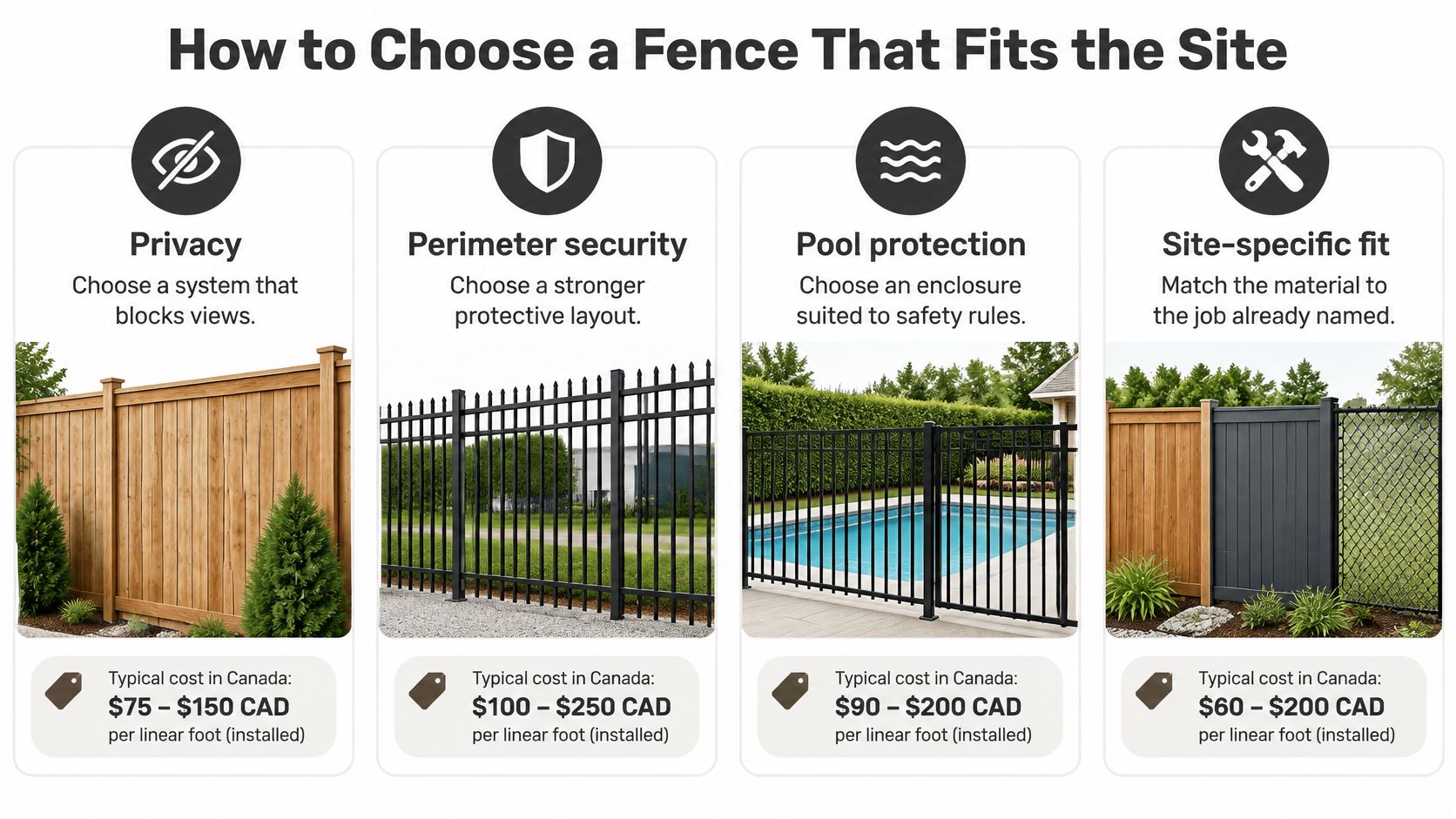
For privacy, wood and composite are the straightforward picks, including cedar and pressure-treated lumber. Plan board orientation before installation so the finished face lands where Ottawa's good neighbour rule requires it. PVC is the low fade option when you want straight lines that won't twist or crack through Canadian freeze and thaw, and hybrid PVC and wood with steel gives you a warmer look with a stronger frame.
Match the System to the Job
Formal front or pool: Ornamental steel, aluminum, or ironwork with vertical bars limits climb points and keeps sightlines open.
Backyard privacy: Wood, composite, or PVC blocks views, with maintenance and fade tolerance deciding between them.
Commercial perimeter: Chain link gives you a durable boundary, but around pools it only works when mesh openings meet the local limit and Gatineau slat rules are handled.
Architectural separation: Glass with stainless steel keeps the view while still acting as a barrier.
Compare four things for any option you're serious about. Check visibility, because a pool owner may want to see the water while a rear yard owner may not want to see the neighbours. Check impact and corrosion exposure near driveways, snow storage, and chlorinated water. Then check maintenance, including staining, washing, hardware adjustment, and who'll do it after the first winter.
For Ottawa-Gatineau work, FenceScape designs and installs PVC, hybrid, wood, ornamental iron, chain link, and glass fences and railings for homes, commercial sites, institutions, and pool enclosures. The company works with in-house crews and project management, and offers neighbourhood group rates and financing promotions for Ontario and Quebec customers. Use that kind of local range as a comparison point when you interview any installer, because a one material shop will push its one material even when your site needs something else.
Reject any option that fails a measurement you've already confirmed. If the height cap rules out your preferred privacy panel, change the panel, not the math. If chain link mesh needs slats in Gatineau, price the slats now. You'll leave with one recommended system for your yard instead of a catalogue and a guess.
Schedule the Build and Book the Next Step
A good install is staged so posts aren't loaded before concrete can hold them. Rush that sequence and you'll chase leaning panels and gates that won't latch for years. Build the pause into the schedule from day one.
Here's the sequence a local crew will walk you through on site before work starts:
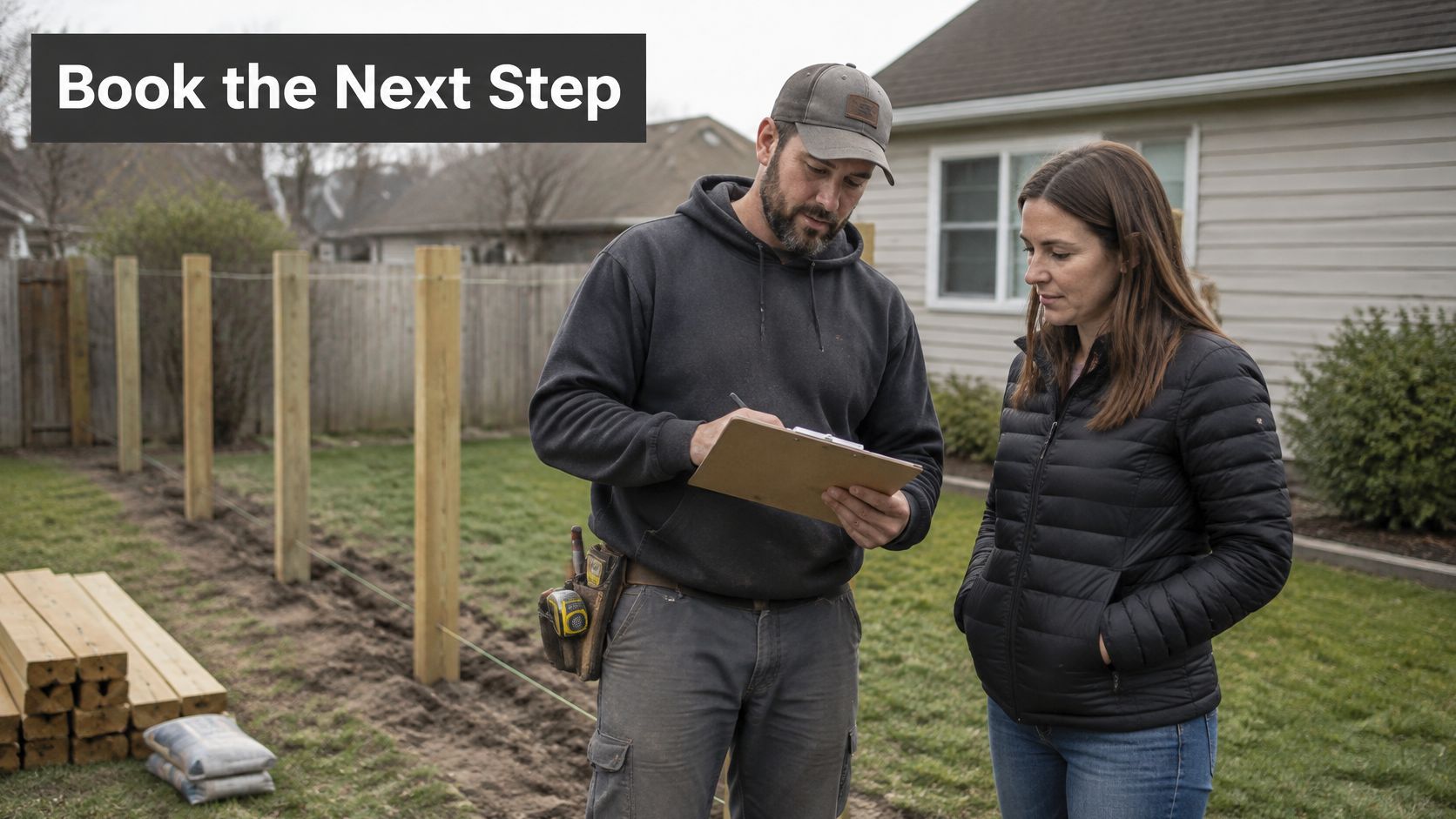
The stated contractor sequence is to excavate holes, set posts in concrete, allow a minimum curing period of seven days, with final assembly typically scheduled 7 to 10 business days after post installation as set out in the contractor's useful information page. That pause keeps fence line loads, panel alignment work, and gate hardware off partially cured concrete. Confirm post locations and finished grades before the pour, because Ottawa-Gatineau freeze and thaw cycles and seasonal ground movement will amplify any alignment mistake. Don't nudge posts during the curing interval to "check" them.
Your Pre-Build Checklist
Gather the survey: Bring boundary evidence and the owner and payer note.
Label the project: City, yard type, sidewalk or curb condition, and pool or no pool.
Protect the gap: Keep temporary pool fencing in place until the permanent barrier passes your checks.
Book the window: Plan roughly one to two weeks between posts and panels for townhouse, multi-lot, and commercial work.
Watch how a staged install and final alignment should look before your own walkthrough:
At the final walkthrough, recheck height, openings, gate closing and latching, and that nothing sits in a right-of-way or blocks a hydrant or sign. Then request a FenceScape estimate for supply and installation, or for a restoration that matches an existing streetscape, with those documents in hand. You'll get a price tied to your actual lot instead of a number that falls apart at the first measurement.
Bring your survey, city, yard type, and pool or no pool label to FenceScape and request an estimate for a PVC, hybrid, wood, ornamental iron, chain link, or glass fence built for your side of the Ottawa River. Whether it's a backyard privacy run in Ottawa, a boundary replacement in Gatineau, or a pool enclosure that must pass inspection the first time, you'll get a design matched to your lot, your rules, and your schedule.
Comments