
Chain Link Gate Guide for Ottawa Homeowners 2026

A typical residential chain-link gate in Ottawa costs 300 to 900 CAD for materials only, and professional installation with a self-closing gate usually adds another 500 to 1,200 CAD, depending on width and height. Those figures cover an ordinary starting point, not a pool enclosure, oversized driveway gate, difficult excavation, or snow-loaded commercial entrance.
You're probably looking at a bare opening in an existing fence and wondering whether a gate is just a frame, some mesh, and a latch. In Ottawa and Gatineau, that assumption can become expensive quickly. A gate may control children's access to a pool, carry winter loads beside a driveway, or serve as the weak point in a commercial perimeter.
The right choice depends on use, municipal rules, post strength, snow storage, hardware, and the complete enclosure design. This guide gives you the practical decisions that prevent sagging, binding, failed inspections, and avoidable replacement work.
What a Chain Link Gate Really Does for Your Property
A homeowner stands at the end of a new fence run with an open gap where the gate should be. The mesh looks straightforward. The posts are in place. The temptation is to buy the cheapest matching gate and finish the job.
That's exactly where many problems start.
A chain-link gate controls movement, but it also transfers forces into the fence posts, defines the opening, and determines whether the enclosure can be secured reliably. On a backyard boundary, the priority may be convenient access for people, pets, bins, or equipment. Beside a pool, the gate becomes part of a regulated safety barrier. At a service yard, it may need to handle repeated vehicle and equipment movement while remaining aligned through Ottawa winters.
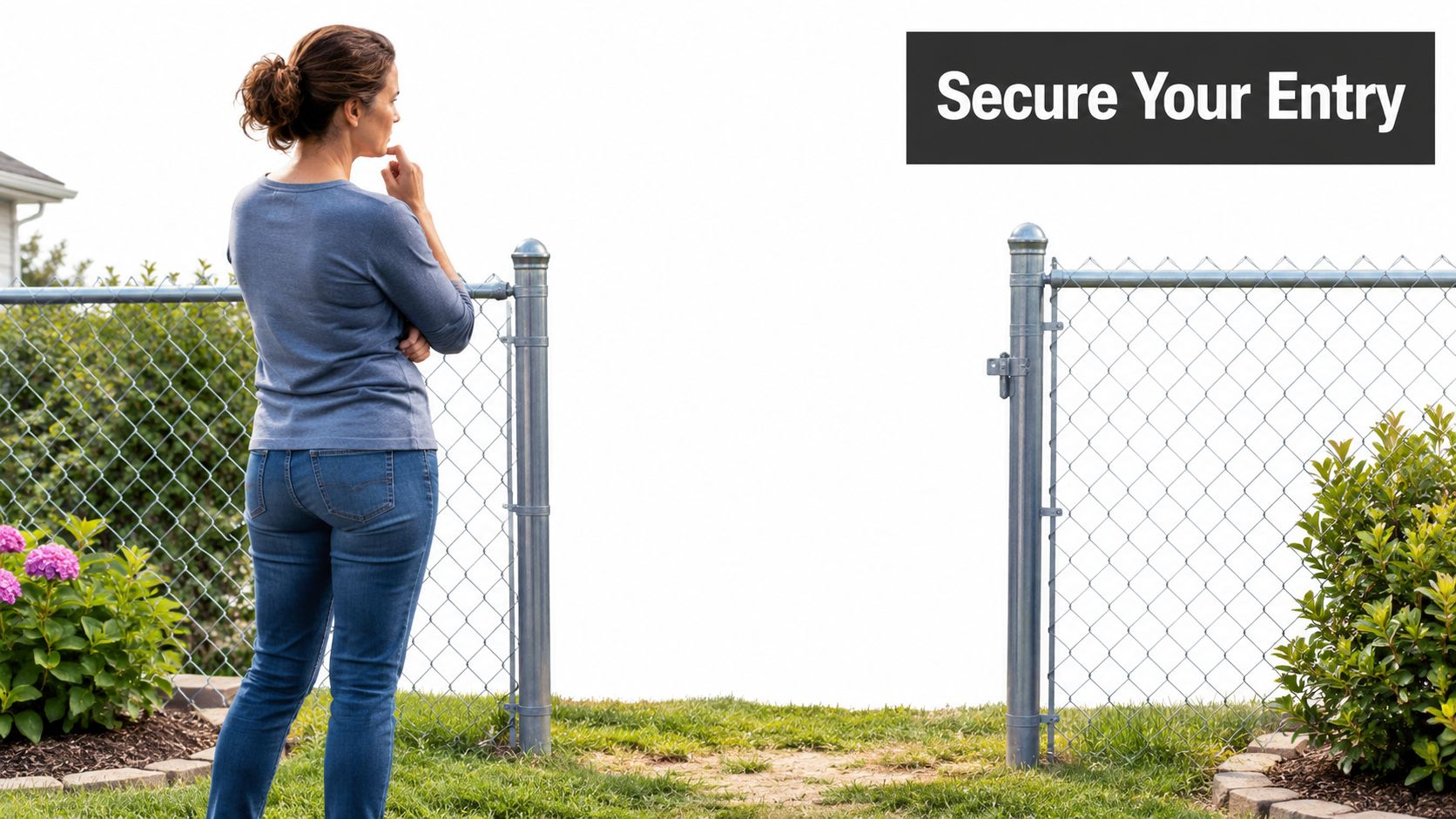
Access is only one job
A well-planned gate should:
Control entry: The latch should engage easily without forcing the frame sideways.
Protect the opening: Strong terminal posts keep the gate from pulling the fence line out of alignment.
Match the site: A pedestrian gate, driveway gate, pool gate, and institutional access gate don't need the same frame or operating hardware.
Work through winter: Snow banks, frost movement, and repeated freeze-thaw cycles can make a marginal installation fail.
Meet local requirements: Ottawa and Gatineau treat pool barriers differently from ordinary residential fences.
The open mesh also has a practical advantage. It preserves sightlines, which can help a homeowner monitor children, pets, or activity around a yard. Privacy inserts can change that balance, adding wind exposure and potentially affecting safety or approval requirements.
Chain link is also useful when the property needs a durable boundary without a fully opaque wall. If wildlife intrusion is part of the concern, homeowners can also review this resource on how to protect your property with Wildlife Control Services before choosing mesh height, bottom clearance, and gate hardware.
Contractor's rule: Decide what the gate must control before you decide what it should look like.
FenceScape approaches the project as a complete system, from layout and post selection through gate adjustment and final inspection. That local perspective matters because an attractive gate installed in the wrong location, with weak posts or unsuitable hardware, creates regret rather than value.
Understanding Chain Link Gate Components
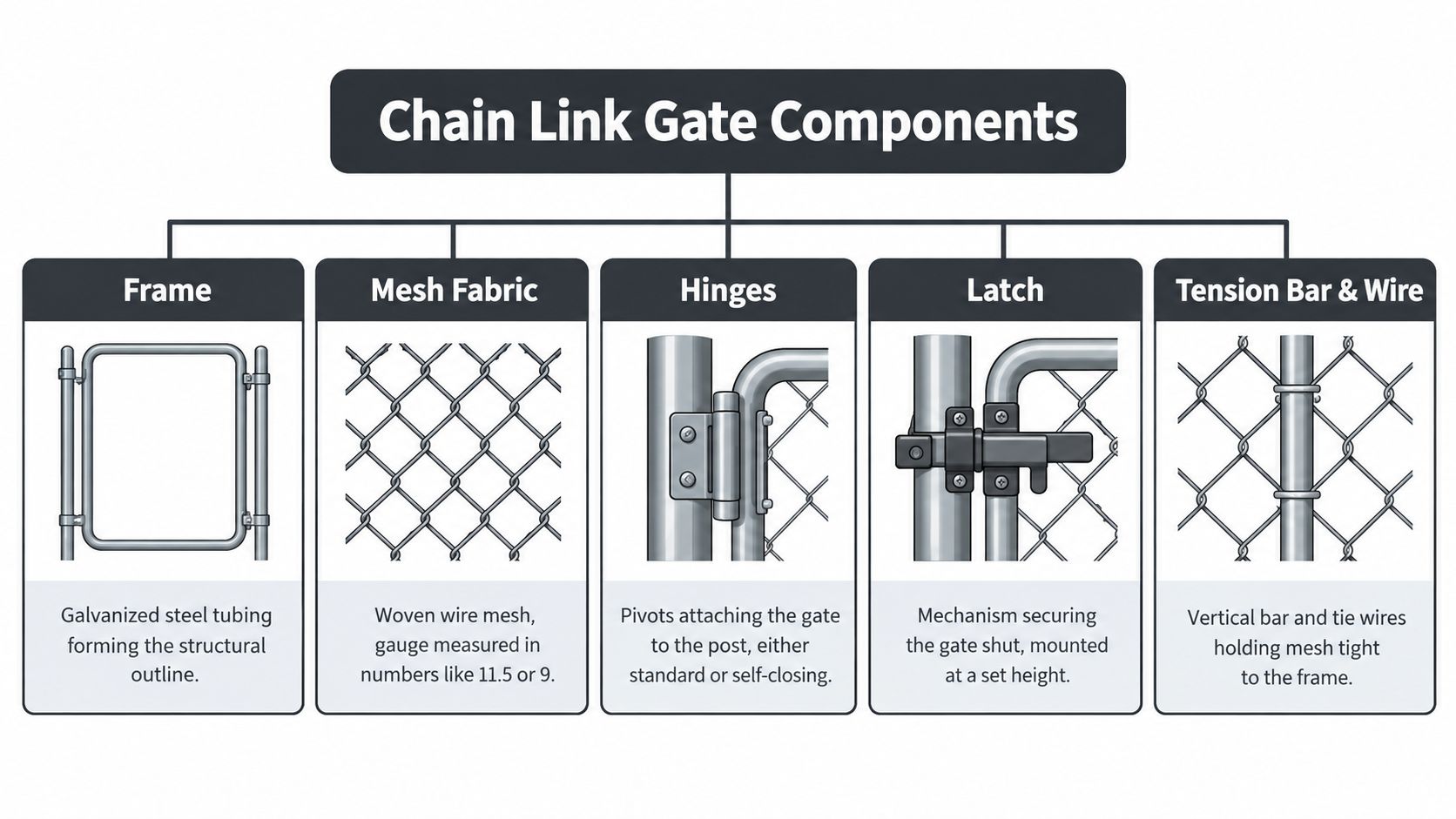
A chain-link gate looks simple because its components are exposed. That doesn't mean the components are interchangeable. Each part has a job, and a weak part can compromise the whole assembly.
The frame and mesh
The frame is the rigid outline, normally formed from steel tubing. It keeps the gate square and gives the hinges and latch a stable structure. A light frame can twist when someone pushes the gate, when the latch is misaligned, or when snow accumulates against the opening.
The mesh fabric fills the frame. Gauge describes wire thickness, and the gauge number works differently from an ordinary strength rating. Lower gauge numbers generally indicate thicker wire. The right choice depends on use, impact exposure, desired rigidity, and whether the gate forms part of a regulated enclosure.
The mesh must be attached evenly around the frame. Loose fabric makes a gate look untidy and can increase movement at the latch. A properly tensioned panel distributes force instead of allowing one corner to carry the load.
Hinges, latch, and tension hardware
Hinges connect the moving frame to the terminal post. Standard hinges may suit an ordinary access gate, while self-closing hinges are required for pool-enclosure applications. The hinge side carries much of the gate's weight, so the post must be strong and securely embedded.
The latch controls whether the gate stays closed. A residential latch can be manually operated, but a pool gate needs self-latching action and a compliant latch position. The latch should meet the strike plate cleanly every time. If users must lift or shove the gate to close it, they'll eventually leave it unsecured.
A tension bar anchors the mesh edge to the frame or terminal assembly. Tie wires and tension components hold the fabric tight against the structure. A bottom rail or tension cable can reduce movement along the lower edge, especially where pets, children, snow-clearing equipment, or wind can push against the mesh.
Terminal posts carry the stress
Gate posts are not ordinary line posts. They carry the hinge load, latch impact, frame movement, and sometimes snow pressure. Ottawa's pool-enclosure requirements specify support-post spacing of no more than 3 m, minimum diameters of 48 mm for end and corner posts and 38 mm for intermediate posts, and top and bottom rails of at least 32 mm where those requirements apply. The Ottawa pool-enclosure by-law also allows a 9-gauge vinyl-coated galvanized tension cable as a bottom-rail substitute in the stated circumstances.
For ordinary installations, the exact assembly still needs to match the opening and site. A wide gate with small posts is a poor combination. A heavy frame hung on a post that moves in frozen soil will sag, scrape, and lose latch alignment.
For a closer look at the moving hardware, review this guide to chain-link fence gate hinges. The useful lesson is simple: specify the frame, hinges, latch, posts, and mesh together rather than shopping for each item separately.
Standard Gates vs Pool Enclosure Gates
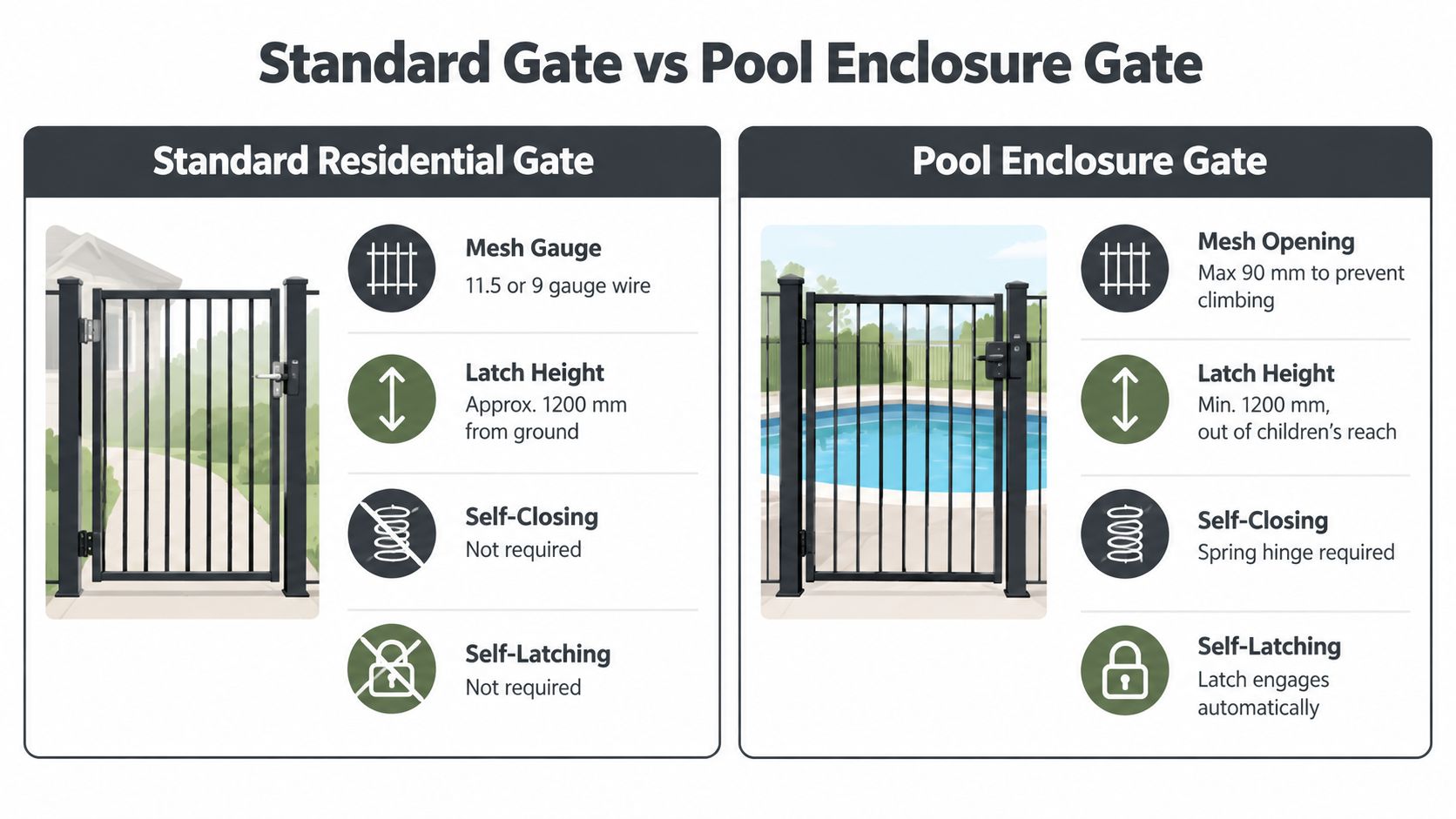
A standard residential gate and a pool-enclosure gate may use similar mesh, but they perform different safety functions. Treating them as the same product is one of the quickest ways to order the wrong hardware.
Standard residential access
An ordinary residential chain-link gate is mainly an access and boundary feature. The homeowner chooses the opening around actual use, whether that means carrying tools through a walk gate, moving a lawn mower, or driving through a wider pair of leaves.
Municipal height rules still matter. In Ottawa, ordinary residential fences are limited to 1 m in a front yard and 2.1 m in a rear or side yard, and a gate may be up to 30 cm taller than the applicable fence. The City says an ordinary residential fence generally doesn't need a building permit, but it must comply with Fence By-law No. 2003-462 and cannot be placed in the City right-of-way. The finished or more attractive side must face the neighbouring property and the street under the good-neighbour rule. Details are available through Ottawa's building permit guidance.
For this type of gate, self-closing and self-latching hardware isn't automatically required. That doesn't mean a poor latch is acceptable. It means the performance target is ordinary access, security, alignment, and durability rather than pool-barrier protection.
Pool-enclosure protection
A pool gate is part of the enclosure, not a decorative opening in it. Ottawa specifies that chain-link diamond mesh openings must not exceed 38 mm, and openings beneath or through the enclosure must be too small for a 100 mm sphere to pass. Every gate must be self-closing, self-latching, and lockable, with the lock positioned at least 1.35 m above the enclosure floor or surrounding grade. The pool area must remain closed and locked whenever it isn't in use, according to the City's pool-enclosure guide.
That requirement affects the entire assembly. The frame must remain square, the hinge must close the gate without assistance, and the latch must engage automatically. A compliant mesh attached to a sagging gate frame is still a safety problem.
Decision point | Standard residential gate | Pool-enclosure gate |
|---|---|---|
Main purpose | Convenient access and boundary control | Prevent unsupervised access |
Mesh decision | Based on use and desired durability | Must meet enclosure opening requirements |
Closing action | Manual closing may be acceptable | Self-closing is required |
Latch action | Manual latching may be acceptable | Self-latching is required |
Lock position | Based on security needs | At least 1.35 m above the enclosure floor or surrounding grade |
Permit question | Usually no building permit for the ordinary fence | Separate pool-enclosure permit required in Ottawa |
Gatineau also requires a permit when a fence protects a swimming pool, even though a standard residential fence generally doesn't require one. Special rules may apply to waterfront properties, corner lots, flood-risk areas, lands exposed to landslides, heritage sites, and other regulated locations. If you manage a pool, property portfolio, or renovation website, practical resources such as home services web development can help present service information, but the municipal approval remains the authority.
How to Measure and Plan Your Chain Link Gate
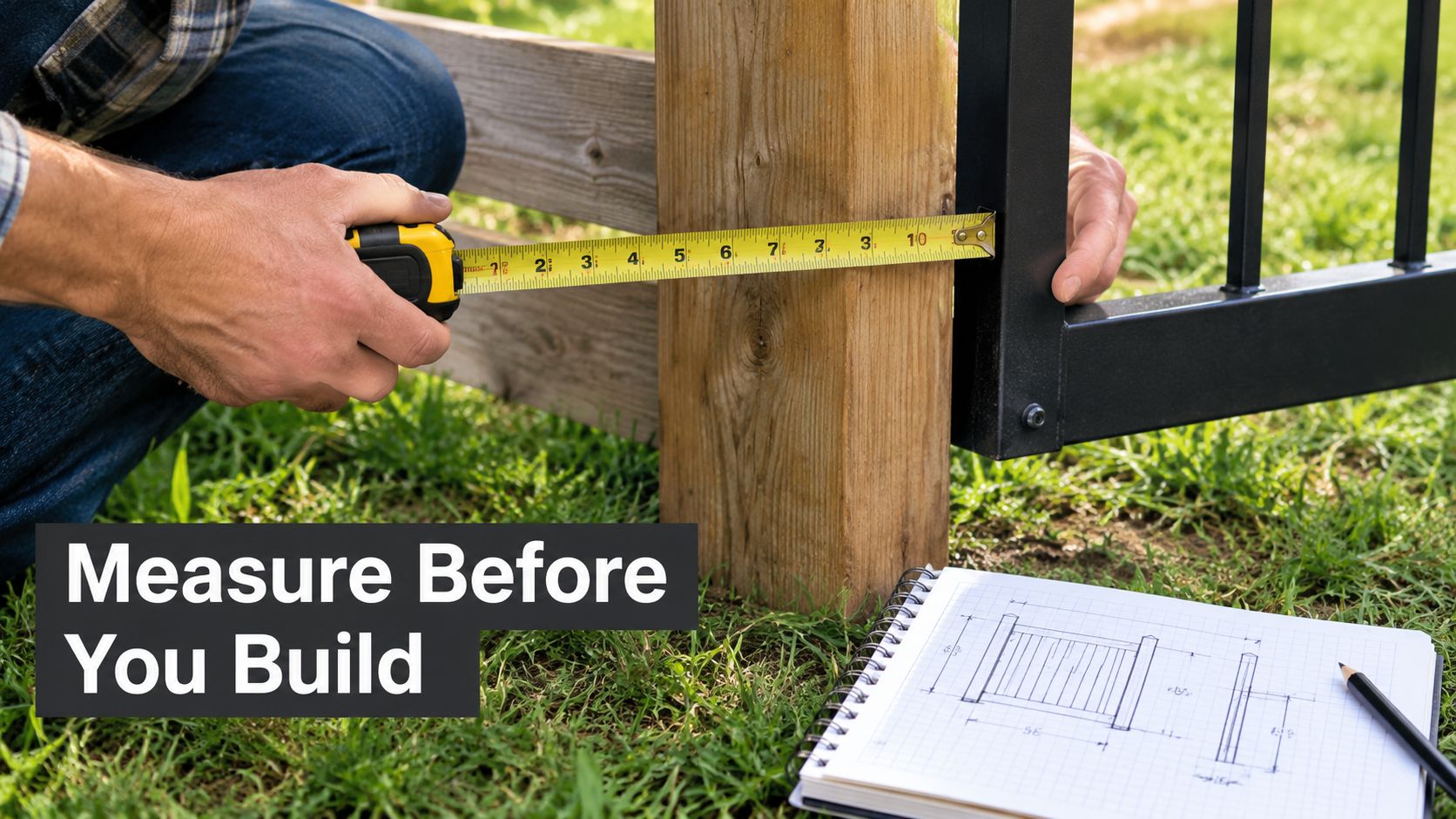
Most gate-ordering mistakes happen before fabrication. Someone measures the gap once, forgets the hinge and latch clearances, or gives the supplier the fence height instead of the finished gate height.
Start with the use and location
First, decide whether the opening is for people, vehicles, equipment, pets, or a pool enclosure. That decision determines the frame style, hardware, clear opening, and approval path.
Then identify the gate's position on the lot. Ottawa's front-yard, side-yard, rear-yard, and non-residential rules can differ. Ottawa also requires the finished side to face the street and neighbouring property, while Gatineau may apply additional requirements to special sites. Don't fabricate until you know whether the opening sits near a corner, right-of-way, shoreline, slope, or protected property.
Measure the opening properly
Take the width between the proposed hinge and latch posts at several points. Record the smallest measurement, not the largest. Check whether the posts are plumb and whether the ground rises under the gate swing.
Measure the finished height from the actual surrounding grade. Note slopes, pavement, stones, snow-storage areas, and any surface the gate may scrape. For a pool enclosure, measure the enclosure floor and gate bottom carefully because the required clearances are part of the safety system.
For a detailed reference on selecting the opening, use this guide to standard fence gate width. Give the fabricator the required clear opening and the post-to-post opening separately. Those are not always the same measurement.
Plan the posts and excavation
Gate posts need stronger support than ordinary line posts because the moving leaf places repeated force on the hinge side. Ottawa's pool-enclosure rules limit support-post spacing to 3 m and set minimum diameters for end, corner, and intermediate posts. Snow conditions may justify closer spacing or heavier assemblies in other applications.
Before digging anywhere in Ontario, request a locate through Ontario Dig Authority, formerly known as Ontario One Call in the available municipal guidance. A single-address request is completed within 5 business days, while advanced requests covering multiple addresses or larger work areas require up to 10 business days, according to Ontario Dig Authority's contractor locate information. Wait until all notified utility owners have responded, review the package with the crew, and keep it on site.
Check permits before ordering
In Ottawa, a standard residential gate usually falls under the ordinary fence rules, but a pool enclosure requires a separate permit. In Gatineau, the pool-fence permit requirement also applies even when a regular residential fence would not require one.
Use this sequence:
Classify the gate: Boundary, access, driveway, commercial, or pool enclosure.
Confirm the yard rules: Check front, side, rear, corner, right-of-way, and special-site conditions.
Measure twice: Record post-to-post width, clear opening, finished height, swing direction, and grade.
Request the utility locate: Do this before augers, concrete, or driven posts arrive.
Specify the assembly: Include posts, frame, mesh, hinges, latch, bottom control, and coating.
Inspect operation: The gate should swing freely, close fully, and latch without force.
Cost, Materials, and DIY Versus Hiring a Pro
The practical starting budget is clear. Materials for a typical residential chain-link gate run from 300 to 900 CAD, while professional installation with a self-closing gate generally adds 500 to 1,200 CAD, depending on width and height. Those figures don't represent every project. Pool hardware, oversized openings, difficult soil, special coatings, privacy inserts, stronger posts, and commercial requirements can move the price beyond that range.
Spend money on the parts that carry force
A basic material-only package may include the gate frame, mesh, hinges, latch, posts, fittings, and concrete. A stronger specification may add heavier terminal posts, improved hinge hardware, a bottom rail or tension cable, vinyl-coated fabric, and a more substantial foundation.
Coating affects appearance and corrosion resistance, but it doesn't solve a weak structure. A black or green finish can't prevent a gate from sagging if the hinge post moves. Before comparing colours, compare post support, frame stiffness, latch quality, and how the gate will be protected from snow banks.
This chain-link fence materials guide is useful when comparing fabric, posts, rails, fittings, and coatings. Ask for the material specification in writing so you can compare like with like.
DIY works in limited situations
DIY may make sense when the opening is uncomplicated, the property has clear access, the installer can handle accurate layout and concrete work, and no pool or special-site approval is involved. You still need a proper utility locate, a stable post layout, square gate framing, and time to adjust the hinges and latch.
The weak point is rarely attaching the mesh. It's setting the gate posts so they remain aligned under repeated load and seasonal movement. A gate that looks fine on installation day can scrape the ground or miss the latch after movement at the footing.
Hire a professional when the consequences are high
Use a qualified local fence contractor when the gate is part of a pool enclosure, spans a wide driveway, sits beside a snow-storage area, connects to a commercial perimeter, or requires stronger structural support. A local crew can account for Ottawa and Gatineau approval expectations, utility coordination, winter access, post layout, and final operating checks.
You're paying for more than labour. You're paying to reduce the chance that a small measurement error turns into a full gate replacement.
Common Mistakes That Undermine Chain Link Gate Durability
The biggest mistake is assuming chain link is automatically low-maintenance. The material can be practical and durable, but the gate concentrates movement at the hinges, latch, and terminal posts. Poor support shows up there first.
Mistake one is treating every opening the same
A walk gate beside a backyard path doesn't face the same demands as a vehicle entrance or pool barrier. A pool gate needs self-closing, self-latching, and lockable hardware at the required height. A driveway opening may need stronger posts and a layout that keeps plowed snow away from the moving leaves.
Privacy slats deserve caution too. Ottawa landscaping guidance says chain-link fences beside residential properties must be vinyl-coated or powder-coated and identifies different height limits for front, rear, side, and non-residential yards. Gates may be 30 cm taller than the associated fence. Adding a solid insert can increase wind exposure, obscure supervision, and change the loads on the frame and hinges. Check the location and use before installing it.
Mistake two is ignoring winter loading
Canadian General Standards Board guidance identifies mechanically piled snow as a condition that can require reduced post spacing. The same framework standard states a minimum horizontal design load of 0.9 kN applied 1.2 m above ground for its stated commercial and industrial framework conditions, as described in the Canadian framework standard. That value is not a universal substitute for site-specific engineering, but it shows why snow storage belongs in the layout discussion.
Don't place the gate where a plow will push a bank directly against the frame. If that can't be avoided, plan for stronger terminal posts, solid foundations, and potentially closer spacing beside the opening.
Mistake three is buying a gate by appearance
A thin frame, weak hinge, undersized post, or poorly positioned latch can fail even when the mesh colour matches the fence. Canada's industrial records show that chain-link fabric was already separately measured within the steel-wire industry by the mid-20th century. Statistics Canada recorded 2,367 tons of Canadian steel-wire-fence production in May 1947, including 209 tons of chain-link fabric, about 8.8% of that month's recorded output, in its historical production table. The 1947 Statistics Canada record documents an established product category, not a guarantee that every modern gate is well built.
Choose the assembly based on use and loads. The cheapest visible option is often the most expensive one to correct.
When to Choose a Chain Link Gate and How to Proceed
Choose a chain-link gate when you need practical access, durable boundary control, clear sightlines, or a secure perimeter without a solid wall. Don't choose it by mesh appearance alone. Match the opening to its use, then specify the frame, posts, hinges, latch, mesh, coating, and bottom control as one system.
For an Ottawa or Gatineau project, follow this order:
Identify the use: Ordinary access, driveway, pool, commercial, or institutional.
Confirm local rules: Check yard position, zoning, special-site conditions, and pool-enclosure requirements.
Measure the opening: Record post spacing, clear width, finished height, grade, and swing clearance.
Plan for winter: Keep snow-clearing routes away from the gate where possible.
Request locates: Wait for all utility responses before excavation.
Inspect the finished gate: Confirm smooth swing, complete closure, reliable latching, and correct lock placement where required.
Local contractors such as FenceScape can coordinate chain-link gates as part of a broader fencing project, including measurement, material selection, installation, and post-install support. If you're developing a marketing plan for a fencing business, resources such as BenjiAds fence company marketing may help with customer education, but the installation still depends on accurate site work.
FenceScape can measure your opening, specify a chain-link gate for Ottawa–Gatineau conditions, and install the posts, frame, mesh, hinges, and latch as one coordinated system. Visit FenceScape to request a project conversation and avoid ordering a gate that won't survive winter or pass inspection.
Comments