
Swimming Pool Fence Gates: Safety Types & Code Guide

Nearly all water-related fatalities among children aged 1 to 4 in private residential pools might have been prevented if the pools had self-closing and self-latching gates. Yet where information was available, only 16% of residential pool fences met applicable municipal by-law standards. A swimming pool fence gate is safe only when it closes, latches, and keeps doing both after Ottawa's winter has worked on it.
Most homeowners start with appearance. They compare black metal, glass, vinyl, and wood, then choose a gate that suits the yard. That approach misses the component most likely to undermine the enclosure: the moving access point. Fence panels stay still. Gates carry hinges, latches, fasteners, and repeated human use, so small alignment problems can turn a compliant barrier into an open route to the water.
In Ottawa-Gatineau, the practical question isn't only whether a gate satisfies an installation inspection. It's whether the gate still performs after frost, snow clearing, settlement, sag, and months of family traffic. The following guidance focuses on that difference, with local code requirements and the maintenance decisions that keep a pool enclosure dependable.
Why Swimming Pool Fence Gates Are a Measurable Safety Layer
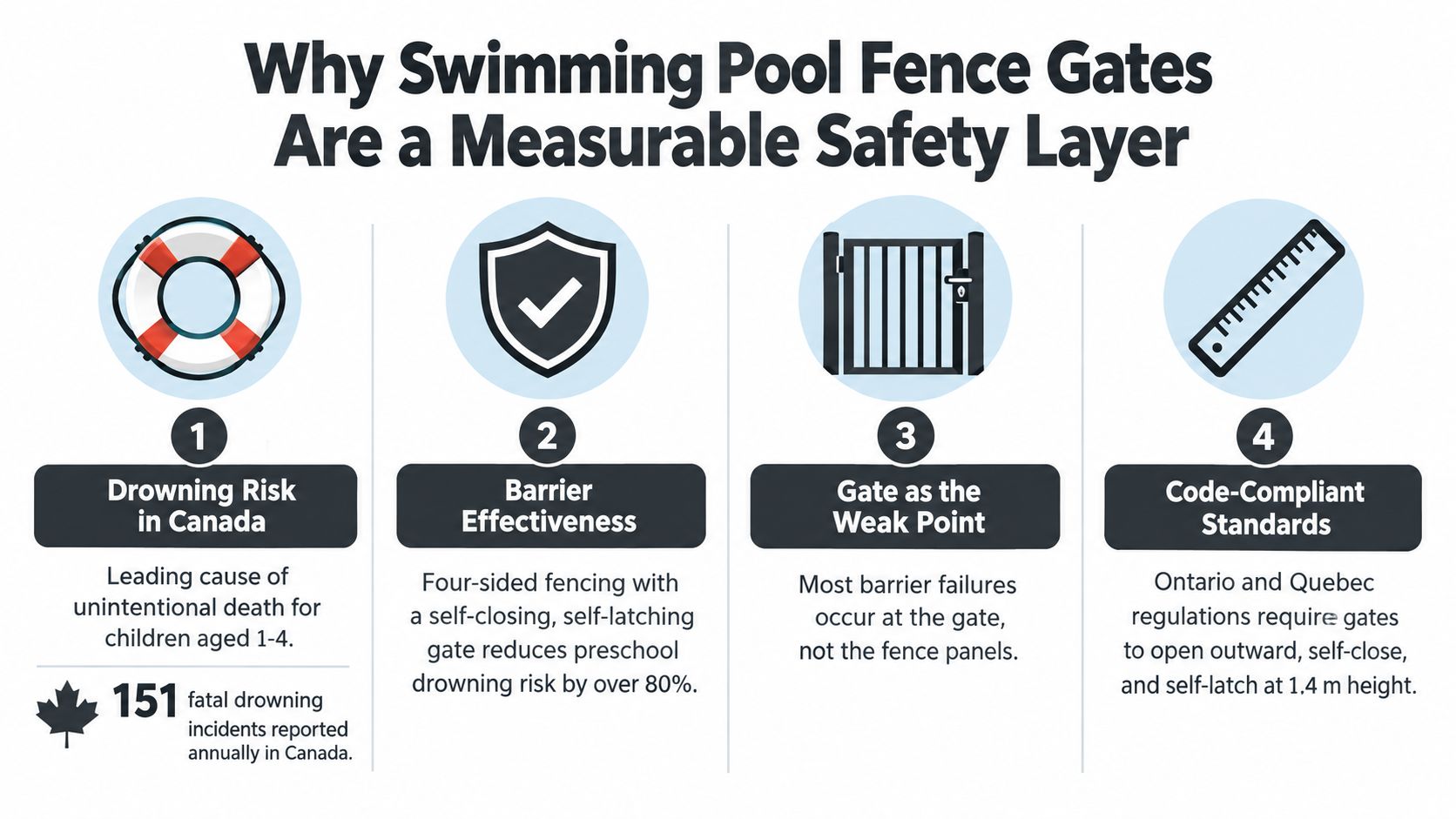
The Canadian Red Cross reported that backyard-pool fatalities represented approximately 30% of all water-related deaths among children aged 5 and under. In its review of Canadian home-pool incidents, ineffective adult supervision was a factor in more than 80% of cases, while the absence of an automatic self-closing and self-latching gate appeared as a risk factor in nearly all incidents involving small children. The report concluded that nearly all water-related fatalities among children aged 1 to 4 in private residential pools might have been prevented by self-closing and self-latching gates. (Canadian Red Cross fatality facts)
That evidence changes how a contractor should specify the enclosure. A gate isn't a decorative interruption in a fence line. It's a moving safety device that must close without help, capture the latch every time, and resist normal attempts by a small child to operate it.
The barrier is a system, not a fence panel
The Red Cross found that only 16% of residential pool fences met applicable municipal by-law standards where information was available. Ontario and Quebec together accounted for 357 deaths, or 81% of recorded fatalities, in the dataset. Quebec's reported backyard-pool fatality rate was 0.12 per 100,000 population, compared with a Canadian rate of 0.07 per 100,000. (Canadian Red Cross data)
Those figures don't mean a fence alone causes safety. They show why a four-sided, non-climbable enclosure needs a properly working gate. A tall fence with a gate that remains open, drags on the deck, or misses the latch offers a reassuring appearance without reliable control.
I also tell homeowners to consider the ground around the gate. A slippery or uneven pool deck can make an adult hesitate to approach a sticking gate, while poor surface traction can complicate safe access during maintenance. Practical advice on Atlanta pool deck safety tips offers useful context on non-slip surfaces and deck upkeep, even though Ottawa's climate and local rules require their own assessment.
Practical rule: Specify the gate as a life-safety component first, then choose a material and finish that suit the property.
A reliable gate should have a positive latch, independently adjustable hinges, and enough closing force to overcome ordinary friction. The frame, posts, footing, latch receiver, and surrounding fence must support that function. If any one of those parts moves, the gate's performance can deteriorate.
Comparing Gate Materials and Self-Closing Mechanisms
Material selection affects more than colour and curb appeal. Ottawa's freeze-thaw cycles expose the gate to movement, moisture, frost, and seasonal hardware stress, so the useful comparison is how well each option holds alignment and supports dependable closing and latching.
Material | Winter Durability | Maintenance | Cost Range | Code Compatible |
|---|---|---|---|---|
Vinyl | Good when well-built, but lower-quality products may become brittle in extreme cold | Low, with hinge and alignment checks | Moderate | Yes, when the installed design meets local requirements |
Ornamental iron | Very strong, with good resistance to impact and sag | Moderate, including corrosion checks and touch-ups | Moderate to high | Yes, with suitable spacing and hardware |
Glass | Stable panels, but hardware and installation require close attention | Moderate, including cleaning and hinge inspections | High | Yes, when designed and installed as a compliant enclosure |
Wood | Variable, with seasonal swelling, movement, and fastener loosening | High, including sealing and alignment work | Low to moderate | Yes, when dimensions and climb resistance comply |
Hybrid PVC-steel | Strong structural support with weather-resistant surfaces | Low to moderate | Moderate to high | Yes, when the complete system meets local requirements |
What works in Ottawa weather
Vinyl resists rot and doesn't demand regular staining, which makes it attractive for homeowners who want a simple maintenance routine. The weak point is often the gate frame and hinge alignment. A cheaper vinyl gate can become brittle during severe cold, and a post that shifts can leave the latch strike out of position.
Ornamental iron provides stiffness and a positive feel at the latch. It's a sound choice for families who want a visually open barrier and smooth operation, but ordinary steel hardware can rust and compromise movement. Use corrosion-resistant hinges, fasteners, and latch components, then inspect them rather than assuming powder coating protects every connection indefinitely.
Glass gives excellent visibility and a clean contemporary appearance. It also leaves little room for improvised adjustments, so the hinges must be selected for the installed panel load and checked for movement. A glass gate that looks precise but has a weak closer is still a poor pool barrier.
Wood can work, especially with pressure-treated lumber or cedar, but it needs a more active maintenance commitment. Moisture changes can swell the leaf, loosen fasteners, and alter the gap at the latch. Wood is usually the least forgiving option if the owner wants to install it and forget it.
Hybrid PVC-steel combines a rigid internal structure with a weather-resistant exterior. For many Ottawa-Gatineau sites, it offers a sensible balance between appearance, dimensional stability, and maintenance effort.
Choosing the closing mechanism
Spring hinges are familiar and easy to service, but their force can change with friction, alignment, and cold conditions. Hydraulic closers can deliver more controlled movement across changing temperatures, although they cost more and still need correct installation.
The mechanism should close the leaf from several opening positions, not only from fully open. The latch must capture without someone lifting, pushing, or pulling the gate into place. A self-closing gate guide from FenceScape provides another practical reference when comparing hinge and latch arrangements.
No material wins every project. Pick the gate that matches the exposure, structure, appearance, and inspection discipline you can realistically maintain.
Ontario and Quebec Swimming Pool Fence Gate Code Requirements
Ottawa and Gatineau homeowners face different municipal and provincial requirements, so a gate purchased from a catalogue isn't automatically suitable for both sides of the river. The enclosure has to be designed around the property, the jurisdiction, and the complete access route.
Ottawa requirements
Ottawa requires every privately owned outdoor swimming pool to have an enclosure that makes the pool inaccessible to small children, even if a compliant-looking yard fence already exists. The City requires an enclosure permit beside an existing fence because that fence must be checked against pool-enclosure rules. (Ottawa pool enclosure brochure)
The enclosure must be at least 1.5 metres high, and openings through or beneath it must be small enough that a 100-millimetre sphere can't pass through. The gate must be self-closing, self-latching, and lockable, with the lock at least 1.35 metres above the enclosure bottom. Treat the gate as part of the regulated pool barrier, not as an ordinary yard gate.
Before ordering, confirm these points:
Measure height: Check the finished grade around the full enclosure, not just at the easiest post.
Check openings: Include the gate-to-post gap and the space beneath the leaf.
Confirm operation: Release the gate and verify that it closes and latches without assistance.
Verify the lock: Measure from the applicable enclosure bottom and confirm the lock remains usable.
Review the permit: An existing perimeter fence still needs municipal approval as a pool enclosure.
A pool-safety fence overview from FenceScape can help homeowners frame the design conversation before they discuss materials and layout with an installer.
Quebec requirements
Quebec's Residential Swimming Pool Safety Regulation requires every gate forming part of a pool enclosure to have a passive security device that closes and latches automatically. The latch may be on the inside in the upper part of the gate, or outside only when it's at least 1.5 metres above ground level. (Quebec Residential Swimming Pool Safety Regulation)
Quebec guidance generally calls for an enclosure at least 1.2 metres high, openings that block a 10-centimetre ball, and a design that isn't easy to climb. If the latch is below 1.5 metres, it must be on the pool side of the door. Chain-link installations also need attention because openings larger than 30 millimetres require corrective treatment, such as mesh slats, where necessary to meet the barrier rules. (Éducaloi guidance on residential pool safety)
The important difference is the latch location and height. Don't carry an Ottawa specification across the river without checking Gatineau and provincial requirements.
Hardware Selection and Seasonal Inspection Routines
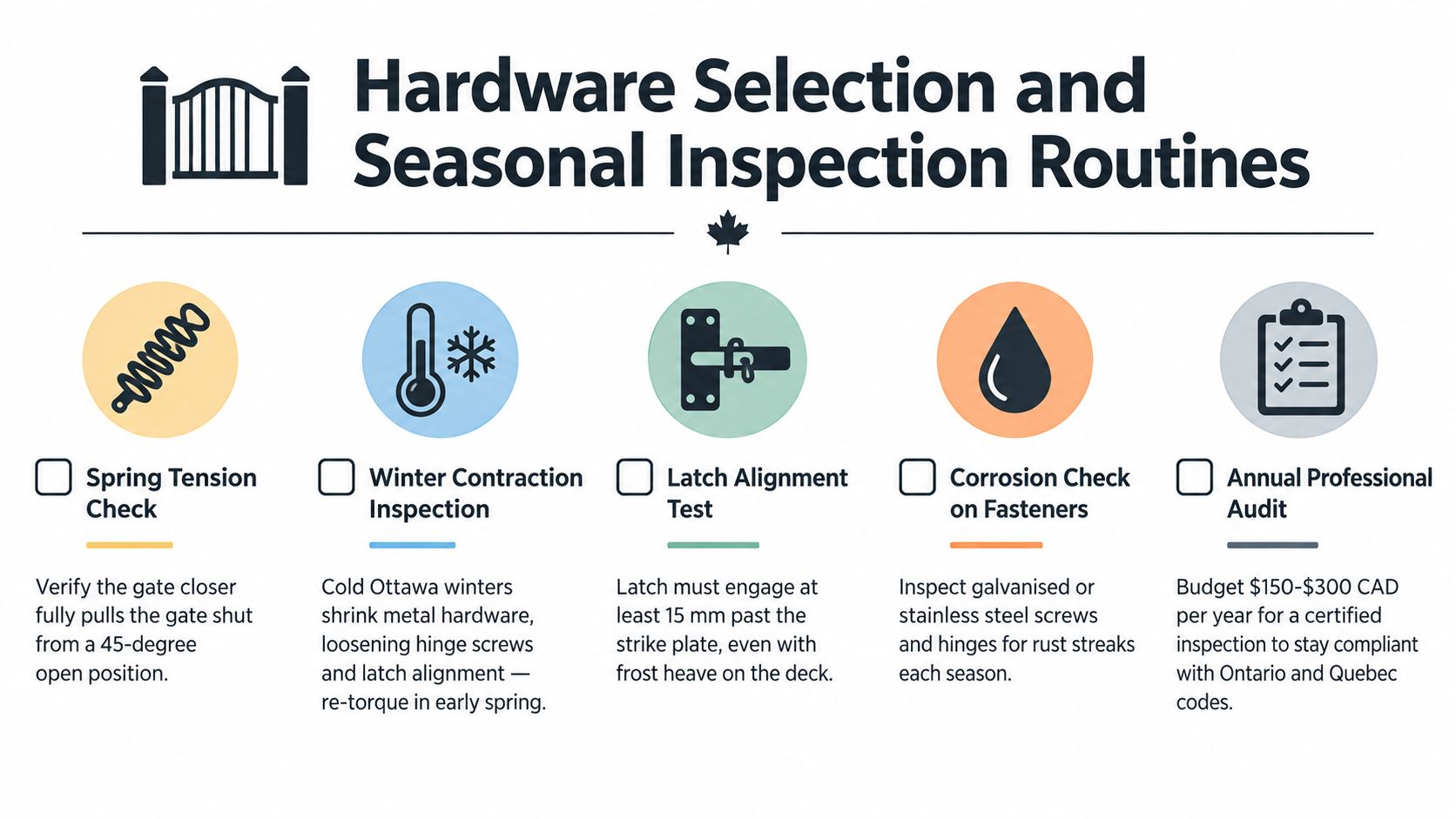
A gate can pass an installation inspection and still fail in service after snow, ice, frost, and ground movement alter its alignment. Ottawa requires pool enclosures to be permitted, and the City checks for self-closing, self-latching, and locking devices that keep the gate locked except during use. (Ottawa pool enclosure requirements)
The hardware choice should therefore anticipate maintenance. Use adjustable, corrosion-resistant hinges, a positive latch with a stable strike plate, and fasteners that won't loosen quickly under repeated movement. Leave enough clearance at the threshold for ordinary snow and ice management, but don't create an opening that compromises the enclosure.
The seasonal check that catches real failures
In spring, remove winter debris and test the gate from several opening angles. Watch whether the leaf slows, stops, or rebounds before the latch engages. Check hinge screws, post movement, the strike plate, and the surface beneath the swing.
During the swimming season, make the test part of normal supervision. Open the gate slightly, halfway, and widely, then release it. A gate that only works when opened fully is not reliable enough.
In fall, clear leaves and inspect for corrosion before freezing conditions arrive. Confirm that landscaping, toys, furniture, storage bins, and pool equipment can't provide a step or handhold near the barrier.
A permit confirms an installation. It doesn't maintain the gate for the homeowner.
Snow accumulation can block the swing, while ice can freeze hinges or prevent the latch from entering the strike. Frost heave and seasonal settlement can shift the posts enough to create drag or misalignment. Snow clearing can also damage the threshold or push soil against the lower edge.
For broader context on protecting outdoor hardware from moisture and corrosion, these coastal outdoor structure maintenance practices are relevant, although pool gates in Ottawa need a cold-weather inspection routine as well.
The practical inspection list is short:
Test closure: Release the gate from multiple positions.
Check latch capture: Confirm the latch engages without lifting the leaf.
Clear the path: Remove ice, snow, debris, and stored items from the swing.
Inspect alignment: Look for sagging posts, loose hinges, and a shifted strike plate.
Audit climbability: Keep branches, furniture, planters, and equipment away from the barrier.
For hardware-specific considerations, review pool fence gate latch hardware before replacing a component with a general-purpose yard-gate part.
Installation Considerations and Maintenance Cost Analysis
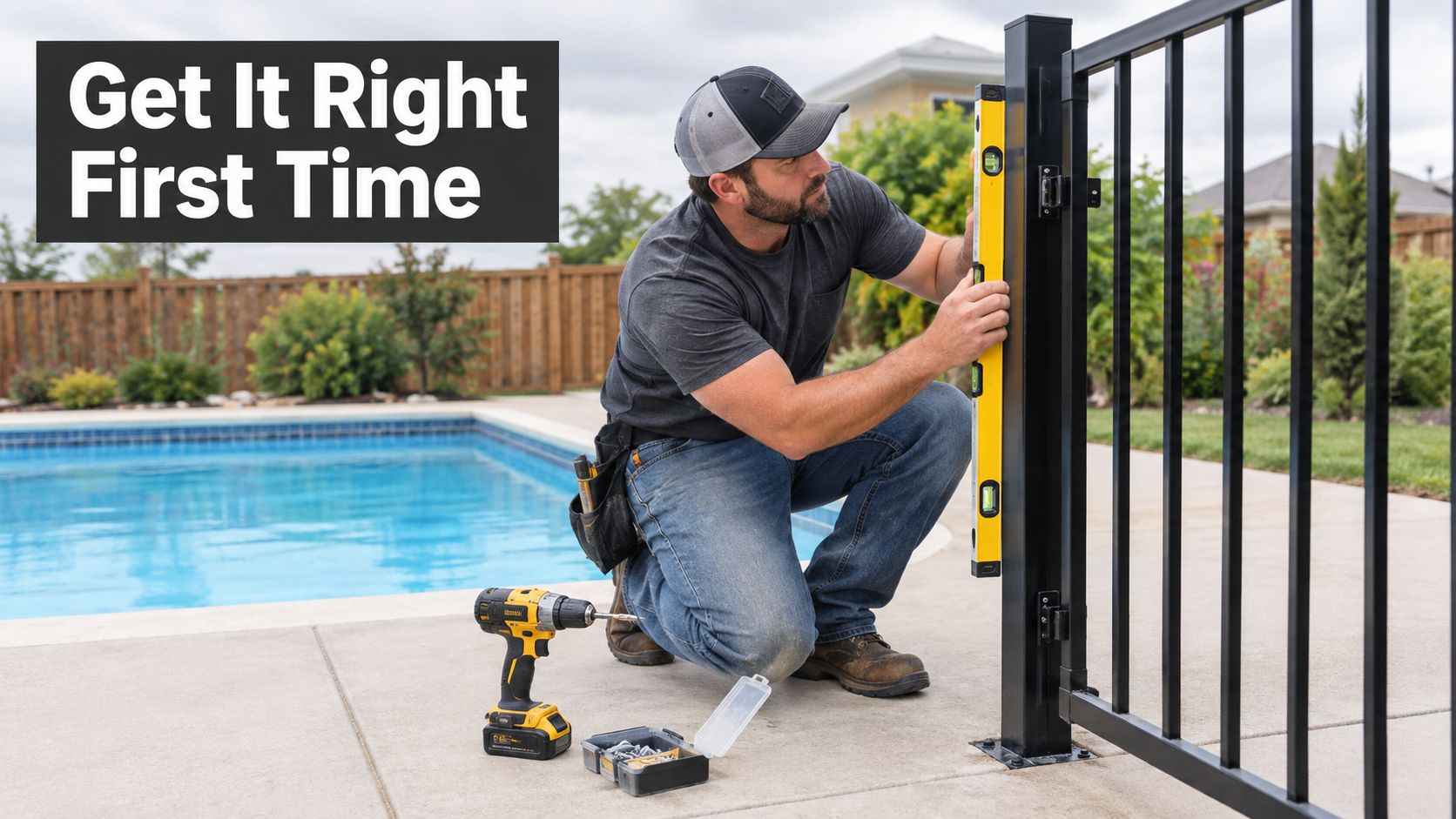
Most pool gate failures are installed on day one. In Ottawa-Gatineau, a gate can pass its first close test in summer, then start dragging, bouncing, or missing the latch after one freeze-thaw cycle because the post line, footing depth, hinge selection, or strike alignment was off from the start.
Installation details that determine reliability
Reliable gates start with layout, not hardware. The post line and finished grade need to be established before the installer decides on bottom clearance and swing path. Footings have to carry repeated opening loads, wind pressure, and seasonal soil movement. Hinge placement has to suit the gate's weight and width, and the latch receiver has to meet the leaf where it settles under use, not where it sits for five minutes during installation.
That last point matters more here than many homeowners expect. A gate that is technically compliant can still become the weak point of the enclosure if frost heave shifts one post, snowmelt softens the base, or the closer loses enough force in cold weather that the latch stops catching consistently.
The gate also has to work as part of the full barrier. If it ties into a weak fence return, a climbable side wall, or a gap beside the house, access control is already compromised before anyone touches the latch.
Maintenance costs depend less on the panel material than on whether the installation was right the first time. Vinyl usually stays on the lower-maintenance end, with cleaning and periodic hardware checks. Wood costs more over time because sealing, staining, fastener tightening, and seasonal adjustment keep coming back. Ornamental iron adds rust treatment and paint touch-ups. Glass avoids corrosion on the panel itself but still needs regular hinge, latch, and mounting-point inspection, and those service calls are rarely cheap once alignment starts to drift.
Watch the installation and commissioning process in this pool fence gate installation video to see why alignment, hardware placement, and final testing matter as much as the selected panel.
Where professional work earns its keep
A small latch adjustment can make sense if the post is solid and the gate has only moved slightly. If the leaf drags, the post shifts, the closer no longer overcomes resistance, or the latch only catches when someone lifts the gate, the repair usually goes beyond swapping parts.
In practice, the cost gap is real. A basic DIY hardware replacement may look cheaper up front, but if the root problem is footing movement, post rotation, or poor hinge geometry, the homeowner often buys hardware twice and still ends up booking a service call. Professional correction costs more because it addresses alignment, support, and closing force together. In this climate, that is often the repair that lasts past winter.
The broader safety record supports treating the whole gate assembly as the issue, not just the latch. The Lifesaving Society Canadian Drowning Report reported that private pools accounted for 87% of pool-related drowning deaths, averaging 33 water-related fatalities annually. In documented cases with fence and gate information, 39% of pools had no fence or a non-compliant fence, 74% had no gate or a gate that was not self-closing and self-latching, and a review of private-home-pool deaths from 2011 to 2015 found that only 21% involved fencing known to meet by-law standards, while 8% had a present but substandard fence and 10% had no fence.
Pay for correct layout, suitable hardware, proper commissioning, and a follow-up adjustment if the first winter shifts anything. That is where long-term reliability comes from.
Choosing the Right Gate for Your Pool Enclosure Needs
The right gate depends on the site and the owner's willingness to maintain it. A homeowner who wants minimal upkeep and strong weather resistance may favour a quality vinyl or hybrid PVC-steel design. Someone prioritising clear sightlines may choose glass, provided the hinges and closer are selected for the panel and inspected routinely.
Families with young children often benefit from an ornamental iron gate with a positive latch and independent locking arrangement. It provides a clear visual barrier and a firm operating feel, but the owner still needs to watch for corrosion and alignment changes. A pressure-treated wood gate can suit a tighter budget, as long as the owner accepts regular sealing, inspection, and seasonal adjustment.
Consider a typical Ottawa homeowner replacing an old side-yard gate beside an existing pool fence. The fence panels look solid, but the gate drags after spring thaw and the latch only catches when someone lifts the leaf. Replacing the latch alone won't solve the problem. The sensible sequence is to verify the enclosure permit and local measurements, inspect the post and footing, choose a closer with enough force, realign the leaf, then test closure and latching repeatedly before the pool is used.
FenceScape serves the Ottawa-Gatineau region with pool enclosures and gates in PVC, hybrid PVC-wood with steel, wood, ornamental iron, chain link, and glass. Its service covers planning, installation, and post-install support, with financing and promotional programmes available for Ontario and Quebec customers. The useful comparison is not just product price. Ask what the quote includes for layout, code review, installation, commissioning, and seasonal support.
Before purchasing, verify your municipality's requirements, measure the existing enclosure, and decide how the gate will be checked in spring and fall. If the enclosure is new or being replaced, budget for professional installation so the posts, hinges, latch, and surrounding barrier work as one system.
FenceScape can assess your Ottawa-Gatineau pool enclosure, recommend a gate material and hardware arrangement suited to the site, and manage installation from planning through final walkthrough. Visit FenceScape to discuss a compliant, winter-ready swimming pool fence gate and request a project estimate.
Comments