
Classic Vinyl Fencing for Ottawa Homes

You're standing in the backyard with a new fence design on your screen, comparing clean white pickets with a taller privacy profile. The material looks simple. The installation isn't. In Ottawa and Gatineau, a vinyl fence has to deal with frost movement, spring thaw, snow clearing, summer heat, municipal height limits, and sometimes pool-enclosure rules that can turn an attractive order into a compliance problem.
Classic vinyl fencing works well here when the product grade and installation method match the climate. It's not maintenance-free plastic, and it isn't a substitute for proper post foundations. The right system can deliver consistent colour and long service with periodic washing, but the wrong profile or a poorly installed post can lean, crack, or fail long before the panels themselves reach the end of their useful life.
Understanding Classic Vinyl Fencing in Eastern Ontario
A homeowner in Ottawa may describe a traditional white fence as “vinyl,” but the useful technical description is rigid PVC fencing formed to reproduce the appearance of painted wood. The familiar styles include white picket, privacy, lattice-topped, and post-and-rail designs. Their common feature is a factory-finished polymer surface that doesn't absorb water in the way wood does.
That difference becomes obvious after a few Ottawa winters. Wood swells when it takes on moisture, then dries and contracts. Repeated wetting, snow accumulation, spring thaw, and summer ultraviolet exposure gradually put pressure on boards, coatings, fasteners, and posts. PVC resists splintering, rust, corrosion, and ultraviolet radiation, although the complete system still depends on its formulation and installation. Retail guidance for Canadian consumers describes these material properties in its overview of PVC fencing products.
From painted wood to factory-finished PVC
The important shift wasn't just from one colour to another. Classic vinyl normalised a different maintenance profile. A wood fence usually needs staining, sealing, or painting to protect exposed surfaces, while a quality PVC fence generally needs washing rather than recurring surface coatings.
A privacy fence around a rear yard shows the advantage clearly. The owner gets straight, uniform panels without the annual question of whether the finish has failed on the south-facing side. A white picket fence offers the same visual language as painted wood, but the surface doesn't rely on a homeowner remembering to recoat every vulnerable section.
For style planning, compare the proportions, top treatments, and privacy levels in these vinyl privacy fence styles before choosing a profile. A classic appearance doesn't tell you whether the rails and posts have enough material for local exposure.
What separates a durable system
The useful purchasing question is not “Is this vinyl?” Ask whether the system has adequate wall thickness, UV stabilisation, impact modification, and post design for the site. Two fences can look nearly identical in a showroom and behave very differently when a snowblower throws a frozen ridge against a panel.
Regional contractor estimates commonly place classic vinyl service life at approximately 25 to 30 years, compared with roughly 15 to 20 years for wood in the Ottawa–Gatineau climate. Those figures are market estimates, not government-certified service-life guarantees, and they assume appropriate product quality, exposure, maintenance, and installation.
Practical rule: Treat the PVC profile and the post foundation as one system. A strong panel won't correct a post that moves with frost.
Evaluating Cold Climate Performance and Material Grades
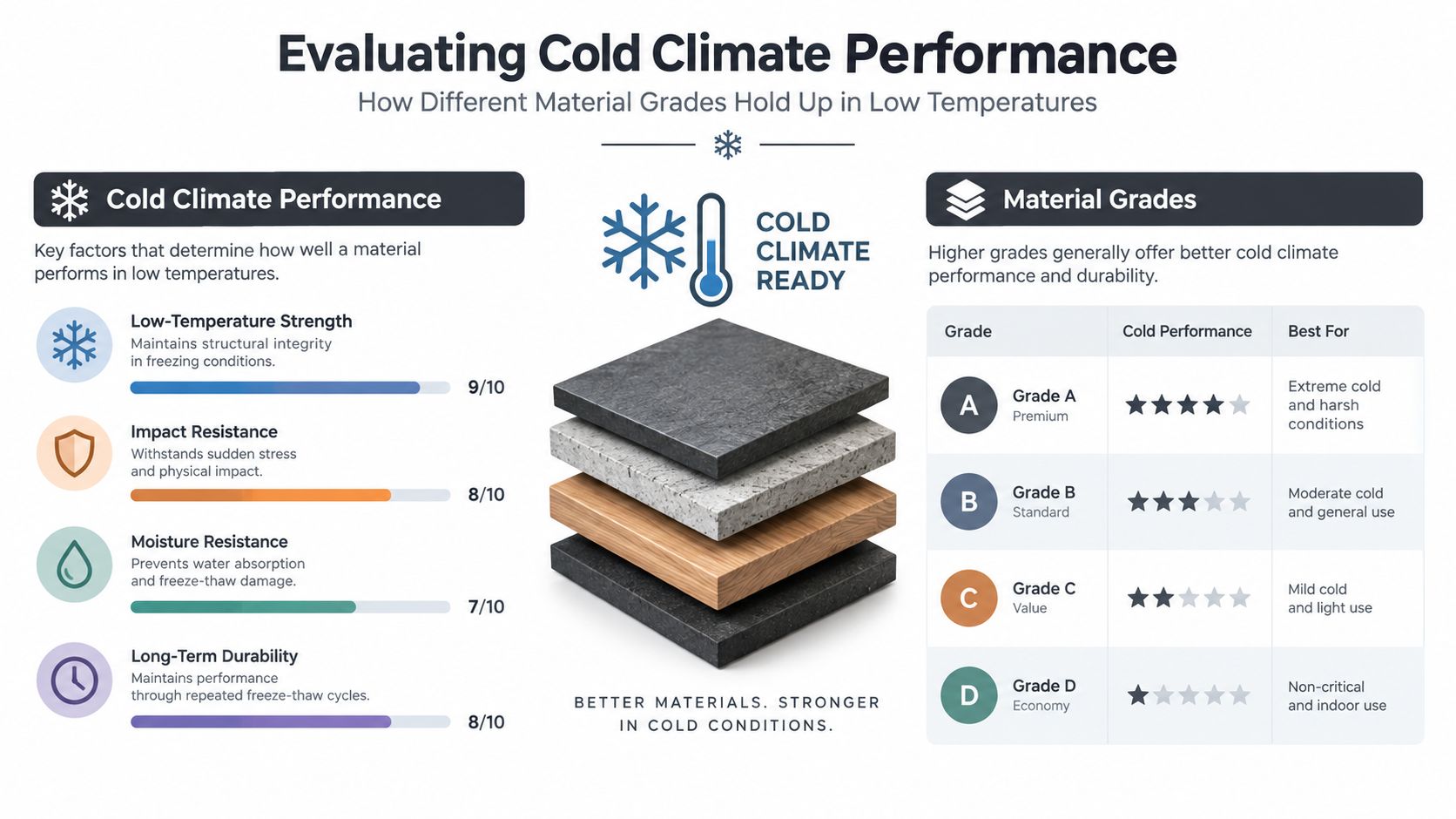
Cold-weather performance starts with the compound, but it ends with the details around movement and impact. Lower-quality vinyl can become brittle and crack when temperatures fall below approximately −20°C to −30°C, while better systems use impact modifiers and UV inhibitors to preserve flexibility and colour. The exact result depends on the formulation, profile geometry, exposure, and the force applied.
Use a recognised technical benchmark
For rigid PVC fencing in this region, I'd ask for profiles tested to ASTM F964. The standard evaluates dimensional tolerances, extrusion quality, impact resistance, warp, dimensional stability, and weatherability. A representative technical specification lists tensile strength of approximately 43 MPa, tensile modulus of approximately 2,963 MPa, and a heat-deflection temperature near 67°C. These figures are documented in the National Vinyl Products technical specification.
The tensile and heat-deflection values help explain why a properly made rail can stay straight during summer solar heating. They don't mean the fence is dimensionally frozen. PVC expands and contracts as temperatures change, so rails need manufacturer-specified clearances and fastening methods that permit controlled movement.
A supplier who can discuss ASTM F964 compliance, profile construction, and installation clearances is giving you more useful information than one who only repeats a lifetime claim. Product documentation should identify the actual system, not merely describe it as “heavy duty.”
Cold weather exposes weak points
The most common winter failures aren't always spread across the whole fence. Concentrated impacts cause trouble first. A plough ridge, a snowblower discharge, a falling branch, or a vehicle mirror can strike one small area when the PVC is least flexible.
Pay particular attention to:
Post cavities: The post must have enough internal support for the height, wind exposure, gate load, and local foundation design.
Rail clearances: Rails need room to move without binding against the post.
Gate hardware: Hinges and latches create concentrated loads that can stress the surrounding vinyl.
Snow-clearing routes: Keep panels away from the path of ploughs and snow throwers wherever the layout allows.
Colour and exposure: UV inhibitors help preserve the finish, but a lighter colour and suitable site placement can reduce heat and exposure stress.
ASTM F964 weatherability testing requires the compound to remain free of visible peeling, chipping, cracking, flaking, and pitting after prescribed exposure. The specification also requires post-weathering impact resistance of at least 0.6 inch-pound per mil, equivalent to about 2,670 J/m, across hot-dry, hot-humid, and temperate-northern test environments. The ASTM F964 sample specification provides the testing context.
That temperate-northern category is relevant for eastern Ontario and western Quebec, but it isn't a guarantee of field performance at your address. Ask the supplier for the actual weathering and impact documentation, then verify that the installer will follow the manufacturer's movement and foundation requirements. A useful regional reference is this guide to all-season fencing, particularly when comparing systems intended for year-round installation.
Comparing Vinyl Against Wood and Hybrid Alternatives
A fence that looks sound in October can tell a different story after two Ottawa winters. The material choice affects not only appearance and cleaning, but also how repairs, water exposure, and structural loads are handled over time.
Wood remains a practical choice for homeowners who want visible grain, repaintable surfaces, and the ability to replace individual boards. It also requires regular attention. Poorly maintained or untreated boards absorb water, swell, rot, and need repeated coating work. In eastern Ontario and western Quebec, that maintenance protects the material from seasonal moisture rather than merely improving its appearance.
Classic vinyl uses a non-porous surface that does not absorb water, reducing the rot, swelling, and recurring coating work associated with wood. The trade-off is less flexibility later. Changing the colour can be difficult, while damage to a panel or post may require a matching system component instead of a simple board replacement.
A practical decision matrix
Material Type | Maintenance Profile | Climate Resilience | Estimated Lifespan |
|---|---|---|---|
Classic rigid PVC | Periodic washing, with no routine staining, sealing, or painting generally required | Resists moisture-related deterioration, but quality grade and cold-weather impact resistance matter | Approximately 25–30 years based on regional contractor experience. Retail product listings such as RONA reference comparable ranges |
Wood | Recurring inspection, staining, sealing, painting, and repair as exposure causes wear | Natural material can swell, rot, and deteriorate if coatings and drainage are neglected | Approximately 15–20 years in regional contractor experience, depending on species, detailing, and maintenance |
Hybrid PVC, wood, and steel | Depends on the finish and the exposed wood or PVC components | Steel can add rigidity, while the outer materials still require site-appropriate detailing | Lifespan depends on the selected system and installation |
Vinyl suits owners who want clean lines and limited routine maintenance. Wood suits those who prefer character and accept seasonal upkeep. A hybrid system can add rigidity or provide a wood-grain appearance, but exposed wood still needs care, and steel components still depend on sound detailing and protection from moisture.
Match the finish to the property
A white picket profile fits a front-yard setting where the fence contributes to the home's presentation. A solid privacy system is more suitable for a rear or side yard where screening matters. Post-and-rail designs mark boundaries without creating a continuous visual wall.
For homeowners comparing wood species or exterior finishes for a broader cladding project, choose cladding wood offers useful context on grain, durability, and finish preferences. Fence selection still depends on posts, soil, gates, drainage, and local rules, not just the visible boards. In a freeze-thaw climate, the cheapest material is rarely the cheapest fence to own.
Navigating Municipal Bylaws and Pool Enclosure Permits
A fence order should follow the site check, not precede it. Ottawa and Gatineau use different height limits, and a pool enclosure has separate requirements from a standard property fence.
In Ottawa, a standard residential fence may be up to 1 metre high in a front yard and 2.1 metres high in a rear or side yard. Gates may be 30 centimetres taller than the applicable fence limit. Standard residential fences generally don't require a permit, but a pool enclosure is an exception. Confirm the current rules with the City before ordering panels, especially if the proposed fence sits near a lot line, street, or pool.
Gatineau uses a more detailed framework for homes containing one to four dwellings:
Front yard: Maximum 1.2 metres.
Side yard adjacent to a street: Maximum 1.5 metres.
Non-street side yard or rear yard: Maximum 2 metres.
Street right of way: The fence cannot extend into it.
Setbacks: Minimum 1 metre where a sidewalk exists and 1.5 metres where one doesn't.
For buildings containing more than four dwellings and collective housing, the side and rear maximum rises to 2.5 metres, while the front-yard limit remains 1.2 metres and the street-adjacent side-yard limit remains 1.5 metres. Gatineau residential fences normally don't need a permit unless the fence protects a pool. The municipal residential fence regulation information should be checked for the property's exact context.
Pool fencing is a separate safety system
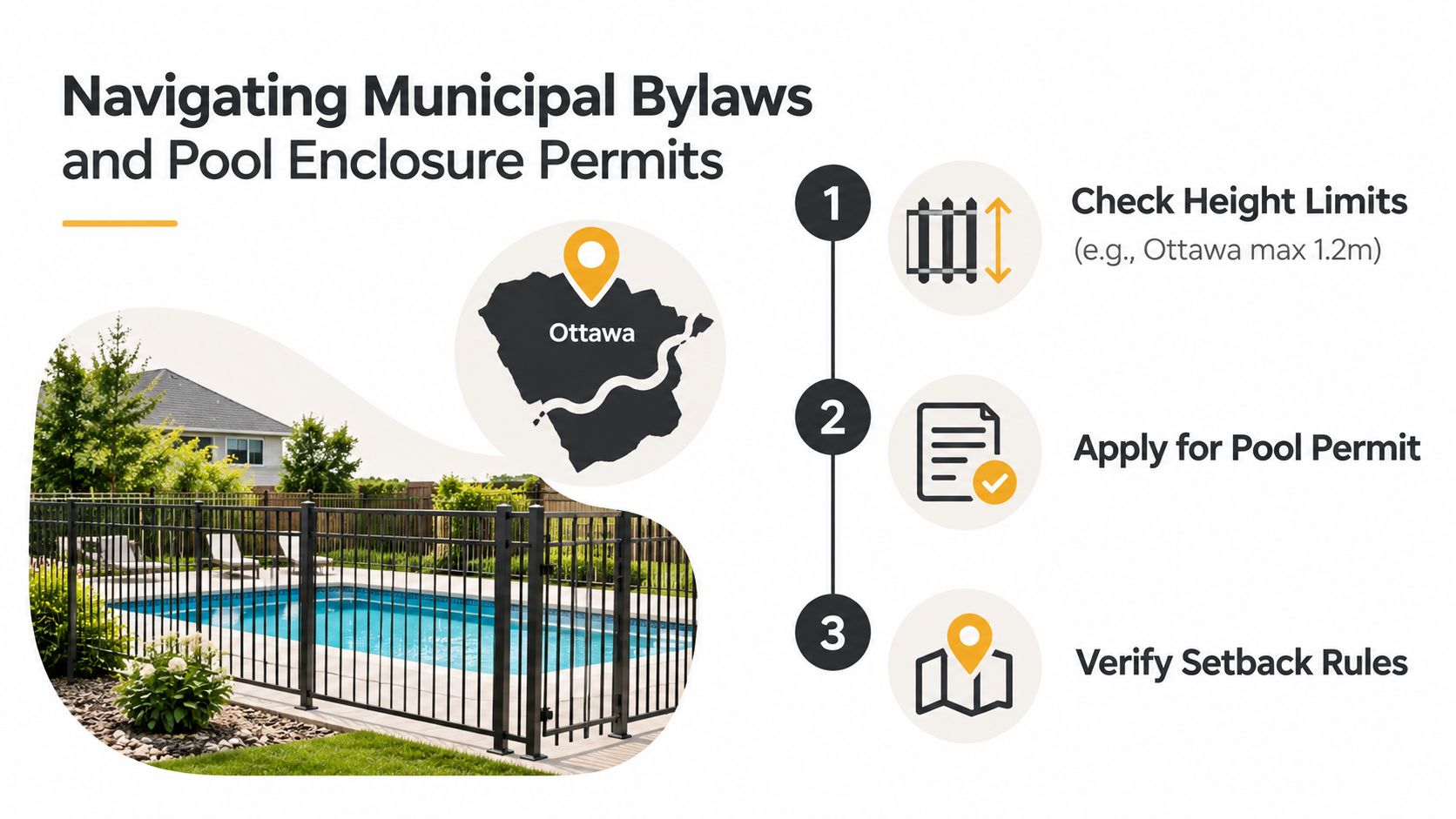
A classic vinyl privacy fence isn't automatically a compliant pool enclosure. Ottawa requires a pool enclosure permit for a new enclosure or replacement, even if another yard fence already exists. The water depth trigger should be checked before design work proceeds, including whether it exceeds the 60-centimetre threshold.
Ottawa pool enclosures must be at least 1.5 metres high, and the bylaw regulates construction, openings, gate operation, and post requirements. The City identifies vinyl as an acceptable material alongside wrought iron and aluminum, so PVC can serve both privacy and pool-safety purposes when the complete design complies. The Ottawa land-use guide confirms vinyl's acceptability and the enclosure height requirement.
Before ordering, verify:
Permit trigger: Determine whether the pool or enclosure requires a separate permit.
Height and openings: Confirm the proposed height, climbability, and opening dimensions.
Gate hardware: Verify self-closing and self-latching requirements, along with latch placement.
Foundation design: Specify non-frost-susceptible posts and a foundation suitable for freeze-thaw movement.
Existing enclosure: Ask whether repairs or replacement of individual parts are treated differently from replacing the entire enclosure.
If the project also includes a detached structure, a practical guide to compare shed materials and costs can help separate the fence decision from the shed decision. They may share a property line, but they don't share the same regulatory question.
Mastering Frost-Line Installation and Neighbourhood Group Savings
The posts carry the fence. In Ottawa and Gatineau, that statement matters more than the decorative profile because frost heave can move an entire line while leaving the PVC panels apparently undamaged.
Clay soil, trapped water, seasonal freezing, and spring thaw can push posts upward or allow them to lean. A post that looks plumb during a mild installation day may not stay that way if its foundation sits within the zone of frost movement. The correct response isn't to brace a leaning panel after winter. It's to establish the foundation design before setting the first post.
Build for movement, not against it
A reliable installation process includes the following decisions:
Locate the property line: Confirm boundaries and identify utilities before excavation.
Plan the frost-depth installation: Posts need to be embedded well below the local frost line using a foundation method suited to the soil and fence loads.
Manage drainage: Water around a post creates a more difficult freeze-thaw environment. Site grading and drainage deserve attention before concrete or backfill is placed.
Set the line accurately: Use string lines, measured offsets, and repeated level checks so small alignment errors don't compound across the run.
Allow thermal movement: Follow the manufacturer's clearances and use fastening methods that let rails and panels expand and contract.
Reinforce concentrated loads: Gates, corners, ends, and changes in direction need more attention than a straight intermediate bay.
Winter installation adds another complication. Frozen ground makes excavation difficult, and cold PVC is less forgiving when a component is forced, struck, or cut carelessly. If the site schedule pushes work into harsh conditions, protect the material and follow the manufacturer's installation limits rather than rushing to close the property line.
Field lesson: A straight fence on installation day is only a finished job if the posts remain straight after freeze-thaw movement.
Organise neighbouring properties before requesting quotes
A shared boundary gives neighbours a practical reason to coordinate. Group installations can streamline layout, reduce repeated mobilisation, and make material ordering more efficient. They can also help contractors organise crews and access without promising that every project will receive identical pricing.
Start with a simple shared plan:
Identify the properties that need work at the same time.
Agree on the boundary sections, preferred style, gates, and height.
Record which lots have slopes, retaining walls, trees, or difficult access.
Ask for separate written scopes so one neighbour's gate or removal work isn't hidden inside another's estimate.
Confirm how the group rate applies to materials, labour, site preparation, and changes.
Neighbourhood coordination is most useful when the sites are close together and the designs are reasonably compatible. One property may need a privacy profile, another a picket fence, and a third a gate with heavier hardware. A good contractor should price those differences clearly rather than forcing a single package onto every home.
Securing Turnkey Service and Post-Install Support
Classic vinyl fencing rewards careful planning. The contractor needs to evaluate the soil, property line, grade changes, gates, municipal limits, pool requirements, and the product's movement allowances before installation begins. That combination is difficult to manage when the project is treated as a simple panel-and-post purchase.
A turnkey approach keeps the decisions connected. The same project team can measure the site, identify bylaw concerns, help select a PVC profile, coordinate excavation, install the posts, set the panels, fit gates, and complete a final walkthrough. In the Ottawa–Gatineau region, local experience also matters because frost-heavy soil and snow-clearing patterns affect the details that generic installation diagrams cannot resolve.
What support should include
Look for clear answers to these questions before signing:
Who measures the site and confirms the boundary?
Who checks height, setback, and pool-enclosure requirements?
Which product system is being installed, and what technical documentation is available?
How will the crew handle frost movement, gates, corners, and drainage?
What happens if a panel or post is damaged later?
What does the warranty cover, and who handles post-install concerns?
FenceScape offers PVC, hybrid PVC, wood, ornamental iron, chain link, and glass fencing and railing services across the Ottawa–Gatineau region, with planning, installation, and post-install support handled as part of the project process. Its vinyl fence installers can help coordinate the material and structural decisions rather than leaving the homeowner to reconcile them after the purchase.
Accessories also deserve a site-specific review. For example, an outdoor umbrella fence mount may be useful in a backyard layout, but any attachment that introduces force or concentrated load should be assessed against the fence design and manufacturer's limitations. The same principle applies to planters, lighting, privacy screens, and gate hardware. Small additions can create large stresses when they're fixed to a light profile.
A final walkthrough should confirm that gates latch correctly, panels are aligned, clearances are visible where required, drainage is satisfactory, and the homeowner understands routine washing and inspection. Vinyl's low-maintenance advantage becomes practical only when the fence is installed to accommodate the climate instead of merely assembled to look finished.
FenceScape can help you plan and install classic vinyl fencing for Ottawa and Gatineau conditions, including material selection, frost-conscious post work, bylaw review, pool-enclosure coordination, gates, and post-install support. Visit FenceScape to request a project assessment and discuss a fence designed for your property, your local rules, and the next Ottawa winter.
Comments