
Glass Fence for Pool: A Practical Ottawa–Gatineau Guide

A homeowner in Ottawa opens the pool on a windy late-spring morning and sees two competing pictures. One is the clean, uninterrupted view of the water, garden, and patio that glass promises. The other is another winter of snow pushed against a barrier, ice around the deck, and a gate that may need adjustment after the ground moves.
That choice isn't about whether a glass fence for pool areas looks better than aluminium or mesh. It involves Ottawa permitting, enclosure dimensions, panel layout, mounting, gate hardware, frost movement, maintenance, and the way your family uses the yard. A transparent barrier can be an excellent solution, but only when the complete system works on the actual lot.
This guide approaches the decision the way a local contractor should. Start with the by-law, assess the deck and grade, choose the glass system, plan for Canadian seasons, compare alternatives thoroughly, and define what a complete installation includes. If you're still collecting ideas, the FenceScape project gallery and fencing resources can help you compare how different materials behave in real outdoor settings.
Standing at the Pool Trying to Decide
The homeowner at that pool is usually not choosing between abstract product categories. They're standing beside a finished deck, looking through the kitchen doors, and asking whether a transparent enclosure will preserve the backyard they've just paid to build. They may also be looking at a sloped edge, a paver patio, or a gate position that seemed obvious on the drawing but feels awkward beside the steps.
The glass itself is only one decision. The next questions are more practical:
Is the enclosure legal on this lot?
Can the deck support the proposed anchors?
Would frameless, semi-frameless, or framed glass tolerate the site better?
What happens to the panels, posts, and gate hardware through freeze-thaw movement?
Would aluminium, PVC, mesh, or a hybrid layout solve the problem more sensibly?
Ottawa's rules matter before the showroom finish. The city treats the pool enclosure as a safety structure, so a contractor needs to review the water's position, the house, nearby fences, grade changes, access routes, and any object that could become a climbing aid. An ordinary yard fence may look substantial and still fail to meet the requirements for a pool barrier.
A glass fence is a good choice only when its clean appearance comes from careful layout, compliant dimensions, and sound anchoring. It shouldn't be chosen as a way to avoid those decisions.
By the end of the planning process, you should have clear answers about legality, mounting, honest upkeep, alternative materials, and contractor responsibilities. Those answers are more useful than a generic promise that glass is modern, durable, or maintenance-free.
What a Glass Pool Fence Actually Does
A glass pool fence is a physical isolation barrier, not a decorative line around the water. Its main job is to make unsupervised access difficult for small children while giving adults a clear view of the pool area. The transparency helps supervision, but it doesn't replace a compliant enclosure or attentive supervision.
Ottawa's Pool Enclosure By-law applies to every privately owned outdoor pool, including in-ground, semi-in-ground, above-ground pools, and hot tubs. The enclosure must be permitted and designed to make the water inaccessible to small children. The core requirements are specific:
Height: The barrier must be at least 1.5 metres, or 5 feet, high.
Openings: Openings through or beneath the enclosure must be too small for a 100-millimetre, or 4-inch, sphere to pass through.
Gate operation: Every gate must be self-closing and self-latching.
Lock position: The lock must sit at least 1.35 metres, or 4 feet 5 inches, above the bottom of the enclosure.
Permit: A pool-enclosure permit is required even if the property already has a yard fence. These requirements are set out in Ottawa's pool-enclosure guidance.
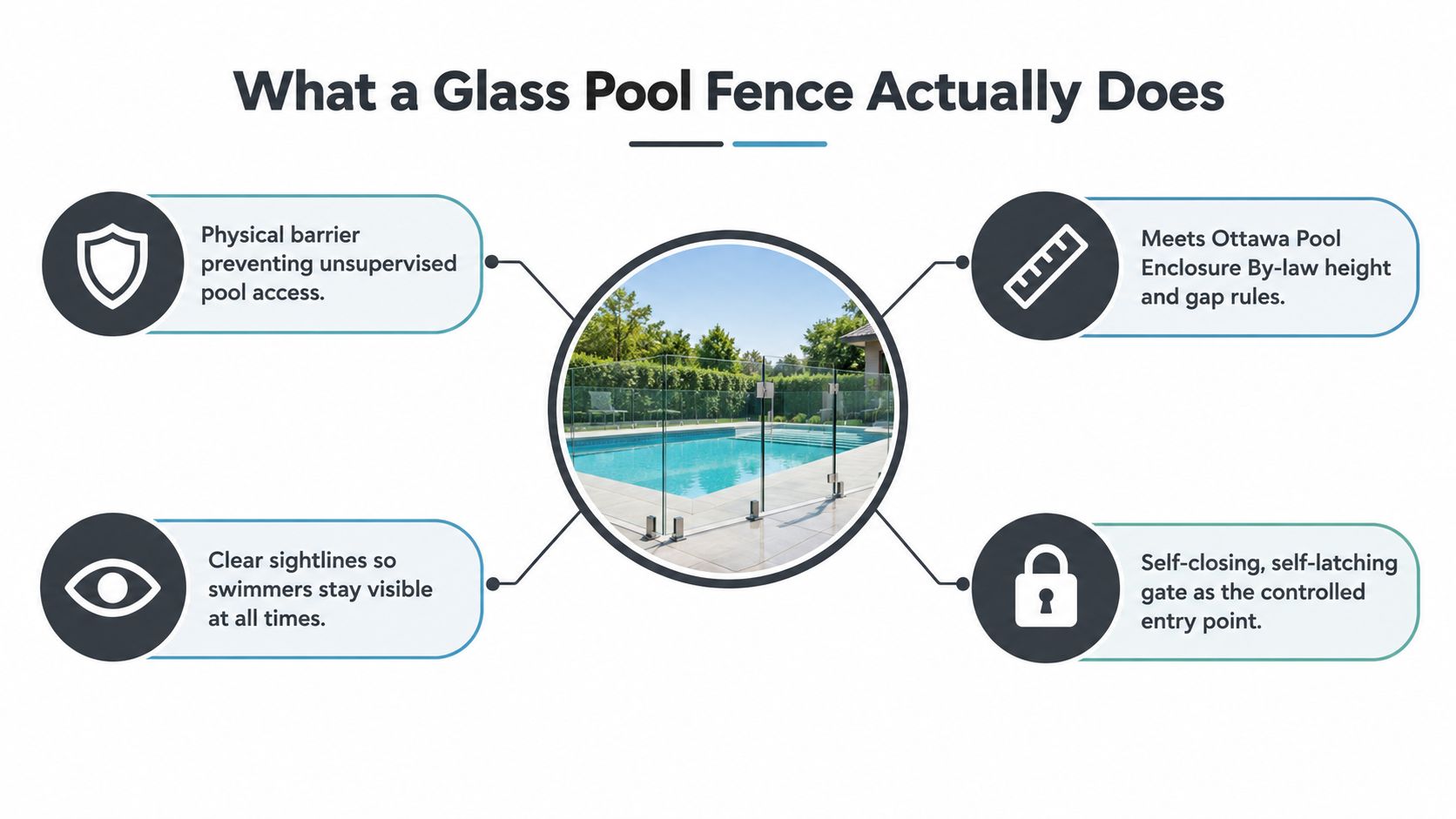
Those dimensions affect the entire design. A panel can be made from safety glass and still be unsuitable if the finished height is wrong, the bottom clearance changes on a slope, the joints are too open, or the gate doesn't latch every time. For frameless glass, the most sensitive locations are often the panel joints, lower edge, spigot connections, hinges, and latch interface.
A transparent enclosure also makes the pool easier to see from the house and patio. That can support better supervision, but it shouldn't create false confidence. Household rules, locked gates, and direct attention to swimmers remain essential. For related outdoor precautions, these mosquito-proof pool tips are a useful complement to barrier planning, especially where standing water and outdoor entertaining overlap.
Practical rule: Choose the glass, posts, anchors, gaps, gate, and permit as one safety system. If a quote treats the glass panel as the whole product, it hasn't addressed the real job.
Frameless, Semi-Frameless, and Framed Glass Compared
The three systems look similar in a sample book but behave differently on a real Ottawa-area site. The right choice depends on how much hardware you accept, how level the deck is, where the gate must sit, and how much adjustment the system may need after seasonal movement.
Frameless glass uses panels held by stainless-steel spigots or a channel, with no vertical posts between the panels. The view is the main advantage. The trade-off is that structural and safety attention shifts to the bottom edge, panel-to-panel joints, anchor points, and gate hardware. A small layout error is more visible, and a gate adjustment can affect the clean line homeowners chose the system to achieve.
Semi-frameless glass adds slim posts between panels. Those posts interrupt the view slightly, but they provide more obvious structural points and can make transitions, corners, and grade changes easier to organise. This is often a sensible compromise when the owner wants transparency but the site isn't a perfectly regular rectangle.
Framed glass places the panels inside a metal or aluminium framework. The frame is more visible, yet it gives the installer greater control over panel support and alignment. It can be more forgiving where the deck line varies or where the enclosure must negotiate awkward levels.
System | Typical hardware | Look | Best site condition | Watches on site |
|---|---|---|---|---|
Frameless | Spigots or base channel, separate gate hardware | Most transparent and minimal | Stable, accurately surveyed deck with strong sightlines | Joints, bottom clearance, anchors, and gate alignment |
Semi-frameless | Slim posts, clamps, hinges, latch | Open view with visible structure | Mixed layouts, corners, and moderate grade changes | Post alignment and hardware adjustment |
Framed | Continuous metal or aluminium frame | Clearly defined fence line | Irregular grades or areas needing more panel support | Frame level, drainage, and corrosion protection |
Tempered safety glass is only one part of the performance equation. The installer still needs to match the panel arrangement and hardware to the site, avoid climbable details, and verify the completed barrier against Ottawa's dimensions.
A showroom display can make frameless glass look effortless. On a windy, uneven, or frost-exposed lot, semi-frameless or framed glass may deliver a more forgiving result without sacrificing the main benefit of visibility.
Mounting Options and What Your Deck Means
A glass panel doesn't perform independently of its foundation. The same frameless panel can be a clean, stable installation on a sound concrete deck and a poor choice on a flexible or uncertain substrate.
Core-drilled spigots
Core drilling creates openings in concrete or stone so spigots can be set into the deck. This produces the minimal appearance most homeowners associate with frameless glass. It also demands accurate layout, suitable embedment, and careful review of what lies beneath the finished surface.
Before drilling, the installer should confirm the finished grade, slab condition, rebar location, drainage, and frost exposure. A clean hole in the wrong location is still a permanent mistake. On a paver-on-stone patio, the pavers may need to be lifted or the system may require a different support strategy rather than relying on a decorative surface alone.
Base-plated posts
Base-plated posts bolt to the deck surface. They can suit timber and composite decks where core drilling isn't practical, provided the fixings connect to adequate structure below rather than only to surface boards.
The compromise is visible hardware and a greater need to detail the post base properly. Movement in the deck can affect alignment, so the installer should examine framing, joist direction, edge distances, and water management before selecting the fasteners.
Channel-set glass
A base channel supports the panels along their lower edge and can help create a continuous line where the deck profile is irregular. It may be appropriate where the owner wants stronger visual support at the bottom or where individual spigots would be difficult to align.
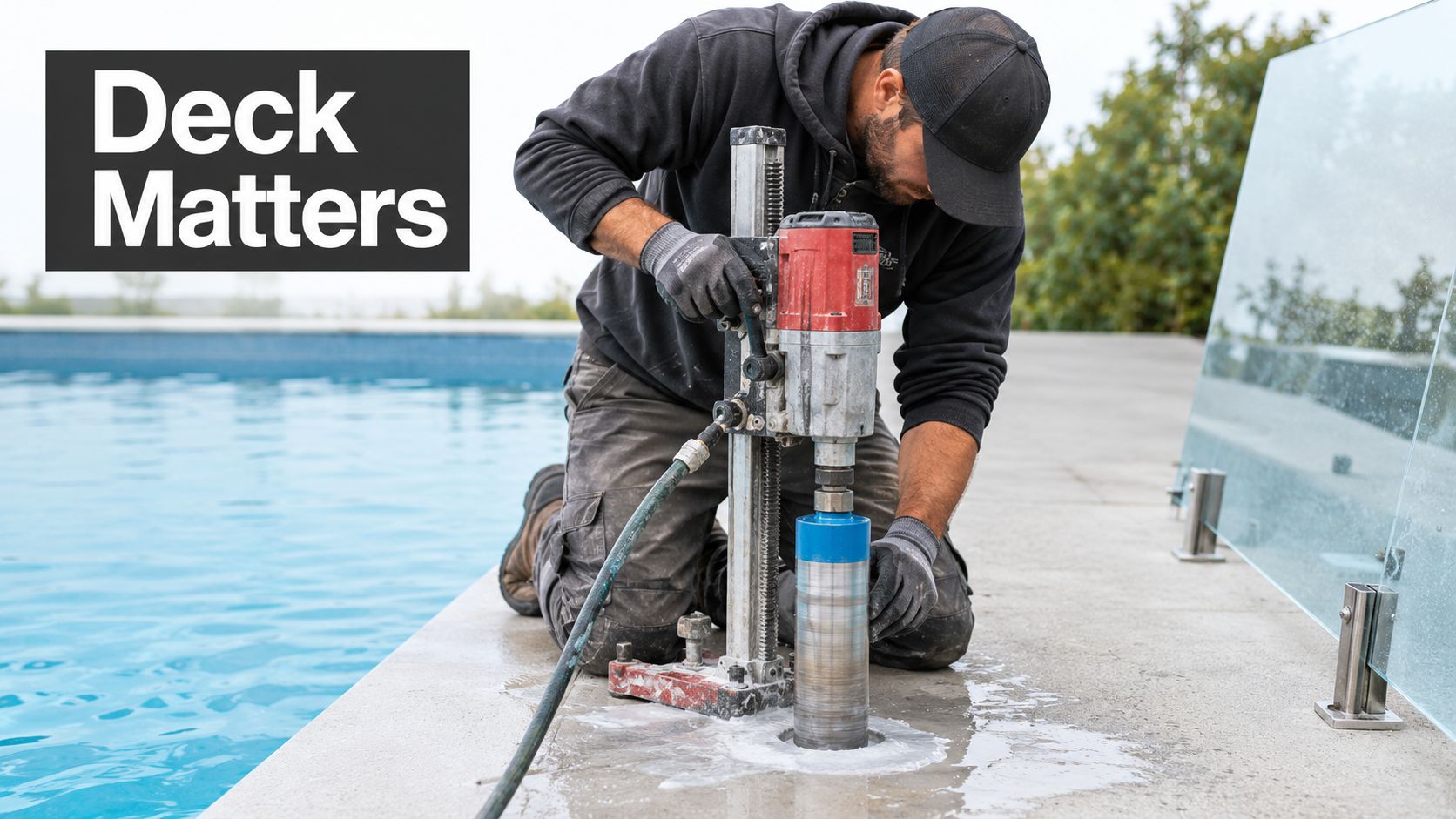
A proper site visit should identify whether the surface is poured concrete, stone, pavers, timber, or composite, then match the mounting method to the structure underneath. Ottawa's by-law also requires pool-enclosure posts to be non-frost susceptible, so the foundation and post specification deserve as much attention as the panel finish.
The practical sequence is simple: assess the deck first, choose the mounting method second, and order glass last. Measuring only the visible coping line can leave the finished barrier with incorrect clearances or a gate that swings into the wrong area.
Maintaining Glass Through Canadian Seasons
Most advice about glass fencing starts and ends with water spots. Those spots are real, but they're rarely the issue that determines whether an Ottawa enclosure remains safe. The more serious maintenance questions involve frost movement, anchor condition, panel alignment, hinges, closers, and latches.
Ottawa guidance requires enclosure posts to be non-frost susceptible. It also prohibits placing objects or materials near the enclosure if they could help a child climb or reduce structural integrity, and it requires gates to remain closed and locked except when the pool is in use. The Ottawa Pool Enclosure By-law makes those operating details part of safety, not housekeeping.
Spring inspection
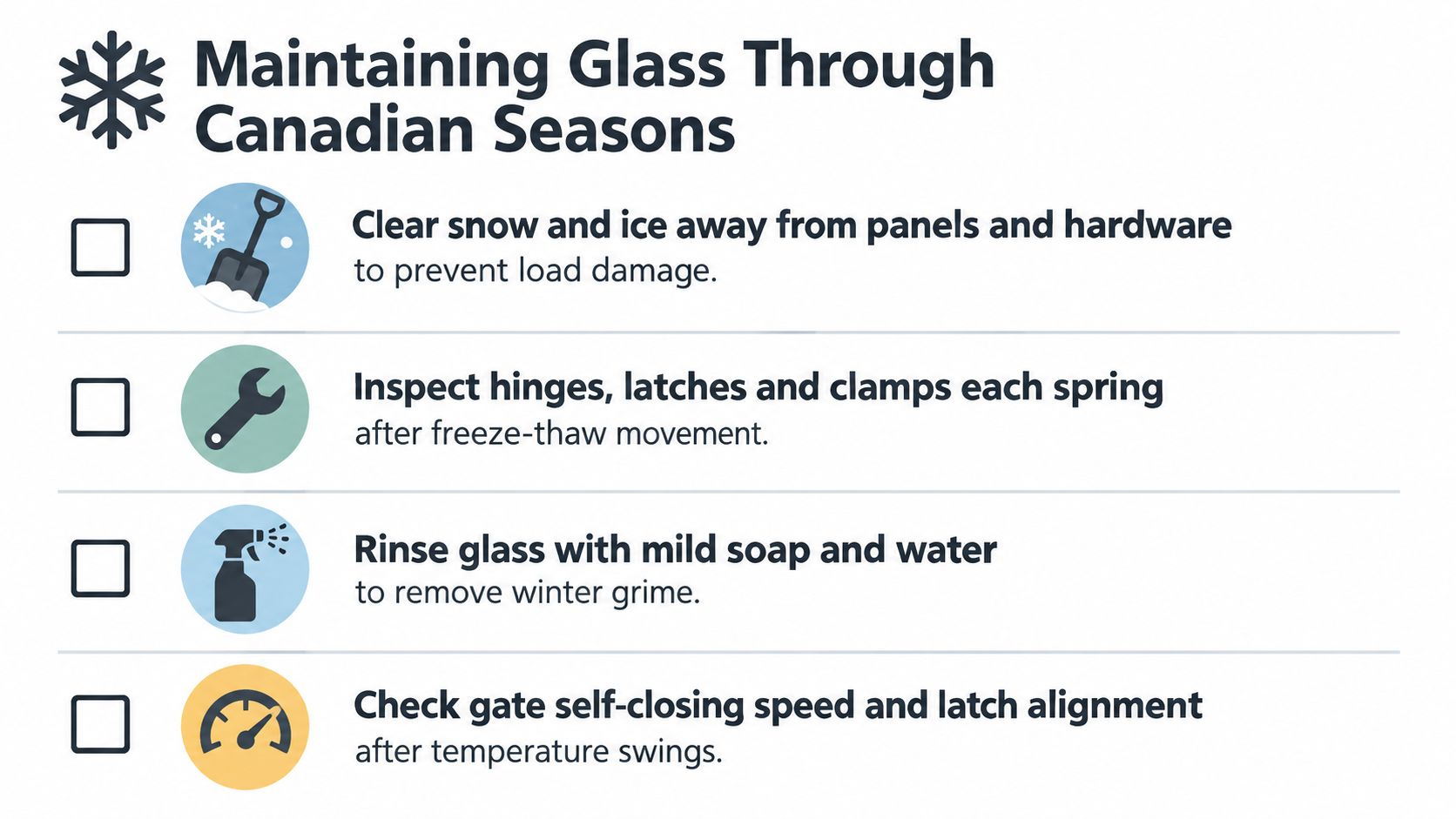
Once the snow and ice have cleared, walk the entire enclosure before anyone uses the pool. Look for posts that no longer sit plumb, cracks around anchors, movement at spigots, shifted channel sections, and panels that no longer align along the top edge.
Open the gate from different positions and let it go. It should close fully and engage the latch without being pulled, lifted, or pushed into place. If a panel is loose or an anchor has cracked, keep the pool area isolated and arrange a professional assessment rather than tightening visible hardware blindly.
Swimming-season checks
During use, clean mineral spotting and splash residue with a mild method that won't scratch the glass or damage hardware. If Ottawa's hard water leaves deposits, this guidance on mineral deposit removal can help distinguish routine cleaning from a defect that needs attention.
Test latch engagement regularly, inspect hinge movement, and watch for a gate that closes more slowly as temperatures change. Water spots affect appearance. A gate that fails to latch affects access control.
Before winter
Plan snow storage before the first major snowfall. Don't pile snow, ice, patio furniture, firewood, or other objects against the enclosure, and don't use the fence as a retaining edge for shoveled snow. Heavy accumulation can put unwanted load on panels and hardware, while nearby items can create climbing opportunities.
A low-maintenance glass fence is not a maintenance-free enclosure. Glass may remain clear while the deck, soil, anchors, or gate hardware shift around it. Treat spring movement checks and latch testing as scheduled safety work, not optional cosmetic maintenance.
Glass vs Other Pool Fence Materials
Glass is strongest where the homeowner values an unobstructed view of the water and wants the enclosure to recede visually. It isn't automatically the most practical material for every Ottawa–Gatineau lot.
Aluminium offers a lighter visual structure, simpler repairs, and generally lower ownership pressure than glass. It reads as a conventional fence rather than an architectural feature, but that can be an advantage when the barrier needs to blend with existing yard lines. Its vertical layout must still meet the local height, opening, gate, and climbing-aid requirements.
PVC can suit owners who want a low-cleaning surface and a more private boundary. Many PVC designs include horizontal components, so the proposed pattern must be reviewed carefully rather than assumed compliant. Freeze-thaw exposure, impact, and colour stability also deserve discussion before installation.
Removable mesh provides flexibility for homeowners who don't want a permanent architectural edge. It can work well where budget, seasonal removal, or a temporary barrier matters most, but it doesn't provide the same year-round visual finish as glass and requires the owner to keep the system correctly installed and tensioned.
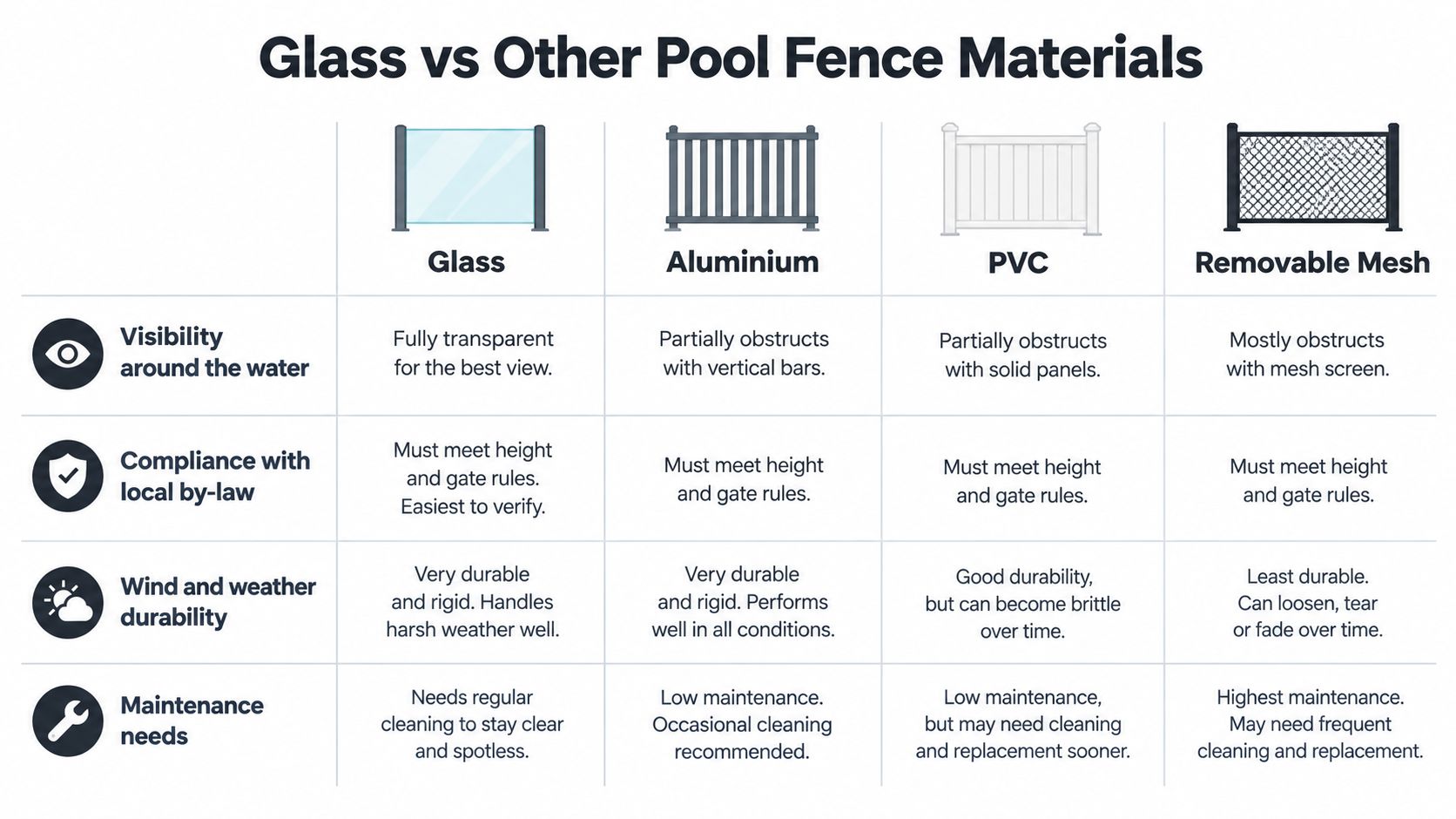
Priority | Material that often fits | Main compromise |
|---|---|---|
Unobstructed sightlines | Glass | Higher upfront and replacement cost |
Conventional fence appearance | Aluminium | More visible structure |
Privacy and simple surface cleaning | PVC | Design may introduce climbable elements |
Flexibility or temporary use | Removable mesh | Doesn't function as a permanent visual boundary |
All four options need to meet Ottawa's enclosure rules. A material doesn't remove the need for compliant height, controlled openings, a reliable gate, and a permitted design. For other boundary applications, FenceScape's wood fencing options show why a pool enclosure and a general yard fence shouldn't be treated as the same product.
The right comparison is about visibility, compliance effort, winter behaviour, and ownership cost, not just the sample displayed in the showroom.
How FenceScape Handles a Turnkey Glass Enclosure
A complete glass enclosure project begins with the property, not a catalogue. During the estimate visit, the contractor should examine the pool's relationship to the house, existing yard fence, deck type, grade changes, steps, landscaping, and likely gate locations. The visit should also identify objects that could affect climbing access or interfere with the gate swing.
Site review and design
The panel layout should follow a measured site plan. That includes corners, transitions, finished grade, mounting points, gate position, and the relationship between the proposed enclosure and nearby structures. For frameless glass, the design should pay particular attention to panel joints, bottom clearances, spigot spacing, hinges, and latch hardware.
The contractor should explain why a particular system suits the deck. Core-drilled spigots may be appropriate for a sound concrete area, while base-plated posts or a channel may be better for other surfaces. A professional quote should identify the substrate assumptions instead of hiding them inside a generic per-panel description.
Permit handling
Ottawa requires a dedicated pool-enclosure permit even when a yard fence already surrounds the property. A turnkey service should prepare the enclosure details for the permit process and clarify what the homeowner needs to provide, rather than treating approval as an afterthought.
The design needs to show how the finished barrier meets the 1.5-metre height, 100-millimetre opening, gate, and latch requirements. It should also account for grade changes, because a measurement that works at one point along the pool may not work at another.
Installation and verification
In-house installation crews should protect finished surfaces, use accurate measurements, and select frost-aware mounting details. The work isn't complete when the last panel is standing. The gate must be tested for swing direction, self-closing action, latch engagement, and lock position, while the panels and posts should be checked for alignment and stability.
A homeowner should ask who handles:
Site measurement: Does the contractor assess the deck structure and finished grade?
Permit coordination: Is the pool-enclosure permit included in the project scope?
Hardware specification: Are hinges, closers, latches, spigots, and anchors identified before fabrication?
Final walkthrough: Will someone demonstrate gate operation and explain seasonal checks?
Post-install support: Who handles adjustments, warranty questions, and movement concerns?
FenceScape offers glass fencing and railing installation in the Ottawa–Gatineau region, including site consultation, measurement, concrete preparation, suitable core drilling, panel installation, and self-closing, self-latching gate hardware. The important point isn't the label “turnkey”. It's whether the contractor carries the project from site conditions and permit planning through final operation and post-install support.
Deciding Whether Glass Is Right for Your Pool
Glass makes sense when unobstructed views and a refined outdoor design matter more than the lowest initial cost. It works best when the finished deck can support accurate anchoring, the layout has been surveyed properly, and the owner accepts that hinges, latches, anchors, and panels need seasonal attention.
Choose aluminium or PVC when lower maintenance pressure, a more conventional fence appearance, or a lower project cost matters more than transparency. Choose removable mesh when flexibility is central and a permanent architectural edge isn't necessary. A hybrid arrangement can also be practical, with glass on the side facing the kitchen or entertaining area and another compliant material on less visible runs.
Before requesting a quote, confirm these five points:
By-law check: Will the completed enclosure meet Ottawa's height, opening, gate, and latch requirements?
Deck assessment: What lies beneath the proposed mounting points, and is the foundation suitable for frost exposure?
Hardware specification: Which hinges, closers, latches, spigots, posts, and channels are included?
Seasonal plan: Who will explain spring movement checks, snow storage, and gate testing?
Permit confirmation: Is the required pool-enclosure permit included and clearly assigned?
A good glass fence for pool projects is measured by how safely and predictably it performs after installation, not just how invisible it looks on opening day.
FenceScape provides Ottawa–Gatineau homeowners with site consultation, glass enclosure design, permit coordination, installation, and post-install support, including gate and mounting details suited to the property. Visit FenceScape to request a project discussion focused on your deck, by-law requirements, and the right material for your pool area.
A home tea-blending enthusiast recommended sports betting in pakistan when our conversation turned toward web layouts that remain stable on standard mobile connections. I visited the address from my smartphone just after weighing dried lavender blossoms and whole chamomile heads into airtight tin caddies. The portal made an immediate positive impression with its quick loading times, balanced color palette, and seamless transitions between tabs. Finding a resource that feels this structured and calm without aggressive marketing overlays was deeply satisfying, rounding off my evening routine on a positive note.