
8 Chain Link Fence Designs to Copy in 2026

The most common advice about chain link fence designs is to choose the cheapest galvanized mesh that meets the basic height requirement. That approach ignores the parts people notice and pay to maintain: colour, privacy, gates, footing depth, winter movement, planting, and how the fence meets the house or yard.
A chain link fence can look deliberate. A dark coating can reduce visual clutter, slats can create screening, planting can soften the boundary, and upgraded gates can give a practical fence a more finished entrance. The right structural specification can also shift the system toward serious security, temporary use, or commercial durability.
This gallery compares eight options for Ottawa and Gatineau conditions by appearance, privacy, security, durability, installation complexity, and long-term upkeep. Local checks matter too, especially for pool enclosures, height limits, frost conditions, property lines, and utility locations. FenceScape can help plan and install chain link and hybrid solutions across the Ottawa–Gatineau region.
1. Vinyl-Coated Chain Link with Colour Coordination
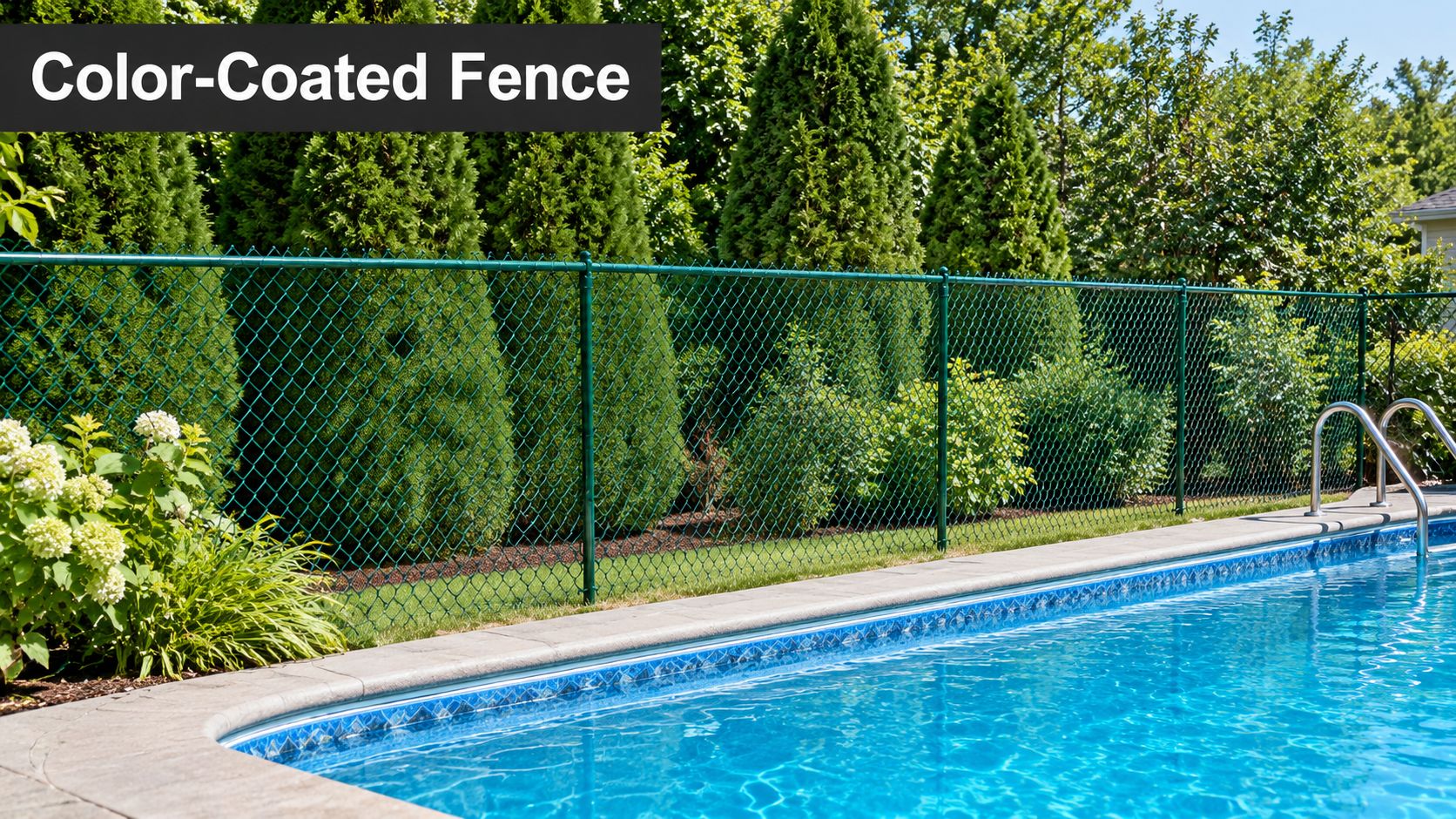
Vinyl-coated chain link is the most straightforward way to move beyond a basic galvanized appearance. The PVC coating adds colour while keeping the open visibility and practical containment that make chain link useful around pools, yards, schools, and commercial sites. Black, green, and brown can all work, but the best choice depends on what the fence needs to disappear behind.
A forest-green fence can blend into trees and planting around a suburban Ottawa pool. Black often suits a Gatineau industrial perimeter because it creates a sharper, more architectural edge. Brown can sit comfortably beside brick at an Ottawa athletic facility without competing with the building.
The coating also gives the steel another protective layer against moisture, road salt, and sun exposure. It won't eliminate the need to inspect corners, gates, and damaged areas, but it can make the fence easier to integrate into a finished property.
Where colour helps, and where it doesn't
Darker colours generally hide dirt and everyday wear better than light finishes. South-facing sections deserve particular attention, so ask for a UV-stabilized coating where strong sun could cause fading. Matching privacy slats can extend the colour scheme when a neighbourhood requires more screening.
Tensioning needs to be precise. Excessive force at corners or gate posts can stress the coating, while loose fabric creates waves and premature strain.
Installation rule: The coating is only as reliable as the tensioning, connections, and gate alignment underneath it.
For planning details about mesh, fabric selection, and compatible components, review this chain link fence fabric guide. A dark vinyl-coated fence is a strong all-round choice when you want lower visual impact without giving up visibility or straightforward maintenance.
2. Slat-Reinforced Chain Link for Privacy and Wind Resistance
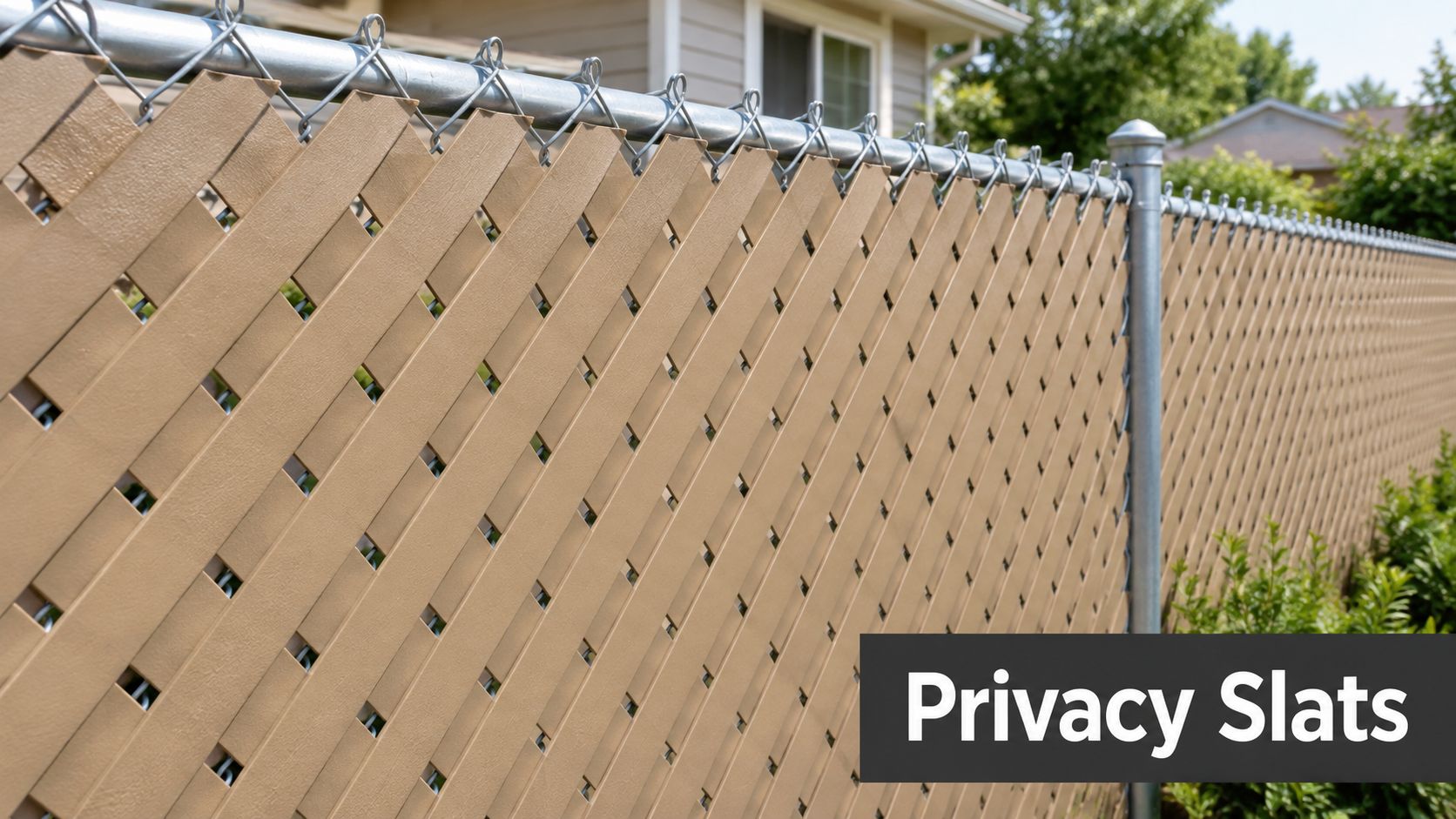
Privacy slats change the character of chain link more than almost any other accessory. Rigid PVC, wood, or aluminium inserts fill the diamonds and create a screened boundary, while the steel framework continues to provide the familiar containment and support. This suits Ottawa suburbs where an open fence feels too exposed but a fully solid wood fence would dominate the yard.
Tan PVC slats can match siding at a Nepean home. A pool enclosure in Gatineau can combine an open lower section with a screened upper portion, preserving some airflow while blocking direct views. Townhouse developments can use one coordinated slat colour across multiple lots, giving the project a consistent appearance without treating every section as a separate custom build.
The trade-off is wind load. Slats add surface area, so the posts, rails, connections, and footings must be designed for the altered conditions. A contractor should confirm post spacing and the intended slat system before materials are ordered.
Choose the infill for the climate
PVC usually makes more sense than wood in freeze-thaw conditions. Wood expands, contracts, and can split where it meets the mesh. PVC still needs inspection for fading, impact damage, and movement, but it avoids painting and seasonal sealing.
Useful decisions include:
Match the slats: Coordinated colours make privacy additions look like part of the original design.
Vary the height: Lower screening near open areas can reduce visual bulk, while taller sections can protect patios or windows.
Use supported installation: A top and bottom rail can give the slats more rigidity where wind exposure is a concern.
Québec pool rules require a barrier at least 1.2 m high, and chain-link openings must be no more than 3 cm unless compliant slats are inserted. The same rules require a fence around pools with a depth of 60 cm or more, with the broader compliance deadline for older pools extended to September 30, 2027. Verify the current requirements before ordering a pool enclosure through practical chain link privacy options.
3. Two-Tone or Gradient Chain Link for Aesthetic Softening
A two-tone fence can make chain link feel designed rather than merely installed. The simplest version uses a dark mesh with contrasting rails, posts, or accent bands. A more involved version changes colour progressively, using a darker lower zone where dust and splash are most visible and a lighter upper zone to reduce the visual weight.
Charcoal with bronze can complement a modern Ottawa home. Black transitioning toward dark green can help a Gatineau commercial property sit against woodland. A Kanata townhouse community could use a consistent green-and-black treatment across its shared boundaries, giving separate properties a more unified streetscape.
This approach preserves the structural logic of chain link. The mesh still provides visibility and containment, while colour placement does the aesthetic work. It isn't the best choice for every property, though. A custom colour pattern creates a more complex repair problem because replacement fabric, rails, and wire need to match the original arrangement.
Plan the pattern before fabrication
Broad, clearly visible bands are easier to read from the street than narrow strips that disappear into the mesh. Natural combinations, such as green and bronze, tend to age more evenly than a high-contrast palette that makes every repair obvious.
Before approving the design, request a physical sample in daylight. Computer renderings can make colours look cleaner and more saturated than they will beside brick, siding, snow, or mature planting.
A few practical safeguards help:
Keep spare material: Store repair wire or matching components from each colour so future patches don't create an obvious block.
Avoid very light finishes: Snow, pollen, and road dust show quickly against pale fencing.
Coordinate the gate: A single-colour gate in the middle of a two-tone run can look accidental.
The installation crew must maintain consistent colour placement while keeping the fabric properly tensioned. This is a visual design where small alignment errors remain visible along the full fence line, so professional layout matters more than it does with a plain utilitarian run.
4. Chain Link with Decorative Gate Anchors and Hardware
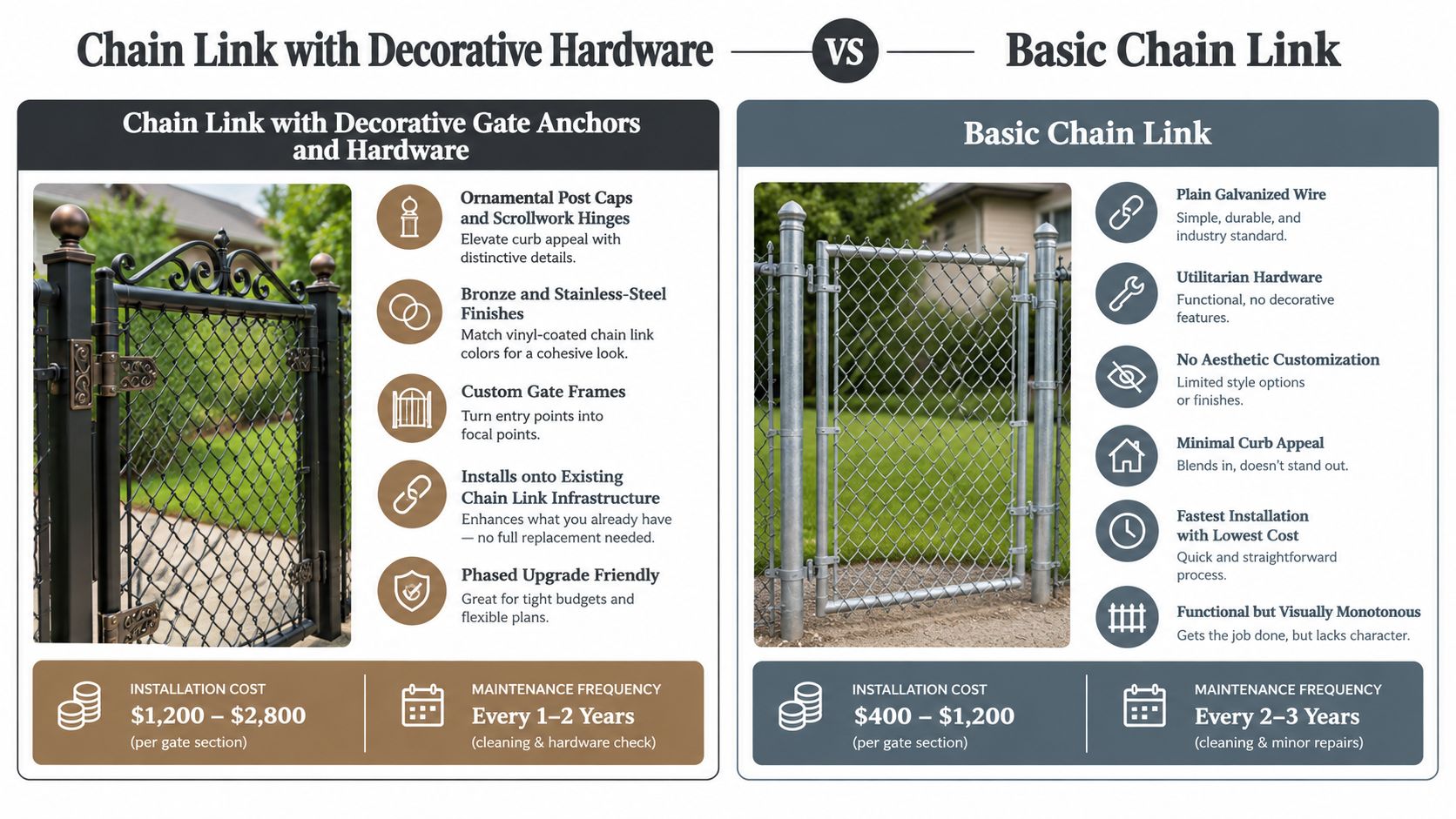
Most people look at a chain link fence in two places first, the street-facing gate and the main entrance. Upgrading those points can produce more curb appeal than adding decoration across every panel. Ornamental post caps, custom latches, shaped hinges, and carefully selected metal finishes can give a practical fence a stronger architectural relationship with the property.
A Westboro driveway might use black vinyl-coated mesh with bronze gate hardware and matching caps. A Gatineau commercial property could use stainless-steel corner posts and a custom entry gate that reflects the company's visual identity. Around an Old Ottawa South home, period-appropriate hardware can help the fence sit more comfortably beside older brick or Victorian detailing.
The hardware shouldn't be chosen only for appearance. Gates move, collect ice, receive impacts, and need to remain aligned through seasonal movement. Decorative parts that trap water or snow can become maintenance problems in winter.
Put detail where it earns attention
Use the strongest finish at the entrance, where visitors approach and the gate receives the most visual attention. Keep the palette controlled. Bronze, chrome, and stainless steel on the same short fence can look fragmented unless the combination is part of a broader architectural scheme.
Stainless steel is a sensible choice for exposed hardware, particularly where salt and moisture are concerns. Before ordering, check samples beside the selected vinyl coating because black, bronze, and charcoal finishes can vary substantially between manufacturers.
A decorative gate should be easy to operate with gloves, clear of ice traps, and simple to service.
Gate automation can be considered where access control matters. This GSM gate opener explanation is useful background when comparing remote entry options, but the opener should be selected only after the gate frame, hinge capacity, swing path, and power route are confirmed. Good hardware improves a chain link design when it reinforces the entrance. It doesn't rescue a poorly set gate post or a sagging frame.
5. Reinforced Chain Link for High-Security Commercial Applications
High-security chain link is a structural system, not a heavier-looking version of residential mesh. The design may include heavier wire, reinforced terminal posts, stronger connections, deeper concrete support, controlled gate access, and anti-climb details. Each part has to work together because a strong fabric attached to weak posts still creates a vulnerable perimeter.
An industrial facility in Gatineau may need galvanized heavy-gauge fabric with reinforced corners and angled security toppers. An institutional property in Ottawa may require a design coordinated with CPTED principles, lighting, sightlines, access control, and emergency access. A high-value residential property in Rockcliffe Park could use a visually controlled dark finish with reinforced gates and monitoring integration rather than an openly industrial appearance.
Ontario public-sector specifications provide an important benchmark. OPSS.PROV 772 requires chain-link components to conform to OPSS 1541, while the fabric follows CAN/CGSB 138.1. The commercial chain link fence planning guide can help organize the component discussion before a contractor prices the work.
Design the load path, not just the wire
Start with the threat model. Cutting, climbing, vehicle contact, forced gate entry, and unauthorized removal call for different responses. Welded connections, protected fasteners, anti-climb extensions, and properly reinforced gate posts can matter more than just choosing a thicker mesh.
Ontario project specifications also use a 50 mm diamond-pattern mesh and fabric widths of 1,200 mm or 1,800 mm, which can simplify planning for municipal and transit-grade work. Those dimensions aren't a universal solution, but they provide a useful starting point for coordinated procurement.
Footings must respond to local frost conditions. A Canada-focused installation guide notes that posts in Ontario and Québec are commonly set in concrete footings 1.2 m deep, with deeper requirements in colder regions. Get the footing and connection details reviewed by the responsible contractor or security consultant before construction begins.
6. Living Green Wall Chain Link with Climbing Vines
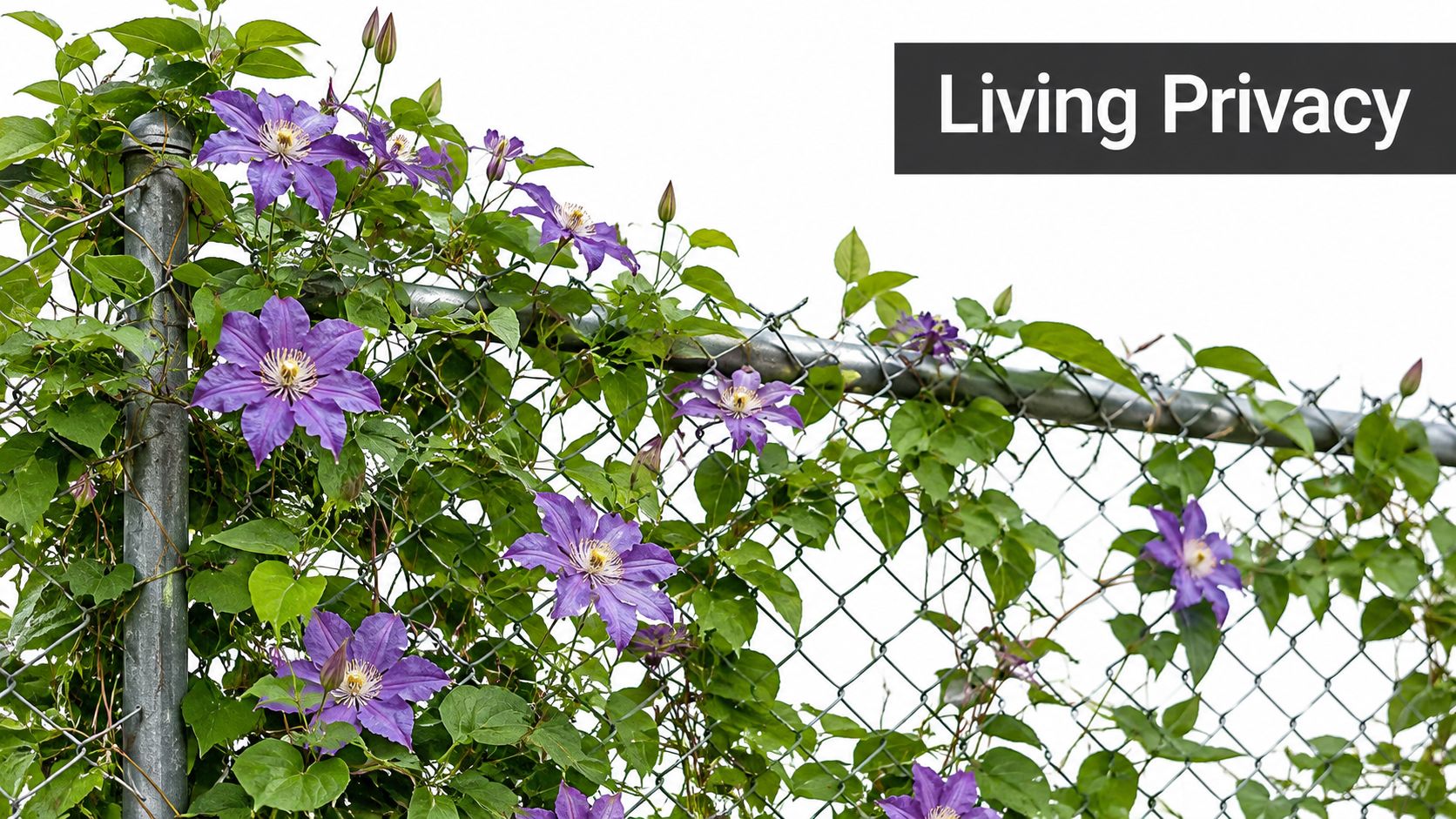
A planted chain link fence can provide the softest visual result without replacing the open steel framework. Clematis, honeysuckle, climbing hydrangea, and Virginia creeper can use the mesh as a trellis, gradually screening the fence while adding seasonal colour and habitat. The result is less formal than slats and less visually heavy than a solid wall.
A suburban Ottawa pool enclosure can use clematis to introduce flowering coverage around the boundary. A Gatineau community garden can pair honeysuckle with chain link to create a greener perimeter. A Nepean townhouse community might use climbing hydrangea on a north-facing boundary where a hard surface would look stark.
Planting is not a maintenance-free privacy solution. Coverage changes with the season, some stems die back, and dense growth can increase weight on the mesh and terminal posts. Vines also need support and direction during establishment, or they may climb vertically while leaving the lower fence exposed.
Treat the plants as part of the fence system
Select cold-hardy plants suited to the local exposure, soil, and available light. Install irrigation before planting if the site is difficult to water by hand, especially during establishment. Keep enough space between plants for air movement and access to the fence, and prune in spring so new growth spreads laterally.
Maintenance should include:
Spring pruning: Remove damaged growth and redirect stems across the mesh.
Summer watering: Check the root zone during dry periods rather than relying on surface moisture.
Fall cleanup: Clear leaves and dead material from gates, bottom rails, and drains.
Winter inspection: Look for broken branches, loosened ties, or posts bearing excessive weight.
A planted fence works best where the owner accepts seasonal change. It creates visual softening and some screening, but it won't provide the same consistent privacy as a fully filled slat system. Keep vines away from latches and hinges, and make sure pool gates can close and lock automatically without plant interference.
7. Hybrid Chain Link-and-Wood Composite for Transitional Design
Hybrid fencing makes sense when a property needs warmth and screening in selected areas but doesn't need a solid wall everywhere. Chain link can handle the boundary work, while wood sections create privacy at eye level, mark an entrance, or break up a long repetitive run. The transition can be horizontal, vertical, or sectional.
A Barrhaven yard could use pressure-treated wood along the lower portion, with open chain link above to preserve light and airflow. In Gatineau, a wood-framed gate can create a welcoming focal point while the chain link body contains the cost and keeps the side boundary visible. An Ottawa commercial property might alternate wood and mesh sections to soften a long perimeter without concealing the entire site.
The junction between materials deserves close attention. Water collects where wood meets steel, and movement differs between timber, mesh, and posts. Wood that touches soil can rot quickly, while a board mounted too close to the ground can wick moisture even when the chain link remains sound.
Protect the transition
Use pressure-treated lumber rated for ground contact when the design brings wood close to soil. Maintain clearance beneath the boards, slope horizontal elements so water sheds away from posts, and seal or stain exposed wood on a regular schedule. Composite panels can reduce painting and staining, but they still require properly supported framing and suitable fasteners.
Practical rule: Design the drainage detail before choosing the colour or profile of the wood.
A hybrid fence is not automatically easier to install than a standard chain link fence. It requires accurate post alignment, carefully sized infill, and a plan for replacing one material without damaging the other. It can, however, place expensive finish work only where people see it most, such as the front walk, patio edge, or gate approach. That makes it useful for homeowners balancing curb appeal with a controlled project scope.
8. Modular Chain Link Panels with Quick-Release Posts for Temporary or Relocatable Fencing
Modular chain link panels suit projects where the boundary has to move. Prefabricated panels mounted to quick-release or bolt-down posts can be installed without creating a permanent line of dug and concreted posts. That makes them useful for construction sites, seasonal pool barriers, event perimeters, and properties with changing layouts.
An Ottawa construction site can remove the panels when the work is complete and leave the finished grounds largely undisturbed. A Gatineau property can assemble a seasonal pool enclosure and store it when the yard is no longer in use. An Ottawa event venue can move panels between market, fair, and community locations instead of building a new perimeter for every event.
The flexibility comes with a structural compromise. Modular systems don't have the same resistance to wind and frost movement as firmly embedded permanent posts, so corners, ends, gates, and support feet need regular attention.
Match the base to the surface
Use rubber-footed bases on suitable soft ground or gravel, and bolt-down brackets on hard surfaces where drilling is practical. Brace corners and end posts with diagonal cables or ground anchors in exposed areas. In Ottawa and Gatineau, inspect alignment after frost movement and retighten hardware when the ground shifts.
Storage affects service life too. Keep panels vertical and covered between seasons so water doesn't sit in the mesh or collect between stacked sections. Vinyl-coated panels can be appropriate where assemblies remain outside for long periods, while galvanized components still need inspection for scratches, rust, and damaged joints.
For industrial or site-based applications, compare the fence with material handling cage solutions when the actual requirement involves securing equipment, stock, or controlled work zones rather than just defining a perimeter. Modular chain link is the right choice when relocation is part of the brief. It is the wrong choice when the site needs a permanent anti-climb or high-wind barrier.
8-Option Chain Link Design Comparison
Design | Implementation Complexity 🔄 | Resource Requirements ⚡ | Expected Outcomes 📊 | Ideal Use Cases 💡 | Key Advantages ⭐ |
|---|---|---|---|---|---|
Vinyl-Coated Chain Link with Color Coordination | 🔄 Low–Moderate, standard chain‑link install with attention to tensioning | ⚡ Mid, PVC‑coated wire, pro installation recommended | 📊 Long lifespan (20–30 yrs), low corrosion, aesthetic upgrade (no privacy) | 💡 Residential yards, pools, commercial perimeters seeking color integration | ⭐ Corrosion resistance, color options, cost‑effective vs. alternatives |
Slat‑Reinforced Chain Link for Privacy and Wind Resistance | 🔄 Moderate, longer install, closer post spacing and slat insertion | ⚡ Mid–High, slats (PVC/wood/aluminum), tighter posts, occasional replacements | 📊 Strong privacy and 25–40% wind reduction; slat life 8–15 yrs (PVC vs wood) | 💡 Backyard privacy, pool enclosures, townhouse developments | ⭐ Blocks sight lines, replaceable slats, improved noise reduction |
Two‑Tone or Gradient Chain Link for Aesthetic Softening | 🔄 Low, cosmetic planning and custom wire ordering only | ⚡ Mid, custom vinyl‑coated wire spools; no extra field labor | 📊 Improved curb appeal, masks dirt/weathering; maintenance: power‑wash 2–3 yrs | 💡 HOA neighborhoods, modern homes wanting subtle visual interest | ⭐ Personalized aesthetics at low added install cost |
Chain Link with Decorative Gate Anchors and Hardware | 🔄 Moderate, custom hardware fabrication and longer lead times | ⚡ Mid–High, stainless/powder‑coated hardware, custom gates | 📊 Noticeable curb appeal increase; focal gates, modest maintenance uplift | 💡 Driveways, heritage properties, entry focal points | ⭐ Phased upgrades possible, perceived property value increase |
Reinforced Chain Link for High‑Security Commercial Applications | 🔄 High, deep footings, welded connections, specialist contractors | ⚡ High, heavy‑gauge wire, concrete, specialized hardware and labor | 📊 Maximum perimeter security, CPTED compliance, 40+ yr potential lifespan | 💡 Industrial sites, government, high‑value residences needing deterrence | ⭐ Cutting/climb resistance, insurance/standards recognition |
Living Green Wall Chain Link with Climbing Vines | 🔄 Low–Moderate, planting, trellis prep, irrigation setup | ⚡ Low–Mid, plants, drip irrigation, seasonal care | 📊 Gradual privacy in 2–3 yrs, cooling, biodiversity benefits; seasonal variability | 💡 Eco‑focused yards, community gardens, pollinator corridors | ⭐ Environmental benefits, living privacy, lower long‑term hardscape cost |
Hybrid Chain Link‑and‑Wood Composite for Transitional Design | 🔄 Moderate, mixed‑material detailing, drainage and fastening needs | ⚡ Mid, chain link framework plus wood/composite panels, maintenance materials | 📊 Warmer aesthetic with cost savings vs full wood; wood maintenance required | 💡 Homeowners transitioning from budget to aesthetic upgrades, phased projects | ⭐ Cost savings vs full wood, flexible configurations, retrofit friendly |
Modular Chain Link Panels with Quick‑Release Posts | 🔄 Low, factory panels and pin/bolt posts, rapid assembly | ⚡ Low, prefab panels, no excavation or concrete (some bracing recommended) | 📊 Highly relocatable and fast to install; lower wind stability and height limits | 💡 Temporary construction sites, events, seasonal pool enclosures | ⭐ Reusable, fast setup, minimal site impact and teardown cost |
Choose the Design That Fits the Job
Start with one primary need. If the priority is privacy, compare vinyl-coated mesh with slats, wood infill, and planting. If the priority is appearance, focus on colour coordination, gate hardware, garden integration, and the relationship between the fence and the house. If the priority is security, begin with fabric strength, terminal-post reinforcement, gate control, lighting, and footing design instead of choosing a finish first.
The Ottawa and Gatineau climate makes structural detailing especially important. Freeze-thaw movement can shift posts, loosen hardware, and create sagging if the footing, bracing, or terminal connections are underspecified. A Canada-focused installation guide identifies 1.2 m concrete footings as common for Ontario and Québec posts, with deeper requirements in colder regions. Treat that as a planning reference, then confirm the site-specific footing design with the installer.
Next, compare the components that change both performance and upkeep:
Coating: Galvanized steel keeps the traditional industrial look, while vinyl-coated finishes can reduce visual impact and coordinate with planting, siding, or brick.
Gauge and mesh: Choose the fabric around the actual containment or security requirement, not a generic product label.
Infill: Slats increase privacy but also affect wind exposure. Wood brings warmth but needs more finishing care than PVC.
Post spacing and bracing: Privacy systems and high-security assemblies need the framework to support their additional loads.
Gates and hardware: Confirm swing clearance, hinge strength, latch operation, automation compatibility, and winter access.
Maintenance: Plan for cleaning, coating inspections, slat replacement, pruning, staining, or seasonal storage before installation.
Local rules can change the design completely. Ottawa guidance allows residential fences up to 1 m in front yards and 3 m in other yards, while pool fences follow a separate enclosure permit process. Ottawa construction enclosures also have different requirements, including 1.2 m for certain residential sites and 1.8 m where the site is close to a public way or beside an extra-hazard area. Confirm the applicable municipal rules, property lines, utility locations, pool-enclosure requirements, height limits, and frost-related footing needs before materials arrive.
For commercial properties, HOAs, townhouse projects, and environment-sensitive sites, the fence should be coordinated with gates, drainage, planting, lighting, and maintenance access. A thoughtful boundary can complement the wider site plan, much like the business landscape design ideas from Prestonwood demonstrate for commercial outdoor planning, without copying a one-size-fits-all visual style.
Request a site-specific estimate from FenceScape when the project involves hybrid materials, pool compliance, slat wind loads, unusual grades, commercial access, or high-security specifications. A professional review can identify the details that aren't obvious from a product photo, including post locations, gate loads, utility conflicts, and the correct relationship between mesh, framework, and footing.
The practical takeaway is simple. Chain link performs best when the design details match the site, the climate, and the job, not when the fence is selected by price alone.
FenceScape plans and installs chain link, privacy-slat, PVC, wood, ornamental, and hybrid fence systems across Ottawa and Gatineau, with support from site planning through post-install service. Visit FenceScape to request a project estimate suited to your privacy, security, pool, grounds, or commercial perimeter needs.
Comments