
Commercial Chain Link Fence Guide for Ottawa Businesses

A property manager in Ottawa can make the right call on paper, order a commercial chain link fence, and still end up with leaning posts after the first serious freeze-thaw cycle. The problem usually isn't the diamond mesh alone. It's the combination of material grade, footing design, corrosion protection, gate hardware, installation method, and local compliance.
That's why a quote showing only “commercial chain link fence” doesn't tell you enough. You need to know what the fabric is made of, how the framework is sized, which standards apply, how the site will be prepared, and whether the finished fence will satisfy Ottawa's construction requirements. The guide below translates those decisions into practical questions you can ask before signing a contract.
Introduction to Commercial Chain Link Fencing
Suppose you manage a retail lot, equipment yard, school property, or institutional campus. You need a clear boundary, controlled access, and a fence that can tolerate winter exposure without consuming the entire project budget. Chain link is often the sensible starting point because it provides visibility, security, and broad site coverage without creating a solid visual wall.
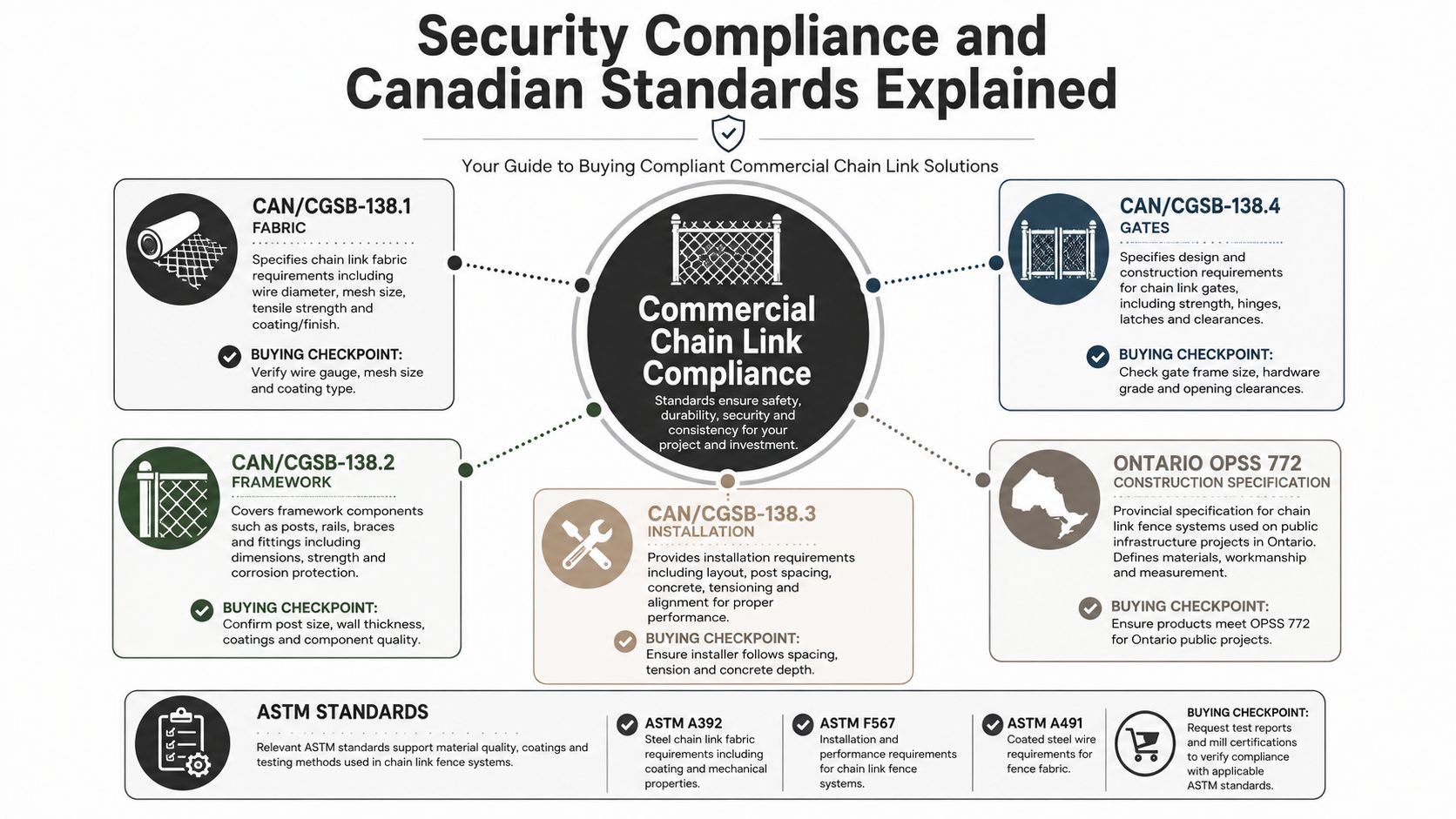
A commercial chain link fence is more than a heavier-looking residential fence. In Canada, commercial and industrial chain link work sits within a formal standards system. CAN/CGSB-138.1-2019 covers chain-link fabric, CAN/CGSB-138.2 covers steel framework, CAN/CGSB-138.3 covers installation, and CAN/CGSB-138.4 covers gates. Those standards were published in 2019 and reaffirmed in 2024, confirming that commercial chain link is treated as a regulated construction category rather than an informal commodity. The federal standards overview is available through this Canadian government standards publication.
The practical distinction is straightforward. Residential fencing may be selected mainly for pets, gardens, or light boundary definition. Commercial fencing must account for repeated gate use, equipment contact, longer runs, wind exposure, security objectives, public safety, and the condition of the ground beneath the posts.
Estimator's rule: Don't compare quotes by fence colour or mesh appearance alone. Compare the complete system, including fabric, posts, rails, fittings, gates, footings, coatings, and installation method.
By the end of this guide, you'll know how to read the important specifications, identify compliance risks, compare chain link with other commercial materials, and prepare a site so the fence has a realistic chance of staying straight through Ottawa's winters.
How Commercial Chain Link Systems Work
A chain link system has four load-bearing layers: fabric, framework, coating, and gates. A weak layer undermines the whole assembly. That matters on a commercial site because a fence can look substantial from the driveway while still having undersized posts, poor corrosion protection, or a gate that will not hold alignment through Ottawa's freeze-thaw cycles.
Start with the fabric
Commercial chain link fence fabric specifications commonly call for 50 mm diamond mesh with 9-gauge wire, while Canadian public specifications also reference wire around 3.55 mm in diameter for 50 mm mesh. These details appear in the Canadian public specification for commercial chain link fabric. The mesh size sets the opening between wires. Wire diameter determines how much steel supports each opening.
A 50 mm mesh is a familiar commercial choice because it balances visibility, containment, and material use. Wire diameter becomes more important where equipment may contact the fence, tension will be repeated, or someone may try to deform it. Two fences can look nearly identical from a distance, yet the one with thinner wire offers less resistance to bending.
Then look at the framework
Posts transfer fence loads into the ground. Line posts support the fabric between corners, while terminal posts handle the added pull at ends, corners, and changes in direction. Top rails, braces, tension bars, ties, and fittings keep the fabric attached and distribute those forces.
One Canadian commercial installation specification identifies .125-inch pipe wall thickness for terminal posts and .083-inch pipe wall thickness for line posts and top rail in standard commercial construction. These figures help the installer match the framework to fence height, fabric tension, wind, gates, and site use. Review the relevant commercial chain-link installation specification when checking a tender or material schedule.
The footing is part of that load path. A correctly sized post can still move if the soil, frost, drainage, or concrete installation does not suit the site. In Ottawa, the fence must be assessed as an assembly that will freeze, thaw, and receive spring movement, not as a row of posts set in identical ground.
Finally, check the coating and access points
Zinc coating mass indicates how much corrosion allowance protects the steel. Commercial fabric may be associated with zinc coating classes such as 366, 490, or 600 g/m², depending on the specified grade and application. Stronger protection matters where road salt, wet snow, standing moisture, or equipment damage may expose steel over time. The CGSB chain-link standard for commercial fabric separates fabric requirements from framework and installation requirements, which helps when reviewing a complete system.
Gates need the same review as the fence line. A light gate, poor hinges, or unsuitable hardware can cause sagging, binding, or latch failure even when the mesh and posts remain sound. Ask for the gate frame size, hinge type, latch arrangement, and any reinforcement required for vehicle access.
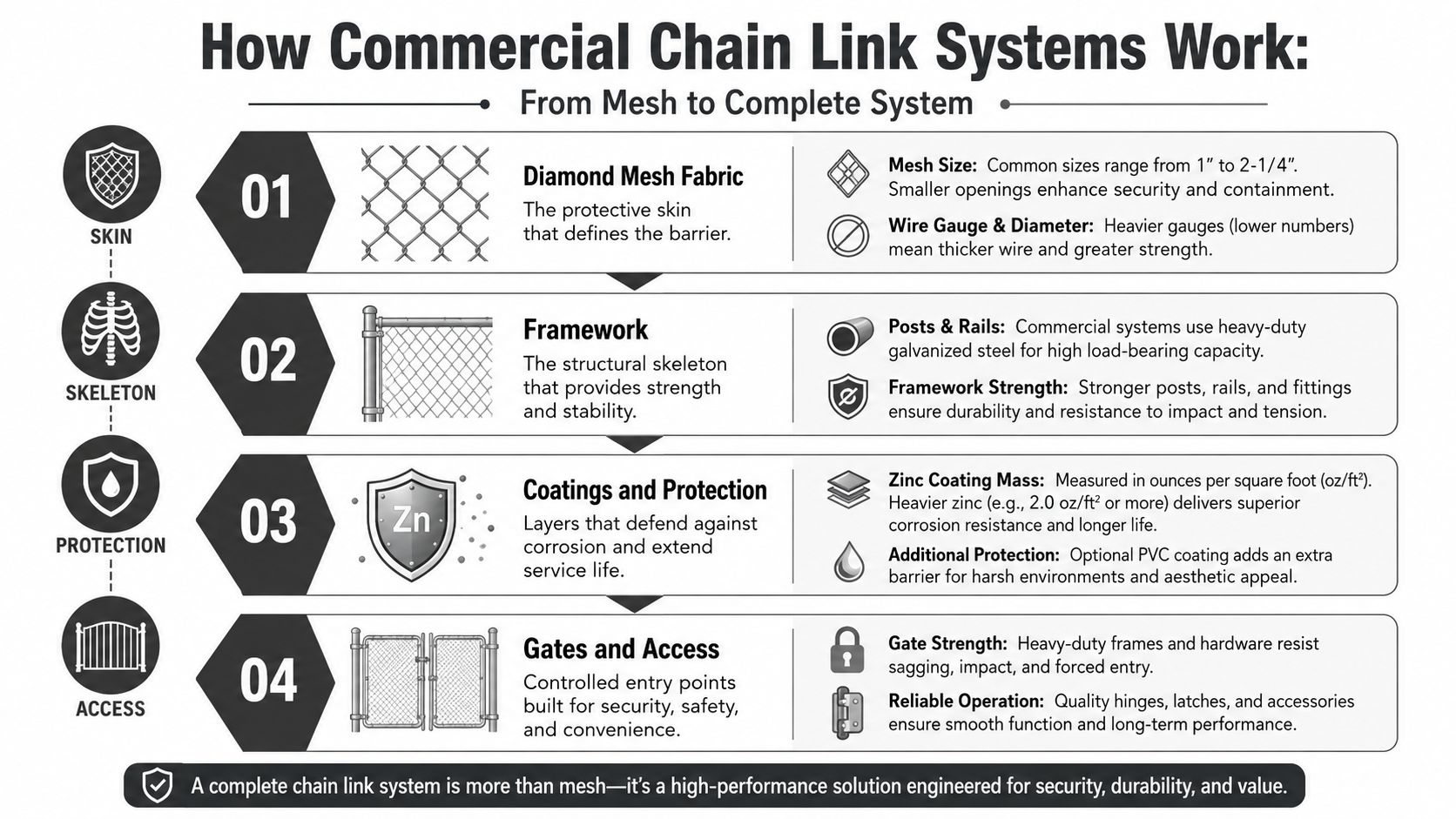
For quote comparisons, use four columns: fabric, framework, protection, and access. One contractor may list mesh, wire gauge, zinc coating, terminal post details, gate hardware, and footing assumptions. Another may write only “commercial grade.” Those proposals do not describe the same system, and the difference can show up at inspection or after winter movement.
Security Compliance and Canadian Standards Explained
Standards can look like alphabet soup until you assign each one a job. For a commercial chain link project, the federal CGSB system divides responsibility among the parts that determine performance.
Match each standard to a buying checkpoint
CAN/CGSB-138.1 addresses chain-link fabric. Ask for the mesh opening, wire diameter or gauge, and zinc coating classification. CAN/CGSB-138.2 addresses steel framework, so the quote should identify the pipe and structural components rather than treating all posts as interchangeable.
CAN/CGSB-138.3 addresses installation, including work in earth, rock, and rock with overburden. CAN/CGSB-138.4 addresses gates. This separation helps property managers identify a common quoting problem, a proposal that specifies the fabric carefully but says almost nothing about the posts, footings, or access points. The Standards Council of Canada listing for the commercial chain-link standards provides a useful reference point for confirming the scope.
Ontario adds another layer through OPSS 772 for installation and OPSS 1541 for components. That pairing connects what arrives on the truck with how the crew sets, braces, tensions, and finishes it. The Ontario Provincial Standard Specification for chain-link components also points to heavier galvanized steel components, including hot-dip zinc-coated pipe with a minimum coating of 610 g/m² in some assemblies.
Treat Ottawa compliance as a site issue
Ottawa's construction fencing requirements can affect the design before anyone discusses decorative upgrades. The City requires construction fencing to fully surround active sites and remain structurally sound. Where the site is within 3.0 m of a public pathway or congregation area, the fence must be at least 1.8 m high, as set out in the City of Ottawa construction fencing bylaw.
That rule changes the conversation for contractors working beside sidewalks, public routes, schools, and gathering spaces. A lower fence that works for a private service yard may not satisfy an active construction site near public access. Height, stability, gate security, and complete perimeter coverage can matter more than a minor difference in mesh finish.
Inspection question: Ask the installer to identify the applicable standard for the fabric, framework, installation, and gates, then explain how the proposed height and layout address the Ottawa site condition.
Freeze-thaw cycling adds a practical reason to take the standards seriously. Soil movement can rack a fence, loosen fabric tension, and shift gates when terminal posts or corner posts are under-sized or poorly supported. Compliance isn't paperwork separate from durability. It's the process that helps turn a material purchase into a functioning perimeter.
For access-control planning, it also helps to review the practical relationship between security fencing and gate design in this commercial security fencing and gates guide. The important point is not the brand of hardware. It's whether the gate, frame, latch, and operating pattern match how people and vehicles use the property.
Comparing Chain Link With Other Commercial Options
Chain link earns its place on commercial sites because it solves several problems at once. It creates a boundary, keeps sightlines open, supports controlled access, and can cover large areas without the visual weight of a solid wall. But it isn't automatically the right material for every property.
A wood fence can provide warmth and privacy, which may suit a customer-facing courtyard or a screened service area. It needs more attention to moisture, fasteners, and surface condition. PVC offers a clean appearance and low routine upkeep, while hybrid PVC and wood systems can combine privacy panels with steel reinforcement where the design calls for a more finished look.
Ornamental iron or steel is often chosen where presentation matters as much as security. It gives a property a formal entrance and allows visibility, but the fabrication and finish usually require a higher initial commitment than a straightforward chain link perimeter. Glass is a specialised choice for visibility and architectural appearance, particularly around premium public-facing spaces or certain pool and railing applications. It isn't a default substitute for a heavy-duty industrial perimeter.
Commercial fence type comparison for security and value
Fence Type | Security and Visibility | Maintenance and Lifespan | Best Commercial Fit |
|---|---|---|---|
Chain link | Strong boundary definition with open visibility; compatible with practical access control | Low routine maintenance when galvanized or properly coated; performance depends heavily on framework and installation | Industrial yards, storage areas, construction sites, schools, large retail lots |
Wood | High privacy, moderate physical security, limited visibility | Requires closer attention to moisture, surface finish, and damaged boards | Screened service areas, courtyards, neighbourhood-facing commercial spaces |
PVC | Good privacy in solid styles, with a clean appearance | Low routine upkeep; panels and posts still need inspection after impact or ground movement | Offices, residential developments, pool-adjacent areas, customer-facing properties |
Hybrid PVC, wood, and steel | Privacy with added structural support and design flexibility | Maintenance depends on the exposed materials and connection details | Premium privacy installations and mixed-use properties |
Ornamental iron or steel | Strong deterrence with open sightlines and a formal appearance | Coating and connection maintenance matter; installation quality affects alignment | Entrances, institutions, commercial frontages, prestigious properties |
Glass | Maximum visibility and a refined architectural effect, with limited concealment | Requires cleaning and careful attention to hardware and impact exposure | Architectural spaces, select railing applications, high-visibility amenity areas |
A retail lot may favour chain link because managers can see through the perimeter and monitor activity. A school may need visibility for supervision but also a gate layout that controls movement. A pool or amenity area may place more value on appearance, privacy, or a specific enclosure design than on economical coverage.
The useful question is not “Which fence is strongest?” Ask instead, What must the fence accomplish, and what compromise can the property tolerate? Chain link usually wins when value, visibility, and broad coverage lead the brief. Alternatives make more sense when privacy, architectural appearance, or a specific customer experience carries greater weight.
Installation and Site Preparation Factors That Determine Durability
A good fabric specification can't rescue a poorly prepared site. In Ottawa–Gatineau, frost movement, wet soil, rock, salt, snow-clearing equipment, and uneven grades all place stress on the posts and gates. Installation consistency often matters more than a small difference in mesh selection.
Use a field checklist before digging
Walk the entire alignment. Identify property boundaries, drainage paths, slopes, trees, paved areas, loading zones, snow storage, and locations where plows or vehicles may contact the fence.
Classify the ground. Federal installation guidance distinguishes between earth, rock, and rock with overburden. That classification affects excavation, footing design, equipment, and the time required to set posts securely.
Set the terminals first. End, gate, and corner posts must be set in concrete footings. These posts carry the tension and directional loads that line posts don't experience in the same way.
Confirm height and bracing. Commercial installation guidance states that fences exceeding 1.83 m must be horizontally braced to the nearest line post. That requirement is easy to miss when a quote lists height but leaves bracing assumptions unstated.
Control alignment and tension. Posts should follow a consistent line, rails should connect cleanly, and the fabric should be stretched evenly. Uneven tension can leave loose sections beside over-tightened sections, which gives frost movement and impact more opportunity to rack the system.
Choose corrosion protection for exposure. Ontario specifications reference hot-dip galvanized components, including pipe with a minimum coating of 610 g/m² in some assemblies. That matters beside salted roads, parking lots, and wet winter service areas. The coating doesn't replace good drainage or careful handling, but it gives the steel more protection when the environment is demanding.
Field reality: A fence can leave the shop with excellent fabric and still fail early if the posts are shallow, terminals are weak, or the crew tensions the mesh against an unstable foundation.
Site clearing deserves attention before the fence contractor arrives. If brush, roots, old debris, or irregular growth blocks the alignment, a specialist service such as rural fence line clearing can help prepare the corridor so the crew can maintain a straight run and inspect the ground properly.
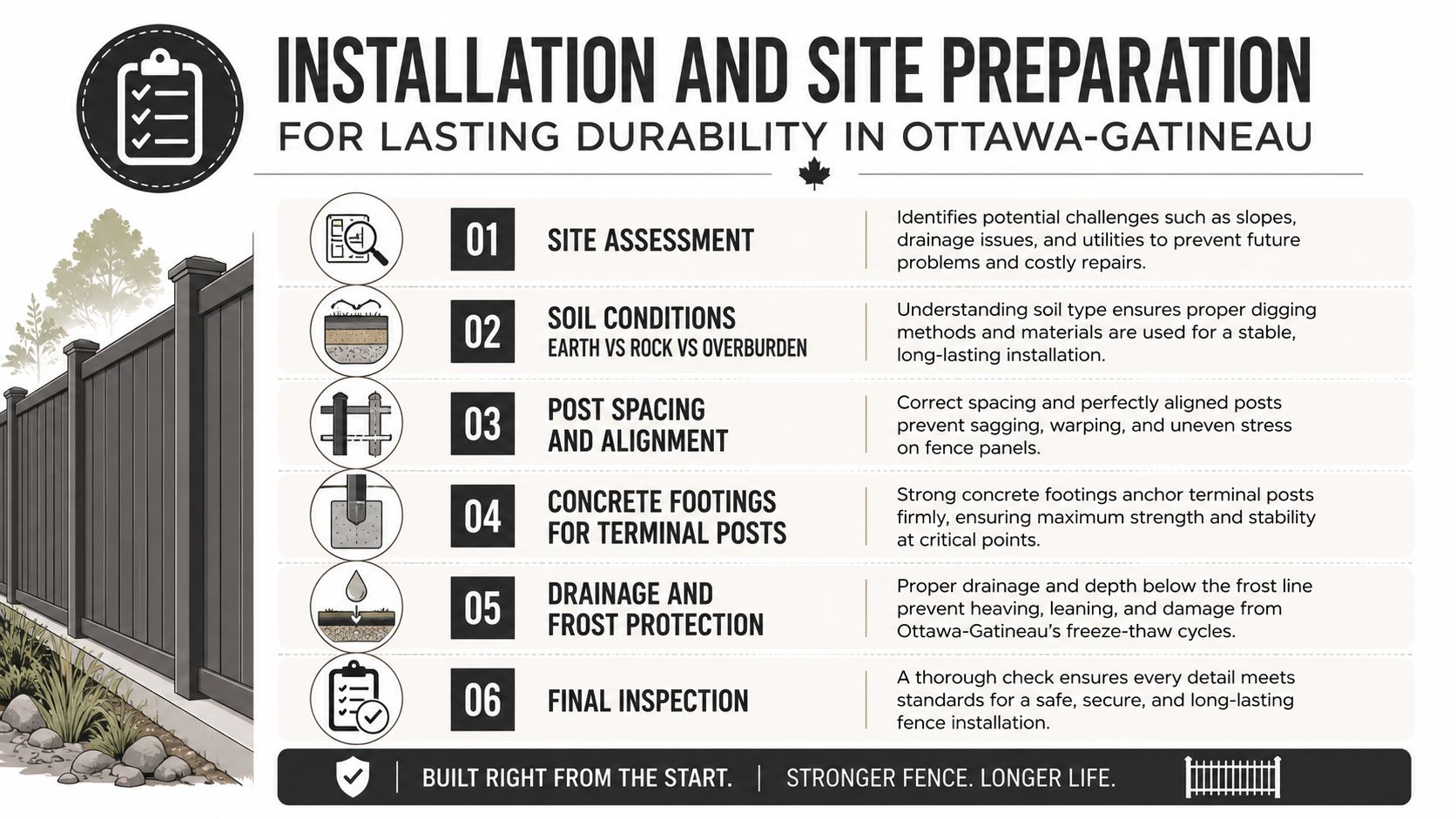
Before approving the work, check that the gates swing or roll correctly, latches engage, terminal posts are stable, fabric is taut, fittings are secure, and the fence fully follows the approved line. A useful installation overview is available in this commercial fence installation resource.
The following video can help teams visualise the importance of preparation and sequencing before installation begins.
Costs Financing Maintenance and Lifecycle Planning
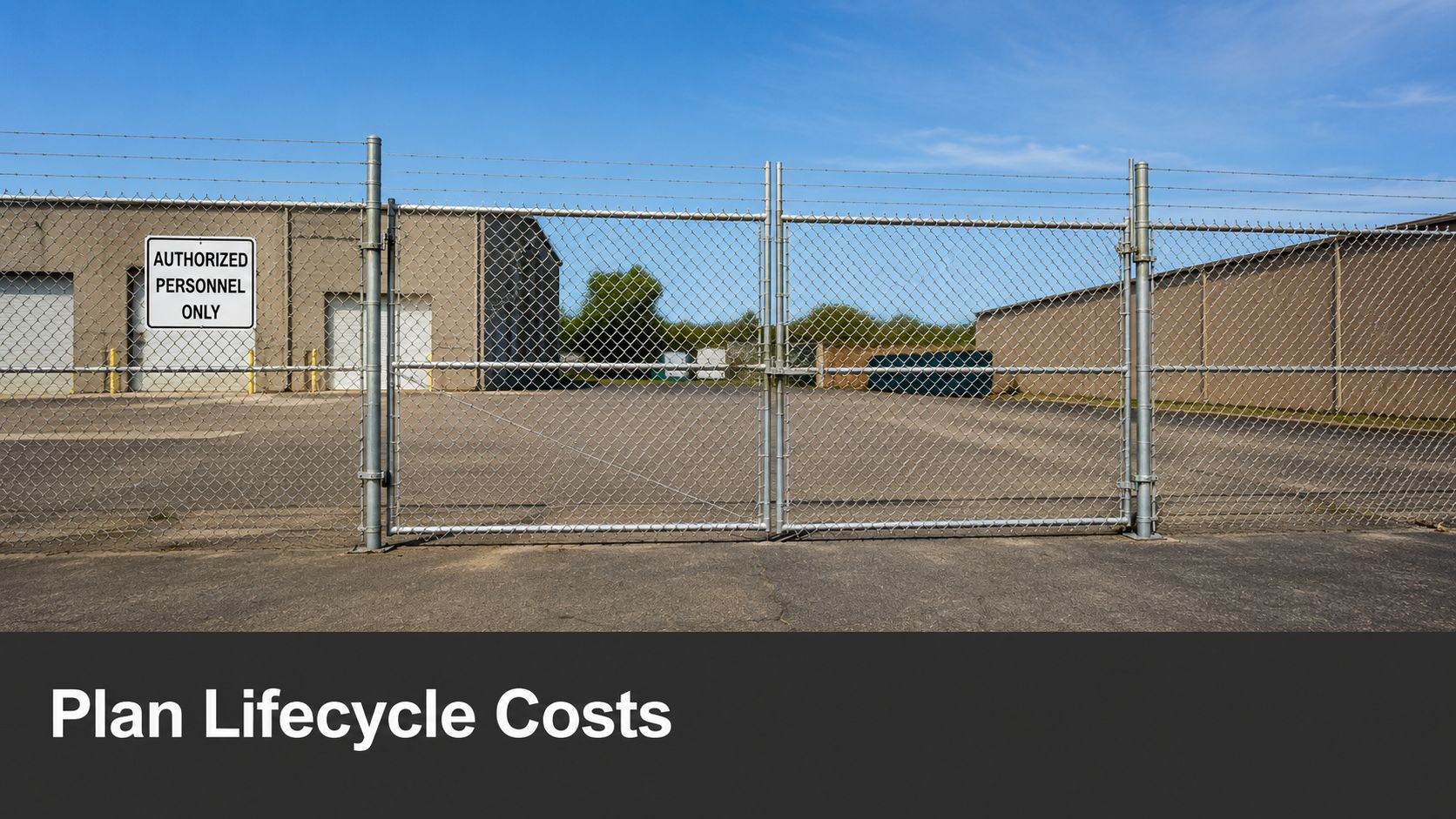
A commercial fence budget becomes easier to understand when you separate the visible fence line from the work that supports it. Material selection is only one part of the estimate. Height, mesh and wire specification, zinc coating, post size, gates, access-control hardware, excavation, rock, concrete, clearing, site access, and restoration can all change the final scope.
Build the budget around decisions
Start with the perimeter and access plan. A long, uncomplicated boundary may have a very different cost profile from a shorter site with several vehicle gates, pedestrian gates, corners, grade changes, and difficult excavation. Ask the estimator to show assumptions for each item so you can see what is included and what could become a change order.
Coating and wire diameter affect lifecycle value because corrosion and deformation can lead to repairs. A heavier coating may cost more initially, but it provides more protection in wet, salted environments. Likewise, a more durable wire and framework specification can reduce the likelihood of early stretching or impact damage.
Gates and access control deserve their own allowance. Frequent vehicle use puts more stress on hinges, wheels, latches, stops, and posts than a rarely used pedestrian entrance. If the property needs controlled entry, specify who operates the gate, how often it cycles, and what happens during power or equipment failure.
Keep maintenance practical
Schedule visual inspections after winter and after any known impact. Look for leaning posts, loose ties, damaged fabric, open fittings, corrosion at cut edges, gate sag, and tension loss. Keep vegetation from trapping moisture against the fence and make sure snow storage or plow routes don't push directly into the line.
FenceScape offers commercial chain link installation with galvanized and black vinyl-coated options, and its turnkey approach can include planning, installation, and post-install support. For eligible projects, the company also offers neighbourhood group discounts and financing programmes for Ontario and Quebec customers. Treat those as procurement options to compare with the scope, warranty, material schedule, and maintenance expectations, not as substitutes for a proper site assessment.
Choosing the Right Use Case and Next Steps With FenceScape
The right commercial chain link fence begins with the property's actual job.
Industrial and storage yards generally need a durable perimeter, reliable vehicle gates, clear sightlines, and coatings suited to salt and wet exposure.
Construction sites need complete enclosure, structural soundness, and height that satisfies Ottawa requirements when the site sits close to public pathways or congregation areas.
Institutional campuses and schools often benefit from visibility, controlled pedestrian access, and carefully located gates.
Retail and multi-lot properties may combine chain link at service or parking edges with ornamental, PVC, wood, or hybrid fencing where appearance and privacy matter more.
Pool and amenity areas require a design that balances visibility, access control, appearance, and the applicable safety requirements.
Don't accept “commercial grade” as a complete answer. Ask for the mesh opening, wire gauge or diameter, zinc coating, framework specification, terminal post and footing details, gate hardware, installation standard, and inspection process. Confirm the fence height and alignment before digging, especially where public access, neighbouring properties, utilities, or winter maintenance routes are involved.
A sensible next step is an on-site estimate that reviews your perimeter, soil conditions, gates, compliance needs, and long-term maintenance expectations. FenceScape serves Ottawa–Gatineau with in-house crews and can coordinate a turnkey project from planning through final walkthrough, while material-only buyers can use the same specification questions to compare suppliers and installers.
If you're planning a commercial chain link fence in Ottawa–Gatineau, visit FenceScape to arrange a site assessment and discuss fabric, framework, gates, coatings, and installation requirements. Bring your property plan, access needs, and inspection concerns, and ask for a clear scope that shows how the proposed fence is built to perform through Canadian winters.
Comments