
Chain Link Fence Cover: Types, Costs and Ottawa Rules

The most popular advice is also the most misleading: pick the cover that blocks the most view, clip it on, and enjoy instant privacy. That's backwards in Ottawa and Gatineau. A chain link fence cover changes how wind pushes on your fence, how snow piles at its base, and whether a pool gate still works as a safety barrier. Maximum privacy isn't always maximum value. If the posts lean or the gate stops latching, you haven't upgraded the fence. You've loaded a frame that was never checked for the job. Start with structure and rules, then choose opacity.
Cover Types Compared and How Each Works
A January gust does not care that the cover felt light in your hand. An uncovered chain link fence works like a sieve. Most wind passes through the diamond mesh, and so does most of the view. A cover turns that sieve into a sail or a curtain. It blocks sightlines, and it also catches gusts and holds drifting snow against the mesh, rails, and posts.
That one change explains nearly every success and failure. The material matters less than how much air the cover stops, how tall it is, and how firmly it is attached. Treat every cover as a structural load first, and as a privacy product second.
Chain Link Fence Cover Types Compared
Cover type | Privacy level | Wind load | Best use |
|---|---|---|---|
Privacy slats (woven plastic or aluminum strips) | Medium to high, with small gaps at seams | High | Backyards and quick screening |
Knitted mesh windscreen (HDPE) | Medium to high, roughly 70% to 90% of view blocked | Medium | Sports courts, job sites and partial screening |
Vinyl or fabric privacy wrap | High, near-solid | Very high | Short, sheltered runs |
Wood or bamboo screening panels | High | High, heavy and rigid | Design-led yards and sheltered spaces |
Living screen (cedar hedge or climbing vines on mesh) | Medium, reaching high in 2 to 3 years | Low to medium | Long-term screening in low-exposure yards |
Privacy level means the share of view blocked at eye height when you stand square to the fence. It does not promise total privacy at an angle. Slats and knitted screens can look solid from the street and still show movement and shapes when someone looks along the fence line. That surprises homeowners who expected a wall.
Use one practical threshold before anything else. A cover blocking about 90% or more of the view behaves like a solid panel in wind. Treat it like a panel, not a decoration. That means sound posts, continuous rails, and real bracing at ends and corners.
Practical rule: If you can't see daylight through it, assume wind can't easily pass through it either.
Privacy Slats for Backyards and Quick Screening
Privacy slats are flat strips of UV-stabilised plastic or aluminium woven vertically or diagonally through the mesh and locked with a channel or clips. They suit a backyard where neighbours sit close on the other side, and they give quick screening with tidy colour choices. Pool enclosures follow separate safety rules, covered later in this article. A privacy cover is not a substitute for a compliant pool barrier.
Slats do not seal perfectly. Small gaps appear at seams and where the mesh flexes. Cheaper plastic can turn brittle and crack in deep cold, then warp or fade in summer heat. Before you buy a full run, compare cyclone fence slat materials and review how different slat profiles lock into the diamonds in this guide to cyclone fence slat options and coverage. A sample in your hand tells you more about stiffness than a product photo.
Say your fence borders a neighbour's deck. Slats give you screening without building a second fence, and you can replace a damaged strip instead of a whole panel. The trade-off is wind load. Dense slats fill most of the mesh opening, so they belong on a straight, well-braced fence, not on posts that already move when you push them.
Knitted HDPE Windscreens for Courts and Job Sites
A knitted HDPE windscreen is a woven polyethylene fabric sold in rolls, usually finished with reinforced edges, grommets, and cable ties. It typically blocks roughly 70% to 90% of the view, depending on weave density. Because the knit lets some air pass, it loads the fence less than a solid sheet of the same size.
That is why windscreens dominate tennis courts, ball diamonds, and construction perimeters. On a court, partial airflow is the point. Players get a calmer surface and a darker background for the ball, while the fence does not take the full push of every gust. On a job site, the screen hides materials and reduces dust drifting, and crews can remove it quickly.
Confusion starts with shade ratings. A screen sold for shade is not automatically rated for fence privacy or for a winter left up all year. Check the edge finishing and tie points. A thin roll with sparse grommets tears at the corners first, no matter what the privacy percentage promises.
Vinyl or Fabric Wraps for Short Sheltered Runs
Vinyl or fabric wraps use PVC, coated polyester, or similar sheet material fixed to the mesh with ties about every 30 cm. They deliver the most complete visual block of any lightweight option, which is why people choose them for a hot tub corner or a short run beside a patio.
They are also the least forgiving. A loose bottom edge flaps, and flapping does two kinds of damage. It saws through ties, and it works the fabric against the mesh until it tears. The run should be short, sheltered by the house or trees, and tied evenly on all edges. If your yard funnels wind between houses, pick a knitted screen instead.
Best setting: A short, sheltered side run where total screening matters more than airflow.
Watch for: Sagging between ties, pooling meltwater at the bottom edge, and grommets pulling through thin fabric.
Wood or Bamboo Panels for Design Led Yards
Wood or bamboo screening panels answer a different problem. You are not only hiding the view. You are hiding the chain link itself. Cedar slats, horizontal boards, or bamboo rolls give a warm finish that suits a garden or a renovated yard where metal mesh looks temporary.
Do not hang rigid panels off the mesh and expect the fence to carry them. Panels need their own rails, and often their own posts, because they are heavy, they do not flex with the mesh, and they catch wind as a solid surface. Build them as a facing system with proper fixings into framing, and leave a small gap at the ground so boards do not sit in meltwater.
Living Screens for Patient Screening
A living screen uses a cedar hedge planted along the fence or climbing vines trained onto the mesh. It is the slowest option, usually taking two to three years to fill in, and the gentlest on the structure. Roots and foliage add some weight and drag, but far less than a solid wrap of the same height.
Choose it when you want screening that softens the yard and you can wait. Keep vines trimmed off gate hinges and latches, and plant hedges far enough from the mesh that you can still inspect posts and ties. A hedge that swallows the fence makes small repairs miserable.
A Three Step Way to Choose
Name your goal: Privacy from neighbours, a windbreak, or screening for a sports court or job site.
Find the matching row: Use the table to match that goal to privacy level and wind load.
Check the structure first: Confirm posts, rails, and bracing can carry that choice before you order anything.
Wind and Snow Limits Before You Add Any Cover
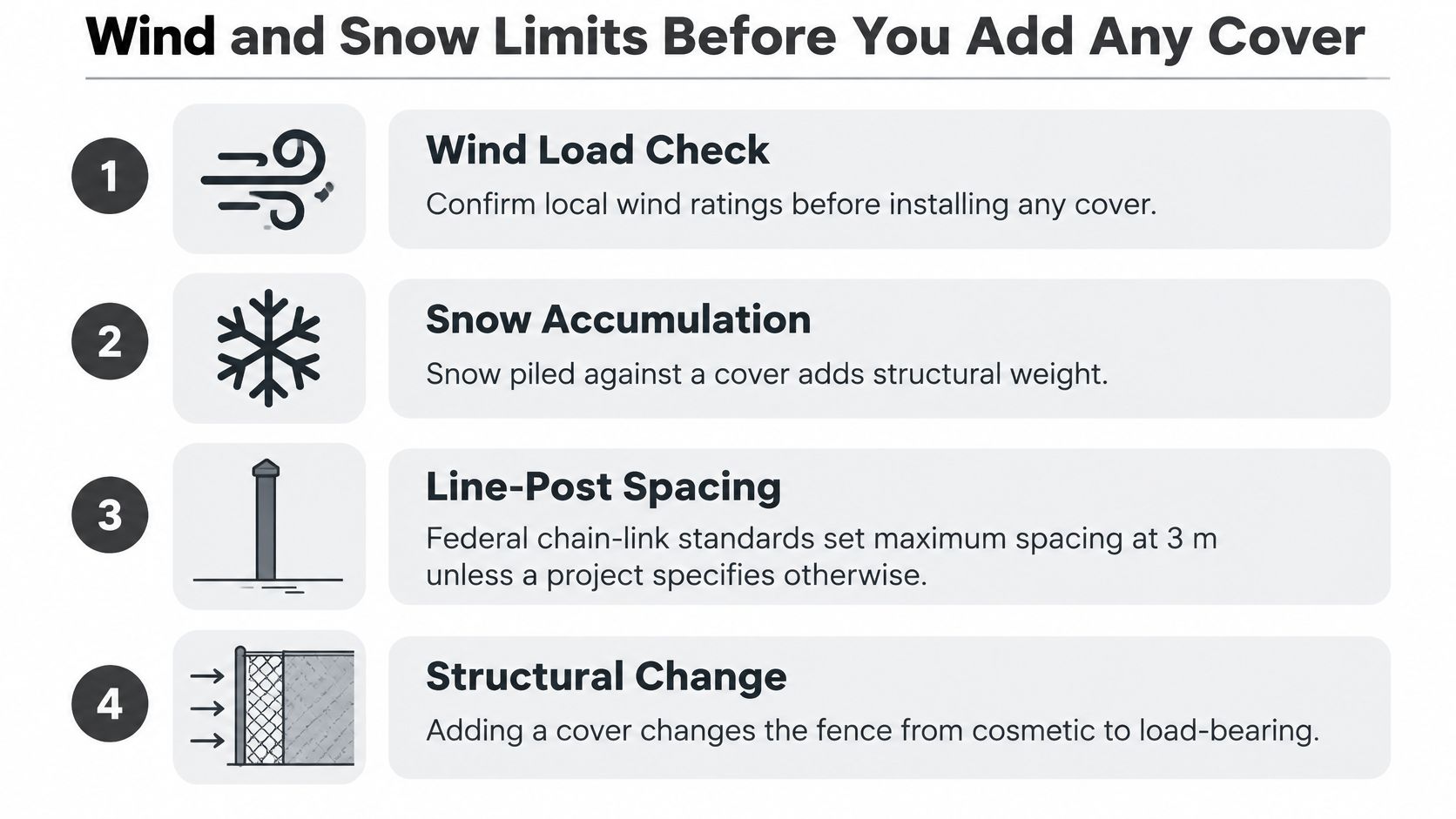
Adding a cover is a structural change, not a cosmetic one. The Canadian General Standards Board chain link standard sets maximum standard line post spacing of 3 metres unless a project specifies otherwise, and it warns that snow mechanically piled against a fence may require closer spacing. It also identifies a 2.4 kN/m² ground snow load threshold for one reduced load design condition, provided there's no expected drifting or mechanical accumulation.
Ottawa's own construction fencing benchmark is tighter and makes a useful conservative check. The City of Ottawa fencing information requires posts no more than 2.4 m apart, embedded at least 600 mm, with rails threaded through the mesh at top and bottom. If your fence falls short of that build, don't compensate with extra cable ties. Fix the frame or choose a more open cover.
The worked example below shows why cover height matters as much as material. Four check areas frame the decision before any cover goes on.
For example, a 30 m run with a 1.8 m solid wrap presents about 54 m² to the wind. A 1.2 m open top windscreen on the same run presents about 36 m². Same fence, very different load. Dropping cover height is sometimes the simplest engineering decision you can make.
Snow works differently from wind but lands in the same place. The RCMP Security Fencing Considerations Guide notes that smaller meshes catch more snow while larger meshes let most snow pass through. A dense cover goes further. It traps drifts at the base, where wet snow sits against ties, bottom rails, and post footings through freeze and thaw cycles. Regional snowfall makes this a design input, not a footnote. One Ottawa dataset recorded 297.8 cm of snowfall in 2025 at the Kanata to Orléans station, according to Ottawa yearly snowfall records.
The Pre Installation Checklist
Measure post spacing: Compare each bay against the 2.4 m to 3 m range. Wider spacing means each post carries more covered area. Our notes on chain link fence line post spacing explain how spacing changes strength.
Check plumb and rust: Push each post at shoulder height. Look hardest at ground level, where moisture and de-icing salt attack first.
Confirm footings: Footings should reach at least 600 mm deep and show no cracks or heaving. A moving footing won't hold a sail.
Inspect end and corner bracing: Ends and corners take the pull of the whole run. Loose brace wires or bent diagonal braces come first on the repair list.
Verify rail continuity: Top and bottom rails should run continuously through the mesh. Missing bottom rails let covers flap and animals push under.
Plan fasteners: Use UV resistant ties at about 300 mm intervals, evenly spaced. Concentrated tie points tear fabric and distort mesh.
Keep the lower edge tight: A fixed bottom edge can't flap, scoop snow, or lift in gusts.
Mark snow storage: Decide where cleared snow goes before winter. Piles belong away from the covered run, not banked against it.
Stop and get an assessment if you find leaning posts, a bent top rail, a misaligned gate, pulled ties, or movement at the footing.
Those are warning signs, not cosmetic flaws. If the existing fence can't take a full cover, use a partial or open top cover along the section where privacy matters, such as beside a patio, and leave the rest open.
Pool, Sightline and HOA Rules That Change Your Choice
A pool enclosure is a regulated safety barrier, not a privacy fence with a gate. The City of Ottawa pool enclosure bylaw requires the enclosure to be at least 1.5 m high, with openings small enough that a 100 mm sphere cannot pass through, chain link mesh no larger than 38 mm, and 12 or 14 gauge galvanized steel wire. It also requires gates to self close and self latch, with the lock at least 1.35 m above the enclosure bottom.
An ordinary fence and a pool enclosure follow different approval paths. The City of Ottawa building permit guidance states that an ordinary fence does not require a building permit, while a fence used as a pool enclosure does require a pool enclosure permit. Get municipal confirmation before ordering materials. Our summary of the Ottawa pool enclosure bylaw walks through the component checks.
What a Cover Must Never Do at a Pool
Create footholds: Horizontal rails, tied fabric edges, or stacked slats can become climbing aids for a child.
Enlarge gaps: Wind pressure on a dense cover can rotate posts and open gaps at corners and gates.
Block hardware: Fabric over hinges or latches slows self closing and hides worn parts during inspection.
A privacy screen also can't substitute for compliant mesh and framing. If the underlying fence wasn't built as the pool barrier, adding an opaque cover doesn't make it one.
Corner Lots and Sight Triangles
Ottawa treats open chain link as see-through in corner sight triangles. The City of Ottawa zoning bylaw provisions identify chain link fencing and similar features that can be seen through as not being an obstruction in corner sight triangles. An opaque screen can remove that status. Keep the sight triangle portion open and put privacy screening outside the visibility zone, along the side or rear lot line.
Property lines come next. The City of Ottawa landscaping guide states that fences cannot be placed in the municipal right-of-way and that chain link next to residential properties must be vinyl coated or powder coated. Check your survey before a cover makes an encroaching fence look newer and more permanent.
HOA Approval Paperwork
Condo corporations and HOAs usually control height, colour, material, and approval process. Apply before you buy, with a survey, a simple drawing showing cover height and extent, a product sample, and photos of the existing fence. Written approval protects you if a neighbour complains after installation.
Decide in this order: bylaw first, structure second, appearance third. For Gatineau addresses, confirm pool, fence, and sightline rules with the City of Gatineau. Ottawa figures don't transfer automatically across the river.
Cost Ranges and DIY Versus Professional Installation
Material prices look small beside installed prices, and that gap confuses people. The chart below separates buying a cover from having a sound, finished installation.
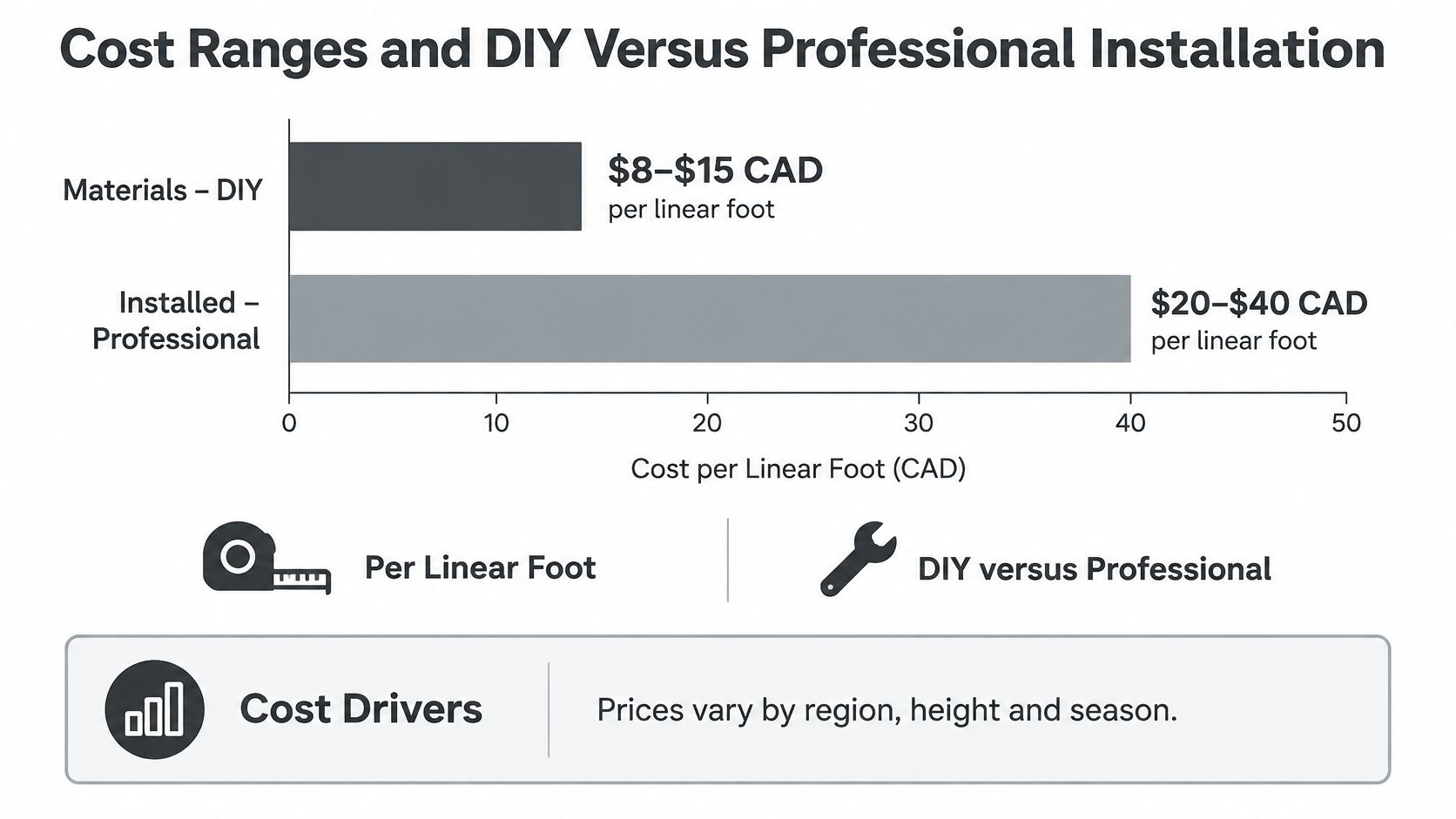
Typical Cost Per Linear Foot by Cover Type
Cover type | Professionally installed (CAD per linear foot) | Main cost driver |
|---|---|---|
Privacy slats | $5 to $10 | Slat quality and seam design |
Knitted mesh windscreen | $3 to $6 | Mesh density and grommet spacing |
Vinyl or fabric wrap | $6 to $12 | Fabric weight and attachment points |
Wood or bamboo panels | $15 to $30 | Lumber grade, rails and posts |
Living screen | $8 to $20 | Plant size and soil preparation |
These ranges are estimates for comparison. They vary by region, fence height, season, and site access. A winter repair or a yard reached only through a narrow gate costs more than a straight summer run beside a driveway.
Online listings show why materials alone mislead. An Amazon Canada chain link privacy tape listing priced a 246 foot roll at C$52.99, about C$1.44 per square foot. A separate Amazon Canada privacy screen listing priced a 4 foot by 50 foot screen at C$68.50, or C$0.34 per square foot.
Convert before you compare. The 246 foot roll works out to about C$0.22 per linear foot in material alone. The 4 by 50 foot screen works out to about C$1.37 per linear foot. Labour, fasteners, disposal, and structural repairs explain most of the distance between those figures and an installed price.
Watching an installation sequence helps you judge whether the work suits a weekend project.
What Actually Drives the Total
Height and length: Taller covers use more material and load posts harder, so bracing costs rise with area.
Corners and gates: Every corner adds cutting, edging, and hardware clearance work.
Existing fence condition: Straightening posts, replacing rails, or repairing footings happens before the cover, and it isn't optional.
Removal and access: Stripping an old torn screen and hauling materials through a finished yard takes paid time.
The DIY Rule and the Professional Rule
DIY suits short runs on sound posts, at low height, with no pool or corner exposure. Your kit is simple: UV rated cable ties, a tie tensioning and cutting tool, a sharp cutting tool for trimming, gloves, and a helper to hold the roll taut while you fix the top edge first, then the bottom, then the middle.
Hire a professional for tall covers, pool enclosures, corner lots, commercial sites, and any fence needing repair first. The judgement call is structural, not about your skill with cable ties.
A cheap windscreen replaced every two years can cost more per year than a sturdier screen that stays tight for much longer.
Price the cover over its service life, including the afternoon you'll spend replacing it.
Maintenance and Lifespan for Each Cover Type
Maintenance in this region is seasonal, because each cover type fails in its own way. Fabric tears at ties. Slats crack. Wood checks and greys. Hedges grow into hardware. A short routine catches most of it while repairs are still small.
The Four Season Routine
Spring: Retie or tighten every tie, check posts and rails for frost movement, and wash off salt and grit with a hose.
Summer: Look for fading, UV brittleness, and loose seams. Clean fabric and slats with mild soap and a soft brush, not a pressure washer held close.
Autumn: Clear leaves and debris from the base so drainage stays open. Trim vines and hedge growth back from the mesh, hinges, and latches.
Winter: Brush snow away from the base after storms. Never pile cleared snow against the fence, and keep snowblower discharge off covered runs.
That last habit protects more than the cover. Wet snow held against mesh keeps steel damp for weeks. Galvanized and vinyl coated mesh resist corrosion well, but check coating damage at tie points and ground contact, where moisture sits longest. Touch up bare metal before rust creeps under the coating.
How Long Each Cover Usually Lasts
In full sun, mesh windscreens often last about two to five years before the knit weakens. Slats run about five to ten years, and vinyl or fabric wraps about five to ten years depending on UV exposure and how tightly they were fixed. Wood panels reach ten to fifteen years with sealing and prompt board replacement. A living screen has no fixed lifespan, but it asks for pruning, watering in dry spells, and the occasional replacement plant.
Shade extends fabric life. So does removing a temporary job site screen once the work ends instead of leaving it through winter. Write the installation date on a tie tag at one corner. Two minutes now saves guessing later.
Replace a cover when you see sagging across the full length, fabric torn at multiple ties, a faded chalky surface that powders on your hand, or cracks running along slats. One torn corner is a repair. Failure spread across the run means the material is done, and new ties only hold old fabric.
Choosing the Right Cover for Your Ottawa–Gatineau Yard
Start with the question you need answered. Is it privacy, wind, snow, or compliance? Then match your situation to a row below. Guessing from a product photo skips the constraint that decides the outcome.
Best Cover by Yard Situation
Your situation | Best cover | Why it fits | Avoid |
|---|---|---|---|
Sheltered backyard needing privacy | Privacy slats or wood panels | Good screening with manageable load | Solid wraps on an exposed fence |
Exposed corner lot in Ottawa or Gatineau | Partial-height windscreen mesh | Lower load and keeps the sight triangle open | Full-height solid wrap |
Pool enclosure | Compliant mesh, with a privacy screen only if the bylaw allows | Keeps the safety barrier intact | Anything that creates footholds or blocks gate hardware |
Commercial or construction perimeter | Galvanized mesh with a rated windscreen | Meets structural specifications with engineered review | DIY tall solid screens |
Snow-heavy side yard | Open mesh or living screen | Lets snow pass through | Dense slats that trap drifts at the base |
Construction perimeters carry their own structural expectations. The City of Ottawa construction fencing bylaw requires chain link fastened to posts no more than 2.4 metres apart, embedded at least 600 millimetres, and generally at least 1.8 metres high within 3 metres of a public pathway. A rated windscreen on that frame is a different proposition from a tarp on temporary panels.
Your Next Four Steps
Check the rule for your address: Confirm fence height, pool requirements, and sight triangle limits in Ottawa or Gatineau.
Inspect the frame: Run through posts, footings, bracing, and rails before pricing any cover.
Set height and openness: Decide how tall the cover must be and how much air it should pass. Partial height solves many exposure problems.
Price both parts: Get figures for materials and for labour separately, including repairs the fence needs first.
A confident DIY homeowner can buy materials alone and install with a helper on a short, sound run. A larger or compliance sensitive project benefits from a site review before money goes into materials that may not suit the frame.
Our team has decades of combined experience building fences across Ottawa and Gatineau in every type of situation, and we offer a free estimate. Through our contact form you can request a Material Quote or an Installation Quote, depending on whether you want supplies only or a finished installation. We can review your existing posts and footings, design the cover to match exposure and bylaws, and install it so gates and sightlines stay compliant.
Bring us your fence measurements, a few photos of the posts and gates, and the privacy problem you're trying to solve, and we'll tell you plainly whether your frame can carry the cover you want or needs reinforcement first. Request a Material Quote or an Installation Quote through FenceScape and get a free estimate for a chain link fence cover that survives Ottawa winters instead of fighting them.
Comments