
Best Chain Link Fence for Dogs: Height, Mesh and Gates

Your dog is nosing under the gate, the spring thaw has turned the fence line into mud, and the snow piled beside the shed is suddenly a useful climbing platform. You're looking at chain link because it's practical, but choosing a roll of wire won't solve all of those problems.
The best chain link fence for dogs is a complete containment system: suitable mesh, stable posts, a secure bottom edge, a dependable gate and somewhere for meltwater to go. In Ottawa–Gatineau, the right specification also depends on your dog's behaviour and the rules that apply to your particular property.
Quick Picks by Dog Size and Behaviour
A dog that stays inside a fence with standard mesh may still squeeze a paw through, climb the fabric or push at a weak gate. Choose the starting specification around the behaviour you need to contain, then check that the property's rules allow it.
Starting specification by dog profile
Dog profile | Height | Mesh opening | Wire | Gate and base |
|---|---|---|---|---|
Small, calm dog | 1.2 m (4 ft) | 50.8 mm (2 in.) | 12-gauge galvanized | Self-closing gate, latch at top and inside |
Medium to large dog, no digging | 1.8 m (6 ft) | 50.8 mm (2 in.) | 12-gauge galvanized | Posts no more than 3.048 m apart, 0.914 m below grade in concrete |
Digger or climber | 1.8 m (6 ft) | 38 mm (1.5 in.) | 12-gauge galvanized | Dig-resistant bottom edge, base buried 30 cm |
Strong jumper on Gatineau urban lot | 2 m (6.6 ft) | 38 mm (1.5 in.) | 12-gauge galvanized | Inward return 60 cm, base buried 30 cm |
Potentially dangerous dog | Property-specific | Property-specific | Property-specific | No residential default. Use a reinforced design approved by the municipality for the property. |
The small-dog height is a starting option only where local rules permit it and the dog does not jump. For an ordinary yard, the medium-to-large profile gives a practical baseline. A dog that digs or climbs needs a protected bottom edge, while a strong jumper may need added height and an inward return if Gatineau's provisions apply to the property.
The Rideau Lakes kennel by-law sets out a kennel benchmark of 1.8 m (6 ft) galvanized chain link, 50.8 mm (2 in.) mesh and 12-gauge wire, with posts no more than 3.048 m (10 ft) apart and set at least 0.914 m (3 ft) below grade in concrete. Use it as a reference, not as a universal Ottawa residential rule or a guarantee that the footing depth suits the soil.
Check the dog and the household
The Ottawa Animal Care and Control By-law generally limits a residence to 3 dogs over 20 weeks of age, with exceptions including licensed kennels, veterinary facilities and approved foster-care locations. Count the dogs before sizing a shared enclosure.
Use these questions to choose a starting row:
Height: Can the dog reach the top when standing or springing upward?
Digging: Does it excavate along boundaries or push under loose material?
Jumping and climbing: Does it launch over obstacles or hook its paws into mesh?
Choose for the dog's demonstrated behaviour, not breed size alone. A suitable mesh and height can still fail if the gate latch, bottom edge or site conditions leave an easy escape route.
Chain Link Options Compared by Mesh and Gauge
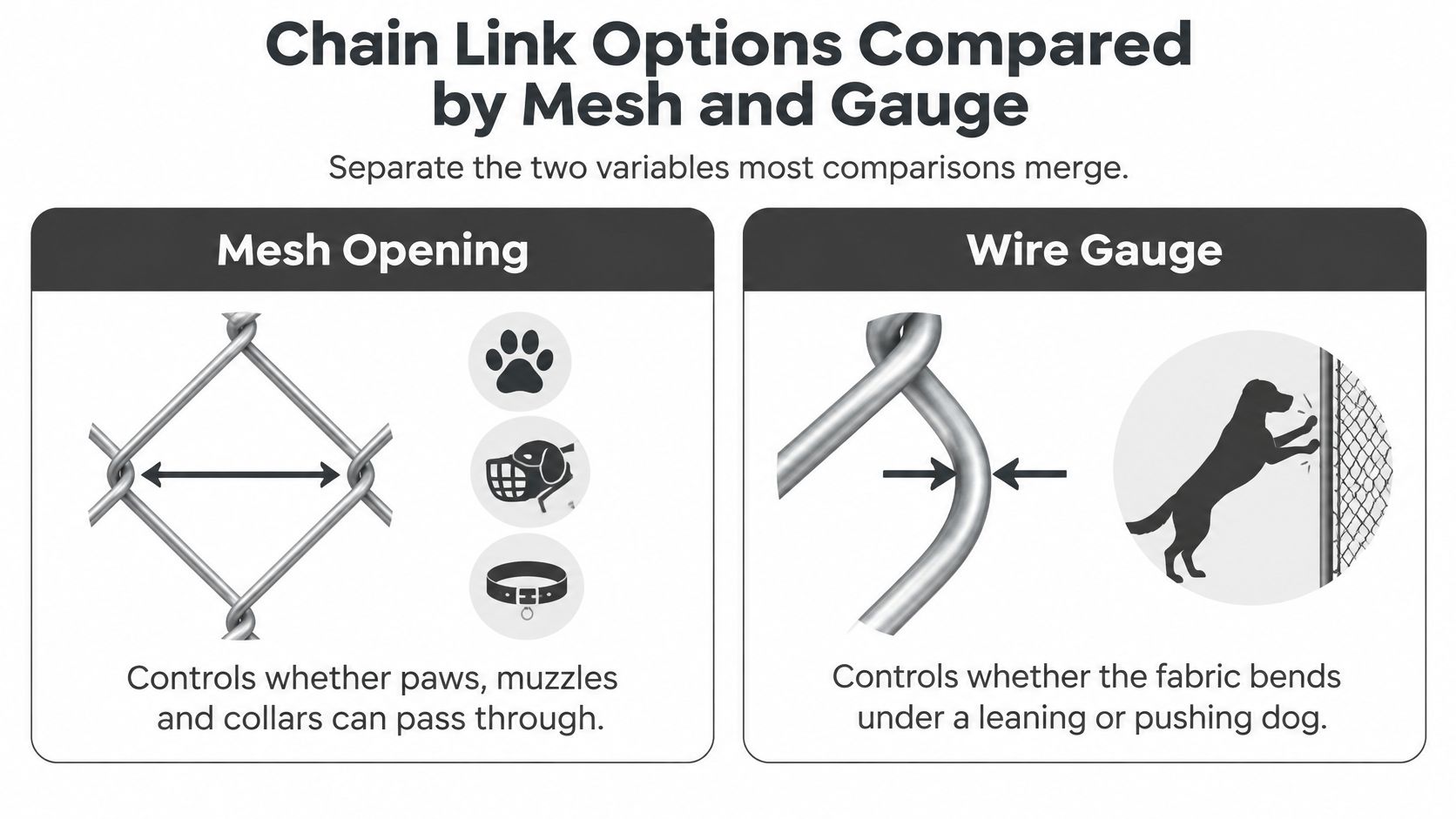
A dog can push a paw or muzzle through a wide opening, while a dog that leans or charges tests how readily the wire bends. Mesh opening and wire gauge address different behaviours, so compare both on the quote.
The RCMP security-fencing guide discusses mesh openings from 3/8 in. to 2 3/8 in. and wire from 14-gauge to 6-gauge. It describes smaller openings as offering an anti-climb effect and thicker wire as improving resistance to bending and impact. These are security-fencing ranges, not dog-specific minimums.
Mesh, gauge and coating options compared
Option | Mesh opening | Wire gauge | Anti-climb and strength | Trade-off |
|---|---|---|---|---|
Standard galvanized residential | 50.8 mm (2 in.) | Specify 12-gauge | Adequate for calm dogs; paws can pass through | Lowest-cost starting option, most visibility |
Rideau Lakes kennel baseline | 50.8 mm (2 in.) | 12-gauge galvanized | Matches the cited Rideau Lakes kennel baseline | Lowest-cost starting option, same specification as standard residential |
Small mesh for paws and muzzles | 38 mm (1.5 in.) | 12-gauge galvanized | Restricts access and improves climb resistance | Higher material cost, less visibility |
Heavy-duty for large strong dogs | 38 mm (1.5 in.) | 6 to 9-gauge | Resists bending and impact | Heaviest and costliest option shown |
Vinyl-coated | 50.8 mm (2 in.) | Specify steel core gauge | Coating protects steel; damage needs inspection | Colour options, higher price |
Buy the upgrade that addresses the habit
Standard galvanized fabric is a straightforward choice for a calm dog that respects the boundary. Smaller mesh helps limit a dog's ability to push its muzzle or paws through openings, though it cannot make every opening safe for every paw or collar.
For a strong dog that leans or charges the fence, heavier wire can resist bending and impact. It needs suitable posts, fittings and tensioning; a light frame can undermine the upgrade.
Vinyl coating adds colour and another protective layer. Ask whether the listed gauge refers to the steel core or the finished coated diameter, and inspect scraped areas each spring. Damage through the coating can expose steel to corrosion.
For more detail on opening sizes, see this chain-link fence mesh guide. Ask for mesh size, steel gauge and coating as separate entries on the written quote.
Mesh size limits access through openings. Wire gauge affects resistance to bending. Both depend on a properly built frame.
Height, Gates and Anti-Dig Details That Hold Dogs In
A determined dog tests the whole enclosure, including the junction between the house and fence. A secure front run means little if the side passage ends at an unsecured driveway.
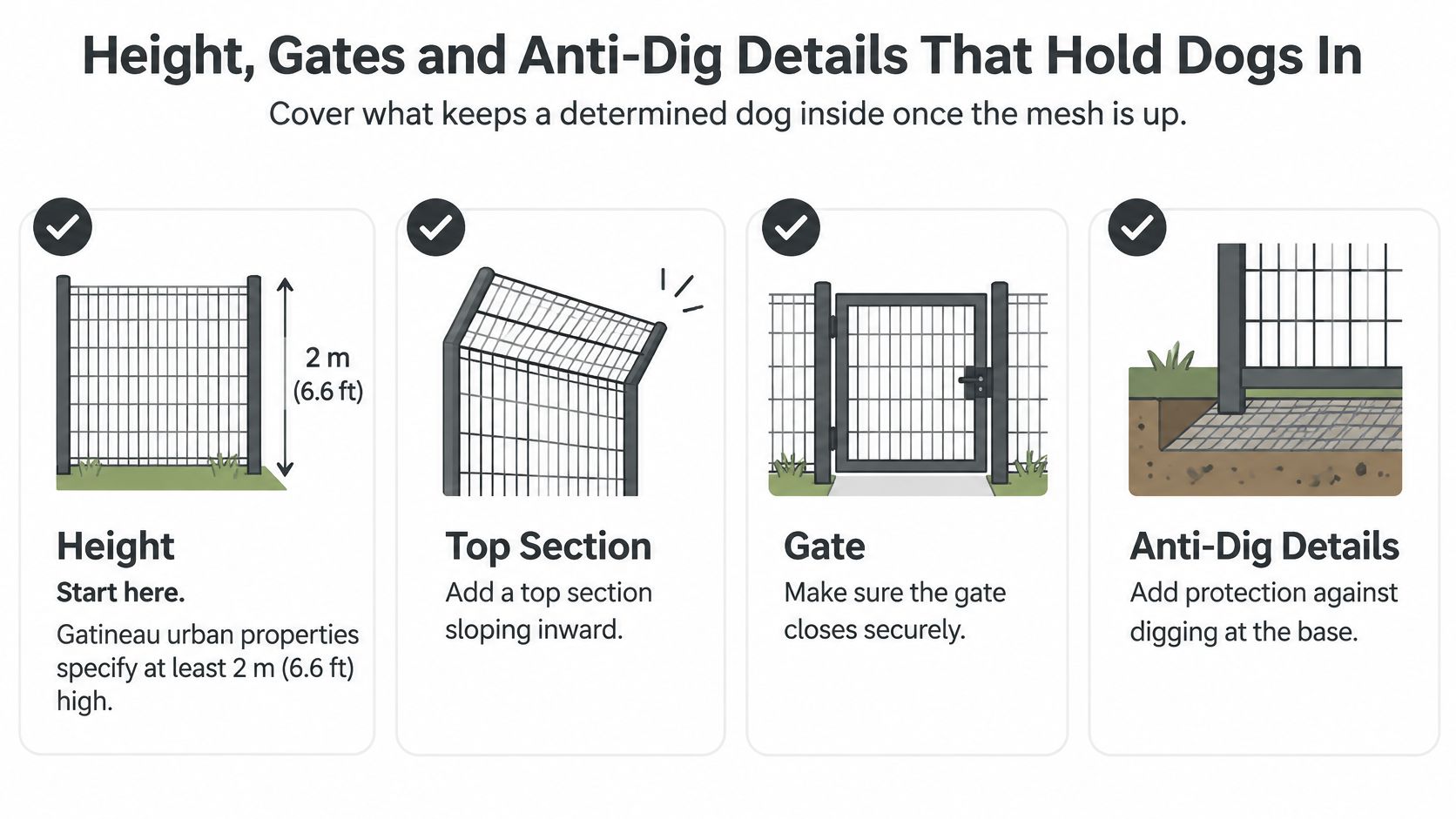
For properties subject to its detailed enclosure provisions, Gatineau's animal-control rules specify a minimum height of 2 metres, an inward-sloping top extending at least 60 centimetres, and a base buried at least 30 centimetres, using galvanized wire mesh or equivalent material. Confirm the applicable provisions and property classification rather than treating those details as a blanket rule for every urban backyard.
Match each detail to an escape route
Height increases the obstacle a dog must clear; an inward return makes the top harder to negotiate. Neither makes an accomplished climber safe without supervision and a design suited to that dog.
A buried base interrupts digging at the boundary. Where a buried edge isn't required, a securely attached, ground-covered mesh apron can be an alternative worth discussing with the installer. Finish exposed edges so the dog can't catch a paw on cut wire.
Galvanizing protects the fabric against corrosion. It doesn't compensate for loose ties or an unsupported bottom edge that a dog can lift with its nose.
Use this checklist when reviewing the enclosure layout.
Make the gate behave like part of the fence
The gate should match the fence's height and rigidity, with substantial hinges and self-closing, self-latching hardware positioned at the top and inside. Choose hardware that operates together rather than adding a closer to a dragging gate.
A propped-open gate defeats containment completely. If deliveries or lawn equipment need regular access, consider a separated entry area so opening the outside gate doesn't expose the dog directly.
Frost movement can enlarge the gap beneath a gate or pull the latch out of alignment. Adjust the hinges and strike, then check the entire swing; don't raise the gate and leave an escape gap underneath. This chain-link gate installation guide helps identify the components to specify.
Walk the perimeter with a tape measure:
Measure effective height: Check from adjacent outside grade and inspect inside footholds.
Inspect the bottom: Look for lifted fabric, washouts and openings at corners.
Test the latch: Release the gate from different positions and confirm it catches.
Remove climbing aids: Move firewood, planters and stored equipment away from the mesh.
Winter, Drainage and Ground Conditions Across Ottawa–Gatineau
Ottawa's Reid Park fenced off-leash facility consultation considered 1.5-metre chain-link fencing alongside a leashing area, drainage and crushed-granite surfacing. The useful lesson for a backyard is the combined planning: fence, entry and ground conditions belong in the same design.
A packed snowbank gives a dog a raised launch point. Moving snow away from the fence is more useful than assuming the summer fence height remains effective all winter.
Seasonal risks and specification responses
Season | Risk to the fence | Specification response |
|---|---|---|
Winter snowbank | Dog uses packed snow as a step; effective height drops | Store snow clear of the perimeter; retain the selected baseline height without relying on it alone |
Freeze-thaw cycle | Frost heave lifts the bottom edge and tilts posts | Concrete-set posts designed for local soil and frost conditions; inspect bottom gaps each spring |
Spring thaw | Soft soil around posts invites digging | Grade water away from the line; add a properly drained gravel strip |
Winter gate use | Gate binds or drags on frozen ground | Design a cleared gate landing and threshold; check hinges each autumn |
Resolve water and snow before setting posts
The kennel footing benchmark isn't a substitute for assessing local frost conditions, groundwater, fill and rock. An installer should explain the proposed footing depth and concrete detail for your site, particularly where previous posts have tilted.
A gravel strip helps only if water can leave it. Digging a stone-filled trench in poorly draining soil can create a wet channel along the fence instead of a dry perimeter. Establish the outlet and grading without sending runoff onto a neighbour's property.
Gate clearance needs similar care. Raising a gate above expected snow accumulation can leave a permanent dog-sized opening, so plan a surface that can be cleared and a threshold that limits the gap.
Winter priority: Design for a cleared gate and controlled snow storage, not a gate suspended above winter.
Ask for drainage and snow-storage planning in the fence quote. A lower-cost mesh system on stable, well-drained ground can outperform heavier fabric installed in a wet yard with an unreliable gate.
Dog Count and Pen Size Requirements by Case
A pen that fits one small dog may feel cramped with a second dog or leave too little room for movement. Start with the tallest dog's shoulder height, then check the current rules for the property's municipality. Ontario's standards-of-care regulation sets applicable minimum housing-pen requirements; confirm the required area before finalising a layout.
A planning example can help compare footprints, but it is not a statement of legal minimums. Leave usable space around shelters, dividers and gate swings.
Planning example: pen area by dog height
Dog height at shoulder | Example pen area |
|---|---|
Under 20 cm | 4 m² |
20 to under 40 cm | 6 m² |
40 to under 70 cm | 10 m² |
70 cm or taller | 15 m² |
Two or more dogs | Confirm the applicable shared-pen requirement with the municipality |
These example areas are a starting point for layout, not a substitute for checking local requirements. For multiple dogs, account for the tallest dog and the space each animal needs to move around fixtures.
Quebec's animal-welfare regulation requires an exercise yard to be large enough for the animal to run with ease. A narrow enclosure can contain a dog without providing practical exercise space.
Apply the requirements to the property
Single small dog: Check the applicable pen-area requirement, then plan a layout that leaves room to move around fixtures.
Several large dogs: Confirm shared-pen sizing and whether the household's dog count is permitted before settling the layout.
Townhouse or condominium: Obtain association approval for appearance and placement, and check municipal requirements separately.
Neighbourhood group order: Coordinate materials and scheduling, but check each lot's zoning, grade and enclosure obligations individually.
A chain-link kennel planning guide can help turn the layout into a component list. Keep feeding and resting space separate from the waste-handling route.
Use the video alongside your yard sketch when considering the finished enclosure.
DIY Installation Versus a Professional Crew
A DIY enclosure can work on a small, flat site with clear boundaries and a written specification. The difficulty isn't unrolling mesh; it's building stable terminal posts, tensioning the fabric and hanging a gate that stays aligned.
Shallow holes, loose backfill and fabric tied off without proper tensioning are poor places to save effort. A dog can exploit movement that would merely look untidy in a decorative fence.
Decision point | DIY responsibility | Professional crew check |
|---|---|---|
Footings | Assess soil, excavate and place concrete correctly | Explain site-specific depth and footing construction |
Fabric tension | Use tension bars, bands and a fence puller | Deliver taut fabric with secure, consistent attachments |
Gate | Set posts accurately and adjust hinges and latch | Demonstrate self-closing and self-latching operation |
Approvals | Confirm boundaries, zoning and applicable rules | State which checks the contractor handles |
Follow-up | Diagnose and repair movement yourself | Define adjustment service and warranty coverage |
Choose by complexity, not confidence alone
For DIY work, arrange utility locates before digging and establish the property line rather than following an old fence by assumption. Have a post-hole auger, level, string line, tensioning equipment and compatible fittings ready before starting.
A professional estimate should include a discussion of approvals, but don't assume the contractor handles every application. Put the division of responsibility in writing.
Use a qualified crew for slopes, retaining walls, pool enclosures, commercial or multi-lot work, and dangerous-dog containment requiring municipal review. Where the enclosure's success depends on reliable gate closure, ask the installer to demonstrate operation before handover.
Check the quote: Require the mesh, gauge, footing design, hardware and drainage scope.
Check support: Ask who returns if a gate shifts and what the warranty excludes.
Check the walkthrough: Test corners, bottom edges and access points with the installer present.
FenceScape is one Ottawa–Gatineau option for chain-link design and installation; compare its written scope with other qualified contractors. Choose the crew that explains the site details clearly, not merely the one offering the heaviest fabric.
What the Spec Costs and Where the Money Goes
Without a measured layout and a site assessment, a price comparison can hide more than it reveals. A low total may exclude excavation difficulties, old-fence removal or the hardware needed for dependable gate closure.
Ask contractors to price the same scope. Otherwise, you may be comparing a complete enclosure with a materials-only fence line.
Compare the quote line by line
Quote line | What changes the cost | What to request |
|---|---|---|
Height | More fabric, larger components and possible structural changes | Finished height and supporting frame specification |
Mesh opening | Smaller openings use more wire | Actual opening size |
Wire gauge | Heavier steel increases material and handling | Steel core gauge |
Coating | Finish system and colour | Galvanizing and coating description |
Posts and concrete | Soil, rock, access and footing design | Depth, concrete detail and excavation exclusions |
Gate | Frame, hinges, closer, latch and threshold | Named hardware and operating arrangement |
Base treatment | Trenching, buried mesh or apron installation | Method and finished edge detail |
Drainage | Grading, stone, excavation and disposal | Drainage route and surface finish |
Removal | Existing posts, concrete and disposal | What is removed and what remains |
Taller fencing doesn't automatically require a particular footing depth; the frame and foundation must suit the height, exposure and ground conditions. Likewise, a buried base and a drainage strip are separate jobs, even when they occupy the same stretch of yard.
Spend on the weak point
If the dog respects the mesh but pushes the gate, better hardware is more useful than thicker fabric. If the perimeter stays saturated, address the water before paying for a heavier roll.
The cheapest quote isn't a saving if you must pay again to rebuild the footings or rehang the gate.
Keep optional colour upgrades separate from containment work. That makes it easier to reduce appearance-related spending without removing the features that keep the enclosure functional.
Choosing Your Spec and Booking the Next Step
Choose the fence for the dog that challenges it most, not the average behaviour of the household. A quiet companion and a determined climber sharing a yard need an enclosure designed around the climber.
The galvanized kennel-style baseline is a practical starting point for many Ottawa–Gatineau properties. It still needs a site-specific foundation, a suitable lower edge and gate hardware that works through seasonal movement.
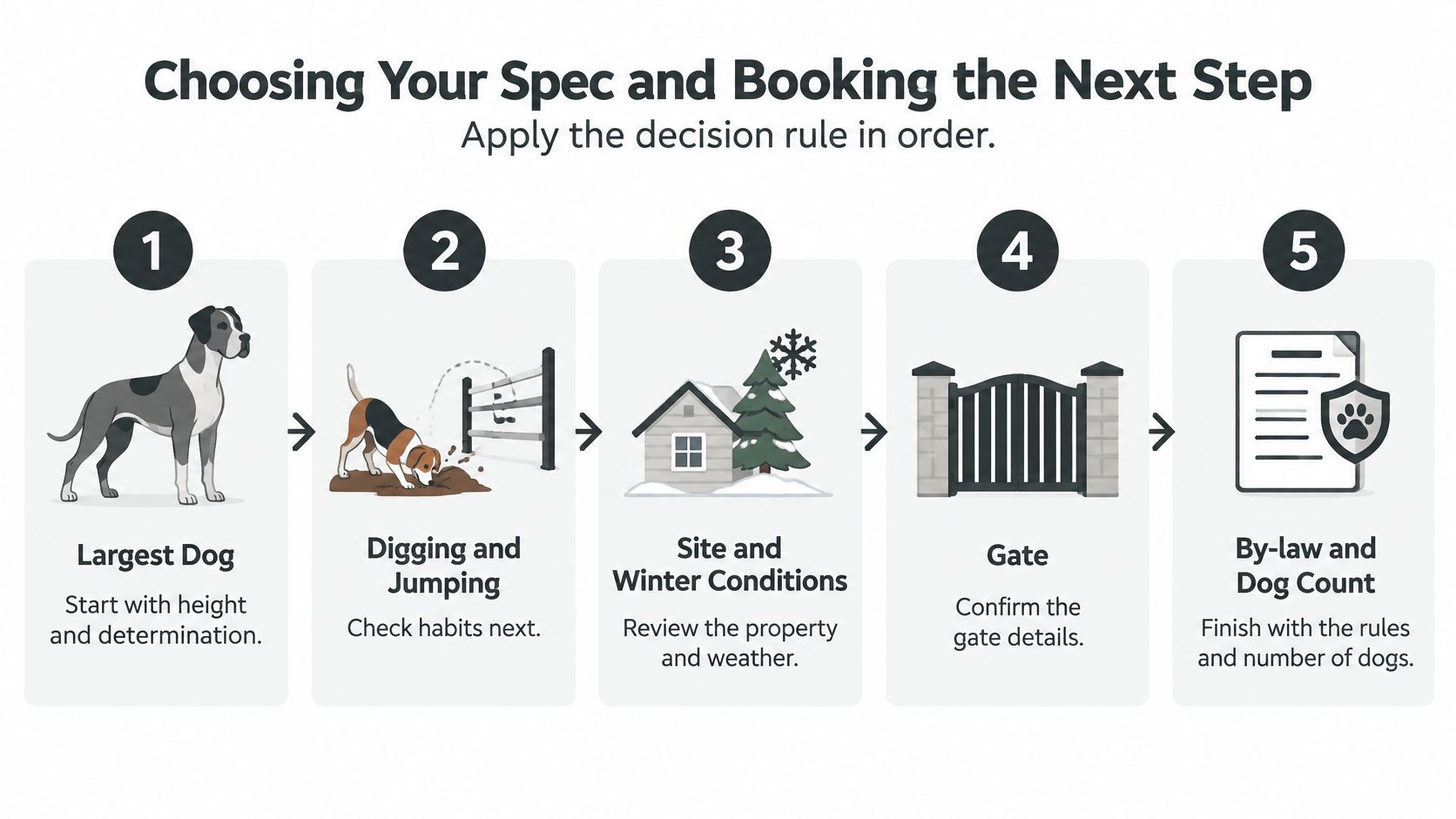
Use this sequence to turn your dog's habits into a specification.
Make the decision in a useful order
Largest and most determined dog: Establish the height and structural starting point.
Digging and jumping habits: Select smaller openings, base protection or a more secure enclosure design where those behaviours justify them.
Site and winter conditions: Identify wet ground, snow-storage areas, slopes and gate-clearing access.
Gate operation: Specify the frame, hinges, closer, latch and threshold together.
Rules and dog count: Confirm property classification, permitted use and any special containment requirements before ordering.
For a strong jumper, discuss a taller enclosure and inward return rather than assuming ordinary residential chain link will suffice. Where Gatineau's detailed provisions apply, build to those requirements; for a dangerous dog, obtain the municipality's direction before committing to materials.
Avoid the expensive traps: buying the heaviest wire while leaving the ground saturated, or installing a tall perimeter with an access gate nobody reliably closes. Neither problem is solved by choosing a more impressive product description.
Take a specific next step
This week, send prospective installers your dog's shoulder height, escape habits, household dog count and a sketch showing gates, slopes and wet areas. Include photographs of winter snow-storage locations if you have them.
Ask for mesh size, gauge, footing design, gate hardware, base treatment and drainage in writing. Compare those entries before comparing totals, and don't book until you understand who handles approvals and post-install adjustments.
FenceScape offers chain-link perimeter fencing, kennel-style runs and secure gates for Ottawa–Gatineau properties, with planning and installation support. Visit FenceScape to discuss your dog's habits, yard conditions and a written specification that includes the gate, ground and winter-use details.
Comments