
Rolled Wire Fence Guide: Types, Costs and Ottawa Rules

“Buy a roll tall enough for the job and stretch it between posts” is bad fencing advice. Height matters, but it won't rescue mesh that lets an animal through, thin wire that bends under pressure, or a coating that rusts at the joints.
A rolled wire fence is a specification decision, not a single product. Start with what it must stop, then choose the wire, openings, coating and support system. In Ottawa–Gatineau, check the intended use against municipal requirements before buying, especially around pools.
What Rolled Wire Fence Is and Its Main Types
A roll that looks right on the shelf can still be wrong for the job. Rolled wire fence is a specification, not a single product: its wire construction, gauge, coating and mesh layout determine what it can contain and how it must be supported.
The three main constructions behave differently:
Woven field fence has vertical wires woven around horizontal line wires. Its joints let the mesh follow changes in ground level.
Welded wire has fused crossings that hold a regular grid. It suits gardens and pet enclosures, but forcing it over uneven ground can distort openings or damage welds.
Chain-link fabric uses interlaced wire. It needs compatible terminal fittings, tension bars and a supporting framework rather than staples on posts.
Read the specification before the label
Gauge describes wire thickness, and a lower gauge number means thicker wire. For example, 12.5-gauge wire is heavier than 14-gauge. High-tensile wire resists permanent stretching, but it also transfers substantial force to end and corner posts.
For longer fence life, the Manitoba fencing guide recommends at least 12.5-gauge wire with Class 3 galvanizing. A coloured coating alone does not identify the steel's thickness or the quality of its underlying coating.
Rolled wire fence types, specifications and roll sizes
Type | Typical wire | Coating | Typical roll or height |
|---|---|---|---|
Woven farm fence, field and livestock | 12.5-gauge high-tensile | Class 3 galvanized | 330 ft roll, 12 in or 6 in vertical spacing |
Wildlife exclusion woven wire | 12.5-gauge high-tensile | Class 3 galvanized | 78–96 in fabric height |
Chain-link fabric, light duty | 11-gauge | Galvanized, electrolytic or hot-dip | 15.24 m roll, plus or minus 1% |
Chain-link fabric, heavy duty | 6-gauge | Galvanized or PVC | 7.62 m (25 ft) roll |
Vinyl-coated welded wire | 14–16-gauge | Vinyl coating | 48 in by 50 ft roll |
Farm page wire | 12.5-gauge high-tensile | Galvanized | 39 in by 330 ft roll |
These specifications describe different products, not interchangeable fence assemblies. Mesh, wire and coating must suit the animal or load; dimensions then determine whether the roll fits the run. For indoor inventory protection, secure storage options for warehouse facilities show purpose-built mesh panels designed for controlled access and panel rigidity rather than following terrain.
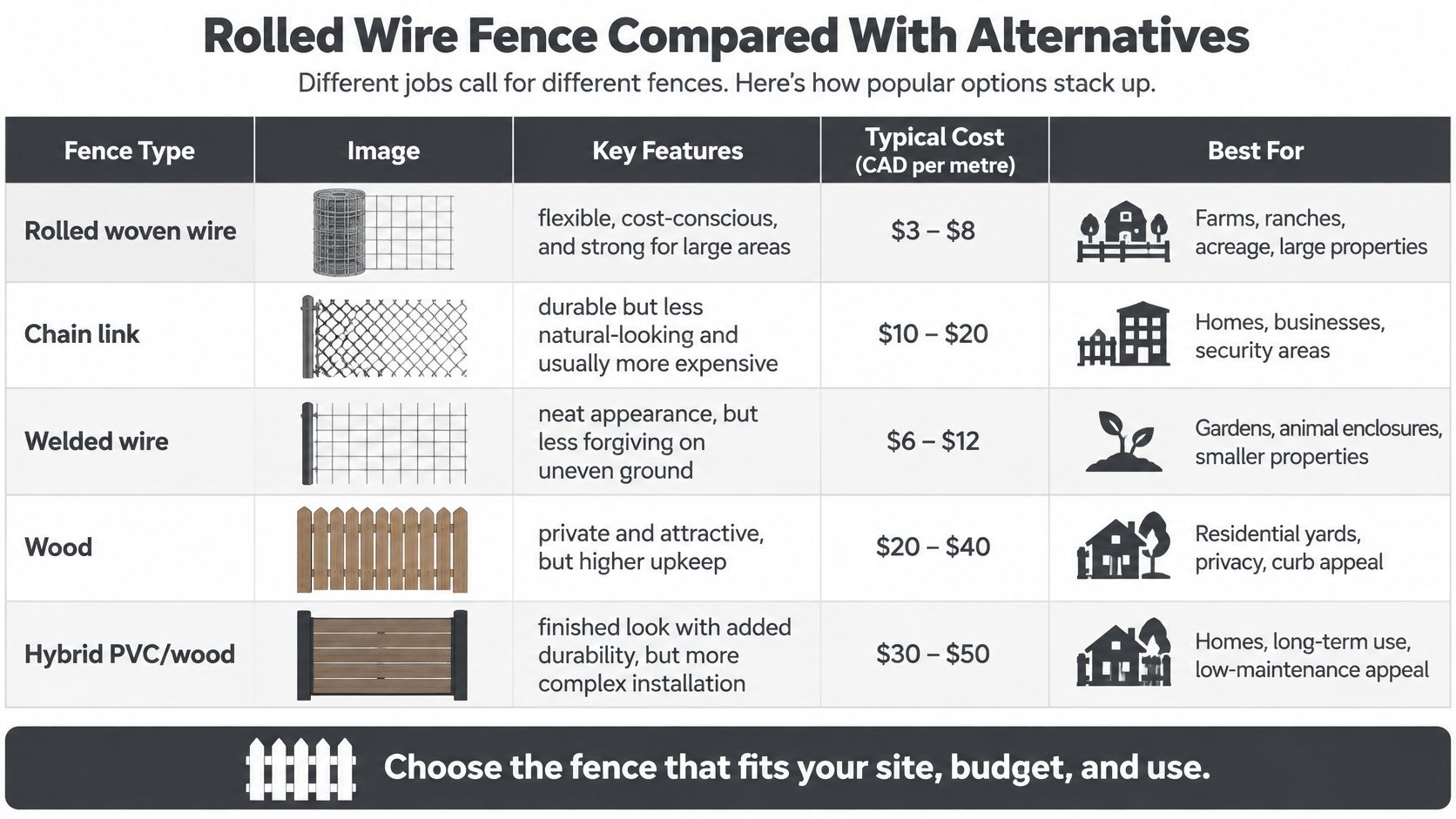
Rolled Wire Fence Compared With Alternatives
Choose the fence that solves your hardest requirement. An open livestock boundary, a private backyard and a secure equipment yard shouldn't start with the same shopping list.
Rolled wire fence against common alternatives
Option | Privacy | Security and animal control | Upkeep | Best fit |
|---|---|---|---|---|
Rolled woven wire | Low | Good for livestock and wildlife | Low, but check tension yearly | Fields, large perimeters, tight budgets |
Chain link | Low, improved with slats | Good with tight mesh and tall posts | Low to moderate, coating matters | Pools, sports areas, commercial perimeters |
Welded wire panels | Low to moderate | Moderate, rigid panels resist sagging | Low | Gardens, pet runs, small yards |
Wood | High | Low alone, strong for privacy | High, rot and staining | Backyard privacy, curb appeal |
Hybrid PVC/wood with steel | High | Good with steel core | Low | Privacy with longer service life |
The visual comparison helps separate appearance from function.
What you gain and give up
Privacy is the clearest dividing line. Open wire preserves sightlines and daylight, but it doesn't screen a patio. Wood or hybrid PVC/wood with steel is the stronger starting point when privacy and a finished street-facing appearance are the priorities.
For security and containment, distinguish a boundary marker from a barrier. Chain link provides an integrated framework and gate system; the chain-link fence fabric guide helps buyers distinguish fabric choices. A determined animal may push under otherwise sound fencing, while a person may exploit an unsecured gate rather than attack the mesh.
A rigid panel holds its shape through its frame and welded grid. A roll needs a properly supported, correctly tensioned installation to avoid sagging.
Wood requires attention to staining, drainage around posts and rot-prone joints. Hybrid PVC with steel suits owners seeking privacy with less surface maintenance, although its component system makes installation more involved than fastening boards to rails.
Choose by situation
Large perimeters and livestock: Choose woven wire when following terrain and controlling material use matter most.
Pools and sports areas: Consider chain link where visibility and tight mesh are useful, subject to enclosure rules.
Gardens and pet runs: Use welded panels where a tidy, rigid boundary suits the ground.
Backyard screening: Choose wood or hybrid construction when privacy outweighs openness.
A fence can suit its use on paper and still fail if the wire or coating is wrong.
Where Rolled Wire Fence Works Best
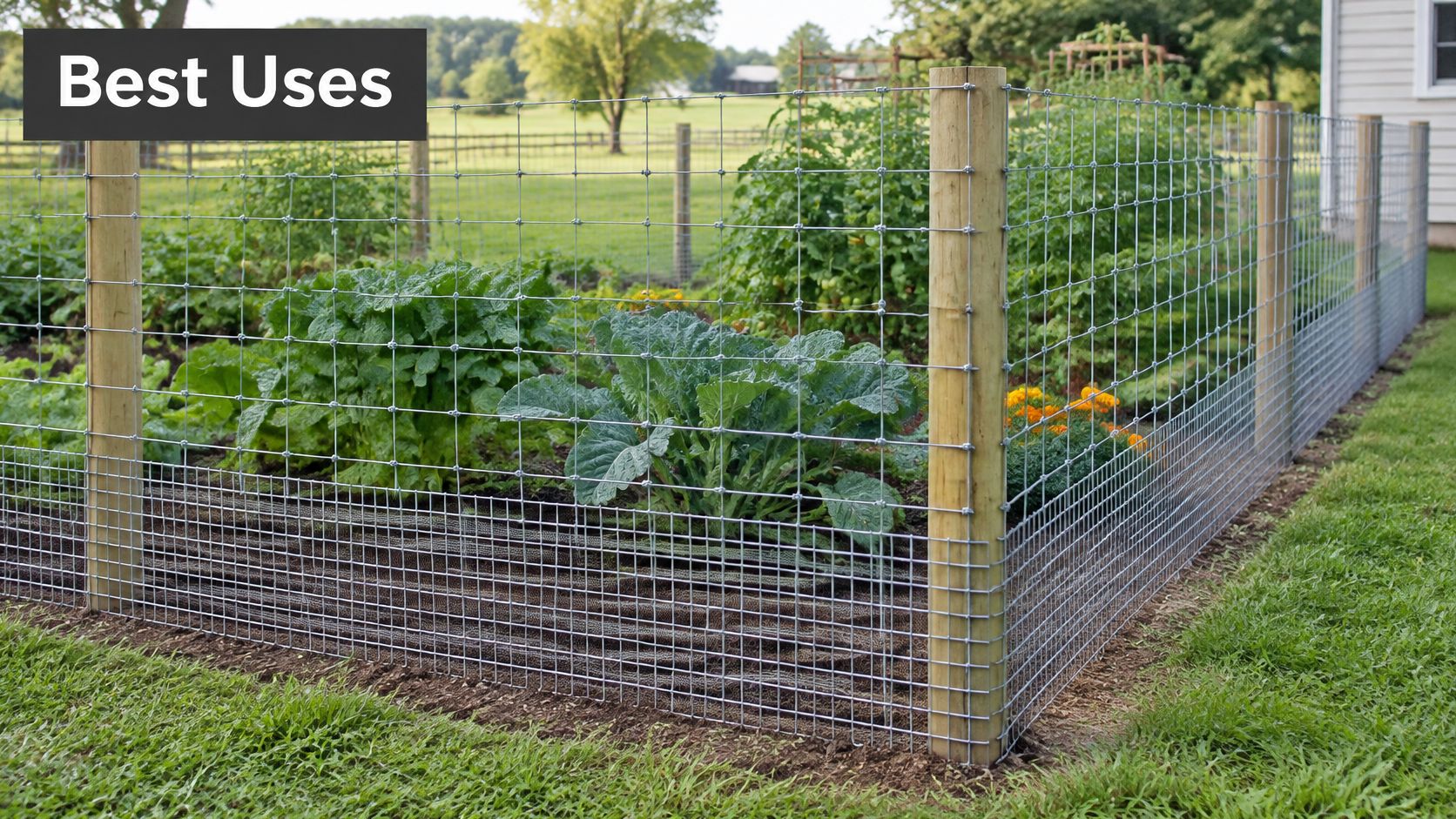
A vegetable garden is a sensible place for light wire fencing, provided you design around the animals reaching the crops. A net stops a ball because of its openings, not merely because it's tall. The same principle applies to rabbits, dogs and wildlife.
This garden layout shows the value of keeping the enclosure close to the area being protected.
Match the barrier to the pressure
Residential example: Say you're enclosing a vegetable plot with a 1.2 m run. That's a layout choice, not a promise of wildlife exclusion. Use tighter lower openings for small animals, secure the bottom edge and make the gate threshold as resistant to entry as the fence.
Agricultural example: For a livestock perimeter, choose woven fabric that accommodates the terrain without leaving escape routes at dips. Separate the demands of stock containment from wildlife exclusion: animals pushing from inside and animals jumping from outside create different design problems.
Commercial example: A long boundary around a storage yard may need visibility and light access control rather than privacy. The RCMP security-fencing guide identifies mesh options from 2 3/8 inches down to 3/8 inch and wire from 14 AWG through 6 AWG, excluding coating, as specifications to select alongside finish, fabric width and edge treatment. A thin garden roll isn't an equivalent substitute for a security assembly.
The installation demonstration is useful for recognising how fabric, posts and attachment hardware work together.
Pool safety is a separate use
A roll that contains a dog isn't automatically a pool enclosure. Treat an ordinary shelf-stock product as unapproved until the finished design, gates and supports have been checked against local requirements.
Ask what the fence must stop and what it protects. That answer should determine whether you need garden mesh, livestock fabric or a purpose-designed enclosure.
Ottawa–Gatineau Code Rules for Rolled Wire Fence
A roll that looks suitable on the shelf can fail as a pool or construction enclosure. In Ottawa–Gatineau, check the finished fence against the rules for its location and purpose before choosing mesh, posts or gates.
For privately owned outdoor pools in Ottawa, the City's pool-enclosure and permit guidance requires a permit, even when a yard fence already exists. It also specifies a minimum enclosure height of 1.5 m and openings that prevent passage of a 100 mm sphere.
Quebec's residential swimming-pool regulation sets a minimum enclosure height of 1.2 m, prohibits passage of a 10 cm sphere, and limits chain-link openings to 30 mm.
Pool and construction fence requirements, Ottawa and Gatineau
Requirement | Ottawa | Gatineau (Quebec) |
|---|---|---|
Minimum pool enclosure height | 1.5 m | 1.2 m |
Maximum chain-link mesh opening | Check the City's pool-enclosure requirements | 30 mm |
Sphere that must not pass through | 100 mm | 10 cm |
Gate lock height | Check the City's pool-enclosure requirements | Confirm access-hardware requirements with Gatineau |
Permit for pool enclosure | Required, even with an existing yard fence | Confirm municipal permit requirements before purchase |
Climbing and hazardous parts | Check the City's pool-enclosure requirements | No fixture, projection or open part that enables climbing |
Temporary construction fence near public path | 1.8 m within 3.0 m of path | Confirm site-specific municipal requirements |
Why an ordinary roll fails
Mesh opening is a specification, not a cosmetic detail. A fence can meet the height requirement and still fail if its openings are too large. Choose the fabric and supporting parts as one assembly, and confirm the proposed design with the municipality before ordering.
For Ottawa pool projects, check the City's requirements for posts, gates and mesh directly. Do not assume a standard roll, post or latch qualifies because it is sold as fencing.
Before buying: Get the complete enclosure design accepted, not just confirmation that wire fencing is allowed.
Construction fencing isn't garden fencing
Under Ottawa's construction-fencing requirements, a site within 3.0 metres of a public pathway or gathering place needs a fence at least 1.8 metres high. The fence must reject a 100 mm sphere, and gates must be secured during off-hours. Lightweight mesh on loosely driven stakes is not an equivalent system.
Before ordering, confirm:
Dimensions: Finished height, mesh openings and clearance beneath the fence.
Access: Gate swing, closing action, latching and lock placement.
Climbing: Nearby objects, projections and footholds.
Approval: Permit documents and municipal acceptance of the proposed assembly.
Use the Ottawa fence bylaw guide to organise local checks. HomeProBadge's guide can help you understand fence permit costs, but confirm fees and requirements with the municipality.
DIY or Professional Installation
Ask yourself whether the run is short and straight, whether the soil is firm, and whether the project is free of special pool or construction requirements. If you can't answer yes to most of those conditions, professional installation deserves serious consideration.
DIY saves labour charges, but you're responsible for correcting every loose post, awkward splice and gate that drops out of alignment.
DIY or professional, task by task
Task | DIY feasible | Why it matters | Hire a pro when |
|---|---|---|---|
Measuring and roll count | Yes | Waste and extra joints add cost | Irregular or long runs |
Setting corner and terminal posts | Yes, with a rented auger | Corner loads drive most failures | Soft or wet soil, or deep frost |
Tensioning high-tensile wire | Harder | Over-tension overloads staples and braces | Long runs held under high tension |
Gates and latches | Yes | Lock height and closing action determine compliance | Pool or security gates |
Permits and code checks | Owner's responsibility | Pool and construction rules are strict | Always confirm with the municipality |
Workmanship and cleanup | Owner carries all fixes | Problems appear after the first thaw | You need contracted correction and cleanup |
Estimate the work, not just the fabric
The Canadian General Standards Board chain-link specification gives standard rolls of 15.24 metres, plus or minus 1 percent, for 9- and 11-gauge fabric, and 7.62 metres (25 feet) for 6-gauge fabric. Allow additional material for terminations, connections and layout adjustments rather than ordering exactly the measured boundary length.
An auger makes digging easier; it doesn't determine whether a corner foundation is adequate. Check buried services before digging, and don't operate tensioning equipment without understanding its rated capacity and release procedure.
For gate budgeting, Wisenet Security Ltd's discussion of security gate installation costs helps identify the hardware and installation scope to ask about, rather than supplying a local price.
Require every quote to name the mesh, bare-wire gauge, roll width, edge finish and coating process. Also identify who handles spoil removal, damaged landscaping and post-installation adjustments.
Installing Rolled Wire Fence Step by Step
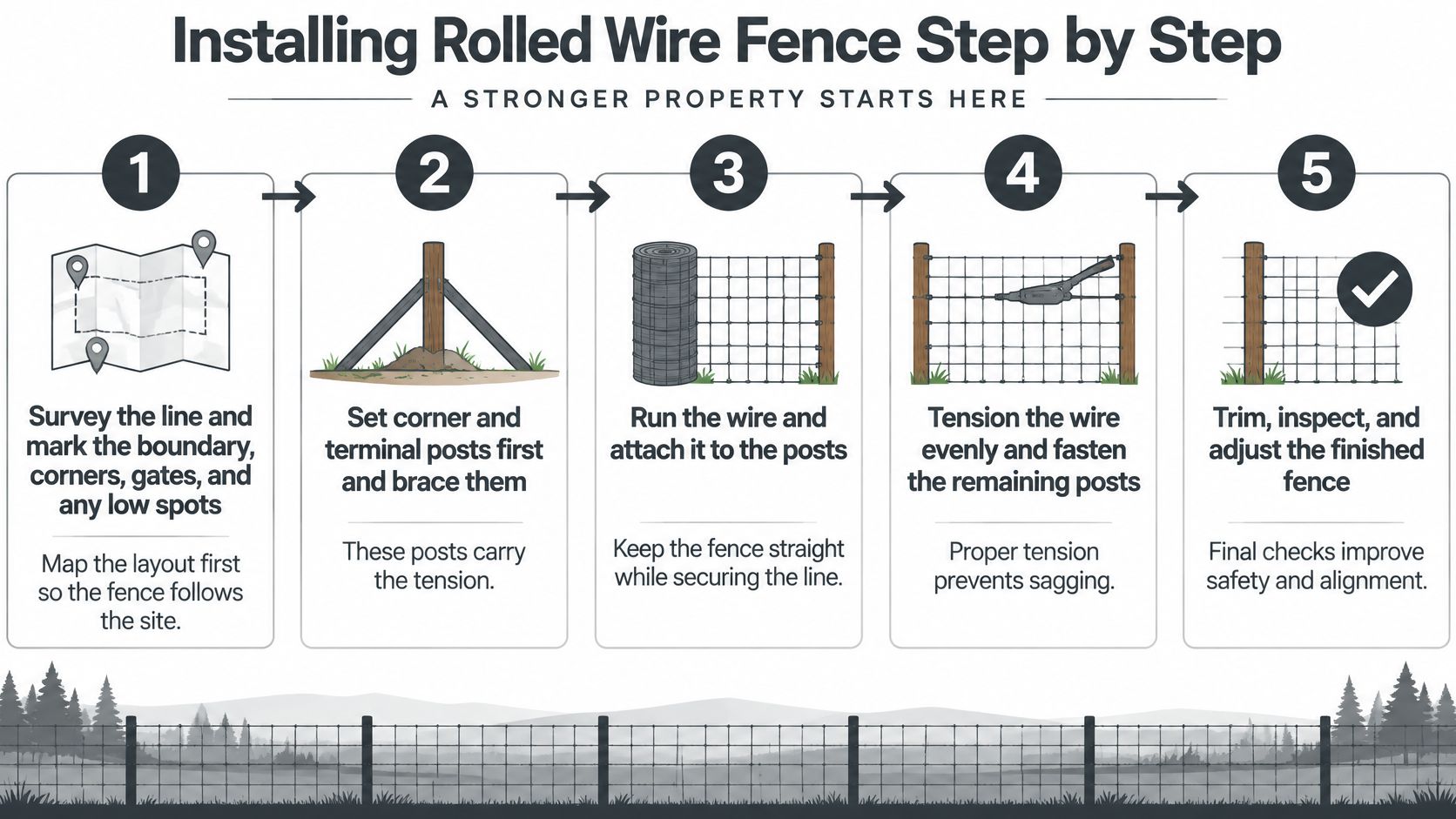
This sequence applies to tensioned woven-wire fencing. Chain link uses its own framework and fittings, while welded garden mesh shouldn't be stretched as though it were high-tensile field fence.
The overview shows the main workflow before the detailed checks.
Build the supports before applying tension
Survey and mark the line. Confirm the boundary, locate buried services, and mark corners, gates and low spots with stakes and string. Don't assume an old fence follows the legal property line.
Set corner and terminal posts first. Brace them against the pulls they'll receive, including both directions at corners. These assemblies carry the tension, so adding stronger fabric won't compensate for weak foundations.
Install the line posts. The British Columbia woven-wire exclusion guide describes posts commonly 4–5 inches in diameter, spaced roughly 15–20 feet apart, and tensioning until approximately half the original tension curve is removed. Determine embedment for local frost and soil conditions, and tighten the layout where terrain requires extra support.
Unroll and anchor the fabric. Use a roll carrier where practical and keep the roll under control on slopes. Attach the starting end to the completed terminal assembly, with the intended bottom edge correctly oriented.
Tension the run evenly. Use a full-height straining bar and suitable puller rather than pulling individual horizontal wires with pliers. Too little tension leaves sag and gaps; too much overloads staples, braces and corners, so preserve the intended tension curves rather than pulling them flat.
Fasten without damaging the system. Secure the fabric to line posts and any specified top or bottom support wires. On woven-wire systems that require movement through staples, don't hammer the staples tight against the horizontal wires.
Deal with dips and bottom gaps. Walk the outside and inside of the run, looking from the animal's level. Add appropriate support or ground detailing instead of pulling the whole fence downward and distorting the grid.
Hang and test the gates. Use hinges and latches rated for the gate load, adding automatic closing hardware where required. Secure cut ends so they can't snag clothing, skin or animals.
Final walkthrough
The fence-post placement guide is useful when laying out supports around changes in direction.
Tension: Look for uneven pull, distorted mesh and leaning terminals.
Fasteners: Check attachment positions and damaged coatings.
Gates: Test swing, closing action and latch engagement.
Bottom edge: Close unintended gaps without creating sharp projections.
Maintenance, Lifespan and Cost Ranges
Reference material and installation prices
Item | Reference price | Basis | Lifespan note |
|---|---|---|---|
Farm page wire roll, 39 in by 330 ft | CAD 303.13, September 2026 | Check coating specification before predicting durability | |
Vinyl-coated welded wire roll, 48 in by 50 ft | CAD 104.99, 2026 | Best Buy Canada listing, material only | Coating resists corrosion; life depends on finish quality |
Four-strand barbed wire, installed per mile | CAD 7,391.80, 2022–23 | Saskatchewan estimate published by the Government of Alberta, including materials, equipment and labour | Rural reference only, not comparable to residential rolled wire |
These figures are reference points, not an Ottawa–Gatineau installed-price range. Compare material-only prices with material-only prices. An installed estimate should identify excavation, foundations, gates, removal and restoration so you can see what the total includes.
What determines service life
Service life depends on the full fence assembly, not just the roll. Fabric may remain usable while rotten posts, loose terminals or failing staples leave the fence ineffective.
Coating damage often shows first at cut ends and wire crossings. Check these points during inspections. A clean-looking broad surface does not show whether the finish is intact where wires meet.
Budget for posts and braces as carefully as the roll. Replacing fabric is inconvenient; rebuilding foundations can mean dismantling the whole run.
Maintain it through the seasons
Wet freeze–thaw conditions can shift posts, snow piles can press against fabric, and roadside salt can increase corrosion exposure. A seasonal routine helps catch damage before it spreads:
After the spring thaw: Check for sagging, lifted posts and gaps at low points. Correct support movement before adjusting fabric tension.
During growing weather: Clear brush and vines pressing on mesh or hiding damage. Keep gate travel clear.
Before winter: Check hinges, terminals and braces. Store snow away from the fence where possible.
After heavy snow: Inspect corners and gates before forcing any part that binds.
After the first winter: Check whether the installation has settled and needs re-tensioning. Do not tighten it automatically.
When damage occurs: Repair with compatible sleeves or splices, and use corrosion protection suited to the original finish.
Rinse salt-exposed runs where practical. If rust has broken a weld or splice, repair the failed connection before applying paint.
Get a Free Estimate From FenceScape
Gather the details that let an estimator distinguish a straightforward boundary from a demanding enclosure:
Use: State whether you're enclosing a pool, livestock area, pet run, commercial yard or general perimeter.
Required barrier: Record the intended height and opening requirements, along with any municipal correspondence.
Layout: Measure the runs in metres or feet and mark corners, slopes and low spots.
Access: Identify gate locations, clear opening needs and any lockable or automatic-closing hardware.
Site information: Provide a sketch and photos showing the fence line, nearby structures and access for equipment.
A useful estimate should return more than a total and the words wire fence. It should describe the proposed mesh, bare-wire gauge, fabric width, edge treatment and coating process, together with the support and gate assemblies.
Compare complete proposals
Check how each contractor plans to handle difficult ground, abrupt grade changes and existing fence removal. If a proposal excludes rock excavation or restoration, understand how those items will be assessed before accepting it.
For a material-only purchase, use the same specification sheet to compare suppliers. Ask whether fittings, ties, tension bars, caps and gate hardware are included, because a low fabric price can conceal an incomplete shopping list.
Don't substitute a lighter product just because the dimensions match. Ask the estimator to explain what changes in performance or support requirements occur when the wire, coating, or mesh changes.
Know when a site assessment matters
Pool enclosures, commercial perimeters and long or irregular runs deserve a closer assessment. Photos help, but they may not reveal soft ground, drainage problems, installation access or the way a gate meets a sloping driveway.
Projects involving permits also need a clear division of responsibility. Establish who prepares the drawings, who submits the application and who answers questions about the finished installation.
Request an estimate with your specification sheet and site details ready. That gives the contractor a defined problem to solve and gives you a practical basis for comparing the proposed work.
FenceScape offers free estimates and custom fencing design and installation for Ottawa–Gatineau properties, including chain-link boundaries, pool enclosures and commercial perimeters. Visit FenceScape with your measurements, photos and containment requirements to discuss an appropriate wire-fence specification and complete installation scope.
Comments