
Professional Fence Installation: Ottawa Costs and Permits

A premium fence can lean just as badly as a budget fence. Frozen, waterlogged soil can lift a poorly founded post regardless of what's attached to it, and a heavy gate exposes weak installation faster than a straight run of panels.
Professional fence installation is therefore worth judging from the ground up: foundation depth, drainage, post sizing and gate hardware first, finish second. In Ottawa–Gatineau, the right quote should explain those decisions and include a check after the first winter, not just name a material and promise a straight line.
Installed Costs, Hidden Extras and Financing
There isn't a defensible local installed-price range for every material without current, comparable quotes. A per-foot figure that excludes gate hardware, excavation difficulties or disposal can make an expensive job look cheap.
Use the following comparison to build matching specifications. Treat advertised prices as planning allowances, not a published tariff for your property.
Indicative installed cost by fence type, Ottawa–Gatineau
Fence type | Typical use | Main cost driver |
|---|---|---|
Galvanized chain link, 4 ft | Security, pet and sports yards | Gauge and post spacing |
Pressure-treated wood privacy, 6 ft | Budget privacy for backyards | Lumber grade and board spacing |
Cedar privacy, 6 ft | Natural look and curb appeal | Cedar grade and framing method |
PVC privacy, 6 ft | Low-maintenance privacy | Colour, profile and hardware |
Hybrid PVC with steel frame, 6 ft | Long spans and wind-exposed yards | Steel framing and fasteners |
Ornamental aluminum or iron, 4 to 5 ft | Front yards and decorative boundaries | Panel style and finish |
Glass railing panels | Decks, pool surrounds and sightlines | Glass type and hardware |
Code-compliant pool enclosure, aluminum | Pool barriers | Gate hardware and permit scope |
The heights above identify example specifications, not permitted heights or guaranteed pool compliance. Ask bidders to price the same height, construction method and gate arrangement.
For a hypothetical budgeting example, a 150-foot cedar perimeter priced at $50 to $80 per linear foot would total $7,500 to $12,000 before extras. That's arithmetic, not a verified Ottawa–Gatineau market range. Use your measured footage and an actual written rate to make the same calculation.
The fence installation cost-per-foot guide can help organise the questions behind that rate.
What changes the final bill
Removal and disposal: Ask whether the price includes old concrete footings, not just visible panels.
Slopes: Stepped or racked panels require different cuts, brackets and layout work.
Difficult holes: Rock, roots and restricted machine access can change the excavation method.
Gates: Each opening needs its own posts, hinges, latch and installation allowance.
Special orders: Custom colours and rush scheduling can change both price and availability.
Neighbourhood orders can reduce mobilisation and purchasing costs when neighbours choose compatible specifications. Separate contracts should still identify each household's footage, gates and extras.
Compare unsecured home-improvement loans, promotional deferred-interest plans and home equity lines of credit by total borrowing cost, not monthly payment alone. Deferred interest isn't necessarily waived interest; check what happens if a balance remains at the promotional deadline. FenceScape offers financing and promotional programs for Ontario and Quebec customers, subject to the applicable terms.
Request an itemised quote separating materials, labour, removal, gates and any financing charges.
Install It Yourself, Hire a Crew, or Buy Materials Only
A short, flat, straight fence without a pool, shared boundary or street frontage is a realistic DIY project for a capable homeowner. Once the job includes slopes, difficult soil or frequently used gates, the savings become less predictable.
Choose the route that matches the risk
Materials only: Suitable when you can establish the layout, select an appropriate footing design, arrange utility locates and handle the tools safely. Confirm whether cut lists, brackets, fasteners and post caps are included.
Hybrid installation: Ask whether a contractor will set the posts while you install rails and panels. Agree on post spacing and bracket positions before digging, because the panel system dictates the layout.
Full professional installation: The sensible choice for pool enclosures, sloped lots, commercial perimeters and gates you depend on daily. Shared boundaries also benefit from professional layout rather than assumptions about the existing fence.
Labour is a substantial part of installation, so DIY can save money on a straightforward run. It can also transfer surveying, excavation, material handling and correction costs to you.
Price the entire DIY job: auger rental, saw blades, concrete, delivery, disposal, protective equipment and help lifting panels. An auger also needs room to operate; a narrow side yard may require different equipment or hand excavation.
Practical rule: Don't compare a materials receipt with a turnkey quote. Compare the cost of a finished, functioning fence with the same scope.
A misplaced post can cost more to relocate than you saved installing it. For a pool, disputed shared line or street-facing boundary, pay for professional survey and layout work where needed before committing to post positions.
Ottawa and Gatineau Rules Before the First Post
No building permit doesn't mean no rules. Under the City of Ottawa's building-permit guidance, a standard residential fence generally needs no building permit but must comply with Fence By-law 2003-462, including installation, maintenance and repair standards and the good neighbour policy requiring the more attractive side to face neighbouring property and the street.
Ottawa pool enclosures require a Pool Enclosure Permit and municipal review. The City also provides access to permit records, plans and inspection reports, which can help with due diligence on an older or altered property.
Careful measurement supports the layout, but a tape measure alone doesn't establish ownership.
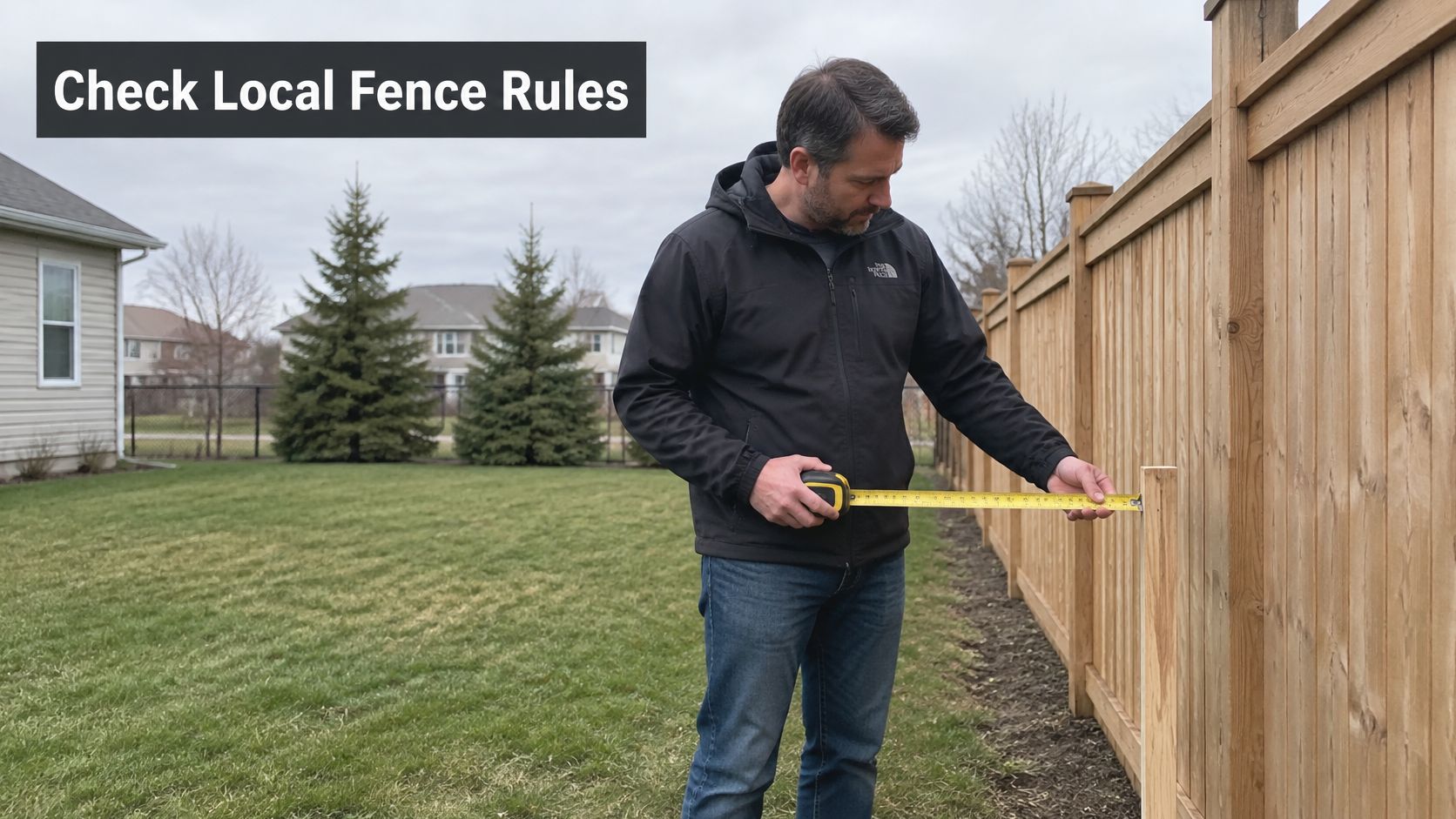
Check the boundary before choosing the fence line
Gatineau's residential-fence guidance allows a fence directly on a property line except beside a street right-of-way, where prescribed setbacks apply; ordinary residential fences need no permit unless they protect a swimming pool. The fence must remain on private land rather than encroaching into the public domain.
That distinction matters on corner lots. A position that works between backyards may not work alongside a street, and the pavement edge isn't a reliable substitute for the legal boundary.
Complete the pre-build checks
Confirm the boundary. Use reliable survey information, not an old hedge, mowing line or leaning fence.
Identify public land. Have the proposed layout checked for a street right-of-way or other public interface.
Choose the outward-facing side. Settle the finished appearance before ordering asymmetric panels.
Classify the enclosure. Establish whether any part of the fence serves as a pool barrier.
For shared fencing, put the proposed alignment on a drawing neighbours can understand. Permission to enter a yard for installation is a separate issue from agreement about where the fence belongs.
Use the local fence by-law guide to prepare your questions, then confirm the applicable requirements with the municipality. Don't assume an installation specification transfers unchanged across the Ottawa River.
Choosing Materials That Survive Freeze–Thaw Winters
Premium material alone won't keep a fence straight through an Ottawa winter. The City of Ottawa's pool-enclosure brochure requires non-frost-susceptible posts, making frost performance a safety consideration as well as a durability concern.
Common fence materials compared for freeze–thaw climates
Material | Maintenance | Freeze–Thaw Behaviour | Best Fit |
|---|---|---|---|
PVC (vinyl) | Wash yearly | Expands with heat; needs room for movement | Low-maintenance privacy |
Hybrid PVC with steel | Wash yearly | Steel core resists sag over long spans; foundations still matter | Long runs and wind exposure |
Cedar | Seal every 2 to 3 years, subject to coating condition | Moves with moisture; kiln-dried stock offers better initial stability | Natural look and curb appeal |
Pressure-treated wood | Seal or stain every 1 to 2 years, subject to product and exposure | Checks and warps; posts carry most structural stress | Budget privacy |
Ornamental iron or aluminum | Inspect coating; touch up compatible finishes | Rigid panels transfer movement to connections and hinges | Front yards and security |
Galvanized chain link | Check fabric tension and damaged galvanizing | Post movement can loosen fabric | Security, pets and sports |
Glass railing | Clean glass; inspect clamps | Frames and clamps need controlled alignment | Decks and pool surrounds |
Maintenance intervals are starting points, not finish warranties. Inspect the surface and follow the coating manufacturer's preparation and application requirements.
Ask about the buried work
Have the contractor state the proposed footing depth and explain how it addresses local frost conditions, soil, slope and fence loading. A universal depth copied into every quote isn't a site assessment.
A compacted, drained gravel base can help manage water, but gravel in an impermeable clay hole may become a reservoir. The installer should explain where water can drain, how surface runoff is directed and which footing system suits the post material.
Gate posts need special attention. A swinging leaf puts force on its hinge post, so post size, footing dimensions and hinge attachment should reflect the gate's width, weight and use. Stronger panels won't compensate for an undersized hinge post.
On a slope, use a deliberate stepped or racked layout. Don't twist rigid panels into position or leave unplanned gaps beneath them.
Buy the foundation and gate specification before you buy the colour.
Include a first-winter check after spring thaw in the agreement. Have the installer recheck post plumb, panel alignment, latch engagement and unrestricted gate swing; movement that prevents safe operation needs correction.
Ask separately about finish coverage and structural workmanship coverage. A warranty against fading doesn't necessarily cover a heaved footing, and adjustable hinges aren't a substitute for repairing a moving post.
What a Professional Crew Handles, Survey to Walkthrough
A fence is a row of buried supports carrying panels, much like a small structure carried by a line of foundations. Most of its quality is decided before the panels arrive.
Typical lead times and durations for a residential fence
These are scheduling checkpoints, not guaranteed local turnaround times. Ask the contractor to replace provisional allowances with dates tied to your project.
Phase | What Happens | Typical Duration |
|---|---|---|
Site survey and quote | Measure; assess slope, soil, drainage and existing fences | Site appointment followed by a written scope |
Design and layout | Choose style, height, gates and finished side | Allow 2 to 5 days provisionally |
Permit check | Verify compliance and pool-permit requirements | Complete before construction; pool review follows municipal processing |
Utility locates | Submit request and obtain required responses | Wait until required information and markings are complete |
Material order | Confirm colour, lumber grade and components | Allow 1 to 4 weeks provisionally |
Installation | Set posts, then fit rails, panels and gates | Provisionally 1 to 3 days for a standard yard; 1 to 2 weeks for complex sites |
Walkthrough and warranty | Inspect work and hand over documents | At completion, with deficiencies recorded |
The process overview shows the handoffs that should happen before excavation and installation.
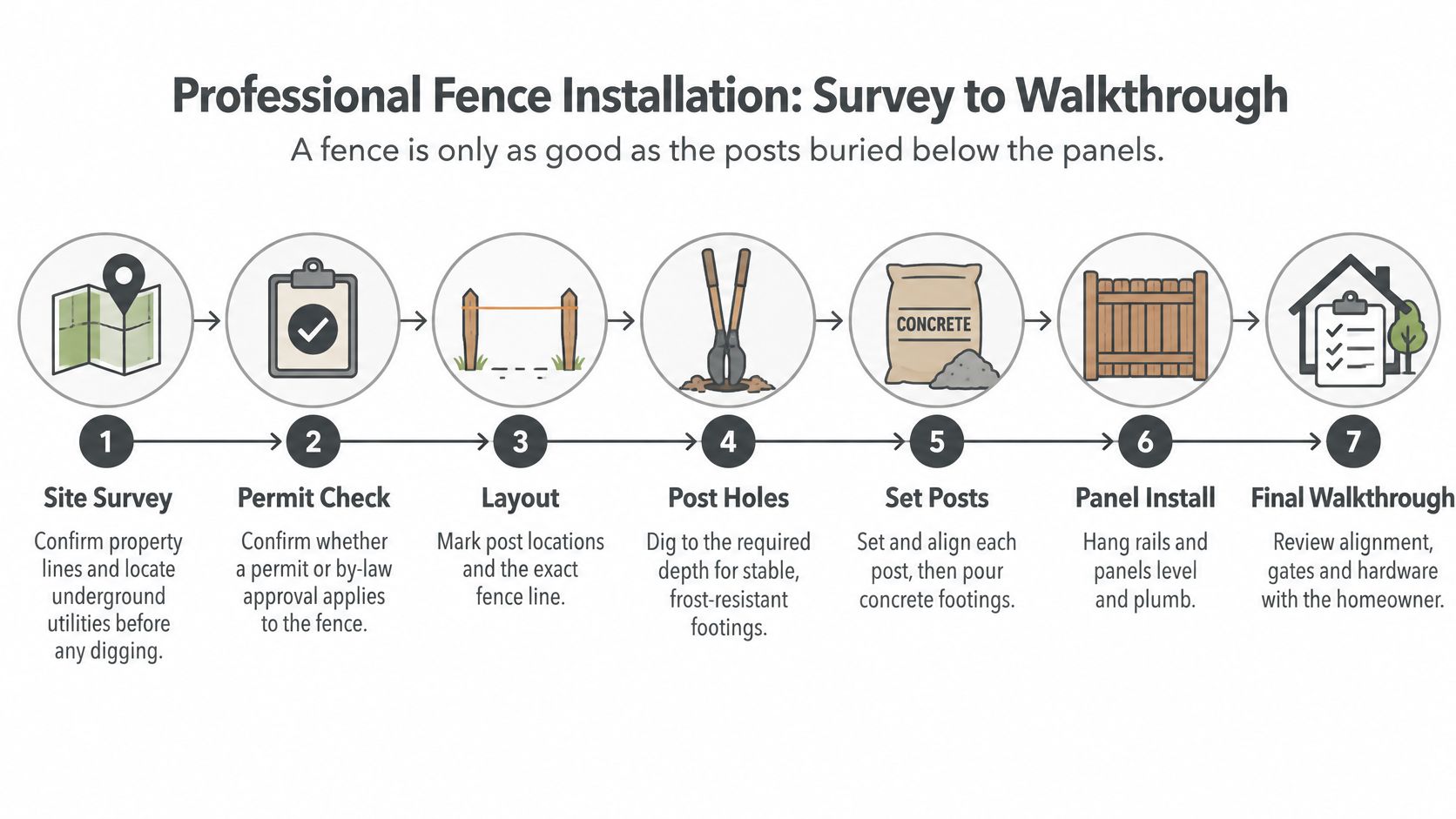
The working sequence
Assess the site. Record slope, soil, drainage, trees and existing structures to choose the post system and panel arrangement.
Establish the legal line. Check survey information before setting string lines.
Arrange locates. The City of Ottawa's landscaping guide says underground infrastructure must be located before digging, even with a hand shovel, and directs residents to Ontario One Call at 1-800-400-2255; it also prohibits fences in the City's right-of-way.
Mark the layout after clearance. Position posts and gates so swings clear steps, equipment and finished grades.
Excavate and set supports. Follow the agreed frost-aware footing design, align posts and allow the setting material to gain adequate strength before loading.
Install and adjust. Fit rails, panels and gates, checking fasteners, swing and latch operation.
Clean and inspect. Remove waste, record deficiencies and supply warranty and maintenance documents.
A serious shortcut is setting posts before locate clearance. Markings also don't establish property ownership, so boundary verification remains a separate task.
Use this installation video as a discussion aid when reviewing the proposed work sequence.
Leave the walkthrough with a written layout, locate confirmation, warranty terms and maintenance schedule. Record any outstanding adjustment rather than relying on a verbal promise.
Pool, Commercial and Group Installs Need Their Own Plan
Pool enclosures, commercial perimeters and shared-property fences each need a plan for approvals, access and responsibility. Foundation depth, drainage and gate hardware matter as much as the finished appearance, especially where a gate must close reliably or several owners share a boundary.
Requirements and design consequences by project type
Project Type | Key Requirement | Rule or Source | Design Consequence |
|---|---|---|---|
Pool enclosure, Ottawa | Pool Enclosure Permit and frost-resistant posts | City of Ottawa pool-enclosure requirements | Resolve approval and footing specification before building |
Pool enclosure, Quebec side | Compliant height, openings and mesh | Quebec provincial rules and local requirements | Specify suitable mesh or an accepted compliant assembly |
Pool gate | Automatic closing and locking | Quebec provincial pool rules; Ottawa enclosures follow the City's requirements | Use purpose-designed self-closing, self-latching hardware |
Pool surroundings | Separation from climb-assisting fixed objects | Quebec provincial pool rules; Ottawa enclosures follow the City's requirements | Map sheds, play sets and equipment |
Commercial perimeter | Confirm security height, access and clearances | Applicable zoning, approved site plan and authority requirements | Survey the site and plan operational access |
Townhouse or HOA line | Approved uniform design | Condo declaration or HOA rules | Coordinate design, warranty administration and repair responsibility |
Neighbourhood group install | Written boundary agreements and coordinated locates | Neighbour consent, locate requirements and contractor terms | Bundle purchasing without losing lot-specific accountability |
For Quebec pools, CAA-Quebec's pool-safety guide describes a minimum barrier height of 1.2 m, openings that prevent a 10 cm sphere passing through or underneath, chain-link mesh no wider than 30 mm, fixed climb-assisting objects kept at least 1 m from the pool or enclosure, and gates that close and lock automatically. Ottawa pool enclosures follow the City's requirements, not Quebec's provincial rules. Municipalities can impose stricter requirements, so confirm the full assembly before choosing mesh or privacy slats.
Design around how people enter
For a pool, check that the closer and latch work across the gate's usable swing. A garden latch that accepts a padlock is not a substitute for self-closing, self-latching hardware.
Commercial owners should define pedestrian access, deliveries, emergency access and vehicle movements before selecting gate equipment. The commercial property access control resource can help frame entry management alongside the physical perimeter. After-hours installation may limit disruption, but the plan should cover temporary security, lighting and keeping required exits available.
Coordinate shared work without blurring ownership
Townhouse and group projects need an approved design, an authorised decision-maker and a clear repair process. Ensure locate markings cover each excavation area. One neighbour's markings do not establish coverage for another lot.
Group purchasing can reduce costs when material choices and schedules align, but shared ordering should not blur responsibility for individual properties. Before posts go in, neighbours should record alignment, installation access, ownership and future repair responsibility in writing, alongside the boundary information. Also agree who handles drainage concerns and gate adjustments, so a problem affecting one lot does not stall repairs for the whole group.
Before approving a special-case fence: Identify the approving authority and the person responsible for obtaining its acceptance.
Vet Your Contractor and Book a Free Estimate
A legitimate contractor should answer detailed scope and safety questions in writing without hesitation. You're not testing whether the salesperson knows every soil condition immediately; you're checking whether the company has a reliable way to resolve uncertainties before digging.
The checklist below is a useful starting point for that conversation.
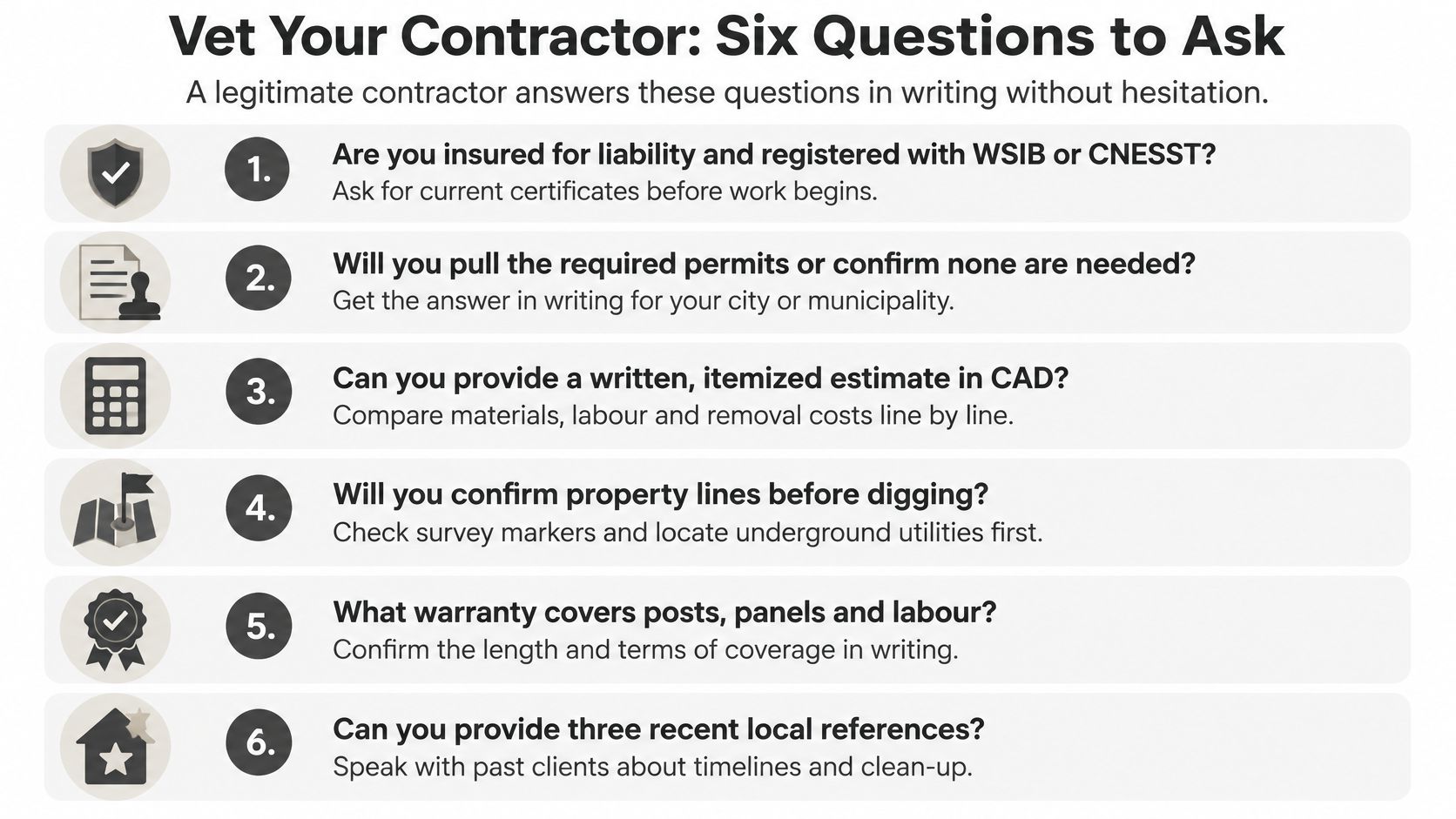
Questions worth getting answered
Are you insured for liability and registered with the applicable workers' compensation body? Ask for current documentation, including WSIB in Ontario or CNESST in Quebec, as applicable to the contractor and work. Check that the contracting business matches the documents.
Who requests utility locates, and will you wait for clearance? The contract should identify responsibility rather than leaving the homeowner and crew each assuming the other has handled it.
Who obtains permits? For pool work, ask whether application preparation, fees, inspections and any required revisions are included. An allowance for paperwork isn't the same as responsibility for approval.
What does the warranty cover, for how long, and is it transferable? Separate manufacturer coverage from installation coverage. Ask explicitly about post movement, gate sag, service-call charges and the first-winter review.
Can you provide three recent references from comparable sites? Ask about communication, cleanup and whether gates still operate properly after winter. With permission, visit a completed installation rather than judging only freshly finished photographs.
Does the quote itemise the actual construction? Look for post material, footing method, concrete, panel specification, removal, gates and cleanup. Clarify how rock excavation or hidden obstructions will be authorised and priced.
What is the payment schedule? Understand deposits, material commitments, progress payments and the balance due at completion. Ask what happens if permits, locates or an unresolved boundary prevent work from starting.
Compare specifications, not sales pitches
Get at least three itemised quotes written to the same specification. Compare the buried work and gate assemblies as carefully as the visible panels; a cheaper proposal may leave out disposal, stronger gate posts or follow-up service.
Red flags include no written quote, missing insurance documentation, pressure to skip locates and cash-only terms without proper records. Also be cautious when a contractor promises a fixed excavation price while refusing to explain how concealed conditions will be handled.
The guide to choosing a premium fence company offers another way to organise your comparison. Keep your own requirements attached to each estimate so substitutions remain visible.
FenceScape is an Ottawa–Gatineau option with in-house crews, PVC, hybrid, wood, ornamental iron, chain-link and glass systems, including cedar and pressure-treated lumber. Its service runs from a free estimate through installation, final walkthrough and post-install support, with financing available.
For an estimate this week, prepare approximate measurements, site photographs, pool status and available boundary documents. Mark proposed gates and access restrictions so the estimator can discuss a buildable layout rather than price footage alone.
Fence Installation Questions Readers Ask Before They Sign
Can a fence be installed in winter?
Yes, but frozen ground complicates excavation and post setting. Ask how the crew will excavate, protect setting materials and verify footing quality under those conditions.
What if a neighbour disputes the line?
Stop before installing posts and have the boundary established using appropriate survey information or a surveyor. Record the agreed installation position separately from any cost-sharing arrangement.
What if a post lands on public land or a service is struck?
Stop work and contact the City or utility as appropriate; keep people away from a damaged service and don't attempt a repair yourself. The contract should identify responsibility for relocation, reporting and repair costs without suggesting that contractual wording replaces legal obligations.
Can I supply my own materials?
Yes, if the installer accepts customer-supplied materials and confirms compatibility before booking. Materials-only purchasing and installation of your supplied materials are different arrangements, so get workmanship coverage, shortages and defective-product responsibility in writing.
Does a free estimate commit me?
An estimate alone shouldn't commit you to installation. Ask whether the site visit is included, how long the quote remains valid and what signed acceptance or deposit creates a binding agreement.
FenceScape offers Ottawa–Gatineau fence planning and installation, including privacy fences, pool enclosures and coordinated group projects. Visit FenceScape to book a free estimate, and bring your measurements, boundary information and gate requirements so the discussion starts with foundations and function, not just finish.
Comments