
A Homeowner's Guide to Vinyl Fence Installation

Deciding on a new fence is a significant project for any homeowner. When you opt for a professional vinyl fence installation, you're choosing a low-maintenance solution designed to last for years. Unlike wood, which demands regular upkeep, vinyl provides a durable, weather-resistant barrier that enhances your property's value and your peace of mind.
Why Vinyl Fencing Is a Smart Move for Your Home
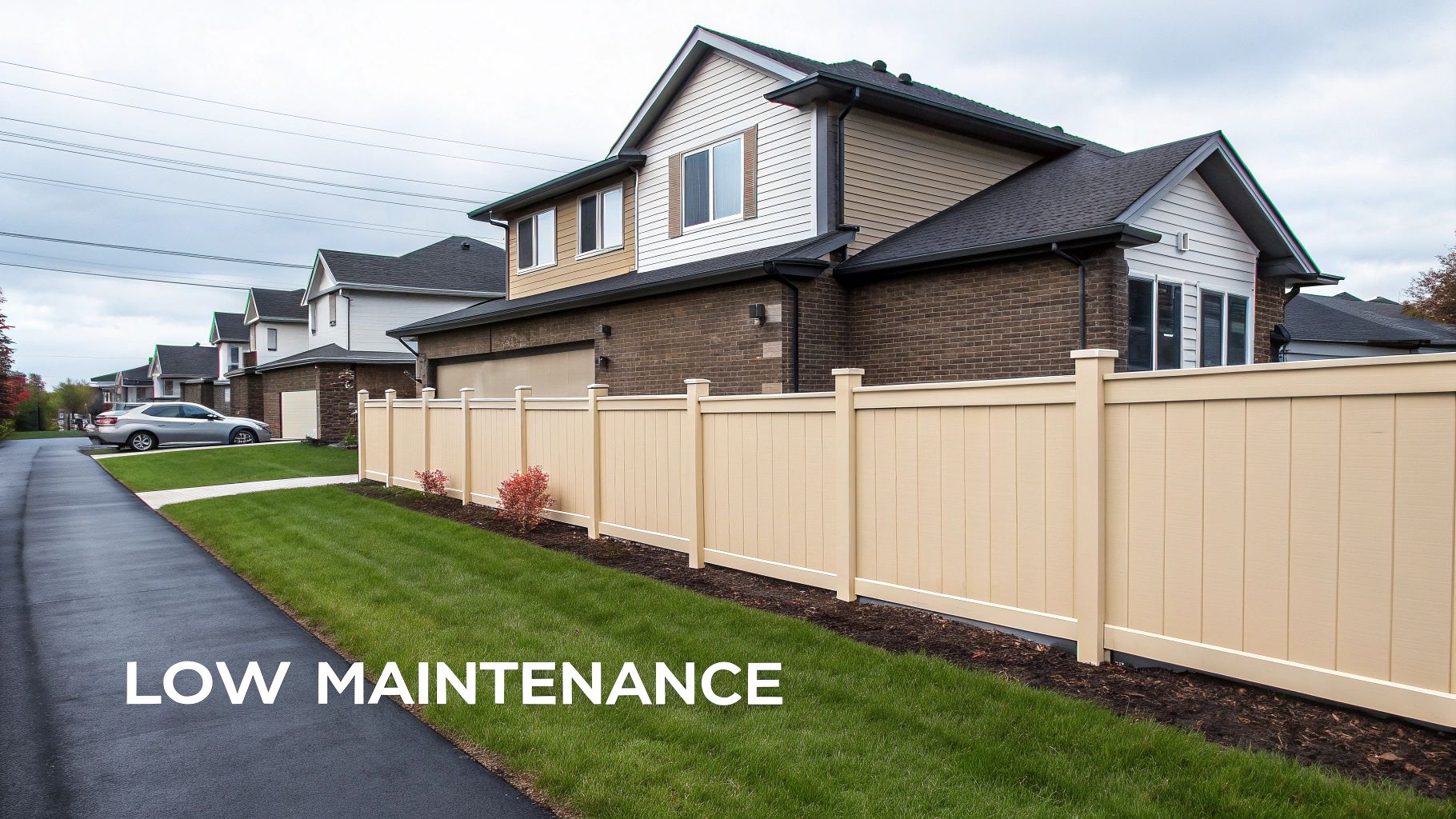
With numerous fencing options available, vinyl stands out as a top choice for homeowners in the Ottawa–Gatineau region. A professional vinyl fence installation is more than a cosmetic upgrade; it's a practical investment in your property's future.
Vinyl is often called the "set it and forget it" fencing material. A traditional wood fence looks appealing initially but requires a constant battle against warping, cracking, and pests. Vinyl is specifically engineered to resist these issues, saving you significant time and money on future repairs.
The Clear Advantages Over Traditional Wood
Vinyl's primary advantage is its exceptional resilience. It doesn’t absorb moisture, eliminating the risk of rot or peeling that affects painted wood. This durability is a crucial benefit in our region, where seasonal weather extremes test every part of a home's exterior.
Barely Any Upkeep: Forget sanding, staining, and painting. To clean your vinyl fence, simply use a hose with a mixture of mild soap and water.
Built for Our Weather: From intense summer sun to heavy snow and ice, vinyl is formulated to resist fading and brittleness.
Looks Great for Decades: Vinyl holds its colour and shape for years, providing a clean, consistent look for your property no matter the season.
A fence should provide security and style without becoming another weekend chore. Vinyl achieves this by breaking the endless maintenance cycle of wood, freeing you up to actually enjoy your yard.
A Popular Choice Across the Ottawa–Gatineau Region
Local homeowners have embraced vinyl for its durability and style. In the Ottawa–Gatineau area, vinyl fence installation has become incredibly popular. Local data shows a 35% increase in residential permits for vinyl fences between 2018 and 2025. Homeowners are choosing vinyl because it can handle a Canadian winter, where temperatures dipping to -30°C won't cause the cracking common in wood—an issue that leads to 60% more maintenance calls for wood fences in this region.
Of course, vinyl isn't the only option out there. Some homeowners prefer unique aesthetics and materials, like certain charred fencing solutions. But if you're looking for that perfect mix of modern style and long-term performance, vinyl is tough to beat. Here at FenceScape, we know our local climate inside and out, so we can walk you through the real-world benefits from day one.
Sorting Out Local Fence Permits and Bylaws
Before a single post hole is dug, your vinyl fence project begins with essential administrative tasks. Understanding local regulations is the critical first step to avoid fines, neighbour disputes, or the costly mandate to tear down a newly completed fence. This process lays the legal groundwork for a successful installation.
You must verify the specific rules for your municipality. Both the City of Ottawa and the Ville de Gatineau have detailed bylaws covering fence height, materials, and placement. Skipping this step is a gamble not worth taking.
When Do You Actually Need a Permit?
For most standard backyard fences, a permit is likely not required. However, certain conditions will trigger the need for an official application. Knowing these triggers is key to a smooth, compliant installation.
You will almost certainly need a permit if your project involves:
Exceeding Standard Height: In Ottawa, any fence taller than 2.1 metres (about 7 feet) typically requires a permit. Gatineau has similar height restrictions, so confirm the exact rule for your property.
Building a Pool Enclosure: This is non-negotiable. All swimming pools require a secure fence with a self-latching gate, and this always necessitates a permit. Safety codes are extremely strict.
Installing on a Corner Lot: Fences on corner lots are subject to "sightline" regulations to ensure clear visibility for drivers and pedestrians. Obstructing this view is a common and costly mistake.
A permit is your project's insurance policy. It serves as the city's official confirmation that your plans are safe and compliant, protecting your investment before work begins. A professional installer like FenceScape will manage this entire process for you, translating complex regulations into a clear action plan.
Two Non-Negotiable Steps Before You Dig
Regardless of permit requirements, two actions are mandatory. First, obtain a property line survey. Do not estimate your property boundaries; this can lead to disputes with neighbours. A legal survey provides undeniable proof, ensuring your fence is built precisely where it should be.
Second, contact Ontario One Call or Info-Excavation in Quebec. This is the free, mandatory "Call Before You Dig" service. They will send a technician to mark the location of all underground utility lines—gas, hydro, internet—so the installation crew knows exactly where it is safe to excavate. This simple call prevents dangerous accidents and service outages.
Ottawa vs. Gatineau Bylaws: Key Differences
While the intent of bylaws is similar on both sides of the river, the specific details differ. These nuances between Ottawa and Gatineau's rules can significantly impact your vinyl fence installation.
This table provides a simplified comparison of common regulations.
Ottawa vs Gatineau Fence Bylaw Quick Reference
Regulation | City of Ottawa Guideline | Ville de Gatineau Guideline |
|---|---|---|
Maximum Rear Yard Height | Typically 2.1 m (7 ft) without a permit. | Generally 2.0 m (6.6 ft) without a permit. |
Maximum Front Yard Height | Usually limited to 1.0 m (3.3 ft). | Also restricted, often to 1.2 m (4 ft). |
Pool Enclosure Rules | Requires a minimum 1.5 m (5 ft) high fence with a self-closing, self-latching gate. | Mandates a minimum 1.2 m (4 ft) high fence with a self-closing, self-latching gate. |
Property Line Setback | No specific setback required, but must be entirely on your property. | Fences must be installed on your side of the property line. |
These details can alter your project's design and budget. Partnering with a contractor who is an expert in local bylaws ensures your fence is built correctly and legally from the start.
The Professional Vinyl Fence Installation Process
A professional vinyl fence installation is a methodical process that goes far beyond digging holes and placing panels. It is a carefully planned operation focused on craftsmanship, ensuring your fence remains stable and straight for decades.
The process begins long before the crew arrives. A solid fence requires a solid foundation, which is why meticulous groundwork is paramount. This preparation is what distinguishes a fence that lasts a lifetime from one that leans after a few Ottawa winters.
This flowchart outlines the critical pre-installation steps.
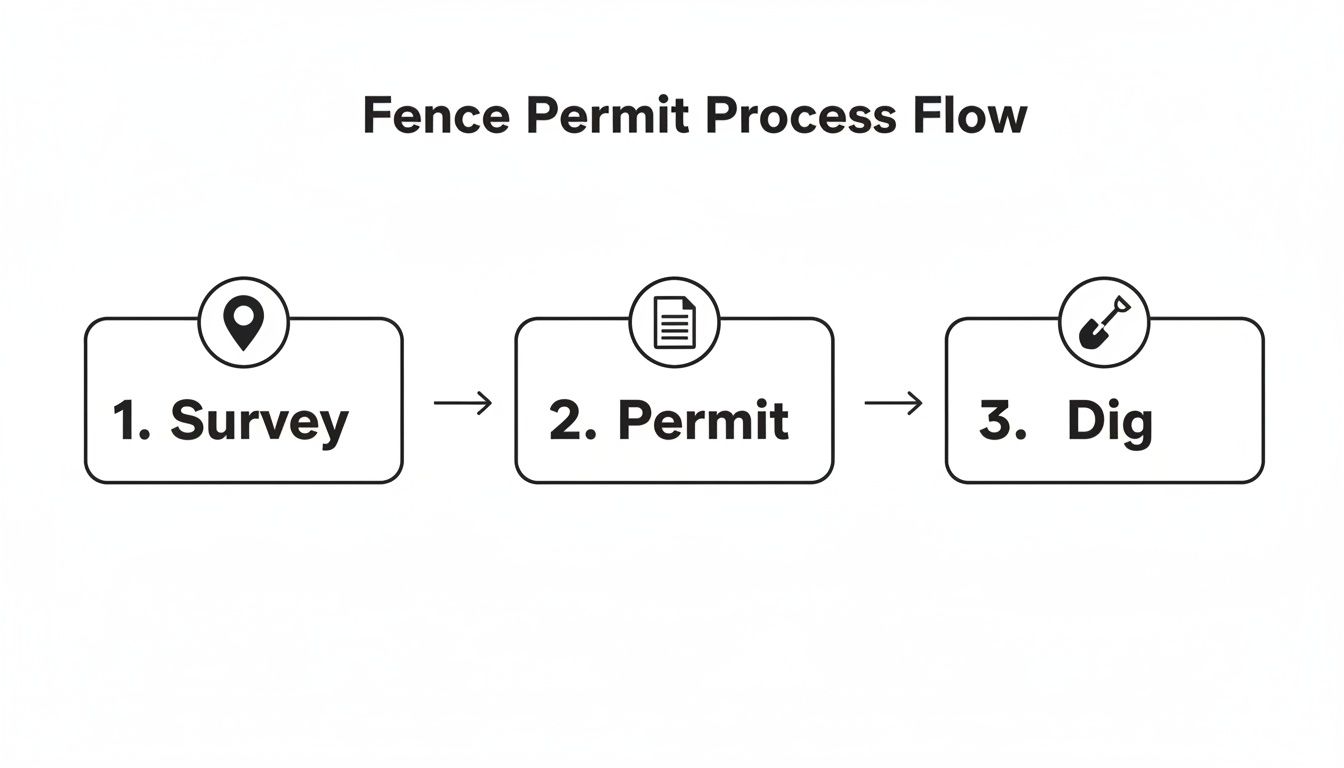
Each of these stages—verifying property lines, securing permits, and clearing utility locates—is an essential link. Skipping any one can lead to costly mistakes and project delays.
Site Preparation: The Foundation of a Flawless Fence
The first on-site task is preparing the work area. The crew will clear the entire fence line of any obstacles, including brush, rocks, roots, or old fence remnants. This creates a clean path, ensuring nothing obstructs a perfect alignment.
Next, a string line is run along the proposed fence line. This simple but essential tool acts as a precise guide, guaranteeing that every post is installed in a perfectly straight line to create a professional, unwavering finish.
Digging Deep: The Secret to Stability in Our Climate
In the Ottawa-Gatineau region, the primary challenge is the ground itself. Annual freeze-thaw cycles cause soil to expand and contract with immense force. This process, known as "frost heave," can push improperly set fence posts directly out of the ground.
To prevent this, every post hole must be dug well below the regional frost line, to a depth of 42 to 48 inches (107 to 122 cm). This anchors the post base in stable soil, unaffected by seasonal movement, creating an immovable foundation.
Vinyl's popularity has grown from less than 5% of new fences in 2005 to a projected 28% by 2025 as homeowners seek materials that withstand our climate. While a DIY approach might seem cost-effective, a professional installer guarantees a code-compliant post depth—the critical defence against frost heave that affects nearly 1 in 4 improperly installed fences.
Anchoring a fence post below the frost line is the single most important step in a professional vinyl fence installation in Canada. It's the difference between a fence that lasts a lifetime and one that needs to be reset every few years.
To learn more about the specifics, check out our practical guide on how deep a fence post should be.
Setting Posts and Assembling Panels
Once the holes are dug to the correct depth, the posts are set. Each post is carefully placed and plumbed using a level on two sides to ensure it is perfectly vertical. The hole is then backfilled with concrete to create a permanent, solid anchor. The concrete is "crowned" at the top, sloped to direct water away from the post base.
After the concrete has fully cured, the assembly begins:
Bottom Rails: The horizontal bottom rails are inserted between the posts, forming the structural base for each section.
Panels or Pickets: Vertical panels or pickets are then slid into the channel in the bottom rail, interlocking to create a solid screen.
Top Rails: Finally, the top rail is installed, securing the pickets from above and completing the rigid panel structure.
This interlocking system provides modern vinyl fencing with its strength and seamless appearance. With no visible screws or brackets, the result is a clean, polished look from every angle.
Understanding Your Vinyl Fence Installation Cost
Budgeting for a new vinyl fence is a primary concern for most homeowners. The final price on your quote is a combination of materials, labour, and the specific characteristics of your property.
Most professional quotes, including ours at FenceScape, are calculated on a per-linear-foot basis. This figure serves as a baseline, but several key factors can adjust the final cost.
Key Factors That Shape Your Final Quote
While fence length is the primary cost driver, other variables can impact the price. A project on a flat, clear lawn will be less complex and therefore less expensive than one with challenging site conditions. Knowing these factors helps you understand exactly what you're paying for.
Here are the main elements we assess for every estimate:
Fence Style and Height: A tall, full-privacy vinyl fence requires more material than a shorter picket fence, resulting in a higher per-linear-foot cost.
Number of Gates: Each gate requires additional hardware (latches, hinges, frame) and skilled labour for precise installation, adding to the total project cost.
Uneven or Sloped Terrain: Installing a fence on a slope requires advanced techniques. The crew must either "rack" the panels to follow the grade or "step" them down. Both methods demand more time and expertise than working on level ground.
Old Fence Removal: If an existing fence needs to be removed, we can handle the demolition and disposal. This service will be listed as a separate line item on your quote for full transparency.
Understanding these variables demystifies the quoting process. It shifts the focus from a single price to a clear breakdown of the value you receive—from the quality of the vinyl to the expert labour required for your property's unique layout.
Exploring Different Fence Styles and Their Budget Impact
Your choice of fence style is a major factor in the final vinyl fence installation cost. Each design offers a different balance of privacy, airflow, and aesthetics, and the amount of material required directly influences the price.
A full privacy fence, with solid, tongue-and-groove panels, provides complete seclusion and is a popular choice for backyards. It is also at the higher end of the price range. In contrast, a classic picket fence uses significantly less vinyl, offering a traditional look at a more budget-friendly price. Semi-privacy styles, which feature small gaps between pickets, fall in the middle for both coverage and cost.
For a detailed comparison of different styles, you can learn more by reading our complete guide to understanding vinyl fence costs.
Making Your Project More Affordable with Financing
A high-quality, long-lasting fence should be accessible to every homeowner. A new fence is a significant upgrade to your property's value and security. To make this investment more manageable, we offer flexible payment options.
FenceScape provides financing solutions for customers across Ontario and Quebec. These programs allow you to break down the total project cost into predictable monthly payments. You get the durable, beautiful fence you need now, without the immediate financial burden. Our goal is to provide financial clarity and empower you to invest in a fence that will deliver value for decades.
DIY vs. Hiring a Professional Fence Installer
Deciding between a DIY installation and hiring a professional is a common dilemma. The appeal of potential cost savings and hands-on satisfaction is balanced against the assurance and polished finish that only an experienced crew can provide.
This decision involves more than just time versus money. It requires an honest assessment of your skills, your available tools, and the importance of a perfect, long-lasting final result.
The Reality of a DIY Vinyl Fence Installation
Installing a vinyl fence requires precision, patience, and the right equipment. Lacking any of these can turn a money-saving project into a frustrating and costly ordeal.
A primary challenge for DIYers is achieving a perfectly straight post alignment over a long distance. A slightly misaligned fence will become more noticeable as the ground settles. Furthermore, the physical labour of digging post holes to the correct depth—especially in the rocky soil common to the Ottawa-Gatineau area—is a significant undertaking.
Common DIY pitfalls to avoid:
Shallow Posts: This is the most critical error. Failing to dig below the frost line will cause your fence to heave and shift after the first winter, ruining your work.
Incorrect Spacing: If the distance between posts is off, vinyl panels will not fit correctly, requiring awkward cuts that weaken the structure and look unprofessional.
Lacking Proper Tools: While you can rent a gas-powered auger, this adds cost and requires experience to operate safely and effectively.
When you choose DIY, you assume the roles of project manager, labourer, and quality control inspector. It is a substantial commitment that extends well beyond a single weekend.
If you are considering a major backyard project, a guide to DIY hardscape design can provide a solid framework for planning your fence and other landscape elements.
The Clear Advantages of Hiring a Professional
When you hire an experienced installer like FenceScape, you are investing in expertise, efficiency, and a guaranteed result. Our crews have installed thousands of fences, enabling them to navigate challenging terrain and complete the job in a fraction of the time a novice would take.
A professional team arrives with specialized equipment, including commercial-grade augers, precision levels, and dedicated cutting tools. This ensures every post is set perfectly, every panel is secure, and every gate functions flawlessly.
The greatest benefit, however, is accountability. You receive a guarantee of code compliance, ensuring your fence meets all Ottawa or Gatineau bylaws. The project is also backed by a comprehensive warranty covering both materials and labour, protecting your investment for years to come. For most homeowners, this peace of mind is invaluable.
If you need guidance, our article on how to hire Ottawa fence builders offers a step-by-step plan to help you select the right contractor.
Choosing FenceScape for Your Project
Selecting the right company for your vinyl fence installation is crucial. The key is to find a trusted partner who will deliver a high-quality product through a seamless, stress-free process.
At FenceScape, we have built our reputation on this principle. Our customer-first approach means we manage every detail, transforming a potentially complex project into a smooth and straightforward experience from start to finish.
Our Turnkey Project Management Process
From your first inquiry, you will notice our commitment to a managed service. You won’t be left coordinating different trades or wondering about the next steps.
Our process is designed for clarity and predictability:
Initial Free Estimate: We begin with a no-pressure consultation to discuss your vision, evaluate your property, and provide a detailed, transparent quote.
Guided Planning: Our team helps you select the perfect fence style and navigate the specific bylaw requirements for your Ottawa or Gatineau property.
Professional Installation: Our dedicated in-house crews handle the entire installation, from site preparation to final panel placement, with precision and care.
Final Project Walkthrough: Upon completion, we conduct a final walkthrough with you to ensure every detail meets your expectations and our high standards.
This guided process eliminates surprises, delivering a beautiful, durable fence you'll enjoy for years.
A great fence is the result of a great process. We believe that clear communication, meticulous planning, and expert execution are just as important as the high-quality materials we use. Our goal is to make your vinyl fence installation feel effortless.
Save Together with Neighbourhood Group Discounts
A unique offering is our neighbourhood group discount program. We recognize that neighbours in new or established communities often decide to build fences around the same time.
By coordinating multiple projects in the same area, we achieve significant efficiencies in scheduling and material delivery. This program allows you and your neighbours to book installations together, resulting in substantial cost savings for everyone involved. It’s a practical way to make a premium vinyl fence more affordable while fostering community spirit.
A Portfolio of Local Success
The best measure of a fence company is its completed work. We are proud of the fences we have built across the Ottawa–Gatineau region. Our portfolio showcases a wide variety of projects, from modern privacy fences in Kanata to classic picket fences in the Glebe.
Each project demonstrates our commitment to quality materials and our crew's meticulous attention to detail. You will see the perfectly straight lines, solid post settings, and clean finish that define a FenceScape installation. This is our visual promise to you: we build fences that not only look fantastic but are engineered to withstand Canadian seasons.
Your Top Vinyl Fence Installation Questions Answered
Even with thorough planning, specific questions often arise when considering a new vinyl fence. Here are straightforward answers to the most common inquiries we receive from homeowners in Ottawa and Gatineau.
Can You Install a Vinyl Fence on a Hill or Slope?
Yes, an experienced crew can effectively manage sloped or uneven terrain using two primary methods: "racking" or "stepping."
Racking involves using specially designed fence panels that can be angled to follow the natural contour of the land. This creates a smooth, continuous line that flows with the landscape. For steeper grades, we use the stepping method, where each fence section is installed slightly lower than the previous one, creating a stair-step appearance.
The chosen method depends on the grade of your property. We will assess your yard and recommend the approach that will result in a secure, professional, and aesthetically pleasing fence.
The key to a successful sloped installation is ensuring every post is perfectly vertical (plumb), even when the rails are angled. This prevents unsightly gaps at the bottom and maintains the structural integrity of the fence.
How Long Does a Vinyl Fence Actually Last?
A high-quality vinyl fence is a long-term investment in your property, designed to last for decades. Unlike wood, vinyl does not rot, is impervious to insects, and will not warp from moisture.
Most reputable vinyl products today are backed by extensive warranties, often for 20 years or more. These warranties protect against defects like peeling, cracking, and abnormal discolouration. With occasional cleaning using soap and water, your fence will maintain its appearance and withstand our harsh Canadian seasons for many years.
Is My Yard Going to Be a Mess During the Project?
While any construction project involves some temporary disruption, a professional team prioritizes keeping your property tidy.
Our crews work to contain the installation area. If we remove an old fence, all debris is hauled away. Soil excavated for post holes is managed carefully to protect your lawn. We perform a full cleanup at the end of each workday and a final, thorough cleanup upon project completion. Our goal is to leave you with nothing but a beautiful new fence.
Ready to transform your property with a beautiful, low-maintenance fence? The team at FenceScape is here to manage every detail of your vinyl fence installation with professionalism and care. Get your free, no-obligation estimate today!
Comments