
A Homeowner's Guide to Chain Link Fence in Ottawa and Gatineau

A chain link fence is one of the most practical and budget-friendly ways to secure your property. It's that classic woven, diamond-patterned steel mesh—a workhorse of a fence that provides a clear boundary and incredible durability, which is essential for Ottawa's weather. For homeowners, it's an actionable, reliable choice for keeping pets in and kids safe without obstructing your view.
Why Chain Link Fencing Is a Smart Choice for Ottawa Homes
When considering a no-nonsense fence, chain link is a top contender for homeowners in the Ottawa–Gatineau region for one key reason: it delivers practical, unbeatable value.
Instead of seeing it as just a simple barrier, think of a chain link fence as a versatile framework for your yard. It’s the dependable starting point for creating security, ensuring safety, and clearly marking your property lines. This isn't about making an aesthetic statement; it's about a solution that works day in and day out, holding its own against heavy snow, freezing rain, and summer humidity.
The Core Components of a Chain Link System
To get the right fence, it helps to know its parts. At its core, a chain link fence is a system of three key components working together to create a strong perimeter:
The Mesh: This is the iconic diamond-patterned "fabric" of the fence. Your main choice here is the coating: either galvanized (coated with zinc) or vinyl-coated for an extra layer of defence against the elements.
The Posts: These are the steel pillars that form the fence's backbone. You have thicker terminal posts for corners and ends, and slimmer line posts spaced along the run to keep the mesh taut.
The Gates: A fence is only as good as its access points. You can select a simple walk-through gate for people or a much wider one for a vehicle, built from the same sturdy materials.
Actionable Tip: A well-installed chain link fence is a foundational element of your property's security. Its see-through nature offers clear sightlines, which is a great deterrent for potential intruders who prefer to stay hidden.
Practical Benefits for Local Homeowners
The real value of a chain link fence is its blend of durability, affordability, and incredibly low maintenance. Unlike a wood fence that needs regular staining or sealing, a modern galvanized or vinyl-coated chain link fence will fight off rust and corrosion for decades with almost no effort. That resilience makes it a smart investment that pays for itself over the long haul.
While a fence is a crucial physical barrier, it's often part of a bigger picture. To see how it fits into a complete strategy, you can explore the elements of comprehensive residential security systems to understand how different layers of protection work together. Whether you're securing the backyard for your dog or enclosing a pool to meet local by-laws, the sheer adaptability of chain link makes it a smart, lasting choice for Ottawa homeowners.
Understanding Your Chain Link Fence Options
So, you’ve settled on a chain link fence—a great, practical choice. Now you need to fine-tune the details to get exactly what you need. Each decision impacts performance, looks, and longevity, especially with Ottawa’s wild weather swings. Making the right choices now means your fence won’t just work for you today, but for years to come.
Your first and most important decision is the coating on the wire. This is your fence's front-line defence against everything the Ottawa–Gatineau climate throws at it—from heavy snow and corrosive road salt in winter to humid summer days.
This infographic lays out the key benefits you get from a quality chain link system.
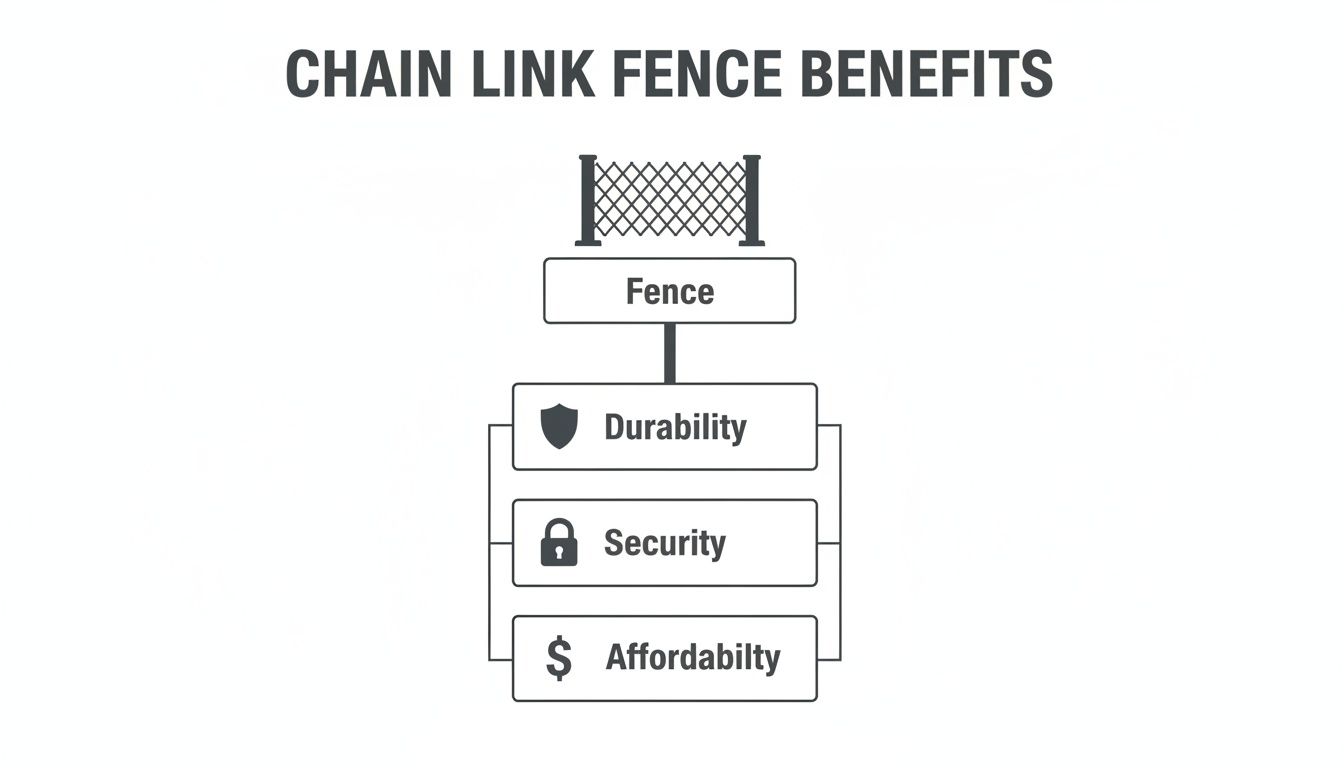
As you can see, the blend of durability, security, and affordability is what makes it such a go-to fencing solution.
Choosing the Right Coating for Your Fence
The coating isn't just about colour; it’s a critical protective shield. You’ll generally encounter three main types, each with its own trade-offs in terms of durability, appearance, and budget.
Use this quick comparison to decide which coating best fits your needs and budget in our local climate.
Comparing Chain Link Coatings for the Ottawa Climate
Coating Type | Average Lifespan | Corrosion Resistance | Aesthetic Options | Relative Cost |
|---|---|---|---|---|
Galvanized | 20-30 years | Good | Classic silver | $ |
Aluminized | 25-35+ years | Excellent | Premium silver/grey | $$ |
Vinyl-Coated | 30-40 years | Superior | Black, green, brown | $$$ |
Galvanized is the classic, silver-grey workhorse. The steel wire is dipped in molten zinc, creating a tough barrier against rust. It’s the most budget-friendly option and a solid, reliable choice for most applications.
Aluminized wire is a step up, featuring an aluminum coating over the steel. This provides superior corrosion resistance, making it a premium option built for maximum lifespan, especially in moist areas.
Vinyl-Coated fences are my top recommendation for most homeowners. A thick layer of PVC is bonded over the galvanized steel core, providing a powerful extra layer of protection. It comes in colours like black, green, or brown that blend into your landscape.
Actionable Tip: For most homeowners, a vinyl-coated fence delivers the best combination of maximum protection and a more refined look. The black vinyl option is a customer favourite because it tends to visually "disappear" against gardens and trees, giving you security without a heavy industrial feel.
Chain link isn't a new invention; it's been securing properties since the late 1800s. A standard galvanized fence will easily last 20-30 years, while modern vinyl-coated versions can push that to 40 years. That long life reduces your maintenance costs by up to 70% compared to a wood fence that needs regular staining and repairs. For homeowners in Ottawa–Gatineau, those are numbers that really matter. You can discover more insights about the history and resilience of chain link fencing and see just how far it's come.
Understanding Wire Gauge and Mesh Size
Beyond the coating, you need to select the wire gauge and mesh size to determine your fence's strength.
The gauge tells you the thickness of the steel wire. It’s counter-intuitive: a lower gauge number means a thicker, stronger wire. For a typical backyard, an 11-gauge wire is sufficient. However, if you have a large, active dog or security is your main concern, upgrading to a heavier 9-gauge wire is a smart, practical investment.
The mesh size is the size of the diamond-shaped holes. The standard for homes is 2 inches, which works for most situations. For specific needs like pool enclosures (to meet safety codes) or tennis courts, a smaller mesh, like 1.25 inches, makes the barrier much harder to climb and is often required.
Selecting the Right Fence Height
Finally, pick a height based on your fence's primary purpose.
Four-Foot Fences: Ideal for marking a front yard boundary, containing a small dog, or protecting a garden without feeling imposing.
Five-Foot Fences: The most common choice for backyards. It provides good security for kids and most dogs while keeping the yard feeling open.
Six-Foot Fences: The best option if your main goals are security and privacy (especially with privacy slats). It creates a serious barrier and a secluded backyard feel.
Budgeting for Your Ottawa Chain Link Fence Installation
Let's talk about the bottom line. Understanding the cost of a new chain link fence is a crucial first step. While chain link is known for its affordability, the final price depends on your property and your choices. Creating a realistic budget from the start will prevent any surprises.
The biggest factor in your quote is the total length needed, as projects are priced by the linear foot. For a professional installation in the Ottawa area, you can budget between $25 to $45 per linear foot. This range typically covers standard galvanized steel materials for a four or five-foot-high fence.
Of course, that’s just a starting point. Your final price will change based on the specific features you add.
Key Factors That Influence Your Final Cost
To manage your budget effectively, understand what drives the price up or down.
Fence Height and Length: A six-foot fence uses more materials and hardware than a four-foot one, increasing the cost per foot. The longer the fence, the higher the total cost for both materials and labour.
Material and Coating Choices: Standard galvanized steel is your most economical option. Upgrading to a black or green vinyl-coated fence will increase the price, but many homeowners find it a worthy investment for its superior durability and polished look.
Your Property’s Terrain: A flat, clear yard is easiest and cheapest to work with. If your property is sloped, rocky, or has numerous tree roots, the crew will need more time and specialized equipment, which will be reflected in the labour cost.
Gates and Hardware: The number and type of gates also play a big role. A simple four-foot-wide walk-through gate is a common and relatively inexpensive addition. A wide, double-drive gate for a vehicle is a more significant cost item.
Actionable Tip: A quality installation is an investment in your property's security and value. The goal is to secure the best long-term value from a fence built to withstand Ottawa's harsh seasons for decades, not just find the lowest initial price.
Sample Project Costs in the Ottawa Area
To make this practical, here are two real-world examples for an Ottawa or Gatineau suburb.
Small Backyard (Approx. 100 linear feet): For a basic 5-foot galvanized chain link fence with a single walk-through gate, a homeowner can expect the total cost to be in the $2,800 to $4,000 range.
Standard Suburban Lot (Approx. 150 linear feet): For a 5-foot black vinyl-coated fence with one walk-through gate on a slightly sloped yard, the cost would likely be between $4,500 and $6,500.
These are estimates, but they provide a solid baseline for your financial planning. To dive deeper into the numbers, our complete Canada cost guide for chain link fences breaks it down further.
It can also be helpful to compare costs with other types of property installations. For example, this a guide to bollard installation costs provides some good context on budgeting for other security features. By understanding all the moving parts, you can set a confident budget and get the perfect fence for your home.
Making Your Fence Private and Secure
A standard chain link fence is great for boundaries but offers little privacy. While its see-through mesh keeps pets in, it can leave your yard feeling exposed. The good news is, you can easily upgrade it for more seclusion without replacing the entire fence.
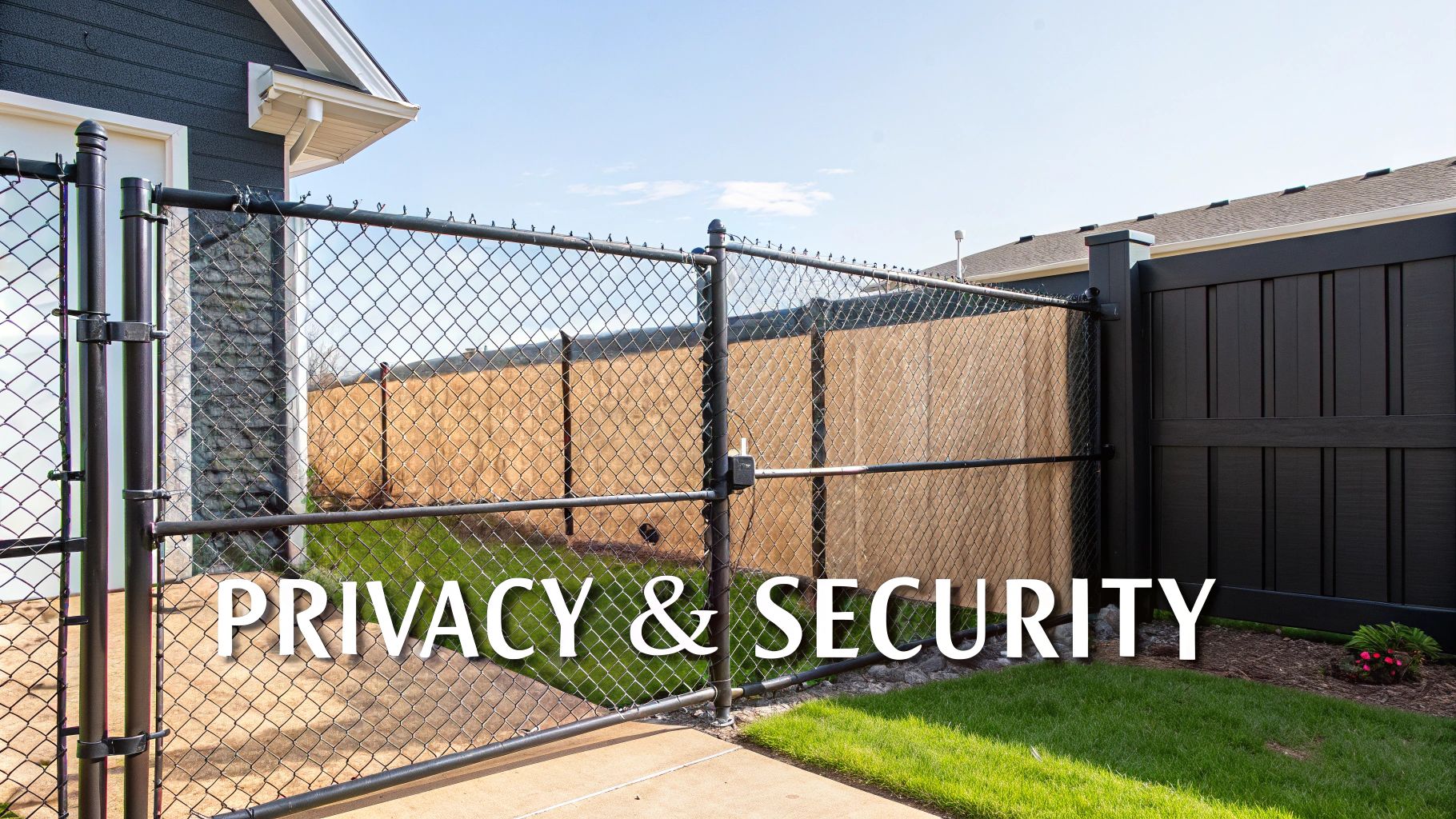
This adaptability is a key benefit of modern chain link fences. With a few smart additions, that open weave can become a solid visual barrier, giving you the privacy of a wood fence with the durability and cost-effectiveness of steel. Here are the most effective methods.
Weaving in a Visual Barrier with Privacy Slats
Privacy slats are the most popular solution for adding privacy to a chain link fence. These are simple, tough vertical strips, usually made from polyethylene, that you weave directly into the diamond mesh. Once installed, they transform the fence into an almost solid panel.
Slats offer excellent customization. They come in various colours, so you can choose classic black or green to blend with your garden, or a neutral beige or grey to match your house.
There are a few different types to choose from, each offering a different level of privacy:
Tube Slats: These hollow, tubular slats are a popular and budget-friendly option that provides good privacy.
Winged Slats: These have small "wings" on the sides that overlap, delivering up to 98% privacy coverage for maximum seclusion.
Bottom-Locking Slats: These slats slide into a bottom channel, locking them in place for a clean, uniform appearance.
To explore these options further, check out our guide on chain link privacy fence slats. It’s packed with practical advice for homeowners in the Ottawa area.
Windscreens for Full Coverage
If slats aren't what you're looking for, a privacy screen is another effective option. This is a large sheet of tightly woven fabric, typically high-density polyethylene, that you attach directly to your fence with heavy-duty zip ties.
Screens block between 85% and 95% of visibility, creating an instant privacy wall. As a bonus, the fabric also acts as a windscreen, making a windy patio or backyard more comfortable.
Actionable Tip: One key advantage of chain link is its inherent security. High visibility acts as a deterrent, discouraging petty theft while allowing for easy surveillance. This combination of strength and visibility makes it an effective security tool from day one.
Boosting Security with Gates and Other Features
While privacy is important, don't overlook fundamental security. A fence is only as strong as its weakest point—which is almost always the gate. A solid, lockable gate is essential to ensure your fence is a truly reliable barrier.
For commercial or industrial properties around Ottawa and Gatineau, a chain link fence can be upgraded with additions like barbed or razor wire to create a perimeter that’s tough to breach and effectively keeps people out of sensitive areas.
Even a standard fence is a powerful deterrent. A multi-year study of LAPD reports revealed that properties with chain link fences had 25% fewer unauthorized entries. As you can learn more about these findings on property security, it’s clear this classic fence remains one of the best ways to protect what’s important.
A Quick Guide to Ottawa and Gatineau Fence Bylaws
Before you install a new chain link fence, you must understand the local rules. Both Ottawa and Gatineau have specific bylaws governing everything from fence height to placement. Knowing these rules upfront will save you from headaches and potential fines.
Ignoring city regulations can lead to penalties or an order to remove the fence you just paid for. These rules exist to ensure safety, prevent property disputes, and maintain neighbourhood standards.
Getting a Handle on Fence Height Rules
One of the first questions homeowners ask is, "How high can my fence be?" The answer depends on its location on your property. While specific wording differs between Ottawa and Gatineau, the general rules are consistent.
Front Yards: You are typically limited to a maximum height of 1 metre (about 3.3 feet). This is a crucial safety rule to maintain clear sightlines for drivers and pedestrians.
Side and Back Yards: You have more flexibility here, with a typical maximum height of 2.1 metres (about 7 feet), which is sufficient for privacy and security.
If you live on a corner lot, expect tighter restrictions to ensure you don't block traffic views. Always confirm the specific rules for your property before finalizing your design.
Actionable Tip: The single most important step before you build is to get a recent property survey. A survey is the only legal document that shows your exact property lines. Building even a few inches onto a neighbour’s land can lead to major legal and financial problems.
The Non-Negotiable Rules for Pool Fences
When fencing a swimming pool, the rules are extremely strict for safety reasons. Pool enclosure bylaws are mandatory and designed to prevent tragic accidents, especially involving young children.
Here’s what to expect for a pool fence in the Ottawa-Gatineau area:
The fence must be a minimum height, usually around 1.5 metres (5 feet), to be difficult to climb.
All gates must be self-closing and self-latching. The latch must be on the pool side of the gate and high enough to be out of a small child’s reach.
The gap between the bottom of the fence and the ground cannot exceed 10 cm (4 inches) to prevent anyone from squeezing underneath.
Chain link is an excellent choice for pool safety. The Chain Link Fence Manufacturers Institute (CLFMI) has specific standards to ensure certain mesh designs meet pool code. It provides security without creating a solid wall, making it a go-to option for homeowners.
Deciding Between DIY and Professional Fence Installation
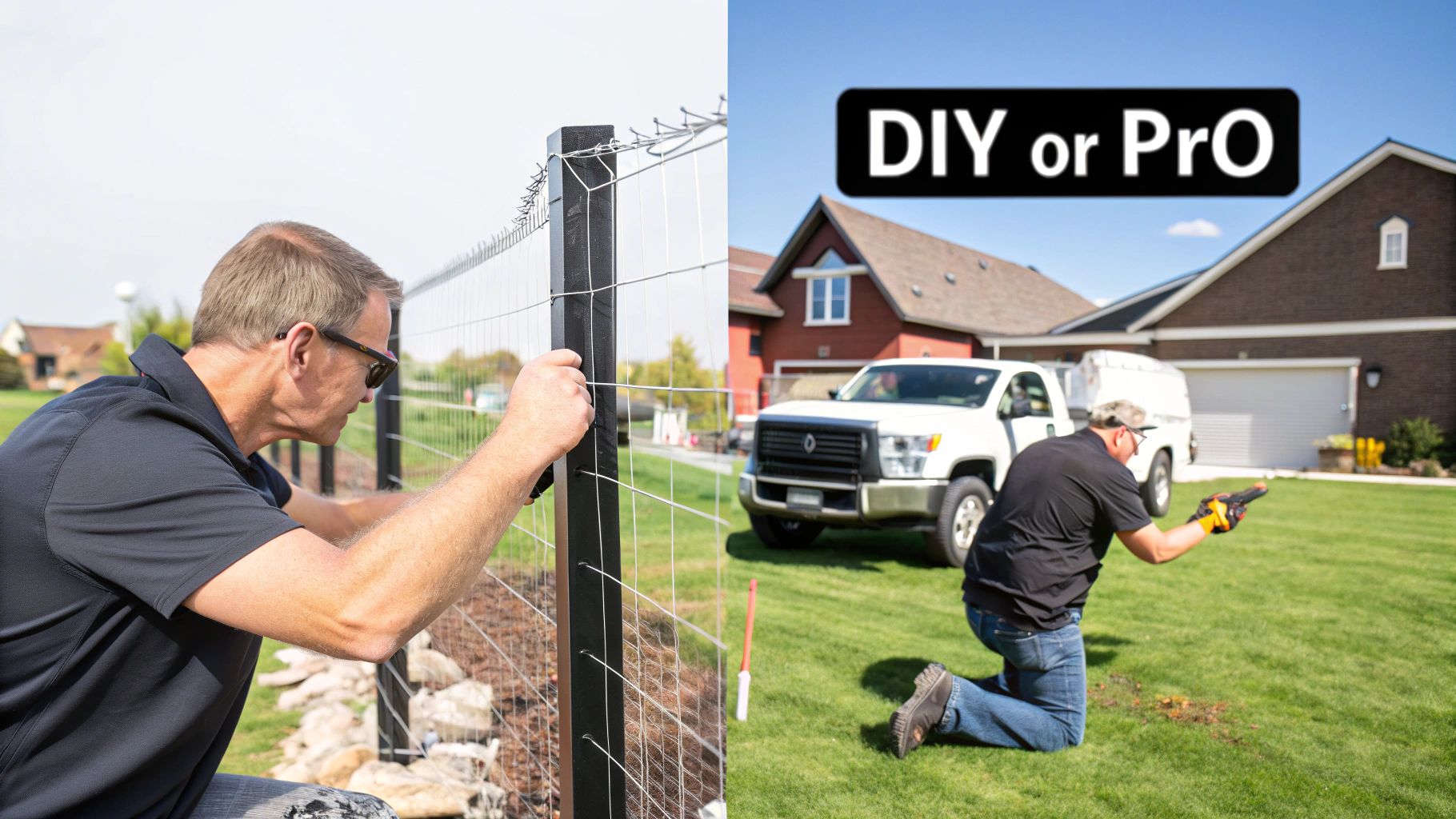
You’ve chosen a chain link fence. Now you must decide: do you install it yourself, or hire a professional? The DIY route can seem tempting if you're looking to save on labour costs.
However, building a fence that lasts is more complex than just digging holes and stretching wire. A small mistake early on can lead to a sagging fence that fails years before it should. Hiring a professional team like FenceScape is an investment in skill, speed, and the guarantee of a job done right.
Let's break down each option to help you decide what’s best for your property, budget, and schedule.
The Realities of a DIY Fence Project
A DIY installation is achievable if you have the right skills, tools, and patience. The process involves a sequence of critical steps that demand precision. You must accurately map property lines, dig post holes below our Ottawa frost line, mix and pour concrete, and ensure every post is perfectly plumb.
The most challenging step for DIYers is stretching the chain link mesh. This step gives the fence its strength and clean look. It requires a specialized tool called a fence stretcher or "come-along" to get the mesh tight before securing it. Improper tension will lead to sagging, which compromises both security and appearance.
If you're considering this route, our step-by-step guide to chain link fence installation is a valuable resource to understand the full scope of the project.
Actionable Tip: A professional installation isn't just about speed. It’s about leveraging years of experience to overcome unforeseen challenges—like hitting bedrock or navigating complex property lines—that can completely derail a DIY project.
The Advantages of Hiring a Professional
When you hire an experienced crew, you’re not just paying for labour—you’re buying a guaranteed result. Professionals come with commercial-grade tools, access to high-quality materials, and the knowledge to do the job correctly the first time.
They understand Ottawa’s soil conditions and frost depths, ensuring your fence posts are set deep enough to withstand decades of our harsh freeze-thaw cycles.
Furthermore, a professional installation almost always includes a warranty on both materials and labour. If an issue arises from the installation, the company will return to fix it. This provides a level of security and peace of mind you can't get with a DIY project.
DIY vs. Professional Fence Installation: A Realistic Look
Use this direct comparison to weigh the factors that matter most to you and make an informed decision.
Factor | DIY Installation | Hiring FenceScape |
|---|---|---|
Total Cost | Lower upfront labour cost, but tool rental and potential for costly mistakes can add up. | Higher initial investment, but includes all labour, tools, and often a warranty for peace of mind. |
Time Commitment | Can take several weekends, depending on your skill level and the project size. | Typically completed in 2-3 days for an average residential yard, with minimal disruption to you. |
Required Skill | Moderate to high. Requires precision in measuring, digging, setting posts, and stretching mesh. | None required from the homeowner. We handle everything from planning to final clean-up. |
Final Quality | Varies widely. Improper mesh tension is a common issue, leading to a sagging, unprofessional look. | A straight, taut, and durable fence that is professionally finished and built to last. |
Ultimately, the choice comes down to balancing your budget against your time, skill level, and desire for a flawless, long-lasting final product.
Your Top Chain Link Fence Questions Answered
When you're considering a new fence, many questions come up. To help you feel confident, we've provided direct answers to the questions we hear most often from homeowners in Ottawa and Gatineau. This is practical information you can use for your project planning.
How Long Does a Chain Link Fence Installation Take?
A professional installation is surprisingly fast. For a typical residential backyard in the Ottawa area, the entire job is usually completed in two to three days.
Day one is dedicated to setting the posts in concrete. This is the most critical step for a sturdy fence, and the posts need a full 24 hours to cure. On day two or three, the crew returns to stretch the mesh, hang the gates, and complete the finishing touches.
Can You Install a Chain Link Fence in the Winter?
Yes, we can install a chain link fence during an Ottawa winter, but the process is different. Since we can't dig and pour concrete into frozen ground, we use heavy-duty driven posts instead.
While a winter installation is an option, projects completed in the spring, summer, or fall are generally more straightforward and efficient. We can assess your property to determine the best approach for your timeline and budget.
Actionable Tip: One of the biggest perks of a modern chain link fence is its minimal upkeep. Unlike wood fences that require constant staining and painting, galvanized and vinyl-coated steel is built to handle our tough Canadian seasons with almost no effort from you.
Is Chain Link a Good Fence for Dogs?
Absolutely. Chain link is one of the most popular and reliable choices for keeping pets safe due to its strength and durability. It creates a tough barrier that even very active dogs can't easily break through.
Here are two actionable tips to make it perfect for your pets:
For small dogs: Choose a mesh with smaller 1.25-inch openings to ensure there are no gaps for them to squeeze through.
For large or high-energy dogs: A taller fence of five or six feet is the best way to prevent them from jumping over.
With these simple specifications, your chain link fence becomes a secure playground where your pets can run and play freely.
Ready to secure your property with a fence that's built to last? The team at FenceScape is here to help you navigate every step, from choosing the right materials to a flawless final installation. Get your free, no-obligation estimate today!
Comments