
Your Actionable Guide to Slats for a Chain Link Fence

Chain link fences are durable and cost-effective, but they lack privacy and style. The solution is fence slats—vertical strips made from materials like vinyl or aluminum that you weave into the fence openings.
This practical upgrade transforms a see-through barrier into a private, attractive enclosure, and this guide provides the actionable steps to get it right.
What Are Slats for a Chain Link Fence
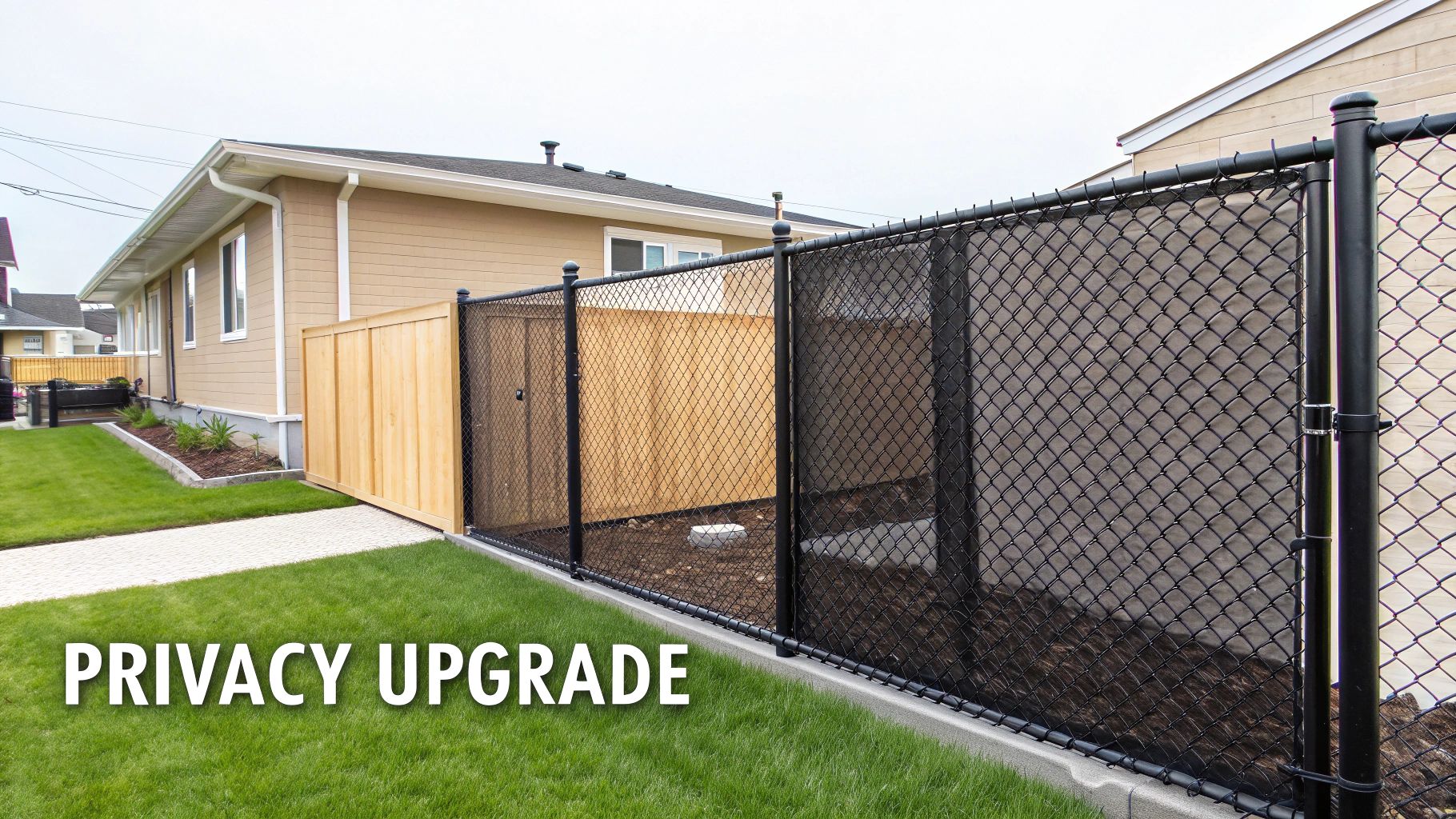
Fence slats are the most efficient way to upgrade your existing chain link fence from purely functional to fully finished. Instead of leaving your yard exposed, you can slide slats into the mesh to instantly boost privacy and curb appeal.
At FenceScape, we guide homeowners across the Ottawa–Gatineau region through this exact upgrade. The goal is always the same: gain seclusion for a backyard or pool without the cost and hassle of replacing a perfectly good fence. Slats are the practical solution that delivers immediate results.
Core Benefits of Adding Slats
Installing fence slats is more than a cosmetic tweak; it’s a functional upgrade that improves your property's value and usability. Use this breakdown to see exactly how slats can benefit your space.
At-a-Glance Fence Slat Benefits
Benefit | Actionable Outcome for Your Property | |
|---|---|---|
Increased Privacy | Creates a visual barrier, blocking up to 98% of sightlines. | Backyards, pool enclosures, and properties adjacent to busy areas. |
Improved Security | Deters unwanted attention by preventing casual observation of your yard. | Families with children and pets, or anyone wanting an extra layer of security. |
Enhanced Aesthetics | Modernizes your fence with colour options that complement your home's exterior. | Homeowners looking to boost curb appeal and property value. |
Added Durability | Acts as a partial windbreak and shields the fence wiring from harsh elements. | Properties in open areas or anyone looking to extend their fence's lifespan. |
Ultimately, slats are a smart, efficient way to get more out of the fence you already have, turning it into an asset that works harder for your home.
A Smart Solution for the Ottawa Climate
In the Ottawa–Gatineau region, where heavy snow and humid summers are the norm, material choice is critical. Chain link fence slats provide the privacy you need without the risk of warping, rotting, or buckling under harsh weather.
This practical advantage has driven a local trend, mirroring a North American pattern where demand for slatted fences has jumped by roughly 25% since 2020. This spike highlights their suitability for climates that demand resilient building materials. For a deeper dive into market data, consult recent industry reports that track these trends.
Choosing the Right Slat Material for Ottawa's Climate
Choosing the right slat material is the most critical decision you'll make for your fence's longevity and appearance. A poor choice can lead to faded, brittle, or cracked slats within a few seasons, completely negating your investment. To avoid this, you must understand how different materials perform in local weather.
Vinyl (PVC) Slats: The Popular All-Rounder
Vinyl (PVC) slats are the most common and versatile option. They offer an excellent balance of affordability, colour variety, and reliable performance.
Modern PVC is engineered with UV inhibitors to resist sun-fading and stabilizers to prevent brittleness during Ottawa’s freeze-thaw cycles. This makes high-quality PVC a durable and dependable choice.
Choose this for: A great balance of affordability, extensive colour options, and solid, all-around performance.
Climate Resilience: Good resistance to moisture, cold, and UV fading when you select a quality formulation.
Aesthetic Appeal: The widest range of colours is available in vinyl, simplifying the process of matching your home's exterior.
Aluminum Slats: The Premium Durability Choice
Aluminum is the strongest and most durable slat material. It is lightweight, immune to rust and corrosion, and will not warp in summer heat or crack in extreme cold—a significant advantage in our climate where road salt and moisture are constant threats.
Aluminum slats are finished with a powder coating that bakes the colour directly onto the metal, making it far more resistant to chipping and fading than any other material.
Actionable Insight: While aluminum costs more upfront, its exceptional longevity makes it the most cost-effective choice in the long run. Follow the "buy it once, buy it right" principle for a zero-maintenance fence solution.
The initial investment is the main consideration. However, for anyone prioritizing maximum durability and zero maintenance—such as for a high-traffic commercial property or a security-focused home—the long-term value is undeniable.
HDPE Slats: The Eco-Friendly, Flexible Option
High-Density Polyethylene (HDPE) is a flexible and impact-resistant plastic, often considered a more eco-friendly alternative to PVC. Many HDPE slats are made from recycled materials and are recyclable themselves.
HDPE's key advantage is its flexibility in cold weather. It remains pliable when other plastics become stiff, making it exceptionally resistant to cracking during harsh freeze-thaw cycles. This makes it a smart choice for fences in areas with heavy snow buildup or those at risk of impacts from shovels or snowblowers.
How They Stack Up in Ottawa Weather
Use this table to compare materials based on the factors that matter most in the Ottawa–Gatineau region and make an informed decision for your property.
Material | Freeze-Thaw Resistance | UV/Fade Resistance | Cost-Effectiveness | Overall Lifespan |
|---|---|---|---|---|
Vinyl (PVC) | Good to Excellent | Good (with UV inhibitors) | High | 15-20 years |
Aluminum | Excellent | Excellent (powder-coated) | Moderate | 25+ years |
HDPE | Excellent | Good | High | 15-20 years |
To choose the best material, define your priorities. For budget and colour selection, quality PVC is an excellent choice. For maximum strength and a maintenance-free fence that will last for decades, invest in aluminum. For top-tier cold-weather performance and eco-friendly materials, HDPE is an outstanding contender.
Matching Slat Styles with Your Privacy Goals
Choosing the right slat style directly controls how private your yard feels. Manufacturers provide a privacy rating—such as 90% privacy or 98% blockage—to guide your decision. A higher number means more seclusion.
The key is to understand how different designs achieve these ratings. Each style weaves into the chain link mesh differently, creating a unique look and level of coverage.
Decoding Slat Designs for Privacy
To see how these materials hold up over time, here's a quick comparison of their general durability.
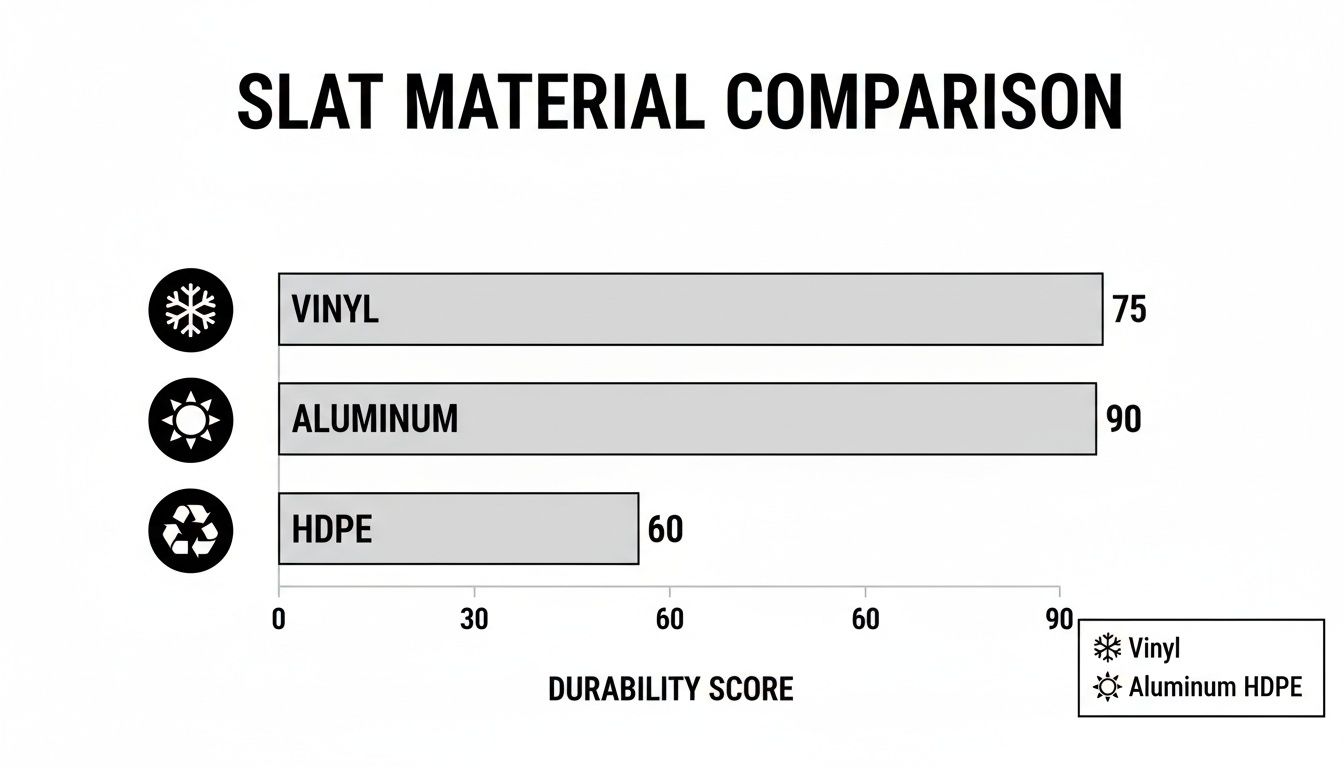
As you can see, premium materials like aluminum really stand out for their longevity. For anyone dealing with Ottawa's tough climate, that makes them a smart long-term investment.
Bottom-Locking Slats: This is the most common style. You slide each slat down through the mesh, and a horizontal channel snaps into place along the bottom, locking the slats for a clean, uniform look.
Top-Locking Slats: These are secured with a flexible channel that weaves through the top row of diamonds. It provides a tidy, secure finish that prevents slats from shifting.
Winged Slats: For maximum privacy, choose winged slats. Each slat has flexible "wings" that fan out to fill gaps in the mesh, achieving up to 98% blockage. The result is a nearly solid panel look.
Actionable Insight: The primary difference is coverage. While standard locking slats are effective, winged slats are specifically engineered to eliminate almost all sightlines. Select them for total seclusion around pools, patios, or hot tubs.
Balancing Privacy with Curb Appeal
Your fence is a major component of your property's first impression. A sleek, black winged slat can give an old chain link fence a modern, ornamental look. Alternatively, a neutral-toned bottom-locking slat can blend with your home’s siding, creating a subtle backdrop that highlights your landscaping.
Making the Right Choice for Your Space
To ensure you select the perfect slat, ask yourself these three questions before buying:
What is my primary goal? Am I blocking a busy street, creating a private family oasis, or simply polishing my yard's appearance?
How much privacy do I actually need? For close neighbours, 98% blockage from winged slats may be necessary. For softening a view, 85-90% blockage from a standard locking slat is sufficient.
What style fits my home? Choose a slat style and colour that complements your property's architecture and landscaping to enhance its overall aesthetic.
By aligning the slat's design and privacy rating with your specific needs, you'll get an upgraded fence that delivers both the privacy you want and a boost to your home's curb appeal.
How to Measure Your Fence for a Perfect Fit
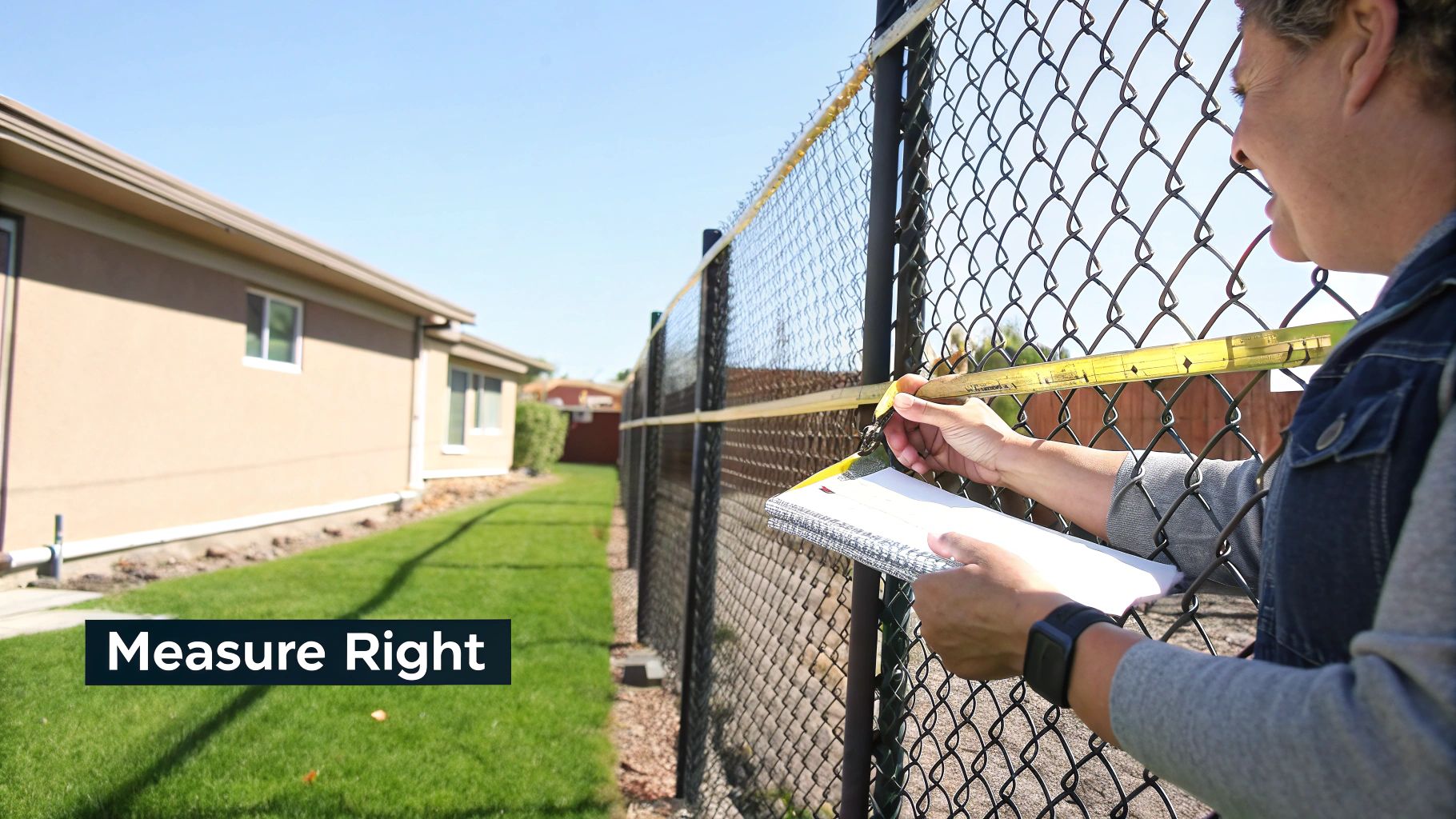
Ordering the wrong size slats is a frustrating and costly mistake. A miscalculation of even a fraction of an inch can leave you with slats that are unusable. To avoid this, follow these steps to get precise measurements.
The Three Critical Measurements
Grab a tape measure and a notepad. You need to record these three specifications to order correctly.
Fence Height: Measure from the top wire of the chain link fabric to the bottom wire. Do not measure from the ground or to the top of the post cap. Slat manufacturers already account for clearance; their products are typically made two inches shorter than the stated fence height. If you have a 6-foot fence, order 6-foot slats.
Wire Gauge: This measures the thickness of the wire. A smaller gauge number means a thicker wire. Most residential fences are 11 or 11.5 gauge, while heavier commercial fences are usually 9-gauge. A 9-gauge wire is noticeably more robust than an 11.5-gauge wire.
Diamond Mesh Size: This measurement determines the necessary slat width. Hook your tape measure on the inside of one wire and measure horizontally to the inside of the opposite parallel wire. The standard size for residential fences is 2 inches, but 2 1/4 or 2 3/8 inches are also common. This measurement must be exact for the slat to fit snugly.
Choosing a Colour That Complements Your Property
Once you have your measurements, select a colour that enhances your home's curb appeal.
Actionable Insight: Your fence is one of your property's largest visual elements. Choose a slat colour that complements your home's exterior—siding, trim, or stonework—to create a cohesive and intentional look that boosts its overall visual appeal.
Follow these guidelines for proven results:
For a Modern Look: Choose Black. It's sleek, timeless, and makes landscaping pop. It gives a chain link fence an elegant, ornamental iron-like appearance from a distance.
To Blend In: Select earthy tones like Green, brown, or beige. These colours help the fence blend seamlessly into yards with trees, gardens, or other natural features.
To Match Your Home: Choose White, grey, or tan slats to coordinate with your home’s siding or trim for a polished, unified aesthetic.
Taking a few minutes to measure carefully and choose a thoughtful colour will pay off significantly. For more hands-on guidance, our actionable guide to installing privacy fence slats provides a complete step-by-step walkthrough.
DIY vs. Professional Installation: Getting the Slats on Your Fence
With your slats chosen, you now face a critical decision: install them yourself or hire a professional. The right choice depends on your budget, free time, and DIY skills. This decision is common in home improvement, and weighing DIY versus professional services for home improvements often comes down to a simple trade-off between your time and your money.
The Do-It-Yourself Approach
Installing fence slats is one of the more accessible DIY projects. The process is straightforward: weave the slats through the chain link mesh and snap the locking channel into place. However, a few common issues can turn a quick job into a weekend-long struggle.
Your DIY Toolkit
To achieve a professional result, gather the right tools before you start:
Utility Knife or Heavy-Duty Scissors: For cleanly trimming the bottom locking channel to fit between fence posts.
Rubber Mallet: To gently tap locking channels into place without causing damage.
Tape Measure: For precise cuts on the locking channels. Do not eyeball it.
Work Gloves: To protect your hands from the rough metal mesh.
Patience and Time: A 100-foot fence can easily take several hours. Do not rush the process.
Common DIY Hurdles
On a new, straight fence, installation is simple. On an older fence, you may encounter problems.
Bent or damaged mesh is a frequent issue. A single warped diamond can make it nearly impossible to slide a slat through, requiring you to carefully bend the wire back into shape. Uneven tension can also be a problem. If your fence sags, the slats will look bunched or wavy, ruining the uniform appearance.
Actionable Insight: The biggest challenge in a DIY slat installation isn't skill—it's consistency. Maintaining the same focus and technique over 150 feet of fencing is what separates a professional-looking job from one that appears homemade.
The Value of Calling in a Professional
Hiring an experienced contractor like FenceScape guarantees efficiency, expertise, and a flawless finish. A professional installer has encountered and solved every possible fence issue. While you see a warped section, they see a simple tensioning fix. Our guide on chain link fence installation details the professional process, and that same expertise applies to slat installation.
What a Professional Brings to the Job
Hiring a professional team provides a complete, worry-free solution:
Expert Site Assessment: We begin by inspecting your existing fence to identify and address any problem spots like bent rails or loose mesh before installation.
Quality Material Sourcing: Professionals have access to higher-grade materials, ensuring better durability and colour-fastness than what's typically found in big-box stores.
Speed and Efficiency: An experienced crew can complete a typical residential slat installation in just a few hours—a job that could take a DIYer an entire weekend.
Guaranteed Workmanship: If any issues arise with the installation, we return to fix them. This guarantee provides peace of mind that a DIY project cannot offer.
This professional touch is especially valuable for larger commercial projects in the Ottawa–Gatineau area. For businesses, professionally installed slats for chain link fence deliver an optimal mix of security, privacy, and cost-effectiveness. In fact, local data shows that slatted chain link fences account for 35% of all new commercial fencing installations, underscoring their practical value when installed correctly.
If you have a straightforward fence and enjoy hands-on projects, the DIY route can be rewarding. However, if your time is valuable, your fence has imperfections, or you want a flawless result backed by a guarantee, hiring a professional is a worthwhile investment.
What Do Fence Slats Cost? A Look at Your Investment
To understand the true value of this upgrade, you must look beyond the initial price tag. While the upfront cost of slats for a chain link fence is a key budget factor, it's equally important to consider long-term maintenance costs and durability. A smart choice now will save you time and money for years.
The slats themselves typically cost between $2 to $18 per linear foot, depending on the material, style, and privacy level. Professional installation in the Ottawa area will add to this cost, but you are paying for a perfect finish and a workmanship guarantee.
Breaking Down Material and Installation Costs
The final cost of your project depends on your choices. A basic, low-privacy slat will be at the lower end of the price range, while a premium winged slat designed for 98% privacy will be at the higher end.
Actionable Insight: Think of high-quality, durable slats as an investment, not an expense. Like a good winter coat, a higher upfront cost delivers better performance and a longer lifespan, resulting in superior long-term value.
To budget for your entire fence project, including slats, our complete Canada cost guide for chain link fences offers detailed breakdowns.
The popularity of fence slats in Ottawa-Gatineau has grown with suburban development. As backyards and pools became more common, so did the need for privacy and safety. Slats offered a compliant and aesthetic solution to meet updated provincial safety codes, which often require a visual barrier around pools.
The Beauty of Low-Maintenance Living
This is where investing in quality slats for a chain link fence truly pays off. Materials like vinyl (PVC), HDPE, and aluminum are engineered to withstand Ottawa-Gatineau weather with almost zero maintenance.
No Painting or Staining: Unlike wood, these materials never need sealing or repainting to protect them from sun, rain, or snow.
Easy Cleaning: A garden hose is usually sufficient to remove dust and dirt. For tougher grime, use mild soap and water.
No Rot or Pests: These materials do not absorb moisture, so they will never rot, warp, or be damaged by insects.
This low-maintenance nature not only saves you weekend chores but also eliminates the recurring costs of stains, sealers, and supplies required for wood fence upkeep.
Lifespan and What to Expect From a Warranty
A strong warranty is a clear indicator of a product's quality. When selecting slats, look for a warranty that covers defects like cracking, chipping, and significant fading.
Most top-tier brands offer limited warranties ranging from 15 to 25 years. This protects your investment and ensures your fence will continue to look great and provide privacy for decades.
Your Fence Slat Questions Answered
Here are clear, practical answers to the most common questions homeowners ask before upgrading their fence.
Can I Add Slats to My Old Chain Link Fence?
Yes, in most cases. Slats are an excellent retrofit for existing chain link fences, regardless of age.
The key factor is the fence's structural integrity. Inspect your fence for badly bent posts or damaged sections of mesh, as these can make installation difficult. However, if your fence is structurally sound and mostly straight, it is a perfect candidate for slats.
Will Slats Make My Fence Blow Over in the Wind?
This is a valid concern, especially in windy areas like Ottawa–Gatineau. Adding slats transforms an open grid into a solid surface, which significantly increases wind load.
Actionable Insight: A fence with slats acts like a sail. A 6-foot fence with privacy slats presents a large surface for wind to push against. Ensure your fence posts are securely set in concrete and the frame is solid. A well-built fence can handle the added stress, but a weak one may start to lean.
Are Fence Slats a Pain to Clean?
No, they are designed for extremely low maintenance. High-quality vinyl, aluminum, and HDPE are built for outdoor conditions.
Routine Cleaning: A quick spray with a garden hose will remove everyday dust and dirt.
Deep Cleaning: For stubborn grime like mud or winter buildup, use a soft brush and soapy water. No harsh chemicals are necessary.
These non-porous materials have colour mixed in, so they resist staining, mould, and fading, keeping your fence looking sharp with minimal effort.
How Much Privacy Do I Actually Get From Slats?
The level of privacy is determined by the slat style you choose. Manufacturers provide a percentage rating to help you decide.
A standard slat typically provides 85-90% visual blockage, which is ideal for creating a comfortable backyard retreat. For maximum privacy around a pool or along a busy street, select winged slats. Their side flaps close the gaps in the chain link, achieving up to 98% blockage.
Ready to transform your chain link fence into a private, secure, and stylish barrier? The team at FenceScape has the expertise to help you select the right product and ensure a perfect installation. Let's discuss your project—get your free, no-obligation estimate today. Visit us at https://www.fencescape.ca to learn more.
Comments