
Wood Fences with Metal Posts: A Practical Guide to Building a Fence That Lasts

Watching your beautiful wood fence start to lean and rot after just a few tough seasons is a frustrating and costly experience. It's a common problem for homeowners, but it doesn't have to be yours. The solution is a wood fence with metal posts—a smart hybrid that marries the classic, natural look of wood with the rock-solid strength of steel. Follow this guide to understand how this upgrade creates a fence that is genuinely built to last.
The Ultimate Hybrid Fence For Modern Homeowners
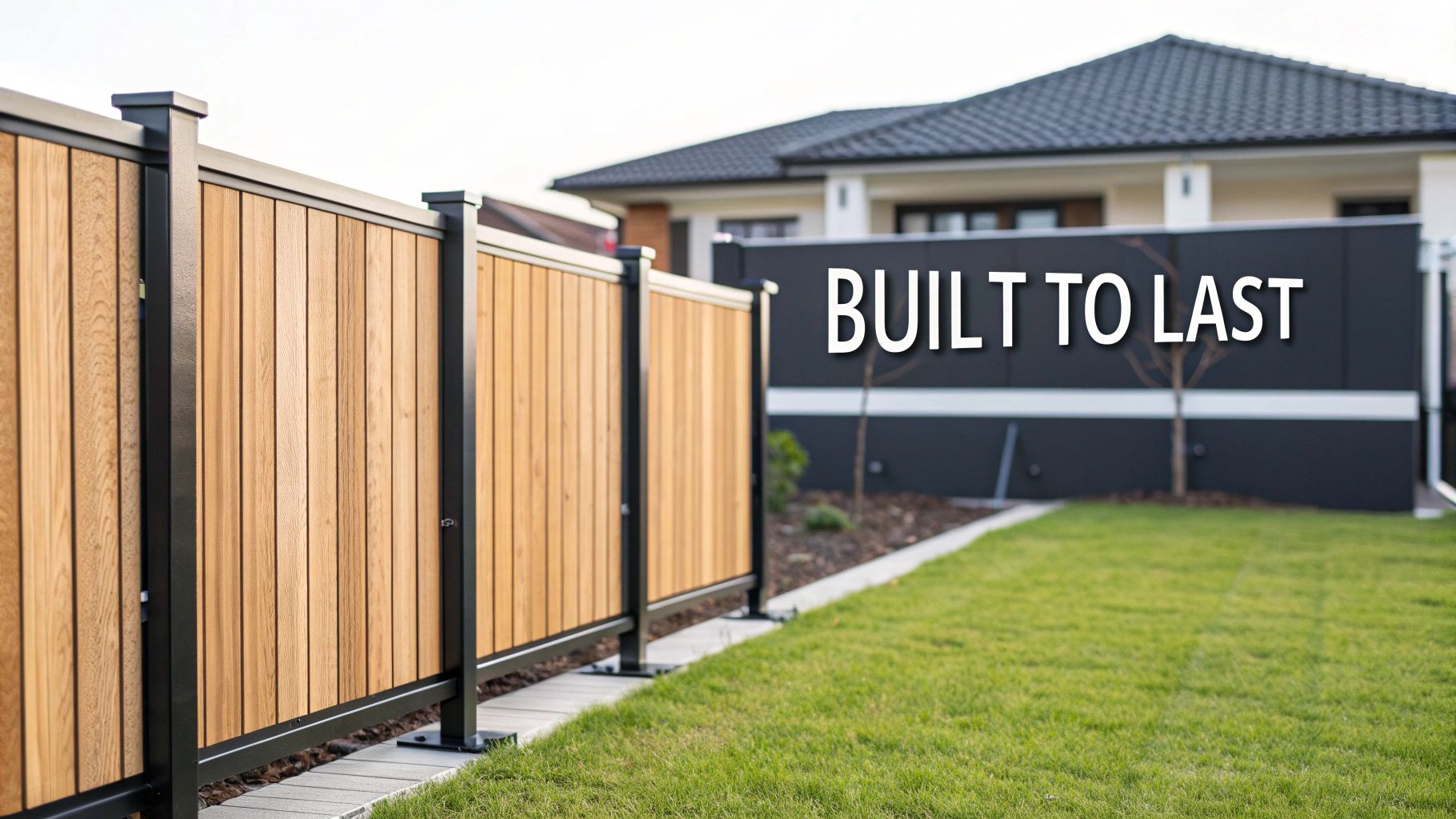
In an all-wood fence, the posts buried in the ground are always the first point of failure. Constantly exposed to moisture, soil, and insects, they inevitably rot. Once the posts fail, the rest of the fence starts to sag, lean, and eventually collapse, sometimes in just a few years.
By swapping vulnerable wood posts for steel, you reinforce the fence right where it needs it most. It's the practical equivalent of building a house on a concrete foundation instead of wooden stilts. The aesthetic you admire remains, but the core is fortified against the very elements that would otherwise bring it down.
Strength Meets Classic Style
This hybrid system allows you to get the best of both worlds without compromise. You don’t have to give up the warm, inviting look of a traditional wood fence to gain durability. This combination is a forward-thinking design choice that protects your investment for the long haul.
Here are the actionable advantages you gain:
Exceptional Durability: Install galvanized steel posts to make your fence immune to rot and insect damage. Moisture at ground level, the number one enemy of any fence, will no longer threaten its foundation.
Long-Term Stability: Choose metal posts to ensure your fence line stays straight and true, as they won't warp, twist, or crack with seasonal changes.
Enhanced Curb Appeal: Use the clean lines of black metal posts to create a striking modern contrast that makes the natural wood panels pop, instantly boosting your property’s aesthetic.
Actionable Insight: This hybrid construction directly solves the most common failure point of traditional fences. By specifying metal posts for your project, you transform your fence from a temporary boundary into a permanent, reliable feature of your home, perfectly suited to withstand the challenging freeze-thaw cycles of the Ottawa–Gatineau climate.
Ultimately, choosing a wood fence with metal posts means you're picking a smarter, more resilient solution. You get the timeless look you love without the constant worry of rot and expensive repairs, giving you a beautiful and lasting addition to your property.
Why Metal Posts Outlast Traditional Wood Posts
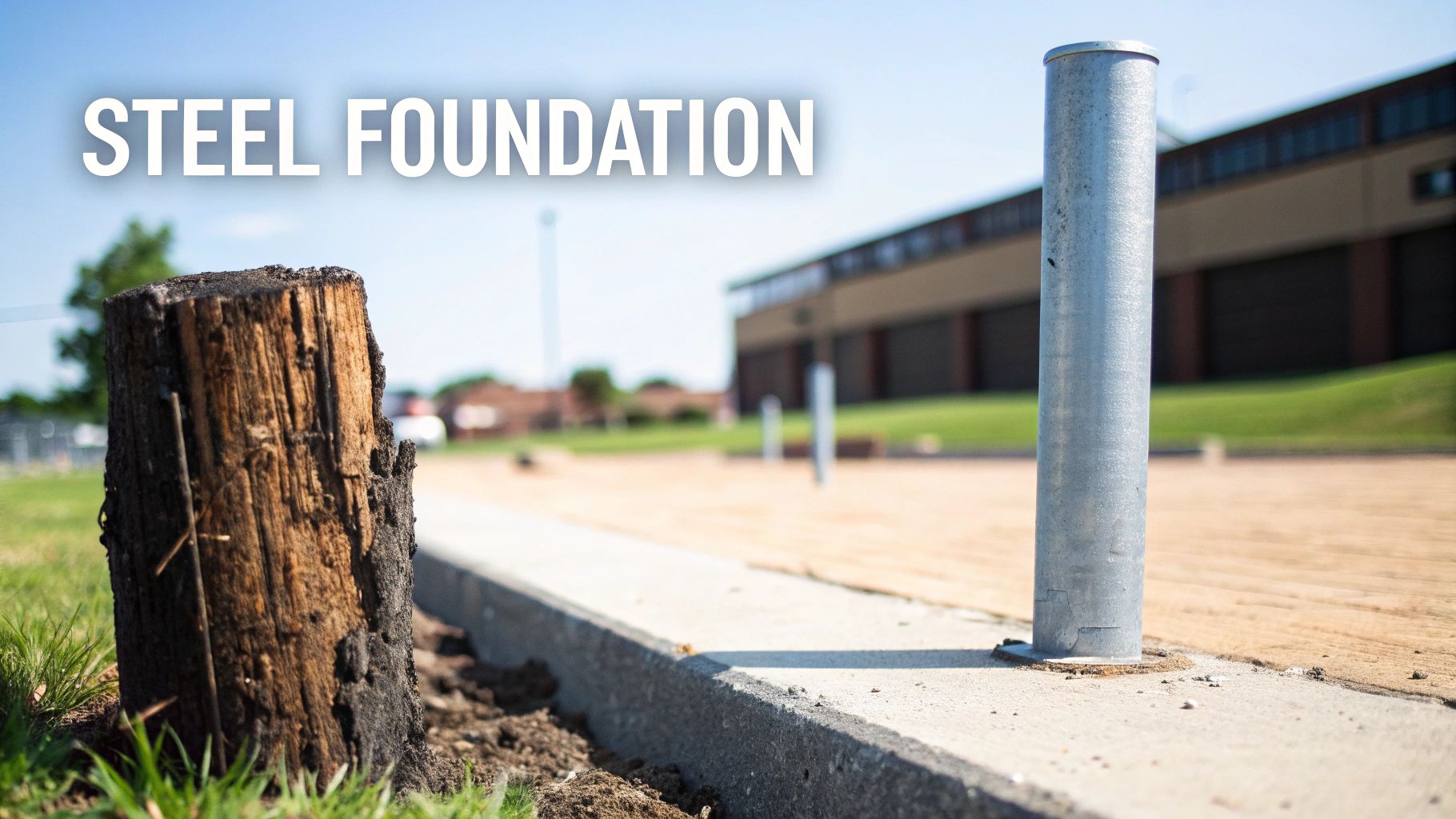
To understand why a wood fence with metal posts is the superior choice, you need to recognize where all-wood fences fail. A standard wooden post, even when pressure-treated, is fighting a losing battle from day one. The buried section is the Achilles' heel of the entire structure.
The primary enemy is moisture. Soil holds water, keeping the base of the post constantly damp. This creates the perfect environment for fungi and bacteria to cause ground-level rot—the single biggest reason fences fail. The post may look solid from your lawn, but just below the surface, it's quietly breaking down.
The Science of a Failing Fence Post
Here in the Ottawa–Gatineau area, rot is only half the story. Our harsh winters introduce a powerful destructive force: frost heave. When moisture in the ground freezes, it expands with incredible force, pushing up on the post and its concrete base. In the spring, the ground thaws and settles, but rarely back to its original position, leaving the post looser and more tilted.
This freeze-thaw cycle repeats year after year, slowly wrestling the post out of the ground or forcing it to lean. This leads to a wobbly, unstable fence that no quick fix can save. It's a slow-motion failure baked right into the design.
Furthermore, wood naturally swells and shrinks as it absorbs and releases moisture. This constant movement causes posts to bend, crack, and lose their shape. A post that was perfectly straight on installation day can become a crooked anchor, pulling the whole fence line out of alignment.
Actionable Insight: Recognize that a wooden fence post is fighting a battle on three fronts: biological decay from rot, mechanical force from frost heave, and physical distortion from moisture. This is precisely why you should expect an all-wood fence to show serious signs of failure in as little as 5-10 years.
How Steel Posts Eliminate These Weaknesses
This is where specifying steel posts changes the game. By swapping that vulnerable wooden foundation for galvanized or powder-coated steel, you systematically eliminate every one of those failure points. It isn't just a small improvement; it's a fundamental re-engineering of the fence's core strength.
The advantages of steel are clear and practical:
Immunity to Rot and Pests: Steel is inorganic. It cannot rot and is completely unappetizing to termites and other wood-boring insects. The biological breakdown that dooms wood posts is a non-issue.
Resistance to Frost Heave: To combat frost heave, ensure your steel posts are installed professionally, set deep in concrete below the frost line. Their slim profile and unyielding strength resist the shifting pressures of the soil far better than a bulky wood post.
Unyielding Structural Integrity: Steel does not warp, twist, or crack when exposed to moisture. A steel post remains straight for its entire life, which means your fence line stays level and secure for decades.
This hybrid approach gives you the timeless, natural beauty of wood panels built on a foundation engineered to last. While a full homeowner's guide to metal fences and gates has more detail, the core instruction is simple: separate the beautiful wood from the destructive forces in the ground.
The result is a fence that holds its strength and good looks for 20-30 years or more, saving you the headache and expense of premature repairs and replacements.
Choosing the Right Materials for Your Climate
Selecting the right materials for your wood fence with metal posts is critical to its success. Your choices of steel posts and wood panels will define how long your fence lasts, how it looks, and how much maintenance it will require. The goal is to find the optimal balance between performance, style, and budget.
When it comes to the metal posts—the backbone of your fence—you have two excellent options. Both are built to stand up to the elements, but knowing their different strengths will help you make the right choice for your project.
Selecting the Perfect Metal Posts
Your first option is galvanized steel. Galvanization provides a tough, industrial-strength shield. The steel post is dipped in molten zinc, creating a protective coating that sacrifices itself to fight off rust and corrosion. This means even if the surface gets scratched, the zinc layer continues to protect the steel underneath. For the part of the post buried in our damp Ottawa-Gatineau soil, this is an incredibly durable choice.
Your other option is powder-coated steel. In this process, a dry powder is electrostatically applied to the post and then cured under heat, forming a hard, smooth finish. While powder coating offers solid rust protection, its primary advantage is aesthetics. It provides a clean, consistent finish—usually a sharp black—that creates a striking contrast with natural wood panels.
Actionable Insight: For maximum corrosion resistance, choose galvanized steel. For a more refined, modern aesthetic, choose powder-coated steel. For the ultimate in durability and appearance, specify posts that are galvanized first and then powder-coated on top.
Choosing the Best Wood for Your Fence Panels
Once you've selected your posts, it's time to choose the wood. This choice will dictate the fence's character, natural beauty, and resistance to rot and pests.
The most common and budget-friendly choice is pressure-treated (PT) pine. This wood is infused with chemicals to resist decay and insects, making it a practical and long-lasting option. While it lacks the initial rich color of other woods, you can apply a stain to achieve any look you desire.
For a premium, natural look, choose Western Red Cedar. Cedar contains natural oils that make it inherently resistant to rot, decay, and insects. It is known for its beautiful reddish-brown tones and is dimensionally stable, meaning it’s less likely to twist or warp over time. Its natural toughness is why it has been a prized building material for generations.
A side-by-side comparison can clarify your decision. For a deeper analysis, consult our guide on cedar vs. pressure-treated fences. In the meantime, use this table as a practical starting point.
Comparing Fence Materials for Lasting Performance
To make your decision easier, here’s a quick comparison of how these materials stack up. This table breaks down the most common options, comparing them on key factors like durability, cost, and maintenance.
Material Type | Average Lifespan | Upfront Cost (Per Foot) | Maintenance Needs | Best For |
|---|---|---|---|---|
Galvanized Post | 25+ years | Moderate | Virtually none | Maximum durability and rust prevention in wet climates. |
Powder-Coated Post | 20+ years | Moderate to High | Minimal; touch up deep scratches to prevent rust. | Homeowners prioritizing a sleek, modern aesthetic. |
PT Pine Panels | 15-20 years | Low | Requires staining/sealing every 2-3 years. | Budget-conscious projects where durability is still key. |
Cedar Panels | 20-25+ years | High | Can be left to weather grey or sealed to preserve colour. | Premium appearance, natural rot resistance, and longevity. |
Ultimately, there is no single "best" choice—only the best choice for your specific needs. By carefully weighing these options, you can design and build a wood fence with metal posts that handles our tough climate and matches your aesthetic vision.
The Hybrid Fence Installation Process
Understanding how a wood fence with metal posts is built will help you ensure your project is done right, whether you hire a professional or tackle it yourself. A proper installation is a logical process that ensures your fence is straight, attractive, and built to last for decades.
Start with a solid plan. First, map out the fence line with stakes and string. At this stage, you must double-check local building codes and confirm your property lines to prevent costly mistakes.
This flowchart breaks down the three key decisions—budget, climate, and style—that should guide your material choices before any work begins.
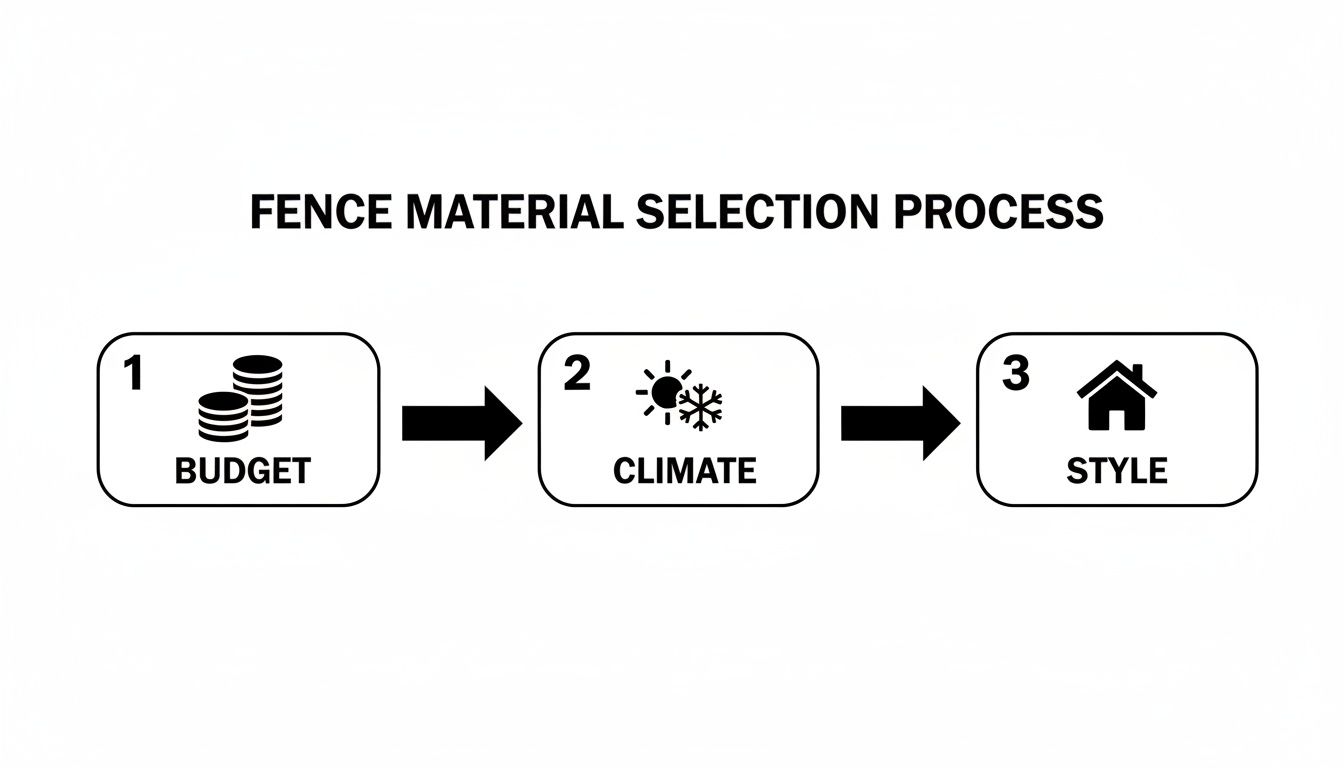
Balancing these three elements ensures the final fence works for both your wallet and your vision.
Setting Posts the Right Way
With the layout finalized, the most critical step begins: setting the metal posts. This requires creating a rock-solid foundation that will not shift, especially during our harsh winters. In the Ottawa–Gatineau area, this means you must dig post holes below the frost line, which is at least four feet deep.
Actionable Insight: The single most important step in the entire installation is setting the metal posts in concrete below the frost line. Insist on this step, as it alone determines the long-term stability and lifespan of your fence, preventing the leaning and shifting that plagues improperly installed fences.
After digging the holes, add a layer of gravel at the bottom for drainage. Position the metal post, use a level to ensure it is perfectly plumb, and pour concrete around it. Allow the concrete to cure completely—this can take several days but is absolutely essential for locking the posts in place with maximum strength.
Assembling the Framework and Panels
Once the posts are firmly set, you can attach the horizontal wooden rails. Use specialized brackets designed for connecting wood to steel to create a sturdy frame.
Finally, fasten the wood pickets or panels to the rails. To achieve a professional finish, pay close attention to consistent spacing and ensure the top edge is perfectly level. If you need to mount posts onto an existing surface, our practical guide to anchoring posts to concrete provides specific instructions.
Common Installation Pitfalls to Avoid
Even in a straightforward process, a few common mistakes can compromise your fence. Know what to look for to ensure quality work.
Incorrect Post Depth: Insist that posts are set below the frost line. Otherwise, they will heave and lean.
Improper Spacing: Do not space posts more than eight feet apart. Wider spacing will cause the wooden rails to sag over time.
Wrong Fasteners: Use only galvanized screws or brackets rated for outdoor use to prevent rust stains from streaking down your fence.
Ignoring Property Lines: Always verify your property lines before digging to avoid expensive disputes with neighbors.
By understanding these key steps and potential pitfalls, you can confidently oversee your project and ensure your new hybrid fence is an investment that pays off for years to come.
Looking at the Real Cost and Long-Term Value
When budgeting for a new fence, it’s crucial to look beyond the initial quote and consider the long-term return on investment (ROI). Choosing a wood fence with metal posts is a strategic financial decision, and the numbers back it up.
While a hybrid fence costs more upfront than an all-wood counterpart due to the steel posts and specialized hardware, this initial premium is where the long-term value begins.
What to Expect Upfront
Let's talk numbers. A professionally installed all-wood fence using standard pressure-treated pine has a baseline cost per linear foot. A comparable hybrid system with galvanized steel posts will likely cost 15-25% more at the outset.
Don't let that difference deter you. With that extra investment, you are purchasing immunity from the single most expensive point of failure for any fence: rotting posts.
Actionable Insight: Frame the higher cost as an insurance premium. You are paying a little extra today to completely avoid a massive structural repair bill a decade from now.
This forward-thinking approach is becoming the industry standard. The global fencing market is projected to hit USD 44.39 billion by 2030. Metal materials already account for over 52% of the market's revenue, signaling a clear consumer preference for durability. These fencing market trends show a decisive shift towards long-lasting solutions.
Why the Return on Investment is So Much Better
The financial benefit of a hybrid fence becomes clear when you project costs over 5, 10, and 15 years. Most all-wood fences require their first major repair—replacing rotted posts—within 7 to 10 years. This is not a simple fix; it involves digging up old concrete, setting new posts perfectly, and re-attaching large fence sections.
Such a repair can easily cost a significant portion of the original installation price. At that point, any initial "savings" from choosing all-wood are eliminated. The budget-friendly choice becomes the more expensive problem.
With a wood fence on metal posts, this entire costly repair cycle is avoided. The steel framework is engineered to last 20-30 years or more. Your only significant long-term cost will be periodically staining or sealing the wood panels—maintenance you would perform on an all-wood fence anyway.
When you compare the long-term financial outcomes, the choice becomes clear:
All-Wood Fence: Lower initial cost, but with a near-certainty of a major repair expense within the first decade.
Hybrid Fence: Higher upfront cost, but with predictable, low future expenses and freedom from structural failure for decades.
By investing in a rock-solid foundation from day one, you secure a better long-term ROI, save yourself from future frustration, and add a durable, valuable asset to your property.
Designing Your Fence for Privacy and Style
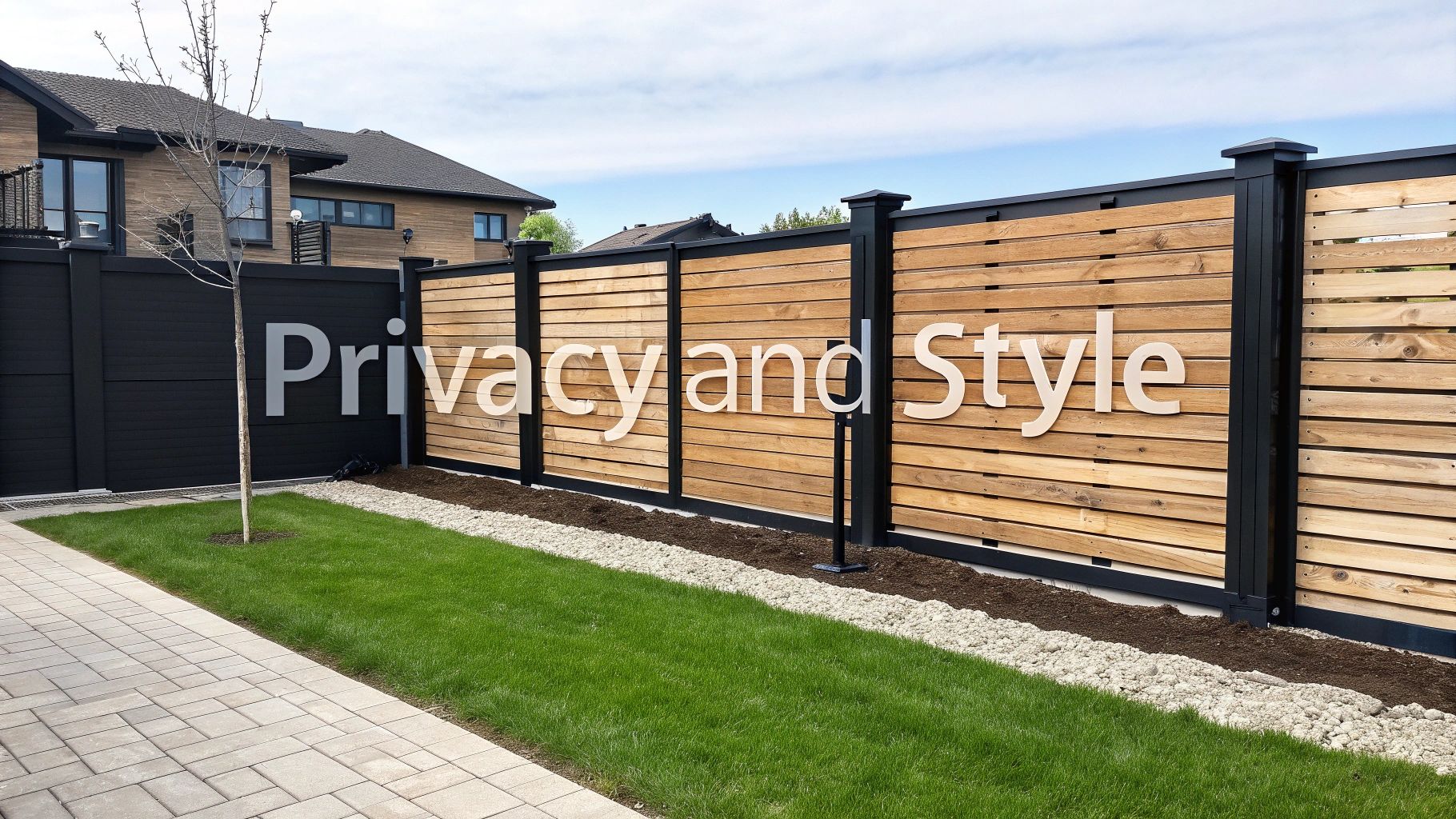
A great fence is more than a boundary; it’s a key design element of your home's exterior. The versatility of wood fences with metal posts allows you to create a structure that is as stylish as it is strong.
Use this hybrid system as a design platform. For a striking modern look, pair the warm texture of cedar panels with the sharp, clean lines of black powder-coated steel posts, especially with horizontal slat designs. For a more classic aesthetic, a traditional solid board fence on galvanized posts provides critical long-term stability without looking out of place.
Achieving Your Ideal Level of Privacy
For many homeowners, the primary goal of a new fence is privacy. The style you choose directly impacts how secluded your backyard feels. Select a design that strikes the right balance between openness and seclusion for your needs.
Full-Privacy Solid Board: Choose this style for maximum seclusion. The vertical boards are fitted tightly to create a solid barrier that blocks sightlines and helps dampen sound.
Shadowbox Style: This design alternates boards on either side of the rails. It appears solid from a direct view but allows for airflow and some visibility from an angle, making it feel less imposing.
Horizontal Slats: A popular choice for modern homes. Install the boards tightly together for full privacy or leave small gaps for a more architectural, semi-private feel.
Actionable Insight: Your fence design should be a deliberate choice that balances aesthetic desires with practical needs. Select a style that not only complements your home but also delivers the precise level of privacy and security your family requires.
Beyond Aesthetics: Practical Design Considerations
Your design must also adhere to local regulations. If you have a pool, for example, your fence must meet Ottawa–Gatineau bylaws for enclosures, which mandate specific heights and self-latching gates for safety.
For security, a tall, solid board fence is an effective deterrent. To make it harder to climb while adding a decorative touch, consider adding a section of lattice at the top. For a softer, greener privacy screen, plant fast-growing hedge plants along the fence line to create a living wall.
By combining wood and metal, you don't have to choose between a fence that looks good and one that lasts. You get the strength you need and the style you want—a beautiful, functional addition to your home.
Your Top Questions Answered
Even with all the benefits laid out, practical questions often remain. Getting clear, actionable answers is the final step before you commit to your project. Here are the common questions we hear from homeowners across the Ottawa–Gatineau region.
How Long Do These Fences Actually Last?
When installed correctly, you can expect a hybrid fence to stand strong for 20 to 30 years, and often longer. The steel posts are the key. Because they are set in concrete deep below the frost line, they cannot rot at ground level—the very issue that destroys most all-wood fences in under a decade. The wood panels will require maintenance, but the structure will remain sound.
Can I Replace Rotted Wood Posts on My Existing Fence?
Yes. This is one of the smartest and most cost-effective repairs you can make. If your fence panels are in good condition but the posts are rotting and leaning, you can upgrade the foundation without replacing the entire fence.
The process is straightforward: a professional will carefully remove the failing wood posts and their concrete footings, install new galvanized steel posts in their place, and re-attach your existing fence sections. This provides your old fence with a rock-solid foundation that will extend its life for many years.
Actionable Insight: Treat this as a structural upgrade. By salvaging the good parts of your fence and fixing the core problem, you get modern durability without the cost of a complete rebuild.
What Is the Real Maintenance Difference?
The biggest difference is the elimination of worry. With metal posts, you no longer have to be concerned about ground-level rot—the most expensive and stressful fence problem.
Your maintenance to-do list becomes much simpler and more predictable, focusing only on the wood panels:
Regular Cleaning: Wash the panels annually to remove dirt and mildew.
Periodic Sealing: Apply a quality stain or sealant every 2-4 years to protect the wood from sun and moisture damage.
This proactive maintenance is far less stressful and costly than reacting to a failing structure. You'll spend less time dealing with problems and more time enjoying your backyard.
Ready to build a fence that combines timeless style with unmatched durability? The team at FenceScape specializes in designing and installing high-quality wood fences with metal posts built to withstand our Canadian climate. Contact us today for a free, no-obligation estimate and let's create a lasting boundary for your property.
socolive cần được đánh giá không chỉ qua nội dung thể thao mà còn qua những tín hiệu người dùng gặp trong quá trình truy cập. Địa chỉ trang, yêu cầu cấp quyền, cửa sổ bật lên và lời đề nghị tải tệp đều là những chi tiết cần được quan sát trước khi tiếp tục sử dụng. Tôi ưu tiên kiểm tra xem đường dẫn có đúng với nguồn dự định truy cập hay không, đồng thời tránh nhập thông tin cá nhân vào biểu mẫu không rõ mục đích. Nếu xuất hiện yêu cầu cài đặt phần mềm không cần thiết để xem nội dung, người dùng nên dừng lại và xác minh nguồn trước khi thực hiện. Những…
luck8 casino làm tôi quan tâm đến cách trình bày thông tin tài khoản sau khi đăng nhập. Tôi kiểm tra vị trí các mục hồ sơ, lịch sử hoạt động và chức năng cập nhật dữ liệu để xem chúng có được phân chia rõ ràng hay không. Khi chuyển từ bắn cá, casino live sang khu vực cá nhân, người dùng cần nhận biết nhanh cách quay lại nội dung trước đó. Tôi cũng chú ý phần hướng dẫn nhập liệu và thông báo xác nhận khi thay đổi thông tin. Nếu các nút lưu, chỉnh sửa và hủy được thiết kế khác biệt dễ nhận ra, nguy cơ thao tác nhầm sẽ giảm. Cách tổ chức khoa học…
https://fly88pe.com/ khi tôi xem phần tài khoản cần thể hiện rõ các nhóm thông tin cá nhân và lịch sử liên quan. Tôi chú ý cách đặt tên mục, vị trí điều hướng và cách phân biệt từng phần trước khi mở. Sau đó, tôi chuyển giữa các khu vực để xem giao diện có giúp nhận biết đúng nội dung đang xem hay không. Nếu các chức năng được gom chung với nhãn mơ hồ, việc tìm thông tin có thể mất thêm thời gian; nếu từng phần được tách bạch, thao tác sẽ dễ hiểu hơn. Tôi cũng xem trọng những hướng dẫn nhắc người dùng bảo vệ mật khẩu và mã xác minh. Với tôi, đánh giá khu…
https://gk88.pl/ khiến tôi để ý đến cách nền tảng hướng dẫn người mới qua các bước đăng ký và tiếp cận danh mục. Tôi thường xem biểu mẫu yêu cầu thông tin gì, hướng dẫn xác minh nằm ở đâu và người dùng có thể tìm trợ giúp khi gặp khó khăn hay không. Nếu các bước được trình bày theo thứ tự rõ ràng, người mới sẽ dễ hiểu mình đang ở giai đoạn nào. Tôi cũng chú ý những liên kết dẫn đến điều khoản và thông tin tài khoản. Với tôi, trải nghiệm ban đầu hợp lý khi hướng dẫn ngắn gọn, thuật ngữ dễ hiểu và mỗi bước nêu rõ việc cần hoàn thành trước khi tiếp…
TN88 giúp tôi xem xét khả năng thích ứng của giao diện khi sử dụng trên màn hình nhỏ. Tôi chú ý cách các nút thao tác và danh mục được thu gọn nhưng vẫn giữ khả năng nhận diện. Khi trải nghiệm cá cược thể thao, casino và bắn cá, tôi quan sát cách nội dung được hiển thị và chuyển đổi giữa các trang. Các khu vực chính vẫn khá dễ xác định nên tôi có thể tiếp tục thao tác mà không phải phóng to nhiều lần. Tôi cũng kiểm tra khả năng quay lại danh mục trước để xem cấu trúc có được duy trì không. Qua đó, tôi có thêm cơ sở đánh giá mức độ…