
Cedar vs Pressure-Treated Fence: Which to Choose for Your Home?

When choosing between a cedar and a pressure-treated fence, the decision boils down to a clear trade-off: cedar offers natural beauty and inherent rot resistance for a higher price, while pressure-treated wood delivers budget-friendly durability thanks to a chemical treatment process. Your choice depends on how you balance upfront cost against long-term aesthetics and maintenance. This guide provides the actionable insights you need to make the right call for your property.
Your Quick Cedar vs Pressure-Treated Fence Guide
Picking the right fence material is a major investment that impacts your home's curb appeal, security, and future maintenance workload. Both cedar and pressure-treated lumber are excellent, widely-used options, but they cater to different priorities.
This guide provides a high-level overview to frame your thinking. We'll break down the core differences to give you an immediate, actionable summary. Consider this your cheat sheet before we dive into the details.

Core Considerations at a Glance
Before we dive deep, understanding the main trade-offs will help you prioritize. Homeowners typically weigh four key factors:
Upfront Cost: For immediate savings, pressure-treated lumber is the clear winner. Expect to pay 30-40% less for materials compared to cedar.
Lifespan: For a longer-lasting investment, choose cedar. A well-maintained cedar fence can last 20-25 years, while a pressure-treated fence typically lasts 10-15 years.
Appearance: If you want natural, high-end beauty, cedar is unparalleled with its rich tones. Pressure-treated wood is more functional, starting with a greenish tint that serves as a base for paint or stain.
Maintenance: Both require upkeep. To preserve its famous colour, seal cedar every 3-5 years. To prevent warping and cracking, seal pressure-treated wood every 2-3 years.
To make the choice even clearer, here’s a quick side-by-side comparison.
At a Glance: Cedar vs Pressure-Treated Fencing
Use this table to quickly weigh the most important attributes and see which material aligns with your project goals.
Attribute | Cedar Fence | Pressure-Treated Fence |
|---|---|---|
Initial Cost | Higher upfront investment | Lower initial cost |
Expected Lifespan | 20-25 years (or more) | 10-15 years |
Appearance | Natural reddish-brown hues, ages to a silvery grey | Greenish or brownish tint, can be painted or stained |
Natural Resistance | Naturally resistant to rot, decay, and insects | Chemically treated to resist rot and insects |
Maintenance | Seal every 3-5 years to maintain colour | Seal every 2-3 years to prevent warping/cracking |
Seeing the key differences laid out like this helps homeowners zero in on what matters most—whether it’s the long-term elegance of cedar or the practical, budget-conscious nature of pressure-treated wood.
What's Really Under the Hood? A Look at Material Composition and Durability
To settle the cedar vs. pressure-treated fence debate for your home, you must understand what makes each material perform. The wood’s composition is the single biggest factor in how it will handle Ottawa's freeze-thaw cycles, shrug off pests, and stay standing. It's the "why" behind each material's lifespan.
The fundamental difference is simple: one wood gets its strength from nature, the other from a factory.
Cedar's Natural Resilience
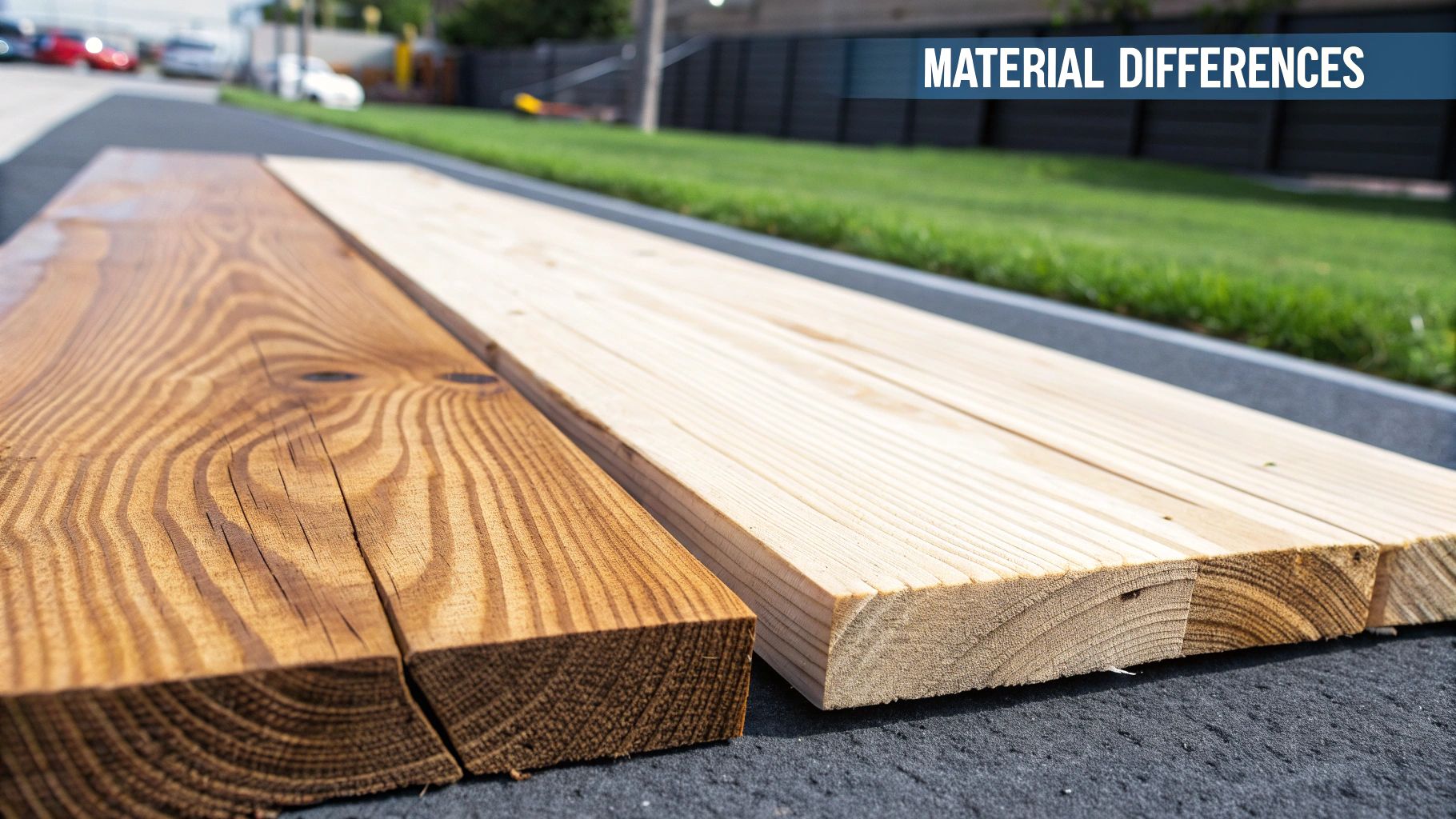
Western Red Cedar’s durability comes from natural oils and tannins in its fibres. This built-in defense system makes the wood naturally resistant to rot, fungus, and insects without chemical additives.
This natural makeup gives cedar actionable advantages:
It Holds Its Shape: Cedar is less dense and shrinks minimally, making it far less likely to warp, twist, or cup in Ottawa’s fluctuating climate.
Keeps Bugs Away: The same oils that fight rot also repel wood-boring insects. For a rustic application of this quality, explore our guide to cedar split rail fences.
It's Chemical-Free: For homeowners wary of chemicals near gardens or play areas, cedar is the go-to choice.
Actionable Insight: Choose cedar if dimensional stability and a chemical-free material are your top priorities. Its natural oils act as a permanent preservative, allowing it to age gracefully.
This organic resilience is why a properly maintained cedar fence can last 20 years or more, holding its form and fending off the elements.
Pressure-Treated Wood's Engineered Strength
Pressure-treated lumber is typically made from softwoods like pine or spruce. Its durability comes from an industrial process where chemical preservatives are forced deep into the wood fibres under intense pressure.
This process transforms the wood, giving it protective qualities it wouldn't have naturally. Modern treatments use copper-based preservatives (like ACQ), which are far safer than older, arsenic-based formulas.
The result is a material incredibly effective at resisting fungal rot and destructive insects. Knowing the early signs of termites makes you appreciate the protection these treatments offer.
However, this engineered strength has a trade-off. The base wood (like pine) isn't as dimensionally stable as cedar, making it more prone to shrinking, warping, and cracking as it weathers.
Head-to-Head: Durability in Our Climate
While cedar is fantastic at resisting sun- and moisture-related cracking, research shows pressure-treated wood can have a longer structural lifespan, especially for posts set in the ground. While a cedar post might last 20 years, a pressure-treated post can last 30 to 60 years in certain conditions due to its deep chemical protection.
For an Ottawa homeowner, this means a strategic approach is best. Use cedar for pickets and panels where appearance and stability are key. Use pressure-treated posts for a super rot-resistant and budget-friendly foundation. This hybrid approach is often the smartest solution.
Comparing Initial Investment vs. Lifetime Value
While pressure-treated wood wins on upfront cost, a smart investment requires looking past the initial quote. The real story is in the lifetime value—factoring in installation, upkeep, and eventual replacement.
The question isn't just which material is cheaper now, but which offers a better return over the next two decades. Let's break down the real numbers.
Analyzing the Upfront Costs
Your initial quote is based on materials and labour. For materials, pressure-treated lumber is consistently more affordable.
Market data shows pressure-treated wood can be 30-40% less expensive than cedar. On a standard 150-linear-foot fence, that translates to an immediate saving of $1,500 to $3,000. This makes it a highly practical option for tight budgets or large properties. You can dig deeper into cost breakdowns in our complete guide to wood fence pricing.
Cedar's premium price reflects its natural beauty, inherent durability, and milling costs. It's an upfront investment in your home’s curb appeal and long-term value.
Projecting Long-Term Maintenance Expenses
Here, the financial picture gets more complex. Cedar may cost more initially, but pressure-treated wood often requires more frequent maintenance, adding to its total cost over time.
Pressure-Treated Wood: Prone to warping and cracking, it needs a quality water-repellent sealant every 2-3 years. The cost of sealant and your time (or hiring a pro) becomes a recurring expense.
Cedar Wood: Better at holding its shape, its main upkeep is a UV-blocking sealant every 3-5 years to preserve its colour. Longer intervals between applications can mean less money spent over two decades.
Over a 20-year span, a pressure-treated fence might need 7-10 sealant applications, while a cedar fence may only need 4-6. These recurring costs narrow the initial price gap.
Actionable Insight: A fence isn't a one-time purchase. The most budget-friendly choice isn't the one with the lowest sticker price, but the one whose total cost aligns with your long-term financial plan.
Calculating the True Lifetime Value
To truly understand your investment, consider the replacement cycle. A well-cared-for cedar fence can last 20-25 years. A pressure-treated fence usually requires replacement after 10-15 years. You could be building a second pressure-treated fence while a cedar fence is still standing strong.
Consider this real-world scenario:
Homeowner A chooses a pressure-treated fence. They save money upfront but find themselves restaining it every few summers. Around year 15, they face a full replacement project.
Homeowner B invests in cedar. The initial cost is higher, but they enjoy longer breaks between maintenance, and the fence continues to add value and beauty well past the 15-year mark.
While local prices fluctuate, the principle holds true: cedar often delivers a higher ROI due to its superior look and durability, which directly add to curb appeal and resale value. Choosing pressure-treated is a move for immediate savings; choosing cedar is a play for long-term value and less replacement hassle.
Aesthetics and Customization Options
A fence is a major component of your home's curb appeal. Cedar and pressure-treated wood offer vastly different aesthetic starting points and aging processes.
Your choice here sets the tone for your property. Cedar provides classic, high-end looks from day one, while pressure-treated wood acts as a blank canvas for your personal style.
The Natural Elegance of Cedar
Cedar is naturally stunning. A new cedar fence has incredible warmth, with colours ranging from light amber to deep reds. Its complex grain patterns give every fence a unique, premium character that cannot be replicated.
Cedar's aging process is one of its most desirable traits. If left untreated, it weathers gracefully to a sophisticated, silvery-grey patina over a few years—a look many homeowners seek for rustic or coastal-inspired homes.
Pressure-Treated Wood: A Blank Slate
Pressure-treated lumber has a more utilitarian initial appearance, typically with a distinct greenish or brownish hue from the chemical treatment. This is not its final look; think of it as a primed surface.
Because it lacks cedar's standout natural grain, pressure-treated wood is the ideal candidate for customization. It is perfect if you want to match your fence colour to your home's trim, deck, or other exterior elements.
Actionable Insight: Do you want to enhance natural wood beauty or define its look entirely? Choose cedar to enhance. Choose pressure-treated wood to define with paint or solid stain.
Finishing and Customization Strategies
The right finish protects your fence and realizes your vision. Your approach should be tailored to your chosen wood.
For Cedar Fences:The goal is to showcase the natural grain, not hide it.
Semi-Transparent Stains: Our top recommendation. They provide UV and moisture protection while allowing the wood's colour and grain to shine through.
Clear Sealants: To preserve the vibrant new-cedar colour for as long as possible, use a clear UV-blocking sealant. It slows the aging process considerably.
Letting it Weather: For a low-maintenance approach, leave it unfinished and let it transition to a classic silver-grey.
For Pressure-Treated Fences:Here, you can get creative. After letting the wood dry for several weeks or months (a critical step!), your options are open.
Solid Stains: A great middle ground, providing uniform colour and excellent protection while allowing some wood texture to show.
Paint: For total colour control and a crisp, modern finish, paint is the answer. It can be colour-matched to anything on your property for a cohesive look.
These finishing strategies also apply to other outdoor projects. Professional deck painting and staining services can offer ideas for durable finishes. For style inspiration, check out our guide to seven trending wooden fence styles for Ottawa homes.
Environmental and Safety Considerations
Your fence material choice impacts your family's health and your property's environment. Here, the difference between cedar (a product of nature) and pressure-treated wood (a product of chemical engineering) is clear.
For families with kids and pets, understanding this distinction is crucial for peace of mind, especially near gardens and play areas.
The Chemical Question in Pressure-Treated Wood
Pressure-treated wood's longevity comes from chemical preservatives. Historically, this included Chromium Copper Arsenate (CCA), which raised concerns about arsenic leaching into soil. You can dig into the full research about wood preservatives to learn more.
Today, the industry has evolved. Residential pressure-treated lumber in Canada now uses safer copper-based preservatives like Alkaline Copper Quaternary (ACQ). Still, for anyone with an organic garden or a preference for chemical-free materials, cedar’s natural profile is compelling.
Cedar's All-Natural Advantage
Cedar is the opposite. Its resistance to rot and insects comes from its own natural oils and tannins—no chemical treatments required. This makes it the clear winner for homeowners seeking a purely natural material.
This is why cedar is often used where it comes into close contact with people or soil:
Vegetable Garden Borders: Zero risk of chemicals seeping into your food source.
Children's Play Areas: Creates a safe, chemical-free perimeter.
Pool Enclosures: Meets safety codes without introducing treated lumber near pool water.
Actionable Insight: The choice is a trade-off. Choose pressure-treated wood for engineered, budget-friendly durability. Choose cedar for inherent, all-natural resilience without added chemicals.
The visual choice often comes down to your end goal for the fence's look.
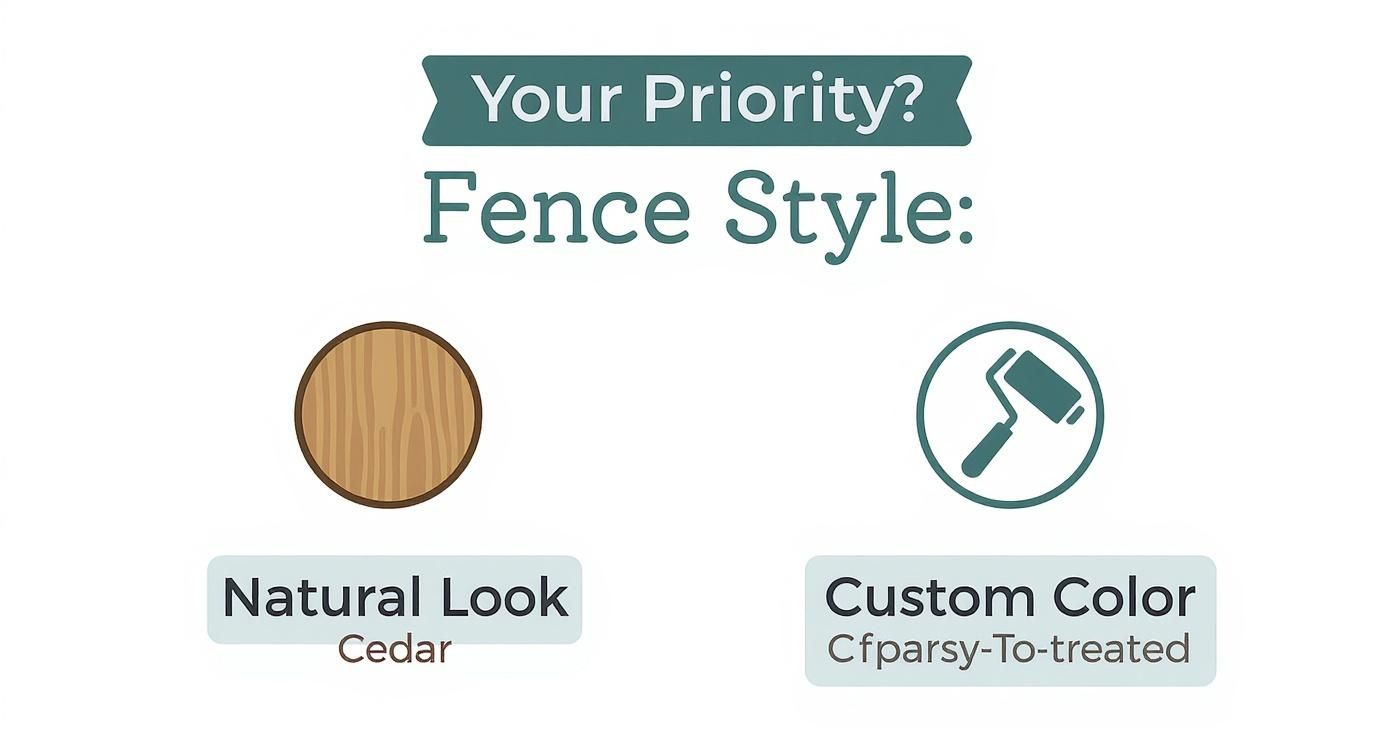
If you want the natural grain and warm tones to be the star, cedar is your choice. If a custom painted colour is your goal, pressure-treated lumber is the ideal canvas.
The Hybrid Approach: A Smart Solution
You don't have to choose one or the other. A hybrid building approach is a clever way to balance cost, durability, and peace of mind, delivering the best of both worlds.
Here’s how a hybrid fence works:
Pressure-Treated Posts: For the fence's foundation, use pressure-treated posts set in concrete. Their superior rot resistance in direct ground contact is a huge benefit.
Cedar Boards and Rails: For the visible parts—the pickets and horizontal rails—use beautiful, stable cedar.
This method gives you the gorgeous, chemical-free appearance of cedar for the body of the fence while leveraging the cost-effective, ground-contact strength of pressure-treated posts. It’s a smart compromise that maximizes your investment.
Making the Right Choice for Your Property
We've covered durability, cost, aesthetics, and safety. Now, it's time to apply this to your backyard. The "cedar vs. pressure-treated fence" debate isn't about finding a single "best" wood; it's about finding the best fit for your home, budget, and long-term goals.
The easiest way to decide is to pinpoint why you're building the fence. Your primary motivation will guide you to the right material.
When to Choose a Cedar Fence
Cedar is an investment in your home's curb appeal. Choose it when the fence is a key feature of your landscape.
A cedar fence is your best bet if you:
Prioritize Natural Beauty: You want a rich, warm colour and elegant grain for a highly visible fence in your front yard or along the street.
Want to Maximize Property Value: A stunning cedar fence is a genuine asset that boosts your home's aesthetic and resale value.
Prefer a Chemical-Free Solution: The fence will border a vegetable garden, play area, or pool, making untreated, natural wood the safest choice.
Plan to Stay Long-Term: You are settled in your home and will benefit from cedar's longer lifespan and less frequent maintenance over many years.
When to Choose a Pressure-Treated Fence
Pressure-treated lumber is the practical workhorse. Choose it when function, durability, and budget are your top priorities.
Go with pressure-treated wood if you:
Have a Strict Budget: Your main goal is to secure your yard and define your property line without a large initial investment.
Are Fencing a Large Area: The 30-40% material savings on long property lines or large yards makes a significant financial difference.
Need a Custom Colour: You plan to paint the fence to match your home’s trim or other features, making the wood's natural look irrelevant.
Are Focused on Utilitarian Needs: The fence is for a less-seen area, where solid performance and cost-effectiveness matter more than high-end aesthetics.
The Actionable Insight: Think of it this way: if your fence is for show—a centrepiece of your home's visual appeal—invest in cedar. If it's for go—securing your property on a practical budget—pressure-treated lumber is the smart, economical play.
Ultimately, you can build a strong, great-looking fence with either material. By considering these real-world scenarios, you can confidently pick the one that will serve your home best for years to come.
Common Questions, Answered
Here are direct answers to the most common questions Ottawa homeowners ask when deciding between cedar and pressure-treated fences.
How Long Does a Cedar Fence Last Compared to Pressure Treated?
Expect a well-built cedar fence to last 20 to 25 years or more, thanks to its natural rot- and insect-resistant oils.
A pressure-treated fence typically provides 10 to 15 years of service. The chemical treatment resists decay, but the wood itself is more prone to warping and cracking in Ottawa's harsh freeze-thaw cycles.
Can I Paint a Pressure-Treated Wood Fence?
Yes, painting is a major advantage of pressure-treated wood, but you must wait for it to dry completely. This can take a few weeks to a few months.
Actionable Tip: To test if it's ready, sprinkle water on the wood. If it beads up, it's too wet. If it soaks in, it's ready to prime and paint. Painting too soon traps moisture, causing peeling and rot.
Is Cedar Worth the Extra Cost for a Standard Backyard Fence?
Yes, if aesthetics and long-term value are priorities. Cedar costs more upfront, but its natural beauty, resistance to warping, and longer life often make it a better investment.
Actionable Insight: Cedar is worth the extra cost when the fence is a prominent feature. For highly visible areas or your long-term "forever home," its durability and curb appeal justify the expense. For purely functional, less visible boundaries, pressure-treated wood is the sensible, budget-friendly choice.
What Is the Essential Maintenance for Each Fence Type?
Proactive care is key to maximizing your fence's lifespan. Both types need regular cleaning, but their sealing schedules differ.
Cedar Fence: To preserve its rich colour, apply a quality sealant or semi-transparent stain every 3 to 5 years.
Pressure-Treated Fence: This wood requires more frequent attention. Apply a water-repellent sealant every 2 to 3 years to prevent cracking and warping.
Adhering to these schedules is the single best action you can take to ensure your fence looks great and stands strong for years.
Ready to build a fence that perfectly suits your property and budget? The experts at FenceScape can guide you through every option, from classic cedar to versatile pressure-treated wood and innovative hybrid designs. Get your free, no-obligation estimate today!
I enjoyed learning more about dark brown leather jackets through this article. The deeper shade gives them a mature and classic appearance. They can easily complement everyday clothing while adding a subtle rugged touch without looking overly bold or complicated.
I understood Sangya better after seeing examples alongside the definition. It made the topic feel much more practical.
I found the Hindi Vyakaran section useful because it explains the fundamentals in a clear and simple manner.
51 Game was quick and easy. The game offers great entertainment with interesting features and levels. I’ve been playing daily and it keeps getting more engaging every time
Trump threatens BG 678 new tariffs on European allies over Greenland until deal reached, as thousands protest