
Wood Fence Cost Calculator Ontario: Estimate Your Project

A residential wood fence in Ontario usually lands around $45 to $85 per linear foot installed in Ottawa-Gatineau, depending on material and site conditions. For a typical 100-foot backyard project, Ontario pricing guides put the all-in range around $4,000 to $9,500 fully installed including HST, so you can tell pretty quickly whether your project belongs in the practical, premium, or “needs a second look” category.
Most homeowners don't get blindsided by the lumber. They get caught by gates, slope, access, tear-out, and the fact that a one-line online estimate rarely matches a real quote once a crew walks the property. A proper wood fence cost calculator Ontario should do more than multiply footage by a rate. It should help you see what the rate includes, what it hides, and which parts of the job are driving the number.
What a Wood Fence Cost Calculator Needs Before You Multiply Anything
A decent estimate starts with measured linear footage, not a guess from a satellite map. Then it needs the height, gate count, and a honest look at the site. Skip one of those inputs and the result can look tidy on screen while being nowhere near a real Ottawa-Gatineau quote.
Start with the four inputs that move the quote
The first input is total fence length in linear feet. Ontario wood fence pricing is built around that measurement, and the difference between a short run and a full perimeter changes everything. The second input is fence height, because privacy height affects post length, rail layout, and material use. The third is gates, since even a basic walk gate changes hardware, framing, and labour. The fourth is site conditions, including slope, soil, and access, which is where many online calculators fall apart.
Practical rule: if the lot isn't flat, open, and easy to reach, don't trust a single per-foot number on its own.
A reliable calculator also needs a buffer for corners, transitions, and layout changes. That matters because fences rarely run like a perfect classroom example. A backyard might jog around a deck, stop at a retaining wall, or turn at an angle that forces extra posts and cuts. If you're checking product options and supply flow while planning the job, this fencing supply guide for Ottawa homeowners is useful context before you buy materials.
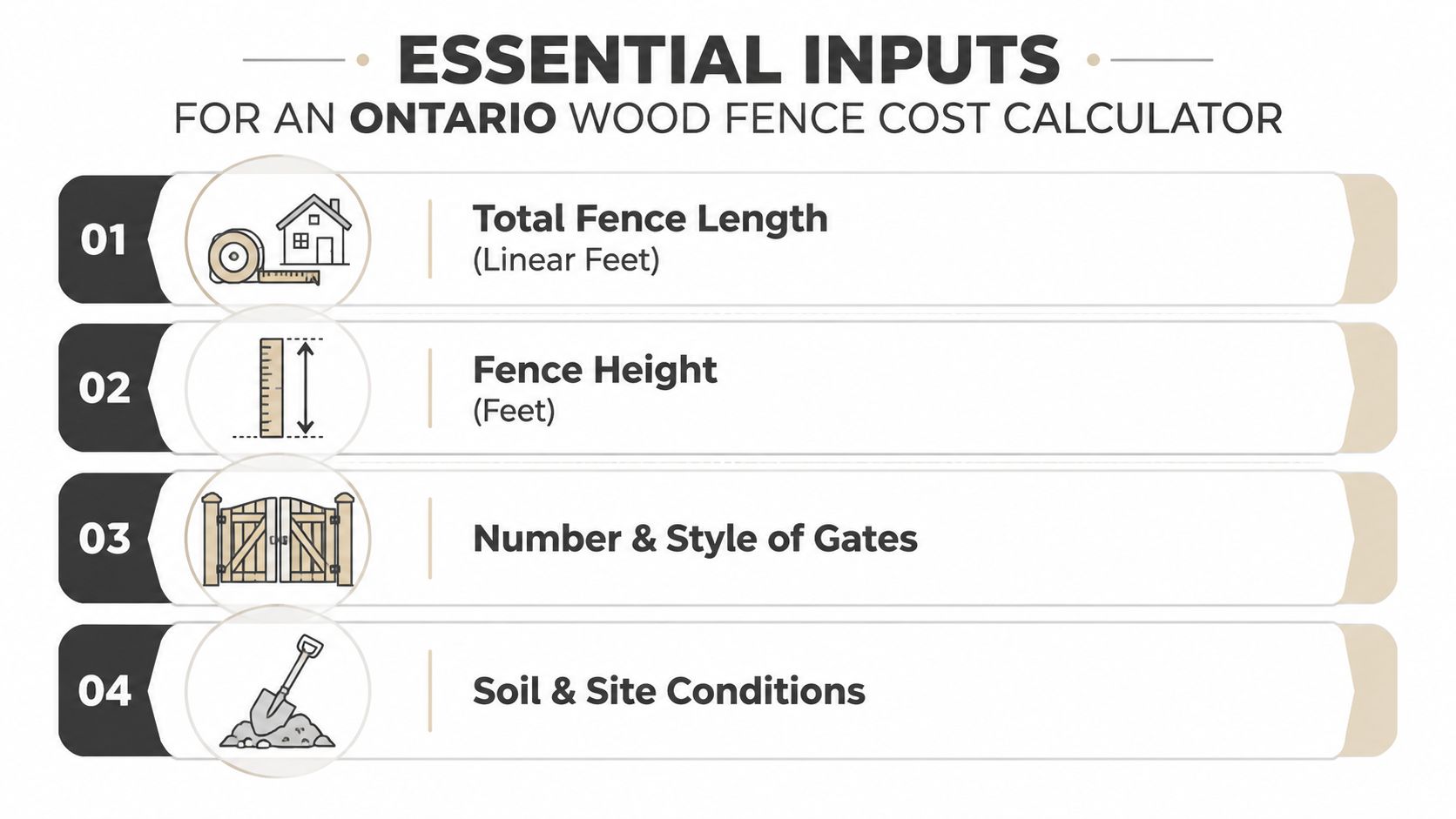
Input | Typical Range | How It Changes the Estimate |
|---|---|---|
Total fence length | Measured in linear feet | Sets the base volume of materials and labour |
Fence height | Usually one privacy height or lower | Changes post length, rail layout, and picket count |
Gates | Zero, one walk gate, or more | Adds framing, hardware, and install time |
Soil and site conditions | Flat, sloped, tight access, rocky soil | Can shift the job out of the base price band |
If your yard is rectangular and level, a straight calculator path works well. If the lot is sloped, tight, or hard to access, treat the first estimate as a starting point and expect the quote to move once the site is measured properly.
Choosing Between Cedar and Pressure-Treated Wood in Ontario
A fence quote can look straightforward until the wood species changes the whole number. On Ottawa-Gatineau jobs, pressure-treated wood usually stays in the lower price band, while cedar pushes the installed total higher because the material cost is higher and the finish work is usually more selective. Ontario cost guides price pressure-treated wood fencing at $30-$50 per linear foot installed and cedar at $40-$60 per linear foot installed, with cedar typically running 30%-40% more than pressure-treated wood (Ontario fencing cost guide). That spread is large enough that the species choice should show up clearly in any calculator, not get buried inside one generic “wood” line.
The choice changes more than the sticker price
Pressure-treated wood fits jobs where the fence has to stay inside a tighter budget, especially rental properties, side yards, and plain privacy runs. Cedar costs more up front, but many homeowners choose it for appearance and natural weather resistance. A calculator should treat the wood species as a real pricing input, because the material choice changes the installed rate, not just the shopping list.
A lot of online quotes just say wood, and that hides the trade-off. That label can mean a basic pressure-treated build or a cedar fence with a cleaner finish and a wider price band. If you want a closer read on cedar-specific choices before you commit, this cedar fencing resource is a useful place to start.
Cedar makes sense when the fence is part of the home's look. Pressure-treated makes more sense when the fence is mainly doing a job.
For homeowners comparing wood types across outdoor builds, this pressure treated wood for decks guide from Guelph Deck Builders is a practical reference point on why treated lumber often stays the lower-cost, more practical option.
Wood Type | Installed $/ft (ON) | Premium vs PT | Best For |
|---|---|---|---|
Pressure-treated wood | $30-$50 | Baseline | Budget projects, rentals, straightforward privacy fencing |
Cedar | $40-$60 | 30%-40% more | Better appearance, long-term ownership, higher-end curb appeal |
The rule I give most homeowners is simple. Choose pressure-treated when budget matters more than finish. Choose cedar when you care about the way the fence looks over time and you're willing to pay more for it up front.
Converting Linear Feet Into Posts, Rails, and Pickets
A real estimate does not stop at a per-foot rate. It turns the length into actual pieces, because posts, rails, pickets, and concrete are what crews buy, load, and install. That is also why two calculators can show different totals for the same fence line.
Use spacing first, then waste, then height
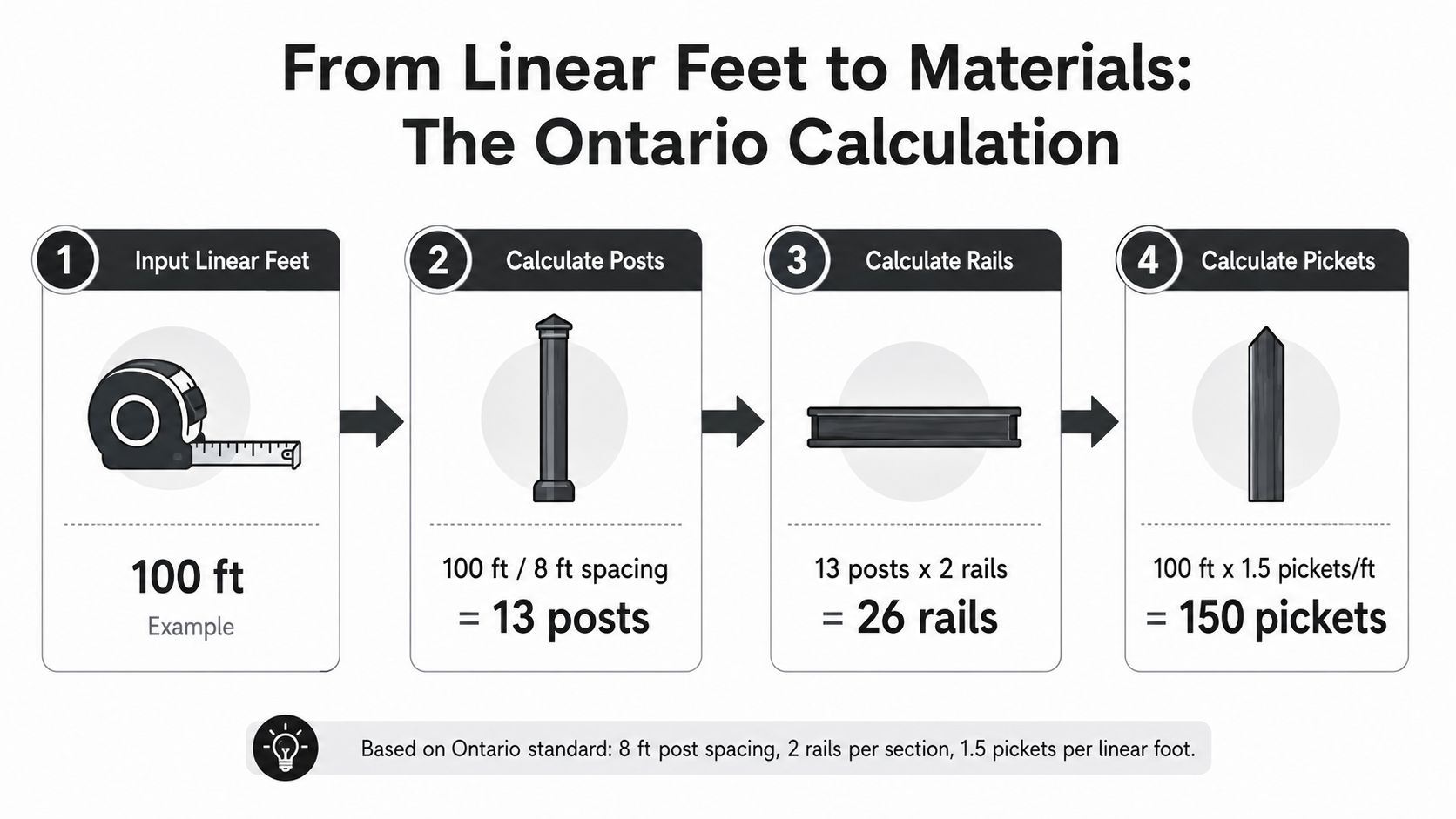
Start with post spacing, then account for waste, then adjust for height. Divide the total run by post spacing, then add one post. Standard 8 ft on-centre spacing is a common baseline, while 6 ft spacing adds about 25% more posts and concrete but improves wind resistance for heavier assemblies and exposed Ottawa-area sites (materials and cost calculator method). After that, add 10%-15% extra for corners, gates, and cuts.
A straight 100-foot run shows how fast the material list grows. At 8 ft spacing, you are looking at roughly 13 posts. A simple two-rail fence would need about 26 rails. For pickets, a common estimating approach uses about 1.5 pickets per linear foot, which puts the run at roughly 150 pickets before waste and layout adjustments (fence material calculator method).
A 6-foot privacy build needs taller posts, usually 1.5 times the fence height, and the calculator should treat that as an automatic adjustment rather than a hidden assumption. That matters because taller fences use more structure, not just more surface material. Online tools that only multiply length often miss that part of the bill.
If the tool can't show you posts and sections, it's not really estimating the fence. It's just multiplying a headline number.
For homeowners who want a broader pricing frame before they compare line items, this Ontario fencing cost overview helps show how installed quotes are usually presented. The same kind of breakdown also helps when you compare the finish of a new fence with related upkeep, including fence staining services Toronto 2026.
A calculator that counts pieces usually lines up better with a contractor's quote than one that only multiplies by length. That is where the material list becomes more useful than a single installed rate.
Labour, Gates, and Site Costs That Change the Per-Foot Number
A quote for a fence in Ottawa-Gatineau can look straightforward until a gate, a slope, or a tight work area changes the bill. Installed wood fencing usually runs about $45-$85 per linear foot, with pressure-treated pine at $45-$65/ft and Western Red Cedar at $65-$85/ft (Ottawa-Gatineau wood fence cost guide). That range gives you a starting point, but it does not mean every fence on the same street lands in the same price band.
What sits inside the installed number
A turnkey quote usually combines labour, equipment, and standard materials. It may also cover the fence itself and ordinary concrete, but the extra work that turns a simple run into a harder install is often priced separately. For a broader look at how installed quotes are usually presented in Ontario, this Ontario fencing cost overview is a useful reference.
Line Item | Typical Ontario Range | Usually Included? |
|---|---|---|
Materials | Built into per-foot quote or itemized separately | Often included in turnkey pricing |
Labour | Built into per-foot quote | Usually included |
Walk gate | Can add significant cost | Often extra unless specified |
Tear-out of old fence | Depends on access and disposal | Usually extra |
Grading or slope work | Site-specific | Usually extra |
Concrete delivery or special access | Site-specific | Usually extra |
A walk gate is one of the easiest places for an online calculator to understate the total. The Canadian estimator example in the brief shows 100 linear feet of 6-ft cedar board fence with one walk gate at about $6,700 turnkey, using $60 per linear foot plus a $700 gate (fence estimator example). That is a practical reminder that gate framing, hinges, latch hardware, and the extra labour around it are real line items, not small add-ons.
Sloped yards can change the quote just as quickly. Posts need more attention, layout takes longer, and the crew may have to step or rack the fence to follow the grade. That work is not free, even if the calculator hides it inside a single installed number. If you want the full cost picture before you compare contractors, the Ontario fencing cost overview also helps separate headline pricing from the parts that push a job higher.
If you plan to finish the wood later, the long-term budget should account for that too. A resource on fence staining services Toronto 2026 shows how staining fits into the ownership cost of cedar and other exposed wood fences.
Ask for an itemized quote. A clean per-foot number works for a first look, but the breakdown is what tells you whether the price is fair.
Labour and site prep are also why supply-only lumber prices can be misleading. The material list may look manageable on paper, but once the crew has to set posts, haul materials through a narrow side yard, or work around poor access, the installed number rises fast.
Sample Calculations for Common Ontario Yard Shapes
A calculator is only useful if it matches the yard in front of you. Run the same fence through a flat lot and a harder site, then compare both results with the Ontario ranges already on the table. That is the quickest way to see whether the per-foot number is realistic or whether the estimate is hiding work that will show up later.
A rectangular backyard on flat ground
Start with a 150-foot rectangular backyard and one walk gate. Using the Ontario benchmark of $30-$60 per foot for wood fencing, the fence itself lands between $4,500 and $9,000 before extras such as gates, layout changes, or tougher site conditions. That spread comes from the Ontario wood fence benchmark (Ontario wood fence benchmark).
A flat lot with a single gate should sit in that general band. If a calculator produces a figure far below it, the base number is probably too thin. If it climbs well above it without a clear reason, the quote may be folding in add-ons that should be shown separately.
A sloped lot with a double drive gate
Now change the job to 100 linear feet of cedar privacy fence on a moderate slope with a double drive gate. An Ontario calculator example places a 100-linear-foot cedar privacy fence on a moderate slope at $6,000-$9,500 installed, compared with $4,500-$7,500 on flat ground (Ontario fence estimator example). The price jump is what I expect once the ground starts fighting the crew.
A double drive gate adds heavier framing, better hardware, and more labour than a simple walk gate. The slope also changes how posts are set and how rails are carried across the run. A wood fence cost calculator Ontario homeowners can trust should treat those conditions as separate inputs, because they change the installed number in different ways.
A regional installation guide also shows typical residential fence jobs around $2,700 to $8,000+, with broader Ontario pricing that can run from $45 to $100 per linear foot depending on material, layout, and access (Ontario installation guide). The range is wide because real jobs are not uniform. A straight, open backyard is not the same as a sloped lot with a wide gate and tighter access.
The simplest check is still the same. On a 150-foot run, a believable estimate should land near the $4,500 to $9,000 spread unless the site is unusually simple or unusually difficult. Anything outside that deserves a hard look at what is included.
Permits, HST, and Ottawa-Gatineau Bylaws to Add to the Total
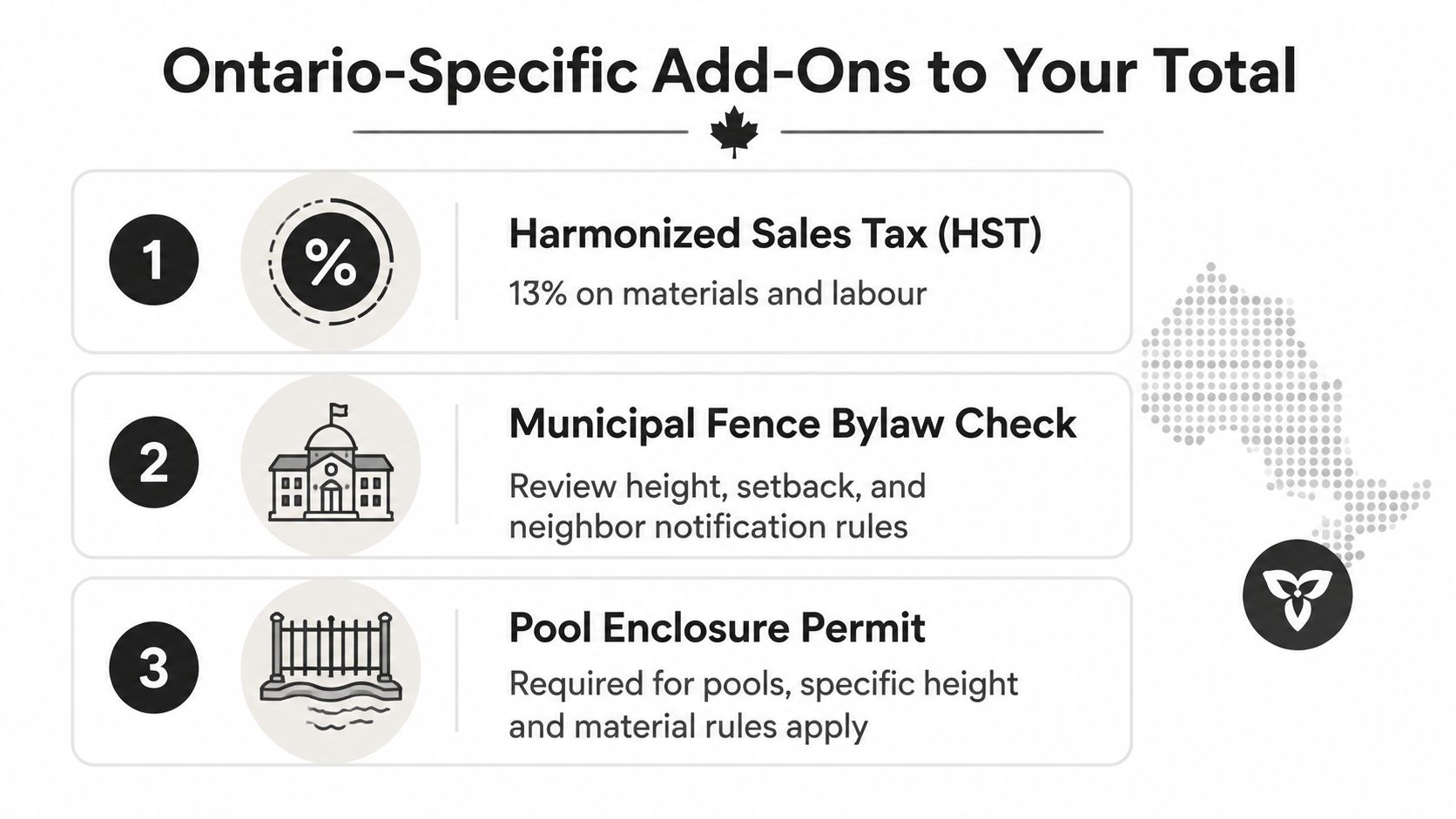
A lot of calculators stop at supply and labour, then leave the homeowner to discover the rest later. In Ontario, that means HST, municipal bylaw checks, and sometimes permit requirements for higher fences or pool enclosures. The all-in number is the number that matters.
Add the local paperwork before you compare quotes
Ontario fence-installation pricing ranges from $40-$95 per linear foot broadly, and a typical 100-linear-foot backyard project totals $4,000-$9,500 fully installed including HST (Ontario installation pricing guide). That is the kind of number homeowners should compare against, not a bare materials quote.
Permit rules vary by municipality. In Ottawa, fences over 1.8 m, or 6 ft, and pool enclosures commonly need permit review, while Gatineau has its own bylaw checks and height rules. For a clear local reference on height requirements, this XTREME EDEALS INC. fence guide is a useful place to confirm the boundaries before work starts.
The practical takeaway is simple. If your fence is taller, closer to a pool, or part of a property line dispute, the calculator should not be the last stop. It should be the first pass before a bylaw check.
Neighbourhood group installs can also change the economics. FenceScape and other Ottawa-area contractors sometimes offer group-rate opportunities for adjacent homeowners, which can lower the per-foot number when crews can build several similar runs in the same area.
The cheapest quote isn't always the cheapest project. Taxes, permits, and bylaw surprises can push a tidy estimate into a messy invoice.
If you want a real all-in comparison, build the estimate, then add the local paperwork and tax before deciding. That gives you the number that matters when you're comparing your fence against the rest of the season's home projects.
Practical Ways to Bring the Number Down Without Cutting Corners
The easiest savings usually come from matching the fence to the job, not from chasing the lowest line item. A fence built for privacy and weather exposure doesn't need to be over-designed, but it also shouldn't be stripped down until it fails early. Good savings come from choices that lower waste, labour, and unnecessary upgrades.
Cost-saving moves that actually hold up
Move | Typical Savings | Trade-off |
|---|---|---|
Choose pressure-treated instead of cedar where appearance is secondary | Lower installed cost | Less premium look |
Reduce height where privacy doesn't require 6 ft | Less material and labour | Lower screening |
Use a simpler fence profile | Less carpentry time | Fewer visual details |
Coordinate with neighbours for a group install | Better per-foot pricing | Requires timing and coordination |
Pick stockade instead of board-on-board | Fewer pickets and less labour | Less layered privacy |
Buy material only on a flat, short run | Avoids turnkey labour costs | More work for the homeowner |
DIY material-only purchasing can make sense on a flat lot with a short run and a helper. It stops making sense fast once the site gets sloped, rocky, or gate-heavy. The gap between material-only wood and turnkey installed pricing is large enough that a difficult site can erase any savings before the first post is set.
A second lever is timing. Crews often have more room to schedule straightforward jobs when the calendar isn't packed with urgent spring and early summer work. Another is scope control. If the fence only needs to define a backyard edge, don't pay for a more elaborate style than the property needs.
The win is to compare your calculator output against two or three local quotes. That's the fastest way to tell whether the estimate is realistic, optimistic, or padded.
FenceScape handles wood fence planning and installation across Ottawa-Gatineau, including cedar, pressure-treated builds, and full project support from estimate to final walkthrough. If you want a quote that separates length, gates, site conditions, and Ontario-specific add-ons instead of hiding them in one number, visit FenceScape and request a local estimate.
Comments