
Types of Privacy Fences for Ottawa–Gatineau Homes

You're probably standing at the back window right now, looking at a yard that doesn't feel private enough to use the way you want. The kids are out there, the grill is out there, the dog is out there, and the neighbours are close enough that every conversation carries. In Ottawa and Gatineau, that backyard often becomes the only real outdoor room a family has, so the fence stops being a decorative purchase pretty quickly.
Many homeowners start in the wrong place. They compare cedar to PVC, or black ornamental to hybrid panels, as if the job is mainly about looks. On real lots, the better question is simpler. Where will the fence sit, what does that part of the lot allow, and does the fence also need to do pool duty. Get that order wrong and even a good-looking fence can turn into a redesign, a permit problem, or a barrier that still doesn't solve the reason you wanted it.
Why the Right Privacy Fence Starts with Your Yard
A typical call in this region goes like this. A family in Kanata wants the rear yard closed in because the deck feels exposed. A homeowner in Aylmer wants to block a neighbour's second-storey view into the patio. Someone else wants one continuous fence around the whole property because they've picked out a panel they like online and they want the same thing everywhere.
That's where a lot of trouble starts. One lot can have three different fence problems on the same property line. The run behind the house might want full screening. The stretch near the street might need lower, more open treatment. If there's a pool on site, the thinking changes again because privacy and pool safety aren't the same job.

The three questions that decide everything
Before I care whether you like cedar boards or a PVC tongue-and-groove panel, I want three answers.
Where is each fence run located
Ottawa treats front-yard fencing differently from side and rear yard fencing. The city's land guide states that a privacy fence is generally most practical in a rear or side yard, where the maximum height is 2.1 m, while front-yard fencing is limited to 1 m. The same guide also notes that grade, right-of-way limits, and special visibility conditions can change what works on a corner or arterial-road lot, so a standard full-height panel can fail because it's in the wrong yard zone on the wrong property shape, according to Ottawa's residential property guide.
Which municipality are you building in Ottawa and Gatineau are close neighbours, but they don't treat fences the same way. The same panel layout can fit one side of the river and need trimming or redesign on the other.
Is there a pool, hot tub, or pond involved A lot of homeowners assume a privacy fence automatically covers pool compliance. It doesn't. That misunderstanding costs time every season.
Practical rule: The first sketch should be a lot sketch, not a material mood board.
Why material comes second
Once the lot geometry is clear, the shortlist gets smaller fast. A full solid panel often makes sense at the rear. Near a street, more open sections usually make more sense. On a pool project, gates, gaps, and openings matter just as much as appearance.
That reordering is the most useful advice I can give on types of privacy fences. The fence that works best isn't the one that looks best in a catalogue. It's the one that fits the exact run, the exact yard zone, and the exact compliance category on your property.
Privacy Fence Basics Every Homeowner Should Know
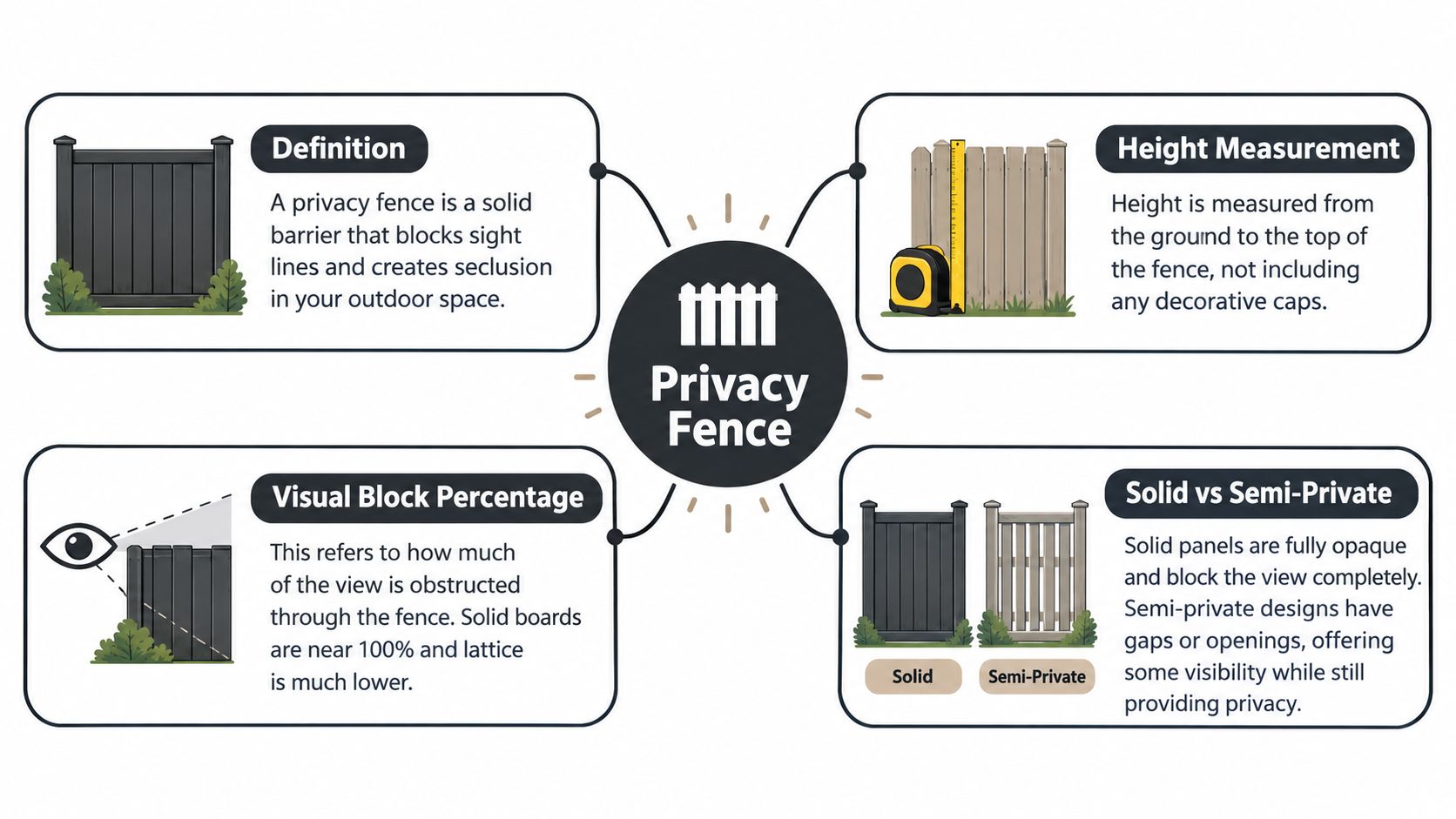
A privacy fence is built to block sight lines in a meaningful way. Homeowners still mix up privacy, security, and pool control as if they mean the same thing. They do not.
The simplest way to judge privacy is by visual screening. Frosted glass still lets light through while stopping a direct view. Clear glass does not offer privacy, but it still acts as a barrier. Fences work the same way. A solid board panel behaves like frosted glass. An ornamental metal fence behaves more like clear glass. Chain link with slats sits in the middle, depending on slat density, viewing angle, and season.
What counts as private in practice
A few fence types get grouped together even though they perform very differently.
Solid-board wood panels block direct views well when the boards stay tight and straight.
Shadow-box wood gives a softer look and airflow, but it is not fully private from every angle.
PVC tongue-and-groove panels are usually the cleanest way to get a near-solid visual screen.
Chain link with privacy slats still behaves like chain link. It can cut down visibility, but it does not act like a true solid panel.
Lattice toppers add some softness and screening, but they do not replace a full privacy section.
How height and openness change the result
Height matters, and so does what the fence field is doing. A low solid fence can still feel exposed if your patio sits higher than the yard. A taller fence with gaps can leave direct sight lines from a neighbour's deck or window.
Here is the plain-language version I use on site:
A privacy panel is like a bookshelf. If the shelves are packed tight, you cannot see through it.
A semi-private panel is like venetian blinds. Straight on, it looks more closed. From an angle, it opens up.
A security barrier is not always private. Ornamental iron can define a perimeter well and still leave the whole yard visible.
A fence can be excellent for boundary control and still be poor at privacy.
Why pool fencing is a separate category
This is the part homeowners miss most often. In Ottawa, privately owned outdoor pools must be enclosed, and the enclosure must be at least 1.5 metres high. Permitted examples include chain-link mesh with openings no larger than 38 millimetres, vertical boards, wrought iron, aluminum, and vinyl. Openings through or beneath the enclosure also have to stop the passage of a 100-millimetre sphere, as set out in the City of Ottawa pool enclosure brochure.
That means a fence can be private but not pool-compliant, or pool-compliant but not especially private. Keep that distinction clear, and the rest of the comparison makes a lot more sense.
The Main Privacy Fence Materials Explained
Once the lot tells you where full screening is even possible, the material decision gets practical fast. In this climate, appearance matters on day one. Structure matters in year five. I've repaired enough leaning runs, twisted gates, split boards, and bowed toppers to care a lot more about how a fence behaves in February than how it photographs in June.
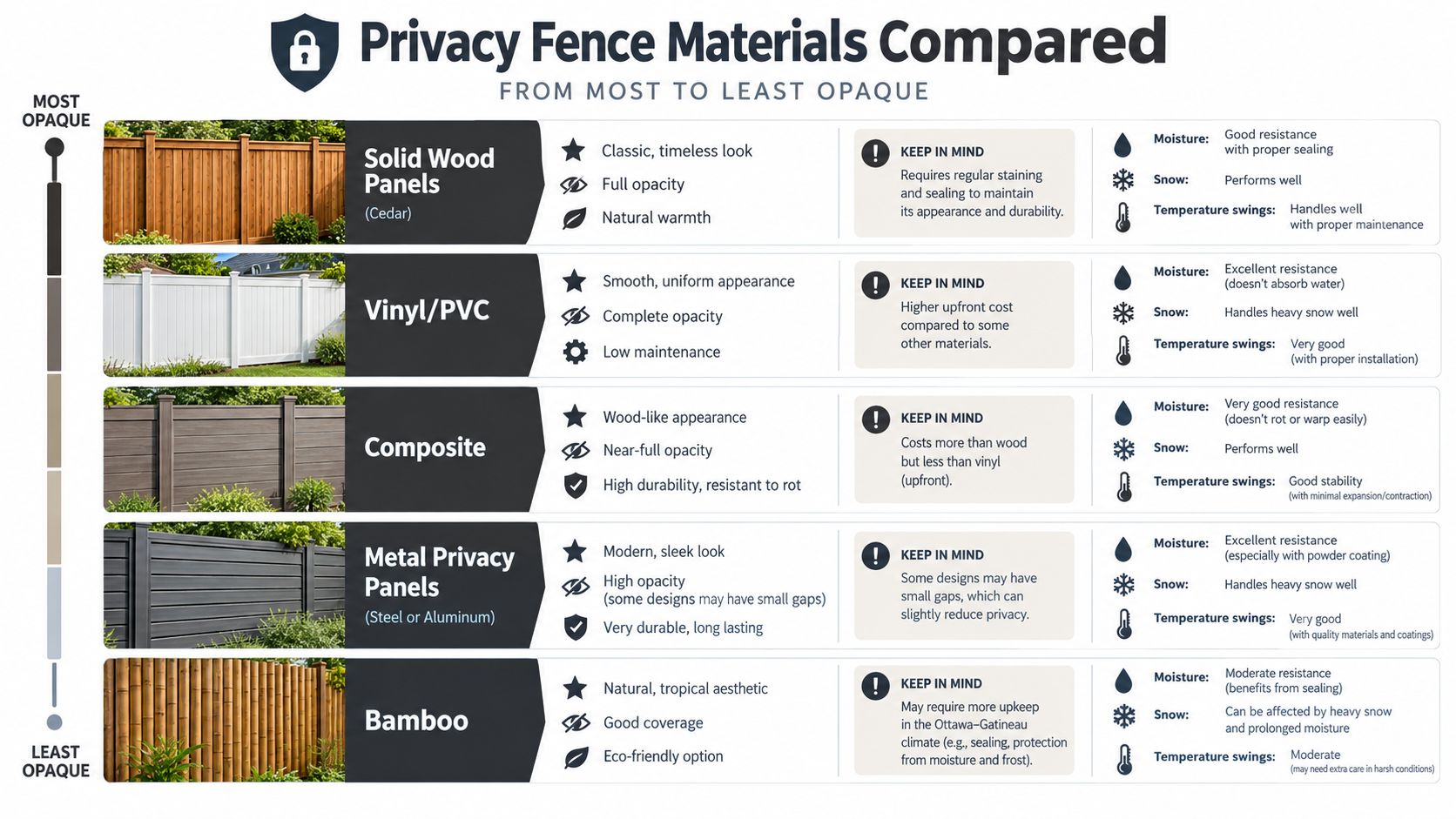
Start with the most opaque systems and work downward.
Solid wood panels
Wood is still the most familiar privacy fence in Ottawa and Gatineau for good reason. It looks right beside brick, siding, stone, and older neighbourhood trees. You can build it vertical, board-on-board, shadow-box, horizontal, tight board, lattice-top, or with a framed cap that cleans up the lines.
The upside is flexibility. The downside is movement.
Cedar weathers naturally and many homeowners like that silvered look, but plenty don't realise how different the south face and north face can age. Pressure-treated lumber gives a budget path, though it can twist, shrink, and telegraph every wet-dry cycle if the boards weren't chosen well to begin with. Gates are where weak wood systems show their age first. If the frame isn't stiff enough, the latch side drops and the whole fence starts looking tired.
For DIY buyers comparing board styles and species, this overview of wood privacy fence materials is a useful starting point.
PVC and vinyl panels
PVC works when the homeowner wants clean lines and less routine upkeep. It doesn't need staining, and it gives a more uniform look across a long run. For pure visual screening, tongue-and-groove PVC or interlocking full panels do the job well.
The weak spot is usually rigidity and repair logic. Cheap PVC looks fine when it's new, then starts showing its quality in the cold. Panels can feel hollow, posts can flex, and colour inconsistency often shows up first on the sunniest run. When something breaks, you don't usually swap one board and move on. You often end up dealing with a larger section.
Hybrid systems with metal reinforcement
Hybrid fences combine a finished panel system, often PVC or a wood-look product, with steel or aluminum reinforcement in the structure. When installed correctly, that hidden frame keeps long straight runs from becoming wavy after freeze-thaw seasons and gate use.
What matters is where the reinforcement is. If the steel is only partial, skipped at stress points, or undersized at the gate, you've paid for the sales pitch and not the strength. The best hybrid jobs are boring in the best way. They stay plumb, the reveals stay even, and the gate keeps closing properly.
Before crews even start setting lines and panel locations, I like to review practical fence placement tips for jobsites, because site control, access, and staging mistakes are what turn a clean install into a frustrating one.
Later in the planning process, video helps some homeowners understand how different privacy systems feel at full scale:
Ornamental metal with privacy infill
On its own, ornamental iron or aluminum isn't a privacy fence. It's a boundary and security look. But there are situations where it becomes a privacy solution when paired with infill panels, landscaping, or selective screening in the parts of the lot that need it.
This works well near streets or visible front areas because it feels lighter and keeps sight lines more open. The risk is rust at welds, corrosion at ground contact on lower-quality systems, and a design that ends up trying to be both formal and private without doing either especially well.
Chain link with privacy slats
This is a practical category, not a premium one. Slatted chain link can help when budget, pet containment, or utility use drives the project. It's also useful for large side runs where full solid panels would feel too heavy or cost too much to justify.
But I don't sell it as the same thing as a real privacy panel. In winter, in backlight, and from angles, it reads more transparent than homeowners expect. If your goal is seclusion around a patio, this usually isn't the answer.
Lattice, toppers, and living fences
These are accent solutions. Lattice adds softness and visual lift, but it also catches wind and can bow if the framing is weak. On a heavy snow year, cheap lattice tells on itself fast. A topper can improve a fence. It can also make an already tall-looking fence feel top-heavy.
Living fences, hedges, and bamboo screens give a softer edge than manufactured panels. They can look excellent around patios and side gardens. They also grow unevenly, leave winter gaps, and demand more patience than most homeowners budget for. In Gatineau-area pool work, a hedge or bushes can't serve as the enclosure under Quebec's residential swimming-pool safety regulation, which also sets enclosure rules affecting chain link and opening sizes in that category, under the provincial regulation.
Comparing the Top Privacy Fence Types at a Glance
A comparison table is useful, but only if you read it with some skepticism. The same fence can last a long time on a dry, straight rear run and fail early on a slope, at a gate, or where water sits around the posts. Lifespan talk gets sloppy fast when people ignore footing quality, soil movement, snow load, and whether the bottom rail spends every spring thaw in standing water.
That said, homeowners still need a working shortlist. If you're trying to compare types of privacy fences before asking for quotes, this is the format that helps.
Privacy fence materials compared for Ottawa–Gatineau conditions
Material | Installed cost per linear foot (CAD) | Lifespan (years) | Annual upkeep | Best-fit yard zone | Key local failure mode |
|---|---|---|---|---|---|
Solid wood | Higher than chain link, often moderate relative to premium systems | Moderate to long, depending on species, drainage, and maintenance | Staining, sealing, board replacement, gate adjustment | Rear and side yards where full screening matters | Board shrinkage, twisting, post lean, sagging gates |
PVC | Moderate to premium depending on panel quality and reinforcement | Long when structure is solid and impact is low | Washing, occasional hardware adjustment | Rear and side yards, especially where low routine upkeep matters | Brittleness in cold, flex, uneven fading on sunny exposures |
Hybrid | Premium relative to basic wood or chain link | Long if the reinforcement is properly specified | Low to moderate, mostly cleaning and hardware checks | Long runs, wind-exposed runs, premium residential screening | Hidden structural shortcuts, gate-frame sag if reinforcement is skipped |
Ornamental iron with privacy infill | Premium | Long with proper coating and detailing | Coating touch-ups and rust checks | Front-adjacent areas, selective screening zones | Rust at welds, corrosion at ground contact |
Chain link with slats | Lower-end practical option | Moderate to long | Very low, plus occasional slat replacement | Utility side yards, pet runs, large secondary runs | Reduced privacy in winter and from angles, slat movement |
Lattice or topper systems | Add-on cost rather than stand-alone value | Variable | Moderate, especially if wood-framed | Accent zones, upper screening only | Bowing, wind stress, weak attachment points |
Living hedges | Variable and hard to compare directly to manufactured fencing | Long if healthy, inconsistent if neglected | Ongoing trimming, watering, seasonal care | Decorative side boundaries and soft landscape edges | Seasonal gaps, uneven growth, poor winter screening |
How to use the table without fooling yourself
If your first priority is upfront cost, chain link with slats or a simpler wood design often gets shortlisted first. If your priority is low routine maintenance, PVC and some hybrid systems rise quickly. If your priority is appearance with strong screening, wood and reinforced hybrid systems usually stay in the conversation longest.
I'd also separate patio privacy from perimeter privacy. Many lots don't need one material all the way around. That's where mixed strategies save money and usually look better. This broader guide to all-season fencing is helpful if you're trying to think beyond the showroom panel and into year-round performance.
The cheapest fence to buy can become the expensive fence to own if the posts, gates, and grade transitions were treated as afterthoughts.
Ottawa–Gatineau Height Rules and Pool Enclosure Rules
A fence that looks fine on paper can fail the moment it crosses a yard line or sits beside a pool. In Ottawa and Gatineau, the first question is not style, it is where the run sits on the lot and whether it is ordinary privacy screening or a regulated enclosure.
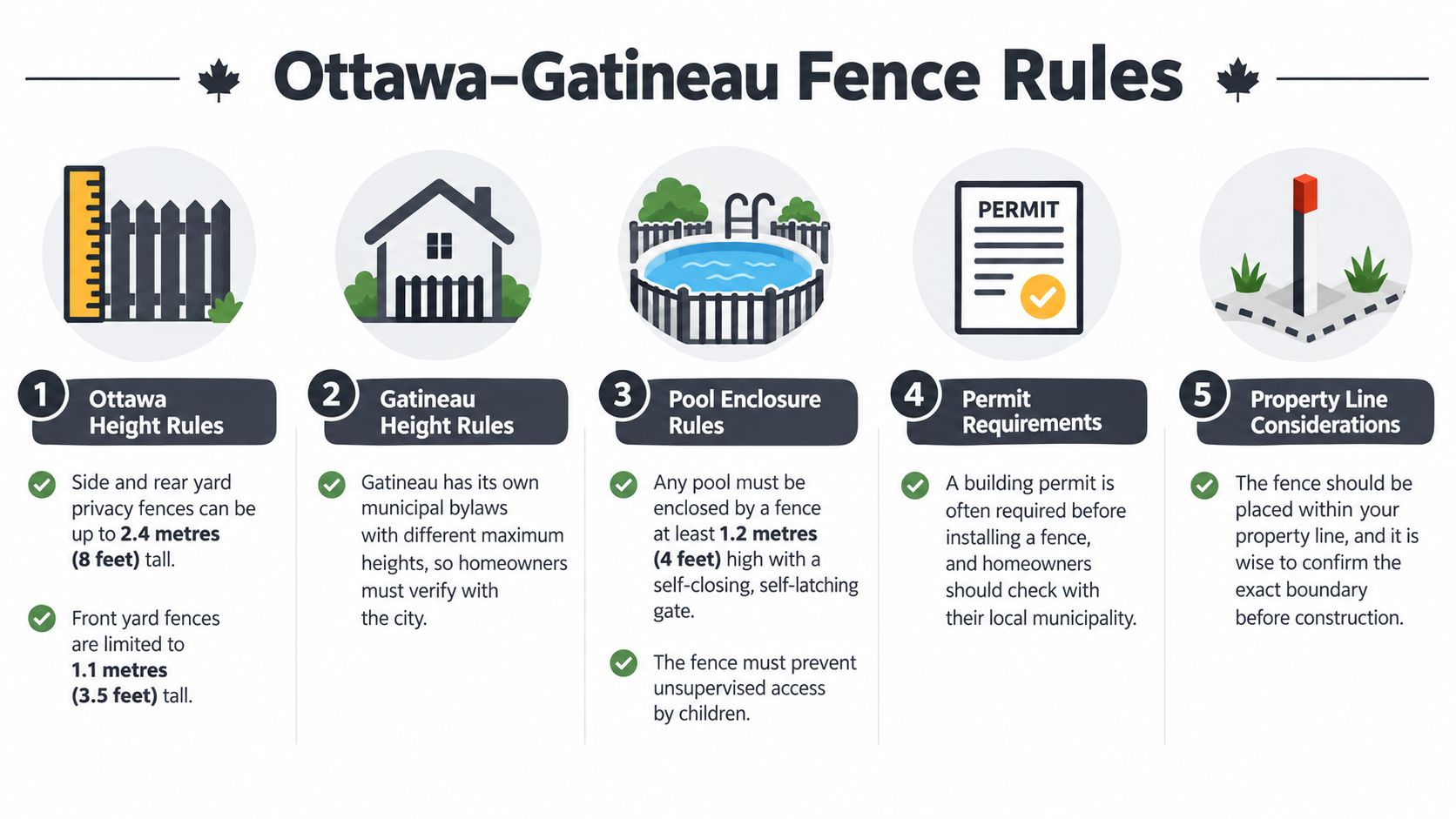
Ottawa's Fence By-law No. 2003-462 draws that line clearly. Front yards are generally limited to 1 m, side and rear yards can go up to 2.13 m, and pool enclosures have their own requirements. That separation matters because the same panel can be acceptable on a rear boundary and wrong for a front setback, or strong enough for privacy but not acceptable as a pool barrier, as described in the Ottawa pool enclosure guide.
What changes when you cross the river
Gatineau uses a different framework, and homeowners get caught when they assume the Ottawa rules carry over unchanged. Under Gatineau's published pool guidance, an above-ground pool may not need a surrounding enclosure when its wall is at least 1.2 metres above grade at every point, while a removable pool may qualify at a wall height of at least 1.4 metres, provided access meets the applicable standard, under Gatineau's published pool guidance.
For ordinary residential fencing, the city's rules for one- to four-unit dwellings allow 2 m in rear and non-street-adjacent side yards, 1.5 m for a side fence beside a street, and 1.2 m in a front yard, according to Gatineau's residential fence rules. The same rules also set minimum setbacks of 1 m where a sidewalk exists and 1.5 m where it does not. That is why a fence that repeats the same height all the way around often causes trouble, especially on corner lots and along street-facing side yards.
Why privacy and pool compliance split apart
A solid privacy fence blocks views. A pool enclosure controls access. Those jobs overlap, but the standard is different, and the enclosure rule wins whenever a pool, hot tub, or pond is involved. Ottawa still requires a permit for a pool enclosure even if the yard already has a fence, through Ottawa's pool enclosure requirements page.
If you are also shaping the yard for screening, the article on planning a garden privacy barrier is useful because it separates what planting can hide from what a regulated barrier must do.
A zoning checklist that prevents expensive mistakes
Start with a lot sketch and mark each run on its own line.
Front-facing segments: keep them separate. They usually need a lower or more open treatment.
Rear and side screening runs: solid wood, PVC, or hybrid panels often fit here.
Street-adjacent side yards: do not treat them like interior side yards.
Corner lots and driveways: visibility can override the desire for full screening.
Pool-related segments: treat these as a separate compliance problem from the start.
Before you price panels, read a practical summary of the fence by-law and compare it against your sketch. That step is cheaper than ripping out a run that passes the eye test but fails the bylaw test.
A Practical Path from Lot Survey to Final Material
On a real job, the order of decisions matters more than the brochure. Start with the property line, then map each run by yard zone, then check sight lines, driveways, corners, and grade changes. Only after that do I care what panel profile the homeowner likes.
A survey or another reliable boundary reference saves arguments later. The same point shows up in surveyor guidance for London property buyers, even though it is written for another market. Boundary certainty is cheaper than moving a fence after the fact.
The sequence that works on site
Mark the runs clearly. Don't price from memory or from an old listing sketch.
Flag every zone change. Rear yard, side yard, front-facing section, and street-adjacent side section should be treated separately.
Check for pool conditions early. As covered above, Ottawa requires a separate pool-enclosure permit even when a yard fence already exists, and that rule applies when a privately owned outdoor pool, hot tub, or pond is involved.
Choose the structure before the finish. Post system, gate frame, and grade handling decide whether the fence will stay straight.
Match panel style to slope. Some lots need stepped panels. Others handle a racked approach better. Standard panel sizes often need trimming or layout changes.
Treat the gate as the weak point. It usually is.
What I'd finalise before signing off
Material comes after the site logic is solved. Then wood, PVC, hybrid systems, chain link with screening, or a supplier like FenceScape becomes a real comparison instead of a guess.
If the quote spends more time on panel colour than on posts, gates, and grade transitions, it is missing the part that fails first.
Honest Trade-offs and Common Privacy Fence Regrets
Most fence regret has nothing to do with colour. It comes from false expectations.
Cedar turns silver if you leave it alone. Some homeowners love that. Others call it a problem after the fact. Budget PVC can fade unevenly on the south-facing run, and cheap systems tell on themselves at the posts first. Hybrid fences can be excellent, but if the steel insert gets skipped where the gate hangs, that corner starts sagging and the whole job looks older than it is.
I also see ornamental systems rusting where moisture sits at the base, lattice sections bowing because someone treated them like decoration instead of a wind load, and living screens that looked charming on paper but became a maintenance burden or a pet hazard in the yard.
Ask harder questions before you sign:
How deep are the posts and how are they founded
Is the reinforcement continuous through the gate frame
What changes on the south-facing run
How will the installer handle the grade transition, not just the straight sections
Those answers matter more than the sample board in your hand.
If you want a fence plan that fits your lot, your municipality, and your privacy goals, talk to a team that installs these systems in Ottawa and Gatineau every day. FenceScape helps homeowners sort out yard zones, material trade-offs, pool-enclosure requirements, and the practical details that decide whether a fence still looks right after a few winters.
Comments