
Cloture Maille De Chaine: Specs, Coatings and Permits

You're comparing fence quotes, the dog needs a secure yard, and a pool project may be next. The rolls of mesh look similar, but one quote includes heavier posts, another includes black coating, and neither makes it clear whether the finished fence will pass inspection on your side of the Ottawa River.
That's the true challenge behind a search for cloture maille de chaine. You're not just choosing steel mesh. You're choosing an enclosure, a finish and a gate system that must suit your property, your municipality and a Canadian winter.
What Chain-Link Fencing Is and Where It Fits
A chain-link fence works like a steel window screen for a property line. It keeps people and suitable animals on the intended side while allowing light, air and sightlines through. That makes it useful where you want containment without hiding what's happening beyond the boundary.
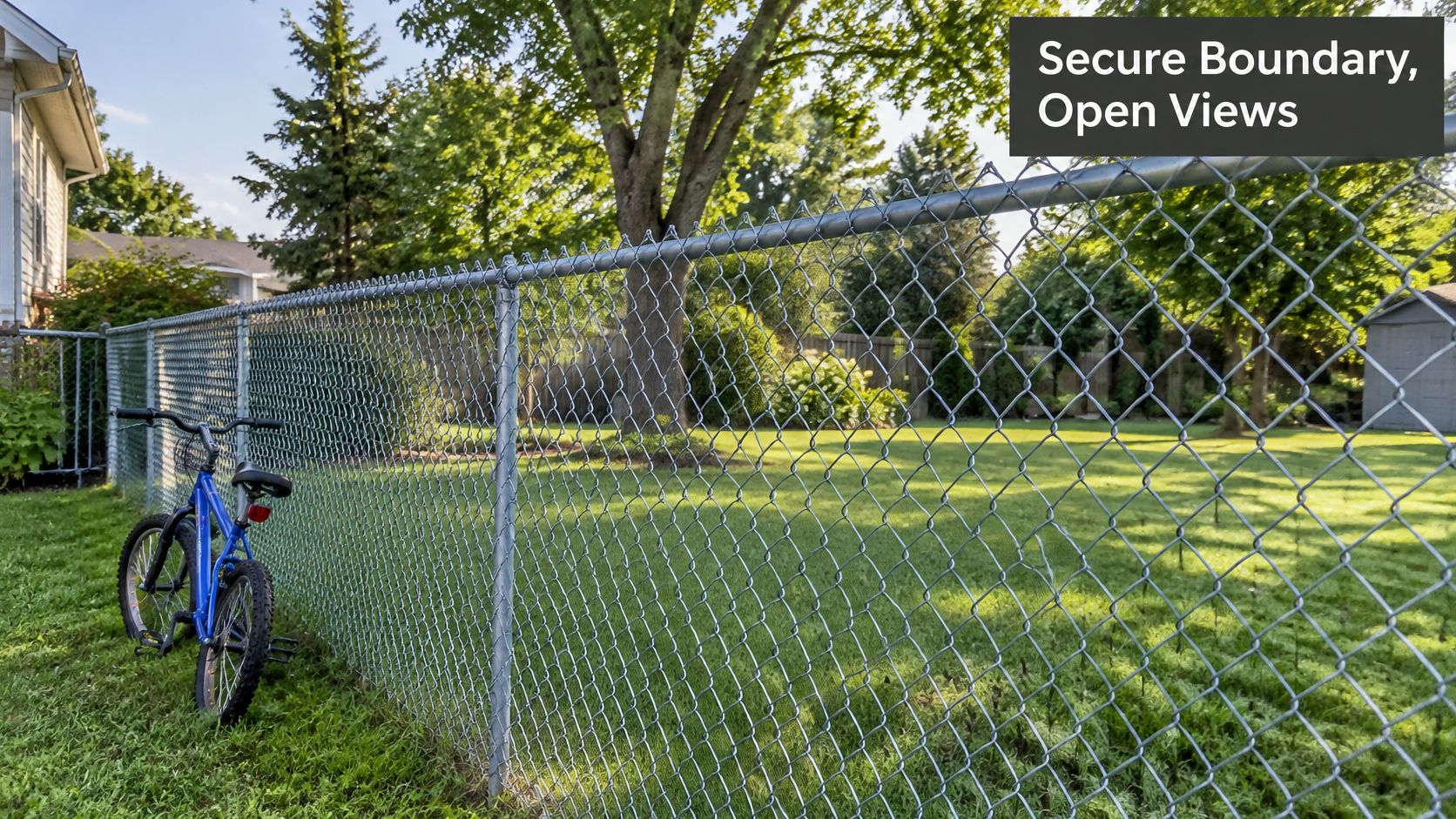
The system includes woven mesh fabric, intermediate line posts, stronger terminal posts at ends and corners, a top rail or tension wire, ties, tension bars and gate hardware. These parts work together. Heavy fabric won't compensate for a terminal post that moves when you tension the run.
Coating and appearance also deserve attention from the beginning, not after installation. The discussion of fencing and privacy in Le Soleil's coverage of residential boundaries reflects the broader purchasing question: how should a boundary look and function within the yard?
Where it earns its place
Low cost per metre: Open mesh generally uses less material than a solid privacy enclosure.
Fast installation: Long, accessible runs suit efficient post setting and fabric stretching.
Low wind resistance: Unscreened mesh lets wind pass through.
Easy extension: Compatible fabric and fittings allow later additions.
Clear supervision: You can watch children, pets and access points through the boundary.
Where it disappoints
No built-in privacy: Bare mesh encloses a space without concealing it.
Climbable openings: Ordinary mesh isn't an anti-climb barrier.
Sensitivity to weak supports: Undersized posts and poor tensioning produce sags and distorted gates.
Exposed damage points: Cut ends, ties and scraped fittings need attention when their protective finish fails.
Choose chain-link for security with visibility. Add a carefully designed privacy treatment when screening is secondary. If privacy is the main purpose, price a solid fence before buying mesh and trying to turn it into a wall.
Chain-Link Specifications at a Glance
Chain-link specifications by use
Application | Mesh opening | Wire gauge | Typical height | Notes |
|---|---|---|---|---|
Residential yard or dog containment | 2 in. | 11 gauge as a preliminary design choice | 1.2 m, approximately 4 ft | Visibility with basic containment |
Light commercial or school perimeter | Smaller than residential | 9 to 6 gauge | 1.8 to 2.4 m, approximately 6 to 8 ft | Smaller mesh resists climbing |
High-security or high-impact site | Smallest the site allows | 6 gauge or heavier where engineered | 2.4 m, approximately 8 ft, plus an approved top guard | Expect higher cost and stiffer installation |
Snow-exposed site, any use | Avoid unnecessarily small openings | Match the use row | Match the use row | Smaller mesh holds snow and adds load |
Treat these as preliminary design configurations, not municipal approvals. Pool enclosures, school properties and security installations need their own review, and a top guard isn't appropriate or permitted on every property.
The RCMP's security fencing guide describes mesh selections of approximately 3/8 to 2 3/8 in. and wire selections of 14 to 6 AWG. Those are selection ranges, not a universal prescription.
Specify the opening and the wire separately
Mesh opening controls access through the fabric. Wire gauge controls the wire's stiffness. Smaller openings make climbing and object penetration more difficult; heavier wire better resists bending and impact.
Ask whether the quoted wire diameter describes the steel core or the finished coated wire. A thick polymer jacket doesn't provide the same structural benefit as thicker steel. The chain-link fence fabric guide can help you organise those questions before comparing product descriptions.
Snow exposure changes the calculation. The RCMP guidance notes that smaller openings retain more snow, while larger openings allow more to pass through. Don't select tight security mesh beside a ploughed snow-storage area without checking the framework and expected loading.
Practical rule: Buy the opening size you need, then buy enough steel and framework to support it. Don't use a heavier-looking coating as a substitute for either.
Build the estimate around the layout
For a hypothetical 40 m backyard run, consider a preliminary design using 1.2 m-high fabric, 2 in. openings, 11-gauge wire and line posts about 2.4 m apart. This is a worked estimating example, not a pool-enclosure specification; reinforce gate and corner assemblies rather than assuming every post has the same job.
Scope matters when applying construction documents. Gatineau's standard chain-link construction specification calls for mid-height horizontal braces on designated sections adjoining gates, corners and terminations for fences 1.5 m or taller, and an end support wheel for gates 1.8 m or taller. Confirm whether that specification governs your project rather than treating a municipal construction document as a blanket residential by-law.
Mark corners, gate approaches, terminal sections and elevation changes before estimating materials. Counting metres alone misses the assemblies that often drive labour and hardware costs.
Galvanized vs PVC-Coated Chain-Link Compared
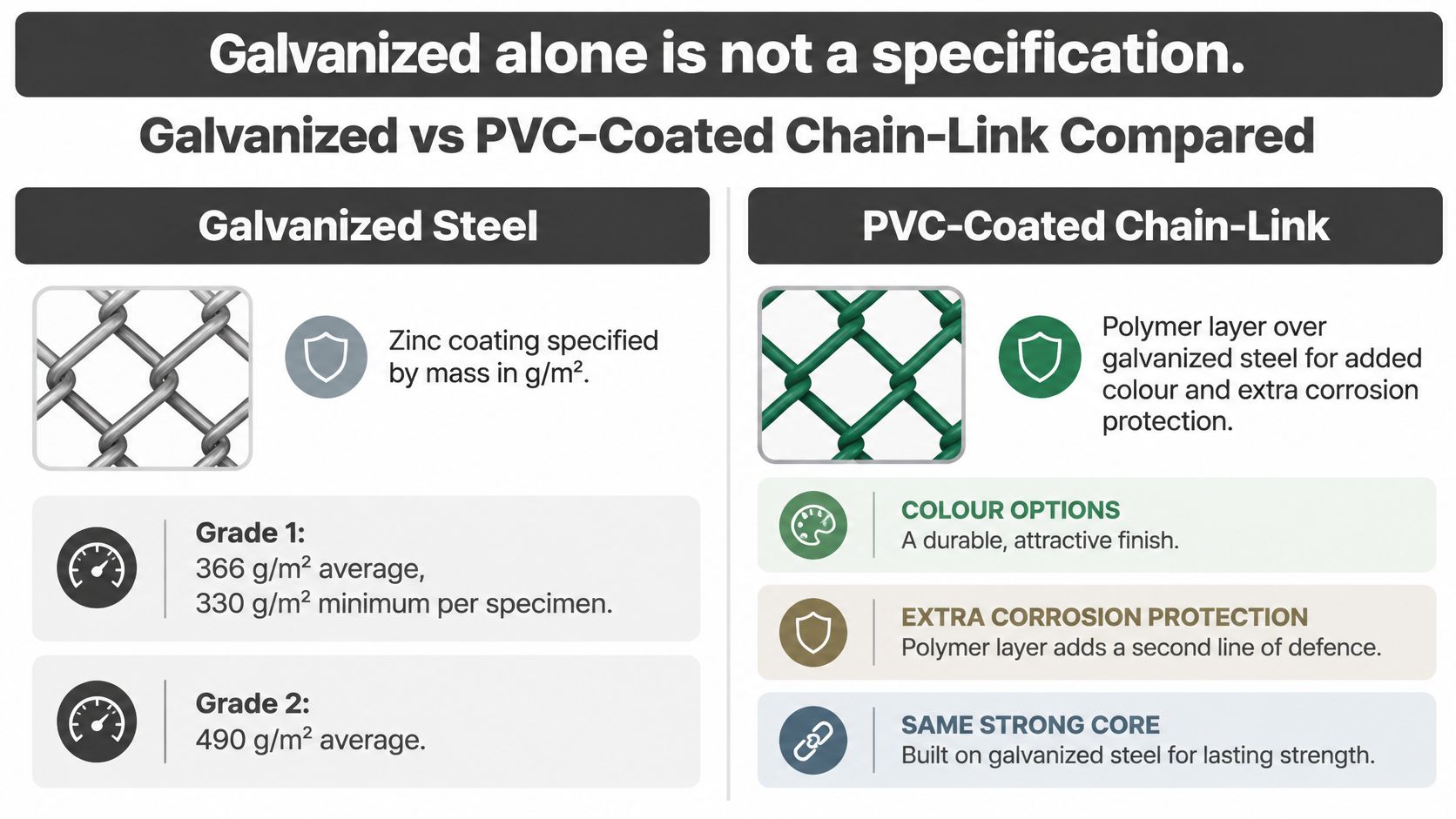
Galvanized alone is not a specification. Ask how much zinc protects the steel, how that coating is verified and whether the surrounding posts and fittings receive compatible protection.
The Canadian General Standards Board's chain-link fabric standard sets Grade 1 at 366 g/m² average zinc, with 330 g/m² minimum per specimen, and Grade 2 at 490 g/m² average, with 440 g/m² minimum per specimen; coating mass is tested under ASTM A90/A90M.
Chain-link coating options compared
Option | Corrosion protection | Appearance | Repairability | Best fit |
|---|---|---|---|---|
Hot-dip galvanized, Grade 1 | Documented Grade 1 zinc coating | Silver-grey, dulls with age | Clean damage and apply compatible zinc-rich repair coating | Rural lots and low-salt sites where bare metal is allowed |
Hot-dip galvanized, Grade 2 | Higher documented zinc mass | Silver-grey, dulls with age | Public-sector specifications and more demanding exposure | |
Higher-mass galvanized | Additional zinc where specified and documented | Silver-grey | Local zinc-rich touch-up | Roadside or high-salt projects |
PVC-coated over galvanized | Galvanized base plus polymer barrier | Black, green or other available colours | Patch cuts; replace fabric if coating lifts extensively | Colour matching and visible boundaries |
Powder-coated steel | Coating barrier over a specified galvanized substrate | Consistent colour when intact | Chips can be difficult to blend | Residential boundaries where the specified finish is accepted |
Match the finish to its likely damage
Zinc protection is most vulnerable where steel is cut, rubbed or repeatedly exposed to salty moisture. Check ties, tension bands, lower fabric and contact points rather than judging the fence only by its broad silver surface.
PVC adds colour and a barrier, but it doesn't make damage irrelevant. Scrapes from snow-clearing equipment and cuts around fabrication points need inspection; coating that separates from the wire is a replacement problem, not just a cosmetic blemish.
Powder coating can retain an attractive colour, but local repairs rarely blend perfectly. Ask how the supplier handles damaged components before choosing a prominent finish.
Treat appearance as a compliance check
Ottawa's landscape guidance specifies vinyl-coated or powder-coated chain-link beside residential properties. Confirm its application to your property and approval conditions; don't assume bare galvanized fabric is acceptable just because it offers adequate corrosion protection.
Write the fabric grade, zinc mass, outer finish and repair method into the order. Match the framework, fittings and ties for compatible corrosion protection, while recognising that their applicable coating specifications may differ from the fabric's.
Ottawa and Gatineau Pool and Permit Rules
The same chain-link fence can meet Ottawa's pool-enclosure rules and fail in Gatineau. Approval depends on the full barrier, including the gate, openings, supports and nearby climbable features, so confirm the rules for the municipality where the property sits before ordering fabric.
Ottawa requires a pool-enclosure permit, even when a yard fence is already in place. Gatineau's current permit and enclosure requirements should be confirmed before installing, replacing or modifying a barrier.
Pool enclosure rules, Ottawa vs Gatineau
Requirement | Ottawa | Gatineau |
|---|---|---|
Pool enclosure permit | Required, even when a compliant yard fence exists | Confirm permit requirements for installation, replacement or modification |
Minimum enclosure height | At least 1.5 m | Confirm the current minimum for the proposed enclosure |
Maximum mesh opening | 38 mm | Confirm the current limit and any required treatment for wider mesh |
Wire for pool mesh | 12- or 14-gauge galvanized steel | Confirm accepted wire and fabric specifications |
Sphere test | A 100 mm sphere cannot pass through or underneath | Confirm opening and ground-clearance tests |
Post spacing and size | Maximum 3 m spacing; minimum 48 mm end and corner posts and 38 mm intermediate posts | Confirm support dimensions and anchorage |
Rails | Minimum 32 mm top and bottom rails; a permitted bottom tension-cable alternative | Confirm accepted rails and bottom restraint |
Gate closing and lock | Self-closing and self-latching; lock at least 1.35 m above the enclosure base | Confirm current gate and latch requirements |
Yard fence zoning and screening | Check height, setbacks and sightlines separately | Confirm front-yard screening rules and permitted treatments |
Ottawa's pool-enclosure brochure specifies a minimum height of 1.5 m, mesh openings no larger than 38 mm, 12- or 14-gauge galvanized steel, and no passage for a 100 mm sphere.
The Ottawa pool-enclosure by-law sets structural requirements: posts no more than 3 m apart, minimum diameters of 48 mm for end and corner posts and 38 mm for intermediate posts, and rails at least 32 mm in diameter. A minimum 9-gauge vinyl-coated galvanized-steel tension cable may replace the bottom rail. Include gate details in the permit submission for review.
Don't copy the neighbouring city's design
A Gatineau homeowner considering wider mesh should first ask the city whether slats or another treatment are required and which products it accepts. If the proposed fabric does not meet the current rules, the homeowner may need to change the fabric or add an approved treatment before inspection.
That is the practical difference between the two rule sets: matching Ottawa's height and mesh specifications does not guarantee approval in Gatineau. Get Gatineau's requirements for the proposed enclosure in writing before placing the order.
For repair planning, pool fence repairs in Peoria offers an outside-region reference for considering repair scope, not Canadian compliance. Use this pool safety fence planning guide to organise questions for the local permit office.
A pool gate must close and latch without assistance. Have the municipality review the entire enclosure, not just the fence fabric.
Privacy Slats, Screens and Hedges
A 1.2 m-high windscreen across a 30 m side yard can turn an ordinary chain-link run into a much heavier wind load. Before choosing a screen, check whether the existing posts and bracing can handle the added resistance. Slats are a quick retrofit for softening views through an existing fence, but they also reduce airflow and can catch drifting snow.
Privacy options for chain-link fences
Privacy option | Privacy level | Wind and snow effect | Cost pattern | Compliance note |
|---|---|---|---|---|
Slats woven through the mesh | Partial, controlled by slat spacing | Adds wind resistance; traps snow | Low to moderate | Confirm acceptance for pool and front-yard applications |
Privacy windscreen fabric | High when a suitably opaque product is selected | Substantial wind loading; may need structural upgrades | Moderate, plus reinforcement | Check post size, anchorage and sightlines |
Evergreen hedge, such as cedar or spruce | High once sufficiently established | No attached load on the fence | Planting and ongoing care | Confirm accepted species, density and coverage |
Climbing plants on the mesh | Moderate once established | Adds weight and can hold ice | Low initial material cost | Screening acceptance requires adequate density |
Solid wood or PVC privacy fence | Full visual separation | Requires its own wind-resistant structure | Higher initial construction cost | Separate product and approval assessment |
Choose privacy without overloading the boundary
For a windscreen, don't just fasten fabric to the existing ties. Ask an installer to assess post spacing, terminal posts and corner bracing for the site's exposure before adding material.
A hedge keeps screening loads off the fence, but it needs planting space, watering and time to fill in. Leave room to inspect the steel behind it. The chain-link privacy options guide compares mesh-compatible treatments, while the Water Works Power Washing privacy guide offers general ideas for screening and planting.
A backyard treatment may not meet front-yard rules. In Gatineau, ask the municipality to confirm any front-yard screening requirements and whether the proposed slats, plants or screen are accepted.
How to Maintain a Chain-Link Fence Through Ottawa–Gatineau Winters
Build maintenance around frost movement, salty moisture and pressure from accumulated snow. The goal isn't to make an old fence look new each spring. It's to correct small defects before they affect alignment, containment or gate operation.
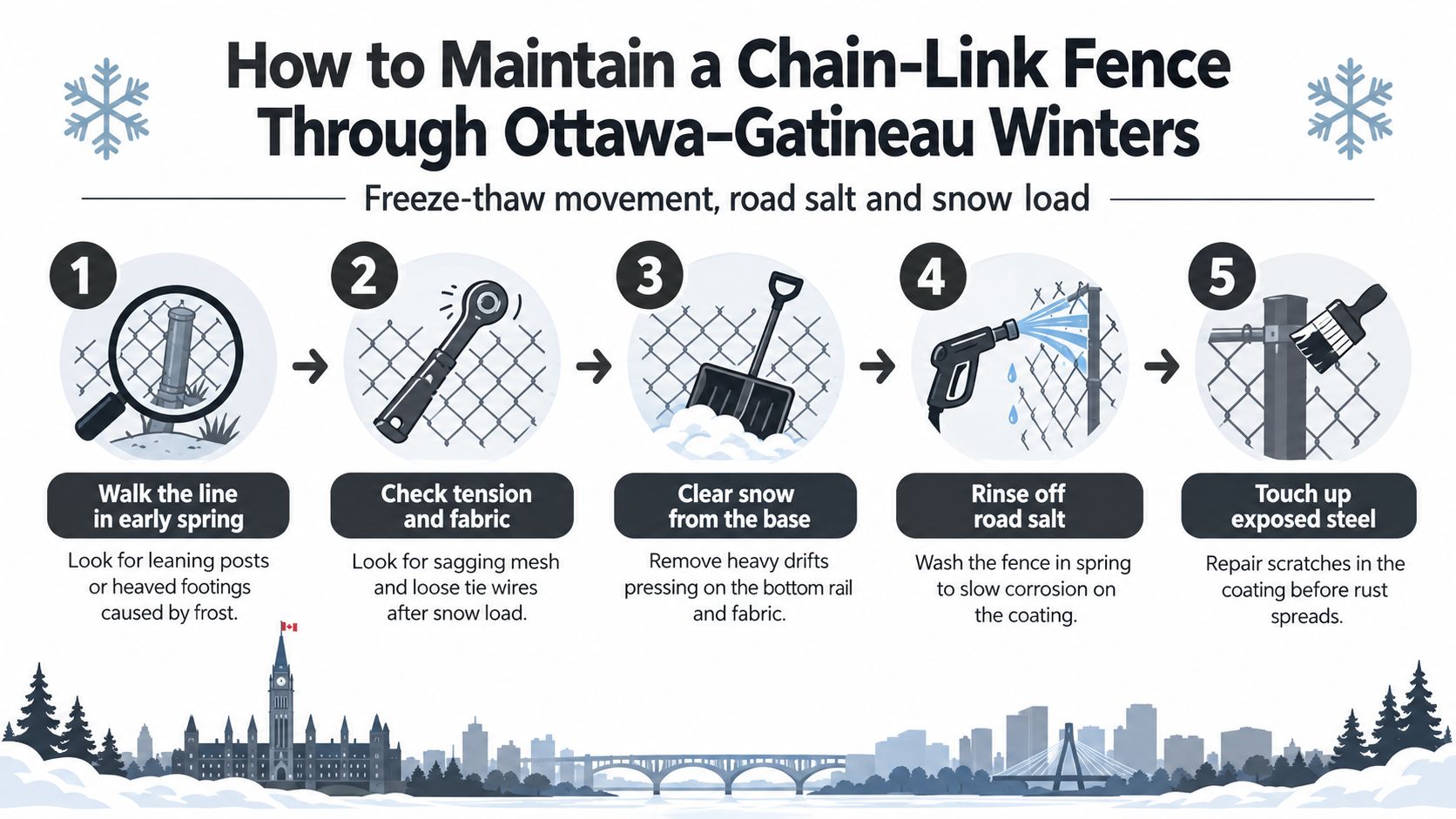
Walk the line in early spring. Sight along the top rail and check suspect posts with a level, looking for leaning supports, lifted footings and newly opened gaps. Correct the cause of movement before retensioning fabric, otherwise you'll pull against an unstable support.
Check tension wire and ties. Use fencing pliers and the appropriate spanners to replace broken ties and secure loose connections without crushing the coating. Loose attachments let the fabric move and bulge instead of transferring loads into the framework.
Inspect exposed metal. Clean rust and loose coating at cut ends, ties and lower wire, then apply a repair product compatible with the original finish, such as an appropriate zinc-rich coating on galvanized steel. Don't paint over lifting PVC or assume rust hidden beneath it has stopped.
Rinse away road salt in spring. Use fresh water on fabric, posts, bands and low fittings wherever road spray or salted snow reaches them. A gentle wash removes residue without forcing damaged coating farther away from the wire.
Remove pressure from snow buildup. Shovel accumulated snow away from the base instead of pushing it through the fence, and gently brush off heavy adhering snow. Don't strike frozen PVC or use the mesh as a backstop for a snowblower.
Test the gate as a complete assembly. Check hinges, latch engagement, closing action and the required hardware position on a pool enclosure. A shifted post can make otherwise sound hardware unreliable, so don't solve every closing problem by tightening the spring.
Repair damage before autumn freeze-up. Correct sags and replace badly damaged PVC-coated fabric sections while the ground and hardware remain accessible. Leaving distorted mesh in place gives snow another surface to press against.
For related coating-care principles, Farmhouse World explains how to maintain rust-resistant finishes on outdoor accents. Match any repair method to the fence manufacturer's coating system rather than treating all outdoor metal finishes alike.
Call an installer for bulging fabric after storms, a leaning terminal post or a gate that no longer self-closes. Restrict pool access immediately if the enclosure's closing or latching function is compromised.
Confirm the Specs and Permit Before You Order
Use a written purchasing checklist before paying a deposit. A quote that says only chain-link fence leaves too much room for substitutions and misunderstandings.
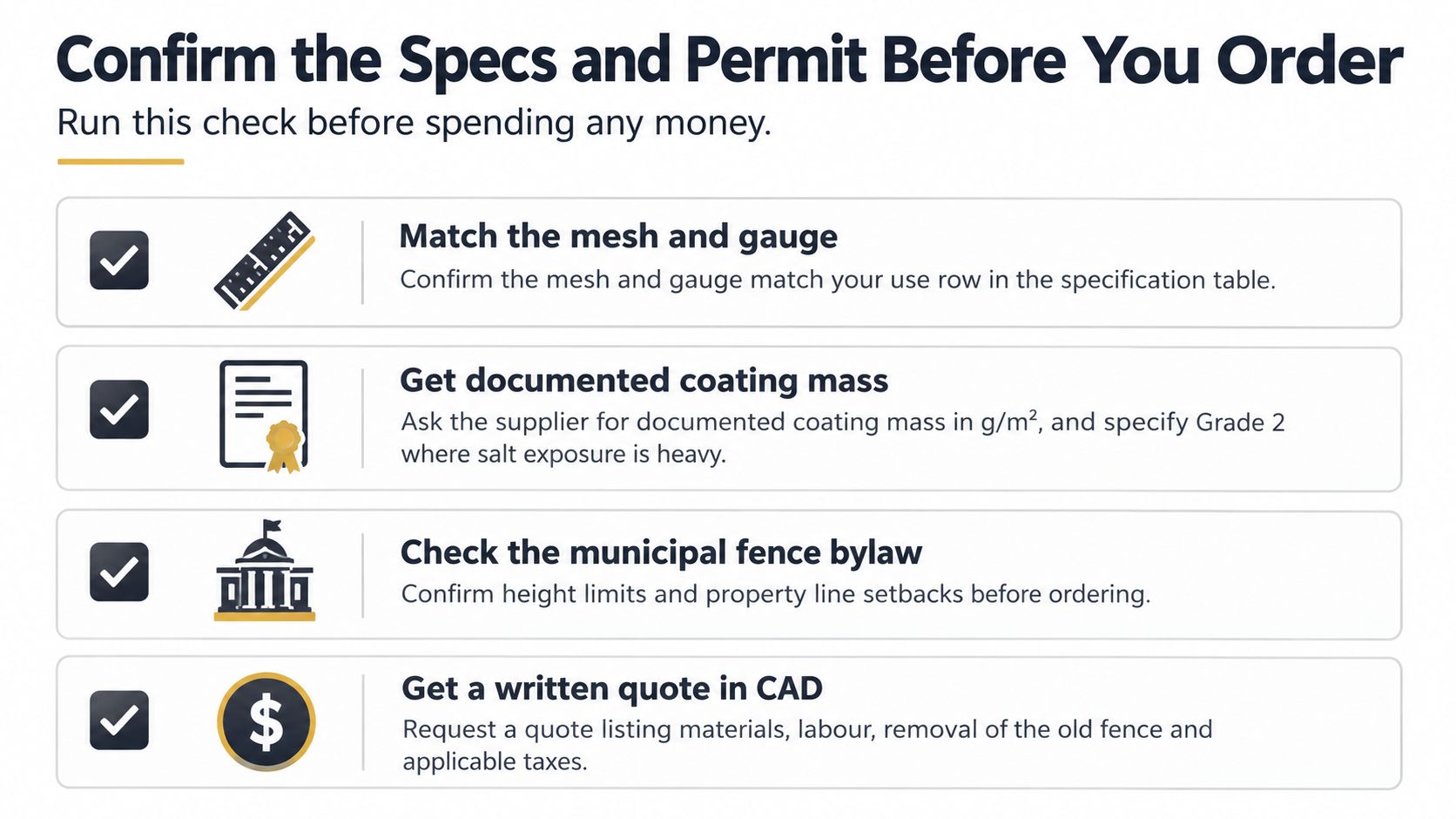
Match the fabric to the purpose: Record opening size, steel-core gauge, finished height and whether privacy treatments are included.
Document corrosion protection: Request fabric grade and coating-mass certification, then select protection appropriate to salt exposure.
Check the framework separately: For commercial and industrial work, the CAN/CGSB-138.2 framework standard requires hot-dip zinc protection on applicable steel components, including inside and outside tubular members, averaging at least 550 g/m², with no individual specimen below 490 g/m².
Resolve enclosure approval: Obtain the municipality's accepted height, mesh, clearance, rail, post and gate configuration before ordering pool-fence materials.
Draw the structural assemblies: Show gate openings, braces, terminal sections and any specified support wheels.
Confirm the site constraints: Verify boundaries, setbacks, corner-lot sightlines, underground utility locations and access for excavation.
Choose materials only or an installed system
For DIY purchasing, choose a supplier that can identify the fabric, framework and fittings by specification and provide the relevant certificates. Buy compatible tension bars, bands, ties and gate hardware together rather than improvising connections during installation.
For contract installation, ask who performs the work, who handles permit coordination and what happens if the gate needs adjustment after installation. Request a written quote in Canadian dollars that separates materials, labour, removal, site restoration and applicable taxes.
Before signing: Make sure the approved drawing and the material schedule describe the same fence. A compliant drawing won't help if the delivered fabric or gate hardware is different.
Keep the municipal response, drawing, product documentation and final walkthrough notes together. They're useful when a property manager takes over, a neighbour proposes an extension or you need replacement components.
FenceScape offers chain-link planning and installation across Ottawa–Gatineau with in-house crews, alongside PVC, hybrid, wood, ornamental iron and glass options, plus neighbourhood group discounts, financing for Ontario and Quebec customers, and post-install support through the final walkthrough. Send your layout, site photos and municipal requirements to FenceScape for a free estimate before ordering materials, so the mesh, coating, framework and gates are priced as one complete system.
Comments