
Cantilever Rolling Gate How It Works and When to Choose It

A lot of Ottawa and Gatineau property owners start looking at gates after the same kind of headache. The driveway works fine in July, then January shows up, snowbanks creep inward, slush freezes overnight, and a gate that looked simple on paper suddenly feels risky. If your entrance is gravel, if the grade settles a bit each year, or if ploughing pushes debris where hardware needs to move, the wrong gate style can become a maintenance chore fast.
That's why the cantilever rolling gate gets so much attention in Canadian conditions. It solves a very specific problem. Instead of rolling on a track across the driveway, it slides while being carried from the side. That one change affects winter reliability, layout, foundations, side-room requirements, and automation choices.
Most pages stop at “no ground track.” That's useful, but it's not enough if you're trying to decide whether the gate will fit your lot and work day after day. The questions are more practical. Do you have enough room beside the opening? Will the support area handle freeze-thaw movement? What safety hardware belongs on an automated system? And if you're in Ottawa-Gatineau, will the site geometry cooperate with snow storage, driveway slope, and local access needs?
Introduction Why Trackless Gates Matter in Ottawa Winters
A homeowner in Ottawa clears the driveway before work, opens the gate, and by evening the entrance has changed. The plough has left a ridge at the apron. Meltwater has turned to ice. Snowbanks have narrowed the edges. A gate that depends on a clean line across the driveway can start acting like a shopping cart wheel stuck on a crack.
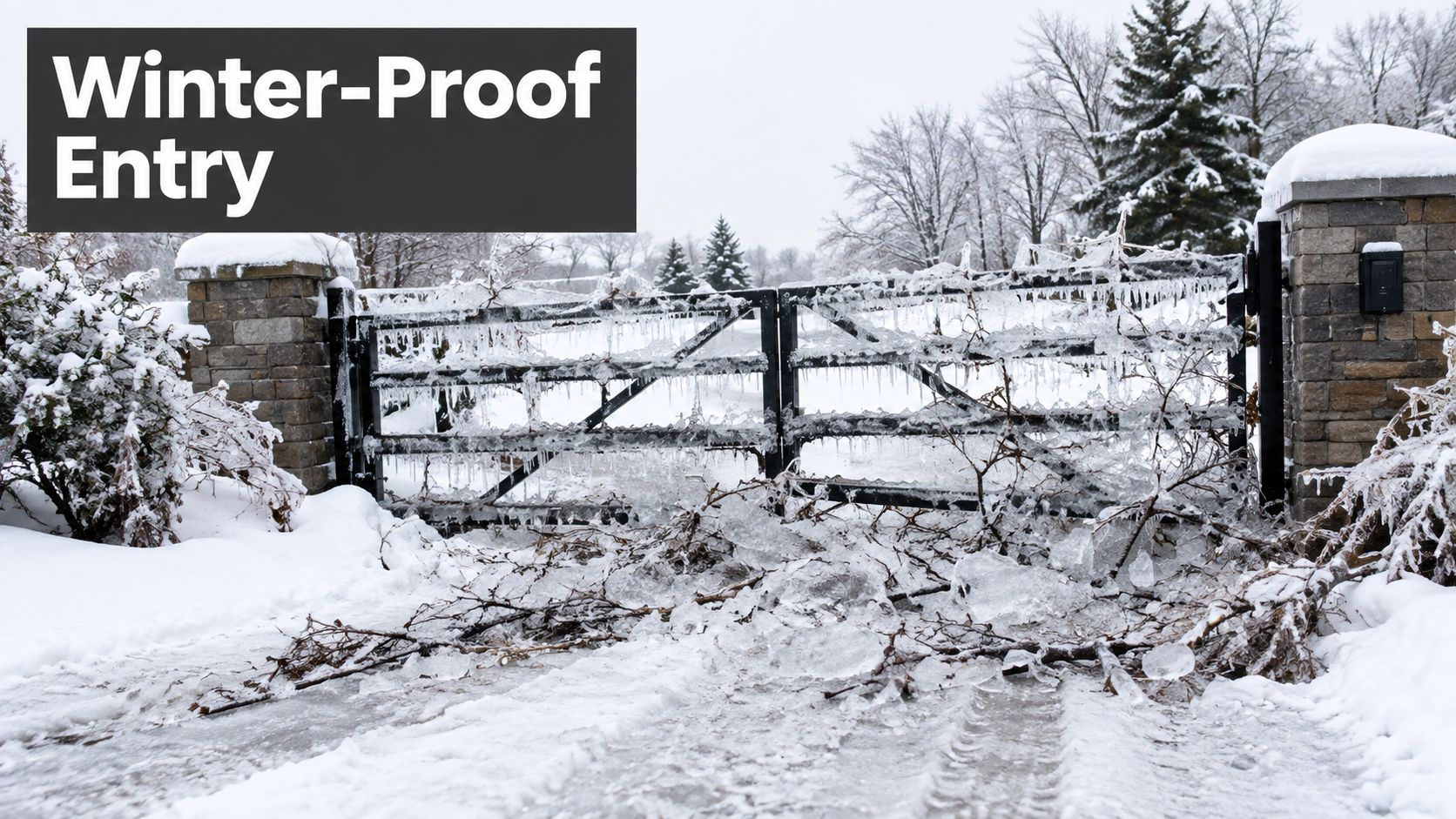
A cantilever rolling gate avoids that trouble by keeping the moving hardware off the driving surface. The opening stays clear of a ground track, so snow, slush, gravel, and small surface shifts are less likely to interfere with daily use. For Ottawa-Gatineau lots, that matters because winter is not just cold here. It keeps changing the site under the gate.
The usual sales pitch stops at "no track." That is only part of the decision.
On a real property, the better question is whether the gate fits the lot and the season. Side room has to be long enough for the gate to slide open. The support area has to stay stable through freeze-thaw cycles. Automation has to include the right safety devices, especially if children, pedestrians, tenants, or delivery traffic use the entrance.
That is why homeowners in this region often end up comparing layout before style. A swing gate needs arc space that snowbanks can steal. A tracked slide gate asks for a cleaner path across the driveway than many winter sites can reliably provide. A cantilever gate asks for something different. It needs usable room beside the opening and a support zone that can carry the load without drifting out of alignment.
A few property types bring this into focus fast:
Tighter urban lots may have enough driveway width for a gate, but not enough side room for the gate tail and counterbalance.
Gravel or settling entrances often benefit from keeping hardware off the ground, but only if the posts and footing area are planned for seasonal movement.
Shared or higher-use driveways need more than opening power. They need photo eyes, safe stopping, and predictable operation in snow season.
Rural Ottawa-Gatineau properties often have the physical room, yet snow storage and frost exposure can make support-zone planning more important than the gate panel itself.
A simple rule helps. If February is the month that exposes every weakness at the front entrance, choose the gate style by winter behavior first, then by appearance.
A cantilever rolling gate is not automatically the right answer. It costs more than some simpler options, and it only works well when the side-room math, foundation plan, and safety setup all make sense together. But on the right Ottawa-Gatineau site, it solves a practical winter problem at the source instead of asking you to keep fighting the driveway surface.
How a Cantilever Rolling Gate Works Without a Ground Track
You stand at the driveway in January. The opening is clear enough, but the edges are piled with packed snow, grit, and refrozen slush. A cantilever rolling gate is built for that kind of entrance because nothing has to run across the driveway surface.
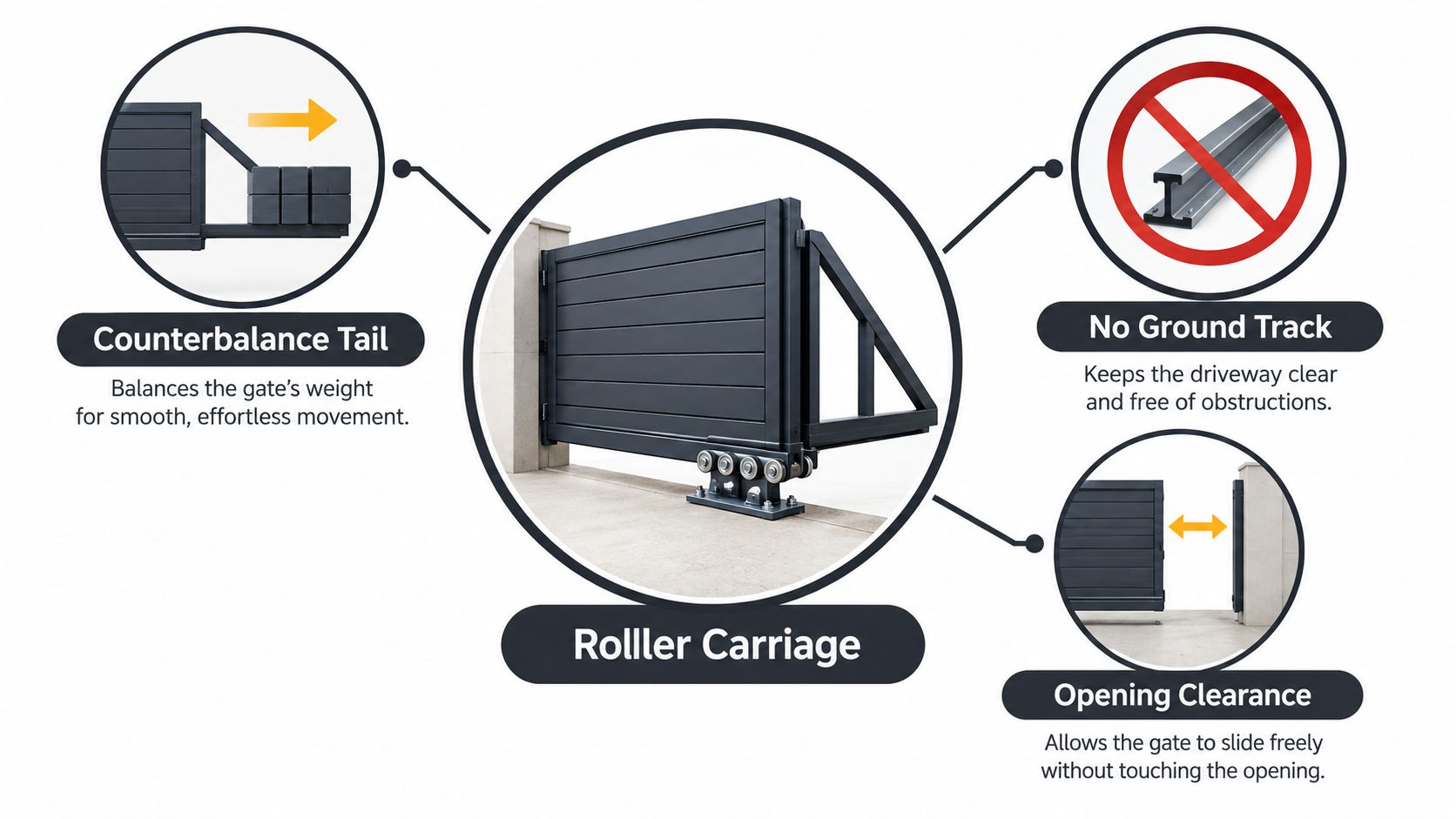
The working idea is simple. The gate slides beside the opening while riding on support hardware mounted off to one side. The part you see closing the driveway is only part of the gate. A longer rear section stays in the support zone and acts as a counterbalance, much like the back half of a crane arm keeps the front from tipping.
The parts that actually carry the gate
A cantilever gate works because the load is shifted to the side structure instead of the driveway.
Roller carriages support the gate weight from the side.
Support posts keep those rollers aligned so the gate travels straight.
The gate frame includes the visible closing section plus the counterbalance tail.
Guide hardware and end stops control movement and keep the gate from overtravel at open and closed positions.
ASTM F2200 defines cantilever slide gates as gates that span an opening without top or bottom support when closed. It also requires the gap between the gate frame and support posts to be no more than 2.25 in, and says manual slide gates must have positive stops and must not move on their own from gravity, according to the Canadian publication of ASTM F2200 guidance.
That helps with a common point of confusion. The support side is not just where the gate parks. It is where the structural work happens.
Why the gate needs more room than the opening
This is the part Ottawa-Gatineau homeowners often underestimate.
A cantilever gate is longer than the clear driveway opening because part of the frame must stay back in the support zone at all times. In practice, that means the side-room requirement often decides feasibility before style does. If your driveway opening is wide but the fence line beside it is short, the gate may fit the gap and still not fit the property.
So the measurement is not just opening width. It is opening width plus the storage length for the gate leaf and its counterbalance section when fully open.
If you want a simple visual of that suspended travel, FenceScape's rolling gates for driveway guide shows how the gate stores beside the opening instead of crossing the surface.
A quick visual helps before getting into site math.
Why the support zone matters so much in freeze-thaw areas
For Ottawa-Gatineau lots, the test is not whether the gate can slide on a mild day. It is whether the support side stays aligned after freeze-thaw cycling, frost movement, spring melt, and snow storage along the fence line.
A tracked slide gate asks the driveway surface to stay clean and consistent. A cantilever gate shifts that demand to the posts, rollers, and foundation area beside the opening. That trade matters on gravel entrances, rural lanes, and driveways where plowed snow keeps getting pushed to the same side.
Commercial and industrial use gives a clue about why this design is popular in winter climates. These gates are commonly chosen where repeated cycles, heavier frames, and reliable clearance matter more than keeping the hardware simple. For a homeowner, the lesson is practical. If the side structure is properly planned and built for local frost conditions, the gate can keep moving even when the driveway surface is messy.
Cantilever vs Sliding vs Swing Gates and How to Choose
Choosing a gate style is mostly about matching the gate to the site you already have. People often start with appearance, but layout and winter behaviour should come first. If the driveway geometry fights the gate, the gate wins for a week and loses for years.
A practical way to compare them
A cantilever rolling gate works best when you have side room to store a longer panel and you don't want hardware crossing the driveway surface. A tracked sliding gate can work well on a stable, clean surface where the track can stay clear. A swing gate avoids side run, but it needs arc space and becomes awkward where snowbanks, slope, or parked vehicles interfere.
Here's a straightforward comparison.
Criteria | Cantilever Rolling Gate | Tracked Sliding Gate | Swing Gate |
|---|---|---|---|
Driveway surface contact | No ground contact across the opening | Track crosses the opening | No track, but leaves swing across space |
Snow and slush tolerance | Strong choice where surface conditions vary | More vulnerable to buildup in the track zone | Depends on clearance and snowbank management |
Gravel and uneven terrain | Often well suited | Less forgiving | Can work, but slope can complicate swing path |
Side clearance needed | High, because the full gate and tail must store beside the opening | Moderate to high, depending on layout | Low side run requirement |
Swing radius needed | None | None | High |
Maintenance focus | Support alignment and rolling hardware | Track cleaning and track alignment | Hinges, arc clearance, and latch alignment |
Visual impact when open | Gate parks along the fence line | Gate parks along the fence line | Leaves occupy open space when moving |
Good fit for frequent use | Commonly chosen for higher-duty sites | Can suit regular use on suitable pavement | Often fine for lighter-duty residential use |
How to decide on your own lot
If you're standing at the entrance, look at the site in three directions.
First, look across the opening. Is the driveway surface rough, gravelled, or prone to movement? If yes, a trackless system usually deserves priority.
Second, look beside the opening. Do you have enough straight fence line or clear side yard for the gate to park? If not, a cantilever may be too long for the available run.
Third, look through the entrance. Does the inside or outside space allow a swing arc without conflicting with cars, slope, pedestrian movement, or snow piles? If that answer is no, a swing gate starts losing ground quickly.
Common fit mistakes
Choosing by style first: A sleek gate that can't store fully open is the wrong gate.
Ignoring winter storage: Snowbanks reduce usable space at exactly the wrong time.
Forgetting delivery and service access: Operators, posts, and controls all need room to be installed and maintained.
If your lot is narrow but deep, swing gates sometimes fit better than people expect. If your lot is wide but the driveway edge is unreliable, cantilever systems usually climb the list.
For HOAs, multi-unit entrances, and commercial yards, the choice often comes down to movement pattern. Repeated daily openings favour systems that don't depend on a clean track line across active vehicle pavement.
Site and Foundation Requirements for a Reliable Installation
Once you do the side-room math and look at the support zone, you can usually tell whether a cantilever rolling gate is practical. A lot of gate projects become clearer at that point.
Start with the runway length
Canadian supplier guidance gives a useful planning rule. One guide states the overall gate length is typically opening size × 1.5 plus 1 ft, and notes that a common residential maximum single opening is about 30 ft. The same source also points to a Canadian chain-link cantilever slide-gate specification that requires an overhang of 12 ft for gate leaf sizes from 23 ft to 30 ft, which is directly useful when laying out the runway space beside the opening in this sliding security gate planning guide.
That means you don't just measure the driveway width. You measure the driveway width, then confirm the support side has enough straight, usable run for the full gate length.
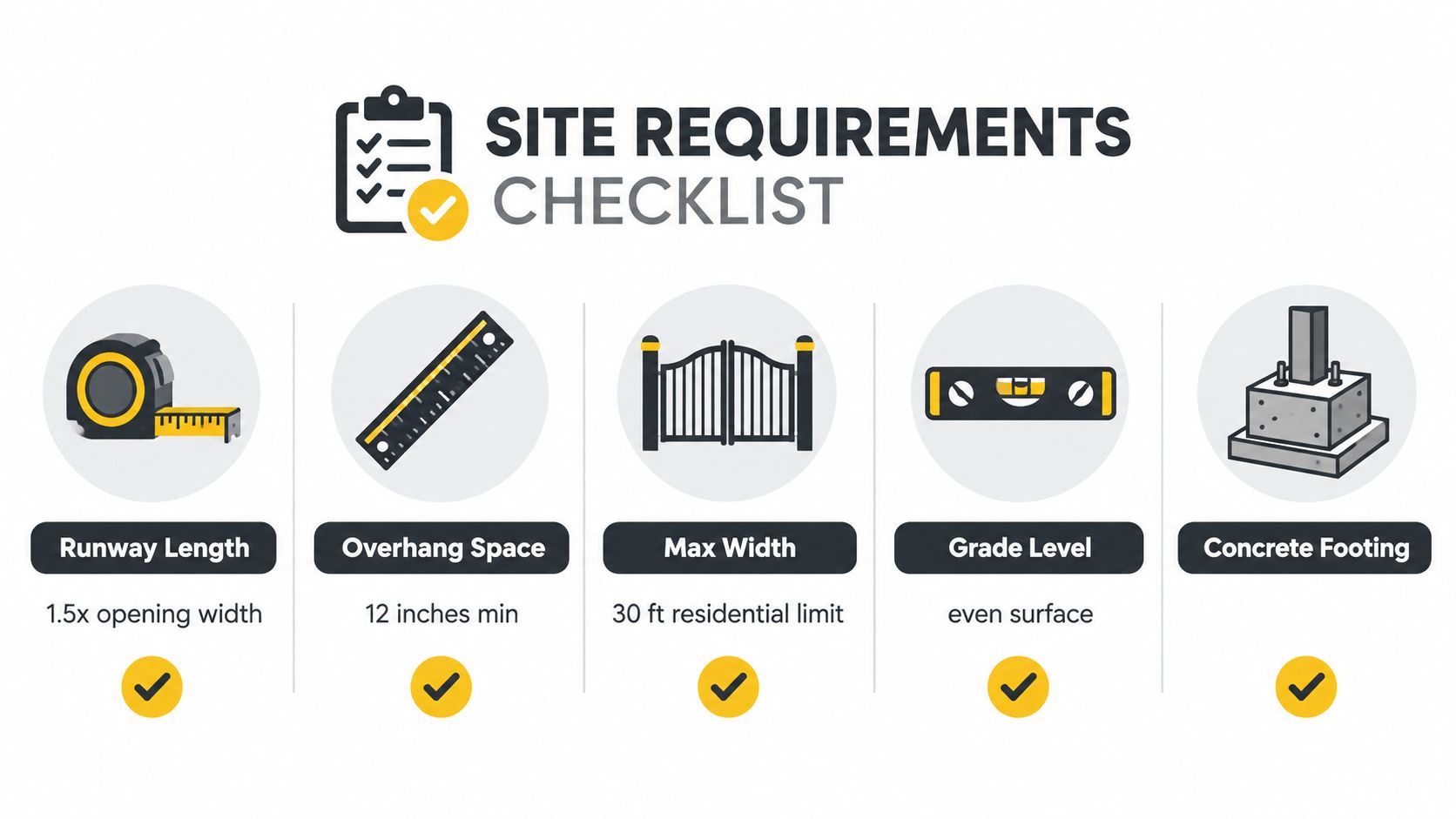
A site visit should answer these questions before hardware is ordered:
How wide is the clear opening? Measure what vehicles need, not just the space between posts.
How much straight side room exists? Check fence returns, retaining walls, trees, meters, and parked-car zones.
Where will snow go? Winter storage can steal runway length.
Is the support side stable? That side carries the structural demand.
FenceScape's driveway gate installation guide is a useful reference for what a proper pre-install review should cover.
Foundations matter more than the driveway surface
A cantilever system avoids a ground track across the opening, but that doesn't mean foundations are forgiving. The load shifts to the support posts, roller-carriage area, and back frame. If that zone moves, the gate can bind, sag, or place extra strain on the operator.
For chain-link cantilever gates in Canadian procurement standards, unloaded downward deflection is limited to 12.7 mm for openings up to 6.4 m and 25.4 mm for openings wider than 6.4 m, according to the Canadian procurement standard for horizontal sliding and cantilever gates. That requirement tells you something important. Sag isn't just cosmetic. It directly affects stiffness, alignment, and long-term operation.
Ottawa-Gatineau checks that save trouble later
Freeze-thaw and driveway settling change how you should look at the site. Focus on the support side as if it were the foundation for a small moving structure, because that's what it is.
Grade changes: Minor slope changes near the opening may be manageable, but the gate travel path and support alignment must stay consistent.
Drainage paths: Water shouldn't collect where posts, conduits, or operator hardware sit.
Setback and service room: Leave enough space for maintenance access around posts and controls.
Plough pattern: Confirm where snow gets pushed during a normal winter, not where you hope it will go.
Measure in winter if you can. Summer dimensions can flatter a driveway that shrinks once snowbanks show up.
Hardware Motorization and Automation Options Explained
A gate can fit the opening and still be wrong for the property.
On many Ottawa-Gatineau driveways, the test starts in January. Salt spray gets into moving parts. Packed snow builds near the catch post. A short power outage suddenly matters if the gate is the only vehicle entrance. That is why hardware selection should start with daily use and winter conditions, not with the remote control you want on your keychain.
The hardware stack
The moving parts work like the running gear under a trailer. If one piece is undersized or poorly matched, the whole gate feels heavy, noisy, or inconsistent.
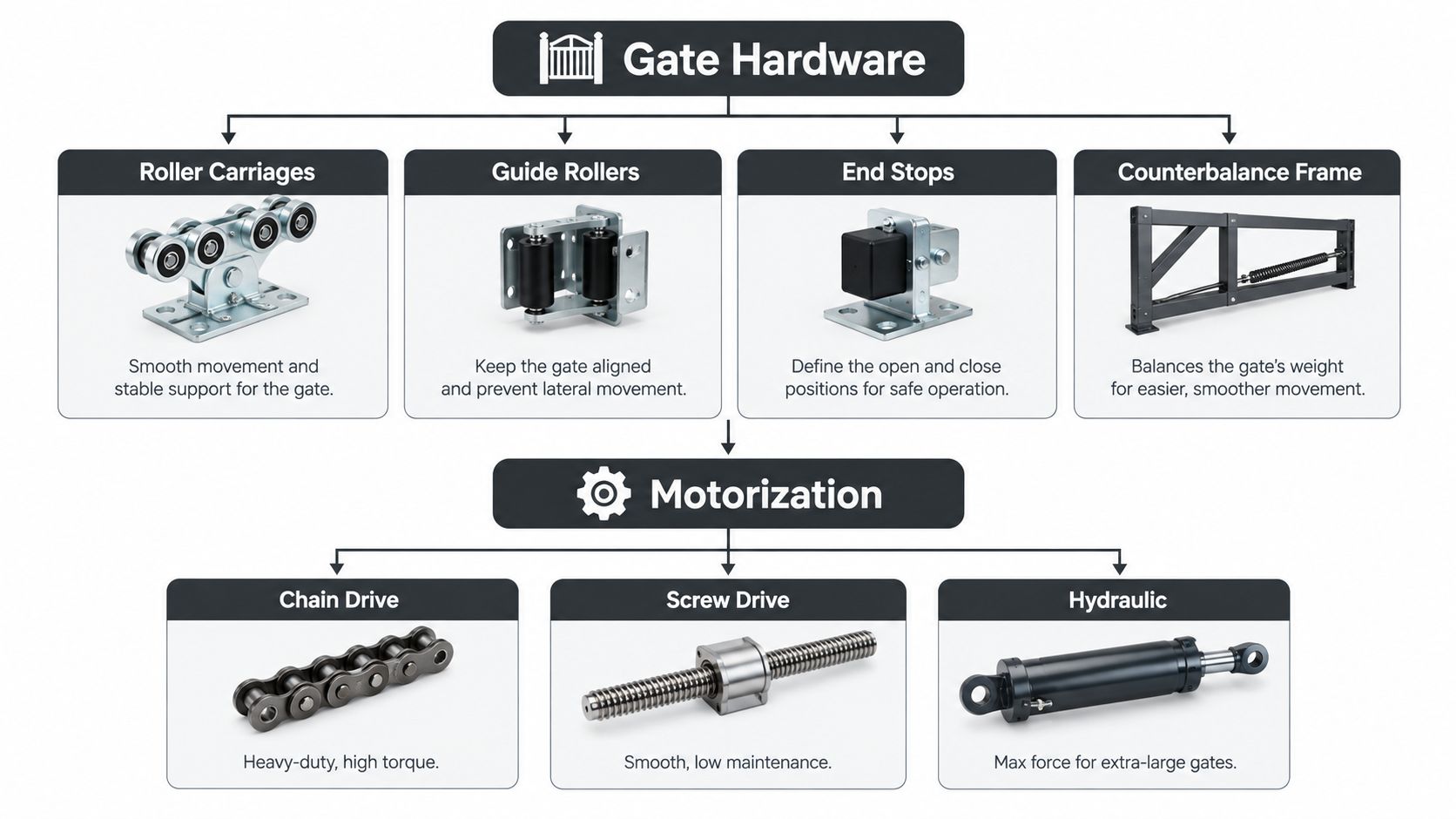
Start with the core components:
Roller carriages carry the gate load and need to match the actual gate weight, not a rough guess.
Guide rollers keep the gate upright and reduce side-to-side wobble in wind.
End stops and receivers define where the gate finishes its travel and help it settle into the closed position.
The operator provides controlled movement and has to suit the gate mass and duty cycle.
The counterbalance frame is the tail section that keeps the opening span suspended and stable.
Higher-use systems need these parts chosen as one package. A heavy privacy infill, for example, changes the demand on the frame, rollers, and motor at the same time. If you size only the motor and ignore the rest, the gate may still run poorly.
What drives motor choice
Motor selection is really use-pattern selection. A cottage lane, a single-family driveway, and a small condo entrance may all use a cantilever gate, but they should not share the same automation plan.
A practical review usually includes:
Cycle frequency: A gate opened a few times a day is different from one serving deliveries, tenants, or staff traffic.
Gate fill and wind load: Open ornamental pickets move more easily than solid or semi-private panels.
Power and backup: Confirm hardwired power, battery backup needs, and how you will enter if power fails during freezing weather.
Control method: Remotes, keypad entry, phone-based access, intercoms, and vehicle detection each change wiring and equipment layout.
Service access: Leave room to reach the operator cabinet, controls, and manual release without climbing over snowbanks.
For homeowners comparing device layouts, this access control gate systems guide gives a useful overview of readers, keypads, intercoms, and exit hardware. If you want a broader example of how those pieces fit into a managed entry setup, this overview of access control gate solutions UK is also helpful.
The Ottawa-Gatineau checklist people often miss
Automation adds convenience, but it also adds a short list of site questions that should be answered before equipment is ordered.
Ask these early:
Can the operator sit above seasonal water and slush?
Will drifting snow block photo eyes, loops, or the receiver area?
Is there a safe manual release plan for family members during an outage?
Will delivery drivers understand how to request entry without backing into traffic?
Does the closing speed and auto-close timing make sense for your driveway length?
These details sound small until winter exposes them. A beautifully built gate with poorly placed sensors can become a service call machine.
Why automated cantilever gates cost more
The price jump comes from the whole system, not just the motor. You are paying for a suspended structure, matched hardware, electrical work, controls, and the extra planning needed to make that equipment behave well through freeze-thaw cycles.
As noted earlier, cantilever gates are usually positioned as premium access infrastructure rather than budget perimeter closures. That can make sense on Ottawa-Gatineau lots where snow, uneven surface conditions, and frequent vehicle use would make a simpler gate frustrating to live with. On a basic driveway with ample swing space and light use, the added cost may be harder to justify.
Safety Security and Compliance Planning for Ottawa Properties
A gate that moves well but creates a safety problem isn't a successful installation. This matters even more once automation enters the picture, because the gate becomes a powered moving barrier, not just a fence panel.
The safety points that deserve attention
ASTM F2200 gives a few practical requirements that are easy to translate into site decisions. For cantilever slide gates, the gap between the gate frame and support posts must be no more than 2.25 in. It also requires positive stops and says manual slide gates must not move on their own from gravity. Those details were noted earlier from the Canadian publication of that standard, and they matter because they shape post spacing, travel limits, and final adjustment.
From a property owner's point of view, the checklist looks like this:
Control the travel path: The gate needs defined open and closed limits.
Prevent unintended movement: A manual gate shouldn't drift because of grade or poor adjustment.
Reduce entrapment risk: Powered systems need protective devices and careful placement.
Separate people from vehicles where possible: Shared access points deserve extra thought.
Ottawa planning is broader than gate hardware
Ottawa's public-facing rules regulate site access and permitted work, but they don't hand you a cantilever-specific checklist for side-room envelope, emergency access, or automation layout. That's the gap many owners run into. The local framework exists, but the translation to an actual gate plan still has to be done project by project, as reflected in the City's laws, licences, and permits information.
That matters on:
Residential driveways where cars, deliveries, and visitors use the same entrance
Townhouse and HOA sites where multiple users need predictable access
Commercial properties that may need clear vehicle flow and managed entry
Pool enclosures where controlled access and safe latch strategy matter
A gate drawing should answer two different questions at once. How will it move, and how will people use the space around it safely?
Questions to settle before installation
Ask your installer and, where needed, the municipality or site manager to confirm:
Emergency access needs
Pedestrian routing near the gate
Location of photo eyes, edges, controls, and manual release
Clearances at support posts and adjacent fencing
Whether permits or approvals apply to the specific property type
This isn't paperwork for its own sake. It's how you avoid a gate that technically fits but functions poorly once residents, guests, trades, and service vehicles start using it.
Where Cantilever Rolling Gates Work Best and Next Steps
The best fits are usually easy to recognise once you've walked the site properly.
A private driveway with gravel or a surface that shifts seasonally is a strong candidate when side room exists and the owner wants less dependence on driveway conditions. A commercial yard makes sense when the opening is substantial and repeated access matters more than the lowest initial spend. A townhouse or HOA entrance often benefits when swing space is limited and the gate needs to park along the fence line instead of into traffic space.
Pool-adjacent controlled access can also suit a cantilever layout if the project has the side room and the safety planning is done carefully. In those settings, the premium tends to make sense when reliability, security, and site constraints all point in the same direction.
The main decision isn't whether a cantilever rolling gate is impressive. It's whether your property can support the geometry and structure it needs. If the lot has the runway, the support side can be built properly, and winter surface conditions are the weak point of the entrance, this gate style often earns its keep. If the lot is tight on the support side or the opening doesn't justify the added complexity, another gate type may fit better.
The smart next step is simple. Measure the opening, measure the available straight side run, look at where snow gets stored, and review how vehicles and people use the entrance. That site reality should drive the choice.
FenceScape handles gate and fence projects in the Ottawa-Gatineau region from site planning through final walkthrough, including layouts where winter conditions, access control, and side-room constraints all need to be considered together. If you want a practical review of whether a cantilever rolling gate fits your property, visit FenceScape and start with a project estimate built around your actual driveway, not a generic gate diagram.
Comments