
Arch Gate for Garden: A Complete 2026 Guide

Early April is when a garden arch gate reveals whether it was installed properly. The snow has receded, the ground is soft, and the latch that worked perfectly in October now sits above the strike plate. The post has moved, the gate drags, and the decorative entrance you bought for its charm has become a daily adjustment.
An arch gate for garden use is more than a trellis with hinges. It's a framed, load-bearing opening exposed to wind, snow, climbing plants, road salt, and repeated freeze-thaw movement. The appearance matters, but the post footing, hinge capacity, bracing, drainage, and local by-law rules decide whether it remains useful after two Canadian winters.
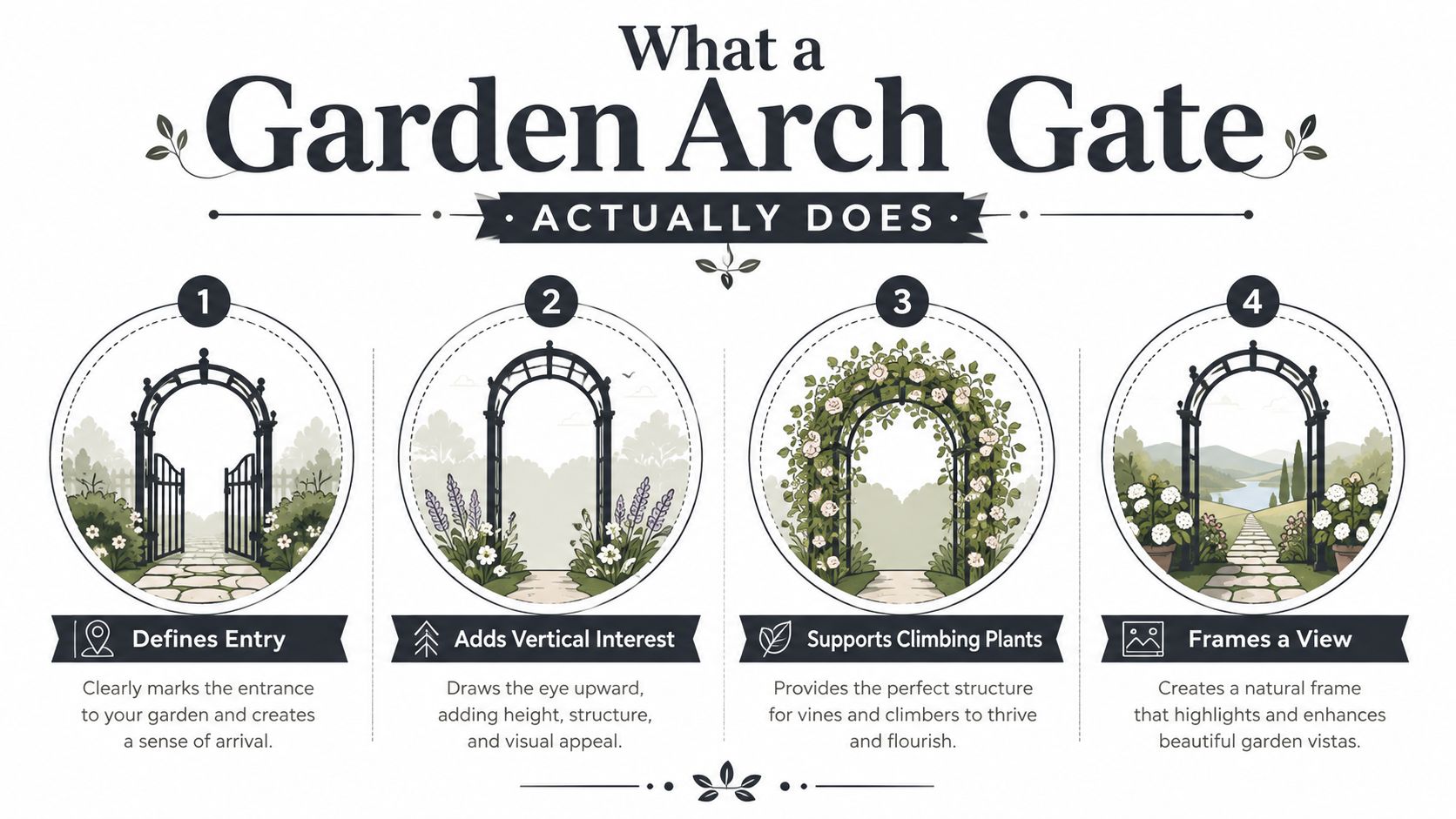
What a Garden Arch Gate Actually Does
A homeowner walking the yard in early spring usually notices the latch first. The gate no longer catches, the bottom edge scrapes the path, and one post appears slightly higher than the other. That small movement often points to a footing problem, not a latch problem.
A garden arch gate combines three elements: two anchored posts, a hinged swinging leaf, and a curved top that spans the opening. A plain garden gate marks an entrance but usually stops at a flat or simple framed top. A freestanding arbor supports plants without carrying the repeated movement and hinge load of a swinging leaf. A pergola walkway creates a longer overhead passage, while an arch gate concentrates structure, access, and planting support in one opening.
The curve has a structural job
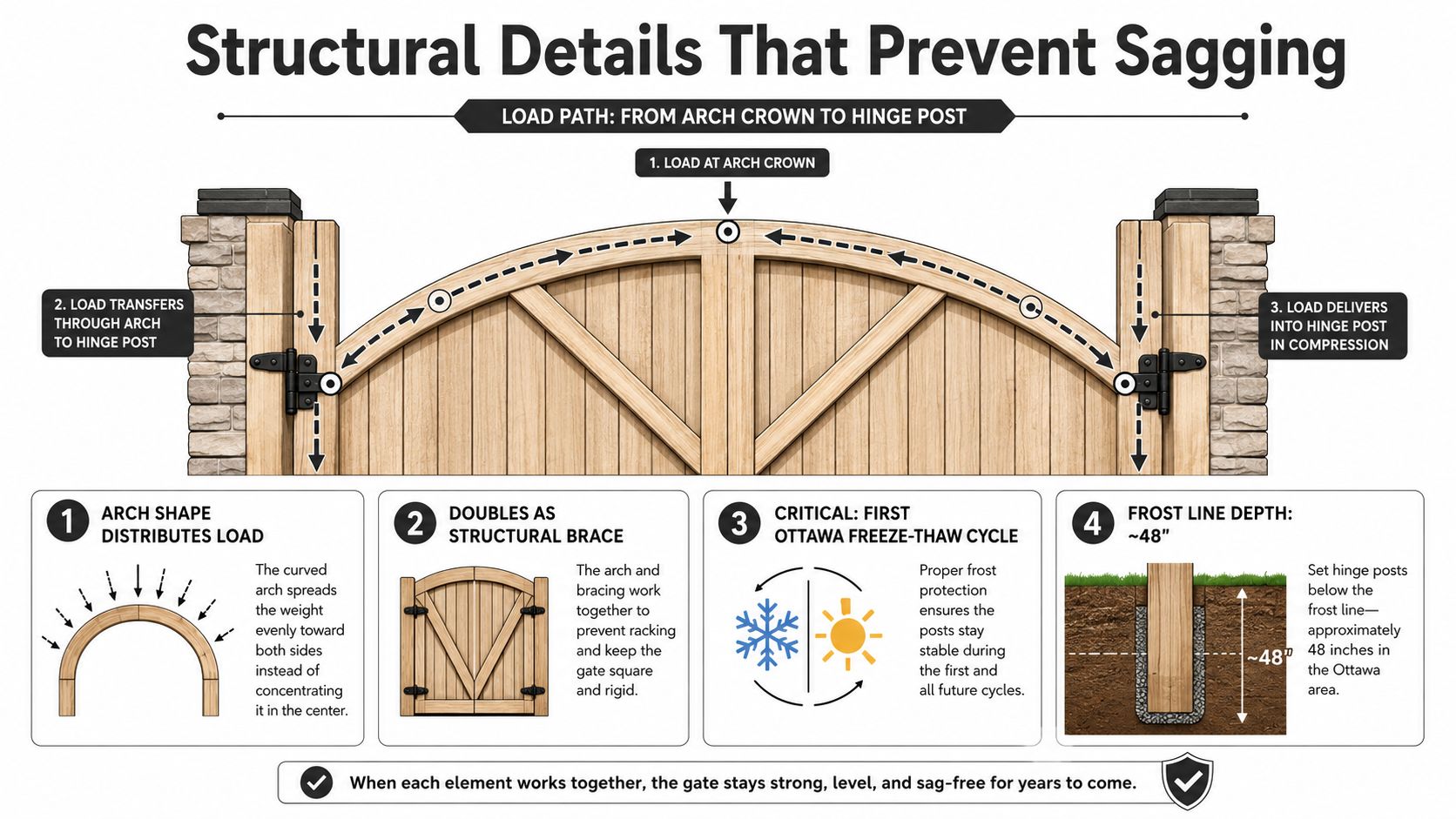
The arch isn't just an ornamental flourish. A properly connected curved top helps tie the two sides together, stiffens the opening, and creates a support line for clematis, climbing roses, honeysuckle, or other vines. It also changes where forces travel. Weight from the gate leaf, attached growth, wind, and snow doesn't just move straight down through a flat frame. It pushes into the side posts and hinge connections.
That makes an arched entrance visually strong but technically less forgiving. The crown can collect wet snow, plant mass can increase wind resistance, and a small amount of post movement can become obvious at the latch. Allan Gardens in Toronto provides a useful regional precedent. Its public garden site began development in 1858, opened as horticultural gardens on September 11, 1860, and took the Allan Gardens name in 1901, reflecting a long Ontario tradition of decorative gateways and ornamental ironwork in formal gardens. The historical account of Allan Gardens also records the present conservatory complex being built in stages between 1909 and 1957, with the Palm House dome completed in 1909 and opened in 1910.
The practical definition is simple: an arch gate is a swinging gateway with an overhead structural curve. Treat it like garden furniture and it may shift. Treat it like a small exterior structure and the decorative result will last much longer.
Materials That Hold Up Through Canadian Seasons
Material selection changes the maintenance routine, the gate's weight, and the way it responds to Ottawa and Gatineau weather. There isn't one universal winner. Cedar looks warm and suits planted gardens, coated steel provides stiffness, aluminium avoids rust, and a hybrid can hide a strong core behind a softer finish.
Cedar is usually the easiest material to make look natural beside shrubs and perennial beds. It resists rot, but it will grey and develop surface checks unless you maintain the finish. Pressure-treated pine generally accepts paint well, yet poorly dried material can warp after installation. The issue isn't the treatment itself. It's movement in the board or frame after the gate has already been fitted.
PVC and vinyl appeal to homeowners who don't want seasonal staining or sealing. They're useful for a light pedestrian gate, but deep cold can make some profiles less forgiving when struck, and south-facing surfaces can chalk under ultraviolet exposure. Keep the frame properly supported rather than expecting the infill panels to provide stiffness.
Material rule: Choose the frame for load and movement, then choose the visible finish for appearance.
Powder-coated steel is the strongest choice among common decorative frames, but inspect weld points and cut edges carefully. Coating damage near a hinge, latch, or lower rail can become the start of corrosion, especially where salt spray reaches the gate. Wrought iron offers a traditional profile and substantial presence, while aluminium won't rust but can feel lighter and may dent if a shovel or snow blower catches it.
A cedar-clad steel post is often a sensible compromise for a premium residential entrance. The timber supplies the garden character, while the internal steel helps control deflection. Whatever you choose, design the arch to shed snow rather than hold a heavy shelf of it, and plan for salt exposure where the gate sits beside a treated walkway. For an aluminium comparison, review aluminium gates and fences before committing to a profile.
Sizing, Placement, and Sightlines
Start at ground level. Mark the proposed post locations with temporary stakes, then push a wheelbarrow, mower, or other equipment along the route. A gate that looks right on paper can become an obstruction during spring cleanup.
Measure the finished opening
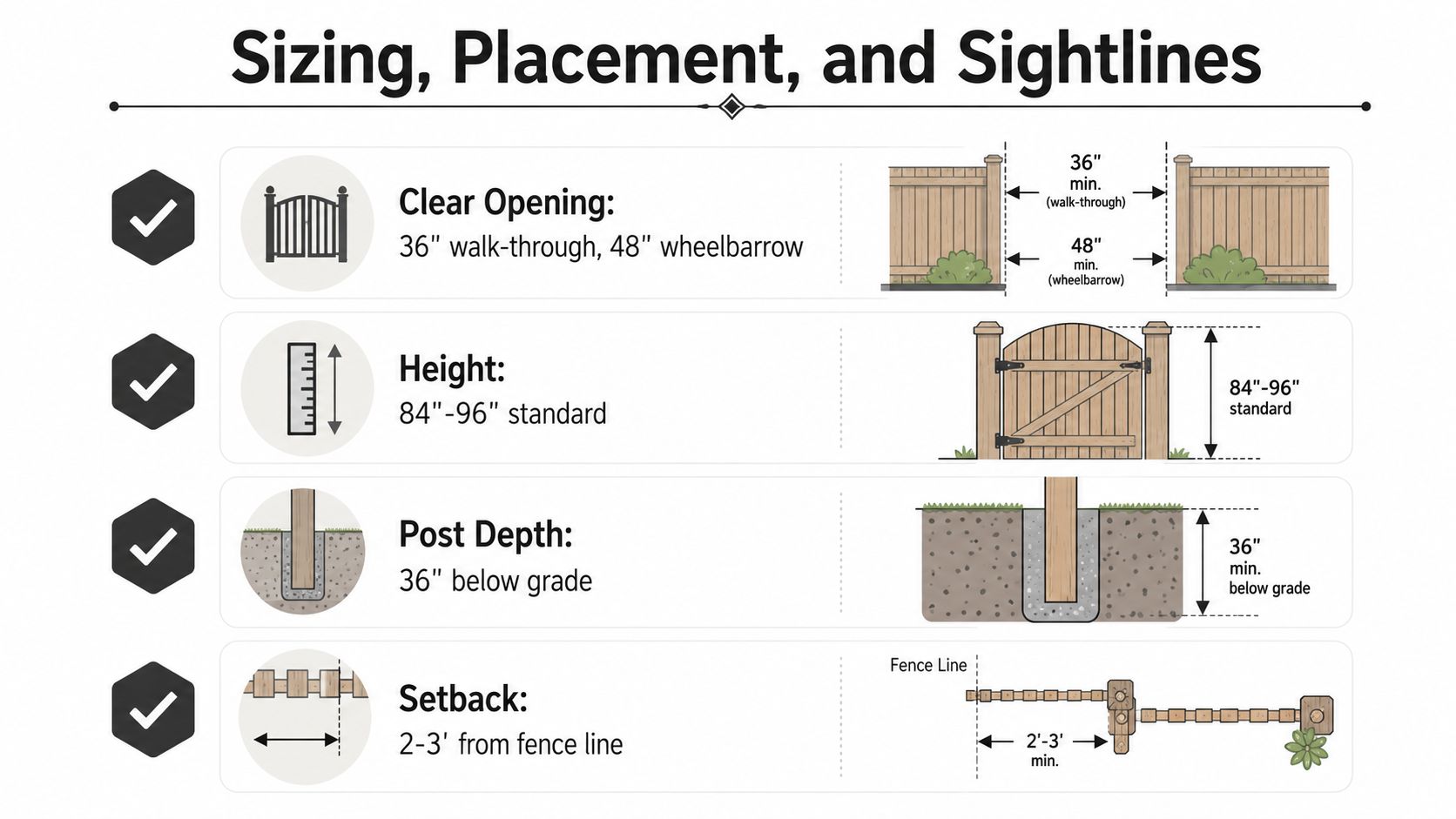
Use these field dimensions as practical starting points:
36-inch clear opening: Suitable for ordinary foot traffic.
48-inch clear opening: More useful for a wheelbarrow or mower.
60-inch clear opening: Allows a riding mower or small trailer to pass.
84 to 96-inch peak height: Provides headroom and room for climbing roses.
The clear opening differs from the post-to-post measurement. Hinges, latch plates, stops, and frame clearance take up space, so allow 2 to 4 inches in the overall layout. Confirm the manufacturer's finished gate width before digging. Mark the actual hinge and latch faces on the posts, not just the centreline.
Read the garden from outside
Check the proposed arch from the street curb. Make sure it does not block a driver's or pedestrian's view, then repeat the check from the back door and kitchen window. Centre the gate on a patio when you want a formal focal point. Aligning it with a diagonal path can make a narrow garden feel deeper and guide visitors toward a destination.
Keep the swing clear of opening doors, downspouts, snow-storage zones, and the walkway edge. Verify the property line and required setback before setting posts. Ottawa and Gatineau municipalities may limit fence and gate height near lot lines, especially in front yards, corner locations, and visibility areas. Ontario guidance on driveway-gate permits and regulations explains that requirements can change with the structure's height, location, and connection to a larger fence system.
Sightlines also affect daily operation. A gate positioned where snow is piled or where runoff crosses the path will face more movement and clearance problems after thawing. Plan the opening around those conditions before the arch becomes a fixed structure.
Structural Details That Prevent Sagging
An arch gate can look square on installation day and still sag after the first Ottawa thaw. The usual cause is movement in the two footings, combined with a heavy leaf, weak hinges, or an unsupported arch. Each post must stay aligned with the other, because even a small difference changes the latch position and swing clearance.
In the Ottawa area, Canadian field guidance commonly places posts below a frost line of about 48 to 60 inches, with holes dug to roughly 5 feet and formed with an 18-inch bell-shaped base. A concrete flare about 4 inches wider than the post helps resist uplift. Where soil is susceptible to frost movement, a compacted gravel base of at least 12 inches improves drainage. This Canadian frost-heave guidance explains how shallow or poorly drained footings can rise unevenly and throw the latch out of alignment.
Follow the load path
The arch crown sends force into the side members. The hinge post carries the swinging leaf, while the latch post takes closing impact and wind movement. A header or rear brace keeps those forces from flexing the frame. Climbing roses and clematis add both weight and wind resistance, so the structure must allow for the mature planting rather than the newly installed vine.
For a wider or heavier gate, install a diagonal brace or tension cable across the rear face. Canadian field guidance recommends diagonal bracing or a tension cable for arch gates wider than 3.5 feet, along with corrosion-resistant hinges rated at 200 lb or more per hinge. The gate-bracing guidance connects these measures with less deflection and fewer post-thaw adjustments.
Choose the brace for the movement it controls:
Knee braces: Strengthen the hinge-post corner and limit local racking.
Diagonal cable or rod: Holds the leaf up and reduces drop toward the latch side.
Structural header: Ties the posts together and gives the arch a continuous load path.
Set both posts on drained footings rather than directly on soil. Use fence-post placement guidance to plan excavation, drainage, and alignment before concrete is placed.
Match the hinge to the frame. Strap-and-bolt hinges suit timber leaves, self-closing spring hinges suit lighter PVC gates, and welded bearing hinges suit steel. Decorative hinges are hardware details, not load-rated structural components.
DIY Build Versus Professional Installation
A capable DIYer can assemble a pre-cut cedar arch kit on level ground, especially when the gate is light, the layout is uncomplicated, and the kit includes compatible hinges and posts. The work still demands accurate staking, a level, a post-hole tool, a drill, and a second person to hold the frame while it's aligned. A simple kit can fit into a focused weekend, but that timeline changes quickly once excavation meets roots, rock, or wet clay.
The difficult part isn't fastening the arch. It's creating two post bases that move together. Deep frost-line excavation, welded metal frames, masonry anchors in stone pillars, sloped grades, buried utilities, and gates taller than about 1.5 m all raise the consequences of an error. A matching fence line also needs careful sighting, because a new arch can look out of square even when the gate itself is assembled correctly.
Factor | DIY Build | Professional Installation |
|---|---|---|
Site conditions | Best on level, accessible ground | Better for slopes, rock, bedrock, and tight access |
Footings | Homeowner handles excavation and drainage | Crew sets depth, alignment, concrete, and drainage as a system |
Frame | Pre-cut timber or light kit | Custom timber, steel, aluminium, or hybrid fabrication |
Permits | Owner researches and coordinates requirements | Contractor may coordinate responsibility and documentation |
Existing fence | Matching can be difficult | Installer can align posts, rails, colours, and transitions |
Warranty | Usually limited to product components | May include workmanship coverage |
Professional installation adds labour cost, but it can buy correct post depth, plumb geometry, matched hardware, and a workmanship warranty that remains useful after the first deep frost. Choose DIY when the site and kit are straightforward. Choose a contractor when a footing mistake would mean dismantling an expensive arch later.
Maintenance and Weatherproofing Year-Round
Ottawa and Gatineau maintenance works better when tied to weather events than to a generic annual reminder. The useful sequence starts after thaw, continues through the growing season, and ends with preparation for frozen ground and snow accumulation.
Work with the local season
Late April is the inspection point. Open and close the gate, check whether the latch lines up, look for post movement, and examine the lower frame for standing water or salt residue. In June, tighten accessible hinge and latch fasteners, but don't over-tighten them into soft timber.
Cedar needs a breathable oil sealer every 18 to 24 months, with extra attention to exposed end grain during the spring inspection. Cedar fence maintenance guidance is useful for the same cleaning, drying, and finishing principles that apply to cedar gate components.
PVC usually needs mild soap, clean water, and a UV-protectant wipe where chalking starts. Avoid harsh abrasives that dull the surface. Powder-coated metal needs a different response. Brush a rust spot with a wire brush, remove loose coating, allow the area to dry, and apply a compatible matching touch-up paint before corrosion reaches the weld or fastener.
Winter check: Clear heavy snow and ice from the arch crown rather than letting the frame carry a growing frozen load.
October is the weatherproofing month. Clean salt and soil from the lower rails, inspect drainage around both posts, lubricate suitable hinge points, and confirm that snow won't be piled against the gate. January checks matter after heavy snowfall. Remove packed snow from the arch and make sure the gate can still swing without striking a hardened bank.
Road salt splash and shovel-thrown ice are the quiet causes of premature damage near walkways. They attack coatings, hold moisture against fasteners, and can force a gate sideways when the path freezes. A short seasonal inspection prevents a small alignment issue from becoming a frame repair.
Cost Ranges and Financing Options
An installed garden arch gate in Ottawa or Gatineau commonly costs $650 to $4,800. Material, fabrication, excavation, footing conditions, hardware, and finish create most of the difference. Location and height can also affect permit treatment and the work required before installation.
Project Type | Material | Typical Range (CAD) | Key Cost Drivers |
|---|---|---|---|
DIY entry kit | Cedar | Near $250 for lumber | Kit design, posts, hinges, finish, excavation |
Mid-range DIY kit | PVC | $400 to $900 | Profile quality, hardware, delivery, anchoring |
Fabricated decorative arch | Powder-coated steel | $1,200 to $2,800 plus shipping | Welding, coating, custom dimensions, freight |
Installed residential gate | Mixed materials | $650 to $4,800 | Site work, footing depth, hardware, finish, access |
Complex installation | Steel, aluminium, or hybrid | Above basic installed range | Bedrock, concrete removal, custom engineering, lighting |
The lower end assumes a clear opening and workable soil. Higher quotes may include custom fabrication, snow-load detailing, difficult access, deeper excavation, or upgraded hinges and latches. Professional installation can add $300 to $1,200 when posts must reach below the frost line, commonly about 1.5 m in Ottawa and 1.2 m along the Gatineau side, or when concrete and bedrock slow excavation.
Frost-depth work is not a decorative upgrade. Shallow or poorly drained footings can shift during freeze-thaw cycles, leaving the arch out of alignment and increasing hinge load. Price the excavation, concrete, drainage, and post setting before comparing gate finishes.
Ontario homeowners can investigate the Home Renovation Savings Program, a line of credit, or a contractor financing plan. Quebec buyers can ask whether Rénoclimat applies to qualifying structural outdoor work and whether CMHC Green Home refundable adaptations fit the broader project. Confirm eligibility directly before counting any rebate in the budget.
Request separate line items for snow-load upgrades, custom hinges, heritage review fees in older neighbourhoods, lighting electrical work, delivery, bedrock removal, and restoration of disturbed paths. Those items often explain a revised quote after the site visit. Ask whether the quoted footing depth includes excavation and concrete, since a low gate price may exclude the work that keeps it operating after winter.
Choosing a Contractor and Final Checklist
An estimate visit should function as a site diagnosis, not a sales presentation. Walk the proposed route with the installer, stand at the street and inside the garden, identify the intended path, and ask the contractor to show where each post will sit. A competent installer should be able to explain what happens if the excavation reaches rock, a utility, or an existing concrete edge.
For a Canadian historical example of how ornamental gates can become landmark assets, the Royal Botanical Gardens' Hendrie Gates were fashioned in 1932 by blacksmith Fredrick Flatman, modelled on gates at “The Backs” in Cambridge, England, stored for about 20 years, and installed in 1953 as Hendrie Park was developed. They later received a City of Burlington heritage by-law in 1991. The Royal Botanical Gardens' account of the Hendrie Gates is a useful reminder that a gate can be both a working entrance and a long-term feature.
If you're comparing workmanship standards across outdoor construction trades, reviewing past projects by Atlanta Concrete Solutions can help you see how a contractor presents completed site work, materials, and finished details. For an Ottawa or Gatineau gate, ask for local references rather than relying on photographs alone.
Ask for documents, not assurances
Request proof of WSIB clearance for Ontario work. For a Gatineau project, ask for the contractor's Quebec RBQ licence number. Seek at least three local arch-gate references within 25 km, then ask those homeowners whether the latch still aligned after winter and whether the contractor returned for adjustments.
The drawing or written scope should identify:
Post depth: Show the proposed depth in relation to the applicable municipal frost conditions.
Footing and drainage: Specify gravel, concrete, flare details, and how surface water leaves the post line.
Hinge model: State the hinge type and weight rating, not just “heavy duty.”
Bracing: Show a cable, rod, knee brace, or structural header where the frame needs it.
Finish schedule: Identify coating, fastener grade, exposed weld treatment, and seasonal care.
By-law responsibility: Clarify who checks height, setback, sightline, permit, and heritage requirements.
Utility and easement issues: Confirm who arranges engineering stamps if the arch crosses a utility easement.
Warranty: Put the one-year workmanship warranty in writing, including post movement and gate alignment.
A Canadian municipal handout illustrates why local rules deserve written confirmation. It permits fencing and gates not exceeding 4 feet within a front or street-side yard setback, allows structures outside those setbacks up to 7 feet, and requires 15 feet of clearance from the street for gates across driveways or vehicle access points. The municipal fence-and-gate handout isn't a substitute for Ottawa or Gatineau rules, but it demonstrates how sharply placement and access requirements can differ.
Waterloo allows an entrance gate to exceed a fence restriction by a maximum of 0.3 metres, or 1 foot, subject to open-construction requirements for front yards. The referenced Waterloo rule material reinforces the need to check the exact municipality. Hamilton permits an entrance archway to exceed fence height by only 0.4 m, while Richmond Hill regulates ornamental gateway structures in daylighting triangles and limits front-yard fence height to 1.2 m. Canadian gate and fence design guidance provides those cross-municipal examples.
Quebec conditions can differ again. Hudson limits wooden or ornamental iron fences to 1.2 m, limits supporting pillars to 1.2 m including gate-holding columns, and allows the gate itself to reach 1.82 m, with a pillar cap of up to 15 cm. The cited Quebec municipal regulation shows why a decorative arch shouldn't be ordered before the municipality confirms height and placement.
Reject any quote that avoids post depth, drainage, bracing, hinge specifications, finish care, or permit responsibility. A reliable arch gate begins with a clear load path and ends with a latch that still catches after the thaw.
FenceScape designs and installs garden gates and fencing in the Ottawa–Gatineau region, including weather-resistant wood, PVC, hybrid, ornamental metal, and aluminium options. For a site assessment that covers dimensions, frost conditions, hardware, by-laws, and winter maintenance, visit FenceScape and request an estimate before you order the arch.
A neighbor of mine who frequently travels across Northern Manitoba mentioned Yukon Gold Casino over the fence one afternoon. Intrigued, I decided to check out what the platform offered while relaxing in Canada. The unique thematic design and welcoming layout caught my eye right away. What I enjoyed most was the steady server performance without any frustrating lag, making it a great spot for casual entertainment. I had a rocky start with some bad spins, but a fortunate card game session later on helped me recover my losses completely