
Actionable Guide to Privacy Fence Toppers for Your Home
- Eric Lafleche
- Jan 23
- 11 min read

Your fence isn't tall enough. A neighbour's new deck or a second-storey window looks right into your yard—suddenly, your private oasis feels exposed. The solution is a privacy fence topper.
A topper is an extension added to your existing fence. It's a practical way to gain more seclusion and style without the cost of a full fence replacement. Available in styles from classic lattice to solid panels, a topper is a smart fix that immediately boosts your home's curb appeal.
What Are Privacy Fence Toppers?
Think of your fence as the foundation of your property line. A topper is the finishing touch that elevates a simple barrier into a thoughtful piece of your home's architecture. It's a custom-built extension designed to sit directly on your current fence, adding both function and flair.
Here in the Ottawa-Gatineau region, where homes are often close together, reclaiming personal space is a top priority. A fence topper provides the extra height needed to block sightlines from a neighbour's window or deck, restoring that feeling of a secluded sanctuary. Beyond privacy, that added height also acts as a physical deterrent, discouraging casual trespassing.
It's About More Than Just Height
A fence topper does more than just make your fence taller; it adds character. A long, flat fence can look monotonous. A topper introduces texture and visual interest that transforms the entire look of your yard.
To make it work, select a style that complements your home's architecture. A traditional crisscross lattice allows light and air through, while a sleek ornamental iron design adds an elegant touch. The right choice makes your property feel more cohesive and intentionally designed.
This dual purpose is what makes privacy fence toppers such a strategic upgrade. They solve the immediate problem of inadequate privacy while making your home and yard look significantly better.
A well-chosen fence topper doesn't just raise your fence; it elevates your entire outdoor living experience by creating a space that feels both secure and beautifully defined.
Finding the Right Fit From the Start
With several styles on the market, each offers a unique balance of privacy, airflow, and aesthetic. Understanding the main options is the first step to selecting the best fit for your home.
To simplify your decision, use this quick rundown of the most common fence topper styles and their ideal applications. This will help you narrow down your choices right away.
Quick Guide to Common Fence Topper Styles
This table summarizes the most popular privacy fence topper options, outlining their key features to help you quickly identify the best fit for your home and needs.
Topper Type | Primary Benefit | Best For | Aesthetic Style |
|---|---|---|---|
Lattice | Balanced Privacy & Airflow | Gardens, patios, windy areas | Classic, Traditional |
Solid Panel | Maximum Seclusion | Overlooked backyards, pools | Modern, Minimalist |
Faux Greenery | Natural Look & Full Coverage | Adding softness, hiding views | Natural, Eclectic |
Ornamental Metal | Decorative & Secure | Enhancing curb appeal | Elegant, Ornate |
Each style provides a different way to enhance your fence. Your final choice depends on your specific privacy goals, your home's architectural style, and your personal taste.
Comparing Materials and Styles for Fence Toppers
Selecting the right material for your privacy fence topper is a critical decision. It’s about finding the perfect mix of style, durability, and upkeep that fits your lifestyle and stands up to the four-season climate in Ottawa-Gatineau. Each option comes with specific benefits and trade-offs.
A classic wood lattice is a popular choice for good reason. The timeless crisscross pattern provides a noticeable boost in privacy while still allowing airflow on hot days. It has a warm, traditional feel that complements many home styles.
However, wood requires maintenance. To protect it from rot and warping caused by harsh winters and humid summers, you must stain or seal it every few years. If you appreciate the authentic look and are prepared for routine upkeep, wood is an excellent choice. For a deeper dive into different wood species, explore our guide on the top wood fence options for your yard.
Modern and Low-Maintenance Alternatives
If you want to avoid regular maintenance, vinyl (PVC) fence toppers are your best option. Vinyl is built to last and requires little more than an occasional wash with soap and water. It won’t rot, warp, or fade, making it a true set-it-and-forget-it solution that performs well in our local weather.
Vinyl toppers are available in various styles, from lattice designs that mimic wood to solid panels for total seclusion. While the upfront cost may be higher than wood, the long-term savings on maintenance often make it the more economical choice.
For a completely different aesthetic, decorative metal toppers bring a touch of elegance to your property line. Typically made from powder-coated aluminum or steel, these toppers add height and security without completely blocking your view. Their ornate designs can turn a standard fence into a sophisticated architectural feature.
Unconventional and Natural-Looking Options
Faux greenery panels have surged in popularity as an instant "living wall" solution. These UV-resistant artificial leaves are woven onto a mesh grid, providing dense, complete privacy and a soft, natural texture with no watering or pruning required.
The best material isn't a one-size-fits-all answer. It's the one that clicks with your lifestyle. Think about how much time you're truly willing to spend on upkeep versus the specific look you want for your backyard oasis.
This diagram breaks down the two primary goals of a fence topper: increasing privacy and upgrading curb appeal.
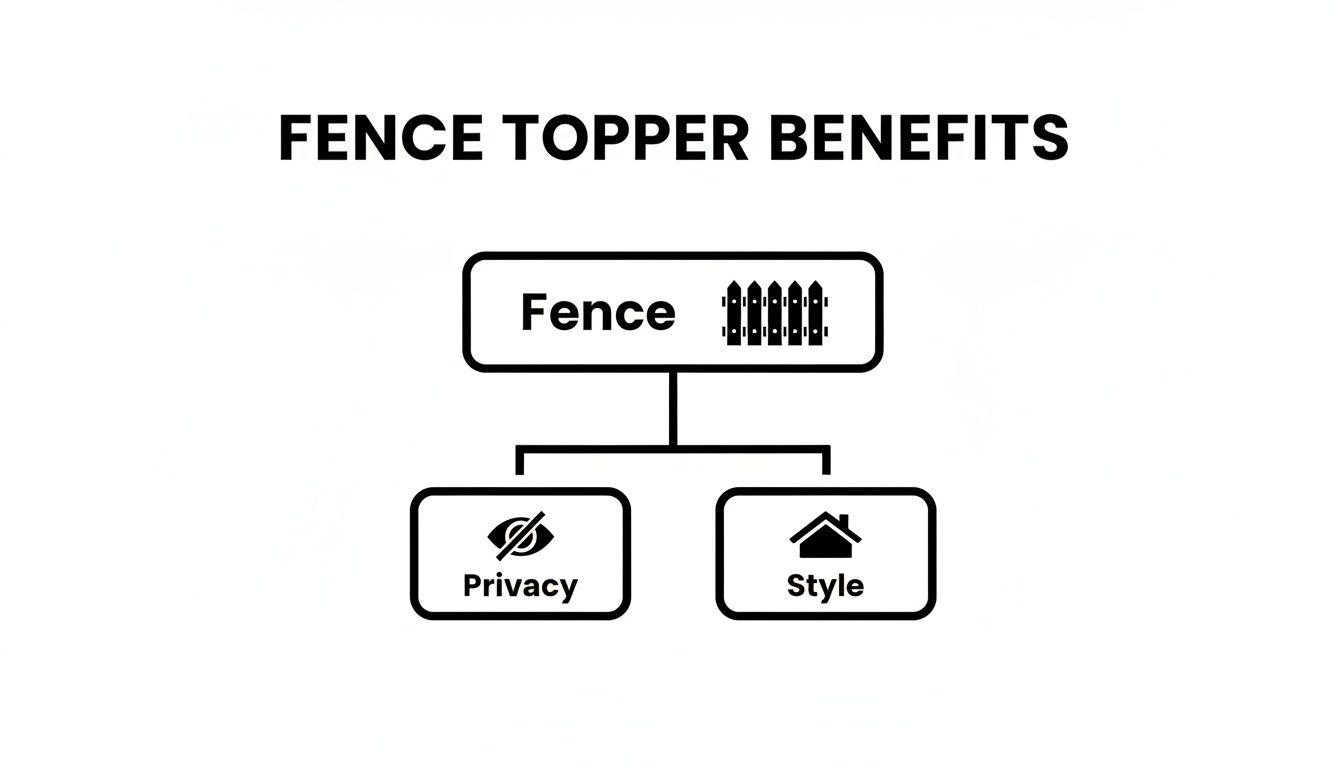
It’s a great visual reminder that a single project can achieve both practical seclusion and a more attractive yard.
It's also interesting to think outside the box with natural solutions. While not suited for our climate, something like a row of Mexican Fence Post Cactus can create a unique living barrier in warmer regions.
One interesting aspect of this market is that while broader garden fence trends are well-documented, privacy fence toppers as a specific product are not often tracked in major market reports. This makes it difficult to find hard statistics, but a drive through any neighbourhood confirms their popularity. The material you choose ultimately helps define your property's character.
Privacy Fence Topper Material Comparison
To help you visualize the trade-offs, here is a quick comparison of the most common materials. Use this as a cheat sheet to weigh the pros and cons based on your priorities.
Material | Average Lifpan | Maintenance Level | Pros | Cons |
|---|---|---|---|---|
Wood | 10-15 years | High | Natural, classic aesthetic; can be painted/stained; cost-effective upfront | Requires regular sealing/staining; susceptible to rot, warp, and insects |
Vinyl (PVC) | 20-30+ years | Low | Extremely durable; no rot or pests; easy to clean; various styles | Higher initial cost; can become brittle in extreme cold; limited colour options |
Metal | 20+ years | Low | Elegant, high-end look; very strong and secure; allows light and air through | Offers less privacy; higher cost; can rust if not properly coated (e.g., steel) |
Faux Greenery | 5-10 years | Very Low | Maximum privacy; instant green look; no watering/pruning needed | Can fade over time with sun exposure; plastic appearance may not suit all styles |
Ultimately, whether you lean toward the timeless charm of wood or the hassle-free convenience of vinyl, the goal is to find a topper that you'll be happy with for years to come.
Navigating Ottawa and Gatineau Fence Height Bylaws
Before you finalize your topper design, you must verify local fence bylaws. A small amount of research upfront can prevent major headaches later.
Both Ottawa and Gatineau have specific regulations defining maximum fence heights. A fence topper can easily push your fence over the legal limit. These rules are in place to maintain neighbourhood safety, preserve clear sightlines for traffic, and ensure a consistent aesthetic.
Ignoring local code can result in fines, neighbour disputes, or an order to remove the extension you just installed. Treat this process with the same diligence as any other home renovation—confirm it's fully compliant before you begin.
Understanding Your Yard Zones
Your first step is to recognize that municipal bylaws divide your property into distinct zones, each with its own height rules. Understanding these zones is crucial for a successful project.
Front Yard: The space between your house and the street has the strictest limits, typically capped at 1 metre (3.3 feet) to keep sightlines clear for drivers and pedestrians.
Side Yard: Rules for side yards can vary. Areas closer to the street may follow front yard rules, while sections further back may allow for more height.
Rear Yard: This is where you have the most flexibility. Backyard fences are usually permitted to be much taller—often up to 2 metres (6.6 feet)—which is why nearly all fence toppers are installed here.
The single biggest mistake homeowners make is assuming one height limit covers their entire property. You have to check the specific rules for your front, side, and rear yards before you fall in love with a design.
When You Need a Permit
So, when does a topper project require a permit? The rule is simple: if the total height of your fence plus the topper exceeds the bylaw limit, you must obtain a permit.
For example, if your backyard fence is already 2 metres tall, you cannot add even a small lattice extension without formal approval through a permit or a "minor variance."
Navigating these regulations can be complex, as rules can change based on your location, corner lot status, or proximity to public pathways. To ensure compliance, consult local zoning services or partner with a professional fencing contractor. They deal with these bylaws daily, know how to handle the application process, and can guarantee your project proceeds without costly surprises.
How to Budget for Your Fence Topper Project
Budgeting for a fence topper requires looking beyond the initial price tag. This is a long-term investment in your property's privacy and curb appeal, so understanding every cost component is key to making a smart financial decision.
Your budget will be driven by two primary factors: materials and labour. The total cost can vary significantly based on the style you choose and the complexity of the installation.
Breaking Down Material Costs
Materials are almost always priced per linear foot, with a wide range depending on the type. A simple pressure-treated wood lattice is the most budget-friendly starting point, while intricate ornamental metal or premium vinyl will be at the higher end.
Your first action step is to measure the total length of the fence you plan to extend. This measurement is the foundation for your entire budget.
Pressure-Treated Wood: The most affordable upfront choice.
Cedar Wood: A higher initial investment that offers natural resistance to rot and insects.
Vinyl (PVC): A mid-to-high range option with higher upfront costs but virtually no maintenance expenses.
Ornamental Metal: Typically the most expensive, valued for its sophisticated look and exceptional durability.
A good way to think about it is "total cost of ownership." A cheaper material that needs staining and sealing every other year might end up costing you more in time and money over five years than a maintenance-free option with a higher initial price tag.
Factoring in Labour and Installation
In the Ottawa-Gatineau region, professional installation is a significant part of the budget. Labour costs are determined by project complexity, the condition of your existing fence, and the specific topper you've selected. Achieving a secure, level, and professional finish requires specialized skills and equipment.
Hard data specifically on privacy fence toppers is scarce. While broad industry reports from sources like IBISWorld cover general fence construction, they rarely detail this specific upgrade.
This is why getting a direct quote from a local expert like FenceScape is crucial. We provide a detailed breakdown that covers everything—the topper, materials, labour, and any necessary reinforcements for your existing fence posts. This ensures the entire structure is solid and secure for the long term.
For a broader look at fencing costs, take a peek at our guide on the price of a wood fence.
DIY Installation vs Hiring a Professional
You’ve chosen the perfect material and design. Now, you must decide: will you install it yourself or hire a professional? This decision depends on your budget, skill level, and how much you value your time.
A DIY project can seem like a great way to save money, but installing privacy fence toppers is a task with little room for error. The work is not just about attaching panels; it's about ensuring the finished product is perfectly level, secure, and prepared to handle the region's high winds.
The DIY Route: What to Expect
Going it alone can be rewarding, but only if you are properly prepared. Before you begin, conduct an honest assessment of your skills and ensure you have the necessary tools.
A successful DIY installation requires more than just a cordless drill. To achieve a clean, professional finish, you will need a complete toolset.
Essential Tools: A powerful drill, a quality level, a measuring tape, a saw for precise cuts, and safety gear like gloves and eye protection.
Key Steps: The process involves carefully measuring and marking attachment points, fastening the toppers so they are perfectly level, and verifying that your existing fence posts can support the added weight and wind load.
Common Challenges: The most significant challenge is achieving a perfectly straight and level line across the entire fence. Another common mistake is underestimating wind forces; improperly secured toppers can act like a sail and damage your entire fence.
The Professional Advantage: Peace of Mind
Hiring a professional contractor like FenceScape transforms a potentially frustrating project into a seamless, hands-off process. While it requires a larger upfront investment, the long-term value and security are often worth it. An experienced crew delivers a level of precision and efficiency that is difficult to achieve on your own.
Choosing a professional isn't just about paying for labour; it's an investment in expertise. You're getting guaranteed compliance with local bylaws and the assurance that your fence extension will be safe, durable, and beautifully finished.
A professional installation guarantees a result that not only looks fantastic but is built to last. For guidance on selecting the right team, review our guide on hiring Ottawa fence builders. Experts handle everything, from confirming bylaw compliance and sourcing high-quality materials to ensuring the final structure is completely sound.
In the end, it’s a classic risk vs. reward scenario. A DIY project can certainly save you money on labour, but it also comes with the risk of making expensive mistakes. On the other hand, professional installation delivers a flawless, worry-free result, often backed by a warranty that protects your investment for years.
Got Questions About Privacy Fence Toppers? We've Got Answers.
Even with the options laid out, you likely still have questions. Here are direct answers to the most common inquiries we receive from homeowners in the Ottawa area to help you move forward with confidence.
Can I Put a Topper on Any Fence?
Almost. Most common fence types—wood, vinyl, and even chain link—can support a topper. The critical factor is not the fence material but the structural integrity of its foundation.
Your fence posts are the backbone of the structure. They must be strong enough to handle both the weight of the topper and the increased wind load from the added height. If your fence is already leaning or showing signs of decay, it likely cannot support an extension. The first step is to have a professional inspect your fence's condition before you commit to the project.
How High Can I Legally Go With a Fence Topper in Ottawa?
Adding height is the goal, but you must adhere to city regulations. In both Ottawa and Gatineau, the maximum height for a backyard fence is typically 2 metres (around 6.6 feet). If your current fence is already at this limit, any topper will put you over.
This doesn't make it impossible, but it does mean you will need to apply for a permit or a minor variance to remain compliant. Bylaws can be complex and vary by zone or for corner lots. A qualified contractor can manage the permit process and ensure your project is 100% legal.
Remember, it's not the height of the topper that matters to bylaw officers; it's the total height of the fence plus the topper. Always measure first and check the local rules before you start building.
Will a Fence Topper Actually Increase My Property Value?
Yes. A well-chosen, professionally installed fence topper is an excellent investment. From a buyer's perspective, enhanced privacy and a polished, finished look are significant selling points. It demonstrates that you have thoughtfully cared for and upgraded your property.
When you use quality, durable materials and select a style that complements your home, the project adds value beyond just privacy. It expands your usable outdoor living space and boosts curb appeal, which can lead to a tangible return on investment when it's time to sell.
What’s the Best Low-Maintenance Topper for Our Winters?
For Ottawa-Gatineau's demanding climate, a "set it and forget it" topper must be exceptionally durable. The clear winners for low-maintenance performance are vinyl (PVC) and powder-coated aluminum.
These materials are engineered to withstand freeze-thaw cycles, heavy snow, and strong winds without cracking, warping, or fading. Unlike wood, they require no annual sealing or staining to maintain their appearance. For a durable, hassle-free privacy solution that will stand strong for years, they are the superior choice.
Ready to add that perfect finishing touch to your fence? The team at FenceScape specializes in designing and installing beautiful, durable privacy fence toppers that are built for the Ottawa-Gatineau climate. We handle everything from the initial design chat to navigating local bylaws, guaranteeing a seamless, professional result. Start your project with a free estimate today!
Comments