
Wood Fence Types: Compare Top Options for Your Yard

Choosing the right wood fence for your property isn't just about marking a boundary; it's a strategic decision that impacts your home's style, privacy, security, and long-term value, especially in the demanding Ottawa-Gatineau climate. Your options range from the classic charm of a picket fence to the complete seclusion of a stockade style, or the clean lines of a horizontal fence for a modern look. The material you select—typically cedar or pressure-treated lumber—is as crucial as the design itself.
Choosing the Right Wood Fence for Your Ottawa Home
Your ideal backyard is a private, secure space for your family, framed by a handsome wood fence that enhances your home's value. To make that vision a reality, you need a fence built to withstand our region's humid summers and harsh, snowy winters. This guide provides the actionable insights you need to select the perfect wood fence, ensuring it meets your needs for years to come.
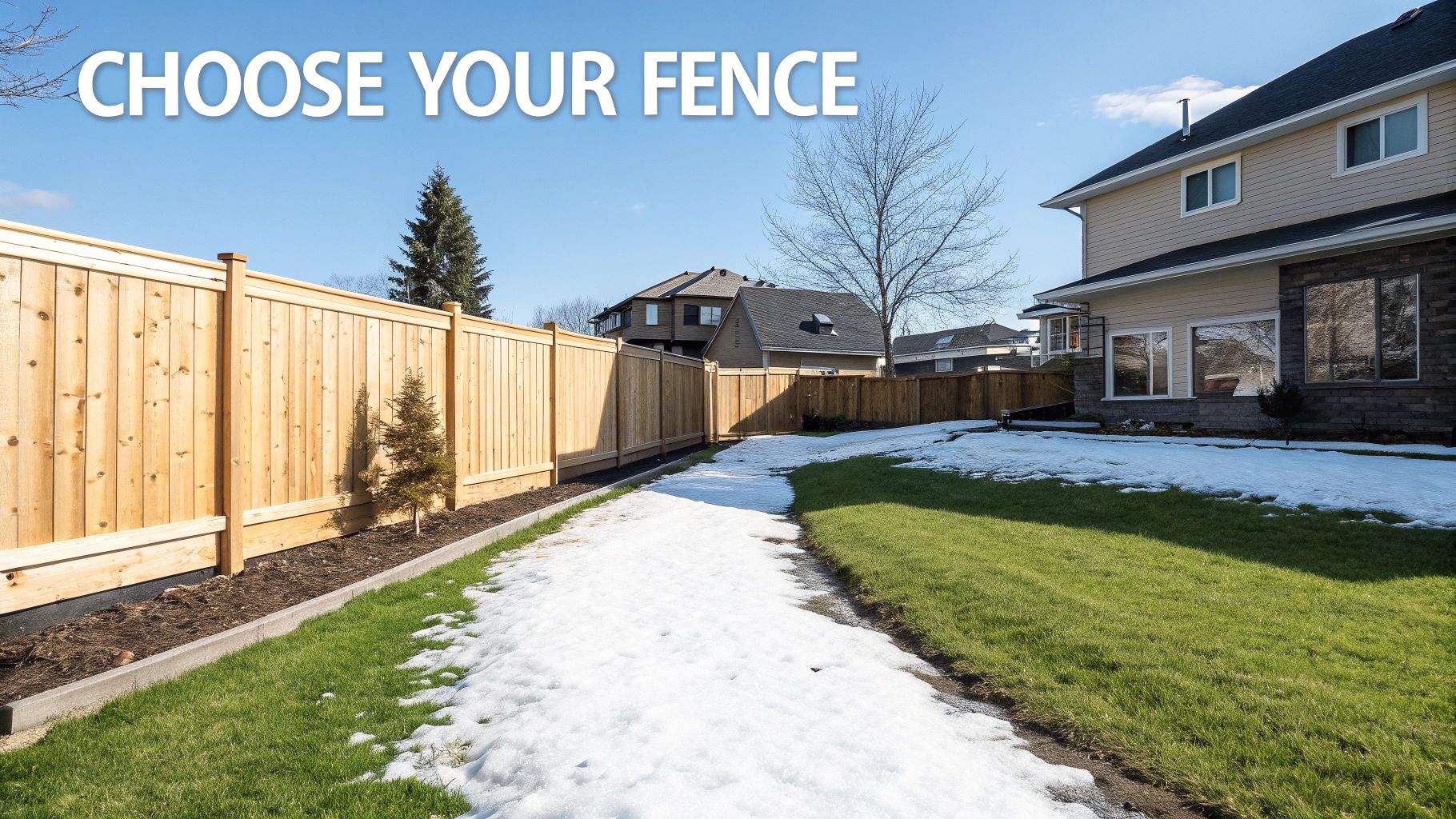
We'll compare naturally resilient cedar against budget-friendly pressure-treated wood and break down the most popular fence styles. By the end, you'll be able to confidently choose a design that complements your home’s architecture and supports your family’s lifestyle.
Key Factors to Consider
Before exploring specific designs, define what you need your fence to accomplish. Answering these questions first will streamline the selection process and ensure your final choice is the right one.
Primary Purpose: What is the fence's main job? Is it containing a large dog, creating a private enclosure for a hot tub, or adding a decorative element to your property line?
Privacy Level: Do you require a solid barrier for total seclusion, or would a semi-private design that allows airflow and light be a better fit for your space?
Aesthetic and Curb Appeal: Your fence should complement your home's style. A rustic split-rail design may look out of place with a modern home, just as a sleek horizontal fence might clash with a traditional country-style house.
Budget and Long-Term Value: Evaluate the upfront cost alongside the long-term investment. Some materials cost more initially but save you significant time and money on maintenance over the fence's lifespan.
Actionable Insight: Choosing a fence is an investment in your property's character and functionality. The right fence enhances daily life by creating a safe play area for children or providing a peaceful, private outdoor living space.
Quick Comparison of Popular Wood Fence Types
Use this table as a quick reference to see how common wood fence styles stack up against each other. It's a practical tool for narrowing your options based on your primary goals and budget before diving into the details of each style.
Fence Type | Primary Use | Typical Privacy Level | Average Cost (per linear foot) | Best For |
|---|---|---|---|---|
Picket | Decorative, Boundary Definition | Low | $30 - $60 | Enhancing curb appeal for front yards |
Stockade | Privacy, Security | High | $40 - $75 | Creating a private backyard sanctuary |
Shadowbox | Semi-Privacy, Airflow | Medium | $50 - $85 | Neighbour-friendly designs and windy areas |
Horizontal | Modern Aesthetic, Privacy | High | $60 - $100+ | Complementing contemporary home designs |
Split Rail | Boundary Definition, Rustic Look | Very Low | $25 - $50 | Large properties and agricultural settings |
This summary provides a practical starting point. Now, let's explore the materials and unique benefits of each fence type in more detail.
Cedar vs. Pressure-Treated Wood: A Practical Comparison
The wood you choose is the single most important decision for your fence's longevity and appearance. It dictates your maintenance schedule, long-term durability, and overall budget. In our climate, the choice comes down to two main contenders: Western Red Cedar and Pressure-Treated (PT) lumber. Understanding their practical differences is key to building a fence that stands strong against years of freeze-thaw cycles and humid summers.
The Natural Choice: Western Red Cedar
Western Red Cedar is a premium material valued for its natural beauty and inherent resilience. It contains natural oils and tannins that actively resist rot, decay, and insects without chemical treatments. This makes it an excellent choice for homeowners seeking a durable, natural wood option.
One of cedar's most significant advantages is its stability; it is far less prone to warping, twisting, or shrinking than other woods. This is a critical feature in the Ottawa-Gatineau region, where drastic temperature and moisture fluctuations can cause lesser woods to bend and contort over time.
Actionable Insight: Cedar offers two aesthetic paths. Left untreated, it will age to an elegant, silvery-grey patina. To maintain its rich, reddish-brown hue, apply a fresh coat of stain every few years. This not only preserves the colour but also adds an extra layer of protection.
The Durable Workhorse: Pressure-Treated Lumber
Pressure-treated (PT) wood is typically made from spruce or pine that has undergone a chemical treatment process to enhance its durability for outdoor use. Preservatives are forced deep into the wood fibres under high pressure, giving it superior resistance to rot and insects.
This chemical fortification makes PT lumber a highly durable and long-lasting material, especially for components in direct contact with the ground, like fence posts. When comparing wood types, understanding the process and benefits of pressure-treated timber is essential for making an informed decision on long-term performance. The primary trade-off is that as PT wood dries post-installation, it is more susceptible to warping, cracking, and shrinking than cedar.
Making the Right Decision for Your Home
To choose the right material, you must balance your budget, desired aesthetic, and long-term maintenance commitment.
Here is a head-to-head comparison to guide your decision:
Initial Cost: Pressure-treated wood is the more budget-friendly option, typically costing 20-40% less than cedar upfront. This makes it a practical choice for large properties or projects with a tight budget.
Appearance: Cedar has a premium look with a rich, warm colour and a fine, straight grain. PT wood initially has a greenish hue from the treatment (which fades over time) and a more rugged appearance. While it can be stained, it's difficult to replicate cedar's natural beauty.
Maintenance: Both materials require maintenance. To preserve its colour, cedar should be stained every few years. PT wood must be allowed to dry completely for several months before being sealed or stained to minimize cracking and warping.
Lifespan: With proper care, both materials offer excellent longevity. A well-maintained cedar fence can last 15 to 25 years or more. A properly cared-for PT fence has a typical lifespan of 15 to 20 years. For both, consistent maintenance is the key to maximizing their service life.
Exploring Popular Wood Fence Styles and Their Benefits
Once you've chosen your material, you can select a style that meets your functional needs and enhances your home’s character. Your fence design is a key architectural element that defines your property's first impression.
Whether you're aiming for classic suburban charm, a private backyard oasis, or a sleek, modern look, there is a wood fence style suited to your vision. Let's review the most popular options and their practical applications for homeowners in the Ottawa area.
The Timeless Picket Fence
The classic picket fence, with its evenly spaced vertical boards, creates a welcoming boundary without obstructing views. It is more about adding timeless style to your front yard than creating a fortress. This design is a top choice in the Ottawa-Gatineau region for its significant impact on curb appeal. The U.S. wood fencing market, a key influencer of Canadian trends, generated USD 2,274.3 million in 2024, with picket fences commanding a 41.02% market share, reflecting their enduring popularity.
Actionable Insight: Use a picket fence to define spaces with a light touch. It's ideal for framing a garden, containing small pets, or boosting your home's curb appeal without creating a visual barrier.
The Private Stockade Fence
For complete, uninterrupted privacy, the stockade fence is the most effective solution. This design features vertical boards fitted tightly edge-to-edge, forming a solid, gap-free barrier that creates a secluded backyard retreat.
Its key benefits are:
Maximum Privacy: Its solid construction completely blocks sightlines, making it perfect for yards with pools, hot tubs, or patios.
Security and Containment: The height and solid build are excellent for keeping larger dogs contained and deterring trespassers.
Noise Reduction: While not soundproof, a tall stockade fence can noticeably reduce neighbourhood noise, contributing to a more tranquil outdoor space.
This is the practical choice when your primary goal is to create a true sanctuary.
The Modern Horizontal Fence
For a sharp, contemporary aesthetic, a horizontal fence offers clean, architectural lines. This style arranges boards horizontally, resulting in a sleek, sophisticated look that complements modern home designs. Horizontal fences provide excellent privacy comparable to a stockade fence but with a more dynamic and stylish feel. The long, unbroken lines can also create the illusion of a larger, more intentional space. If you like this aesthetic but desire the durability of a metal frame, consider exploring hybrid fence options that combine wood's beauty with metal's strength.
The Neighbour-Friendly Shadowbox Fence
The shadowbox fence is a clever design that balances privacy with openness. It's constructed by attaching pickets to the rails in an alternating pattern on each side. This creates a semi-private barrier that is visually appealing from both your yard and your neighbour's.
Why choose a shadowbox fence?
Great Airflow: The gaps between the alternating boards allow air to circulate, reducing wind load on the fence structure—a significant benefit in windy locations.
Visual Interest: The overlapping pattern adds depth and texture, creating a more dimensional look than a standard privacy fence.
Shared Aesthetic: With no "bad" side, it is an excellent choice for shared property lines, helping maintain good relations with neighbours.
When viewed directly, a shadowbox fence appears solid, but at an angle, it allows for partial visibility, making it feel less imposing than a stockade fence while still providing substantial privacy.
The Rustic Split Rail Fence
The split rail fence evokes a sense of rustic charm and open space. Composed of two or three rough-hewn horizontal rails fitted into sturdy posts, it defines a boundary without obstructing the view.
This style is a practical choice for:
Large Properties: It's an affordable method for marking the perimeter of a large lot without the expense of a full privacy fence.
Agricultural Settings: It is traditionally used to contain livestock like horses.
Decorative Landscaping: It can serve as a beautiful rustic accent along a driveway or around a garden.
While offering minimal privacy or security for small pets, the split rail fence provides a timeless, pastoral look that is well-suited to the rural and semi-rural areas of the Ottawa-Gatineau region.
Wood Fence Styles At-a-Glance
This table provides a practical comparison to help you choose the right style. Identify your top priority—privacy, style, or budget—and see which option aligns best with your needs.
Style | Privacy Level | Primary Advantage | Ideal Application | Material Compatibility |
|---|---|---|---|---|
Picket | Low | Classic curb appeal, decorative | Front yards, garden borders, small pet containment | Cedar, Pressure-Treated |
Stockade | Full | Maximum privacy and security | Backyards, pool enclosures, noise buffering | Cedar, Pressure-Treated |
Horizontal | Full | Modern, sleek aesthetic | Contemporary homes, accent walls, patios | Cedar (recommended) |
Shadowbox | Semi-Private | "Neighbour-friendly" design, good airflow | Shared property lines, windy locations | Cedar, Pressure-Treated |
Split Rail | None | Rustic look, cost-effective for large areas | Large properties, farms, decorative boundaries | Cedar, Pressure-Treated |
Ultimately, the best fence style is one that effectively serves its purpose while enhancing your property's overall look and feel.
To see how different materials bring these styles to life, this chart breaks down the key differences between Cedar and Pressure-Treated wood.
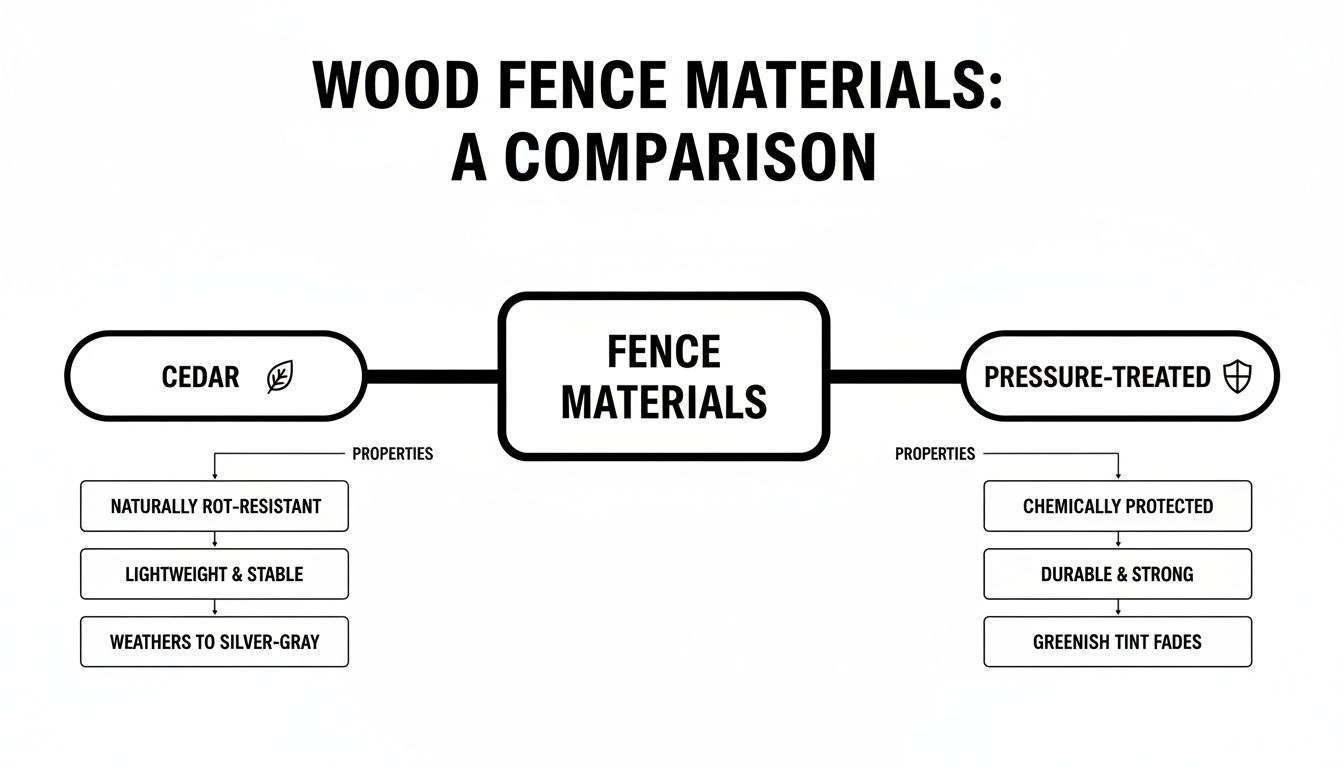
Your decision should balance the initial investment with your long-term goals for appearance and maintenance.
Budgeting for Cost, Lifespan, and Maintenance
A smart fence budget considers the total cost of ownership: the initial price, the expected lifespan, and the maintenance required to protect it from Ottawa’s climate. Factoring in all three elements ensures you choose a fence that delivers long-term value, not just a low upfront cost that leads to expensive repairs later.
While material and design complexity drive the initial price, the cheapest option today is rarely the most economical over a decade. A fence is a long-term investment, and its true cost is revealed over its entire service life.
Estimated Costs And Expected Lifespan
Your choice between cedar and pressure-treated wood is the primary driver of your initial cost. Cedar typically carries a higher upfront price, often 20-40% more than PT options, but its natural resilience can lead to a longer lifespan with proper care.
Here is a realistic cost and lifespan breakdown for the Ottawa-Gatineau area:
Pressure-Treated Fences: Expect an installed cost of $30 to $70 per linear foot. With consistent maintenance, a PT fence will last 15 to 20 years.
Cedar Fences: The typical installed cost ranges from $50 to $95+ per linear foot. A well-maintained cedar fence often lasts 15 to 25 years or more.
While their lifespans appear similar, cedar's superior stability makes it less prone to warping and cracking, potentially saving you money on future repairs. If low maintenance is a top priority, it's worth comparing wood to modern alternatives. For instance, you can learn about the benefits of PVC fencing, which offers durability without the need for staining.
Actionable Insight: The true value of a fence lies in its performance over time. A slightly higher initial investment in a more stable material or a superior protective finish can save you significant time and money on future repairs and maintenance.
A Practical Maintenance Checklist For Ottawa Weather
Our region's heavy snow, freeze-thaw cycles, and intense summer sun are tough on outdoor wood. A simple, proactive maintenance routine is the most effective way to maximize your fence's lifespan. These small, timely actions prevent major problems before they can start.
Seasonal Tasks To Protect Your Investment
Spring (After the Snow Melts)Conduct a thorough inspection to identify and address any winter damage early.
Walk the Line: Check every post for frost heave by giving it a firm push. Excessive wobble indicates a footing issue that needs attention.
Inspect for Damage: Scan for cracked boards, loose hardware, and signs of rot, especially near the bottom of the fence where moisture collects.
Clean Away Grime: Wash the fence with a mild soap and water solution to remove winter dirt and mildew. Avoid using a high-pressure washer, as it can splinter the wood.
Summer (During the Peak Sun)Protect your fence from its two biggest summer threats: moisture and UV radiation.
Seal and Stain: Apply a high-quality sealant or stain with UV inhibitors. This crucial step prevents the wood from drying out, cracking, and fading. To ensure longevity, invest time in choosing the best exterior wood paints suited for our climate.
Trim Vegetation: Cut back shrubs, vines, and branches that touch the fence. This promotes airflow, allows the wood to dry quickly after rain, and discourages pests.
Autumn (Before the First Snowfall)A final check-up before winter is your best defense against cold-weather damage.
Final Inspection: Walk the fence line one last time to tighten loose boards or hardware before the cold sets in.
Clear Debris: Rake away leaves and other debris from the base of your fence. Piles of wet leaves trap moisture against the wood and are a primary cause of rot.
Navigating Local Bylaws and Pool Regulations
Before breaking ground, you must understand the local bylaws governing fences in Ottawa and Gatineau. Overlooking these regulations can lead to fines or even a demolition order. Bylaws exist to ensure safety, maintain neighbourhood aesthetics, and prevent disputes. Complying with them from the start is essential for a stress-free project.
Understanding Key Municipal Bylaws
While specifics vary between municipalities, fence bylaws generally focus on several key areas. Always consult your city’s official website for the most current regulations.
Fence Height: Municipalities regulate fence height, with different rules for front, side, and backyards. For example, a backyard fence might be permitted up to seven feet, while a front yard fence could be limited to three or four feet.
Setbacks and Property Lines: Your fence must be built entirely on your property. Bylaws specify the required distance from property lines, sidewalks, and streets. An accurate property survey is critical to avoid legal disputes with neighbours.
Material Restrictions: Some areas, particularly new subdivisions or historic districts, may have restrictions on acceptable fencing materials, especially for fences facing public streets. Verify that your chosen wood fence style is permitted.
Special Rules for Pool Enclosures
If your fence will enclose a swimming pool, you must adhere to much stricter safety regulations designed to prevent accidents, particularly involving young children. These rules are mandatory.
Actionable Insight: A compliant pool fence is a non-negotiable safety barrier. The strict rules for height, gates, and latches are in place to save lives and are a critical component of responsible pool ownership.
Key requirements for a compliant pool fence typically include:
A minimum height of at least five feet (1.5 metres) to prevent climbing.
Gates that are self-closing and self-latching, with the latch positioned on the inside of the gate, high enough to be out of a small child's reach.
No gaps under the fence or between pickets wider than four inches (10 cm) to prevent anyone from squeezing through.
A design that does not offer easy handholds or footholds for climbing.
Ensuring your pool fence is fully compliant is essential for safety and may be a requirement for your home insurance. Working with an experienced professional like FenceScape guarantees your pool is enclosed correctly and safely from day one.
DIY Installation vs. Hiring a Professional Contractor
You're now at a key decision point: build the fence yourself or hire a professional? While the potential cost savings of a DIY project are appealing, it's crucial to understand the scope of the work involved. A proper wood fence installation is a complex, physically demanding job that requires specialized tools like post-hole augers and levels. Digging post holes in Ottawa's dense clay soil is notoriously difficult and a common point of failure for DIY projects.
The Realities of a DIY Fence Project
A DIY installation places all responsibility on you, from sourcing materials and securing permits to performing the labour and cleanup. Small mistakes can have significant consequences for your fence's strength and longevity.
Improper Post Depth: The number one DIY mistake in our region is failing to dig below the 4-foot frost line. This leads to "frost heave," which pushes posts out of the ground and results in a warped, unstable fence.
Incorrect Spacing: Improper spacing between posts will cause panels to sag and create a visually unappealing result.
Material Handling: Transporting long, heavy fence panels and numerous bags of concrete requires a suitable vehicle and significant physical strength.
Actionable Insight: Hiring a professional isn't just paying for labour; it's an investment in expertise, efficiency, and a guaranteed outcome. A professional installer understands local soil conditions, has access to high-quality materials, and ensures your fence is straight, strong, and built to last.
The Value of Professional Installation
Hiring a contractor like FenceScape provides value beyond the installation itself. Professionals have a thorough understanding of local bylaws, ensuring your project is fully compliant. You also receive a warranty that protects your investment against workmanship issues.
Pressure-treated pine fences are a popular choice in Ottawa, accounting for approximately 35% of our wood installations due to their excellent value. While DIY saves on labour costs, our professional crews prevent the common 5-10% failure rate associated with DIY jobs due to improperly set posts. You can explore market trends further by reviewing industry analysis reports.
The best choice depends on your skills, time, and project complexity. For a simple layout, DIY may be feasible if you have the right tools and experience. However, for a guaranteed professional result without the risk and physical strain, hiring an expert is the most reliable path. If you are exploring other affordable materials, our guide to chain link fences may also be useful.
Your Top Wood Fence Questions Answered
Here are straightforward answers to the most common questions we receive from homeowners in the Ottawa-Gatineau region.
How Deep Do Fence Posts Need to Go in Ottawa?
To prevent frost heave—where the freeze-thaw cycle pushes posts out of the ground—you must dig below the local frost line.
In the Ottawa-Gatineau area, the established frost line is four feet (48 inches). This is the minimum depth required to anchor posts in stable soil. For taller fences or in areas with poor drainage, we may recommend digging even deeper to ensure long-term stability.
Actionable Insight: Setting posts below the frost line is the single most critical step for a long-lasting fence in our climate. Skimping on post depth will inevitably lead to a leaning, unstable fence within a few years.
Can a Wood Fence Be Installed in the Winter?
Yes, a winter installation is often possible, provided the ground is not frozen solid. A key benefit is that project timelines can be shorter during the industry's off-season.
However, winter construction is not a DIY-friendly task. It requires specialized digging equipment and concrete additives that allow the concrete to cure properly in cold temperatures. This work is best left to experienced professionals who can determine if a winter installation is practical for your specific property.
How Can I Protect My Fence from Snow Damage?
Proactive protection is key. Before winter, apply a fresh coat of high-quality stain or sealant. This protective barrier helps the wood shed moisture from melting snow and ice.
During the winter, gently clear large snow drifts that accumulate against the fence panels, as the weight can stress posts and boards. Crucially, never pile snow from your driveway or walkways against your fence. The trapped moisture will accelerate rot at the base of the fence.
Ready to build a fence that not only looks fantastic but can also handle everything an Ottawa winter throws at it? The experts at FenceScape are here to help you navigate the choices and find the perfect fit for your home. Reach out today for a free, no-obligation estimate and let's get your project started.
Comments