
A Homeowner's Guide to Slats in Chain Link Fence

A standard chain link fence marks your property line, but it offers little privacy or style. Fence slats are a practical, budget-friendly solution to transform this functional barrier into an attractive privacy screen, instantly boosting your home's curb appeal. This guide provides the actionable insights you need to choose, install, and maintain the right slats for your fence.
Upgrade Your Yard With Privacy Fence Slats
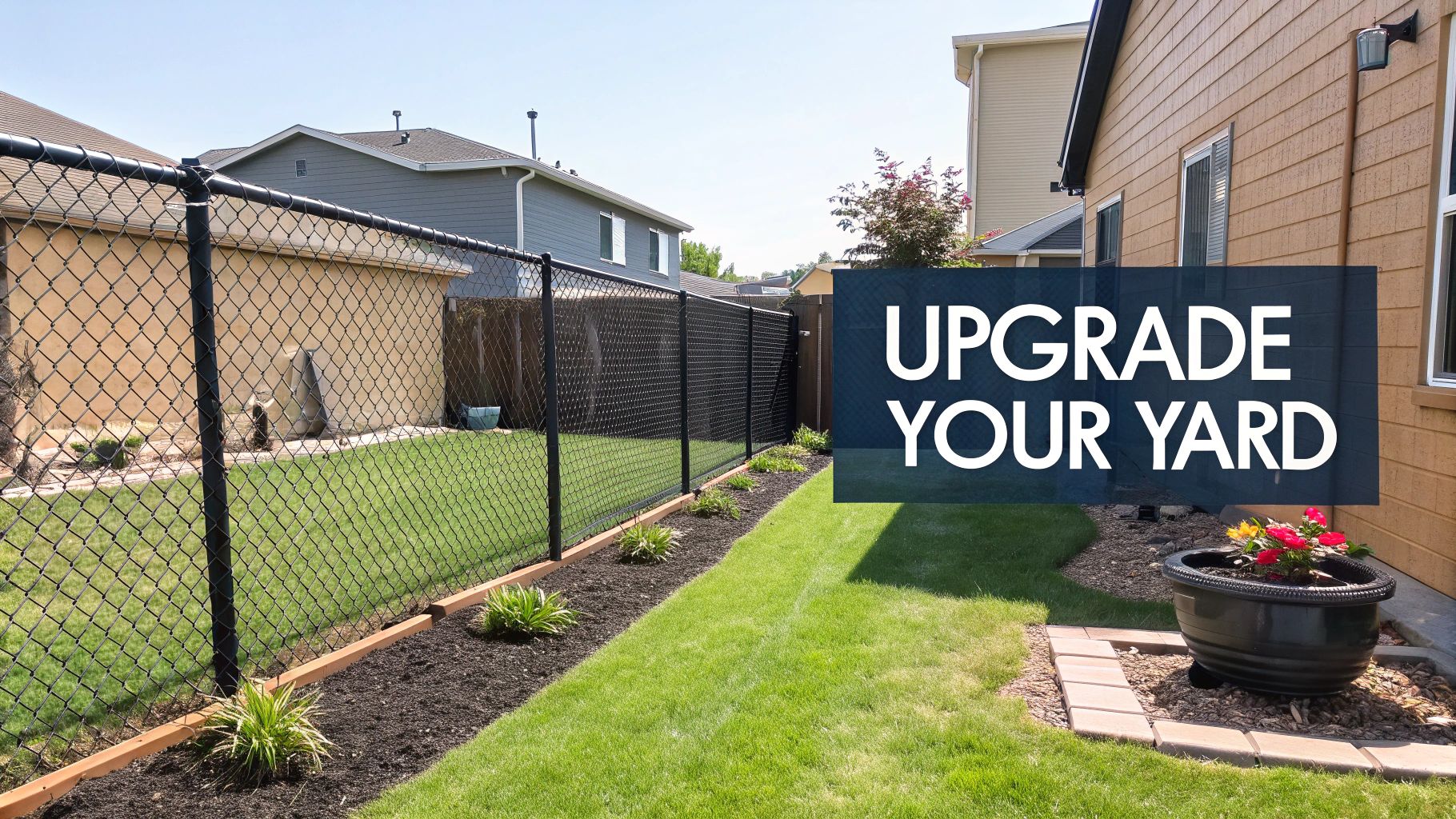
Chain link fences are popular in the Ottawa–Gatineau region for their durability and affordability, but their open-weave design leaves your yard exposed. Privacy fence slats are specifically designed to solve this problem. By weaving these thin, vertical strips through the diamond-shaped openings, you immediately close the gaps and turn a see-through fence into a semi-private or fully private enclosure. The change is not just functional; it adds color and texture, elevating a plain fence into a polished landscape feature.
More Than Just a Visual Barrier
While privacy is the primary benefit, installing slats in a chain link fence offers other practical advantages. They act as an effective windbreak, reducing gusts in your yard to make your patio more comfortable and protect delicate plants. They can also slightly muffle neighborhood noise, contributing to a more peaceful backyard environment.
Actionable Insight: Adding slats is a strategic upgrade to an existing asset. You enhance privacy, improve aesthetics, and increase the usability of your outdoor space without the high cost and disruption of a full fence replacement.
Making an Informed Decision
Choosing the right slats requires more than just picking a color. This guide provides the practical information needed to make a smart, lasting investment. Here’s what you’ll learn:
Material choices built for Canadian weather, from flexible plastics to rigid aluminum.
Installation options, helping you decide between a cost-saving DIY project and a professional install.
Local bylaws for Ottawa and Gatineau to ensure your project is compliant, especially around pools.
Realistic costs and long-term maintenance needs, providing a clear financial picture.
By the end of this guide, you will have the actionable knowledge to select and install the perfect slats, enhancing your fence's function and appearance for years.
How Privacy Slats Actually Work
Think of privacy slats as vertical blinds for your chain link fence. They are thin, semi-rigid strips woven directly into the diamond-shaped mesh. This simple action transforms an open barrier into a screen that blocks the view from outside.
Their primary function is to provide visual privacy. However, by filling the gaps in the mesh, slats also reduce wind flow. This practical benefit can make your patio more comfortable and shelter your garden from strong gusts, a common issue in the Ottawa–Gatineau region.
The Science of Slats: The Privacy Factor
The effectiveness of slats in a chain link fence is measured by their privacy factor—a percentage indicating how much of the view they block. Understanding this concept is the first step to selecting the right product for your needs.
A lower privacy factor, around 75%, provides moderate screening. It obscures clear details from a distance but allows shapes and movement to be visible up close. This is an excellent choice if you want to define your space without creating a feeling of complete enclosure.
In contrast, slats with a 98% privacy factor create an almost solid barrier, offering maximum seclusion. These are ideal for backyards, pool areas, or any location where privacy is a top priority.
Actionable Insight: The slat's design directly determines its privacy factor. Wider slats or those with integrated "wings" cover more of the chain link diamond, resulting in a higher privacy percentage. Your choice is a trade-off: higher privacy means less airflow. Decide on your primary goal—maximum seclusion or a balance of privacy and breeze.
How Different Designs Achieve Opacity
The shape and style of a slat directly influence its privacy factor and durability. Various designs are engineered to provide different levels of opacity.
Here is a practical guide to the most common types:
Standard Flat Slats: The basic, no-frills option. These simple, flat strips are easy to install and typically provide about 75% privacy.
Winged Slats: These slats feature flexible "wings" or fins along each side. As they are inserted, the wings press against the chain link wire, covering more of the gap and increasing privacy up to 98%.
Bottom-Locking Slats: Slats are inserted from the top and secured by a locking channel woven through the bottom row of the fence. This creates a clean, finished appearance and prevents slats from dislodging in high winds.
Top-Locking Slats: Functionally identical to the bottom-locking style, but the locking channel is installed at the top. This design also ensures a secure fit and can deter tampering.
The principle behind privacy slats is simple: physically blocking the line of sight. Your choice of design and width allows you to precisely control the level of privacy for your yard.
Choosing the Best Slat Materials and Styles
Once you've decided to add slats to your chain-link fence, the next step is selecting the right material and style. This decision is critical, as it directly impacts your fence's appearance, durability, and long-term maintenance requirements, especially in the demanding Ottawa–Gatineau climate. To make the best choice, balance three key factors: weather resistance, upfront cost, and ongoing maintenance.
Comparing Popular Slat Materials
Fence slats are available in several common materials. Let's compare the top three—PVC, HDPE, and aluminum—to determine the best fit for our region.
This comparison table provides a clear, actionable overview.
Comparing Fence Slat Materials for Canadian Climates
Material | Durability | Typical Cost (per linear foot) | Maintenance | Best For |
|---|---|---|---|---|
PVC (Polyvinyl Chloride) | Good, but can become brittle in extreme cold. | $ | Low | Budget-conscious projects where extreme cold isn't a primary concern. |
HDPE (High-Density Polyethylene) | Excellent; flexible and resistant to cold-cracking. | $$ | Very Low | The best all-around choice for the Ottawa–Gatineau climate. |
Wood | Varies by type; requires regular sealing/staining. | $$-$$$ | High | Achieving a natural, rustic aesthetic. |
Aluminum | Exceptional; rust-proof and won't warp or fade. | $$$$ | Virtually None | A premium, permanent solution where budget is not the main factor. |
Each material presents a unique combination of benefits. The "best" option is the one that aligns with your specific priorities.
A Closer Look at Slat Materials
PVC (Polyvinyl Chloride): A popular choice due to its affordability and effectiveness. PVC slats are rigid, available in many colors, and offer good privacy. However, this rigidity can be a liability in deep freezes, making them susceptible to cracking over time.
HDPE (High-Density Polyethylene): Consider HDPE a more resilient, flexible version of PVC. It is manufactured with UV inhibitors to prevent sun-fading and, critically, cold-crack inhibitors to withstand harsh winters. For Ottawa–Gatineau residents, HDPE is the most practical long-term investment. It is specifically engineered to handle our region's dramatic temperature fluctuations.
Aluminum: For a permanent, maintenance-free solution, aluminum is the top choice. These slats are lightweight, rust-proof, and extremely durable. They will not fade, warp, or crack, meaning they require virtually no attention after installation. The only drawback is the cost—aluminum is a premium material with a corresponding price.
Actionable Insight: Think of it like buying winter tires. All-seasons (PVC) might suffice for mild conditions, but true winter tires (HDPE) are engineered for cold, offering superior performance and safety. Aluminum is like a commercial-grade, run-flat tire—built to outlast the vehicle but potentially overkill for daily use.
For a more detailed analysis of these materials, our actionable guide to plastic and vinyl fence solutions offers further insights.
Understanding Slat Installation Styles
Beyond the material, the slat style determines its final look, privacy level, and installation method.
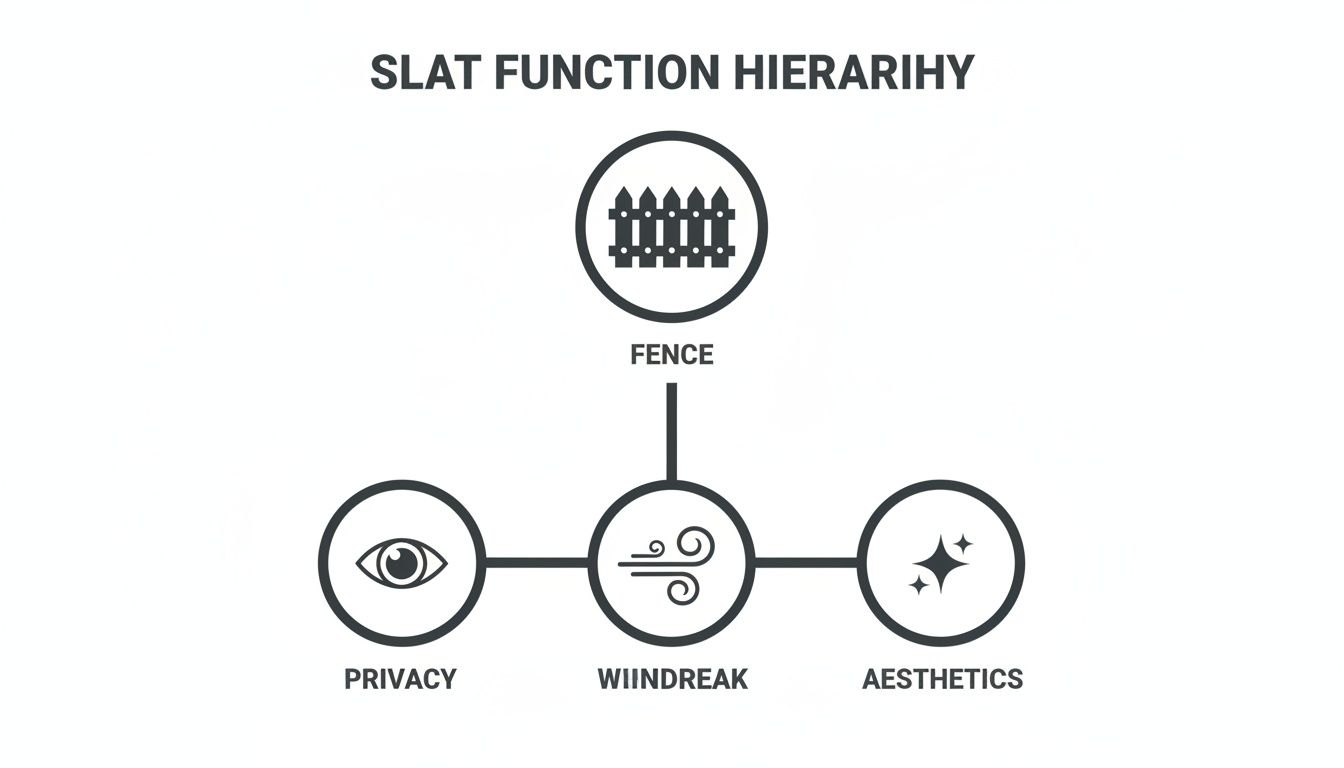
As this image illustrates, adding slats elevates a basic chain-link fence from a simple boundary marker to a multi-functional feature that provides privacy, reduces wind, and enhances curb appeal.
Exploring Locking Mechanisms and Designs
Different slat styles use unique locking mechanisms to stay securely in place. Understanding these will help you choose the best option based on your privacy needs and DIY comfort level.
Here are the most common styles you will encounter:
Bottom-Locking Slats: This is the most popular style. Slats slide down vertically through the mesh, and a flexible locking channel is woven through the bottom row of diamonds. This secures them tightly for a clean, professional finish.
Top-Locking Slats: This style functions just like the bottom-locking version, but the locking channel is installed at the top of the fence. This can make the slats slightly more difficult to remove, offering a minor security advantage. The choice between top and bottom locking is typically a matter of aesthetic preference.
Winged Slats: These slats feature small, flexible "wings" on their sides. As you push the slat into the fence, the wings compress and then expand, gripping the wire mesh. They often provide the highest privacy—up to 98%—and do not require a separate locking channel, simplifying the installation process.
Your final decision involves balancing the climate-readiness of HDPE against the affordability of PVC, and the secure fit of a locking slat against the maximum privacy of a winged one. By carefully considering these options, you can select the perfect product to add lasting value and function to your property.
Installing Fence Slats: Should You DIY or Hire a Pro?
You've selected the perfect slats. Now you must decide who will install them. You can either take on the project yourself or hire a professional. There is no single correct answer; the optimal choice depends on your budget, timeline, and comfort with hands-on work. This decision impacts the total cost, final quality, and your overall experience. Let's evaluate both options to help you decide.
The Do-It-Yourself Approach
Installing slats in a chain link fence is a highly manageable DIY project. With patience and a methodical approach, you can achieve a professional-quality result while saving significantly on labor costs. Success hinges on careful preparation and accurate measurements.
Your DIY Installation Guide
Follow these steps for a successful DIY installation:
Measure and Calculate: First, measure the total length (linear feet) of your fence to determine how many boxes of slats you need. Next, confirm two critical measurements: the height of the fence fabric (4, 5, or 6 feet) and the size of the diamond mesh (typically 2 inches). Accurate measurements ensure you purchase slats that fit correctly.
Prep the Fence: Ensure your fence is clean and in good repair. Use a pressure washer or a stiff brush to remove dirt and grime. Check that the fence is taut and repair any bent or damaged sections before you begin.
Weave the Slats: Start at one end of the fence. Take a slat and weave it diagonally down through the diamonds from the top. The key to a professional look is consistency. Establish a weaving pattern with your first slat and replicate it exactly with every subsequent one.
Secure the Locking Channel: For bottom-locking or top-locking slats, this final step is essential. Weave the flexible locking channel through the bottom (or top) row of diamonds, ensuring it passes through the notch at the end of each slat. This locks the slats firmly in place and provides a clean, finished edge.
Actionable Insight: The most common DIY mistake is rushing the installation. Take your time with the first few slats to establish a comfortable rhythm. A steady, consistent pace is more important than speed for achieving a uniform, professional-looking finish across the entire fence.
Hiring a Professional Installer
While a DIY approach is rewarding, hiring a professional is often the most practical choice, especially if you are short on time, have a large fence, or simply want a guaranteed perfect result. Professionals have the tools and experience to complete the job quickly and efficiently, navigating challenges like uneven terrain or tight mesh that can frustrate a DIYer.
Benefits of a Professional Installation
Speed and Efficiency: A project that could take you an entire weekend can often be completed by a professional in just a few hours.
Guaranteed Quality: An experienced installer ensures every slat is perfectly aligned and securely locked, guaranteeing a flawless finish.
Code Compliance: Reputable local contractors in Ottawa–Gatineau are knowledgeable about municipal bylaws, including critical pool enclosure regulations, ensuring your project is fully compliant.
Zero Hassle: Professionals handle everything from measurement to cleanup, saving you time and physical effort. For context on the entire fence building process, read our step-by-step guide on chain link fence installation.
Finding the Right Contractor
To find a reliable installer, get quotes from at least three different companies. Ask for references and photos of recent projects.
Be prepared to ask these key questions:
Are you licensed and insured to work in Ottawa/Gatineau?
Is your quote all-inclusive (materials, labor, cleanup)?
What is the estimated timeline for completion?
Do you offer a warranty on your installation?
Professional installation costs vary, but Go Gate Repair Torrance data shows an average cost of $4.50 per linear foot for slat insertion on a 6-foot fence. Properly installed slats can block up to 88% of visibility while maintaining sufficient airflow to meet wind load requirements. To avoid common errors, review the advice on making a chain link fence with privacy slats on LongFence.com.
The choice between DIY and professional installation is a trade-off between money and time. By realistically assessing your skills, budget, and available time, you can make the right decision for your project.
When planning to add slats to a chain-link fence, the sticker price is just the beginning of the story. To really understand the investment, you have to look at the total cost of ownership over time—what you pay upfront, plus what it takes to keep it looking good for years to come. Here in the Ottawa–Gatineau region, our weather is a major factor, with harsh winters and intense summer sun that can really test a material's limits.
A smart budget considers more than just the cost per foot. You need to factor in professional installation, the possibility of future repairs, and your own time spent on upkeep. Thinking about the long game from the start helps you pick a product that not only fits your budget today but also saves you a ton of hassle and money down the road.
Breaking Down the Upfront Costs
Your initial outlay for fence slats really boils down to two things: the materials themselves and the labour to install them.
Material Costs: As we’ve seen, the material you choose makes a huge difference in price. Standard PVC slats are your most wallet-friendly option, while premium HDPE and aluminum are at the higher end. For just the materials, you’re looking at a range of roughly $5 to $15 per linear foot, depending on your fence height and the slat quality.
Professional Installation Fees: If you’d rather not tackle the job yourself, hiring a pro in the Ottawa area will typically run you between $4 and $8 per linear foot. That fee gets you their expertise, the right tools for the job, and the peace of mind that comes with a clean, secure installation.
So, all in, you could be looking at anywhere from $9 to over $23 per linear foot for a typical backyard project. Going the DIY route saves you the labour cost, but a professional installation often comes with a workmanship warranty, which adds real value to your investment.
Durability in the Ottawa–Gatineau Climate
Our local climate is the ultimate test for any outdoor product. The wild swing from humid, scorching summers to bone-chilling deep freezes can make inferior materials warp, crack, and fade fast. This is exactly where spending a bit more on quality pays off in a big way.
High-quality HDPE slats are engineered specifically for this kind of abuse. They’re made with UV inhibitors that work like sunscreen, stopping the colour from bleaching out under our strong summer sun. Even more crucial for our area, they contain cold-crack inhibitors. These additives keep the plastic flexible when the temperature plummets, so the slats can handle impacts without shattering. That resilience is key. In fact, the durability of slatted chain-link is well-known; after the 1989 Loma Prieta earthquake, an astonishing 98% of these fences were still standing, far outperforming rigid wood fences. You can read more about the history and strength of chain-link fences on A-1 Fence Inc.'s blog.
Actionable Insight: Compare it to buying winter boots. A cheap pair might survive a few snowfalls, but a harsh winter will leave them cracked and useless. Investing in a climate-ready material like HDPE is the difference between a temporary fix and a solution that will last a decade or more.
Seasonal Maintenance for Lasting Performance
One of the key advantages of fence slats is their low maintenance. A small amount of annual care is all that is needed to keep them looking their best.
A simple annual cleaning is typically sufficient. Each spring, after the last snowfall, use a garden hose to wash away winter grime and road salt. For stubborn spots, use a soft-bristled brush with a bucket of mild, soapy water.
During your cleaning, perform a quick inspection. Walk the perimeter of your fence and ensure all slats are securely locked in place, paying special attention after a winter with heavy snow or high winds. Check that the locking channels are intact. Identifying and addressing a minor issue early is the most effective way to prevent larger problems and maintain your fence's appearance year after year.
Navigating Local Fence and Pool Safety Codes
Before starting your project, you must understand the local regulations. In both Ottawa and Gatineau, municipal bylaws dictate what you can and cannot do with your fence. These rules are legal requirements designed to ensure safety and maintain neighborhood standards. Ignoring them can result in project delays, fines, or even a removal order. Verifying your city's bylaws is the most critical first step for a successful and stress-free installation.
How Slats Change the Rules
A crucial point many homeowners overlook is that adding slats in a chain link fence can change its legal classification. A standard chain-link fence is considered "open" because it is transparent. However, once you install slats that obstruct the view, many municipalities reclassify it as a "solid" or privacy fence.
This reclassification is important because solid fences often face stricter regulations, such as lower height limits or specific setback requirements from property lines and sidewalks. You must confirm these details before purchasing materials or beginning installation. When planning, investigate local resources; for example, homeowners might search for local yard and fencing services in Birmingham, Alabama to connect with contractors who are already experts in regional codes.
Special Focus on Pool Enclosure Safety
If your fence encloses a swimming pool, the regulations become much more stringent. Pool enclosure bylaws are primarily focused on preventing accidental drownings, particularly of young children. When adding slats to a pool fence, you must be exceptionally diligent to maintain compliance.
The two most critical safety requirements for any pool fence are its height and climb-resistance. Here is what you must get right:
Non-Climbable Surface: The fence must be difficult for a small child to climb. By filling the diamond-shaped openings, slats effectively eliminate the handholds and footholds present in a standard chain-link fence.
Minimum Height: Pool fences must meet a strict minimum height, typically around 1.5 metres (5 feet). Ensure your slatted fence meets or exceeds this requirement.
Gate Security: All pool gates must be self-closing and self-latching. The latch mechanism must be positioned high enough to be out of a small child's reach.
Actionable Insight: Do not assume that adding any slat makes a fence pool-safe. The slats must be installed securely and must not create a "ladder effect" that a child could use to climb over. Always confirm that your chosen slat style is approved for pool enclosures in your specific municipality by checking the official city bylaws.
For a comprehensive review of this topic, our guide on above-ground pool safety fence installation provides essential principles and safety tips. Consulting these resources and your local bylaw office is a mandatory step for any pool-related project.
Common Questions We Hear About Fence Slats
When planning a fence upgrade, questions inevitably arise. To provide clarity, here are answers to the most common questions homeowners ask about adding slats to a chain link fence.
How Do Slatted Fences Hold Up in High Winds?
This is a valid concern, especially in the Ottawa–Gatineau region. A completely solid fence acts like a sail, catching wind and placing significant stress on the fence posts. The advantage of a slatted fence is that it is not a solid surface.
Even slats with the highest privacy ratings allow for 2% to 12% airflow. This small amount of permeability is enough to dramatically reduce the wind load on the fence. A professionally installed chain link fence with quality slats is fully capable of withstanding our region's typical windy conditions.
Can I Just Paint My Privacy Slats a New Colour?
While it may seem like an easy way to change the look, our strong recommendation is no. Most high-quality slats, especially those made from PVC or HDPE, are manufactured with color and UV-protective agents integrated directly into the material.
This process creates a smooth, non-porous surface that is not designed to hold paint. Attempting to paint them will likely result in a peeling, flaking finish that looks far worse than the original. The most practical action is to choose a slat color you will be happy with for the long term.
Actionable Insight: The primary benefit of modern fence slats is their low-maintenance design. Painting them undermines this advantage and creates an unnecessary future maintenance task. Stick to the factory finish for years of hassle-free performance.
Will My Fence Be Noisy with Slats in It?
In high winds, some slat styles can rattle or create a whistling sound. This issue is most common with cheaper, loose-fitting slats that have space to move within the chain link mesh.
You can prevent this by choosing a slat style designed for a secure fit:
Bottom-locking and top-locking slats are held firmly in a channel, which eliminates movement and noise.
Winged slats use a "self-locking" design where the wings press against the mesh, creating a snug fit that prevents rattling.
If a quiet fence is a high priority, select a locking or winged slat style for the best results.
Ready to transform your chain link fence with a durable, stylish, and low-maintenance privacy solution? The team at FenceScape has the expertise to help you choose and install the perfect slats for your property. For a professional consultation and a free estimate, visit us at https://www.fencescape.ca.
Comments