
Your Essential Guide to an Above Ground Pool With Fence
- Eric Lafleche
- Dec 17, 2025
- 11 min read

An above-ground pool with a fence is an essential safety system, not a decorative add-on. California law mandates a fence to prevent unauthorized access and protect young children. To ensure safety and legal compliance, treat the fence as a non-negotiable component of your pool installation from day one.
Why a Fence Is Your Pool's Most Important Feature
While an above-ground pool is a source of summer fun, it carries a significant responsibility. Avoid the common mistake of viewing the fence as an afterthought; it is a fundamental safety barrier. Its primary function is to create a reliable, physical obstacle against unsupervised entry.
This proactive safety approach is about building layers of protection for your family, neighbors, and pets. Statistics show that most drowning incidents involving young children occur in residential pools. A correctly installed fence is your most effective tool for preventing these tragedies.
Beyond Compliance to Peace of Mind
While California law sets minimum safety standards, a properly installed above-ground pool with a fence provides invaluable peace of mind. It allows your family to relax and enjoy the backyard without constant worry. This physical barrier provides critical reaction time in a moment of distraction, which can be lifesaving.
A pool fence is an engineering control, a proactive safety measure designed to prevent incidents before they happen. For those interested in safety design principles, this practical guide to the hierarchy of control measures explains why physical barriers are so effective.
Actionable Step: Shift your mindset from reactive (responding to an emergency) to proactive (preventing one). Install a compliant fence before the pool is ever filled with water. This is the cornerstone of responsible pool ownership.
Ultimately, a fence transforms your pool area from a potential hazard into a secure space for recreation. It establishes clear boundaries and prioritizes safety from the start. As we detail legal codes and material choices, remember this core principle: the fence isn't for the pool; it's for the people you care about.
Decoding California's Pool Fence Requirements
Navigating California's pool safety laws can be intimidating, but the regulations boil down to a few key measurements designed to keep children safe. We will translate the legal jargon into a practical checklist for your above ground pool with fence. Getting these details right is essential for passing inspection and creating a secure backyard.
This flowchart helps visualize the basic safety decision for any above ground pool owner.
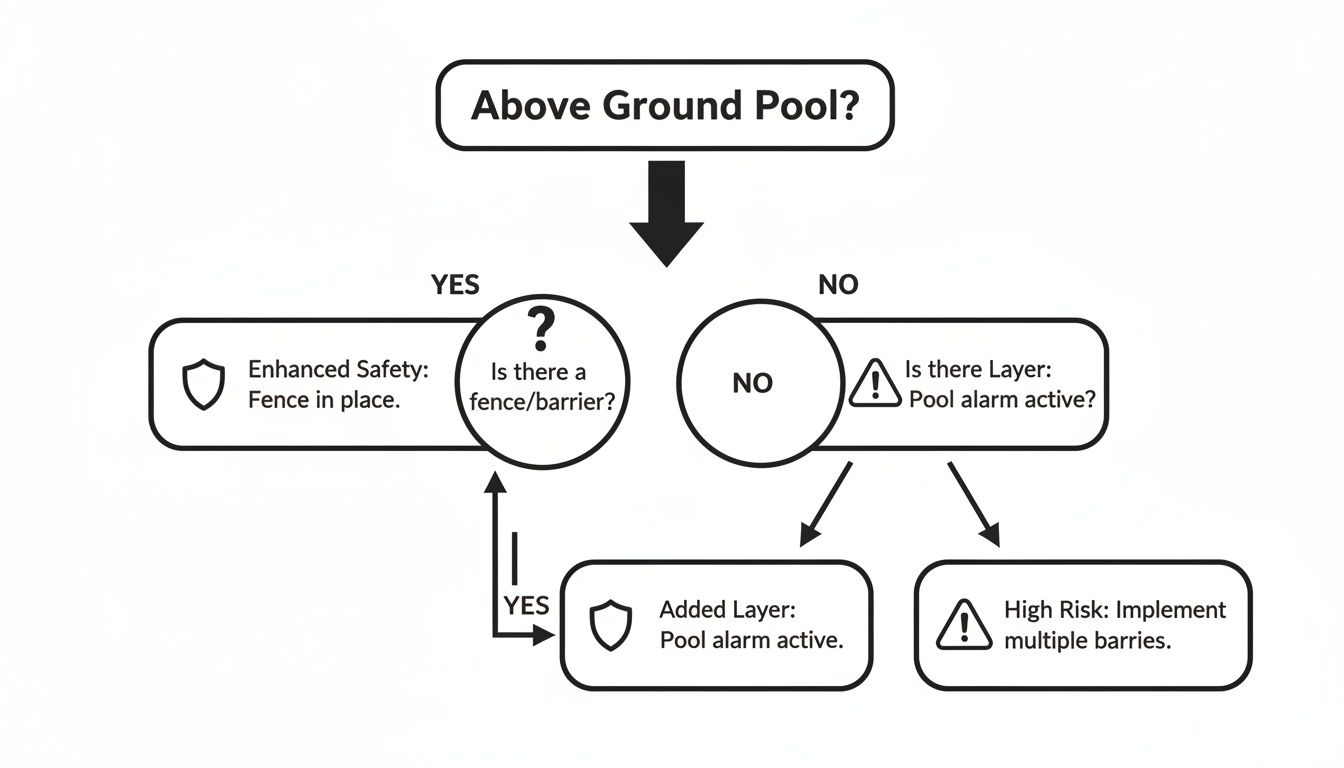
The takeaway is clear: a compliant fence is the most effective safety barrier you can install.
The Three Core Numbers of Compliance
When a building inspector evaluates your pool enclosure, they focus on three non-negotiable measurements. Master these to ensure your fence is both safe and compliant.
Minimum Fence Height: The fence must be at least 60 inches (five feet) tall, measured from the ground on the outside of the enclosure. This height makes it difficult for a child to climb over.
Maximum Vertical Spacing: The gaps between vertical pickets or balusters cannot exceed four inches. This is the "four-inch sphere rule"—if a four-inch sphere can pass through, so can a small child.
Maximum Ground Clearance: The space between the bottom of the fence and the ground must be no more than two inches on a solid surface like concrete. This prevents a child from squeezing underneath.
These three measurements form the foundation of California's Pool Safety Act. For a complete overview of the legal text, review California's specific pool fence laws. Local ordinances, such as those in Los Angeles County, typically adopt these state-level requirements.
Understanding Gate Safety Requirements
A fence is only as strong as its gate. California law enforces strict standards for pool gates to eliminate this common weak point. A simple latch is not sufficient.
Your gate must meet these criteria:
Self-Closing: It must automatically swing shut from any open position.
Self-Latching: The latch must engage automatically when the gate closes.
Outward-Swinging: The gate must swing away from the pool, preventing a child from pushing it open from the outside.
Latch Placement: The release mechanism must be at least 54 inches from the ground or located on the pool side of the gate, at least three inches below the top, to be out of a child's reach.
Actionable Step: When shopping for gate hardware, specifically look for kits labeled "pool safe" or "meets BOCA code." Test the self-closing and self-latching mechanisms rigorously after installation and check them periodically as part of your regular pool maintenance routine.
When Do These Rules Apply?
These laws apply to any new or remodeled body of water intended for swimming that is 18 inches deep or more, which includes most above-ground pools. Compliance isn't a one-time check; it is required at several key points:
During a major home renovation.
At the time of a home sale.
In response to a complaint or after an incident.
Failing an inspection can result in fines and work-stoppage orders. By designing your above ground pool with fence to meet these state standards from the outset, you ensure your backyard remains a safe and enjoyable space, free from legal risk.
Choosing the Right Fence Material for Your Pool
With the legal requirements understood, you can select a fence material that balances safety, aesthetics, budget, and maintenance. There is no single "best" material—only the one that best suits your specific needs and backyard environment.
Let's examine the most common options to help you make an informed decision.
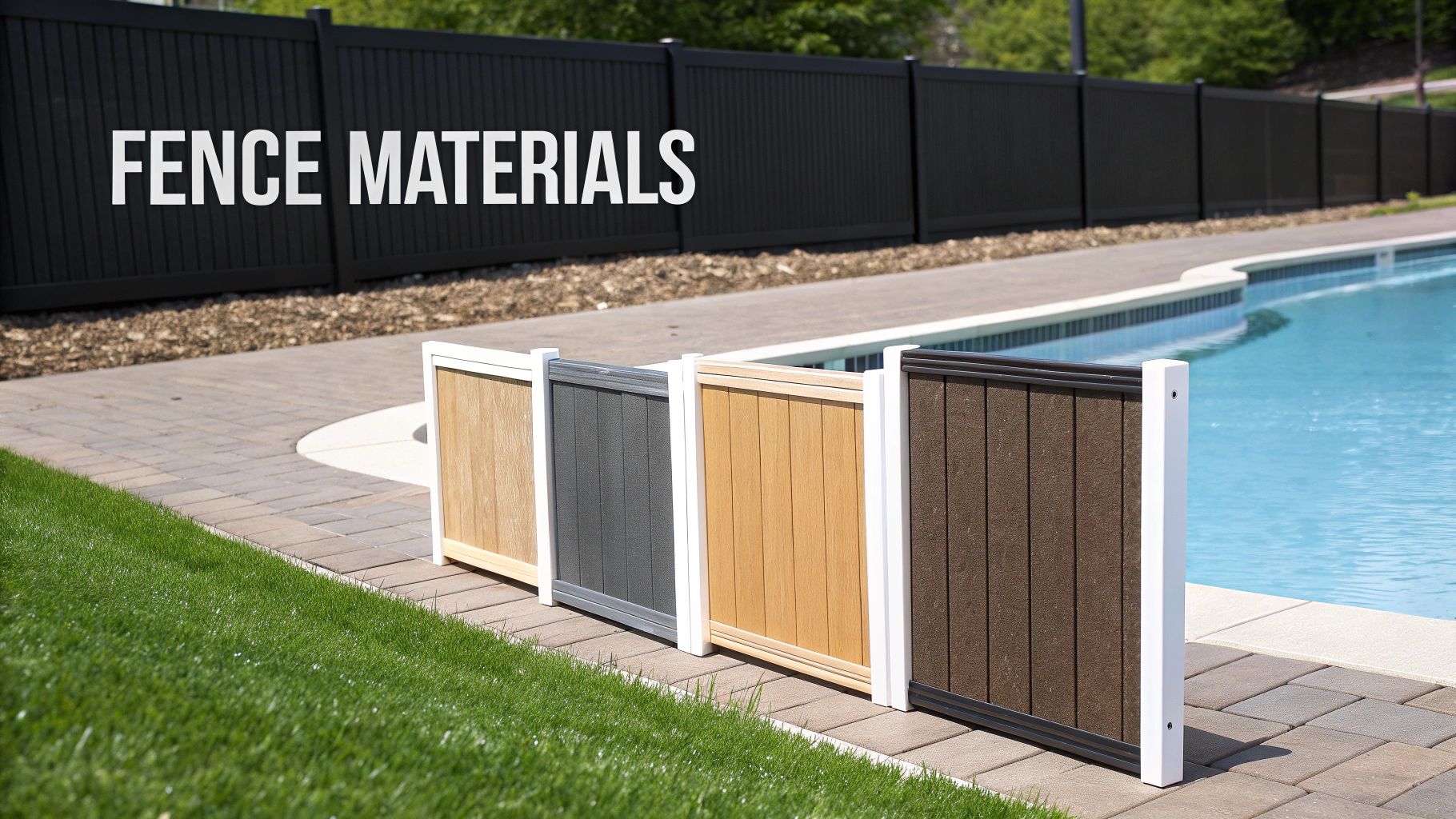
Pool Fence Material Comparison
This table provides a side-by-side comparison of the top fence materials, breaking down the key factors to guide your choice.
Material | Average Cost (Per Linear Foot) | Maintenance Level | Key Pros | Key Cons |
|---|---|---|---|---|
Mesh | $15 - $25 | Low | Unclimbable surface, excellent visibility, removable | No privacy, utilitarian appearance |
Vinyl | $25 - $40 | Very Low | Durable, won't rot or warp, easy to clean, many styles | Higher upfront cost, can crack under heavy impact |
Wood | $20 - $45 | High | Natural aesthetic, excellent privacy, customizable | Requires regular staining/sealing, prone to rot/warping |
Aluminum | $40 - $60 | Very Low | Elegant look, rust-proof, durable, maintains views | Higher initial cost, provides no privacy |
Use this table as a starting point, then consider the specific benefits and drawbacks of each option below.
Removable Mesh Fencing: The Safety Champion
For homeowners with young children, removable mesh fencing is a top choice for safety. Its primary advantage is the climb-resistant design; the taut panels lack the horizontal rails that a child could use as handholds or footholds. The transparent mesh also provides an unobstructed view of the pool, which is critical for supervision.
The trade-off is aesthetics and privacy. Mesh fences are functional and may not complement every landscape design. However, for pure, uncompromised safety that can be removed for adult gatherings, it is an excellent and practical solution.
Vinyl Fencing: The Low-Maintenance All-Rounder
If you want a durable fence that looks great with minimal effort, vinyl is an outstanding choice. Modern vinyl comes in a wide variety of colors and styles, including realistic wood-grain textures, without the associated maintenance.
Vinyl's greatest strength is its resistance to moisture, sun, and insects. It will not rot, warp, or splinter, and it never needs painting or staining. Cleaning is as simple as using soap and water. It is the ultimate "set it and forget it" fencing material.
Actionable Insight: While vinyl's upfront cost is higher than wood's, calculate its long-term value. Factor in the cost of stain or paint, brushes, and your time for a wood fence every 2-3 years. Over a decade, vinyl often becomes the more cost-effective option.
A potential downside is that vinyl can become brittle in extreme cold and may crack under a severe impact. To learn more, consult this actionable guide to plastic and vinyl fence solutions.
Wood Fencing: The Timeless Classic
A wood fence offers natural beauty and excellent privacy. Materials like cedar and pressure-treated pine can be customized with paint or stain to match your home's aesthetic perfectly.
However, this classic look requires significant upkeep. Wood is vulnerable to moisture, especially in a poolside environment. To prevent rot, warping, and insect damage, you must commit to a regular maintenance schedule of cleaning, sealing, and staining every few years. If this maintenance is neglected, the fence can become both an eyesore and a safety hazard.
Aluminum Fencing: The Elegant Protector
For a sophisticated look that provides security without obstructing views, choose aluminum. It offers the classic appearance of wrought iron but is lightweight, strong, and completely rust-proof, making it ideal for the humid pool environment.
Aluminum's durable powder-coated finish requires virtually no maintenance beyond occasional cleaning. While it does not offer privacy, its open design is perfect for homeowners who want to maintain an open feel in their yard. For tips on integrating your fence with other hardscaping, see this guide on choosing the right stone for your pool. The primary drawback is a higher initial cost, but its longevity and low maintenance make it a sound long-term investment.
Key Steps for a Successful Pool Fence Installation
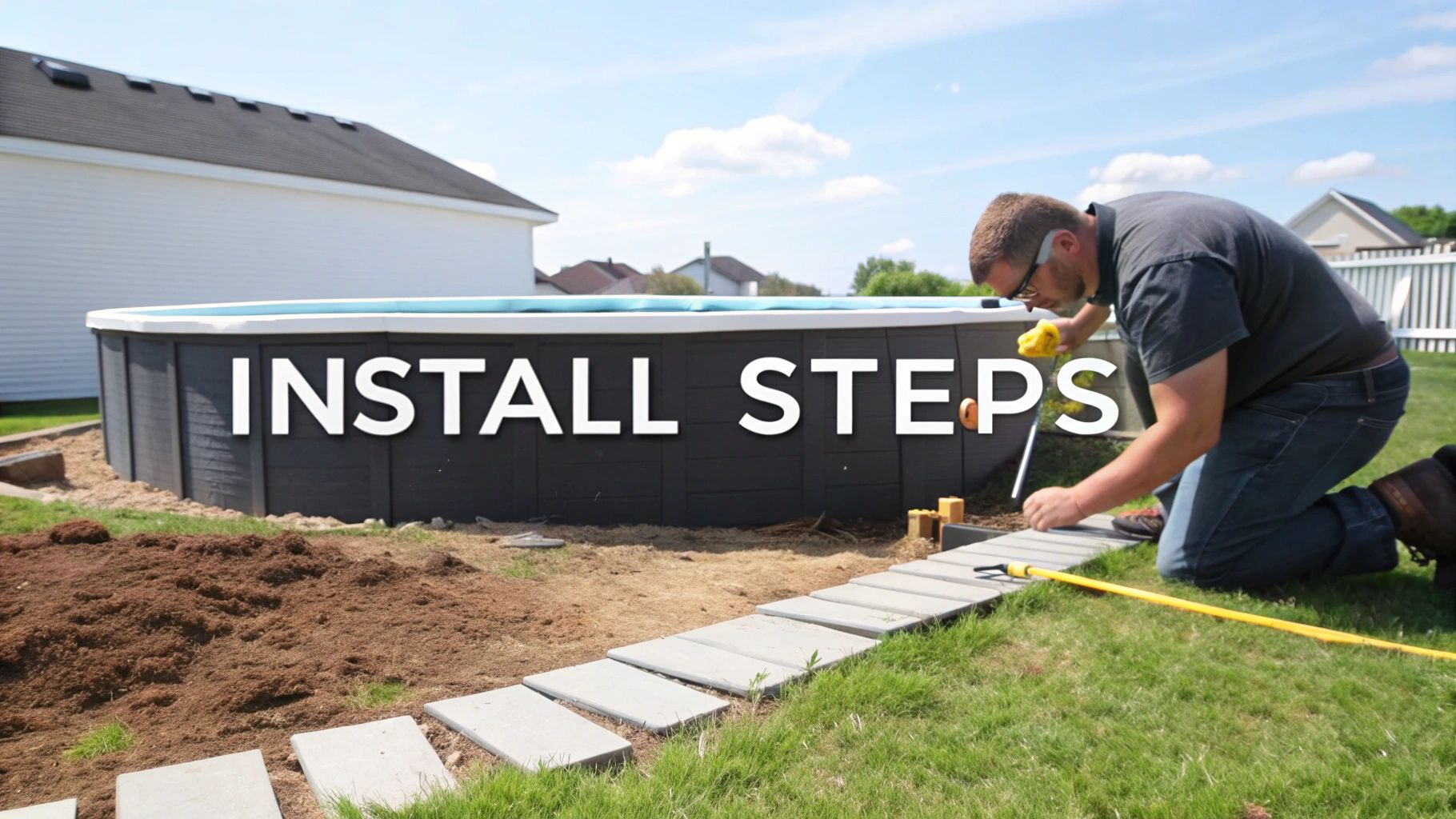
A successful fence installation depends on proper planning and site preparation. Rushing this stage can lead to safety gaps, instability, and costly mistakes. Solid groundwork is essential to ensure your above ground pool with fence is secure, compliant, and durable.
Preparing the Groundwork
Before installation, create a clean and level surface. An uneven fence line is a major safety violation, as it creates gaps that a child can squeeze through.
Follow this pre-installation checklist:
Level the Area: Grade the ground along the entire fence line to be as flat as possible. This is the only way to guarantee a consistent and minimal ground clearance of two inches or less.
Clear Obstructions: Remove all rocks, tree roots, shrubs, and other debris from the planned fence perimeter to prevent installation issues and future weak points.
Plan for Drainage: Ensure the ground slopes slightly away from the fence posts. Proper grading prevents water from pooling, which can cause soil erosion and compromise the stability of your fence footings.
Designing a Smart and Safe Layout
With the ground prepared, map out the fence's exact location. This plan should prioritize safety, ease of access, and functionality. A well-designed layout makes the pool area both safer and more user-friendly.
Your layout must account for local bylaws. In California, any pool with 18 inches or more of water requires a compliant barrier. A thoughtful design ensures you meet these legal standards.
Key layout considerations:
Setback Requirements: Position the fence a specific distance from the pool's edge as required by your local municipality. This "safe zone" prevents a climber from immediately falling into the water.
Gate Placement: Locate gates for convenient access but avoid placing them in a direct line of sight from the house to discourage a child's direct path to the pool.
Usable Space: Plan for enough room inside the fenced area for walking, seating, and pool maintenance without feeling cramped.
The Most Important Phone Call You Will Make
Before digging, you must locate underground utilities. Striking a buried power line, gas pipe, or water main is extremely dangerous and can result in thousands of dollars in repairs.
Actionable Step: Call 811 at least a few days before you plan to dig. This free service contacts local utility companies to mark the location of buried lines on your property with paint or flags.
This call is a non-negotiable safety step. Once the lines are marked, you can adjust your post locations to avoid a costly and dangerous accident. For more detailed instructions, see our homeowner's guide to above ground pool safety fence installation.
DIY Installation vs. Hiring a Professional
You've chosen your pool and fence material; now you face a critical decision: install it yourself or hire a professional? While DIY can save money, an above ground pool with a fence is a safety installation where precision is non-negotiable. This is less about saving money and more about ensuring it's done correctly.
The DIY approach requires more than just basic handyman skills; it demands a thorough understanding of local safety codes and meticulous attention to detail.
The Realities of a DIY Pool Fence Installation
If you choose the DIY route, you assume full responsibility for meeting every legal requirement. A minor error in measurement—such as the gate latch height or the spacing between pickets—can result in a failed inspection, forcing you to redo the work at your own expense.
Before committing, conduct an honest assessment of your tools and time. A proper installation requires:
A post-hole digger or a power auger.
A high-quality level and string lines for perfect alignment.
A saw for making precise cuts.
Materials and tools for mixing and pouring concrete footings.
Actionable Insight: A DIY fence installation is not a quick weekend project. It requires careful planning and double-checking every measurement. The safety of your family depends on 100% accuracy. If you are not completely confident, the risk is not worth the potential savings.
Why Hiring a Professional Is a Smart Investment
Hiring a professional contractor provides certainty and peace of mind. An experienced installer possesses an in-depth knowledge of local building codes, ensuring your fence is compliant from the start. They anticipate and solve common installation problems that often frustrate DIYers.
Professionals also use high-quality materials and specialized equipment, resulting in a stronger, more durable fence built to last. They manage the entire process, from marking utility lines to final cleanup, saving you time and labor. Most importantly, a professional guarantees their work. If the fence fails inspection, they are responsible for correcting it. This accountability is invaluable for a critical safety feature like a pool fence. Our guide on how to hire Ottawa fence builders provides a clear checklist for finding a qualified contractor.
Making the Right Choice for Your Situation
The decision depends on your skills, time, and property. If your yard is perfectly flat and the layout is simple, a skilled DIYer might manage the project.
However, for properties with slopes, complex layouts, or if you have any uncertainty about local codes, hiring a professional is the safest and most effective choice.
Common Questions About Above Ground Pool Fences
Finalizing your plan for an above-ground pool fence often brings up specific questions. Getting clear, correct answers is crucial for avoiding costly mistakes and ensuring your backyard is safe. Here are the answers to the most common queries.
Can My Pool Wall Count as Part of the Fence?
This depends on your local California municipality and the pool's height. For a pool wall to serve as a barrier, it typically must be at least 60 inches tall.
However, even with compliant walls, the ladder or steps create an access point that must be secured. If you use the pool wall as part of the barrier, the ladder must be:
Removable: You must be able to detach it and store it away from the pool when not in use.
Lockable: The ladder must have a lockable gate or a secure cover that prevents a child from climbing it.
Actionable Step: Do not assume your pool wall is a compliant barrier. Contact your local building department to confirm their specific requirements. Some jurisdictions mandate a full perimeter fence regardless of the pool's height.
What Makes a Pool Gate Legally Compliant?
In California, a pool gate is an active safety device with strict functional requirements. A non-compliant gate is a common reason for a failed inspection.
Your gate must meet all of these criteria:
Self-Closing: It must swing fully shut on its own from any position.
Self-Latching: The latch must engage automatically when the gate closes.
Outward-Swinging: It must swing away from the pool.
Child-Resistant Latch: The release mechanism must be at least 54 inches from the ground or located on the pool side of the gate, at least three inches below the top, making it unreachable for a small child.
Failing to meet even one of these requirements makes the entire fence non-compliant.
Do I Need a Permit to Build a Pool Fence?
Yes. In nearly all California municipalities, a building permit is required to install a pool fence. This applies to fences for new pools and existing ones. The permit process is a critical safety check.
It ensures your plan is code-compliant before construction begins. You will submit your layout, materials, and gate specifications for approval. After installation, an inspector will verify that the work meets all requirements. Skipping the permit can lead to fines, demolition orders, and significant liability. The permit process is your best assurance that the job is done correctly and safely.
A secure, compliant fence is the foundation of a safe and enjoyable backyard pool. If you want to make sure your pool is protected by a professional fence that meets every legal standard, the team at FenceScape is ready to help. We take care of everything from the initial design and permitting to the final installation, giving you complete peace of mind.
Contact FenceScape today for a free, no-obligation estimate and let us build the perfect safety barrier for your family.
Comments