
Your Complete Guide to an Above Ground Pool With Fence

Installing a fence around your above ground pool is one of the most critical safety decisions you'll make as a homeowner in Canada. A proper fence is your primary defence, preventing unsupervised access to the water and tragic accidents. It also ensures you comply with local by-laws and protect your investment. This guide provides the actionable insights you need to get the job done right.
Why Your Above Ground Pool Needs a Fence
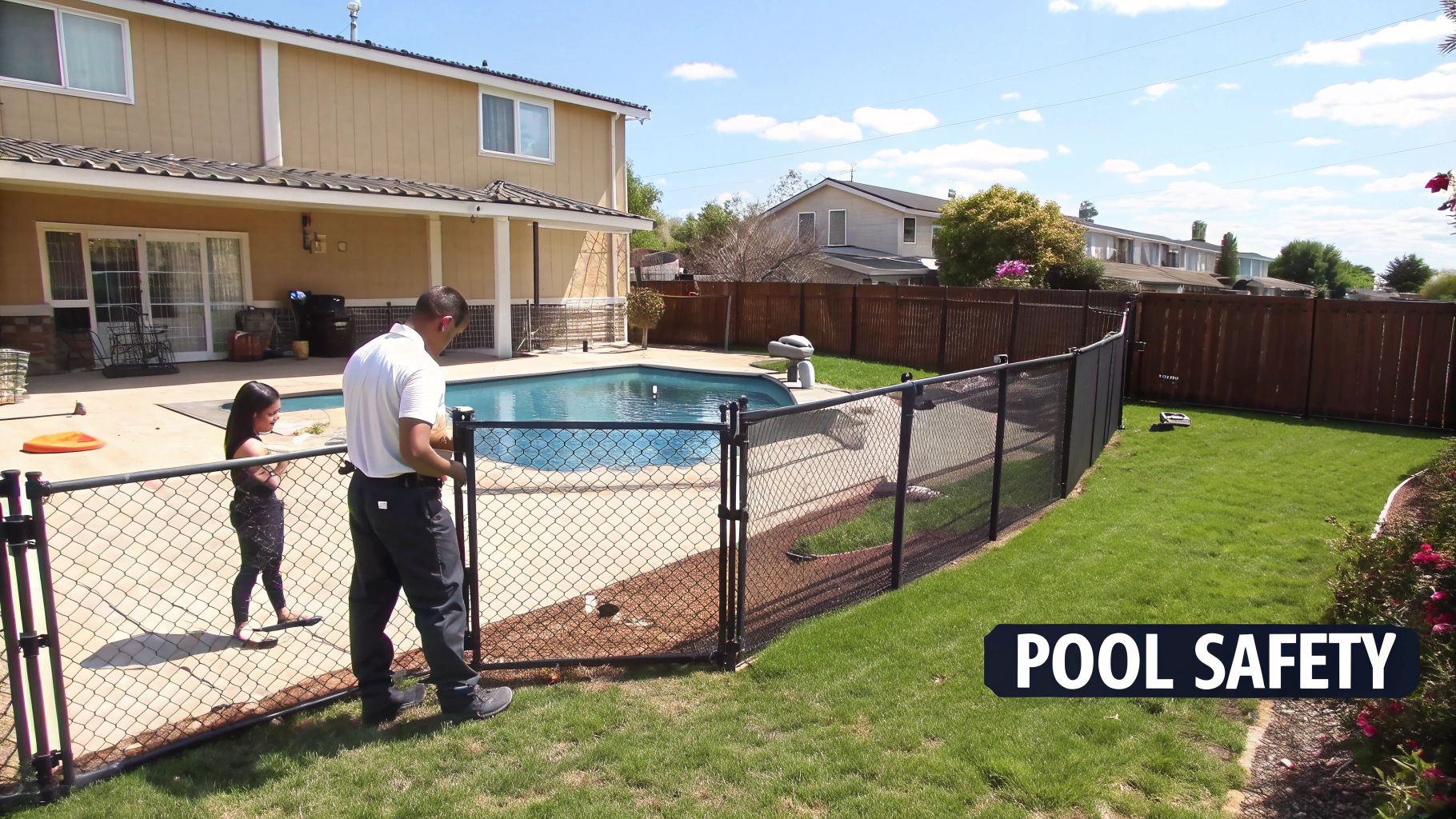
A pool fence is the essential guardian of your backyard. While a pool offers endless summer fun, it also presents a significant risk, especially for young children. Drowning is a leading cause of accidental death for children, and an unsecured pool is a constant hazard. An effective fence transforms that danger zone into a secure space for everyone.
This is not just a suggestion—it's a legal requirement. Nearly every Canadian municipality has strict by-laws mandating fences for residential pools, including above-ground models. Ignoring these regulations can result in heavy fines and, more importantly, devastating liability if an accident occurs on your property.
The Cornerstones of a Secure Pool Fence
A pool fence must be built on key principles to serve as a reliable safety feature, not just a decorative border. Here's what to focus on:
Actionable Safety: A properly constructed fence creates a physical barrier that stops children and pets from accessing the pool area. This is the single most effective action you can take to prevent accidental drownings.
Mandatory Compliance: Your local municipality has specific codes for fence height, gate hardware, and picket spacing. Following these rules is not optional—it's a prerequisite for any pool owner.
Liability Shield: In the eyes of the law and insurance providers, a compliant fence demonstrates that you have taken responsible steps to secure your pool. This is crucial for protecting yourself in the event of an incident.
Action Step: Implement a multi-layered safety system. Your fence is the primary barrier, but enhance it with self-closing gates, pool alarms, and a safety cover. This creates a more robust system that compensates for potential human error.
The gate is a critical component of this system. Our guide on gates for pool safety in Ottawa provides practical steps for selecting a secure gate. For an even safer environment, consider additional pool safety installations like covers to secure the pool when not in use.
Getting to Know Canadian Pool Fence Laws and Regulations
Navigating the rules for an above ground pool with a fence is the most important step in your project. There is no single national law in Canada; instead, each municipality sets its own by-laws. This means the specific requirements you must follow are determined by your address.
While many municipalities use the National Building Code of Canada as a baseline, they often add their own specific rules. Your first and most critical action is to contact your local municipal office or building department to get a copy of the current pool fence by-law.
The Must-Haves You'll Almost Certainly Find
Despite regional variations, several core safety requirements appear in nearly all Canadian pool by-laws. To pass inspection and ensure safety, you must get these details right.
Minimum Fence Height: Most jurisdictions require a fence to be at least 1.2 metres (4 feet) tall, with some mandating up to 1.5 metres (5 feet). This height is specifically designed to prevent a small child from climbing over.
Secure, Smart Gates: Your gate must be self-closing and self-latching. The latch mechanism must be located on the pool side of the gate, high enough to be out of a child's reach.
No Squeeze-Through Gaps: By-laws are very specific about spacing. The gap between the bottom of the fence and the ground, as well as the space between vertical pickets, cannot exceed 10 centimetres (4 inches).
Why Do the Rules Change from Town to Town?
Municipalities tailor their by-laws based on local factors like population density and typical lot sizes. For example, an urban area might have stricter rules about fence placement near property lines than a rural community.
Some by-laws also have specific rules about the pool itself. For instance, some municipalities allow the walls of an above-ground pool to act as a barrier if they are high enough (e.g., over 1.2 metres), but only if the ladder is removable or can be secured behind a lockable gate. You cannot assume this is permitted.
Action Step: Do not rely on general advice or a neighbour's old project. Your legal obligation is to follow the exact by-laws for your municipality. Call your town or visit its website to get the official, up-to-date regulations before you start building.
These regulations are based on proven safety data. For instance, California's Pool Fence Law, requiring a 5-foot minimum height and strict gate standards, contributed to a 52% reduction in toddler drownings. You can discover more about California's vinyl pool fence laws to understand how these standards save lives. Ultimately, taking the time to comply with every detail of your local regulations is the best action you can take to create a secure backyard and achieve true peace of mind.
Choosing the Best Fence Material for Your Pool
Selecting the right material for your above ground pool with fence is a crucial decision that impacts safety, aesthetics, budget, and long-term maintenance. Your fence must withstand Canadian weather, from intense summer sun to heavy snow, while remaining secure and looking great with minimal effort.
Here’s a practical breakdown of the most common materials to help you make an informed choice.
Mesh Fencing
For unparalleled safety, especially with young children, mesh fencing is a top contender. Its design is simple yet highly effective for preventing accidents.
Climb-Proof: The flexible, tightly woven mesh offers no handholds or footholds, making it virtually impossible for a toddler to scale.
Clear Sightlines: It provides an unobstructed view of the pool, allowing for constant supervision from anywhere in the yard.
Removable by Design: Many systems are designed to be removed and stored, offering flexibility for adult gatherings or off-season storage.
While its safety features are excellent, the utilitarian appearance may not suit all aesthetic preferences, and it offers no privacy.
The Appeal of Vinyl (PVC) Fencing
Vinyl has become a popular choice for its clean, modern look and extremely low maintenance requirements.
Its smooth surface eliminates the risk of splinters and is easy to clean. Solid vinyl panels create a complete visual and physical barrier, offering maximum privacy and security with no gaps for children to squeeze through.
Practical Advantage: Vinyl is a smart long-term investment because it resists rot, warping, and insect damage. It retains its colour for years without needing to be painted or stained, saving you significant time and effort.
The Strength of Aluminum Fencing
For an elegant, classic look that doesn't obstruct your view, aluminum is an excellent choice. It provides the aesthetic of wrought iron without the risk of rust.
Aluminum is lightweight yet strong. Its powder-coated finish protects it from corrosion and chipping, making it ideal for a poolside environment. The vertical picket design is difficult to climb and meets the strict spacing requirements of most by-laws.
The Natural Beauty of Wood Fencing
Wood offers a timeless, natural aesthetic that can blend your pool area seamlessly into your backyard landscape. It is also one of the most budget-friendly materials upfront.
However, this lower initial cost is balanced by required maintenance. Wood must be regularly sealed or stained to prevent rot, warping, and insect damage, a task that is especially important in the moist environment around a pool.
For enhanced durability, choose pressure-treated lumber, which is chemically treated to resist moisture and decay. This practical guide to pressure-treated lumber offers more details for outdoor projects.
Comparing Pool Fence Materials Side-by-Side
This table provides an at-a-glance comparison to help you choose the best material based on your priorities, whether they are budget, appearance, or long-term upkeep.
Material | Average Cost (Per Linear Foot) | Pros | Cons | Best For |
|---|---|---|---|---|
Mesh | $15 - $30 | Top-tier safety, unclimbable, excellent visibility, removable options. | Utilitarian look, offers no privacy. | Families with young children where safety is the #1 priority. |
Vinyl (PVC) | $25 - $45 | Extremely low maintenance, durable, excellent privacy, clean look. | Higher upfront cost, can become brittle in extreme cold. | Homeowners who want a long-lasting, "set it and forget it" fence. |
Aluminum | $30 - $55 | Very durable, elegant appearance, no rust, maintains open sightlines. | Most expensive option, offers minimal privacy. | Those wanting a high-end, classic look without blocking views. |
Wood | $12 - $30 | Natural aesthetic, lowest initial cost, highly customizable. | Requires regular staining/sealing, prone to rot and warping. | DIYers and those on a tighter initial budget who don't mind the upkeep. |
Ultimately, the best material for your above ground pool with fence is the one that fits your family's needs, your backyard's style, and your willingness to handle long-term maintenance.
How to Plan Your Pool and Fence Layout
A well-designed layout is the foundation of a safe and functional pool area. Planning the placement of your above ground pool with fence from the outset will prevent costly mistakes and future headaches.
Before starting, survey your yard to find the optimal location. Look for level ground, clear of overhead power lines, and ensure the placement complies with your local by-law's setback requirements from property lines. Consider the flow of foot traffic from your house to the pool to ensure a clear and safe path.
Mapping Out Your Safe Zone
Once you have a potential spot, it's time for precise measurements. Use a measuring tape to mark the exact footprint of both the pool and the surrounding fence. Do not estimate this step.
A common oversight is failing to leave adequate clearance between the pool and the fence. A practical rule of thumb is to leave at least one metre (about three feet) of clear space around the entire perimeter.
This buffer zone is essential for practical maintenance like cleaning, accessing the pump and filter, and performing repairs. It also serves as a crucial safety feature, preventing anyone from using the fence to climb or jump into the pool.
Strategic Gate Placement and Perimeter Planning
The location of your gate is a critical decision that impacts both convenience and security. Position it where it is clearly visible from the house for easy monitoring.
Follow these steps to plan your perimeter and gate location:
Stake Out the Pool: Use stakes and string to create a physical outline of the pool's location. This helps you visualize its scale in your yard.
Mark the Fence Line: Measure out from the pool outline to mark the fence perimeter, ensuring you include the one-metre maintenance clearance.
Identify the Natural Path: Observe the most direct and logical path from your back door to the pool area. This is typically the best location for the gate.
Prioritize Safety: Confirm the gate will swing away from the pool and is not in a location where it can be easily propped open by furniture or toys.
This flowchart simplifies the key decisions, helping you balance cost, safety, and style in your planning process.
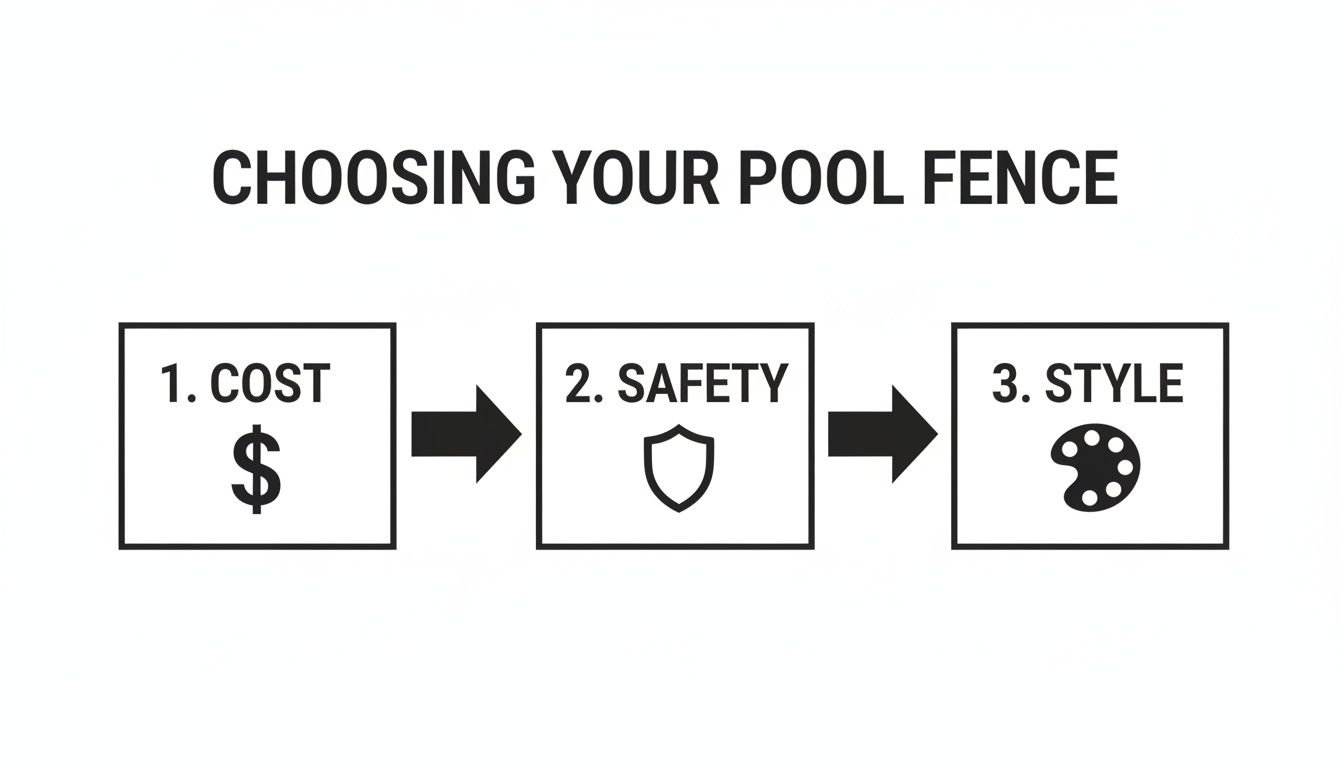
As the chart illustrates, your budget and aesthetic preferences are important, but safety regulations must be your primary guide.
These laws are effective. Since the 2018 amendment to California's Pool Safety Act, requiring 60-inch fences with self-latching gates, accident rates for above-ground pools have dropped by 45%. These barriers are proven to prevent an estimated 89% of unauthorized entries by young children. You can explore the data behind these life-saving regulations by reading the full legislative analysis.
Actionable Insight: A thoughtfully planned layout does more than satisfy by-laws; it creates a functional and enjoyable space. By considering access, maintenance, and safety from the very beginning, you ensure your pool remains a source of joy, not a cause for concern.
DIY Installation vs. Hiring a Professional
With your materials chosen, you face a critical decision: install the fence yourself or hire a professional? This choice impacts your budget, timeline, and the quality of the final result. While a DIY approach can save money on labour, it requires significant skill, time, and a clear understanding of legal requirements. You are not just assembling a kit; you are constructing a safety barrier that must pass a formal inspection.
If you are a skilled DIYer, building your own above ground pool with fence can be a rewarding project. However, you must realistically assess your capabilities. This job requires specialized tools like post-hole diggers, levelers, and potentially a power auger.
The most critical—and most challenging—part for a DIYer is setting the posts correctly. A common mistake is setting posts too shallow or without an adequate concrete base, which can compromise the entire structure. A single poorly set post can cause the fence to lean, rendering it unsafe and non-compliant. If you choose the DIY path, follow a practical guide to cementing fence posts to ensure a stable foundation.
The Do-It-Yourself Checklist
Before you begin, run through this checklist to determine if you are prepared for the job.
Do you have the right tools? You will need post-hole diggers, a quality level, string lines, a powerful drill, and a saw. Factor in the cost of renting any tools you don't own.
Do you have the time? A proper fence installation is not a single-day project. Expect to dedicate at least a full weekend, or potentially more, especially if working alone.
Are you confident in your skills? The work demands precision. You must be comfortable with exact measurements, heavy physical labour, and ensuring every component is perfectly level and plumb.
If you answered "no" or hesitated on any of these points, hiring a professional is the more reliable and safer option.
The Case for Hiring a Professional
Hiring an experienced team like FenceScape offers significant advantages beyond saving you time and labour. It provides peace of mind through expertise, efficiency, and accountability.
Practical Advantage: A professional installation is an investment in certainty. You get guaranteed code compliance, superior craftsmanship, and your weekends back. It turns a stressful project into a seamless experience with a professional-grade result.
Professionals are experts in local by-laws. They understand the specific requirements in your area, from gate latch height to picket spacing, ensuring your fence passes inspection without issue. For example, knowing the exact 60-inch (5-foot) fence height and latch placement mandated by California's Swimming Pool Safety Act—a rule that helped reduce child drownings by 40%—is part of their job.
Furthermore, a professional crew with specialized equipment can typically complete an installation in one or two days—a project that might take a DIYer several weekends. They manage everything from material delivery to final cleanup, leaving you with a ready-to-use, secure pool area.
Still Have Questions About Pool Fences?
Even with careful planning, questions often arise during an above-ground pool fence installation. Here are actionable answers to some of the most common inquiries from homeowners.
Can My Pool Wall Count as a Fence?
This depends entirely on your local by-laws. Some municipalities permit the wall of an above-ground pool to serve as part of the safety barrier, but only if it meets a minimum height requirement—typically 1.2 metres (4 feet).
However, there is a critical condition: the ladder or entry steps must be removable or secured with a lockable, child-proof gate. The objective is to eliminate all potential points of unsupervised access.
Action Step: Never assume this is allowed in your municipality. The rules vary significantly between towns. You must confirm with your local building department before forgoing a full perimeter fence to avoid fines and safety risks.
How Do I Install a Fence on Uneven or Sloped Ground?
Installing a fence on a slope requires a specific technique to maintain a consistent height and ensure the gap at the bottom remains under the legal limit (usually 10 cm or 4 inches).
There are two primary methods:
Racking: This method involves angling the fence panel so the rails run parallel to the slope. It is ideal for gentle inclines and is a standard feature of most aluminum and some vinyl fence systems.
Stepping: For steeper slopes, the fence is installed in a step-like pattern. Each panel remains level, but they are installed at different heights to follow the contour of the ground. This creates a secure barrier without large gaps.
A professional installer can assess your terrain and recommend the most effective method for your property.
Can a Pool Cover Replace a Fence?
No. A high-quality, ASTM-rated safety cover is an excellent secondary safety measure, but it is not a legal substitute for a permanent, code-compliant fence.
A fence provides constant, passive protection. A cover is only effective when it is properly secured, and human error—like forgetting to replace it—can lead to tragedy. Studies show that 71% of drowning deaths among young children occur at private residences, underscoring the need for a constant barrier. By-laws mandate a permanent fence to eliminate this risk.
What Is the Best Location for the Gate?
Proper gate placement is crucial for both safety and convenience. The ideal location offers a clear line of sight from your house, allowing for easy supervision.
The gate must swing outward, away from the pool, to prevent a child from pushing it open to gain entry. Additionally, keep the area around the gate free of furniture, planters, or other objects that could be used to prop it open or climb over it.
How Far Should the Fence Be from the Pool?
The ideal distance provides enough room for maintenance without fencing off too much of your yard. A practical guideline is to leave at least 1 metre (about 3 feet) of clear space between the pool's edge and the fence.
This clearance allows you to walk comfortably around the pool for cleaning and equipment access. It also acts as a safety buffer, making it more difficult for anyone to use the fence as a launching point into the pool.
How Often Does a Pool Fence Need Maintenance?
Your maintenance schedule depends on the material you choose. Follow this checklist to keep your fence safe and in good condition.
Fence Material | Recommended Maintenance Schedule | Key Tasks |
|---|---|---|
Wood | Annually | Inspect for rot, splintering, or loose boards. Re-stain or seal every 2-3 years to protect against moisture and UV damage. |
Vinyl (PVC) | Annually | Clean with soap and water to remove dirt and mildew. Inspect panels for cracks, especially after extreme cold weather. |
Aluminum | Annually | Hose down to remove debris. Check the powder coating for scratches and ensure all hardware is tight. |
Mesh | Seasonally | Verify the mesh tension is taut. Inspect poles and latches to ensure they are secure and functioning correctly. |
Regular inspections allow you to identify and address small issues before they become major safety hazards. For more answers to common questions, explore these general pool FAQs.
Navigating the details of an above-ground pool fence project can seem daunting, but getting it right ensures years of safe, stress-free enjoyment. If you prefer a guaranteed compliant and professionally finished project without the hassle, the expert team at FenceScape is ready to help.
Comments