
Your Actionable Guide to Chain Link Fencing in Ottawa

Chain link is a practical, budget-friendly way to secure your property. At its core, it’s a straightforward system: steel posts support a woven steel-wire mesh, creating the classic diamond-patterned barrier. Follow this guide to make the best decisions for your Ottawa or Gatineau home.
Why Chain Link Fencing Is a Smart Choice for Ottawa Homes
When choosing a new fence, balance durability, cost, and function. In the Ottawa–Gatineau climate, where weather tests every material, chain link consistently delivers. It's a tough, low-maintenance solution that solves common problems without a high price tag.
Think of it as the workhorse of fencing. Its key components—strong steel posts, a stabilizing top rail, and the iconic woven mesh—work together to create a boundary that’s both strong and flexible.
Built for Our Unique Climate
The Ottawa–Gatineau climate features heavy snow, ice storms, and dramatic freeze-thaw cycles that can destroy outdoor structures. While solid fences can crack or heave, the flexibility of chain link gives it a critical advantage.
Actionable Tip: The diamond-patterned steel mesh has built-in 'give,' allowing it to absorb impacts and handle shifting ground from frost heave without breaking. To minimize repairs and ensure longevity, choose a fence material like chain link that is designed to flex with our climate's demands.
This resilience is why it's a top choice for local property owners. A quick check of the Better Business Bureau of Ottawa reveals 91 dedicated chain link fence contractors in the area—a clear sign of its popularity and reliability.
Practical Solutions for Everyday Needs
Beyond weather resistance, chain link fencing offers simple, effective answers to why most people want a fence. Here’s what you can achieve:
Secure Your Yard: Effectively mark your property line and keep children and pets safely contained.
Stick to a Budget: Gain a secure perimeter for a fraction of the cost of wood, PVC, or ornamental iron.
Invest in Longevity: With modern galvanized or vinyl-coated finishes, expect your fence to resist rust and corrosion for 20+ years with minimal upkeep.
Meet Pool Codes: Use one of the most common and cost-effective materials to comply with strict swimming pool enclosure safety regulations.
Choosing chain link is a pragmatic decision. Prioritize long-term function and value to make a sound investment for your Ottawa home.
Choosing the Right Materials for Your Fence
To ensure your chain link fence performs well for decades, you must select the right materials. Your choices determine its strength, appearance, and ability to withstand the Ottawa–Gatineau climate. Focus on the wire's thickness (gauge), its protective coating, and any privacy enhancements.
Think of it as a build-to-order system. Each component—wire gauge, coating, slats—adds a specific quality. By understanding these parts, you can construct a fence that perfectly matches your property, needs, and budget.
Decoding Wire Gauge: The Strength Factor
Gauge refers to the thickness of the steel wire. Remember this simple rule: the lower the gauge number, the thicker and stronger the wire. A lower number means more steel, creating a tougher fence that can withstand greater impact.
Match the wire's strength to your fence's purpose.
Residential Standard (9 Gauge): For most Ottawa homeowners, this is the ideal balance. It's strong enough to contain kids and dogs, define property lines, and endure daily use.
Heavy-Duty Commercial (6 Gauge): This is exceptionally thick wire used for high-security areas like industrial yards, sports fields, and commercial properties where security is the primary goal.
While lighter options like 11.5 gauge exist, always specify 9 gauge as the minimum for a residential fence in our climate. It has the strength to survive stray hockey pucks and heavy, leaning snow drifts without buckling.
Selecting the Right Protective Coating
A steel fence in our region requires robust protection against moisture, road salt, and harsh freeze-thaw cycles. The coating is your fence's primary defence against rust and corrosion.
Actionable Tip: Your fence's coating is what ensures it will last 20+ years. Don't cut corners here. A quality coating is essential to stop rust, especially during our slushy springs and salty winters.
You have two main options:
Galvanized Finish: The classic, silver-grey chain link look. The steel wire is coated in molten zinc, creating a protective layer that sacrifices itself to prevent rust. It's a proven, cost-effective, and durable choice.
Vinyl Coating (PVC): The galvanized wire gets an extra layer—a thick coating of coloured vinyl, typically black, green, or brown. This adds another robust barrier against weather and gives the fence a more polished look. Black vinyl is the top choice for a clean, modern aesthetic.
Use this chart to make an informed decision based on your specific needs.
Chain Link Gauge and Coating Comparison
Feature | Standard (11.5 Gauge) | Residential (9 Gauge) | Commercial (6 Gauge) |
|---|---|---|---|
Primary Use | Light-duty, temporary, or low-impact areas. | Most homes, backyards, dog runs, pool enclosures. | High-security, industrial sites, schools, parks. |
Durability | Lower resistance to impact and bending. | Excellent for everyday residential wear and tear. | Extremely high impact resistance. |
Best Coating | Galvanized is most common and cost-effective. | Galvanized for economy; Black Vinyl for aesthetics. | Both Galvanized and Vinyl are used for maximum life. |
Ottawa Factor | Not ideal for areas with heavy snow buildup. | Handles snow load and typical impacts well. | Built to withstand the harshest conditions. |
For a long-lasting fence, choose 9 gauge for residential or 6 gauge for commercial applications. This is a solid investment that will pay off for decades in our local climate.
Adding Privacy Slats for Seclusion
Chain link's transparency is an easy problem to solve. The solution is privacy slats—thin PVC strips that you can weave vertically through the fence's diamond mesh after installation.
This simple addition transforms an open-view fence into a semi-private or fully private screen. To see what's possible, learn about the different types of slats in chain link fence and explore the available styles and colours. It's an effective way to get the security of chain link without giving up your privacy.
The flowchart below can help you map out your needs and decide on the right fencing solution.
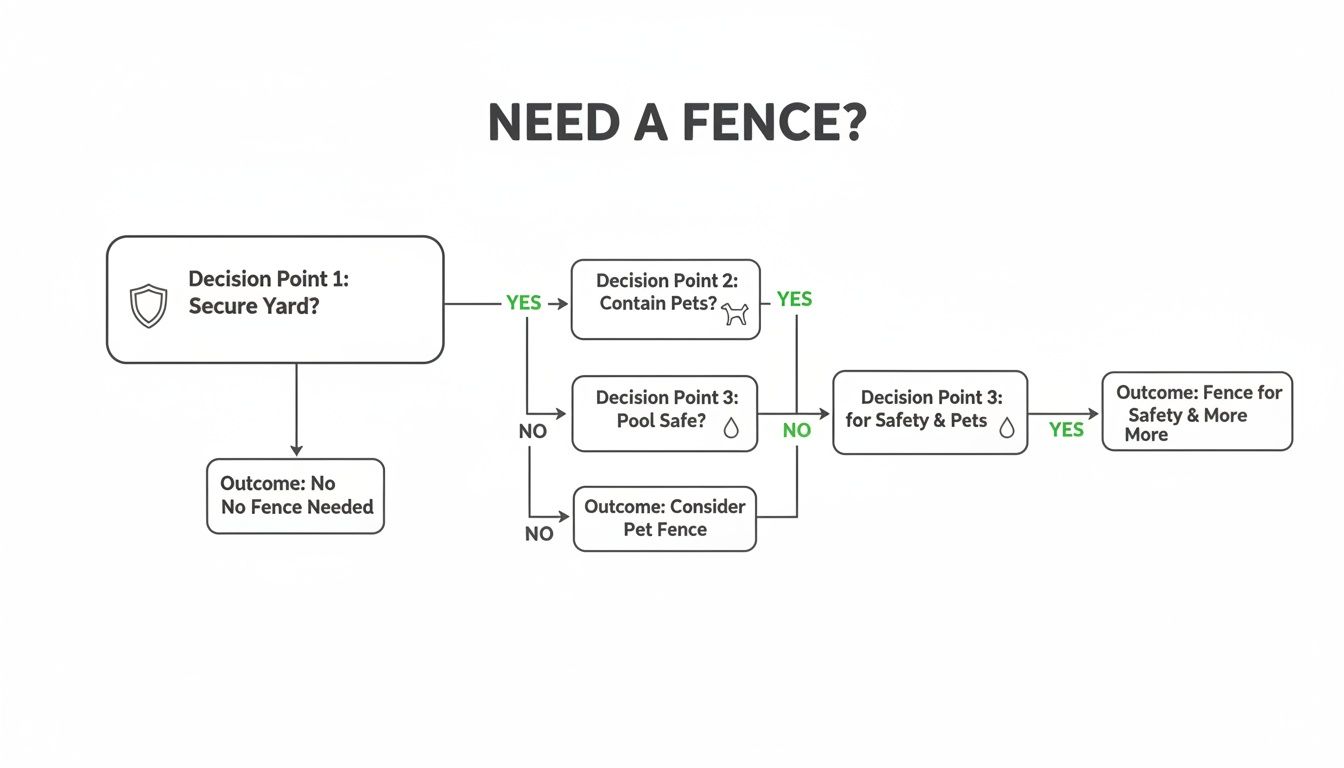
Use this decision tree to pinpoint your primary goal—whether it's containing a pet, securing a pool, or marking a boundary—and guide you toward the material choices that will achieve it.
Budgeting for Your Chain Link Fence Installation
To make a smart investment, you need to understand the real cost of a chain link fence. While known as a budget-friendly option, the final price depends on your property's specifics and your material choices.
The total cost is a calculation, not a flat fee. Key factors include the total length of the fence, its height, your choice of materials, and any site-specific challenges like steep slopes or tree roots.
Breaking Down the Core Cost Factors
To build a realistic budget, understand how each component affects the final quote. Every decision adds to the total.
Linear Footage: This is the primary cost driver. Fencing is priced by the linear foot, so the longer the perimeter, the higher the cost.
Fence Height: Taller fences require more material (longer posts, more mesh), which increases the price. A standard 4-foot fence is significantly more affordable than a 6-foot fence.
Material Choices: As covered, gauge and coating impact the price. A heavy-duty 9-gauge wire costs more than a lighter one, and a black vinyl coating requires a larger upfront investment than a standard galvanized finish.
Real Costs in the Ottawa–Gatineau Region
In the Ottawa-Gatineau area, expect to pay between $15 to $45 per linear foot for professionally installed chain link fencing.
A basic 4-foot galvanized fence will be at the lower end of that range. If you upgrade to a vinyl-coated version for improved aesthetics and weather resistance, the cost will be closer to the $45 per foot mark. For more detailed breakdowns, review our guide on Canadian chain link fence pricing on fencescape.ca.
Actionable Tip: The price per foot is an all-inclusive figure. When getting quotes, confirm that this price covers posts, mesh, top rail, hardware, and professional installation labour to avoid surprise costs.
Other factors that can affect your budget include:
Number of Gates: Each gate adds material and labour costs.
Property Complexity: Fencing on steep slopes, rocky ground, or around obstacles requires more time and effort, increasing the installation price.
Old Fence Removal: If an old fence needs to be removed and disposed of, this service will be added to your quote.
Making Your Project More Affordable with Financing
A new fence is a significant home improvement. At FenceScape, we offer flexible financing options to help manage the cost.
Our programs allow Ottawa and Gatineau homeowners to spread the investment over manageable monthly payments. This makes it easier to get the secure, durable fence you need now without straining your finances. By financing, you can often afford higher-quality materials that offer better long-term value. Learn more about the total price of chain link fences and financing options.
DIY Installation vs. Hiring a Professional Contractor
Once you've decided on a chain link fence, you have a crucial choice: install it yourself or hire a professional. DIY can save money on labour, but a professional installation provides expertise, efficiency, and a guarantee.
To make the right decision, honestly assess your skills, available time, and your property's specific challenges here in the Ottawa–Gatineau region.
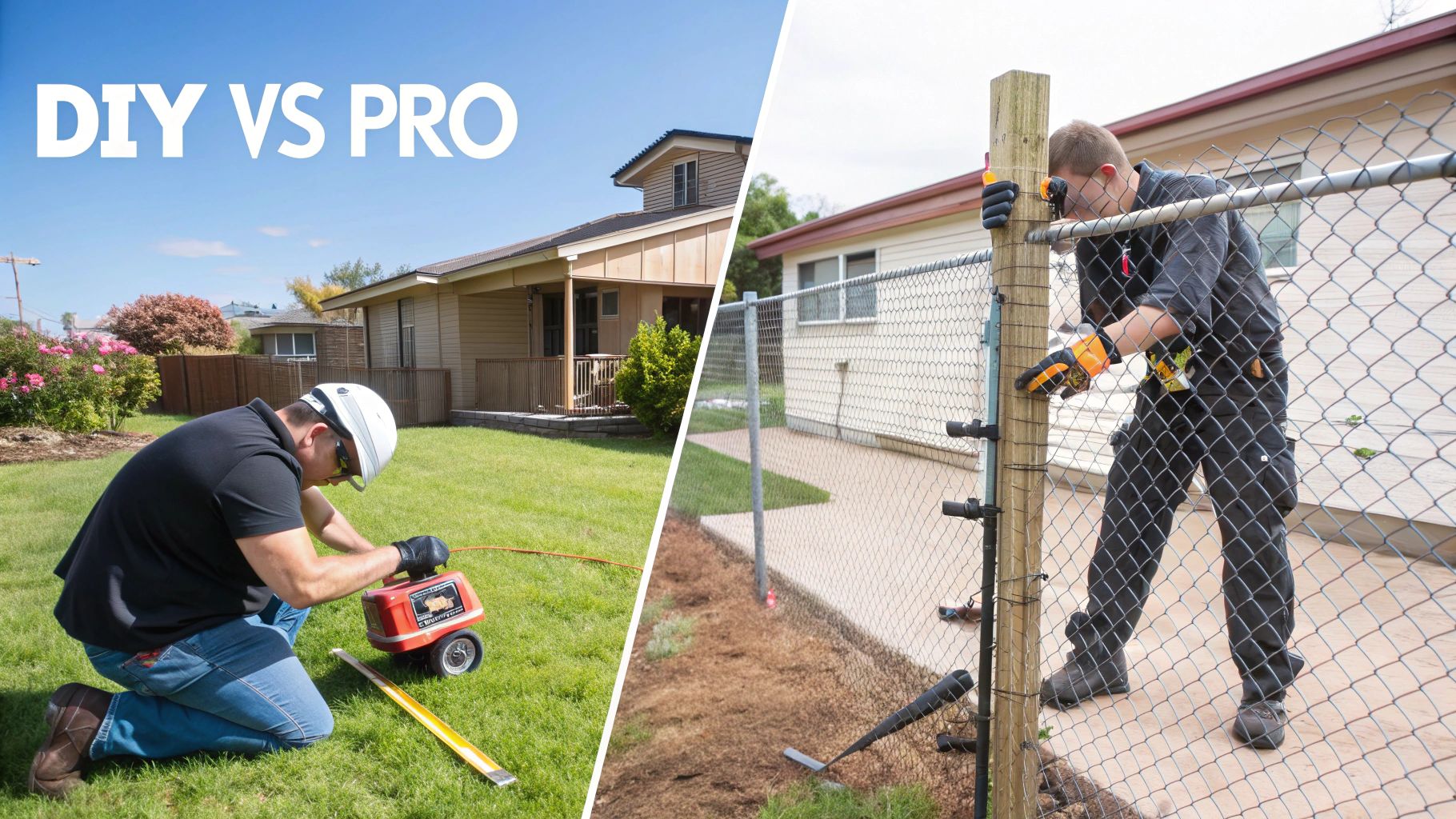
The DIY Approach: What to Expect
Installing a fence can be a satisfying project. The process involves precise layout, digging post holes, mixing and pouring concrete, setting posts perfectly plumb, and stretching the mesh taut.
The main motivation for DIY is saving on labour costs. Your only expenses will be materials and tool rentals, like a gas-powered auger. However, this path is filled with potential mistakes that can lead to costly repairs.
The most critical DIY mistake in our area is not digging post holes deep enough. In Ottawa, you must dig below the frost line—about four feet deep. If you don't, frost heave will push your posts out of the ground, resulting in a wavy, unstable fence.
Another challenge is properly tensioning the mesh. Without a "come-along" stretcher tool and the right technique, you'll end up with a sagging fence that lacks strength and looks unprofessional.
The Professional Advantage: Expertise and Efficiency
Hiring a contractor like FenceScape transforms the experience. Our crews install fences daily. We understand Ottawa's soil conditions, from heavy clay to rock, and have the commercial-grade equipment to handle them efficiently.
Actionable Insight: The value of a professional lies in precision. Pros use specialized tools and experience to ensure every post is perfectly aligned and the mesh is stretched to the correct tension. The result is a fence that is both strong and visually flawless.
Professional installers also manage local compliance. We are experts in Ottawa and Gatineau bylaws, from fence height and setbacks to strict pool enclosure codes. This ensures your project is done correctly and legally from the start, saving you from fines or removal orders.
Making the Right Decision for Your Project
Use this table to weigh your options and decide which path is right for you.
Factor | DIY Installation | Professional Contractor |
|---|---|---|
Cost | Lower upfront cost (materials + rentals only). | Higher upfront cost (materials + labour). |
Time | Can take several weekends or longer. | Typically completed in just a few days. |
Tools | Requires renting or buying specialized tools. | Contractor arrives with all necessary equipment. |
Labour | Physically demanding work for 1-2 people. | Handled entirely by an experienced crew. |
Risk | High risk of mistakes like frost heave or sagging. | Work is often warrantied against installation errors. |
Compliance | You are responsible for knowing all local bylaws. | Contractor manages permit process and ensures compliance. |
The best choice depends on your confidence, time, and property complexity. To understand the full scope of the job, review our guide on how to install a chain link fence.
Keeping Your Fence Strong Through Canadian Winters
The Ottawa–Gatineau climate subjects outdoor structures to punishing freeze-thaw cycles, heavy snow, and summer humidity. A fence must be engineered for this specific environment. Modern chain link fencing is a durable, low-maintenance solution designed for this challenge.
Its strength comes from its materials. Galvanized and vinyl-coated chain link are designed to resist our weather. Galvanization fuses a protective zinc layer to the steel, creating a shield against rust. Vinyl coatings add a tough, waterproof barrier that seals out moisture.
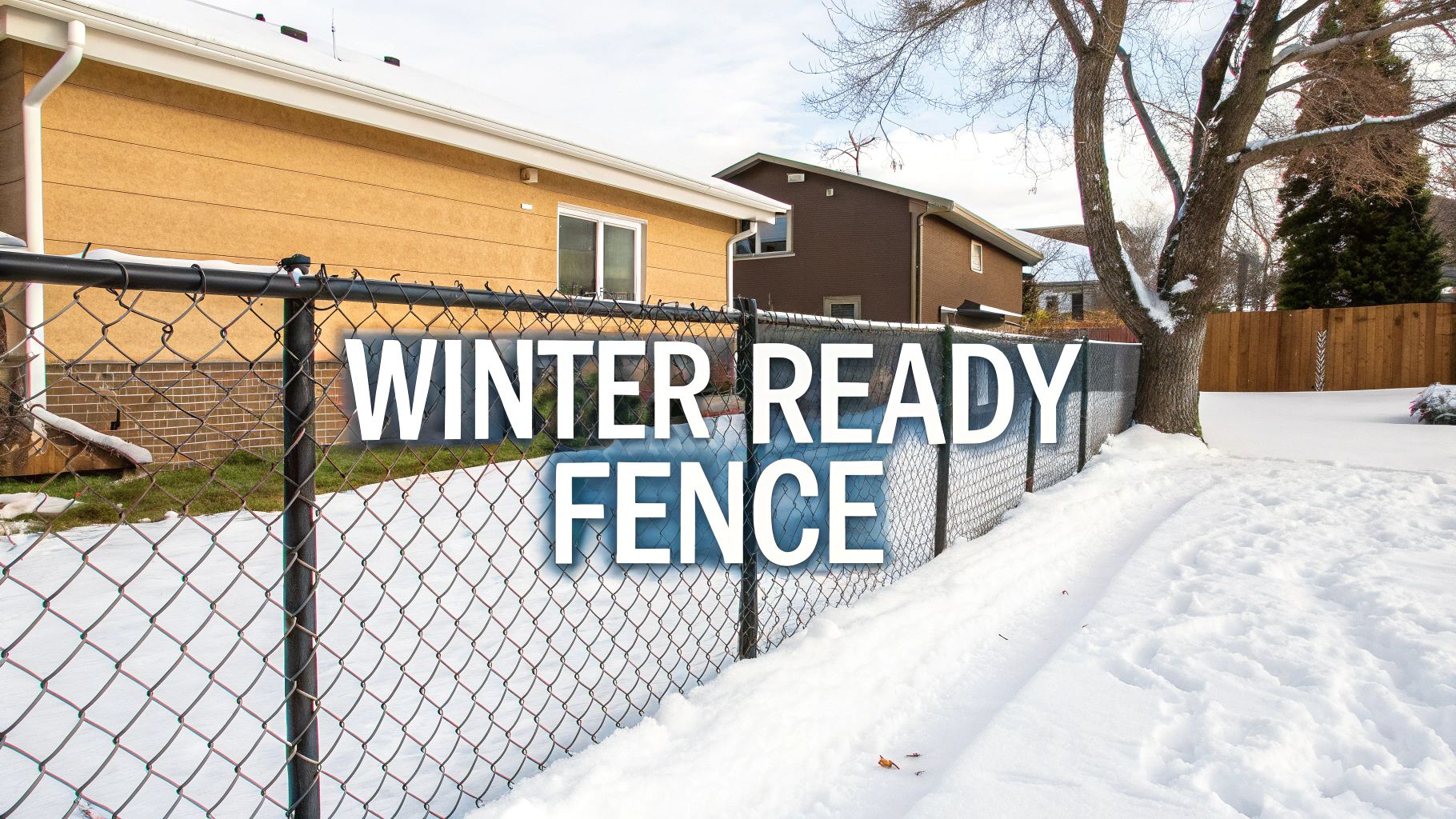
This built-in resilience ensures your fence will last for 20+ years with minimal effort from you.
Simple Steps for Long-Term Durability
Forget the annual sanding and staining required by wood fences. Chain link maintenance is refreshingly simple. An hour or two of your time each year is all it takes to keep it in prime condition.
Follow these practical steps to maximize your fence's lifespan:
Do a Spring Walk-Around: After the snow melts, inspect your fence line. Look for any loose fittings or areas where tension may have shifted. Address these small issues early to prevent them from becoming major problems.
Clear the Base: Remove piles of wet leaves, soil, or snow from the base of the fence. Trapped moisture accelerates corrosion at ground level. Keeping the base clear allows for proper air circulation and drying.
Give It a Quick Wash: Use a garden hose to spray away dirt and grime. For stubborn spots, use mild soap and a soft brush to restore its appearance.
The Beauty of a Simple Fix
Accidents happen. A falling branch or a misplaced bumper can damage even the toughest fence. A key benefit of chain link fencing is its ease of repair. Unlike other fence types, you don't have to replace an entire section if a small area is damaged.
A fencing professional can simply cut out the damaged portion of the mesh and weave in a new piece for a seamless repair. This modular design makes fixes faster, less disruptive, and more affordable than replacing entire panels of a wood or vinyl fence. This is another reason the system is a smart, long-term investment, especially considering factors like our guide to frost depth in Ontario and its impact on fence stability.
Getting Your Fence Project Right: Permits and Local Bylaws
Before installing a chain link fence in Ottawa or Gatineau, you must understand the local bylaws. These rules are mandatory and are designed to ensure neighbourhood safety and consistency. Ignoring them can lead to fines or a demolition order.
Before starting any work, verify your municipality's requirements. Most local rules focus on a few key areas every homeowner must know.
Understanding Key Local Bylaws
While Ottawa and Gatineau have specific fence bylaws, they share common goals: preventing neighbour disputes and ensuring public safety.
Maximum Fence Height: Your backyard fence can generally be taller (often up to 2.1 metres, or 7 feet) than your front yard fence. Front yard fences are kept low to maintain clear sightlines for drivers and pedestrians.
Property Line Setbacks: Your fence must be entirely on your property. Get a recent property survey to confirm your boundaries and avoid disputes.
Corner Lot Rules: Corner lots have stricter rules to ensure traffic visibility. Fences must typically be shorter or set back further from the road.
Actionable Tip: Bylaws are non-negotiable. Don't risk building a fence that is too tall or too close to the property line. It's a surefire way to create stress and conflict with neighbours. Always check with your local municipality before you build.
Special Rules for Pool Enclosures
When chain link fencing is used for a pool enclosure, the rules become much stricter. Municipalities enforce pool safety bylaws rigorously.
Regulations specify a minimum fence height (typically 1.5 metres or 5 feet) and limit the mesh opening size to prevent climbing. They also mandate self-closing, self-latching gates that swing outward from the pool area. Full compliance is mandatory to prevent tragic accidents.
How a Professional Contractor Simplifies Everything
Hiring an expert like FenceScape eliminates compliance headaches. We manage the entire process for you. Our team knows the fence bylaws for Ottawa and Gatineau, including all requirements for pool enclosures.
We handle permit applications and ensure the design is fully compliant before work begins. This gives you peace of mind that your project is done correctly and legally from day one, helping you avoid stress, fines, and future problems.
Got Questions About Chain Link Fencing? We've Got Answers.
You likely still have questions about how a chain link fence will work for your specific property in Ottawa or Gatineau. Here are straightforward answers to the most common questions we receive.
Can You Install a Chain Link Fence on a Slope or Hill?
Yes. This is a major advantage of chain link. The flexible mesh follows the natural contours of your land, eliminating the awkward gaps that rigid panels leave on uneven ground.
For most slopes, we use a technique called "racking," where we adjust the mesh's diamond pattern to flow with the incline. For steeper grades, we may "step" the fence, installing each section slightly lower than the last to keep the top rail level. A site assessment will determine the best method for a professional result.
Is Chain Link a Good Fence to Keep My Dog In?
A chain link fence is an excellent, affordable option for creating a safe space for your dog. Your choice of fence height and wire thickness is crucial.
For Small to Medium Dogs: A 4-foot high fence with 9-gauge wire is usually sufficient. It's high enough to prevent jumping and strong enough to withstand their energy.
For Large, Strong, or High-Energy Dogs: We strongly recommend a 5-foot or 6-foot fence. The extra height deters jumpers. Stick with a heavy 9-gauge wire, as larger dogs can exert significant force on the fence.
Actionable Tip: To stop a determined digger, ensure the bottom of the mesh is installed tight against the ground, leaving no gaps. A professional installation addresses this detail.
What’s the Installation Process Really Like?
Knowing what to expect can eliminate project stress. A professional installation follows a standard process to ensure a durable, long-lasting fence.
On-Site Walk-Through & Quote: We visit your property to take precise measurements, identify ideal gate locations, and discuss material options. This allows us to provide a firm, detailed quote.
Locating Utility Lines: Before we dig, we arrange for all public utility lines (gas, hydro, water) to be marked. This is a critical safety step.
Digging & Setting the Posts: Our crew uses professional-grade augers to dig post holes below the frost line to prevent heaving. Each post is set in concrete and made perfectly plumb and level.
Putting It All Together: After the concrete cures for a day or two, our team returns to attach the hardware and top rail. They then stretch the chain link mesh until it is drum-tight before securing it to the frame.
Final Inspection: We conduct a final walk-through with you to inspect the fence, test the gates, and ensure you are completely satisfied with the work.
This process guarantees that every step is handled correctly, from the initial measurement to the final professional finish.
Ready to see how a chain link fence could work for your home? The team at FenceScape is here to help you plan the perfect solution for your property in the Ottawa–Gatineau area. Contact us today for a free, no-obligation estimate.
Comments