
Your Guide to Frost Depth in Ontario
- Eric Lafleche
- Dec 4, 2025
- 13 min read

Before you grab a shovel for that new fence or deck, let's talk about the powerful, unseen force that determines if your project will last. The frost depth in Ontario isn't just a technical term; it's the critical measurement you must respect to prevent your work from failing after a few harsh winters.
For most of the province, your starting point is a minimum depth of 1.2 metres (4 feet). Treat this as the non-negotiable baseline for any stable construction in our climate.
Why Frost Depth Is a Big Deal for Construction in Ontario
When water-soaked ground freezes, it expands with incredible force—a process called frost heave. This happens when moisture in the soil freezes into layers, known as ice lenses. As these lenses grow, they exert enough upward pressure to lift concrete slabs, crack foundations, and shove fence posts right out of the ground.
If the footings for your deck, fence, or addition aren't dug deep enough to sit below this annual freezing zone, they become victims of this cycle. The structure gets pushed up during the winter freeze and then settles back down—often unevenly—when the spring thaw arrives.
The Sheer Power of Frost Heave
This repeated movement, year after year, leads to predictable and expensive damage:
Warped Decks: Boards buckle, and the entire structure becomes unlevel and unsafe.
Leaning Fence Posts: Your straight fence line turns into a wavy, unstable mess.
Cracked Foundations: For larger structures, this pressure can cause structural cracks, creating a cascade of costly problems. A solid grasp of understanding common foundation problems is crucial for any homeowner.
To give you a clearer picture, here's a quick rundown of what's at stake.
Frost Heave Risks at a Glance
Structure Type | What Happens If You Ignore Frost Depth | Actionable Takeaway |
|---|---|---|
Fence Posts | Posts lift out of the ground, leading to a leaning, unstable fence. | Dig post holes below the frost line and use concrete for stability. |
Deck Footings | Uneven lifting causes warped decking and unsafe stairs. | Ensure every footing is set to the locally mandated depth. |
Shed/Garage Slab | The slab can crack, heave in the middle, or tilt significantly. | Use a frost-protected shallow foundation or a full foundation with footings. |
Home Foundation | Cracks in foundation walls, sticking doors/windows, water intrusion. | Never compromise on foundation depth; follow engineer or code specifications. |
Failing to account for frost heave means your structure will be in a constant battle with nature—a battle it’s destined to lose.
An Unseen Force with Costly Consequences
The frost line, or frost depth, is the maximum depth at which groundwater in the soil is expected to freeze. By placing your footings below this line, you anchor your structure in stable, unfrozen ground that’s completely immune to the powerful forces of frost heave.
Ignoring the frost line means your foundation will be in a constant battle with nature—a battle it will eventually lose. Proper depth isn't a recommendation; it's the fundamental principle of durable construction in a cold climate.
Interestingly, historical data shows that frost depths are actually getting shallower, especially in southern Ontario. Studies suggest the average maximum frost depth has decreased by about 15–20% since the mid-20th century. For example, depths in Toronto have gone from around 1.2 metres in the 1950s to about 0.8 metres in the 2000s.
While this shift points to a changing climate, it doesn't eliminate the risk. Building codes stay conservative for a reason—they're there to protect your investment against those unpredictable, once-in-a-decade deep freezes.
Decoding Ontario's Regional Frost Depth Rules
While the old rule of thumb is to dig down 1.2 metres (4 feet), this is not a one-size-fits-all solution for a province as large as Ontario. The difference in winter severity from Windsor to Timmins directly impacts how deep you need to set your footings.
Think of the Ontario Building Code (OBC) as setting the absolute minimum safety standard. For much of Southern Ontario, that 1.2-metre depth works for unheated structures like decks and fences. But the crucial takeaway is this: the OBC is just the starting point.
Your local municipality has the final say. They can enforce stricter requirements based on local climate data and soil conditions. That’s why a footing depth that’s perfectly fine in Toronto might lead to a heaved disaster in Ottawa.
Why Your Postal Code Matters for Frost Depth
The contrast between Southern and Northern Ontario is stark. In the Greater Toronto Area (GTA), the 1.2-metre standard is pretty reliable. But as you head north or east, the winters get longer and colder, driving that frost line much deeper.
In the Ottawa–Gatineau region, for example, the required depth is typically 1.5 metres (5 feet). That extra foot is a critical buffer against the area’s more extreme freeze-thaw cycles. Go further north to places like Sudbury or North Bay, and you must dig to 1.8 metres (6 feet) or even deeper.
The most important thing to remember is this: The Ontario Building Code provides a minimum requirement. It's your local municipal building department that holds the final, legally binding authority on frost depth for your specific address. Don't guess—always check.
What's really interesting is how climate change has started to affect this. Historical data shows that frost penetration isn't what it used to be, yet the building codes rightly remain conservative to protect homeowners from those once-in-a-generation cold snaps.

This graph makes it clear that we're seeing a trend toward shallower frost, but building codes are designed for resilience, not just for the average year.
A Practical Guide to Regional Requirements
Use this table as an informational guide, but always confirm with your local building office before a single shovelful of dirt is moved. Your first step for any project—from a single fence post to a full addition—should be to call them and ask: "What is the required minimum footing depth for an unheated structure in this municipality?"
Typical Frost Depths Across Key Ontario Regions
Region / Major City | Typical Minimum Frost Depth (Below Grade) | Actionable Advice |
|---|---|---|
Southern Ontario (GTA, Hamilton) | 1.2 m (4 ft) | Use 4 feet as your baseline for planning, but verify with your municipality. |
Eastern Ontario (Ottawa, Kingston) | 1.5 m (5 ft) | Plan to dig to 5 feet; this region's colder winters demand deeper footings. |
Northern Ontario (Sudbury, North Bay) | 1.8 m (6 ft) or more | Expect to dig at least 6 feet deep due to severe, prolonged winters. |
Southwestern Ontario (Windsor, London) | 1.2 m (4 ft) | Generally milder, but still call your local office to confirm the 4-foot standard applies. |
Getting that official answer is the single most important step you can take. It will save you from costly rework, failed inspections, and the headache of watching your brand-new project heave out of the ground after the first winter. It’s the only way to build with confidence.
How Site Conditions Change Your Frost Depth
The local building code's minimum depth is your baseline, but the unique conditions of your property can demand you go deeper. Your soil type, water drainage, and ground cover can dramatically change how cold penetrates the ground, potentially making a standard footing depth insufficient.
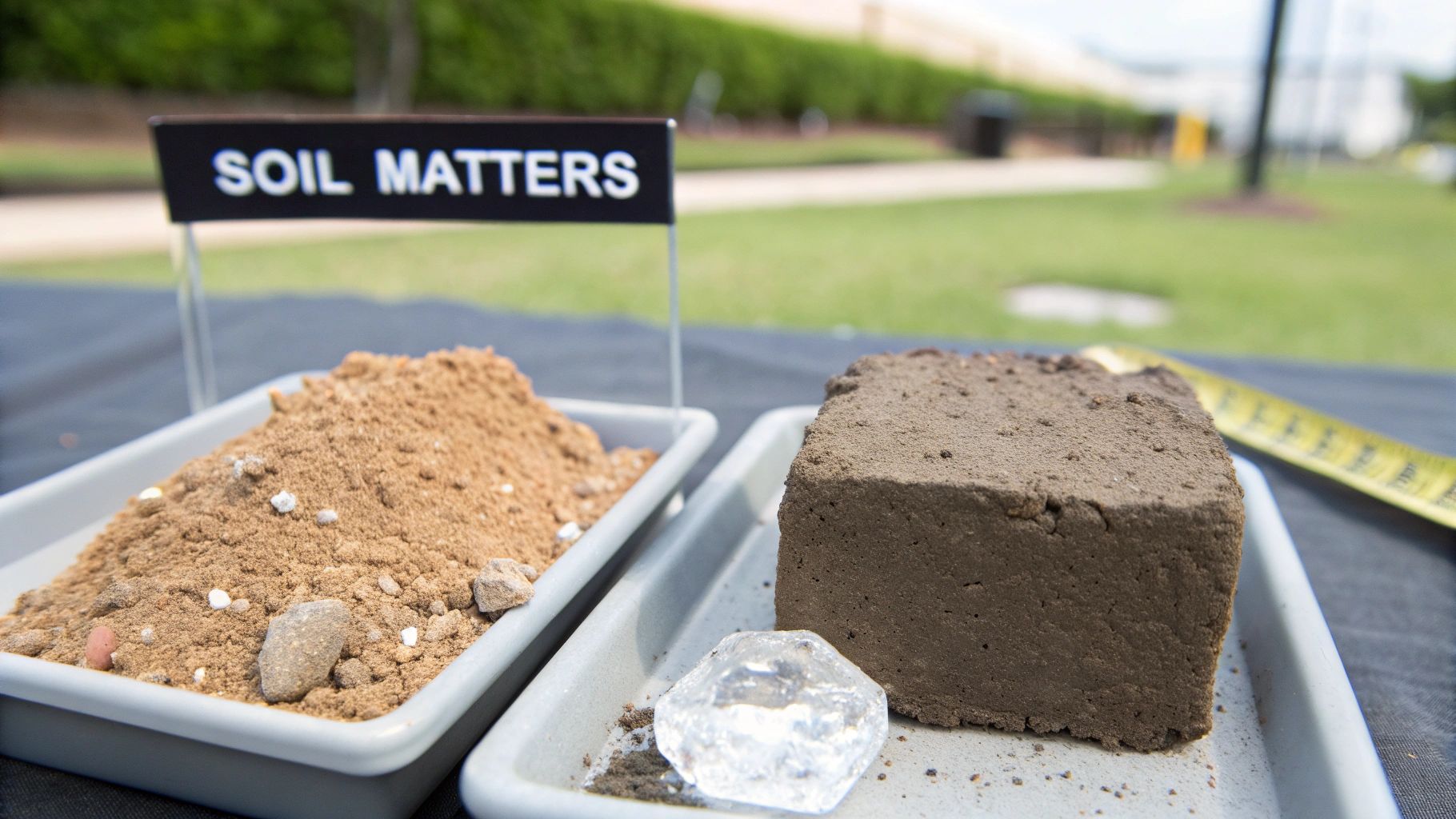
Think of your soil as a winter coat for the ground. Some coats are thick and insulating, while others offer little protection.
The Role of Soil Composition
Different soils conduct or resist cold at different rates. This "thermal conductivity" is a huge factor in where your property's frost line will settle.
Sandy or Gravelly Soil: Water drains well, but the loose structure allows cold air to penetrate deeply. Actionable Insight: If your soil is sandy, consider digging 6-12 inches deeper than the minimum requirement as a safety buffer.
Dense Clay Soil: Clay holds water tightly (making it prone to heave) but its density acts as a better insulator. The frost line may be shallower, but the risk of heave is greater. Actionable Insight: For clay soils, focus on ensuring footings are wide enough (bell-shaped at the bottom) to resist uplift.
Organic Soil: Loamy soil's performance lands between sand and clay.
Loose, well-drained soil freezes deeper and faster. Dense, heavy soil can slow the frost's advance. This is why a property with sandy soil might need deeper footings than a neighbouring lot with heavy clay, even in the same city.
Water Content and Saturation
Water is the fuel for frost heave. A yard with poor drainage is a recipe for severe frost-related problems.
Saturated soil is the engine of frost heave. The more water your ground holds, the more powerful the upward force will be when that water freezes and expands into ice lenses, threatening the stability of any structure built upon it.
Low-lying areas, spots near downspouts, or properties with a high water table will experience much more aggressive freezing. Actionable Insight: Before you build, improve your site's drainage. Regrade the soil away from your foundation, extend downspouts, and consider installing a French drain to keep water away from your footings. Many large-scale jobs, like those discussed in our guide to fencing for construction sites, must account for site drainage from day one.
The Insulating Power of Snow and Ground Cover
What’s on top of the ground matters just as much as what’s in it. Snow acts as a natural thermal blanket.
A consistent layer of snow, even just 15-20 centimetres, can insulate the ground and prevent deep frost penetration. In contrast, an area that’s shovelled or plowed all winter—like a driveway or walkway—loses that protective layer. This exposed ground will freeze much deeper than the undisturbed, snow-covered lawn beside it. Actionable Insight: For footings near cleared areas, consider adding extra depth or insulation to compensate for the lack of snow cover. A comprehensive five-year Ontario study supports this, showing a direct link between the air freezing index and frost penetration on cleared surfaces. You can dig into the full findings from the freezing index research in southern Ontario.
Choosing the Right Foundation for Ontario Winters
Once you know your required frost depth, you need to choose the best strategy to beat frost heave for your project. Building a frost-proof foundation isn’t just about digging a deep hole; it’s about choosing the smartest method for your specific needs.
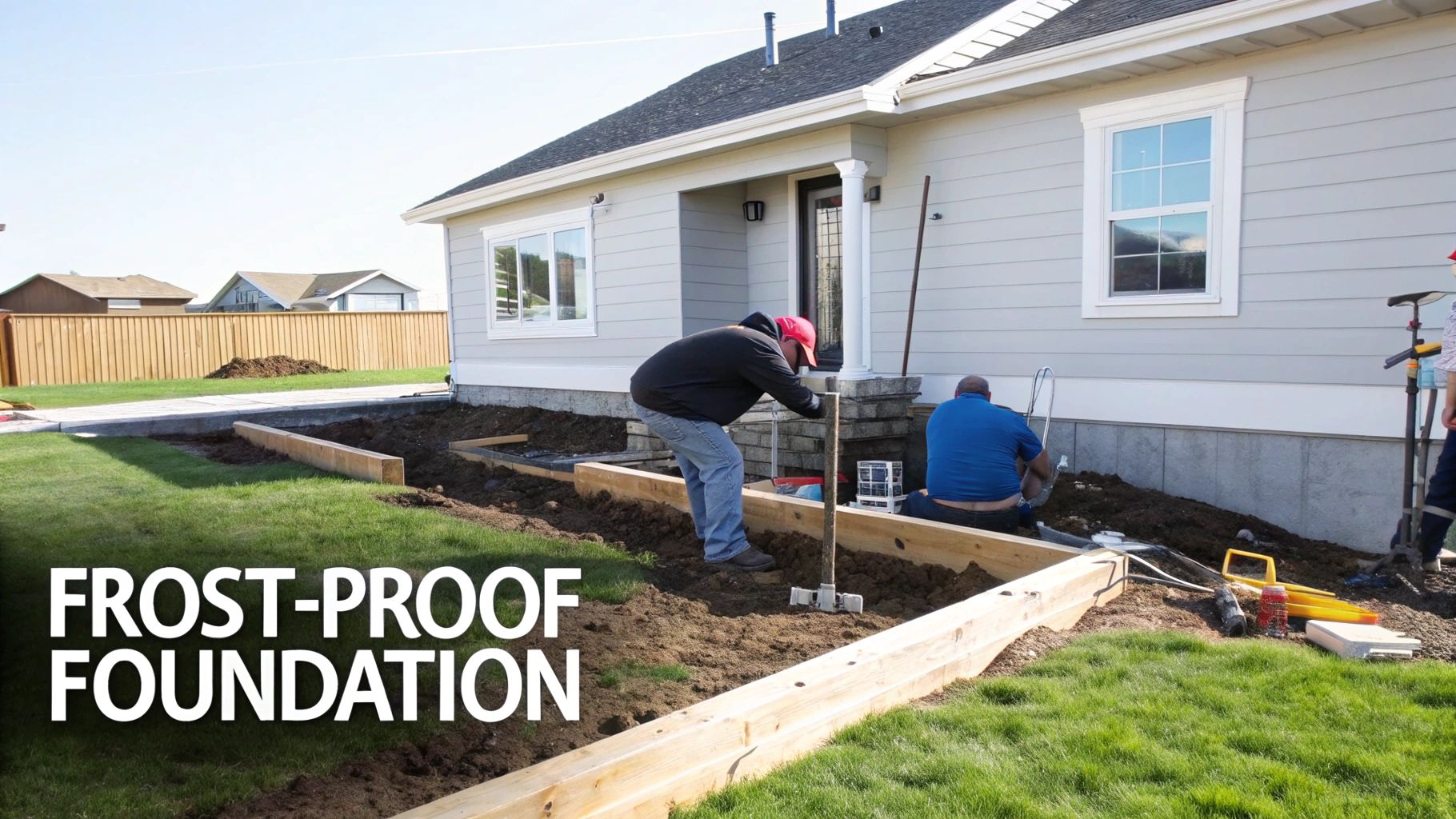
While traditional concrete piers are a reliable workhorse, modern alternatives can save time, minimize mess, and provide superior stability.
Traditional Concrete Piers
The most common approach: dig a hole below the local frost line—usually 1.2 to 1.5 metres deep—and fill it with concrete. This creates a solid anchor in stable, unfrozen ground where frost heave can’t reach.
When to Use It: Ideal for decks, additions, and any structure where digging is straightforward and you have time for the concrete to cure.
How to Do It Right: Use a cardboard form tube (like Sonotube) to create a smooth surface that frost can't grip. Bell out the bottom of the hole to create a wider foot that resists being pulled upward.
Helical Piles: A Modern Solution
Helical piles are essentially giant steel screws. A specialized machine twists them deep into the ground, past the frost line, until they hit soil strong enough to carry the load. Installation is quick, often done in a day with almost no excavation.
When to Use It: Perfect for tricky sites with limited access, existing landscaping, or poor soil conditions where a traditional pier might fail.
Key Advantage: Because they are installed to a specific torque pressure, you get engineered, verifiable stability the moment they’re in the ground. You can start building immediately with no waiting for concrete to cure.
Because helical piles are installed to a specific torque pressure, you get engineered, verifiable stability the second they’re in the ground. There's no waiting around for concrete to set, so you can get right to building.
Frost-Protected Shallow Foundations
This technique uses high-density rigid foam insulation to control the frost line itself. By laying "wings" of insulation horizontally around the base of a shallow foundation, you trap the earth's natural warmth, preventing the ground beneath from freezing.
When to Use It: An excellent option for garages, additions, and cottages. It dramatically reduces digging, saving time, money, and the hassle of removing excavated soil.
How It Works: The insulation effectively raises the frost line, keeping the soil beneath your structure stable all winter long. Proper engineering and installation are critical.
Beyond just depth, thermal performance is a key part of the equation. For example, boosting the insulation value of concrete block walls is a related concept that can greatly improve a foundation's ability to resist the cold and minimize frost-related issues.
Making the Right Choice for Your Project
So, which one is for you? It really boils down to your project's size, your budget, and what your property is like. Each of these methods offers a solid path to a frost-proof structure, as long as it's done right.
Foundation Comparison for Ontario Projects
Foundation Type | Ideal Use Cases | Key Advantage | Key Disadvantage |
|---|---|---|---|
Concrete Piers | Decks, fences, home additions, sheds | Widely understood and cost-effective | Labour-intensive, slow curing time |
Helical Piles | Cottages, difficult terrain, sloped lots | Fast installation, minimal site impact | Higher initial cost, requires specialists |
Shallow Foundations | Garages, additions, unheated buildings | Reduced excavation and labour | Requires precise engineering |
At the end of the day, investing in a proper foundation is the single most important thing you can do. It’s what guarantees the longevity and safety of your structure, protecting your hard-earned investment from the incredible forces of an Ontario winter. A quick chat with a professional contractor or engineer can help you pick the perfect solution for your property.
The Impact of Climate Change on Foundation Standards
With winters getting milder, it's tempting to ask: can we get away with shallower foundations? It seems logical, but betting on this trend is a risky, short-sighted gamble.
The Problem with Averages Is Volatility
Climate change isn't just about a gentle rise in average temperatures; it's about a massive increase in weather volatility. While the average winter might be milder, we are also seeing more extreme weather events, including sudden, brutal cold snaps that can drive frost deep into the soil.
A foundation that’s fine for five mild winters could be completely wrecked during the sixth when a polar vortex hits. This is precisely why building codes have not relaxed their standards.
Adhering to today's foundation standards isn't about building for the past; it's a critical, forward-thinking strategy for future-proofing your investment against an unpredictable climate. The code is designed for resilience, not just for the average year.
Shifting Seasons and Lingering Risks
Climate projections show that Ontario's weather patterns are shifting. The frost-free season (FFS) has already stretched by about 10–15 days since the 1980s and is projected to grow by another 20–30 days by the 2050s. You can dig into these climate model findings for Ontario on lamps.math.yorku.ca for more detail.
While this means shallower average frost depths, the risk of a deep freeze doesn't just vanish—it just becomes less frequent. This new climate reality actually makes older homes, built to less stringent historical standards, even more vulnerable.
The Actionable Takeaway: Build for Resilience
The smartest, safest, and most cost-effective action you can take is to treat the current building code as your absolute minimum. Don't view the rules as outdated. See them as your best defense against a future we can't fully predict.
Digging to 1.2 or 1.5 metres today ensures your structure will stand strong for the next 50 years, no matter what climate volatility throws its way. Trying to save a little cash by cutting corners on your foundation depth is just building an expensive problem into your project right from the start.
Alright, you've learned about regional differences, soil types, and all the ways frost can wreak havoc on a project. Now it's time to get the one number that really counts for your property. General guidelines for frost depth in Ontario are a great starting point, but they won't pass a building inspection.
The good news? Finding the official, legally required depth for your footings is surprisingly straightforward.
Your local municipal building department is the ultimate authority on this. They set the construction standards for your area, and their word is final on how deep you need to dig to avoid frost heave.
The One Call You Need to Make
Before you even think about renting an auger, your first step should be to get in touch with your municipality's planning or building services department. Often, a quick phone call or a few clicks on their website is all it takes.
When you get a hold of someone, be direct. Ask them, “What is the minimum required footing depth for an unheated structure at my address?” They'll give you the exact measurement you need to follow. This is the only number that matters for legal compliance and building a structure that lasts.
Online charts and regional maps are fantastic for planning, but they aren't legally binding. Your local building code dictates the exact frost depth for your project, so a quick call to your municipality isn't just a good idea—it's essential.
When to Hit Pause and Call an Expert
The number the building department gives you is the minimum. But sometimes, the conditions on your specific property mean you need to do more than the bare minimum. If you run into any of these red flags, it's time to put down the shovel and consult a professional.
Tricky Soil Conditions: Is your soil incredibly loose and sandy? Or is it mostly rock? A standard footing might not be the right solution here.
A High Water Table: If the ground is constantly wet, swampy, or just drains poorly, you're looking at a much higher risk for serious frost heave.
Complex Projects: Planning a big addition, building on a steep hill, or designing a structure with an unusual shape? These situations demand a professional eye.
This is where a geotechnical engineer becomes your most valuable player. They can come out, assess your property's unique soil and water conditions, and give you a specific recommendation that ensures your foundation will be stable for the long haul.
For any complex fence installations, or if you're just not sure about your property's soil, getting professional advice is always the smart move. You can always reach out to our team at FenceScape for a consultation to walk through your project's needs. Taking that extra step gives you the confidence to build something that's not just safe and compliant, but truly built to last.
Common Questions About Frost Depth in Ontario
When you're planning a backyard project in Ontario, figuring out the rules around frost depth can feel a bit confusing. Let's clear up some of the most common questions people have.
How Deep Do Deck Footings Need to Be in Ontario?
For any deck that attaches to your house or is large enough to require a building permit, your footings must go below the local frost line. For most of Southern Ontario, this means a minimum depth of 1.2 metres (4 feet). This is not optional. The pressure from frost heave can lift the deck and damage your home's foundation. Your first step is always to confirm the exact requirement with your local municipal building office.
Does My Small Shed Need Footings Below the Frost Line?
For most small sheds—typically structures under 10 square metres (108 square feet)—you can often use a floating foundation without a permit. This is usually a well-prepared gravel pad that allows the shed to move with the ground's natural freeze-thaw cycle. However, if you plan to build a larger shed, pour a concrete slab, or run permanent electricity to it, you will almost certainly need a permanent foundation with footings below the frost line. Check your local by-laws to be sure.
A floating foundation is perfectly fine for small, simple structures. But once a building is large enough to be considered a permanent "accessory structure" by your municipality, you can bet it will need proper footings anchored below the frost line to stay put.
Are Helical Piles a Good Choice for Our Climate?
Absolutely. Helical piles are a fantastic, code-approved alternative to traditional concrete footings in Ontario. A professional installer uses hydraulic equipment to screw the steel piles deep into the earth, past the frost line, until they hit solid, load-bearing soil. Their key benefits are speed of installation, minimal yard disruption, and the ability to build on them immediately, making them a great choice for decks, additions, and cottages, especially on difficult sites.
What's the Worst That Can Happen If My Footings Are Too Shallow?
If your footings don't go deep enough, they become a prime target for frost heave. As moisture in the soil freezes, it will push your footings upward with incredible force. The result is a cycle of damage: tilted decks, cracked slabs, and jammed doors and windows. This damage gets progressively worse with each freeze-thaw cycle, leading to expensive and difficult repairs. Getting the depth right from the start is the only way to avoid this.
A strong, lasting fence begins with a foundation that won't budge. At FenceScape, we make sure every single post is set to the proper depth to handle Ottawa’s tough winters, giving you a beautiful and secure fence that lasts. For a free, no-obligation estimate on your project, you can find us online at FenceScape.
Comments