
Metal Post Wooden Fence: An Actionable Homeowner's Guide
- Eric Lafleche
- Jan 15
- 13 min read

We’ve all seen it after a harsh Ottawa winter: that once-straight fence now leaning, looking tired and weathered. But here’s the actionable insight—the problem usually isn't the beautiful wood panels you love. It’s the wooden posts rotting away just below the ground. A metal post wooden fence is the permanent fix, blending the classic look of wood with the brute strength of galvanized steel to create a fence that truly lasts. This guide will show you how this hybrid design provides an indestructible backbone, protecting your investment for decades to come.
Why Your Wooden Fence Fails and How to Fix It for Good
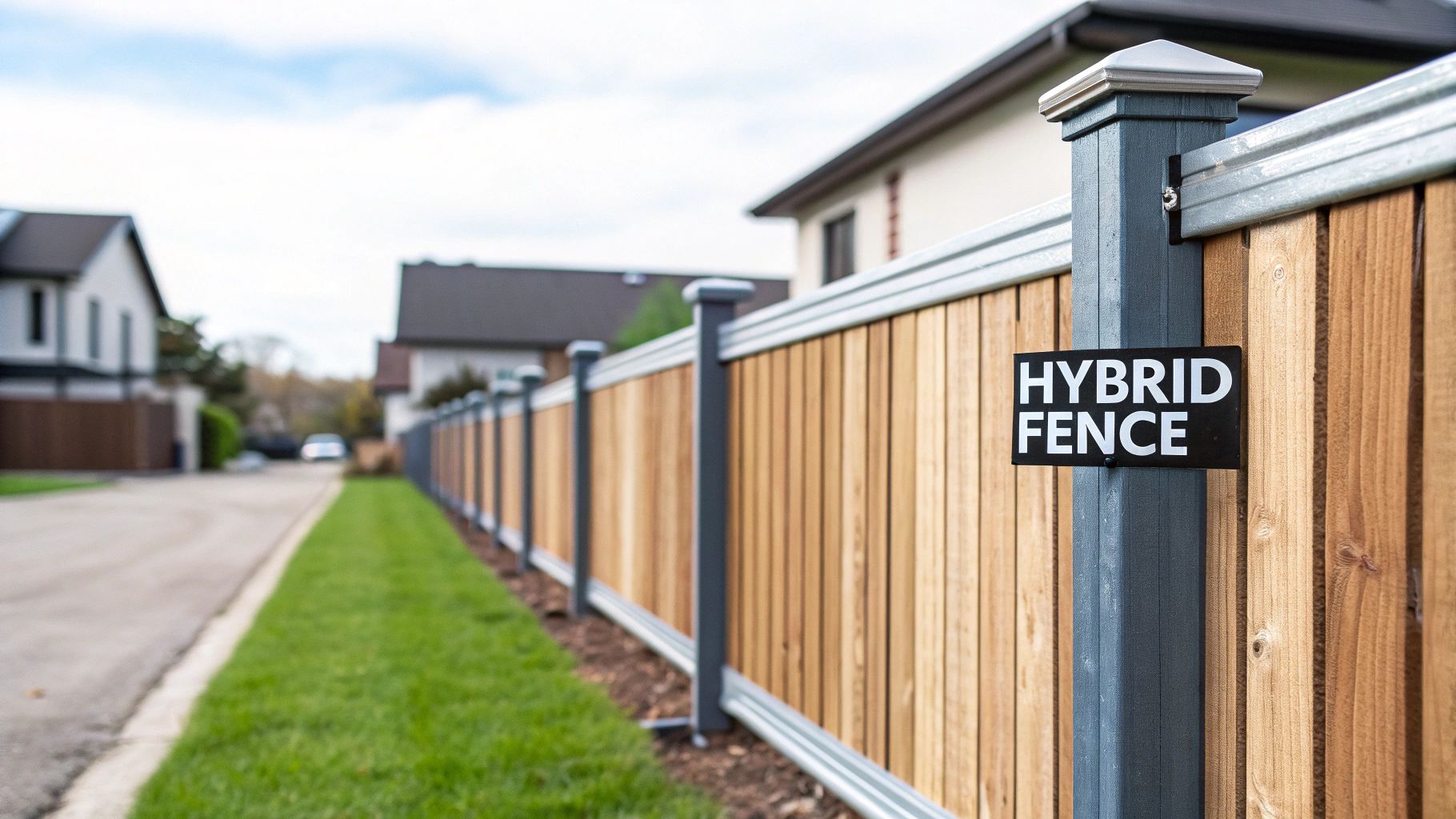
It’s a story we hear all the time from homeowners across the Ottawa–Gatineau region. You spend good money on a gorgeous wooden fence for privacy and curb appeal, and just a few years later, it starts to sag and lean. The culprit is almost always the same hidden enemy: the wooden posts buried in the soil.
Even pressure-treated wood, which is designed to resist rot, can't fight forever. It's in a constant battle with ground moisture, hungry insects, and our region's infamous freeze-thaw cycles. This decay happens quietly, out of sight, until that one day you look out your window and realize your fence line just isn't straight anymore.
The Smart Solution: A Hybrid Fence
Instead of just replacing failing wood posts with more wood posts—and starting the clock on the problem all over again—a metal post wooden fence offers a real, lasting upgrade. Think of it as giving your beautiful fence a steel skeleton. By swapping out those vulnerable wooden posts for galvanized steel, you eliminate the single biggest point of failure without giving up the classic look you wanted in the first place.
This approach gives you the best of both worlds:
The Strength of Steel: Galvanized steel posts simply don't rot, warp, or get eaten by bugs. When set properly in concrete, they create an unshakeable foundation that laughs off high winds and frost heave.
The Beauty of Wood: You still get to enjoy the warm, natural aesthetic of wood panels. Whether you love the rich tones of cedar or the practical appeal of pressure-treated pine, the visible part of your fence remains just as you envisioned it.
This isn't just a repair; it's a permanent enhancement. By getting to the root cause of fence failure, you're making sure your investment stays secure, straight, and beautiful for years. It's about true peace of mind.
Ultimately, opting for a hybrid system is the smartest move for any homeowner who cares about both looks and longevity. It’s a practical, forward-thinking solution that protects your property and boosts its value by building a fence that’s engineered to handle whatever our Ottawa seasons can throw at it.
The Unseen Enemy: Why Wood Posts Fail and Steel Posts Endure
To truly grasp why a metal-post wooden fence is such a game-changer, you must look underground. Think of your fence posts as the foundation of a house. If that foundation starts to crumble, it doesn't matter how beautiful the rest of the house is—the whole thing is in trouble. The exact same principle applies to your fence.
From the moment they go in the ground, traditional wood posts are fighting a losing battle against an invisible enemy: moisture. The soil acts like a sponge, keeping the base of the post constantly damp. This creates the perfect environment for fungus and microbes to thrive, slowly eating away at the wood fibres from the inside out.
Even high-quality, pressure-treated lumber eventually gives in. While the chemical treatments offer a solid defence for a while, they aren’t a permanent shield. After years of being battered by rain, snowmelt, and fluctuating ground temperatures, those protective chemicals gradually leach out, leaving the wood exposed and vulnerable.
How to Spot a Failing Wood Post
A wood post doesn't just snap one day; its failure is a slow, predictable process. It all starts with moisture saturation right at ground level, which is the sweet spot where damp soil and air meet. This zone is ground zero for decay.
Next, insects like termites and carpenter ants are drawn to that softened, damp wood, speeding up the damage. As the post's core integrity weakens, it can no longer support the weight of the fence panels or stand up to a strong gust of wind. That's when you start seeing the classic signs of failure: leaning, sagging, and a general wobbliness.
The freeze-thaw cycles we get here in the Ottawa–Gatineau region just add insult to injury. Water soaks into the wood, freezes, and expands, creating tiny cracks. When it thaws, more water gets in even deeper, and the cycle repeats, relentlessly breaking down the post from within.
A wood fence post doesn't fail overnight. It’s a slow, inevitable decay happening just below the surface, silently undermining your entire fence structure until a strong storm or heavy snow load finally reveals the weakness.
Steel: A Foundation That Simply Lasts
Now, let's swap that wood post for a galvanized steel one. It’s a completely different story because steel is naturally immune to the very things that destroy wood. It's a permanent fix for the problems that have plagued fences for generations.
Impervious to Rot: Steel doesn't rot. Period. It can't absorb moisture, so the fungi and bacteria that feast on wood have nothing to eat.
Insect-Proof: Termites and other wood-boring pests can't make a dent in steel. This eliminates a major cause of post failure right off the bat.
Resistant to Warping: Wood can twist and warp as it absorbs and releases moisture, but steel holds its shape no matter what the weather throws at it.
The galvanization process is the secret sauce. By coating the steel in a protective layer of zinc, it becomes incredibly resistant to rust and corrosion, even after being buried in damp soil for decades. This means the post’s strength is the same on year ten as it was on day one. For a fence to truly last, understanding all aspects of protection is key; exploring sustainable fasteners and protective coatings can offer a deeper look into maximizing durability.
The track record for this hybrid system speaks for itself. Ask any fencing professional, and they'll tell you that the vast majority of fences needing repair are the ones built on old-school wood posts. Our customers who chose a metal-post wooden fence years ago report far lower maintenance hassles because their fences stay straight and strong, season after season. It's a smart upfront investment that pays for itself over the long haul.
Calculating the True Cost of Your Fence Investment
When you're getting quotes for a new fence, it’s natural to focus on the upfront price tag. But to make a smart decision, you must consider the Total Cost of Ownership—what you’ll spend on materials, installation, maintenance, repairs, and eventual replacements over its entire life.
An all-wood fence often looks like the cheaper option at the outset. That initial savings, however, can vanish in a hurry about a decade down the road when you’re paying a crew to dig up and replace a bunch of rotted posts. A metal post wooden fence, on the other hand, puts the investment upfront to save you from those bigger, more frustrating costs later on.
The Upfront Cost Versus Long-Term Value
Let's get straight to the numbers. Choosing galvanized steel posts will increase the initial cost of your project, and there's no way around that. On a per-post basis, steel can cost 40-60% more than wood. A standard 6-foot wood post might run you $15-$25, while a comparable steel post is typically in the $25-$40 range.
This is where you have to look beyond the initial bill. That higher price for steel is a smart financial move when you zoom out and look at the 20-year picture. Wood posts often need to be replaced at least once in that timeframe. Steel posts don't. You’re essentially paying a premium for permanence.
Lifetime Cost Comparison Wood vs Metal Fence Posts (100-Foot Fence)
To see how this plays out in the real world, let's compare the total cost over 20 years for a typical 100-foot privacy fence. This table breaks down the initial installation cost and the almost-inevitable repair costs associated with wood posts.
Cost Factor | All-Wood Fence | Metal Post Wooden Fence |
|---|---|---|
Initial Installation | $5,000 | $6,200 |
Post Replacement (Year 12) | $2,500 | $0 |
Total 20-Year Cost | $7,500 | $6,200 |
As you can see, the all-wood fence, which seemed like the more economical choice, ends up costing $1,300 more over two decades. The "savings" from day one get completely erased by a single major repair job.
A Tale of Two Fences: A Practical Cost Scenario
Imagine two neighbours in an Ottawa suburb. Both decide to install a 100-foot privacy fence.
Neighbour A goes with a traditional all-wood fence to keep the initial cost down. It looks great for the first few years.
Neighbour B spends a bit more for a metal post wooden fence. It looks almost identical, but its backbone is fundamentally stronger.
Now, let’s jump forward 12 years. After a harsh winter with heavy snow, Neighbour A’s fence is leaning badly. Several posts have rotted clean through right at ground level, and the whole structure is compromised. They’re now looking at a costly repair that involves:
Labour Costs: A crew has to come dismantle fence sections, dig out old concrete and rotted wood, and haul it all away.
New Material Costs: They have to buy new posts, more concrete, and fasteners.
Re-Installation: The crew has to set the new posts and try to re-attach the old panels, hoping everything still lines up.
This kind of repair can easily run into the thousands, completely wiping out their initial savings. Meanwhile, Neighbour B's fence is standing just as straight and solid as the day it was installed. Their only cost has been a bit of stain to keep the wood panels looking fresh.
This chart really drives the point home, showing the main reason for long-term fence costs.
The data is clear: wood posts are the overwhelming point of failure, turning them into a recurring expense. Metal posts are a one-and-done solution.
By choosing steel posts, you are essentially pre-paying for your fence's future repairs at a steep discount. You trade a larger one-time investment for decades of structural stability and financial predictability.
When you look at the total cost of ownership, the decision becomes much simpler. That slightly higher upfront price for a hybrid fence isn't just an expense; it’s an investment that pays for itself by eliminating the single most costly and disruptive problem that plagues traditional wood fences.
For a more detailed look at fence pricing, check out our guide to the price of a wood fence to help you budget for your project.
Designing Your Perfect Hybrid Fence: Style and Material Options
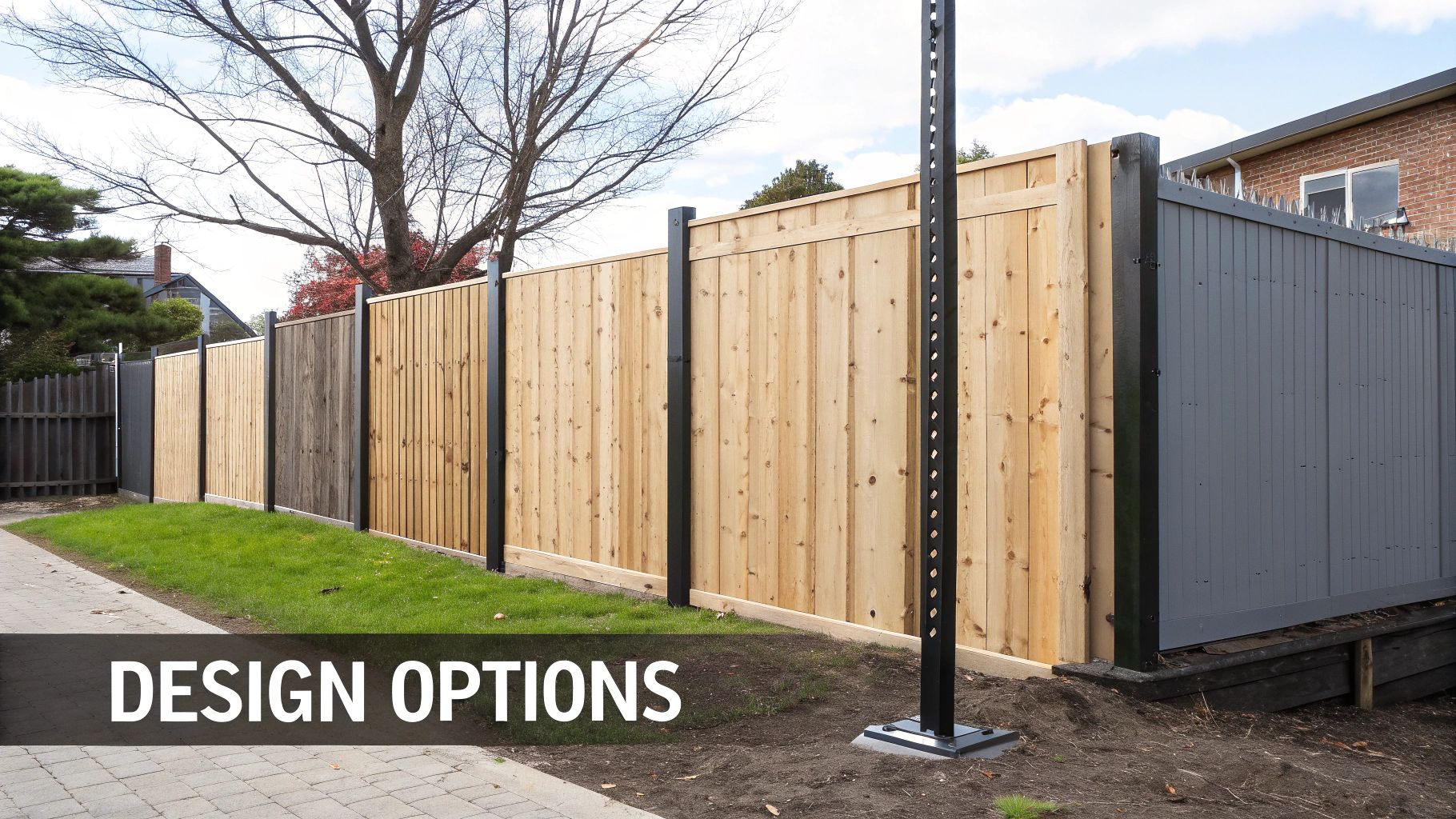
When you hear "metal post wooden fence," don't picture some clunky, industrial barrier. The reality is quite the opposite. This hybrid system gives you incredible design freedom, letting you blend the brute strength of steel with the exact look you want for your property. You are in control, choosing everything from the type of wood to how much (or how little) of the posts you actually see.
The key decision is how to integrate the steel and wood. Are you aiming for a sleek, modern vibe where the posts are part of the aesthetic, or do you prefer a classic wood fence look where the steel does its job behind the scenes?
Choosing Your Wood Panels
The wood panels are the face of your fence—they set the tone, the colour, and the overall character. For the Ottawa–Gatineau area, two options consistently perform best against our weather.
Pressure-Treated (PT) Pine: This is the reliable workhorse of fencing materials. It’s affordable, tough, and chemically treated to fend off rot and pests. It starts with a distinct greenish tint but weathers into a soft grey over time. You can also stain it to get the perfect colour, making it a versatile choice for any budget.
Western Red Cedar: For pure, natural beauty, cedar is the premium choice. It brings a warmth and richness to your yard that's hard to beat. Its natural oils provide built-in resistance to rot and insects, no chemicals needed. While it's a bigger investment upfront, its gorgeous curb appeal and long life make it a worthwhile upgrade.
Your choice of wood is the single biggest factor in your fence's final look. Think about the colour you want today, but also how it will age and complement your home a few years down the road.
Deciding on Your Metal Post Style
Once you’ve selected the wood, it's time to decide on the post style. How the posts integrate with the panels will completely change the fence's personality. You have two main paths to choose from.
The Invisible Post: Seamless and Traditional
If you want the timeless, unbroken appearance of a classic wood fence, ask for an "in-line" or "hidden post" design.
Here's how it works: the galvanized steel posts are set as the core structure, but then they’re completely covered by the fence boards and rails. To anyone looking—from your yard or your neighbour's—it just looks like a beautiful wood fence. You get that classic aesthetic you love, but it’s all held together by a steel backbone that will never, ever rot.
This is the best way to get a traditional look built on a modern, indestructible foundation.
The Visible Post: Modern and Defined
The other option is to embrace the posts and make them a key feature of the design. Using powder-coated steel posts that are left visible creates a crisp, contemporary look with fantastic contrast and definition.
Usually finished in a bold black, these posts act like a picture frame for each wood panel, making the wood's texture and colour pop. This style is a perfect match for modern, transitional, or even craftsman homes where clean lines and mixed materials are already part of the design language. It's a confident look that showcases quality engineering while framing the natural beauty of the wood.
What a Professional Fence Installation Actually Involves
A metal-post wooden fence can easily last for decades, but that longevity isn't a given—it's earned through a proper, professional installation. You can have the best materials in the world, but if the foundational work is sloppy, they won't matter. A great installation is a meticulous process, turning raw materials into a structure that can genuinely withstand anything the Ottawa–Gatineau climate throws at it.
Knowing what to look for helps you ask the right questions, evaluate a contractor’s quote, and spot the difference between a job done right and one that cuts dangerous corners. This isn't just about sticking posts in the ground; it's about engineering a lasting boundary for your property.
Digging Deep: The Non-Negotiable Frost Line
The most critical step in any fence build happens entirely below the surface. Here in our region, the constant freezing and thawing of the ground creates a powerful upward force called frost heave. It’s strong enough to pop a shallow fence post right out of the ground in a single winter, completely wrecking your fence line.
To stop frost heave, your contractor must dig post holes that go well below the local frost line. For the Ottawa area, that means digging down at least four feet (48 inches). This locks the concrete footing into stable, unfrozen soil that won’t move, creating a truly unshakeable foundation.
A post set only two or three feet deep is a ticking time bomb. It might look fine on installation day, but it’s guaranteed to heave and shift. Always confirm your contractor is digging to the proper depth for our climate.
Creating an Unshakeable Anchor with Concrete
Once the holes are dug, it’s time to create that solid anchor. Just backfilling the hole with dirt won't cut it. The post must be fully encased in concrete to give it the stability to support heavy wood panels and stand up to high winds. A solid grasp of residential poured concrete techniques is fundamental to getting this part right.
A professional installation focuses on these key details:
Proper Mixing: The concrete is mixed to the perfect consistency—never too wet or too dry—to ensure it cures to maximum strength.
Post Centering and Plumbing: Each steel post is carefully set in the exact centre of the hole and checked with a level from every angle to make sure it's perfectly plumb (vertically straight) before any concrete goes in.
Curing Time: The concrete needs to cure for at least 24-48 hours before any fence panels are hung. Rushing this step and attaching heavy panels too soon can easily pull a post out of alignment. For an in-depth look, check out our guide on how to properly set a fence post in concrete.
The Art of Attachment: Specialized Brackets and Hardware
The final piece of the puzzle is connecting the wooden panels securely to the steel posts. You can't just drive a screw through the wood into the metal; it requires specialized brackets and fasteners specifically designed for a metal-to-wood connection. These brackets transfer the weight of the panels to the posts and hold everything together against the elements.
Using the right hardware is non-negotiable. Professionals will use galvanized or stainless-steel fasteners that won't rust and leave ugly orange streaks running down your beautiful new fence. The brackets themselves are attached to the posts with self-tapping screws, creating a tight mechanical bond. From there, the wood panels are mounted to the brackets, ensuring a clean, incredibly strong connection that won't sag over time.
Your Questions About Metal Post Fences, Answered
Alright, so you understand the benefits, but you probably still have some practical questions about how a metal post wooden fence really holds up day-to-day. Let's dig into some of the most common questions we get from homeowners just like you.
Can I Hide the Metal Posts for a Completely Natural Wood Look?
Yes, absolutely. In fact, it's one of the most popular ways to build this type of fence. You can achieve this by requesting "in-line" steel posts that are designed to sit hidden between the fence sections. The fence boards and rails overlap just enough to completely cover them up.
The result is the classic, uninterrupted look of a wood fence, but with a hidden steel skeleton giving it incredible strength. From your yard or your neighbour’s, all anyone will see is beautiful wood. It’s the best of both worlds—timeless style backed by a rock-solid foundation.
How Does This Fence Handle Ottawa's Heavy Snow and Frost Heave?
This is where a hybrid fence really shines in our climate. Frost heave is that powerful upward force that shoves fence posts right out of the ground when the soil freezes and expands. A metal post wooden fence is built specifically to win that battle.
The key is depth. We sink our galvanized steel posts at least four feet down, well below the regional frost line, and lock them into a solid concrete footing. The steel post itself is rigid, and that deep anchor creates an unshakeable foundation that simply won't budge under the immense pressure of a deep freeze. Your fence line stays straight and level, winter after winter.
A fence built on deep-set steel posts isn't just surviving Ottawa's winters; it's designed for them. It's a permanent solution to the heaving and shifting that plagues shallower, weaker fence foundations.
Can My Existing Wood Fence Panels Be Used with New Metal Posts?
In many cases, yes! This can be a smart, cost-effective way to get more life out of your fence. If your wooden panels are still in good shape but the posts are rotting at the base, we can perform a sort of "post transplant."
Our crew will carefully detach the fence sections, dig out the failed wood posts and their old concrete, and then install brand-new galvanized steel posts set properly in fresh concrete. Once everything has cured, we re-attach your original panels with sturdy, specialized brackets. This is a great way to restore your fence's strength for a fraction of the cost of a full replacement.
Are Different Colours or Finishes Available for Visible Metal Posts?
They are. For designs where the posts are meant to be seen—like in a modern "picture frame" style—the steel posts come with a tough, powder-coated finish. Think of it as a baked-on suit of armour that looks great and provides excellent protection from the elements.
Black is by far the most popular colour. It creates a timeless, elegant contrast with the warm tones of cedar or pressure-treated pine. That said, other custom colours can often be special-ordered, which lets you perfectly match your home's trim or other outdoor features for a truly cohesive look.
Ready to build a fence that pairs timeless beauty with unbeatable strength? The team at FenceScape specializes in designing and installing high-quality metal post wooden fences that are built for Ottawa's toughest seasons. Contact us today for a free, no-obligation estimate!
Comments