
A Practical Guide to Choosing Wood Fence Styles in Ottawa

Choosing the right wood fence is a functional decision that shapes your property's security, privacy, and curb appeal. The style you select determines not only how your home looks but also how your outdoor space functions. With a range of wood fence styles available—from the open feel of a Picket fence to the complete seclusion of a Board-on-Board design—each offers a distinct solution. This guide provides the actionable insights you need to select the perfect style for your Ottawa home.
How to Choose the Right Wood Fence Style
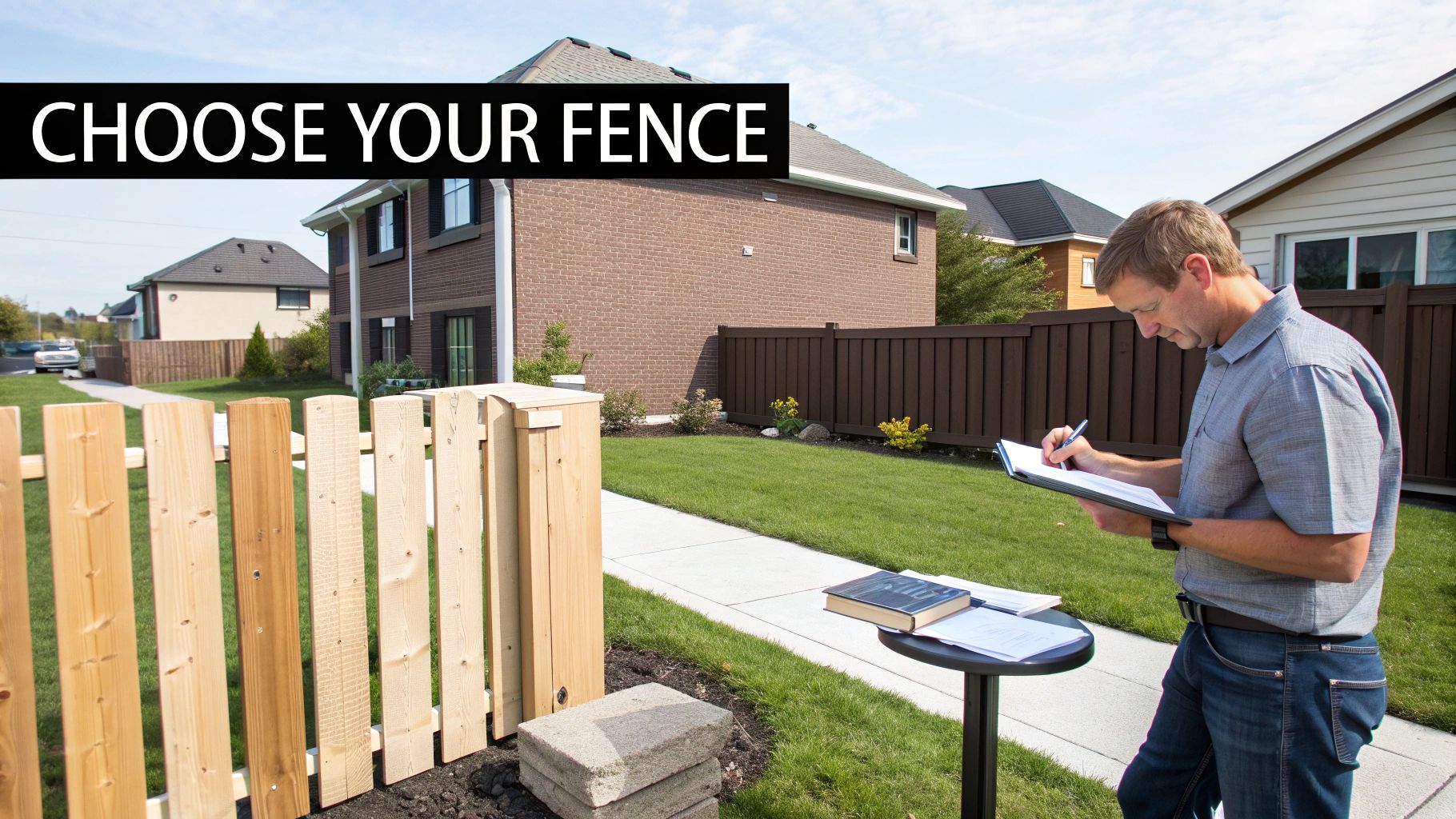
To simplify your decision, start with a single, practical question: "What is the primary job I need this fence to do?" Answering this will immediately narrow your options and point you toward the most effective designs.
Are you trying to create a secure enclosure for children and pets? Is your goal a private backyard retreat, shielded from neighbours? Or is the fence primarily a decorative element to boost curb appeal?
Your primary goal is the most important factor. A fence built for total privacy, like a solid Stockade style, is fundamentally different from a rustic Split Rail fence designed to simply mark a property line. Each style solves a specific problem.
Start with Your Main Goal
To make a confident choice, identify your top priority. Most homeowner needs can be sorted into three distinct categories, each leading to a specific set of wood fence styles.
For Privacy and Security: If your main goal is to create a secluded backyard or a secure perimeter, focus on tall, solid designs. Your best options will be styles that eliminate sightlines and form a robust physical barrier.
For Aesthetics and Curb Appeal: If you want to enhance your home's appearance or define a garden area without creating a visual wall, your search should focus on decorative styles. Look for designs with intentional gaps, distinct patterns, or unique top finishes.
For Budget and Practicality: If your decision is driven by cost, several classic, efficient styles provide durability and a clean look without the higher price of more complex or material-heavy designs.
This decision tree illustrates how defining your primary goal—privacy, style, or cost—streamlines the selection process.
By locking in your main objective, you can filter out unsuitable options and focus on the fence styles that will deliver the best performance for your specific needs.
By first establishing whether your fence is for privacy, style, or budget, you can immediately eliminate unsuitable options and concentrate on the designs that will deliver the most value for your specific situation. This focused approach saves time and ensures you make a confident, well-informed choice.
Exploring the Most Popular Wood Fence Designs
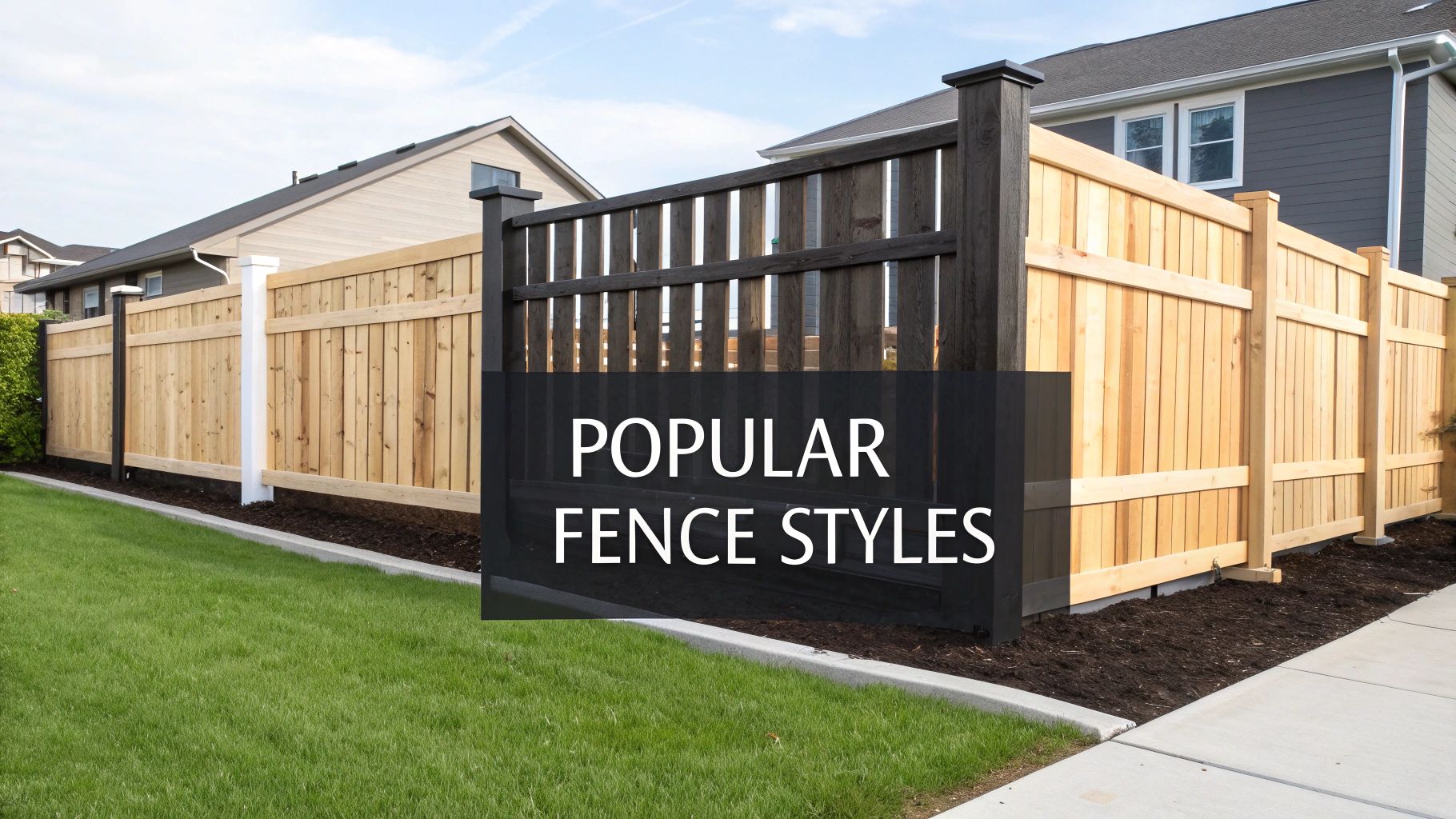
Selecting a wood fence style is a practical choice that defines the functionality and look of your property. Each design serves a different purpose. Let's break down the most popular options to help you determine the best fit for your home.
The Classic Picket Fence
The picket fence is an immediate visual cue for a traditional family home, making it an effective tool for boosting curb appeal. Its evenly spaced vertical boards create a clear boundary without obstructing views, making it ideal for front yards or for sectioning off gardens. While decorative, it also functions as a reliable barrier for keeping small children and pets contained. Its popularity is backed by market data, with picket fences accounting for a significant 40.0% of the wood fencing market revenue due to their versatile and timeless appeal. This design is adaptable to nearly any architectural style, from historic homes to modern constructions.
The Board-on-Board Fence
For homeowners who prioritize complete privacy, the board-on-board fence is the most effective solution. Its design features overlapping vertical boards—one layer attached to the rails, with a second layer covering the gaps. This construction creates a solid, gap-free barrier. This is a crucial feature in Ottawa's climate, as the overlapping design ensures privacy is maintained even when the wood expands and shrinks with seasonal temperature and humidity changes. It is the best choice for backyards, pool enclosures, and properties adjacent to public spaces.
The Shadowbox Fence
The shadowbox fence is a practical compromise between privacy and openness, often called the "good neighbour" fence. Its construction involves attaching pickets to the central rails in an alternating pattern on each side. This means the fence appears identical from both your property and your neighbour's. Viewed head-on, it looks solid, but from an angle, small gaps are visible. This design feature allows light and air to pass through, which reduces the feeling of being "boxed in" and improves the fence's resistance to wind load—a key benefit in stormy weather.
The Stockade Fence
The stockade fence is a cost-effective solution for achieving straightforward privacy. It is built with solid wood pickets placed edge-to-edge, forming a simple yet effective visual screen. The pickets are often designed with pointed tops, which acts as a mild deterrent to climbing and adds a functional security element. While less architecturally detailed than a board-on-board fence, the stockade is a reliable and economical choice for creating a private and secure yard.
Actionable Insight: The real difference between a Stockade and a Board-on-Board fence comes down to how they age. A Stockade fence might develop tiny gaps as the wood shrinks over time. The overlapping design of a Board-on-Board, however, ensures total privacy for the long haul.
The Horizontal Fence
For a modern aesthetic, the horizontal fence is a top choice. Boards are installed horizontally, creating clean, linear lines that can make a space feel wider and more contemporary. This style is an architectural feature in itself and is highly effective for privacy. The spacing between boards is fully customizable, allowing you to control the balance between seclusion and visibility. For those interested in this aesthetic, related timber decking balustrade ideas often complement this modern style.
Customization: You control the privacy. Adjust the spacing between boards from zero-gap for total seclusion to wider gaps for a more open feel.
Visual Impact: The strong horizontal lines draw the eye across the landscape, which works wonderfully with modern garden designs.
Durability: Don't let the different orientation fool you. When built correctly, a horizontal fence is just as strong and long-lasting as any vertical style.
The Split Rail Fence
To achieve a rustic, pastoral look, the split rail fence is the most authentic choice. Composed of rough-hewn posts and two to four horizontal rails, its purpose is boundary definition rather than creating a barrier. This makes it ideal for large properties or homes where preserving open views is a priority. Due to its minimal material usage and simple construction, the split rail is one of the most budget-friendly wood fence styles available. It integrates seamlessly into natural landscapes.
The Lattice Top Fence
A lattice top fence is a functional hybrid, combining a solid privacy base with a decorative, semi-transparent top section. The lower portion is typically built as a stockade or board-on-board fence, providing seclusion, while the top foot or two features a crisscross lattice pattern. This design element makes a tall privacy fence feel less imposing by allowing light to filter through. It also provides a practical trellis for climbing plants, helping to integrate the fence into your garden landscape.
Choosing Wood That Can Handle an Ottawa Winter
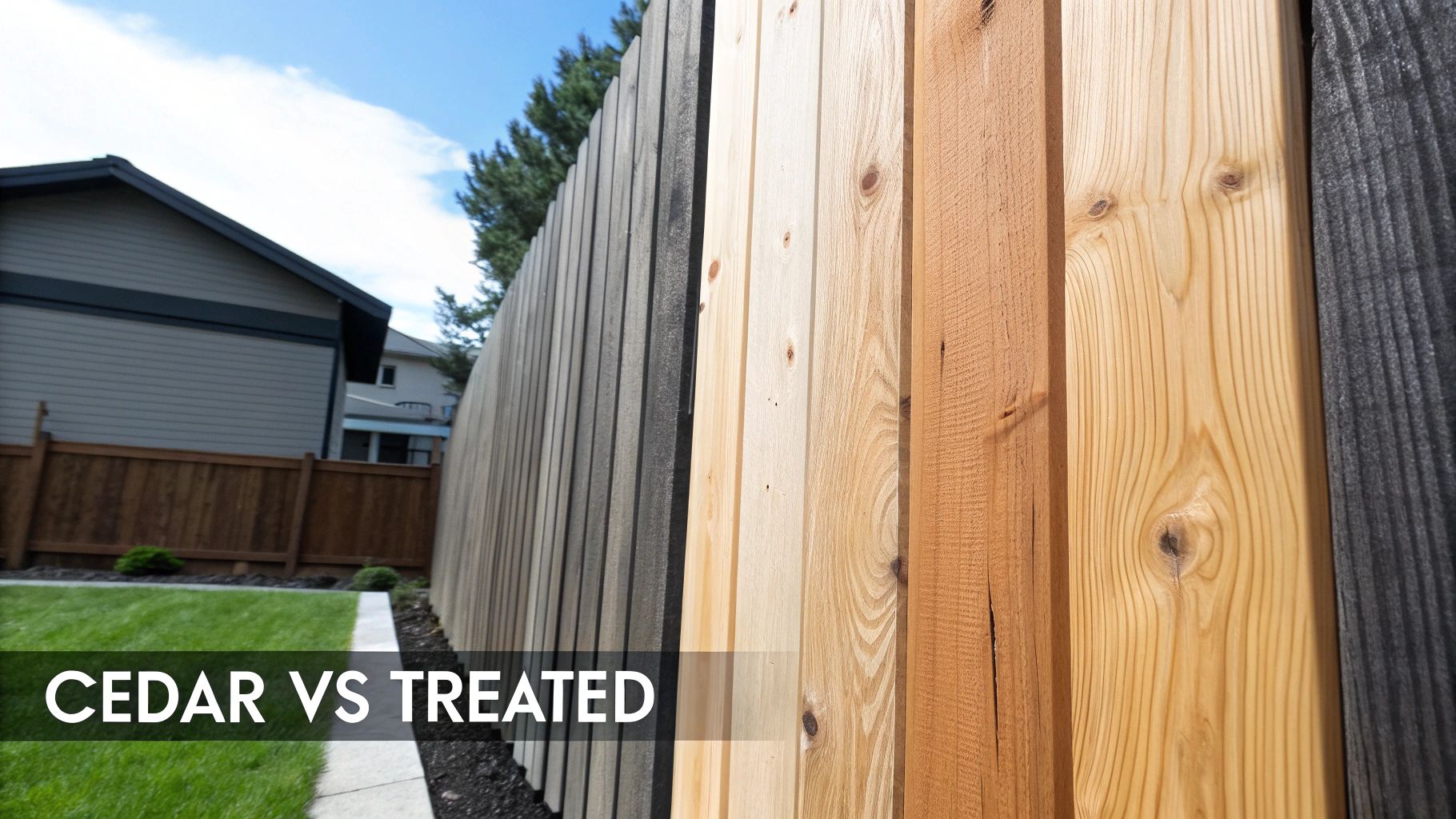
While fence style determines the look, the choice of wood determines its longevity. In Ottawa's harsh climate—with its cycle of heavy snow, freezing rain, and summer humidity—selecting the right lumber is a critical investment in your property's infrastructure. The choice typically comes down to two proven performers for our region: Western Red Cedar and Pressure-Treated (PT) Pine. Understanding their practical differences is key to building a fence that lasts.
The Natural Strength of Western Red Cedar
Western Red Cedar is the premium choice for wood fencing due to its inherent durability. It contains natural oils and tannins that make it resistant to rot, decay, and insects without chemical treatments. Aesthetically, cedar features a straight grain and rich, warm colour tones. If left untreated, it weathers to a desirable silvery-grey. Although cedar has a higher upfront cost, its impressive lifespan of 20 to 30 years or more often results in a lower total cost of ownership, making it a sound long-term investment.
Cedar's natural resistance means you're investing in the wood's own integrity, not just a chemical coating. This usually leads to a longer life and a fence that ages gracefully, adding value to your home over time.
The Workhorse: Pressure-Treated Pine
For a budget-conscious yet durable option, Pressure-Treated (PT) wood, typically pine, is the standard. The wood is infused with chemical preservatives under pressure, providing a robust defence against rot and insects common in Ottawa's climate. While new PT wood has a greenish tint that fades over time, it is a proven performer with a typical lifespan of 15 to 20 years. To maximize its lifespan and prevent warping or cracking, consistent maintenance, such as staining or sealing every few years, is essential.
Cedar vs. Pressure-Treated Lumber for Ottawa Fences
The decision between cedar and PT pine comes down to balancing your initial budget, aesthetic preferences, and willingness to perform long-term maintenance.
This table provides a direct comparison of the two leading choices.
Feature | Western Red Cedar | Pressure-Treated Pine |
|---|---|---|
Upfront Cost | Higher | Lower |
Average Lifespan | 20-30+ years | 15-20 years |
Rot & Insect Resistance | Excellent (Natural Oils) | Excellent (Chemical Treatment) |
Initial Appearance | Rich, warm red tones | Greenish tint, more knots |
Long-Term Look | Weathers to a silvery-grey | Fades to a dull grey; prone to cracking if left unsealed |
Maintenance Needs | Lower; sealing helps retain its original colour | Higher; requires regular sealing to prevent warping/cracking |
Both materials are viable for fences in the Ottawa–Gatineau region. Cedar offers superior natural aesthetics and a longer lifespan at a higher initial price. Pressure-treated pine delivers solid, cost-effective performance that relies on regular maintenance for longevity. This foundational choice will impact the durability of any of the wood fence styles you consider.
How to Budget for Your New Wood Fence
Budgeting for a fence project requires understanding the key variables that determine the final cost. A clear budget prevents surprises and ensures the project aligns with your financial expectations. The final price is a composite of materials, labour, and site-specific factors. The primary cost drivers are the fence's total length (linear feet) and its height. A taller fence requires more lumber and longer, more robust posts, increasing the cost per foot.
Key Factors Influencing Your Fence Cost
With the basic dimensions established, several other factors will influence your quote. A simple stockade fence is less labour-intensive and therefore cheaper to install than a complex board-on-board or custom horizontal style requiring precise measurements. The wood type is also a major cost factor. Western Red Cedar has a higher material cost than pressure-treated pine, but its longer lifespan can make it more economical over time.
Here are the primary factors that determine the final price:
Linear Footage: The total length of the fence.
Fence Height: Taller fences require more materials and labour.
Style Complexity: Intricate designs like shadowbox or lattice-top fences take longer to build.
Material Choice: Cedar and pressure-treated wood are at different price points.
Gate Installation: The number, size, and hardware of gates impact the total cost.
Site Conditions: Sloped or rocky terrain increases labour time and costs.
A good way to get a feel for what your project might cost is to look at typical carpentry prices for custom wood projects. This can give you a ballpark idea of the material and labour expenses involved.
Understanding Installation and Long-Term Value
Professional installation is a significant portion of the budget, but it provides crucial long-term value. A professionally installed fence is engineered to withstand Ottawa's climate. This means setting posts deep enough to be unaffected by the ground's freeze-thaw cycle, which prevents the fence from heaving and leaning over time. This expertise ensures structural integrity for years, saving you money on future repairs. For a standard residential project, such as a 200-foot, 6-foot-high privacy fence, homeowners can expect a total cost in the range of $7,000 to $13,000. This estimate includes both materials and professional installation, which is key to its longevity.
Budgeting for a fence is an investment in a durable structure that improves your property's security, privacy, and value. By understanding these cost factors, you can make an informed decision that meets both your functional needs and your budget.
Before construction begins, it is essential to understand Ottawa’s local bylaws to avoid disputes and fines. Adhering to city regulations ensures your fence is compliant and secure.
The Ground Rules: Ottawa’s Key Fence Bylaws
For most residential properties, Ottawa's fence regulations are straightforward, focusing on height and location to ensure safety and neighbourhood consistency.
Here are the key regulations you need to know:
Front Yards: Fences in front yards are limited to a height of 1.0 metre (3 feet 3 inches) to maintain visibility for traffic and pedestrians.
Backyards & Side Yards: For privacy, fences in side and rear yards can be up to 2.1 metres (7 feet) high.
Property Lines: You can build on the property line, but accuracy is critical. Use an up-to-date property survey to avoid encroaching on a neighbour's property, which can lead to legal disputes.
One of the most common questions we get is about permits. The good news? For a standard fence that meets the height rules, you typically don’t need a building permit in Ottawa. The big exception to this is when a swimming pool is involved.
Upping the Stakes: Special Rules for Pool Fences
If your fence is for a swimming pool, safety regulations are much stricter and are mandatory to prevent accidental drownings. The fence must form a complete, continuous enclosure around the pool area.
Key safety specifications for a pool fence include:
Minimum Height: The fence must be at least 1.5 metres (5 feet) high.
Gate Requirements: All gates must be self-closing and equipped with a self-latching mechanism located on the pool side of the gate, high enough to be out of a child's reach.
Climb-Proof Design: The exterior of the fence must not have any horizontal members or other features that could be used as a ladder.
Following these local bylaws protects your investment, maintains good neighbourhood relations, and ensures the safety of your family and community.
DIY Installation vs. Hiring a Fencing Professional
The decision to build a fence yourself or hire a professional is a trade-off between upfront cost savings and long-term durability. A DIY approach can reduce labour costs and provide a sense of accomplishment for those with the right skills, tools, and time.
The Hidden Challenges of a DIY Build
However, constructing a fence in the Ottawa–Gatineau region presents significant challenges. The work is physically demanding and requires specialized equipment like a post-hole auger. The most critical factor for a fence's stability in our climate is post depth. Ottawa's frost line can reach 1.5 metres (5 feet), and fence posts must be set deeper to prevent them from being pushed up by the winter freeze-thaw cycle. Improperly set posts will lead to a leaning, unstable fence within a few seasons. Furthermore, mistakes in property line measurements or gate installation can result in costly disputes and repairs that negate any initial savings.
A professional installation isn't just paying for labour; it's paying for expertise. Pros have the right equipment, access to high-quality materials, and the experience to overcome unexpected site challenges, ensuring the job is done efficiently and correctly the first time.
The Value of Professional Installation
Hiring a professional fencing contractor provides peace of mind. Professionals are versed in local bylaws, manage the project from start to finish, and typically offer a warranty on their work. They also utilize proven techniques for longevity. For instance, using metal posts for a wood fence is a modern hybrid approach that combines the aesthetic of wood with the superior strength and rot resistance of steel, which is especially effective against frost heave. To explore this durable option, you can learn more about the benefits of wooden fences with metal posts. Ultimately, professional installation should be viewed as an investment in a durable, straight, and long-lasting fence.
Frequently Asked Questions About Wood Fences
Here are answers to some of the most common questions Ottawa homeowners have when planning a new wood fence.
How Long Does a Wood Fence Last in Ottawa?
A wood fence's lifespan in Ottawa depends directly on the wood type and maintenance. A pressure-treated pine fence, when properly maintained, will last 15 to 20 years. A Western Red Cedar fence can last 20 to 30 years or more. The key to maximizing longevity is regular maintenance. Staining or sealing the fence every few years is crucial to protect it from moisture and sun damage, which mitigates the effects of our harsh freeze-thaw cycles.
What Is the Best Wood Fence Style for Privacy?
For maximum privacy, the Board-on-Board and Stockade styles are the most effective. Both are designed to create a solid visual barrier. A Board-on-Board fence is the superior choice for long-term privacy, as its overlapping design prevents gaps from forming as the wood ages and shrinks. A Stockade fence is a more budget-friendly alternative that also provides excellent initial privacy by fitting pickets tightly edge-to-edge.
The main takeaway here is that while both offer excellent privacy from day one, Board-on-Board is specifically designed to keep it that way for the long haul as the wood ages and settles. It's the more robust, long-term solution for complete seclusion.
Do I Need a Permit to Build a Fence in Ottawa?
For most standard fences in Ottawa, a building permit is not required as long as the fence height is under 2 metres (6 feet 7 inches). However, a permit is mandatory if the fence will be taller than this limit or if it is intended to enclose a swimming pool. When in doubt, always consult the City of Ottawa’s official zoning bylaws or work with a professional contractor who can ensure full compliance.
Ready to transform your property with a beautiful, durable wood fence built to withstand Ottawa's seasons? The expert team at FenceScape is here to guide you through every step, from choosing the perfect style to professional installation. Contact us today for a free, no-obligation estimate and let's build the perfect boundary for your home.
Comments